Blog

  • Book Review: Madsen, Eternal Man

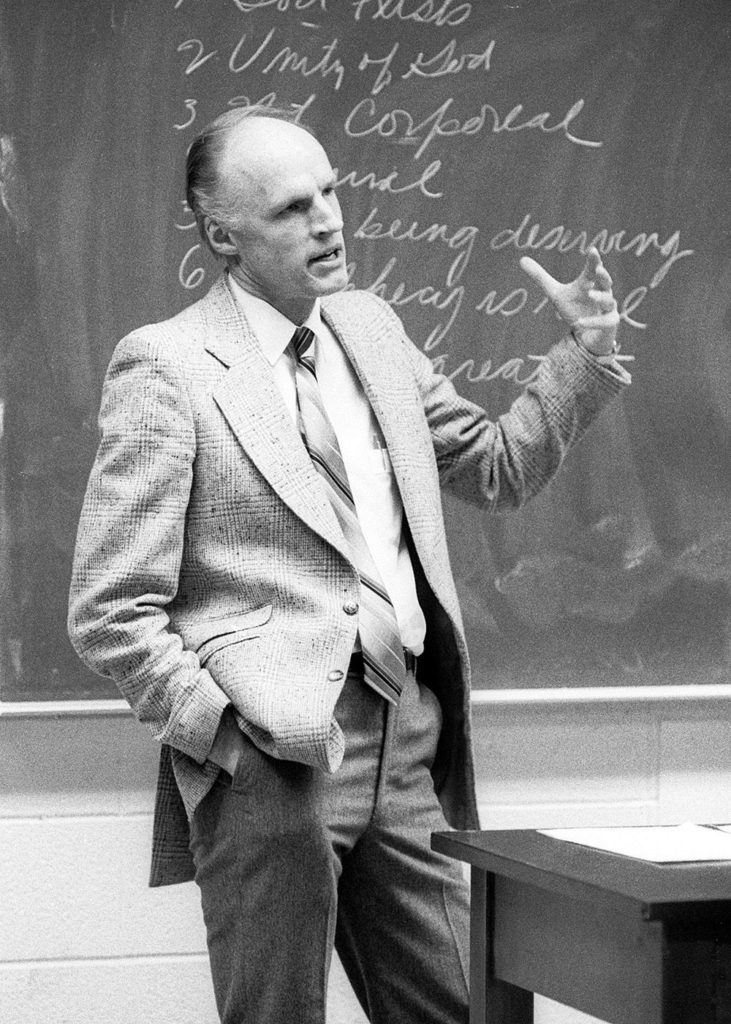
    Chauncey C. Riddle
    BYU Studies
    1968

    (Reviewed by Chauncey Riddle, professor of philosophy and chairman of the Department of Graduate Studies in Religious Instruction at Brigham Young University. Dr. Riddle has published frequently in The Instructor.)

    In a world threatened with drowning under a flood of printed matter, Professor Madsen’s book shines forth in clear contrast to the usual run-of-the-press. It is terse, laconic—sometimes painfully so; more often it is exciting in bare allusion to profound principle (e.g., p. 26). But its brevity and terseness do not prevent it from containing more ideas in total than most tomes many times it length (80 pages). The real strength of this work, however, lies in the quality of the ideas contained therein.

    With the skill that reflects a lifetime of careful thinking and with materials patiently gathered both from the vast literature of the world and from the revelation of the prophets of the latter days, Professor Madsen weaves a fabric that wears well. His pattern is of contrast, highlighting the rich hues of gospel truth in a setting of the somber questions which have pervasively plagued mankind in recorded thought. The form of his doth is a garment for man, to cover man’s intellectual embarrassment about his own being.

    Specifically attentive to the problems of personal identity, the parentage of mankind, the mind-body problem, the challenge of evil, the nature of human freedom, and the knowing of important things, we are treated to the provocative insights of the Prophet Joseph Smith. The dilemmas, paradoxes and frustrated attempts of such thinkers as Aquinas Kierkegaard, Marcel, Bultmann, and Tillich are parried deftly with simple and powerful strokes as the restored gospel is displayed as the avenue of truth and happiness for all men.

    The reader should not expect in this treatise a systematic work either of philosophy or of theology. The intent of the author seems to be rather to speak to his topics as soul-problems that beset each human being. These problems are met, however, on a high intellectual level and are couched in terminology that makes clear the relationship between the kinds of questions the thinkers of the world are asking and the answers provided by the prophets.

    To one not of the same religious persuasion as Professor Madsen, his work offers a clear, incisive examination of the heart of “Mormonism.” To such it is a plain challenge to make a choice, seeing here the intellectual strength of the religion of Jesus Christ but being warned that the intellectual side is neither final nor consummate. But to those of like persuasion, this work is as a catalogue and reminder of riches possessed, though perhaps neglected; of strengths familiar, but possibly unused. They will likely want to review the writings of Joseph Smith with new thirst, and even to seek after the same source as did the Prophet. Perhaps the creation of such a desire would be the greatest compliment the author of Eternal Man could receive.

  • The Mormon Intellectual

    Chauncey C. Riddle
    c. 1967

    Members of the Church of Jesus Christ of Latter-day Saints who develop themselves intellectually enjoy the riches of a double heritage. Participation in the Church brings them a legacy of prophets and principles, revelation, and exhortation, as well as an active program of cultural, social, and more reformation. Intellectual development brings to them the knowledge, culture, scholarship, and technology of the world of their fellowmen. These two heritages might be characterized in Greek terms as “mantic” and “sophic”; in direction as vertical as opposed to horizontal source; or, as “other-worldly” and “worldly”. Tensions associated with the proper relating of these two influences, both within the individual person and also within the LDS intellectual community, create rather considerably interest and excitement, both within and without that community. That tensions may be seen as a great asset or as detrimental, depending upon one’s point of view, but it is unquestionably a very real fact in the present social scene.

    The religious heritage of the LDS intellectual is centered in a special concept of deity. In this heritage, Jesus Christ is the God of this earth, a personal, specific, divine being who once lived on earth as a man and who now, as a resurrected, corporeal person, controls this universe. Much of this foregoing theological commitment is shared with other Christians. The special difference is that to the LDS person, Jesus Christ is available for personal communication at all times. To be a member of the Church of Jesus Christ has and does literally speak with and appear tot the prophets today. To be active in this religion, each individual member is expected to communicate with Christ daily through the Holy Spirit, receiving instruction and guidance about the practical matters of moral uprightness in daily life. The goal of every person who lives this religion is to overcome unrighteousness and evil through the guidance of the Christ, and having done so, to be allowed into the personal presence of Jesus Christ, to see him face to face, as have the prophets, both ancient and modern. This is the “mantic” heritage.

    The “sophic” heritage brings to the LDS intellectual and the total cultural, scientific, and social deposit of the ages. Through the processes of education, scholarship, and experimentation that total deposit Is available to him, as it is to every other human being. Far from being afraid or disdainful of this heritage, as religious persons are sometimes said to be, he is anxious to inherit: “If there is anything virtuous, lovely, or of good report or praiseworthy, we seek after these things.” (13th Article of Faith)

    As the possessor of a dual heritage, however, the LDS person cannot take either light. He must seek revelation constantly to be true to his religion, and he must seek the best that is in the world constantly, through study and experiences; to become a master of both is his religious goal.

    A problem arises, however, when the commitment to his religion runs contrary to the wisdom of his fellow-men. He may then be forced to choose between his prophet and contemporary sociology, between revelation and the opinion of his peers. He cannot give equal allegiance to both traditions. The possible solutions to this dilemma mark the tensions within the Church.

    LDS persons who accept the prophets and revelation but will not study, discuss, reason, and experiment are automatically excluded from the group known as the “LDS intellectuals.” These, of course, do not fully accept their religion, because it enjoins them to seek learning, to be “intellectual”.

    At the other extreme is the member of the Church who is well-acquainted with the heritage of the world and gives it his primary allegiance. Ordinarily he is a person who does not enjoy personal revelation on anything like a daily basis; this makes him suspect that the prophets do not enjoy much, if any, personal revelation. This type of person may be an active member of the Church, but becomes uncomfortable when Church policy or statements of the prophets go contrary to what he has learned from the world. He views the non-intellectual Church member as hopeless and suspects the integrity of any intellectual who puts faith first.

    The LDS intellectual who enjoys personal revelation but insists on meeting the intellectual world on its own ground sees himself as taking the best of both worlds. He sees the non-intellectual Church member as needing to be inspired, and the intellectual who rejects revelation as one who is blind. He believes that revelation will help him to solve the problems of the world to the degree to which he himself works hard to solve the problems of the world to the degree to which he himself works hard to implement these solutions. He sees the LDS Church as the nucleus of a perfect social organization that will eventually meet every human need of every human being: economic, cultural, intellectual, political, and religions.

    The future of the LDS Church will be a struggle to encourage its faithful non-intellectuals to become faithful intellectuals and to encourage its intellectuals to become faithful to Jesus Christ through their own personal revelation.

  • The Problem of the Academician – POINTS TO PONDER

    COLLEGE OF RELIGIOUS INSTRUCTION
    CHAUNCEY C. RIDDLE
    16 November, 1966

                It is patent to observe that academicians often make a poor showing in the work of the Church; frequently they are a destructive, negative influence. The paradox is that sometimes these persons of destructive impact have the best of intentions. It is not intentions or desires which count in the long run, however; rather, it is performance. But the good intention makes this paradox worthy of further examination. The problem of the academician can be traced in part to the frame of mind engendered in his professional atmosphere.

                One principal aspect of the academic atmosphere at its best is extreme negative criticism. It is critical because of the necessity of constant analysis of one’s own and other men’s ideas, actions, and creations. It must at times be negative because it is concerned with excellence of product.  The producer, it is assumed, is enough of a scholar to know the positive aspect of production, to have delight in excellence, and not to take negative criticism personally. The criticism is extreme because of the necessity of making fine discriminations, again in deference to the ideal of performing as perfectly, as expertly as is possible for a given time and circumstance. This is one operation of the academic atmosphere at its best because the world would be flooded even more than it is with specious knowledge, with shoddy performance, with chicanery were it not for the academic crucible which attempts to eliminate the dross. In some respects the academic atmosphere is a great benefit to mankind, and one might lament that its influence is not more widespread. If academicians were not also human beings, the academic atmosphere might well be given far greater influence in society.

                In sum then, the academic approach is to achieve excellence of product through intensive, withering criticism of all that men propose, propound or produce. This approach has been of great and demonstrable beneficence to science, particularly, rescuing it from its origins in aesthetic rationalism and making of it a formidable, pragmatic giant.

                Contrasted with the academic frame of mind is a gospel frame which is in approach antithetical to the academic in almost every respect. The gospel frame begins with the premise that we are engaged in the work of the Lord, which work has come by personal revelation from the Lord. If we have that testimony, then we know that we are not here concerned with criticism of the projects of men. The man or men who present ideas and projects to us are the Lord’s chosen stewards, the prophets and presiding authorities. The task is not to oppose and criticize what they say, but rather to strive mightily to comprehend and implement what they say. What they say may appear to our critical minds to be irrational, shortsighted. But if we have the personal testimony that the Lord had appointed them as His stewards, to criticize them is to set ourselves us as the judge of the Lord.

                The gospel frame of mind has its primary focus on people rather than products. It sees all men as the children of God, as eternal souls who may, if they wish, come to a restoration of their heritage, to know their Father again personally, and to receive of all that he has. Programs and products are seen as devices and opportunities for the building of God-like character in each individual. The most essential ingredient of that character is faith—humble submission as a little child to all that the Father seeth fit to inflict. This is indeed the antitheses of academic criticism. It is learning to be deliberately non-critical of anything that comes from the Lord in order to achieve a proper personal relationship with the Lord. It is to see ourselves as weak, ignorant, biased potential servants of an omnipotent, omniscient and perfect God.

                Within this gospel frame of mind one does not criticize. He will search for the will of the Lord through personal revelation if asked for his counsel, but will only bear humble  testimony to what he believes the Lord wants. He will never attack a brother or a leader for his ideas, but will examine his own conscience for the necessity of repentance if he finds himself at odds with someone with whom he ought to be in agreement, leaving critical judgment to those who preside. If he presides, he will pronounce the Lord’s judgment, not his own. All things will be done in pure love, in genuine respect for all persons concerned, be they in agreement or disagreement with himself.

                In sum, the gospel frame of mind is a positive, joyful acceptance of all that comes from the Lord, with an earnest and eager desire to implement it.

                It can readily be seen that the gospel frame of mind employed in an academic situation would wreak havoc. To accept uncritically what is of men is demonstrably disastrous. And to apply the academic frame of mind towards the work of the church or towards anything which is of the Lord is at least equally disastrous. It will serve to alienate us from all good things—from God, from the prophets, from personal revelation—and with considerable alacrity.

                Should we then reject one frame of mind—say the academic—and adhere to the gospel? Rejection of either could be as disastrous as mis-application of either. If we reject the critical frame of mind, we might reject the possibility of finding the Lord, for it is only by a careful discrimination that we find the voice of the Lord among the welter of human and spiritual influences which play upon us. To reject criticism would be to leave oneself defenseless against the wiles of the adversary and his minions. And of course if we reject the gospel frame we cut ourselves off from all righteousness, choosing to remain in spiritual darkness and death.

                The solution then lies in a thorough mastery of the nature and skillful use of each frame of mind with a corresponding careful attention to the situation of the moment to know which frame to apply. The overall pattern will likely be to emphasize the critical frame until we find the Lord, then to emphasize the gospel frame thereafter. For if we are servants of the Lord, even when we act as acute critics in a proper academic environment, we must above all be saints and be responsive to the person and his spiritual needs even as we dissect what he academically propounds.

                “Every scribe well instructed in the things of the kingdom of heaven, is like unto a householder; a man, therefore, which bringeth forth out of his treasure that which is new and old.” (Matthew 13:52)

  • Points to Ponder, 1966

    Messages to the faculty of the College of Religion, Brigham Young University, 1966

    No. 1

    The following ideas are submitted in the hope that each of us can more completely fill our potential as servants of the Lord in instructing the youth of Zion.

    One of the choice expressions of the task of teachers in the Church is given by Moroni:

    … and their names were taken, that they might be remembered and nourished by the good word of God, to keep them in the right way, to keep them continually watchful unto prayer, relying alone upon the merits of Christ who was the author and finisher of their salvation. (Moroni 6:4)

    Let us enlarge briefly upon these concepts:

    1. Their names were taken: We are accountable for the influence we have wrought upon each soul who has been under our tutelage. We have their names in order to insure that to each one has been extended the love, understanding, and nourishment which is the rightful heritage of the children of God.
    2. That they might be remembered: This is to treat them as individuals, not as “classes” or groups. Needs are personal and particular. Optimal good is done only on a person-to-person basis.
    3. Nourished by the good word of God: The prime function of a teacher in the Church is not to express his or her own ideas and opinions but to lead the flock to feast upon God’s words: first the Scriptures, both canonized and those from the living prophets; then the words of God which come by the Holy Spirit to each individual.
    4. To keep them in the narrow way: There is only one way that is right, and it is strait and narrow. It is to hearken to the voice of God in all things, for by his Holy Spirit God will show us all things which we should do. (2 Nephi 32:3)
    5. To keep them continually watchful unto prayer: Since one receives the Holy Spirit through the prayer of faith, it is the opportunity of the teacher to encourage and commend prayer and meditation, that each spiritually new-born son or daughter of Christ might grow continuously to spiritual maturity, ever watchful against the sophistries of the adversary and the temptation to spiritual drowsiness.
    6. Relying alone upon the merits of Christ: If only we can recognize and teach that all good is of Christ, and that as intelligent beings we ought to rely solely upon Him for our nourishment, our knowledge, our health, our wealth, and our priesthood!

    No. 2

    The true Latter-day Saint is one who has come to terms with at least one fundamental fact: All he or she has or hopes for comes through Christ. They know that they must rely upon their Savior for every good thing –for forgiveness of sins, light to cease sinning, for knowledge of truth, for strength to do what is good, for the gifts of the Spirit to overcome all things. Such persons are humble and meek before God. They know that pride is the enemy of all righteousness. They know that but for the grace of God, they would be as the worst sinner. They know that the rewards of men are paltry compared to the peace of the Spirit. They know that the more like the Savior they become, the more they can expect to be shamed, ridiculed and despised by men. They know that acceptance by their Heavenly Father is the only real test with which they need be concerned.

    How does one act in relation to his fellowmen, especially towards his brothers and sisters in the Gospel? Is one concerned to appear to be learned before his fellow man? Is one constantly concerned with one’s “image?” Does one have to be heard uttering wise sayings in all public gatherings? Does one plead and scheme for the honors of men? Does one apply all the leverage one can to up his salary? Is one offended and self-righteous and critical on the occasion of evidence of the shortcomings of his brothers or sisters or colleagues? Does one demand preferential treatment because of one’s status or callings? Does one seek the adulation of students and derogate those who disagree with him? Does one overestimate one’s ability and contribution?

    All of these questions are important, and there are others even more powerful and disquieting than these. But what is needed is that everyone ask and answer each of these questions for one’s self. It will not do to fly to a loved one or friend and say, “Tell me it is not so.” These problems must be worked out in the depths of meditation, in the anguish of one’s own conscience, in the solace of one’s wilderness. The wonderful prospect is that if we can ever come to full and honest terms with ourselves, with our own conscience, then we are on that strait and narrow road to acceptance by Him who sees and knows all. If ever accepted by Him, then what of arrogance, pomposity, ego-mania, image-adoration, self-aggrandizement? All will be swallowed up in the pure love of Christ as we gain that most precious attainment. And then we can be to our fellowmen the true servants of Christ which it is our opportunity to become.

    No. 3

    What is our task as teachers of religion? It is to bring souls to Christ. The principal means of accomplishing that goal is to encourage everyone whom we can to do three things: (1) to have a profound respect for the Lord, (2) to hearken to the living prophets, and (3) to seek the Holy Spirit as a guide for all things in their lives. We join Isaiah and Jacob in challenging all men: “Who is among you that feareth the Lord, that obeyeth the voice of his servant, that walketh in darkness and has no light?” And with those prophets we also add the solemn warning from the Lord to those who would substitute the reasoning of men for the revelations of God: “Behold all ye that kindle fire, that compass yourselves about with sparks, walk in the light of your fire and in the sparks which ye have kindled. This shall ye have of mine hand –ye shall lie down in sorrow.” (2 Nephi 7:10-11)

    What then of the mechanics of teaching? What of syllabi, curricula, facts, and programs? These are the framework of our opportunity to bring the good word of God to the children of God. Let us make no mistake: There is no salvation in these methods and tools. Only by helping people to come to a personal acceptance of the atonement of our Savior and a spiritual rebirth is there any profit.

    Shall we relegate the mechanics of teaching to the realms of evil and disdain the obligations thereof? Certainly not. Only in the excellence of the academic framework can we obtain the spiritual objective. To be slothful academically would be sheer hypocrisy –pretending to be a university, then dishonoring the trust of those who come for learning. As we are masters of the techniques and disciplines, wise in the things of the world, apt in our scholarship, incisive in our insight, disciplines and in our procedures, faithful to our duties, – then can we in the power of truth and righteousness show to all the better way.

    No. 4

    The moans and groans from students upon the occasion of any examination might lead one to think that such tests are some form of cruelty. One might also be led to think that evaluation of teachers is a terrible evil as one listens to the rumblings of the faculty. But in our sober moments we know that testing and evaluation are an indispensable aspect of progress.

    The hallmark of intelligence is action which is appropriate to the contextual situation. Understanding the situation comes only through constant testing and probing. We test our students to see what they know and thus what they need to be taught. We are evaluated as teachers to see where we can best serve and in what we need to improve. As the carpenter with his square and level, the plumber checking for leaks, the physician performing a thorough examination, the courts proving a will, so we must evaluate and be evaluated constantly. To do otherwise would be to settle for the blind and rigid determinacies of a machine.

    In the Gospel, too, we are constantly being evaluated and are evaluating. The Lord judges our every thought, desire, word and act, and bestows or withdraws his blessings from moment to moment according to our heed and diligence. The essence of home teaching is to discern in love and spirituality the needs of the families we serve, then to administer the Gospel and its ordinances carefully and perceptively in accordance with the progress and problems that are apparent. Likewise we are testing our own hunger for righteousness constantly, deciding from moment to moment where to draw closer to the Lord or to shrink from Him, to have Him as our God or not.

    Since evaluation is an unavoidable and indispensable aspect of this earthly probation, would it not be well to appreciate it and learn to profit fully both from evaluation and being evaluated? “For all who will not endure chastening, but deny me, cannot be sanctified.” (D&C 101:5)

    No. 5

    Time is of the essence.

    The precious passing moments press upon us, then filter into the abyss of eternity, leaving only a residue of memory. But that memory can be of the brightness of accomplishment—of love, or sacrifice in service, of honor in defense of truth and principle; or it can be of the dull pain of waste, of aimlessness, of self-seeking or submission to the pressure of the moment. And that memory is part of the eternal “me.”

    In our teaching, every moment should be treasured as a gem. We can focus our efforts so that the class we are conducting, the counseling we do, the evaluation of student papers,—all can be high quality, and achievement of real love to bless our students. With that in mind, let us review some of the pitfalls to avoid:

    Going to class unprepared, forced to “play it by ear.”

    Allowing meaningless digressions in class discussions, however pleasant.

    Presenting material that is unorganized.

    Dismissing class sessions at “the drop of a hat,” such as only giving an assignment then dismissing the class session on the first day of meeting the class, going early to assemblies, dismissing class for the day before vacation, etc.

    Being “buffaloed” into releasing class five minutes early as the students start to stir, close books, put on coats, etc.

    Finding it unimportant to start the class on time.

    Taking role inefficiently.

    But if one has a yearning to improve the opportunity of time, there are excellent strategies to employ:

    Have a repertoire of choice answers to questions, so that the interest which provokes a student’s question also becomes the cement to fix a gospel principle in that person’s mind.

    Highly integrate class sessions with outside study assignments.

    Deliberately concentrate on building rapport with the class members during the first few meetings, and when it is established, communication and learning will increase many fold.

    Be so filled with your subject that it cries out to be expressed, then measure it carefully to the needs and abilities of your group.

    Artfully turn every digression into a novel approach to the intended subject matter.

    Treasure the chance to bear your testimony in all humility and to impress each child of our Heavenly Father in your charge with the greatness of the simple fundamentals of the Gospel.

    No. 6

    It is good to avoid the very appearance of evil.

    Priestcraft is the merchandizing of religion, representing to promote the work of God but doing it for hire and the honors of men. The Book of Mormon is particularly blunt in labeling priestcraft as one of the great evils of the latter days.

    How then does a professional teacher of religion associated with the Church of Jesus Christ of Latter-day Saints avoid that evil? He is on the horns of a dilemma. He can avoid teaching the truth of the Gospel; in which case he denies the very reason for being hired and becomes a hypocrite. Or, he can teach the Gospel well, which can only be done through the guidance of the Holy Spirit. But then he is selling the gift of God. How can one escape?

    The professional teacher of religion, of all people, must tread the strait and narrow. No final prescription can be given that will answer all situations. But there are some guidelines. Consider these:

    1. He or she can humble themselves in mighty prayer to receive the Holy Spirit, then do all he or she can to follow that spirit unto doing a perfect job of teaching students.
    2. One can recognize that because he or she is paid to teach religion, any real good done in that capacity is simply what is expected –that which one was hired to do. To earn eternal blessings, such an one must also work out his or her heart in the Church and Kingdom of God after working hours, as a free contribution.
    3. He can be careful never to take money for any activity which could possibly be construed as Church work, which others would be expected to do for nothing.
    4. Salary should never be a principal consideration in his teaching. If what he is paid is insufficient for his needs, the Lord will show him other, more remunerative and less perilous occupations if he is faithful.
    5. He should assume no priesthood prerogatives because of his teaching position. One prime objective of his teaching should be to encourage strongly the support of local and general priesthood authorities.
    6. He can plead with the Lord to show him exactly how to escape from his dilemma, how to be a just man while teaching for hire.

    What a great delight it is to teach young people the Gospel! But, oh how careful we must be.

    No. 7

    The typical disease of our age is materialism. Materialism is the belief that all of our important problems have a material (especially economic) causes. The changing of material (especially economic) circumstances supposedly will provide the panacea. This is the thesis of Marx. Curious, isn’t it, that western nations claim to be anti-Communist while having swallowed whole the central Communist idea. No wonder then that we only quibble with the Communists as the most efficient means to achieve the materialist utopia.

    Do you lack evidence of our materialism? Consider these: Most of us live beyond our means (installment buying) in the attempt to hasten felicity. Readiness to take a handout. Concern to buy at the lowest price regardless of whom we thus support or why the price is low. (Do you support Communist governments by purchasing the products of their slave-labor?) Supposing that our problems would be solved if our income doubled. The proportion of time we spend nourishing and caring for our physical being as compared with the time we spend nourishing and caring for our spiritual being. Not to mention present political palaver.

    What is the cure for materialism? It is simply to live that Gospel of Jesus Christ which we verbally and emotionally espouse. It is to heed the full message of John the Baptist. (Have you noticed how many discussions of religion are an attempt to repudiate the specifics of what John said was necessary to the repentance of his materialistic contemporaries, that they should impart of what they have to those who have less, to be honest and exact in business affairs, to be content with their wages, not to attack others nor accuse anyone falsely. Luke 3:9–14) It is to put our full trust in the Lord Jesus Christ, to be guided and instructed by Him in all things, putting first the welfare of our spirits: the purifying of our hearts, our unity with the living prophets, our service in the Kingdom; then latterly and almost incidentally seeking counsel and help for health, wealth and retirement. It is to act to show that we really believe that the best thing to do is to seek first the Kingdom of God and His righteousness, trusting that all else necessary will follow. It is genuinely to seek first for a hope in Christ before we seek for riches. It is to give our wealth away as the Lord directs. It is to begin to sacrifice all we possess, as is necessary, for the sake of righteousness.

    Seek not for riches but for wisdom, and behold, the mysteries of God shall be unfolded unto you, and then you shall be made rich. (D&C 6:7)

    Then shall the righteous answer him, saying, Lord, when saw we thee an hungered, and fed thee? Or thirsty, and gave thee drink? When saw we thee a stranger, and took thee in? Or naked, and clothed thee? Or when saw we thee sick, or in prison, and came unto thee? And the king shall answer and say unto them, Verily I say unto you, Inasmuch as ye have done it unto one of the least of these my brethren, ye have done it unto me. (Matthew 25: 37–40)

    No. 8

    Dr. Nels Ferré, eminent Protestant theologian, visited the BYU campus last week.

    After being with us for nearly two days, talking with faculty and students, reading literature about “Mormonism” which was put into his hands, he finally made what to him was a startling discovery. He found out that “Mormons” are “Christians.” Isn’t it wonderful that he found out before he left?

    But there is an application of all this. How long does it take our students to find out that our master is the Lord Jesus Christ? Do they wonder what the ultimate source of value and truth is to us?

    Is it obvious to them that we stand as witnesses of the divinity of Jesus Christ at all times and in all things, and are delighted to be called his people? Is there any message more crucial to our task than the following:

    And now, my beloved brethren, after ye have gotten into this straight and narrow path, I would ask if all is done? Behold, I say unto you, Nay; for ye have not come thus far save it were by the word of Christ with unshaken faith in him, relying wholly upon the merits of him who is mighty to save.

    Wherefore, ye must press forward with a steadfastness in Christ, having a perfect brightness of hope, and a love of God and of all men. Wherefore, if you shall press forward, feasting upon the word of Christ, and endure to the end, behold, thus saith the Father: Ye shall have eternal life. (2 Nephi 31: 19-20)

    No. 9

    Teaching is an art. It is a “fine art” in the best sense of the term, closely related to the drama.

    The teacher writes the script, selects the cast, directs the performance and evaluates the individual audience response. He writes the script as he prepares his lesson outlines, texts and objectives. He selects the cast as he himself lectures or leads a discussion, employs audio-visual aids, brings in visiting authorities, calls on students for presentations and responses. He directs the performance each day in class, suiting the action to the need, shifting the focus, tempo, devices, scenery and cast as he sees fit. And he evaluates the audience to his own satisfaction, even giving them permanent grades for their aptness or lack of attention.

    Now some observations on this situation:

    1. As drama is the most powerful form of art for most people, so teaching is an opportunity to wield great power.
    2. The teacher is not only powerful, but very powerful; the greater his skill, the more power he has over his students.
    3. The power of teaching can be used either for great good or for great evil.
    4. Some disdain to teach well, thinking it beneath their dignity to communicate effectively or consistently. They limit their role to that of being the “great authority.”
    5. Some confuse effective teaching with entertainment; they “ham” it up or titillate their students by name dropping, or make obscure references, or digress exasperatingly.
    6. The good teacher has a nigh absolute mastery of the subject matter to start with. His principal concern in class work is to lead and guide the individual students in that field,—enthusing, correcting, enriching, nourishing, as his perception of student needs shows opportunity.
    7. Of all subjects, the Gospel of Jesus Christ ought to be taught well.
    8. The real test is the active response of the audience. Does the Holy Spirit operate through us as teachers to make of the students godly men and women, examples of righteousness to all the world?

    No. 10

    What is our task as teachers of religion?

    Our task is to witness of Jesus as the Christ and to point everyone to the straight and narrow gate of faith in the Lord Jesus Christ, repentance of all sin, sincere taking of the covenant of baptism, and seeking and living by the Gift of the Holy Ghost. Everything else is ancillary.

    It is not our task to teach the errors of the world. Satan is highly efficient, and none of us need to be advocatus diabolic, though we may compare truth with error to highlight the truth.

    It is not our task to be “objective scholars” in the manner of the world. There is no such thing as attaining real truth through scholarship alone. But we must be as fair and objective in our scholarship as we can be.

    It is not our position to cower before the onslaughts of modern science. Science today is a powerful pragmatic tool for subduing the earth, but most of its proponents make of it a pious and dedicated atheism. We can give science its due without letting it become Lord and Master.

    It is not our task to disabuse people of all their false and naïve notions. It is sufficient to teach the truth in humility and to let the Holy Spirit guide them to see the error of their ways.

    It is not our task to call anyone to repentance. That function is reserved to those who preside in priesthood authority. But we can show that repentance through Christ is a thing most desirable, the hope of all mankind.

    It is our task to create an atmosphere of light and warmth where the tender plant of faith can take root and grow against the day of trial.

    No. 11

    Suppose evidence comes to my attention that I am not highly rated as a teacher. What should I do? I could deny that the rating has any validity. I could assess the raters evil persons who are “out to get me.” I could insist that I am really an excellent teacher but that there are few who can appreciate my talents. In short, one alternative is to become exceedingly defensive and to attempt to preserve my self-confidence and my self-image by counterattack.

    But another alternative is open to me. I could set my goal to become perfect, even as my Savior is perfect. I could recognize that only as I present myself as a humble little child before my Savior can I truly progress towards perfection. I could take the specific evidence that my teaching leaves something to be desired as a stimulus for thought, meditation, and prayer –for chance to do a better and better job in all things, including my profession. I could refuse to identify the real “me” with the habits and patterns of my fallen nature. I could work to be spiritually alive and to “grow up” in the Lord, to strive for spiritual maturity. I could see spiritual maturity as the goal in which every evil thought, every untoward desire, every petty selfishness would be replaced in my new creation in Christ wherein I would become a more powerful and more humble exponent of the Kingdom of God.

    I could not only teach people to have faith in Christ and to repent. I could show them the way.

    Perhaps I had better do this even if I am highly rated already.

    No. 12

    We cannot see many important things in the universe. We cannot see God, tomorrow, yesterday, or the spiritual order of existence. We cannot tell by seeing or reasoning what true righteousness is. For a knowledge of all these things we must depend on someone other than ourselves. If we believe the Holy Ghost when it whispers to us of these things, we are beginning to exercise the kind of faith that will save us.

    Everyone has faith in something or someone. Sometimes we believe other people. Sometimes we trust our own thinking. Sometimes we expect our strength or our money to save us. But the only faith that leads men to righteousness or salvation is faith in the Lord Jesus Christ.

    For us to have faith in Jesus Christ, three things must happen:

    1. We must receive the still, small voice of the Holy Spirit witnessing that Jesus Christ is the Savior of the world and telling us what to do.
    2. We must believe the witness and instructions of the Holy Spirit. This takes courage to be true to what we know within ourselves.
    3. We must act in accordance with the instructions of the Holy Spirit. If we can repent and become a disciple of Christ through obedience to the Holy Spirit, we then have faith in Jesus Christ.

    No. 13 Conference Weekend

    The Lord has told us that whenever:

    1. His ordained servants
    2. Speak for or to their stewardship
    3. By the power of the Holy Ghost,

    the result is scripture. It is the mind if the Lord, the voice of the Lord, and the power of God unto salvation. (D&C 68:2–4)

    While some wonder why the Doctrine and Covenants ends with the Manifesto [1966], true servants of God recognize that the Lord gives additional scriptures daily, through his living prophets. The true servants recognize that the words of the living prophets are as important and binding as anything in the standard works.

    If there is anything more important that we as teachers of religion could do than to encourage all of our students to pay close attention to Conference, and to instill in them a desire to support and sustain the living prophets? To bring souls to Christ is to bring them first of all to accept His chosen servants. Whosoever receives them receives also the Savior and the Father.

    May we all do our best to make this Conference (April 1966) and its messages the highlight of our teaching this semester.

    No. 14 Repentance

    The man who loves righteousness but finds himself doing evil in spite of himself knows he needs to change. But how can he change if he doesn’t know how to do so? The Gospel of Jesus Christ is the message to all men to tell them how to change to become righteous.

    Men must first recognize that thoughts are the basis for all feelings and actions. “As a man thinketh, so is he.” (Prov. 23:7) To repent, men must change their thinking. First, they must believe in Jesus Christ, that He lives and is the Savior of the world. Then they must be willing to obey the Savior in all things which he commands them, The voice of the Savior through the Holy Spirit will lead them to as much truth and righteousness as they are willing to receive and live.

    As men obey the Savior, they will confess their evil ways and forsake them. They will do whatever they can to right the wrongs they have done and will implore the Savior to right those things they are powerless to correct.

    But the Savior will not continue to guide men nor will he right their wrongdoings unless they formally pledge to accept his atoning blood and covenant to obey His voice in all things. That formal pledge can only be made in the ordinance of baptism. Thus it is that making the covenant of baptism is the most essential aspect of repentance in the Gospel of Jesus Christ. (Moro. 8:25)

    This then is the agency of man: to remain captive to the adversary, confirming the Fall, or to take upon us the mind of Christ, to hearken to the voice of the Lord. Every man must choose. To choose the latter is the true metanoesis.

    Can we teach this so plainly to our students that they can put on the whole armor of God and effectively quench the fiery darts of the adversary?

    No. 15 Book of Mormon Week

    One way of looking at the Book of Mormon is to see it as the special instrument which God has given for the perfecting of the souls of men in these latter days. If a man will read, study, pray, meditate about this book, then reform his life to accord with the intelligence thereby received, he will be able to draw nearer to God and the reality of being redeemed than he can by using any other book. The Book of Mormon is the stone which whets, shapes and sharpens the mind, heart, and life of every person worthy to be called a “Latter-day Saint.”

    Nothing we can do for our students can compare with leading them to Christ and to support the authorities of the Church who the Savior has sent to us than championing to them the Book of Mormon. That book is the priceless antidote for intellectual pride, for dependence on the arm of flesh, for self-centeredness, for carnality, for indifference, ignorance, poverty, tyranny—for any and all of the ills that beset mankind. Since this is Book of Mormon week on campus, we have a wonderful opportunity to bear witness and to encourage our students to appreciate this great gift from our Lord.

    No. 16

    One of the serious faults of our educational process is the oppression of authoritarianism. Professors act often as if they know for sure what they are talking about. Students are pressured into memorization of the opinions of the “authorities” rather than being taught to think for themselves. Non-conformists fare badly, both as students and as faculty. The hallmark of erudition for most academic matters is the paraphernalia of quoting someone.

    One gem of truth which we can crystalize out of the scriptures is that no one knows for sure anything of importance unless it is through personal revelation. Science is an impressive practical tool, but singularly lacking in demonstrable truth, especially as to causation. Scholarship mines opinion, not reality. Reason reinforces prejudice, but never vouchsafes the nature of existence. Only from the Lord, who is The Truth, does one obtain knowledge of things as they are and were and will be: The Truth.

    So when we teach, let us remember certain fundamentals:

    1. If we teach the truth, it is by revelation. (Ye receive the spirit by the prayer of faith, and if ye receive not the spirit, ye shall not teach. D&C 42:14)
    2. If our students understand the truth as we teach, it is by the Spirit. (Therefore, why is it that ye cannot understand and know that he that receiveth the word of truth by the Spirit of truth receiveth it as it is preached by the Spirit of truth? Wherefore, he that preacheth and he that receiveth, understand one another, and both are edified and rejoice together. D&C 50:21–22)
    3. Therefore, we are not authorities, or even teachers, in our own right. We are but messengers, bearing humble testimony to that which we have received, hoping that our hearers will believe not what we say but that they will believe the voice of the Lord.

    Could we ever achieve a university which operates on these ideas, what wonders of learning, ability and technology could we attain?

  • Can Religion Be Objective?, 1966

    Dr. Chauncey C. Riddle
    February 25, 1966

    We are addressing ourselves to the problem, “Can Religion be Objective?” The problem was raised, of course, by the fact that a great many people in our age think it cannot and so we’ll attempt an answer to this. But first of all we will lay some groundwork for the answer. It’s not enough to have an answer. Perhaps even more important is to know why the answer is so, which makes the answer important. To begin with, any time you have discussions on anything important, the obvious thing to do is to define your terms. Let’s first of all define objectivity. There are three definitions which are important relative to objectivity. The first, which is, you might say, the one that people probably think of the most in their minds when they think of being objective is to think that that which is objective is the absolute truth—that which is really so. The problem of this definition is that we human beings don’t have the ability to know very much absolute truth. We see through a glass darkly. We don’t really know the world around us. We don’t really know our surrounding. True, we are discovering more and more about these things, but still we see through that glass darkly, and so for a really good, practical definition we will have to reject this one. Not because it isn’t a fine thing to have, but we just don’t have very much of it.

    We might define objectivity in the sense that that which is objective is that upon which people agree. Now this happens to be a very functional definition. This is actually what passes for objectivity in our society, but on the other hand, it’s a somewhat cynical definition. I don’t think it’s the best definition, simply because we all know that a hundred million Frenchmen can be wrong. We all know that people, as a group, can err. All the progress of science comes from individuals who dared to defy the rest and to prove that it’s so.

    So let’s try a third definition of objectivity. Objectivity, could be construed to be doing the very best you can, using all the evidence available to you and the very best thinking that it’s possible for you to muster in your situation. Now this is the one I choose to use in our discussion today. This is the one that a man must use if he’s going to be an Einstein, and dare to let everybody think he’s crazy. Einstein was willing to run that risk because he had something that was extremely valuable, and he knew it was valuable because he had performed all the tests that he could perform on his ideas and found them to be good, and then he opened them to the criticism of others to let them test also. Time has vindicated him, and so today he is honored as a great scientist. Not so when he first brought forth his ideas. He was considered to be quite a crackpot then. But, you see, it’s awfully easy to say that Einstein is objective 50 years after he has come to acceptance. The problem is to see that Einstein is objective when he first formulates his ideas, and the problem is that the individual has to go back over the same ground and make the same examination of the evidence and the conclusions which Einstein himself made to avoid just going along with the herd. Well, science is the paradigm for objectivity in our world, not that it should be this way necessarily, but it happens to be that way. So, let’s discuss science a little bit and see wherein this good thinking, this objectivity, has come to science.

    Science began as an offshoot of philosophy in ancient Greece 2,500 years ago and until just a hundred years ago or so, all science was called natural philosophy. Many discovered that as they sought to be wise, which is to love wisdom, to be philosophical, that one of the first things they had to know was, “What is the nature of the problem?” “What’s the situation in the world in which I live?” As men sought to know the nature of the problem, they found that it did not pay to take other people’s word for it. They had to find a way to discover for themselves the reality of the world, and this is where science was born. As men began to make this search, the first tool they used to try and discern reality was their own reasoning power, and so the simple cannon for objectivity in Ancient Greece was, “Is it rationally consistent?” Almost all of ancient Greek science was, what you might call, a pure rationalism. If a thing was deductively valid, it had to be true. The paradigm science for them was Euclid’s geometry—this tremendous intellectual feat where you could have taken a few fundamental axioms and tied together all the laws of geometry that had been observed and forming a beautiful, wonderful deductive system. It was thought that all sciences would eventually be formed after this same pattern. But ancient Greek science laid some very important groundwork that didn’t get very far off the ground. There were a few men such as Archimedes, who did go beyond rationalism. The monuments of their work were the beginning points of modern science, but nevertheless, the tenor in ancient Greek science, the hallmark of objectivity was simply to be rationally consistent.

    Now this has remained to this day to be a hallmark of objectivity. It is not the hallmark, however, as it was then. The type of approach made in the middle ages when theology was the queen of the sciences was essentially no different from that of the Greek temper. Rationalism again was the key to objectivity, and the pursuit of theology was done almost strictly by means of a rationalistic approach, taking premises from the scripture and tradition then working out the rational involvements of these things.

    Modern science, as we know it, was not really born until the 16th century. We had the work of the early modern thinkers such as Copernicus, Kepler, Galileo, going down to the time of Newton who pretty well set the stage, you might say. The scheme of modern science sort of climaxed in Newton, with his tremendous triumph, not only in actual scientific ideas, but in methodology. That’s the thing we’re interested in here, is the methodology of thought. Even since Newton’s time the methodology of science has continued to grow and to increase.

    Let’s review some of the further postulates or guidelines which have been introduced into modern science as a help to keep these people from making grievous errors of thought, to help them evaluate evidence and come out with propositions that are highly defensible. The next proposition modern science uses is the idea of uniformity. Uniformity is basically the notion that it is reasonable to consider that the universe at other times and places is like it is here and now. Now the closest tie we have to the universe is sensory observation, but our senses are quite limited. We can’t see very far, and we’re limited, of course, to time and the moment of the present. We cannot perceive tomorrow or yesterday. We can perceive right now. We can’t perceive far away, but we can build yesterday and tomorrow and far away in our minds. We can build imaginative pictures of these things. And we do this on the basis of the principle of uniformity. It just so happens this is the only way we can think. If nature doesn’t happen to be uniform, we can never know it. And so the areas where we have progressed most, in our science, for instance, are the areas of greatest uniformity. Where the number of factors influencing something are the fewest or where we can get down to get experimental control, we thus very quickly achieving uniformity. When we have this uniformity we can project, we can predict, and our hypotheses come to be verified in this kind of a situation. Uniformity is one of the very life bloods of science. We couldn’t have thought very much without this principle of uniformity because we couldn’t have it without the necessity of being rationally consistent.

    Thirdly, science postulates the need for a cause for every effect. This principle is called various names, but it doesn’t matter what you call it. It’s the same thing under any title: causality, determinism, sufficient reason—these are all names for the same idea. This is the notion that events do not happen fortuitously in the universe. Everything that happens happens for some reason. There is a sufficient reason behind every event.

    Now science, from the days of Aristotle down to now, has had as one of its significant points that it’s not enough to observe the world; we must understand what we observe. Understanding comes from our way of thinking, through knowing causes. Causes are relations of things, and understanding is a matter of relating things. The more relationships we see for something, the better we understand it. In our modern terminology we tend to think of causes as the efficient cause; something pushes something. But the word cause has a much broader heritage than that. Perhaps the word because is a little closer to the historic usage. The word because suggests a reason for something and cause simply means a reason. It’s the rational cause, the intellectual explanation, that gives understanding to our observations of the physical world. And so science has said this, “You don’t really know anything until you can explain it.” Just to see the moon eclipse doesn’t give you science, but when you understand why the moon is eclipsed and you see that there is a sufficient reason for it—you see that the earth is interposed between the sun and the moon, the shadow of the earth therefore blots out the light that would otherwise be reflected from the surface of the moon, then, having the sufficient reason or the cause of the phenomenon, we can appreciate what the phenomenon is and we then have scientific knowledge of it. And so, as we pursue science in the world, we try to get this kind of understanding for everything.

    A fourth postulate is the idea of naturalism. This has come since Newton. Newton believed that God was a very important part of the universe and he introduced the notion of God into his theories to account for things that he could not otherwise account for. It so happened, in the last few hundred years, that men have been able to account for all these functions that God was supposed to perform and so God is no longer necessary. No longer is God necessary in the theories of physics. In modern science, if you were to go to a convention and read a paper including the idea of God or such notions as spirits or devils or such beings of any kind, you would be laughed out. This is just not scientific objectivity anymore. Scientific objectivity now includes the idea that we must limit ourselves to what is called the natural universe. We limit ourselves because this is the only way we can be sure to avoid certain kinds of errors. The errors of ancient scientists are many and as our methodology increases and refines, we are able to eliminate more and more of these errors. By limiting ourselves to the natural universe we have been able to make greater progress in describing and accounting for the phenomena of the material world.

    The fifth one of these things we have mentioned is the postulate of publicity which is simply to say that we can have sciences only about things that are publicly observable. The meaning of “publicly observable”: where two people can see the thing in question and agree on its description. Science has had to introduce this postulate to get rid of certain vagaries of opinion that caused it much embarrassment over the years. What it specifically excluded in this is anything that is private or personal. My thoughts, for instance, would never be a subject matter for science because no two of you can observe them and agree with them. This includes feelings that I have; the values that I have. You could take what I say, you can ask me questions. You can take the response I give and use that as a basis for science. This is called behaviorism in psychology, and by limiting yourself to a behavioristic approach, you can get fairly reliable generalizations about things. But you can never have a science about my personal thoughts because you cannot observe them. So, anything that is not publicly observable is simply a sufficiently dangerous ground for even theorization or hypotheses. Scientists, in protecting themselves from making gross errors, delimit themselves from this area.

    Now the strength of science is to take these five principles and apply them, and apply them only where they can be well applied so that what science comes out with is a defensible generalization. As a matter of fact, these principles and others that apply are applied more or less thoroughly by different individuals, but the thoroughness to which an individual applies these things, in the long run, becomes the hallmark of his worth as a scientist. I was talking with an eminent sociologist the other day, a man who is deeply engaged in research in the field and has published, I guess, a hundred articles in the journals. He stuck his neck our quite a bit, and he was telling me that one of the reasons he feels so confident about his work in sociology is because he and the men he respects in sociology have the good sense not to try to make statements about at least 95% of the questions they would like to know about. There’s only a very small area where they have tools and they can apply the methods of scrutiny with sufficient care to be sure of their results. So on the other 95% they don’t even pretend to have answers, and this is the way they obtain objectivity. This is very commendable. It’s not very commendable to make wild statements about something where one has no basis for statements, but if one can limit themselves to the area where they can be objective and then make statements in that area, this indeed is doing very good thinking and it’s the kind of thing I think we would all want to commend. I mentioned the fact that a certain study was done trying to vindicate certain of Freud’s ideas. One hundred fifty tests were made on a certain population. Only about twelve of the tests turned out to be significant. Half of them tended to vindicate Freud and half of them tended to disqualify Freud’s ideas. Probably in this particular study that he mentioned the people picked the half dozen that vindicated Freud’s ideas and published them and, thereby, completely ruined their reputation because other people went out on the same experiment, got different results, not only once but several times. This was brought to the attention of the community of sociologists and now these people aren’t listened to anymore. Why? Because they weren’t careful enough. They did not accept the data and the evidence with sufficient care to be awarded with the kindness, you might say, of being listened to. Maybe they can redeem themselves, but that is awfully hard after making that kind an error. There are a lot of lessons in that for us too. The point of all this is that scientific objectivity is obtained by highly limiting what will be studied. Don’t study and don’t make assertions on anything you can’t be reasonably sure about. That’s the net point of this great approach of objectivity on the side of science.

    Now let’s turn to religion and consider objectivity on the side of religion. Religion also, I think, must come under this third definition. In religion, to be objective, we must do the very best kind of thinking that we can possibly do with the evidence available to us. So, there are postulates in religious thinking that are just as important as there are in scientific thinking. They’re not the same postulates. But let’s go through and see where they are the same and where they differ. The first postulate, the idea of being reasonable, is necessary. In science reasonableness is the thing which, shall we say, is kind of an end product. You don’t start out by being reasonable. You end up by being reasonable. Today we know that light is probably neither a particle nor a wave, because neither of these hypotheses is reasonable. In other words, it’s not consistent with all the evidence, but nevertheless, we continue to use these until we can get something better. So, as we go on, the thing we are saying is that, until this thing works out to be completely consistent, we will openly admit that this is not any kind of final hypothesis. Even if it were reasonable, science has learned enough that you have to experiment. You have to test, and you have to go on. Even then, it might be wrong. Just because it’s reasonable does not mean it’s right or true; but if it is unreasonable, you know there is something wrong; you need to gather more evidence. You need to do something more. That’s the real problem that’s involved. The same thing happens in religion. If a thing is inconsistent, you need to go on gathering evidence and not make any final pronouncements. Science and religion happen to coincide in this particular postulate.

    Secondly, there is the postulate of uniformity. We need a uniformity just as much in religion as we do in science. Again, if it so happens that the spiritual universe is not uniform, we can never know it. That is because our human minds or brains are so equipped to deal with something where the same sort of thing happens again and again. Supposing that no two days were ever of the same length. How could you ever plan a day? If the days were not only not of the same length, but you could not ever know of what length they would be, you could never plan a day, could you? Similarly, if there were no spiritual uniform realities, you could never have knowledge of anything spiritual. It’s interesting as we look into the scriptures you see the statement that God makes about himself. One thing he wants to inform us of, as a hypothesis which we might personally test and find for ourselves to be true, is simply the notion that He is uniform. He tells us, “I am without variableness or shadow of turning. My course is one eternal round. I am the same yesterday and forever.” Why is that important? It’s important simply for this reason: If God is that uniform in His dealings with His children, then if we perform an experiment now and get a certain result, it is very highly likely that if we perform that experiment again we will get the same result. If it were not so, what could a person ever do to live a good life? He wouldn’t know what to do. This is the same as in science. If the sun didn’t come up every morning we couldn’t plan a thing. There has to be a uniformity in the universe for us to “know” it. So far as I can observe the uniformity in the gospel, the spiritual uniformity is at least as great as that of the physical uniformity enjoyed by the physical world. Therefore, we have at least as good a basis. How do you tell there is a uniformity in the physical universe? Only by experimenting, only by trying it to see if there is one. How would you know there is a uniformity in the spiritual universe? With exactly the same test, by trying it and seeing if it works. Only then can you say that you know what you are talking about.

    Let’s go on to the third postulate, the postulate of causality. Again, this is absolutely essential to religion. In religious thinking, there is a cause for everything: there are reasons behind things; there are laws—this universe is run on the basis of law and order. This, of course raises the problem of agency. If everything is determined in the universe, and here’s a causality which is valuable both in science and religion. How does the problem of agency get solved? We don’t have time to solve that one today, but suffice it to say there is a very simple, beautiful explanation. There is such a thing as agency. At the same time there is a determinism. But we don’t have time to follow that one through.

    The next postulate, which is necessary to religion and which differs from science now, is the postulate of honesty. Now, this is the one that corresponds, you might say, to the postulate of publicity in science. The way you keep a scientist honest is by forcing him to be public. As long as he is forced to publish his results in order that people can compare, you don’t have to worry about whether he is going to be honest or not because someone else will come along and check it. So you don’t have a postulate of honesty in science, although it is a fine thing to have. But you don’t need to enforce it by any rule. The social system that we are in in the scientific world enforces honesty; in other words, objectivity, if you will.

    But you see the thing that we deal with in religion is a different universe; we are not even talking about the same sort of thing, at least in large measure. The universe and the area we are talking about in religion is what is going on inside my mind. The important thing to know in religion is: What things do I do that make me happier and what things do I do that make me less happy? This can’t ever be possibly studied by science until we can someday learn to interpret brain waves or something like that. At the present time this can’t be done. But this is the area that is central to religion. It is what makes up my relationship to the rest of the universe—not physically speaking, but within my own mind, my thoughts, my feelings, my values, my hopes, my desires, my fears. Before I can do some kind of good, clear thinking in this area, I can never be a stable person; I can never grow and develop as I ought to; I can never become a religiously mature person; I can never have the blessings of the Gospel of Jesus Christ until my thinking is objective. So the first thing I’ve got to do is to be sure that I’m honest. Specifically, if I perform an experiment and I discover that a certain thing leads me to be happier and then I perform the contrary experiment and find that this leads to unhappiness, I’ve got to be honest enough to admit that the one thing led to happiness and the other didn’t. If I can’t be that honest, you see, since there’s no one that can check—there’s nobody outside that can know my thoughts and my experiences and my happiness—the only salvation I have is to be absolutely and rigorously honest. And as soon as I start kidding myself and telling myself that maybe I enjoy this little bit of sin and I’ll pretend that it leads to happiness, we destroy ourselves religiously right there. There’s no hope for us. It’s no wonder that when the missionaries go out, they look for whom? The honest in heart. They’re the only ones they can possibly help religiously. Unless people have that they just can’t get off the ground, religiously speaking.

    The next postulate in religion is the postulate of courage. This isn’t really a postulate, I guess; this is a way of acting. But it figures very importantly in being objective religiously. Why is courage important? Simply for this reason: When you study psychology you know that social pressure has a tremendous effect on people’s thoughts, beliefs and values. Maybe you’ve seen the experiment where the teacher draws a straight line on a board and asks everybody how long it is. They go around the room saying how long it is. Just guessing, from a distance. What they do is they have everybody except two or three in the back who have been planted to tell them all to say 45 inches long. Well, by the time you get around to the people who don’t know what’s going on, they tend to make a judgment somewhere between what they really think and what the group has said. Almost nobody is strong enough to call a spade a spade the way he sees it. Now, there’s some good in this because we frequently find that we are wrong and other people are able to help us temper our judgment. But you see, in the area of religion you can’t afford to do that. Why not? Simply for this reason. The data you are dealing with in the area of religion is your own personal consciousness. You are not the same as another individual. You never have the same experiences and experiments as another individual, so you can’t afford to depend on what other people say. You’ve got to perform the experiment for yourself and then have the courage to stand by it when you have made the evaluation of the data within your own mind. Religion is thought out in the inside of the individual. It is not a public thing. Every individual has come to his own testimony, to his own light. Don’t mistake me—this is not saying you pay no attention to anybody else. You do. But what you receive from other people is hypotheses, not conclusions. You receive structures of experiments to perform yourself, to be evaluated and to form conclusions on your own. You can’t get a testimony from any other human being. You can’t know right from wrong or what makes you happy or unhappy from any other human being. Now you can go along with other people but that will never make you an individual. That just makes them your master, as it were, and makes you their slave. But the purpose of God is to free all men from every other man. Read Section 1 of Doctrine and Covenants where the Lord tells why He restored His Gospel. Why? So that man would not have to counsel his fellow man, so that every man might speak in the name of the Lord God from his own personal knowledge. Now, that’s freedom, that’s the freedom from tyranny that every human being needs. But he’s got to have the courage to perform his own experiments, he’s got to have the honesty to call a spade a spade and then he’s got to stand forth before the world and bear his testimony to what he thinks is true.

    In religion we don’t have the same kind of thing that we have in science. Science is a community project and the thing that really counts is the consensus of the community in science. And that’s good, that safeguards science. But it also limits science to those things which can be publicly observed.

    Religion, too, by delimiting itself to the consciousness of our own conscience, our own personal feelings, thoughts and desires, it gets strength and we avoid certain kinds of errors that come from letting other people influence us too much. But at the same time, all that we can then assert is that I believe this—on the basis of my experiments, this is what it seems to be. And that’s why the missionaries from this church don’t go forth in the world saying, “I’m right and you’re all wrong.” The missionaries from this church go forth and the only righteous thing they can say is, “I know for myself that this thing that I’m telling you is true. Won’t you please perform an experiment for yourself and see if you find this is true for you.” Personal testimony is the hallmark of our religion. It has to be.

    Well, let’s make a few concluding remarks about objectivity. The important thing about objectivity is not to be concerned with the subject matter. I hope it is clear from what I said that objectivity is not a function of subject matter or discipline. Objectivity is a function of people. It’s meaningless to say that science is objective because science doesn’t even exist. That is a generalization or a platonic idea in our minds which doesn’t have any real existence; it’s just a generalization. The thing that exists is people who act as scientists. Those people who act as scientists have a great need to be objective but because they are pretending to be scientists doesn’t mean they are objective; they must meet the canons and if they meet the canons, they are objective. If they don’t, they aren’t. By the same token, in religion the important thing is to be an objective thinker; to do the very best we can in analyzing, thinking, experimenting so that when we come out with some notions that for our own experience, for our own area of life, we are justified in making the statements that we make.

    So—let’s answer the question, “Can religion be objective?” Well, religion is a thing again that doesn’t exist. The question is, “Are you objective in the religious matters of your life?” That’s the real question, isn’t it? It has nothing to do with whether or not you are thinking about religion. If you are a scientist, you need explanations. As a matter of fact, every human being has a pattern by which he makes his decisions in his life. That is his religion. The question is, “Are you objective about your religion? Do you do the very best kind of thinking you can do?” One of the wonderful and delightful things to know about the Gospel of Jesus Christ is the fact that this kind of thinking is encouraged in this church and in this gospel. The Lord wants every one of us to have our own light and stand upon our own light. He doesn’t want people to follow blindly. He has His prophets tell them, “Don’t listen to just the president of the church. Get down on your knees and pray to find out for yourself.” That’s the only way you can seize upon the truth. That’s the only way you can be objective. And only if you are doing the best you can, can you oppose the adversary.

    The adversary would love to have us fall into all kinds of error and the best defense that we have against him is to know whereof we speak, for our own selves, for our own lives. It’s to know that Jesus is the Christ. It’s to know for ourselves on the basis of our own experiments that God can be trusted. We need to know for ourselves that if we rely on the Holy Spirit it is a sure and unerring guide, a rod of iron that leads in the path of righteousness that leads us to the good things of this life, that it leads us to love, it leads us to kindness, it leads us to peace, to comfort, to all the things that we so desperately need in this world. But that comes only if you’ve tried it. That comes only if you know what you’re talking about, only if you are doing some very fine objective thinking in the area of your own religion.

    So, can religion be objective? The answer is plain. Religion is an abstraction, a figment of our imagination, like unto “science,” another abstraction. But scientists can be objective if they follow the rules for objectivity. And persons can also be objective about their own religion if they follow the rules of careful thinking. Let us think carefully and we will do well. The results show how carefully we have thought, both in science and religion. We can be objective about our religion.

    I bear you my testimony the Gospel of Jesus Christ is true. It works in my life. I am acutely conscious that my unhappiness comes only when I defy the principles of the gospel and that all the good things that I have ever received in my life have come as I have done what is right in the Gospel of Jesus Christ. I bear you that testimony in His name. Amen.

  • The Marks of a Saint

    Religion Lecture Series- 1966

    Chauncey C. Riddle

    The Savior said that signs (physical evidences, marks) would follow his disciples who truly believe in Him.

    And he said unto them, Go ye into all the world, and preach the gospel to every creature. He that believeth and is baptized shall be saved; but he that believeth not shall be damned. And these signs shall follow them that believe: In my name shall they cast out devils; they shall speak with new tongues;

    They shall take up serpents; and if they drink any deadly thing, it shall not hurt them: they shall lay hands on the sick, and they shall recover. (Mark 16:15-18)

    What are the marks of a latter-day saint?

    The hallmark of a true disciple of the Savior is success. Such an one will not put his hand to doubtful or unworthy causes. He seeks a commission from the Lord, and when so commissioned the Lord assures that he need not fail, and will not, if faithful. Essential individual marks are as follows:

    1. Self-control. A latter-day saint is not given to highs and lows, to anger or depression, to compulsive action of any kind. Eating, sleeping, exercise, personal appearance, and properties are all well-ordered, Health and strength are sufficient to the tasks undertaken. Learning, giving and becoming a better person all during life.

    2. Family oriented. Being a father or mother is seen as the greatest mission in this world. The sacrifices necessary to being part of a good family are gratefully made.

    3. Priesthood oriented. Learning and faithfully fitting into the priesthood structure of the family and the church as evidenced by faith acceptance and discharge of callings. Missionary, genealogy, welfare and church service are pursued with enthusiasm and ingenuity. Concern for the poor is always evident.

    4. Skilled in subduing the earth. An honorable occupation will be pursued to provide economic benefits for family and for the kingdom. Whatever one’s profession, one will be skilled in doing many things with one’s hands.

    Active in promoting political freedom. Will be supportive of causes that increase the freedom and agency of man, including just punishment of those who misuse that freedom and agency. Will honor every man in his station but recognize no one worthy to rule mankind except Jesus Christ.

  • Faith, Hope, and Charity

    THE HIGHWAY TO ETERNAL LIFE IS MARKED BY…

    FAITH, HOPE, AND CHARITY

    The Instructor, October 1965

    by Chauncey C. Riddle

    As the Prophet Moroni was completing his message to the people of the latter days, he found it expedient in the Lord to include in his record some of the choice teachings of his father, Mormon. One of these specially preserved sermons is concerned with faith, hope, and charity, the three great virtues of the sons and daughters of God.

    The foundation of all righteousness, Mormon emphasizes, is faith in the Lord Jesus Christ. The Lord blesses men with knowledge of His will; this makes faith possible.

    “And behold, there were divers ways that he [God] did manifest things unto the children of men, which were good; and all things which are good cometh of Christ.”… (Moroni 7:24.)

    Men who delight in righteousness believe God when they receive instruction from Him. Belief in the words of Christ enables them to act in faith, to carry out the instructions of God. As men obey God, the fruits of righteousness abound in their lives.

    “Wherefore, by the ministering of angels, and by every word which proceeded forth out of the mouth of God, men began to exercise faith in Christ; and thus by faith, they did lay hold upon every good thing.” … (Moroni 7:25.)

    One of the blessings consequent to faith in Christ is to be able to have hope, Mormon tells us. If we have kept the commandments of God, we then become heirs to the promises, and we an rightfully anticipate blessings from God:

    “And what is it that ye shall hope for? Behold I say unto you that ye shall have hope through the atonement of Christ and the power of his resurrection, to be raised unto life eternal, and this because of your faith in him according to the promise.” (Moroni 7:41.)

    Those who see with the eye of faith look forward in hope to the overcoming of all of their personal problems. Putting their trust in the Savior, they strive to obey Him in all things, hoping for the time when every bad habit, every false notion, every evil desire, every thoughtless moment will have been subdued. They hope for strength to resist temptation, for help to avoid error, for courage to face adversity, for power to bring to pass much righteousness. Their hope is a bright, vitalizing, liberating power, for they know in whom they trust:

    … Whatsoever thing ye shall ask the Father in my name, which is good, in faith believing that ye shall receive, behold, it shall be done unto you. (Moroni 7:26.)

    Not only the personal but also the social problems of mankind are lightened through hope in Christ. He who mourns the tyranny in human history can hope for the reign of Him whose right it is to rule, knowing that righteousness will triumph over evil. He sees a day when men will serve God, not mammon the time of true brotherhood, real peace, and genuine prosperity for all. He sees order in homes, love in families, and consideration and kindness for all. He hopes for the new world which is to be built upon the ashes of the old

    But the greatest hope of the servant of God is not for this life. That hope is for eternity, where God and the angels dwell, where Satan is bound forever. He hopes for the perpetuity of the family wherein he and his dear wife, his parents, and his children can live and serve together in freedom and love forever. He hopes to gaze unashamedly into the face of the great Being who gave His all for mankind. He hopes to do the works of righteousness and godliness always. Thus, if a man has faith, he can have hope; if he has hope, then he can endure the trials of the world unto the salvation of his soul.

    When a man has this faith and hope in Christ, Mormon emphasizes, then he can have and needs to have the greatest of all virtues, which is charity, the pure love of Christ. This pure love is a gift from God through His Holy Spirit, which gift comes to all who seek it through faith. No man can love purely except he be taught how to do so by God; no one can return good for evil always, as pure love demands, except he has a hope in Christ. This virtue is so important that if his faith and hope do not lead him to that pure love, then he is nothing. That love is the bond which Elijah spoke of which would keep the earth from being utterly wasted. It is the ultimate power of the holy priesthood and the highest fruit of its ordinances. That love is the only motivation sufficient to enable a man or woman to overcome all things. It is a pure, selfless love for God and for one’s fellowmen, and through it comes the joy for which man was created.

    In answer to the question what does it mean to seek first the kingdom of Cod and his righteousness?” we might well answer that it means to attain fullness of faith, hope, and charity, through the laws and ordinances of the Gospel. We are much indebted to Mormon and Moroni for preserving for us these precious teachings, and we could well heed Mormon’s plea:

    Wherefore, my beloved brethren, pray unto the Father with all the energy of heart, that ye may be filled with this love, which he hath bestowed upon all who are true followers of his Son, Jesus Christ; that ye may become the sons of God; that when he shall appear we shall be like him, for we shall see him as he is; that we may have this hope; that we may be purified even as he is pure. Amen. (Moroni 7:48.)

    Library File Reference: Charity

    OCTOBER 1965

    1. For Course 15. lesson of December 12. “Moroni’ s Farewell’:
    2. For Course 17. lesson of November 21. “Salvation Available to All”;
    3. General interest to courses 9. 13. 27, and 29; to support Family Home Evening lesson 40;
    4. Of general interest.

    *Chauncey c. Riddle is a professor of philosophy and chairman of the Department of Graduate Studies in Religious Instruction at Brigham Young University. He obtained his B.S. in 1947 from BYU and both his M.A. in 1951 and Ph.D. in 1958 from Columbia University. He presently serves on the high council of Sharon (Utah) Stake. His wife is the former Bertha Allred. They have eight children.

  • Path of Redemption

    Path of Redemption

    A Talk Given by Chauncey C. Riddle

    Chauncey C. Riddle was professor of philosophy and chairman of the Department of Graduate Studies in Religious Instruction at Brigham Young University. Dr. Riddle published frequently in Church magazines. The following is a close reproduction of a talk given by Brother Riddle, August 12, 1965, at Brigham Young University. Brother Riddle came in very concerned about an incident which had just occurred in his office, which incident is described below. The following has been taken from the notes of Molly Johanneson and Carma Moore, September 2, 1965 and though they believe what is said, the thoughts are those of Brother Riddle, unless otherwise indicated.

    A young man who used to be a student here at Brigham Young University and who has been in the east for the past four years was just in my office. He told me that since leaving the “Y”, he and his wife had experienced a ‘deadening sensation’ in relation to the gospel. He said that he had held a number of jobs in the church; so had his wife, and his wife had supported him in all the things he had done. They had paid their tithing and they still did. They had done everything asked of them. Still he felt that there was not much that the church had to offer him anymore. His wife felt the same way. How is it that a person could come to feel this way? Have you ever had the same feeling? He said that he has a number of friends who commiserate with him and his feelings – a number who felt the same way.

    Why is it that a person who is active in the church, who is doing the things which he is asked to do by the church leaders, who is trying to keep his testimony alive, could find that the church could mean less and less to him? Is this the way that it should be? Are there not many missionaries especially who find this same thing? Are there not many fine men who have at one time been bishops, etc., who were at one time considered “A-l” Mormons who have found that the church has lost its meaning and who are today straying from the straight and narrow? What is the answer to these questions? Do these things need to happen?

    First I would say that there is a need in the lives of all of us to outline clearly in our own minds what the role of the church is in our lives. It is necessary to point out that there are two kinds of people in the church. There are those who go to church to be inspired, to be fed and strengthened, and there are those who go to inspire, to give, and to help. This latter group get their strength elsewhere, and then they are able to go to church and give the strength they have received. The church serves as an important instrument to build, up the individual. The more he participates in the organization, the less he is going to get out of it. This is because the more he accumulates the knowledge disseminated there, the less there is for him to receive in the limited scope of that particular phase of the gospel. Most of the things that are given there, he will have already received.

    Now because he has received these things, is it the Lord’s intention for him to reach that pinnacle of knowledge, starve to death, and leave the church? Impossible! It isn’t the Lord’s intention for any man to starve. When ordinary Church association doesn’t inspire a man, he is supposed to have been converted by this time; he should have been changed, transformed to the point where the Spirit can direct him and inspire him. This is that other source from which he receives strength. The message of the church is to change over our basis of living from a material to a spiritual basis. The converted are those who receive the real message which the church has to give; if people are looking to the church for inspiration, they will see that the message is more than merely going to church and doing the job asked of them. They will see that they are supposed to read the scriptures and perform other acts to gain wisdom, so that they might find the Lord as their source of strength personally; they will seek the Lord many times a day. Those who find the Lord and receive personal inspiration from him do not experience this “lack”, this “deadening sensation”. Those who never shift over to this personal, spiritual basis are never really converted to the Lord; they fall away, as they have come to a dead end. The man I was talking to said, “The shoe fits, all I saw was the church.” He never really got converted over to the Lord.

    Another phenomenon had occurred at the same time. I look at it this way. When people come into the church, they are in a “Broad Way”. All that a man must do to be baptized is say that he will accept the gospel. Perhaps he will have to give up smoking, but few other demands are made on him immediately. Each man brings many of his idiosyncrasies with him.

    Let us take, for example, the man who teaches religion professionally. He is usually the young, fireball type who is most energetic and also most naive – he knows very little about the world and the ways of religion. I think we can class most young returned missionaries in this group. They are not learned, but as they teach, they find that they do learn very rapidly. And as they learn, they begin to experience a squeezing-in sensation. They begin to see that there are fewer and fewer things they can get away with and still obey the spirit and the knowledge which they have received. The way becomes very narrow. They finally come to the point where they realize that in the gospel of Jesus Christ it is all or nothing. If they wish to continue up through the nose of the cone pictured below, they must choose to devote themselves wholly and completely to the Lord Jesus Christ. This is supposed to be the covenant that we make at baptism, but few realize that this is the promise they are making, and even fewer keep the covenant.

    Arrows here represent man coming into the broad way, laden with idiosyncracies 

    Now when one reaches the apex of the cone, one of two things happens. (1) The individual decides that he does not want to sacrifice. He knows that he can go on living in the church apparently as a Latter-day Saint (doing what everyone else is doing). So, HE ESSENTIALLY RENOUNCES COMPLETE SERVICE TO THE LORD JESUS CHRIST. When a man does this, something else occurs. In order to be able to live with his conscience, he begins to water down the doctrines, so he can live them better. He starts broadening the gospel. These people who were once on the upgrade meet themselves on the downgrade and thus experience a deadening effect. I refer to this situation as “spoiling”. Many spoil to the point that they become rotten; others fluctuate all their lives in this state of incomplete service. They have backed off to a terrestrial level; the celestial demands everything.

    The spoilers turn to rotters

     (2) This man realizes that if he is to go ahead, he must devote himself to the Lord – 100 percent. After much struggling he will go ahead, and pass through the apex of the cone. And there is the wonderful thing about passing through the apex. As one passes through the apex of the first cone, he finds himself emerging into another cone where the Lord enlightens his mind to a new undreamed of knowledge which forever expands.

    The Redemption Apex

    As one passes through the apex, one also sees a change in the teachings of that man. They- teach less and less. In other words, their teachings become more and more simple. They emphasize the spirit. This is the foundation on the rock. They teach the fundamentals, the things that are necessary to get through that gate into the new world of knowledge, the things that are necessary to lead a man to redemption. Once a man has made the decision to go ahead, he discovers that other cone on top of the first one. This is a cone in which his spiritual power increases, yet he is still in the same channel of doing what the Lord tells him to do, and only what the Lord tells him to do. Paul says that he is the prisoner of Christ. Not that he minds being the prisoner of Christ! This is the most delightful, most wonderful experience that he has ever had…, in the world. It is by becoming a prisoner of Christ that we truly become free. It is in this way that the power of godliness comes to the world and a man begins to really do good for people. Remember the scripture which says, “If ye continue in my word then ye are my disciples indeed. And ye shall know the truth and the truth shall make you free.” (John 8:31-32) The truth is the Savior himself! (See John 14:6 and John 16:13). By knowing the Savior, one may gain complete freedom by obedience, freedom from Satan’s power, though he, will still be bombarded by temptations as long as he remains on this earth.

    What is it that would keep a person from going through that nozzle? (People refer to the apex as the nozzle of a hose.) One must give himself up completely to the Spirit. He could never eat another meal,never take another drink, unless the Lord told him to do so. (This is a very real thing. I am not exaggerating) But a person will find certain other things on which to feast. It isn’t “HARD” but he can do it.

    IT IS NOT NECESSARY FOR ANYONE TO SPOIL UNLESS HE WOULD RATHER HAVE WORLDLINESS THAN RIGHTEOUSNESS. The decision is up to every man personally. He has his free agency.

    People who never rise above this apex in this life will probably go to the terrestrial kingdom. It is likely that they will see in the spirit world the opportunity they missed because of their desire for worldliness, but they will not be able to enter into the celestial kingdom if they knew and rejected in this life. The decision that we must make in this life is whether we will listen to the voice of our conscience or not.

    Now getting back to going to church. Why would it be necessary for a man who has passed through the apex to go to church? He is just the man who can give. Does this mean that he needs to preach the sacrament sermon every week? No! A man can give much by just sitting in the group. A good man, a good spiritual man will pull out of the speaker all the spirit he has; he will be a catalyst to the man who is speaking, so that he can give to the audience every bit of knowledge and spirit which they need to receive, and both the speaker and the righteous man as well as the people who hear will rejoice. The righteous man is a benefit to all.

    The formal business of the church is meaningless except that it accomplishes its grand purpose which is to bring us together so that we can be exposed to each other. If we don’t learn that this is the most important part of the gospel, then the church will begin to become very boring to us. If we don’t get past the formalism, we will begin to dislike the church. If we only see what the speaker didn’t bring with him – that he is unprepared, if we only see uncouth deacons, then we are not seeing the real meaning of the church.

    Some ask if we are not losing our freedom by doing all things which the Lord directs us to do. I say, and President McKay says also that it takes more determination, more intelligence to do this than to do the things that our own carnal nature tells us to do. Those who deliberately choose to serve the Lord are free. While those who think that they are free when they are doing what they want to do are being led about by Satan. There is only one way not to be a robot. The person who thinks himself free is being led by a power “unbeknownst” to him. Those who choose to serve the Lord are the only ones who are not robots.

    (Someone then asked Dr. Riddle if it was wrong for one who wished to pass through the apex to work for material wealth.) Anyone who has material wealth as a goal, if he is a righteous man, this goal will be a secondary one; I can say that much. He will be working first to build up the kingdom of God. Remember the man who is first working to have money to build up the kingdom after he has the money is strongly influenced by Satan. The worldly influence of Satan is more than just physical; but, so is the influence of the Lord. (However, the first influence that the Lord must have is influence over the spirit. That is why the Church does not go out and feed all the millions of the earth. Our missionaries go out to feed the people spiritually; for when they – any person – receive the gospel, they are fed spiritually and then intellectually and physically. We give people the gospel and then they can learn to handle their own physical needs.

    Too many people think what their profession is going to be first. They should think first how their life will include the spiritual and then all things will follow in their places. This is the message of John the Baptist. Stop being material. Work becomes not the end to the means, but a means to the end. However, we must also remember that with following the gospel there is no guarantee to each man for material wealth and success.

    Now here is my whole point. The gospel is worthwhile to every man. Church is the means whereby we as the children of our Father may meet together and help one another. No matter how righteous you are, what revelation you are receiving personally, you will have your ultimate blessing of exaltation taken from you unless you share your blessings with the other children of our Father in Heaven. (Charity is the greatest gift of all, and without it all else will fail.) If we had any idea what is really in store for us, we would not waste our time on the undesirable.

    Getting through that apex and staying there takes concentrated day-by-day effort of a lifetime. There are recorded instances of people who did it while they were still in their teens. They have to do the first things first. You can do it; I can do it. There is no need for anyone to spoil. There is no need for the church to mean less and less to anyone. There is no need for a deadening sensation to occur, if a person will only understand the real essence of the gospel. And if this deadening sensation does take place, it is not too late. The important thing is for us to discover what we like. Do we like to listen to the prompting of the Lord better than eat that piece of cake, or work overtime when the Lord is telling us to do something else also? If we do, then fine. That choice is yours, my brothers and sisters, and mine. And the Lord will allow us to have whatever degree of freedom we really desire. And now is the time that we must make the choice.

  • The Deadening Sensation

    Chauncey C. Riddle

    12 August 1965

    Notes By Mary Alice “Molly” Johanneson
    Carma Marie Moore
    September 2, 1965

    The Deadening Sensation

    The following is a close reproduction of a talk given by Brother Chauncey C. Riddle, August 12, 1965, at Brigham Young University. Brother Riddle came in very concerned about an incident which had just occurred in his office, which incident is described below. The following has been taken from the notes of Molly Johanneson and Carma Moore, and though they believe what is said, the thoughts are those of Brother Riddle unless otherwise indicated.

    ***

    A young man who used to be a student here at Brigham Young University and who has been in the east for the past four years was just in my office. He told me that since leaving the “Y” he and his wife had experienced a “deadening sensation” in relation to the gospel. He said that he had held a number of jobs in the church; so had his wife, and his wife had supported him in all the things he had done. They had paid their tithing and they still did. They had done everything asked of them. Still he felt that there was not much that the church had to offer him anymore. His wife felt the same way. How is it that a person could come to feel this way? Have you ever had this same feeling? He said that he has a number of friends who commensurated with him and his feelings — a number who felt the same way.

    Why is it that a person who is active in the church, who is doing the things which he is asked to do by the church leader, who is trying to keep his testimony alive, could find that the church could mean less and less to him? Is this the way that it should be? Are there not many missionaries especially who find this same thing? Are there not many fine men who have at one time been bishops, etc., who were at one time considered “A-1” Mormons who have found that the church has lost its meaning and who are today straying from the straight and narrow? What is the answer to these questions? Do these things need to happen?

    First I would say that there is a need in the lives of all of us to outline clearly in our own minds what the role of the church is in our lives. It is necessary to point out that there are two kinds of people in the church. There are those who go to church to be inspired, to be fed and strengthened, and there are those who go to inspire, to give, and to help. This latter group get their strength elsewhere and then they are able to go to church and give the strength they have received. The church serves as an important instrument to build up the individual. The more he participates in the organization, the less and less he is going to get out of it. This is because the more he accumulates the knowledge disseminated there, the less there is for him to receive in the limited scope of that particular phase of the gospel. Most of the things that are given there, he will have already received.

    Now because he has received these things, is it the Lord’s intention for him to reach that pinnacle of knowledge, starve to death, and leave the church? impossible! It isn’t the Lord’s intention for any man to starve. When ordinary Church association doesn’t inspire a man, he is supposed to have been converted by this time; he should have been changed, transformed to the point where the Spirit can direct him and inspire him. This is that other source from which he received strength. The message of the church is to change over our basis of living from a material to a spiritual basis. The converted are those who receive the real message which the church has to give; if people are looking to the church for inspiration, they will see that the message is more than merely going to church and doing the job asked of them. They will see that they are supposed to read the scriptures and perform other acts to gain wisdom, so that they might find the Lord as their source of strength personally; they will seek the Lord many times a day. Those who find the Lord and receive personal inspiration from him do not experience this “lack” this “deadening sensation.” Those who never shift over to this personal, spiritual basis are never really converted to the Lord, they fall away, as they have come to a dead end. The man I was talking to said, “The shoe fits.” “All I saw was the church.” He never really got converted over to the Lord.

    Another phenomenon had occurred at the same time: I look at it this way. When people come into the church, they are in a “Broad Way.” All that a man must do to be baptized is say that he will accept the gospel. Perhaps he will have to give up smoking, but few other demands are made on him immediately. Each man brings many of his idiosyncrasies with him.

    Let us take for example the man who teaches religion professionally. He is usually the young, fireball type who is most energetic and also most naive — he knows very little about the world and the ways of religion. I think we can class most young returned missionaries in this group. They are not learned, but as they teach, they find that they do learn very rapidly. And as they learn, they begin to experience a squeezing–in sensation. They begin to see that there are fewer and fewer things they can get away with and still obey the spirit and the knowledge which they have received. The way becomes very narrow. They finally come to the point where they realize that in the gospel of Jesus Christ it is all or nothing. If they wish to continue up through the nose of the cone pictured below, they must choose to devote themselves wholly and completely to the Lord Jesus Christ. (This is supposed to be the covenant that we keep at baptism, but few realize that this is the promise they are making, and even fewer keep the covenant.

    Time & Learning

    Cone which represents
    Apex of the cone through                                   /\ 
    man’s progress in the gospel.                         /   \  
    which a man must pass to                               /      \  
    become converted–to reach                        /         \  
    this he is aided by the                                    /            \ 
    Lord.                                                                /               \

    Arrows here represent man coming into the broad way laden with idiosyncrasies.

    Now, when one reaches the apex of the cone, one of two things happens. (1) The individual decides that he does not want to sacrifice. He knows that he can go on living in the church apparently as a Latter-Day Saint (doing what everyone else is doing.) So, HE ESSENTIALLY RENOUNCES COMPLETE SERVICE TO THE LORD JESUS CHRIST. When a man does this, something else occurs. In order to be able to live with his conscience, he begins to water down the doctrines, so he can live them better. He starts broadening the gospel. These people who were once on the upgrade meet themselves on the downgrade and thus experience a deadening effect. I refer to this situation as “spoiling.” Many spoil to the point that they become rotten; others fluctuate all their lives in this state of incomplete service. They have backed off to a terrestrial level; the celestial demands everything.

    Many who fluctuate back and forth but who never enter through the apex in this life will probably be good enough to go the terrestrial kingdom.

    Many who decide not to devote themselves completely try to broaden the way.

    Many of the spoilers turn to rotters and exit through the broad way through which they once entered.

    (2) This man realizes that if he is to go ahead; he must devote himself to the Lord 100 percent. After many strugglings he will go ahead and pass through the apex of the cone. And there is the wonderful thing about passing through the apex. As one passes through the apex of the first cone, he finds himself emerging into another cone where the Lord enlightens his mind to a new undreamed of knowledge which forever expands.

    REDEMPTION

    teaching with simplicity                                             \            / 
    constant communication                                           \        / 
    with the spirit                                                                    \    / 
    founded on the rock                                                          \/ 
    knowing the Lord                                                   __________
    face to face                                                                            / \
    This cone represents                                                      /     \ 
    conversion those who pass                                     /         \
    through the apex                                                           /             \
                                                                                            /                   \

    As one passes through the apex, one also sees a change in the teachings of that man. They teach less and less. In other words their teachings become more and more simple. They emphasize the spirit. This is the foundation on the rock. They teach the fundamentals, the things that are necessary to get through that gate into the new world of knowledge, the things that are necessary to lead a man to redemption. Once a man has made the decision to go ahead, he discovers that other cone at the top of the first cone. This is a cone in which his spiritual power increases; yet he is still in the same channel of doing what the Lord tells him to do; and only what the Lord tells him to do. Paul says that he is the prisoner of Christ. Not that he minds being the prisoner of Christ! This is the most delightful; most wonderful experience that he has ever had…, in the world. It is by becoming a prisoner of Christ that we truly become free. It is in this way that the power of godliness comes to the world and a man begins to really do good for people. Remember the scripture which says, “If ye continue in my word, then ye are my disciples indeed. And ye shall know the truth and the truth shall make you free.” (John 8:31-32) The truth is the Savior himself! (See John 14:2 and John 16:13) By knowing the Savior, one may gain complete freedom by obedience freedom from Satan’s power, though he will still be bombarded by temptations as long as he remains on this earth.

    What is it that would keep a person from going though the nozzle? (People refer to the apex as the nozzle of a hose.) One must give himself up completely to the Spirit. He could never eat another meal., never take another drink, unless the Lord told him to do so. (This is a very real thing. I am not exaggerating!) But a person will find certain other things on which to feast. It is “HARD” but he can do it.

    IT IS NOT NECESSARY FOR ANYONE TO SPOIL UNLESS HE WOULD RATHER HAVE WORLDLINESS THAN RIGHTEOUSNESS. The decision is up to every man personally. He has his free agency.

    People who never rise above this apex in this life will probably go to the terrestrial kingdom. It is likely that they will see in the spirit world the opportunity they missed because of their desire for worldliness, but they will not be able to enter into the celestial kingdom if they knew and rejected in this life. The decision that we must make in this life is whether we will listen to the voice of our conscience or not.

    Now getting back to going to church. Why would it be necessary for a man who has passed through the apex to go to church? He is just the man who can give. Does this mean that he needs to preach the sacrament sermon every week? No! A man can give much by just sitting in the group. A good man, a good spiritual man will pull out of the speaker all the spirit he has; he will be a catalyst to the man who is speaking, so that he can give to the audience every bit of knowledge and spirit which they need to receive, and both the speaker and righteous man as well as the people who hear will rejoice. The righteous man is a benefit to all.

    The formal business of the church is meaningless except that it accomplishes its grand purpose which is to bring us together so that we can be exposed to each other. If we don’t learn that this is the most important part of the gospel, then the church will begin to become very boring to us. If we don’t get past the formalism, we will begin to dislike the church. If we only see what the speaker didn’t bring with him — that he is unprepared, if we only see uncouth deacons, then we are not seeing the real meaning of the church.

    Some ask if we are not losing our freedom by doing all things which the Lord directs us to do. I say, and President McKay says also that it takes more determination, more intelligence to do this than to do the things that our own carnal nature tells us to do. Those who deliberately choose to serve the Lord are free. While those who think that they are free when they are doing what they want to do are being led about by Satan. There is only one way not to be a robot. The person who thinks himself free is being led by a power “unbeknownst” to him. Those who choose to serve the Lord are the only ones who are not robots.

    (Someone then asked Dr. Riddle if it was wrong for one who wished to pass through the apex to work for material wealth.) Anyone who has material wealth as a goal, if he is a righteous man, this goal will be a secondary one; I can say that much. He will be working first to build up the kingdom of God. Remember the man who is first working to have money to build up the kingdom after he has the money is strongly influenced by Satan. The worldly influence of Satan is more than just physical; but, so is the influence of the Lord. However, the first influence that the Lord must have is influence over the spirit. That is why the Church does not go out and feed all the millions of the earth. Our missionaries go out to feed the people spiritually; for when they– any person–receive the gospel, they are fed spiritually and then intellectually and physically. We give people the gospel and then they can learn to handle their own physical needs.

    Too many people think what their profession is going to be first. They should think first how their life will include the spiritual and then all things will follow in their places. This is the message of John the Baptist. Stop being material. Work becomes not the end to the means, but a means to the end. However, we must also remember that with following the gospel there is no guarantee to each man for material wealth and success.

    Now here is my whole point. The gospel is worthwhile to every man. Church is the means whereby we as the children of our Father may meet together and help one another. No matter how righteous you are, what revelation you are receiving personally, you will have your ultimate blessing of exaltation taken from you unless you share your blessings with the other children of our Father in Heaven. (Charity is the greatest gift of all, and without it all else will fail.) If we had any idea what is really in store for us, we would not waste our time on the undesirable.

    Getting through that apex and staying there takes concentrated day-by-day effort of a lifetime. There are recorded instances of people who did it while they were still in their teens. They have to do the first things first. You can do it; I can do it. There is no need for anyone to spoil. There is no need for the church to mean less and less to anyone. There is no need for a deadening sensation to occur, if a person will only understand the real essence of the gospel. And if this deadening sensation does take place, it is not too late. The important thing is for us to discover what we like. Do we like to listen to the prompting of the Lord better than eat that piece of cake, or work overtime when the Lord is telling us to do something else also? If we do, then fine. That choice is yours, my brothers and sisters, and mine. And the Lord will allow us to have whatever degree of freedom we really desire. And now is the time that we must make the choice.

    ***

    Brother Riddle took an hour of precious class time to relate this incident and its solution to us in our class. Not being one to spend time on extraneous things, and because of the way and the spirit with which he explained this to the class, we cannot but think that he was under the direction and guidance of the spirit to do so. Everything Dr. Riddle has ever taught us has been with the spirit, so far as we can discern, and his teachings are always in accordance with the teachings of our prophet, David O. McKay. For instance, read President McKay’s editorial in the September Improvement Era. Brother Riddle has testified to us many times the importance of the individual testimony and of individual revelation as he has in the above statement. He says that if each man uses the spirit and the gospel actively working in his life, that no matter what things seem inconsistent in the formal working of the church, the individual will find no reason or need for doubt. And through his faith and prayers he will soon find that all things are made clear. Being an extremely intellectual man, Dr. Riddle has been in many situations, especially at eastern schools where he studied philosophy, to question the church and the gospel. He told an audience once that just after President McKay was put in as President of the church, “he did something which I, at the time, thought just couldn’t be right. I thought, that man just cannot be a man of the Lord and do that. And I seriously doubted that President McKay could be following the voice of the Lord and do a thing which in as far as I could see was entirely against all previous teachings of the church. But, the Lord was helping me in my life. And so I began to pray about this thing. But I did pray daily for three long years. And when the answer came–and it did come, my brothers and sisters–it was clearer and more beautiful than anything I had received before.” It is our opinion that Dr. Riddle is truly a man of God. He teaches and lives by the spirit. And if the above talk did not have much meaning, we ask you to read it again, prayerfully, carefully, that you may find the beautiful message which we found there.

  • Freedom

    Chauncey C. Riddle
    7 January 1965

    Speech given to BYU Young Americans for Freedom

    I appreciate this opportunity to discuss the concept of freedom. I hope that through this we can perhaps do a little mind-stretching and enlarge our horizons.

    I think it’s a worthwhile initial premise that the thing we need to do in talking about freedom is to come to understand different understandings of freedom. You say, “What is freedom?” Well, freedom is many things to many people. There are many sincere people the world over who are worming for what they call freedom, for what they call peace, for what they call happiness. Words confuse men, and these people many times are working for every different ends; I think we need to be careful about impugning motives. So, for the sake of, I think, gentlemanly fair play, let us assume that people’s motives are good and try and understand of different concepts of freedom and why perhaps they might different from our own.

    We cannot fully understand the concept of freedom until we take into account the nature of man. Different people have different concepts concerning the nature of man. What is he? As you’re perhaps aware the majority of the intellectuals in the world believe that man is an evolved organism, that he is a complex, highly adapted beast. He is a being who has only a body, a relatively highly-developed central nervous system, no soul, no spirit, no pre-mortal existence, and no hope for immortality. The best that this being can enjoy is a season of gratification, you might say; a short time of existence on this earth wherein certain pleasantries are vouchsafed to such an individual. And thus it is that people who have this idea of main see the great obstacles to man’s happiness as those things that would prevent his gratification. They see the terrible obstacles as war, for instance, where men have to give up their lives. They feel that to deliver men from war is an ultimate objective. Therefore, anything short of war that will stop a war is legitimate in their minds. They believe that since there is no after life that men ought to have the privilege of enjoying as much of this life as possible, and it’s better to be a slave and to be alive and to enjoy life as one can than to be dead, because if one is dead there is no existence. It’s a simple matter of logic, isn’t it? So, in the minds of these people, they are perfectly consistent in being willing to do virtually anything to have the freedom to live. They’re afraid of poverty. They think that the important thing in life is to enjoy an abundance of material possessions, and therefore in any good system of society every moral act of every man will be to deliver all the goods of society to every man. As a man enjoys this life he will have a bounty of all that can be afforded him of the fruits of the earth. These people see disease as a great threat, and therefore freedom from disease is another great challenge. Anything that can be done to deliver the masses of mankind from disease is a thing to be imposed upon him. They see that much of mankind is grasped in the claw of fear, and this for various reasons. Therefore, to deliver men from fear is a prime objective, to give them those ideas that will enable them to feel comfortable in the world, to remove from their horizons any black cloud that might threaten them, that might make them feel uneasy. Now, this is a simple explanation of what some people think. I think it’s recognizable as the thinking of much of the world. But, if that is not the nature of man, then perhaps these things are not appropriate, at least in this framework.

    For instance, supposing that man is not just a beast. Supposing that man is a child of God and that he has intelligence and a spirit in addition to his physical body and that the important thing about man is to help this intelligence and this spirit to grow, to assert control over the physical body, to learn to handle the materials of this earth and subdue this earth, to learn to live together in society in peace and happiness. If this is the nature of man. And if this is his ultimate objective, then the things we have just talked about can be seen as, shall we say, such poverty-stricken approaches to the concept of man and his opportunity that in a very real sense they are worth of being fully rejected, at least in the manner in which they are approached.

    Now, supposing we hold this latter concept of man, what does freedom mean now? Freedom for this man now is not the opportunity to be protected in all things from his environment. It is more the opportunity to have the opportunity to develop and to grow, to exercise free agency, to exercise stewardship, to have a chance to perform experiments in the world and the chance to reap the benefits from his experiments and the chance to achieve whatever level of happiness he seeks. Now, one of the fundamental things to which we must accord ourselves is the fact that there are truths in the universe; there are laws. Everybody has learned to recognize this fact about the physical universe. There are certain laws that apply. If you want this microphone to work, you have to hook it up a certain way. That’s all there is to it. If I say I don’t want it hooked up that way and I must hook it up the way it pleases me, then we cannot be certain that the microphone will work. And yet, when we get into the realm of social matters and especially into the realm of developing the nature of human individuals, many people like to think this way. They like to think: “Let’s do what we please. Let’s pretend that the results of our actions are good, and let’s try and make sure that we are not exposed to the consequences of our acts.” So, when we say “what is freedom?” we have to have in mind what is the framework of mind from which we are operating.

    Freedom basically to each individual is the opportunity to pursue his own desires, to do what he wants to do. A human being who has no wants and desires is already free, isn’t he? If a person has a conception of nothing but that which he has and desires nothing but that which he has, he’s free; he’s not under any sense of restriction. A person who can lie still looking up at the stars and think that he is perfect free as long as he doesn’t try to move. He can be of that mind; but when he, like Gulliver, starts to try to move and discovers that in his repose he has been bound then he becomes aware of the fact that he does not have freedom simply because of the fact that he cannot pursue his own desire. But as long as he desires nothing, the problem of freedom never arises. So freedom is very closely connected with desire, and the desires of human beings are different. So we have to say, what kind of freedom shall we have? Shall we free those individuals who desire to be free as to the nature of the animal, the first group of people? Or shall we please those who desire to be free as to the nature of the soul and the spirit to become individuals? In fact, this is the struggle of our times. There are those individuals who champion the freedom of the man who is a machine and those who champion the freedom of the man who is a child of God. So where do you and I find our place in all of this? I think that we will simply have to make up our mind what our ultimate commitments are. I think there is a great deal we can say about freedom in the world to convince people who think that man is a beast there ought to be more freedom than they think. Frankly speaking, you don’t have to work very hard on the people who have a testimony of the gospel. If they really understand the gospel, they understand that the spirit of man is important and man must be left free to work out his salvation, and that if government tries to take care of him it destroys him. But then these aren’t the people that we need to be concerned with particularly. The other people we can help probably most by teaching them the gospel of Jesus Christ. If they will not accept that, at least they can see some things. Now let’s point out the things about freedom as an asset in the ordinary world. Let’s take the freedom of the market to begin with.

    Most people fear the time when they shall not be able to provide their own needs, when there won’t be enough food and enough clothing to take care of them; and so they demand that somebody in the society set up a system that will vouchsafe to them a fulness of these blessings, that somehow the economy will be geared so that three will always be plenty of these things at a reasonable price. Now this sounds like a sensible thing to do under most circumstances, but it breaks down at this point. The human mind is not sufficient to calculate all the contingencies of the future, all the necessities, all the natural calamities, all the needs. There simply is not the ability to do this. Whereas, if the market is left free, then we have a convergence on the scene of a kind of intelligence which is different. When you try to get a government to control the economy, what you are doing is making the mind of one man or a few men try to meet all the problems. But, when you have a free society and a free economy, you’re turning every man loose to use his ingenuity, his knowledge, his wisdom, his immediate skills and opportunities in the solution of the problems of society. As a practical example of what I’m talking about, let me mention a certain event in history, In the 17th century, the city of Brussels was besieged. It was known several months in advance that this was going to take place, and the price of foodstuffs in the city began to rise. The city fathers thought that this was a terrible thing, that to have the price of things rise would be to prevent many people from enjoying sufficient food, so they clamped an absolute law on the society sawing that the price would not be allowed to rise and they went into the shops of people who were discovered to be selling for higher prices and destroyed their shops. Well, this succeeded in keeping the price of foodstuffs down, and then the war began. A siege settled in around the city, and it went along nicely for a while; but after a short time the food gave out. Why did the food give out? The city collapsed because of plain hunger whereas it seems quite likely it could have gone on for some time had they not imposed this rigid restriction, had they left the price free to fluctuate. As soon as they saw that the price started rising, foodstuffs from all over the part of Belgium started to flow into Brussels. Why? Because that’s where the best price was. And people began to store up stocks and thus to raise the price. If this thing had been left free, people would have stored a lot of food, and not only that but food production facilities would have been put into motion that would have created a greater supply to meet that greater demand. Now, it’s certainly true that some people would have had a more difficult time getting food; and this is the humanitarian aspect that people always want to bring up. Now take the poor man that has a difficult time getting food. If food is of importance to him, he will take all that he has and he will get the food and get it on hand have it ready to go. But on the other hand, what food is he going to choose? Well, he’s going to choose the food that is at the lowest price, isn’t he? He’s going to choose that food from which he can get the most nourishment for the lowest price and thus he is going to satisfy his needs the most efficiently possible, and possible he will create a greater demand for this thing and maybe even greater production facilities will be brought into play. It’s historically notable that whenever a great demand is created for something the production facilities go into motion and the price actually drops over the long-run. So the poor man, too, is going to be benefited if this thing is free enough, if it has a long enough time to run. Well, at any rate, if we multiply this kind of example through history, we can see that one of the principle barriers to the progress of mankind has been the placing of limits and barriers, stopping prices, either at the top or at the bottom. Now we’ll go on to some examples in other areas.

    Let’s take any example—say a political example, for instance, what would happen if every nation on the earth suddenly “There are no restrictions anymore on what country you live in. You can go to any country you wish and live in that country.” You know what would happen immediately, don’t you. The countries that are best to live in, that provide the most opportunities for their people would immediately flooded, wouldn’t they? Well, what would happen to other countries? Other countries would find that they are not enjoying, say, a population. They would do things to make themselves more attractive so that people would enjoy living there and producing. If you said that money can go anywhere you want it to go in this world, people would put their money where it’s the safest. The leaders of countries would say: “We’d better be careful that we don’t expropriate funds; otherwise, we won’t have any capital in our country.” Capital would flow following the law of supply and demand wherever it was most needed in the world, if there were no restrictions on it. Countries that needed capital would provide a favorable environment for the reception and the protection of capital, and it would go into those countries and would be protected. United States foreign policy at certain times in our history has had the ideal of protecting United States investments. Recently, this hand has been reversed. As I read magazines and business reports, I see that there is a tremendous anxiety, a reflection that people need to be pretty careful in which countries they make their investments. You don’t want to just go to any foreign country to make your investments no matter what the economic opportunity seems to be.

    Now, the let’s apply this to education. This is pretty close to home for all of us. What does freedom in education mean? Suppose you had the freedom to learn anything you wanted to learn. Now the situation you enjoy today is one of fairy severe restriction. You are forced in certain channels, certain requirement to pass certain courses. You have to fill up your curriculum with so much of this and so much of that, according to the expert planning of those who think that they know what all students need. But I ask you, what kind of student does this produce? I think that if you look around and look at the average college graduate, he is not particularly outstanding in anything. Most companies discover that it’s what they do after they get these people that counts and not what they got before they came. It’s true that have acquired a certain measure of conformability or a certain measure of understanding of the world and something of history; yet these things are sufficiently distorted sometimes so as to be value. But, to find that a student is really outstanding in our system is somewhat rare. Supposing the academic situation was free. There would be terrible consequences, but let’s picture some of them. Supposing that any class could grow to any size in the university and that no one would be required to take classes form any given man. Can you see what would happen to teachers? What would happen? Some teachers would have their classes so full that they would swallow half of the university; other teachers would never have a soul in their classes. And wouldn’t this be a good thing for education? Now I admit that there are people who are irresponsible in education, who are willing to go listen to teachers who put forth only sweet diatribes, who really don’t educate in any way; but, on the other hand, that kind of person who does not have that power of discrimination really doesn’t belong in a university anyway. People who know what they’re after, who have some power of discrimination in knowing a good teacher from a bad teacher—these are the only ones that are really students in my book. I’m not saying you could do this on a high school level or on a grade school level, but I think you could do it on the college level and surely on the graduate level. We have a tradition of forcing conformity that stultifies higher education. We find certain other nations that are producing much more than we are in some fields. For instance, in my own field of philosophy, as I read the journals and look at what people are saying, I see very few Americans who are saying anything significant. Most of the things are being said by people from one or two foreign countries who have a system that fosters a high degree of freedom in their intellectual activities.

    Now the traditional method of paying for this in our present society is to shove the payment on to our children, if you know what I mean. The delights of our present government system which intends to vouchsafe to us the great society are being paid for by future generations to a great extent; and it’s going to get worse and worse as time goes on. I think this is obvious. We’re going to force our children to pay for World War II. We’re enjoying the blessings and assets of World War II, but our children are going to pay for it because nothing is being done about paying for it. Well, this gets into the argument about the national debt and whether an ever-expanding economy can always afford to increase its debt, etc. But I simply say this. An economy which will not pay its own debts is an amoral economy in the first place, and secondly, it’s an inefficient economy simply from the standpoint that if future generations did not have to pay off our debts and cope with our interest payments and cope with our monumental expenses they would have much greater freedom to pursue their own goals and have a much greater society in their own times, if you will, but according to their own desires, not according to the yoke that we place upon their necks.

    One of the most important things we need to think of, therefore, in this concept of freedom is this matter of making people responsible for their acts. The best way to destroy a child and make him incapable of meeting life is to protect him from everything. Children have to have freedom to grow, to develop, to learn, to have judgment, to be mature individuals. The only way that they can develop is by their own experiments and by making mistakes. One of the hardest things there is in the world for parents to do is to sit back and watch a child do something wrong, to watch him burn himself, or cut himself, or fall down; and yet if you protect a child from all of these experiences they will think that there is no danger in life and they will not be cautious, they will not be wary of the real dangers that do exist. Now we have to be careful as a parent that we don’t let our children destroy themselves in this process. There has to be restrictions, some limitation; but nevertheless we have to give them enough freedom to make mistakes. I talked with a young man yesterday who said that his parents were converts to the Church, and that as a youngster he had the opportunity to visit many other churches with his friends. When he came to the age of eight years, his parents said to him: “You’ve looked at all these other churches. We’ve taught you the gospel. Wouldn’t you like to be baptized? It’s strictly up to you. If you would like to, you’ve got to remember you’re the one that has to the live the covenants.” He accepted it. He joined the Church of his own free will. How much better is that than just having the children baptized automatically at age eight. That isn’t freedom. That isn’t teaching the child to be a responsible mature person. The scriptures tell us that we are supposed to teach our children that by age eight they can know for themselves, but very, very few parents do it. They believe in protecting their children. They won’t let them make any major decision. How many times have I talked to people and discovered that the first time in their life they ever had to make a major decision was when they were deciding whether to marry somebody or not. That’s a sad plight to be in, and parents who have done this to their children have in a very effective way cursed their children. Sometimes by good fortune these children manage to make good marriages, but they also are going to have a very, very rough time for the first few years while they learn to be people, while they learn to take responsibility, while they learn that there are laws of reality that must be respected when one makes decisions.

    I make my thesis, then, simply this; that the best possible thing that can be done for men is to allow them to be free to pursue their own desires inasmuch as they do not conflict with the pursuit of desires of other men. A paternalistic government which does all things for people destroys them as individuals. In giving them the freedoms from all the wants they have, they create for men what might be called a nirvana, a nothingness, a nonexistence, where they are not. People who are supplied in all of their wants are not individuals; they are just lost in the mass. But, on the contrary, if people are given the liberty to pursue and to work out in accordance with the laws of nature their own goals then they’re going to be real people. Whatever they are, they will be themselves; they will not be part of a mass. They’ll be individuals, and I think this is the great good to be obtained. The most important thing in the world is people; and the most important thing we can do for people, I think, is to let them develop themselves as they wish.

    Now, I’ve made some general statements. I’d like to turn the time now to questions realized that this is where the best of our discussion would come. It’s very difficult to say things like I have and have them fully understood. In a question and answer situation, we can have better communication. Are there questions or comments?

    Q.  This idea of government providing security, is there a difference between providing security for old people and providing it for those who are unable to provide it for themselves?

    A.  Yes, indeed, there is; but where do you draw the line?

    C.  But you have to draw the line.

    A.  You have to draw it, indeed.

    Q.  Should you forget the people who cannot provide for themselves?

    A.  Well, let me say what the ideal would be, and then let’s talk about the approximation we have to make to the ideal. As I understand the ideal, if human beings were taught to love one another as they should, every helpless person would find that someone else would take care of him voluntarily. This is the society that Church projects. As I understand the Gospel, no person who lives the Gospel would ever turn their parents over to state welfare because in doing so they are selling an opportunity to show love and to extend blessings to these who have done so much for them. I think they are missing out on a great opportunity in that respect. But I think that that’s a little bit ideal for our present national situation. We can’t even get members of the Church to support those whom they should support, so how can we expect all of the people of this nation to support whom they should support? So we are going to have to provide for the poor people of society who cannot provide for themselves. This is where wisdom needs to come. If we had administrators who were so wise that they would go out and give people only that help in such areas where they could not provide for themselves, this wouldn’t be bad; this would be good. But the tendency in government always is to extend beyond that and to make a political football of out welfare, saying that we will give you more and more and more regardless of your needs. Medicare is being pushed on the people of United States, in a sense indiscriminately, not in accordance with actual needs, as simply a great propaganda device that can be foisted upon the people regardless of the fact that it will be very inefficient, that it will not really do the job that needs to be done. So, I would say that anybody who promotes freedom, anybody who would like to say that government ought not to do some of these things at the same time has to stand up and promote morality. One of the big difficulties with many of our national leaders who want to cut back on government is that they have nothing to offer in its place. If they would say to people, “Come, let’s do this voluntarily. Let’s do good things of our own accord so that government won’t have to.” I think that the people, many of them, would follow. I think that a strong moral leader could lead this nation into righteousness, maybe not celestial righteousness but at least a terrestrial righteousness where many people would do many good things of their own free will and not have to be forced by government.

    C.  But, I wonder. If the individual family doesn’t take care of this, the next best thing might be local care.

    A.  Well, certainly that’s the program of the Church.

    C.  I mean it as opposed to the Federal Government being forced to do the job.

    A.  Yes, I think that is a good thing. When you decentralize government programs you make the individual program more appropriate to the local needs. Of course, the opponents of this will say, “But you can be much more efficient by having a centralized organization legislating for everybody.” But this idea always operates on the assumption that everybody is the same and all situations are nearly equivalent. We hear, for instance, that private enterprise could not develop the Colorado River. I don’t believe that. I think private enterprise could very easily have built every one of the dams on the Colorado River to take care of all the power and the irrigation companies and do the whole works if people simply had the freedom to cooperate. We could form stock companies and sell enough stock to do this. It’s been done with hundreds of other kinds of enterprises, some of them just as big. I think, personally, that it is just a lot of propaganda that government has to do this. I think free enterprise could do it much better. Just imagine what would be the benefits to the State of Utah and to the surrounding states if all these dams were private property and had to pay taxes. If you assessed them anywhere near what other things are assessed, this would be a tremendous boon to the state, wouldn’t it? And not only that, but it would tend to equalize all over the country. All these federal projects, if they paid taxes as private enterprises, they would contribute to the society tremendously; and they would make government that much better able to take care of its needs. But you promote inefficiency by having government run these things.

    One of the basic necessities of freedom is competition. If you don’t have competition, you don’t have freedom simply because you don’t have a choice to make. If you don’t have a choice, there is no freedom. Now, if there were competition in these matters, if the government had to compete with private enterprise on an equal basis and pay the consequences out of its own funds, it would go down the drain rather rapidly. If you’ve ever been in the army you know how very inefficiently the army operates: Tremendous waste everywhere. Private companies couldn’t afford to operate that way. They’d go broke in a hurry, but the American government can always charge this off to future generations or print more money and take it out of the hides of people on fixed incomes, or something like that. So, I think that we need to push for more freedom in society, more competition, making things responsible to the free play of the market.

    Q.  What do you understand to be meant by anarchy? What are its limitations and values?

    A.  I understand anarchy to be no government at all, and to me there is an inverse ratio between morality and the necessity for government in a society. If people are moral, you could not have anarchy because nothing bad would happen, because every individual would be governed from within himself and would not have to be governed from without whereas in a society where men are not moral you have to have more and more and more government just to keep the population from being destroyed by themselves. Now this is what we are going into in the United States. We are getting a civilization which is more and more immoral. Therefore, just for self-preservation we are going to have more and more government, and the only possibility of reversing the trend is to increase morality.

    Q.  Two questions. First of all, isn’t the old couples’ dilemma not being afforded by their children a result of their failure to teach their children, a failure, a consequence of their own acts, and secondly, on the concept of freedom, how do you correlate and tie in the Rockefeller theory of the American Beauty Rose which destroyed competition with complete freedom?

    A.  Well, let’s take the first one first. It’s certainly true that people need to teach their children, but on the other hand you can’t guarantee what your children will do once you’ve taught them. They must be free, too; in other words, you can’t force them to take care of you. So, that’s a factor; but it does not entitle us to say, “Well, let the old people suffer the consequences for not having taught their children.” I think we have to be a little more charitable than that, but I think you have a good point in the sense that parents ought to teach their children this and they ought to demonstrate by taking care of their own parents that they believe in this. As they do this, this will increase the morality of society and government will not have to step into so many of these cases. Lots of poor people would get busy and work if they were not supported in their indolence. Some would not, but then they would have to be content with a subsistence existence which is all a lot of people really want. I didn’t understand your second question.

    Q.  The second question relates to the theory of freedom and competition which earlier in history this country produced not only in the oil industry but other industries, what Rockefeller called the theory of the American Beauty Rose; that is, if you trim off all the rest of the buds, you will have one giant blossom.

    A.  Granted, that if you want to make one rose all important, you trim off all the rest.

    C.  What I am saying is if there is completely free competition historically it tends to—

    A.  Tends to what? Kill off everybody? I’m not aware of that in my reading of history. The way I read history, where you find freedom is where you see competition arising and prices going down and good being made available to everybody. The American Automotive industry, I think, is a great example of this thing. If you had to go out and make an automobile by hand as they used to, none of us would have one; but the fact is that there has been competition and a constant lowering of prices. It’s my personal feeling that if we would knock down some trade barriers, automobile prices in the United States would drop by many hundreds of dollars. They’re being kept artificially high now, so we can afford certain inefficiencies, certain luxuries. The thing that complete freedom does is it tends to favor the most efficient operator, and the most efficient operator can deliver.

    C.  The most efficient operator, of course, would have prices below everybody else’s and run them out of business. Then, of course, he would raise prices.

    A.  But you see, as soon as he started to do that, what would happen?

    C.  He’d have competition.

    A.  Somebody would come along and undercut him.

    C.  Right, but then all he would have to do is lower his prices in one particular area.

    A.  It all depends on whether there is freedom of movement or not. One of the big problems is that there is an artificial barrier set up where you compartmentalize society. But if goods and people can move, if for instance in the labor market, if there is freedom for people to move and people are not fixed in one job and one situation in one section of the country, if they’ve got a lot of mobility, if they can rise to any skills, to any wage they wish to move to with other things being equal, then we have a good society. Well, you see what is happening in Germany. You’ve got a growing economy, and they have a labor shortage. I think that if we would allow free competition, prices on many things would drop so rapidly that a lot of nations of the world that haven’t yet been able to afford so-called luxuries would begin to gobble up these luxuries which would provide employment for so many more people that we would have a real demand for labor which would provide a mobility and freedom for labor it hasn’t enjoyed much of the time.

    Q.  Dr. Riddle, we often hear the fact that the gross national product is increasing rapidly. It is presented as justification for an increase in the national debt. Is this a legitimate argument for this?

    A.  Lots of people use this argument. Legitimate by whose standards? I think simply again that it’s immoral to make somebody else pay for our luxuries. As I said, I think it’s inefficient in the sense that so much of our energy has to go just paying the interest on the debt. It’s always there. If we want to move ahead, we have to get rid of this first. I can see that we can increase the national debt proportionally and not suffer unbearably. In other words, we won’t be suffering any more than we are now and we won’t be any more inefficient than we are now as it goes up. But I don’t think the present situation is optimal. I think we ought to do better than that; therefore, I would favor reducing the national debt.

    Q.  Do you favor monopoly and anti-trust legislation or anti-monopoly?

    A.  I think this is one of the legitimate businesses of government, to provide freedom from monopoly. Sometimes businesses make artificial deals you might say and they create legal monopolies. In my own mind, I think that anytime we put restrictions on prices and wages, we may achieve a short-run good, but we achieve a long-term evil. We ought to let the market be the determiner of what goes on.

    Q.  You talked about freedom as an asset in the way of the market. What about the farm problem we have today when the government is imposing prices on the production of the farmers?

    A.  I think that this is not good to say the least.

    C.  Well, before they were imposed there was so much competition that the farmers were pricing themselves out of business.

    A.  For instance.

    C.  Well, the over-production of grain, for example, lowered the price of grain per bushel and thus lowered the farmers’ income.

    A.  And yet the farmer is able to produce more bushels at a lower cost, right? What this does is take the people out of the farming business who are inefficient. It allows the efficient operators to continue, and the price dives so that the hungry people of the world can buy cheap grain, which is a good, isn’t it? That is such a great good that the United States government believes in giving grain to other nations and paying the difference. Why not just sell it to them in an open market situation, and then we wouldn’t have people producing things inefficiently, using up resources that are not used efficiently. That’s my idea. Now, I admit that I’m talking about something utopian. I frankly doubt we’ll ever see it in our lifetime. I don’t think we’ve got the chance. I don’t think we’ll have a completely free economy, ever; but I’m simply saying this: You and I can exert a pressure to stop the advance of government monopoly. There have always been men who have said, I am wise enough to run the lives of all you people. Just give me the power, and I’ll make sure that you are well taken care of. And people have always fallen for it. I don’t know why they won’t read history books and see that this is the common political trick of every age, to promise the people the sky and put them into slavery and enjoy lording it over them. Tyranny is the most common factor of history.

    If there were a free economy, people would have to be careful they didn’t live from hand to mouth, wouldn’t they? They’d have to be careful that they had enough money in their pockets to ride over some bumps in the economy. But wouldn’t that be a good thing? I think that would be a tremendous stabilizing factor for our society. People would have to plan ahead a little bit, and that would be a very good thing. They’d have to have some insurance of various kinds, but people whose future is completely assured can be completely irresponsible. They don’t have to care for anything but the pleasure of the moment, which does not promote morality.

    Q.  Do you believe then that this government spending is creating immorality, that it is putting these community service organizations out of business? Is it teaching children to not worry about their parents and more or less teaching us to not really care what happens to anybody who is being taken care of by the government?

    A.  I think so. Maybe you’ve seen this little story book that children get about the little squirrel that decided he didn’t want to do like his fellow squirrels and store up acorns for the winter. He just went to the big white house and hollered, and somebody threw him out an acorn; and this is the pattern that our children are being taught in their primers, that the important things is to know where the blessings lie and to go ask for them, not to work for them; not to store, not to plan, not to buck reality but just put yourself at the disposal of the government and let it support you. I think this is immoral, personally. At least from a Latter-Day Saint point of view, it does not produce righteousness.

    Q.  This beautiful type of education you were speaking of, do you think there is any possibility that this could ever happen? Especially, here?

    A.  You’d get this inverse ratio between morality and government. If students were moral and didn’t have to be whipped through the paces, we could do it today; but the results would be so frightening that it would scare everybody to death. I had an experience with this a few years ago when I was a bishop. Those of you who are members of the Church will know what I’m talking about. We were doing very well with genealogy work in the wards, but it was our feeling that it ought to be the responsibility of the Melchizedek priesthood quorums to promote temple work and not the genealogy committee. Let the genealogy committee work on the research, and the Melchizedek priesthood promote the temple work. We finally talked the stake presidency into turning all the temple work in the stake over to the Melchizedek priesthood quorums. The first month after the Melchizedek priesthood quorums took the responsibility the temple attendance dropped 50 per cent. The next month it dropped another 50 per cent. By that time the stake presidency was ready to have no more, so they put it back on the old basis. This is the kind of thing that happens when you let people have their freedom. Freedom has to be issued gradually, you might say. You remember the story in the Book of Mormon about the pruning of the olive trees. They didn’t cut back the wild branches too fast or too far lest the root would overpower the young shoots. This is a kind of the way freedom is. You have to be careful that it’s given by degrees. It’s being taken away from us by degrees, so delightfully that we apparently don’t mind; and we’ve got to return it the same way. My own attempts in education are to move it over this freedom by degrees, not all in one wallop. This would destroy it. But it is my desire to move in that direction, slowly but surely, and at the same time to build an atmosphere, an eagerness for learning which would really make this thing click. I hope we make it someday.

    Q.  It seems that in the field of education that grades tend to increase competition. However, at the same time there is so much emphasis on grades we have a tendency to lose creativity or production when the students tend to give back what the teacher wants. What do you think would be a good medium to follow?

    A.  I would like to see eventual abolition of grades, except maybe one final grade on the individual to say that in his major field he is equipped to do such and such or not equipped. He’s either skilled or relatively skilled or unskilled in this particular area. I’d like to put the burden of attainment on the student who brings to a certain point in life an ability to achieve. Now, if you take most students and ask them within a month after the end of the last semester what they learned out of a particular course, frankly they can’t tell you very much because they didn’t learn very much. A lot of our learning is frankly useless. We keep struggling with a curriculum, but I think there is a lot of dead wood in the curriculum which we could cut out. I think we need to gear education toward developing minds as tools, getting language skills, getting quantitative skills, teaching people to be able to do. Of course, you have to have a background of knowledge to do.

    Q.  You said that some restrictions should be placed on children. Now aren’t we all children in a sense? All of us need some government restriction or educational restrictions.

    A.  We’re all children relative to whom?

    C.  Well, children relative to the amount of knowledge we have.

    A.  Relative to whom?

    C.  Well, we are children relative to knowledge of someone who has more knowledge than we do.

    A.  Like who?

    C.  Well, anyone has more knowledge—God, for instance.

    A.  Very good. I’m willing to accept us as children of God and that he ought to exercise control over us.

    Q.  Also, don’t you think that people in government positions have more knowledge than we do?

    A.  I think that this is a history of tyranny. When you look back in the history of the world, one of the most common bits of folklore is that there is an aristocracy in the world of certain people who are smarter than everybody else who are entitled to rule. Isn’t that true? And this is the basis of tyranny in every age and generation. The current theory is supported by the idea that every age and generation. The current theory is supported by the idea that these people have been to college and therefore they know how to calculate what grain prices ought to be so they will balance the thing very delicately. But it doesn’t work; they always fail.

    Q.  Then are you saying we don’t need any government at all?

    A.  Did I say that?

    Q.  Without any government restrictions where would the restrictions come from?

    A.  The government restrictions ought not to control certain things. Government ought to provide the freedom to move, to sell, to buy, to learn, to live as long as we do not infringe upon the rights of any other person. That’s the business of government, to preserve these basic freedoms to everyone, the freedom of conscience, the protection of life, the right and control of property. These are the basic, fundamental freedoms. It is government’s business to preserve these, not to guarantee everybody a fixed income, not to guarantee them the opportunity for their individual personality to struggle with reality and develop and grow and become a mature, responsible individual. Okay? I take it you don’t agree. Do you honestly believe that there are people smart enough to tell us what to do in all things?

    C.  Well, I don’t think that any of us know everything.

    A.  Is there anybody that knows enough to run your life or my life for us?

    C.  No, not necessarily. I don’t think but I think that like a little child we need—

    A.  But a little child is relative to whom?

    C.  Relative to their parents.

    A.  Right. But is there anybody in our society as much smarter than you or I as parents are compared to a little child?

    C.  Well, I agree with your ideal. Your ideal is fine, but I think the government should help us reach that ideal, should impose some restrictions and kind of lead us in that direction until we are capable ourselves to have this freedom ourselves.

    A.  But does government teach people to be individuals, to accept more and more responsibility? Is that the historical course of government?

    C.  No, but I think it is good.

    A.  How?

    C.  Well, now for instance, like the British Commonwealth. They have all these commonwealths and they teach these different nations to learn to govern themselves and to demonstrate their independence, and as they get more and more capable they let them have their independence.

    A.  Yes. What have they turned out?

    C.  It’s not what they have turned out. I think it could be possible.

    A.  You mean you won’t judge them by the fruits of their actions?

    C.  Well, I will admit that they haven’t turned out too good.

    A.  Well, that’s the point, you see. Until you build the people from within, you fail. Next question.

    Q.  On this school situation. You were talking about the grades. I was wondering how you felt about the type of democratic school where the teacher is only one member of the class? It’s a group and he has no more authority than anyone else and the group together decides what they are going to study and how they are going to study it and how they are going to be graded. It’s a completely democratic thing instead of having a leader.

    A.  May I pursue a certain axe I love to grind and point out there is no such thing as democracy? It’s impossible to have a democratic group because you never find a group where you have equals, and democracy can only function among equals, isn’t that true? In any group you wish to select, leaders will arise out of the group because they have certain abilities that are superior to other members of the group. You always have this. It’s just as natural as night and day. People should be free to join groups they wish to join and find leaders they wish to follow and then indeed let them follow as they will; but don’t call it democratic, call it a free society of people who wish to grow and progress and achieve. I’m afraid that’s all we have time for. Thank you.