Category: Sperry Symposium

  • The New and Everlasting Covenant

    C. C. Riddle

    6 February 1989

    In Doctrines for Exaltation: The 1989 Sperry Symposium on the Doctrine and Covenants, 224-45. Salt Lake City, UT: Deseret Book, 1989.
    The New and Everlasting Covenant by Chauncey Riddle given at The 1989 Sperry Symposium on the Doctrine and Covenants

    1. Introduction

    I begin with a word about speaking. Realities are wholes. Human words can never capture wholes, thus human descriptions always fall short of being true to the reality they attempt to describe. The best we human speakers can do with words is to paint broad brush strokes which indicate some basic relationships and hope that each recipient will gain inspiration from that painting, partial and incomplete though it be, and that each hearer will then search for the truth of the matter through the Holy Spirit.

    I propose to paint for you a picture of the New and Everlasting Covenant. I do not suppose that I can or will say everything necessary to do justice to this topic. But I will attempt to express what I feel to be certain key concepts and ideas which are important. I ask you to compare these with your own picturings of the reality of things in the hope that we may each move one step closer to understanding those things which are eternally important. I therefore bear the following witness.

    2. The gods.

    We begin with the concept of our God. We know of three beings who are our God: the Father, the Son and the Holy Ghost>>1. These three are individuals, yet they are also one, and furthermore, they invite every human being to become one with them>>2. The good news of the Restored Gospel of Jesus Christ is that God is our Father and invites us to become as he is and one with him through his son Jesus Christ.>>3

    Though there be gods and lords many, there is but one God,>>4 and that God is the priesthood – ordered community of all the righteous exalted beings who exist.>>5 To be invited to join them by hearing the Gospel of Jesus Christ is to receive the greatest message in the universe; to be enabled to join them by receiving the New and Everlasting Covenant is to have the greatest opportunity in the universe; to be joined with them is the greatest gift in the universe, which gift is life eternal, sharing with them all the good they have and are.>>6

    This good which they share is righteousness. Righteousness is that necessary order of social relationships in which beings of knowledge and power must bind themselves in order to live together in accomplishment and happiness for eternity. They bind themselves to each other with solemn covenants to become predictable, dependable and united so that they can be trusted. They bind themselves to be honest, true, chaste and benevolent so that they can do good for all other beings, which good they do by personal sacrifice to fulfill all righteousness.

    The contrary of this good is evil. Evil is departing from God’s order of righteousness by twisting and/or diminishing it. Evil enables one being in a social order to fulfill his own personal desires at the expense of others, thus to be a law unto himself.>>7

    3. Man

    We, the children of God, as we are found in our natural and evil state upon the face of this earth are called by the scriptures “natural man” or sometimes simply “man.”>>8 The natural man is without God and Christ in the world, and by default is carnal, sensual and devilish.>>9 We pay more attention to information that comes through our flesh than that which comes directly to our spirit. We are sensual as much as we delight more in the pleasures of the flesh and of the world than we do in doing good. We make devilish decisions when we would rather yield to the temptations of Satan and be selfish rather than to perform the sacrifices necessary to do good for others. Such a natural man tends to continue in his inertial path of choosing first good, then evil, as he pleases, but is jarred out of his complacency by a divine witness. The witness is that to become righteous he must repent of choosing evil and accept the godly order of choosing good. Those who accept that jarring are the honest in heart.>>10 Those who will not accept it harden their hearts by that rejection, placing themselves further from righteousness.>>11

    The honest in heart who hear the Restored Gospel are taught that Father is Man of Holiness who cannot look upon sin with the least degree of allowance.>>12 They are also taught that Father so loved his children of this world that he gave his Only Begotten Son as a sacrifice so that every human soul might be redeemed both from the effects of the Fall of Adam and from the effects of his own sins and weaknesses. They are taught that because of the Fall man’s nature is to be evil continually,>>13 and that only through striving to accept the merits and mercy of the Son of God can any human rescued from being and doing evil.>>14

    4. Salvation

    The rescue process is called salvation. To be saves is to be placed beyond the power of one’s enemies.>>15 The great enemy of each human being is himself, for in our weakness and selfishness we are and do evil. We as individuals or as collective humanity cannot help ourselves or each other fully to overcome weakness or selfishness.>>16 But that overcoming is possible if we fully cooperate with Jesus Christ in fulfilling Father’s plan of salvation. That cooperation enables each human being also to become a person of holiness, which is to be completely righteous, perfect in good, even as the Father is, even as the Son is.>>17

    But such salvation comes only by covenant with God, never by accident or by natural or human process.>>18 Man must first understand, then desire the proffered transformation of his own eternal nature when it is proffered.>>19 Before it is too late>>20 man must cooperate with Christ to the fullest extent of his considerable human powers to do better,>>21 and he must then fully submit to the incomparable divine power of Jesus Christ to create for him and of him & new creature, remade in every aspect of being.>>22 Thus human beings may become good and gods.>>23

    There are two covenants whereby a human being may attain complete good and thus become an exalted being as God is. These two covenants were established by Father in the beginning for the salvation of his children. The first of Father’s covenants is a covenant of justice; the second is called the New and Everlasting Covenant and is a covenant of mercy.

    5. The first covenant.

    The first covenant of justice was discussed in the council of the gods held before this world was as is recorded in the Book of Abraham:

    God saw these souls that they were good, and he stood in the midst of them, and he said: These I will make my rulers; for he stood among those that were spirits, and he saw that they were good; and he said unto me: Abraham, thou art one of them; thou was chosen before thou was born.

    And there stood one among them that was like unto God, and he said unto those who were with him: We will go dawn, for there is space there, and we will take of these materials, and we will make an earth whereon these may dwell;

    And we will prove them herewith, to see if they will do all things whatsoever the Lord their God shall command them;

    And they who keep their first estate shall be added upon; and they who keep not their first estate shall not have glory in the same kingdom with those who keep their first estate; and they who keep their second estate shall have glory added upon their heads for ever and ever. (Abraham 3: 23?26. Emphasis added.)

    The conditions of the first covenant, the Covenant of Justice, were that:

    1. Father would give his children instruction and commandments.

    2. Any child who would believe Father and obey his every commandment, without exception, would in that obedience grow to attain and maintain all the good which Father is and does, which is exaltation.

    3. Any child who disobeyed any single commandment of Father, would, without exception, immediately die spiritually, which spiritual death is to be cut off from Father’s presence, no longer to be able to grow in his order of good.>>24

    4.For every transgression of a commandment of Father, the offender must suffer for that sin and make full restitution for that sin, this suffering and restitution being at least equal to the suffering and loss caused to the persons against whom the transgression was committed.>>25

    It is possible that the Covenant of Justice, or the first covenant, is the order of heaven spoken of in the Lord’s prayer.>>26 If so, it would have been the abrogation of that covenant by which the third of the hosts of heaven fell in the premortal war in heaven.>>27 That speculation aside, it is quite plain that this covenant of justice was understood by Adam in the Garden of Eden, for he was determined to and intended to keep all of Father’s commandments.

    But Adam transgressed the first covenant, and by so doing immediately brought upon himself and upon all of his posterity the promised spiritual death.>>28 In this condition, if there were no intervention, Adam and his posterity would have been lost and fallen forever.>>29 Upon mortal death every soul would have passed fully into the power of Satan, to become angels to Satan forever.>>30

    This Fall of Adam was necessary. It was necessary because every child of Father needs to be out of Father’s presence, to have forgotten the premortal existence, thus to be thrust into a strange world where he would be forced to choose between good and evil according to the desires of his own heart.>>31 It is a proving of the heart of each person whereby each person may see for himself whether or not he will choose good over evil and thus be able to stand the opportunity of wielding Father’s unlimited knowledge and power.>>32 But if the Fall was necessary, so was it necessary to have a means of reclaiming man from the Fall should any man desire to choose good and only good. Father in his goodness and omniscience had already provided before the Fall for a second covenant.>>33

    6. The second covenant.

    This new covenant is a covenant of mercy, and is the New and Everlasting Covenant. It is new because it is the second covenant,>>34 and it is everlasting because “Everlasting” is one of the names of him in whose name we must learn to do all things.>>35 We make this covenant with the Father, with the Son, and with the Holy Ghost, but we receive all of the blessings of this covenant through the Son, who is Everlasting. Through him and only through him may any fallen creature claim blessings which are everlasting.>>36

    The New and Everlasting Covenant has two basic parts. Part one is the covenant baptism, being born of water and of the spirit. This is our pledge to seek after good and to eliminate all choosing and doing of evil in our lives, and the receiving of the power to keep that promise.>>37 Part two is the Oath and Covenant of the Priesthood. The work of part two is to receive the power and authority of God and to become perfect in using that power and authority to minister unto other beings to bring about their happiness,>>38 The intent of both of these parts is to enable a human being to lay hold on every good and godly thing in both time and eternity.>>39 They enable us to do all that we can do towards our own salvation, but also to receive and rely upon the fullness of the grace of God, that we might be fully transformed from the weak natural creature which we were into one like unto God himself, unto the measure of the stature of the fullness of Christ.

    Please do not mistake: we here consider parts one and two of the covenant as separate only because it helps us to see the whole better by analysis. Analysis reveals distinctions, but these distinctions are artificial and illustrative only. The New and Everlasting Covenant is one living whole; the two parts intertwine and enable each other in every way, even as the intertwining of body and spirit make the living, acting, breathing human soul, indissoluble in function but separable in understanding.

    The formal nature of part one of the New and Everlasting Covenant is initiated in the covenant of baptism, and is progressively renewed and strengthened in partaking of the flesh and blood of our Savior in the sacrament. Part two of the New and Everlasting Covenant is initiated by ordination, and is enlarged by the ordinances of the temple.

    7. Baptism

    The light of Christ is given to every man who comes into the world, that he may know the good, as opposed to the many varieties of evil which are promoted by Satan in this world.>>40 The essence of human living is to make many choices between good and evil each day.>>41

    We choose so that we can demonstrate what we really desire. If we desire the good, we show that our nature is compatible with Father’s and that we would enjoy doing the work of righteousness in time and eternity. If we desire evil, we show that we cannot be trusted with any great power, for we would tend to use it for our personal advantage rather than for the great work of righteousness in which all of the gods participate.>>42

    Every soul who comes to accountability is thus forced to wrestle with good and evil and to make choices. He who chooses good will discover that he also chooses evil, for all of us sin and go out of the way.>>43 To every sinner there eventually comes a new light, the Holy Ghost. This new light bears witness of Jesus Christ and tells him that if he will put his trust in Christ, Christ will become his Savior and help him to stop choosing evil. Those who desire to stop choosing and doing evil find this message most enticing, so much so that they are willing to try the experiment to see if the Promise is true.>>44

    Each soul is instructed that if he wishes to try the experiment, he must believe and trust in the Son of God and begin to eliminate each evil thing from his life. These steps are called faith and repentance. The promised consequence of taking these two steps is that the Holy Spirit which guides and enables these two steps will then come in even greater abundance, and will reward the experimenter with increased understanding and power to have even more faith and to repent of more sins.>>45 If the experimenter is pleased with that result, then a new proposal is made to the experimenter: Would you be willing to enter into a covenant with God what would enable you to have full faith in Jesus Christ, to strengthen your repentance by enabling you to have the constant companionship of the Holy Spirit? Those who accept this message are given the opportunity to enter into the New and Everlasting Covenant by being baptized.>>46

    There are three things which must be promised by the candidate for baptism:>>47

    l. The recipient must be willing to take upon himself the name of Jesus Christ. Taking the name of the Savior begins in the waters of baptism whereby we accept Jesus Christ as our new spiritual father and are willing to be known as his children before all men at all times and in all places. But it is also an expression of the willingness to take upon us all of the names of Jesus Christ, even until we receive a fullness of what he is and has. This willingness then is the willingness to go on to receive the second part of the New and Everlasting Covenant, which is to receive the oath and covenant of the Holy Priesthood.>>48

    2. The covenantor additionally promises always to remember his new father Jesus Christ. This seems to mean that one should think upon him, yearn for him, pray continually in his name, be anxious for the success of his great work of salvation among the children of men.>>49

    3. The recipient of the covenant of baptism must also affirm his willingness to abide and obey every instruction which his new father will give to him. Only in so doing can the covenantor come to avoid choosing and doing evil, for righteousness in this world is only of Christ, he being the sole fountain of this rare reality.>>50

    It will be noted that this requirement of total obedience>>51 is much like the requirement of total obedience of the first covenant; indeed it is identical with it. The difference is that in the second covenant there is the possibility of salvation and exaltation even if this promise is not entirely kept at first. This is to say that there is Provision for salvation even if one is weak and sins after taking the covenant. But the covenant also provides that the covenantor cannot suppose that the provision for sinning will allow him an escape forever; the escape is strictly temporary, and while yet in mortality the person must learn firmly and determinedly to keep this promise to obey fully and faithfully every single instruction the Savior gives him without error or omission, which means a complete cessation of sinning.>>52

    The immediate reward to the covenantor for making these three promises of the covenant of baptism is that hands are then laid upon the person’s head, he is blessed with the right to the constant companionship of the Holy Spirit, and he is commanded to receive that companionship unto himself.>>53 Only with the help received through that constant companionship can any individual keep the promises made in the waters of baptism. And only by keeping the promises made will the Holy Spirit remain with the person. If one willfully disobeys the promptings to do good which the Holy Spirit brings, one is no longer entitled to nor can stand the continuing presence of the Holy Spirit, and the Holy Spirit then mercifully departs.>>54

    Receiving the constant companionship of the Holy Spirit is the baptism of fire which normally follows the baptism of water, and is the occasion for the person receiving a remission of the penalty due for the sins which he has previously committed but has now repented of.>>55 The presence of the Holy Spirit then enables the person to go forth in the knowledge and power of God on the straight and narrow path of righteousness. As long as the person is obedient to the Savior’s instructions as received through the Holy Spirit, he will retain that forgiveness of sins and will enjoy the continued blessed presence of that companionship. Willful disobedience, however, brings a loss of both.>>56

    By receiving the baptism of water and of fire the covenantor has now entered upon the strait and narrow path that leads to the end, which is eternal life.>>57 But he is by no means there yet.>>58 What he has gained is a fighting opportunity to win the battle between good and evil in his life. If he will do all he can to keep the covenant of baptism, surely and firmly evil will be eliminated from his life, replaced in every particular by the righteousness of God. Thus the person triumphs over worldliness and evil in his or her own person. Until this triumph of good over evil is an accomplished fact in his life, little can be done with the second part of the New and Everlasting Covenant.>>59

    8. The Oath and Covenant of the Priesthood.

    As the first part of the New and Everlasting Covenant focuses on the triumph of the covenantor in the battle to replace evil with good in all things, so the focus of the second part, the oath and covenant of the Holy Priesthood, focuses on the training of the individual to function for good in the power of the Holy Priesthood of the Son of God, and to use that power correctly and advantageously in the callings of God to promote the eternal work of righteousness. The challenge of receiving the Holy Priesthood is: Now that you have shown that you can overcome evil for yourself, let us see if you can go further, to wield the power of God, in righteousness, to help others to overcome evil.>>60

    There are three steps or stages by which one takes upon himself the oath and covenant of the Holy Priesthood and receives the power and authority of the Son of God.>>61 The first stage is to receive the priesthood, which one does by receiving ordination, being set apart to a calling, and by functioning faithfully in that calling under the guidance and instruction of the Holy Spirit. Those who thus function carry out the mind and the will of God. If they do this faithfully, they will be given progressively greater power and responsibility in their stewardships, but this does not necessarily mean church position.>>62 To receive the priesthood does mean that one fully accepts the priesthood authority of the Church of Jesus Christ of Latter?day Saints and that one will be subject to those who preside over him in that priesthood.

    The second stage of receiving the oath and covenant of the Holy Priesthood is to receive one’s personal endowments in the Holy Temple of God. The endowment consists first of special blessings which are given to the person so that he or she can bear the power of God in this world without being destroyed by the abundant evil which will confront and oppose his and her labors to do the work of God in the power of God. Secondly, the endowment is a set of instructions and understandings which assist the person to understand mortality and his role therein. Thirdly, there are covenants which the person makes, special promises to bear the burden of the work of the Lord in righteousness and purity. These promises are covenants of the oath and covenant of the priesthood.>>63 The oath is action taken by God, who cannot lie nor sin in any way. Men, who can and do sin and lie, make covenants with God that they might escape sinning altogether and wield the power of God in righteousness, and they do this altogether for the glory of God, as part of their worship of him for his goodness, for his righteousness.”

    The third part of the oath and covenant of the Holy Priesthood is to receive the covenant of marriage in the temple. This is God’s marriage, eternal marriage, the establishment of a new eternal kingdom in the pattern of godliness, to do the supreme work of godliness eternally. Blessings are bestowed, covenants are made, and power and authority to act in the priesthood roles of husband and wife, father and mother, are given.>>65

    To receive the oath and covenant of the Holy Priesthood of the Son of God is to affirm & desire to take one’s place in the divine order of righteousness. To be received into that order is, as it were, to be brought into a harness.>>66 The harness is a great eternal set of bindings that link husbands to wives, parents to children, men to God. To be worthy of the harness, one must pull one’s assigned weight in one’s assigned priesthood labors to further the eternal work of righteousness using the gifts and powers of God. One enters that place in the harness by free will, accepts the burden of the position by free will, and endures to the end by free will. The harness is not imposed upon anyone against his or her desires. Rather it is gained only by much pleading and repentance and is fulfilled only in sacrifice and obedience.>>67 It is true that the outward forms of the priesthood are seemingly imposed upon some in their ignorance, unwillingness or disobedience; but such an imposition is but a temporary thing of this world. Unless they repent, such persons have no power to bind or to act for God in this world, nor have they any claim on the power of God for the next world.>>68

    The net sum of the New and Everlasting Covenant is that it is the power by which a human being learns to love God with all of his heart, might, mind and strength, and to establish God’s righteousness here on earth.>>69 This is another way of saying that we are thereby enabled to love our Savior and our neighbor in the exact same manner in which our Savior’ loves us.>>70 The work of the Aaronic Priesthood is to set into the godly order of righteousness affairs that pertain to the subduing of the earth and civil governing. The work of the Melchizedek Priesthood is to promote the spiritual welfare of souls through missionary work, genealogy and temple work, and the perfecting of the saints unto the establishment of Zion. The highest focus of the Melchizedek Priesthood is the perfecting of the bonds of love between a husband and wife that binds them to the Savior and their children to them in the drawing power of that perfect love which we can receive only from our Savior and only as we abide the promises we make in the New and Everlasting Covenant.

    9. The Atonement of Jesus Christ.

    Hitherto we have concentrated almost solely on what human beings need to do to fulfill their opportunities and responsibilities in the New and Everlasting Covenant. I wish now to turn our attention to our Savior’s role in this grand pattern of salvation for mankind. We have been discussing the necessary human one percent of the work of the covenant. Now we turn to the divine ninety?nine percent, the grace of God whereby we ore saved. We are and can be saved by that ninety?nine percent only if and as we fully do our one percent.>>71 I turn now to the atonement of Jesus Christ.

    When we examine the etymological roots of the word “atonement”, we find that in old English there was a regular expression used to say that people became “at one.” This was sometimes spelled as two words, sometimes as one. The concept was a bringing together, an arranging of agreement, a uniting of hitherto estranged parties. The process by which this uniting was achieved was in English appropriately denominated “atonement.” When a word was desired to express what our Savior accomplishes in our behalf, no better word could be found than the word “at?one?ment,” which we have come to pronounce atonement. This English word is the translation of the Hebrew “kaphar”, which means among other things to cover, and the Greek word “katallag”, which means to change in an intensive way, and also to reconcile. The Savior’s atonement does cover our sins, and change our nature, and reconcile us to the Father.

    My understanding is that our Savior’s atonement is the general descriptive term which covers all of his labors to exalt mankind from the moment he said “Father, thy will be done, and the glory he thine forever,”>>72 to the great and last day when he will present his children spotless before Father for Father’s acceptation unto exaltation.>>73 As it is the task of men to learn to love God with all of heart, might, mind and strength,>>74 so we can see that it is the task of our Savior’s atonement to enable men to love God with all of heart, might, mind and strength. We will describe the atonement in these four aspects.

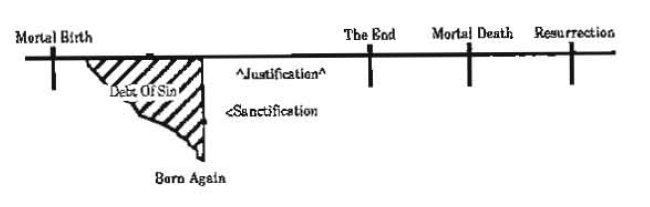
    9. Justification.

    The process by which our Savior enables men to love God with all of their minds is termed in the scriptures “justification.” Our Savior helps us to become just, which is to say righteous, by teaching us the truth we need to understand about God, about righteousness, about ourselves, and about the nature of our mortal probation. That teaching is essentially accomplished through the teaching and preaching of the Gospel of Jesus Christ. This Gospel was given to our father Adam, and will be yet taught to every child of Adam. Jesus Christ is the truth,>>75 and only in truth can man act correctly to be saved. Thus our Savior has worked since the beginning to make sure that every human person has access to enough truth to take advantage of the opportunity to be ennobled in righteousness, to be redeemed from the Fall of Adam, and to be reunited with Father.>>76

    But truth of itself does not fulfill righteousness. The understanding of what is must be supplemented by correct principles which tell us what ought to be, and by specific instructions as to how to implement those correct principles within the framework of the true reality that has been revealed. Thus our Savior also reveals correct principles and specific directions as to how to act wisely for righteousness. These principles and directions are called in the scriptures “light,” and together with truth, they constitute intelligence, or the glory of God. Enabling his children to have his light and truth as the basis of all of their understanding, choosing and acting is the purpose of the Savior’s process of justification of his children, thus to assist each of them to become just beings.>>77 This mission of justification of his children the Savior does largely through his agent, the Holy Ghost.>>78 The receiving of the constant companionship of the Holy Ghost is the means by which our new father, Jesus Christ, teaches each of his children to walk in light and truth, giving each line upon line and precept upon precept until that great day when through complete faith in him each of his children is glorified in light and truth,>>79, even as he, our Savior, has been so glorified by his father.>>80

    In behalf of justification, the prophets have labored in each dispensation to explain to men the basic outlines of truth and righteousness, and have hoped that men would rejoice in those outlines, desire to become more righteous, and enter into the New and Everlasting Covenant to receive a fullness of righteousness. In behalf of justification the scriptures have been written, that men might better understand the witness of past generations and see that God and righteousness are the same today, yesterday and always. The Scriptural epitome of what it means to be just, to have received the justification of Christ, is given in the Sermon on the Mount. The Book of Mormon is the scripture which lays out justification both as a process and a product with greatest clarity.>>81 The scriptures testify that justification through our Lord and Savior Jesus Christ is indeed just and true.>>82

    10. Purification

    As the new children of Christ bask in the light and truth of our Savior’s justificatory power, it gradually dawns on each of them that to pour light and truth into the human vessel is not enough. As a child of Christ attempts to love the light and truth that come to him by his new father’s gift, each becomes aware of an alarming fact: having light and truth is no guarantee of being able to do what is right. Sometimes we know full well what our Savior would have us do, but we yet deliberately do that which is evil because we want to. If a person has indeed begun to love God and his neighbor, this revelation of the impurity of one’s own heart is horrifying. It means that at any time one is able to and apt to kick over the traces of the priesthood harness and consort with the evil powers in this world to gain some short?term personal advantage. It is this realization which makes even the prophets to weep and to mourn because of their iniquities and weaknesses.>>83

    Providentially, the Savior has a cure for this malady of heart, this willingness to choose evil over good. The Savior’s cure is denominated in the scriptures as “purification.”>>84 Being the Lord God Omnipotent, the creator of Heaven and Earth and all things that in them are, being fully invested with the power of Father, our Savior can reach into our bosom and give each of us a new heart, a pure heart. He tells us that he will not do that upon some incidental request but only after we have done literally all we can do to repent and conform to the standards of godliness with the powers and opportunities he has already given to us. if we have repented of every sin which we can repent of, have made fourfold restitution as far as we are able,>>85 have been reconciled to our brother,>>86 we may present ourselves at the altar with a broken heart and a contrite spirit,>>87 and plead in mighty prayer for this change of heart.>>88 Then and only then will our Savior reach in and give that person a new heart.

    The new heart will be a pure heart, one that has no selfish desires, one that is willing to do the right thing. It will choose to do the will of God at all times and places, no matter what the opposition nor the sacrifice involved. This new heart is made in the image of that of Jesus Christ, that same heart which enabled our Savior to say, “Father, not my will, but thine be done,” that same heart that enabled him to live a sinless life, that same heart for which he was chosen to be the Firstborn and to be the Only Begotten.

    To be purified is to become literally a new creature in Christ, to die as. to the old person that we were, literally to become of the heart and mind of our new father. The scriptures promise great rewards for those who qualify and take this step. The scriptural name for this new heart is “charity.”>>89 Charity is to have a heart that loves with the pure love of Christ. Without that charity, we are literally nothing. Thus is the heart of a person saved. Then becomes possible for the person to be redeemed from the fall,>>90 to see God,>>91 and not to need to be further protected from the tree of life by those helpful cherubim.>>92

    11. Resurrection.

    The strength, or the mortal tabernacles of men were rendered temporary and relatively impotent by the fall of their mortal father, Adam. This fallen and mortal state of man’s body is a blessing because being temporary it does not have to be endured forever. Pain, illness, hunger, aging and other kinds of physical distress are able to serve their useful temporary purpose in the education and strengthening of the spiritual aspect of individuals while allowing an anticipated surcease.>>93

    Permanent physical death would not be an improvement. Were mortal death to be the end of being tabernacled in flesh, every human would be at a serious disadvantage, because only when clothed in flesh can there be a fullness of joy.>>94 Because of the circumstances in which Adam fell, he became subject to Satan, and that subjection would have been complete and final had not the Savior a most important part to play relative to our physical tabernacles.

    Our Savior is God for every living creature, for he created all of us physically and is charged with fostering our eternal welfare. All the while that he is offering truth and righteousness for our minds and hearts through the light of Christ and through the covenant processes of justification and purification, he is also entirely mindful of the physical circumstances of each being on earth. Not a sparrow nor a hair of our heads falls to earth unnoticed by him.>>95

    For his eternal purposes our Savior suffers to transpire much that we humans call evil. But he also prevents much evil from occurring and transmutes all of what evil he does allow into the possibility of becoming a blessing. For that behind?the?scenes love for us he gets precious little credit. But he gives that love in spite of the unknowing and selfish complaining of his reluctant charges.

    Persons of the world pay a good deal of attention to creature comforts. In fact, some spend most of their time in acquiring, comparing and consuming the delights of the flesh. Worldly wisdom has it that a pleasure in hand is worth two hundred in the heavenly bush. Worldly wisdom also has it that the end justifies the means in acquiring said carnal delights, especially when taken at the expense of one’s enemies.

    But for his faithful covenant children, those who have hearkened to the spiritual call to truth and righteousness, the Savior recommends sacrifice and selective denial of the flesh.>>96 Those of his children who are faithful to his recommendations then receive special physical blessings through the power of his Holy Priesthood and his Holy Spirit, so that illness, accident, genetic disorders and death take no more than their exact allotted toll. As is appropriate in his wisdom, his faithful servants are renewed in the flesh,>>97 that their earthly mission cannot be shortened by natural processes. He intervenes when appropriate when their enemies would destroy them.>>98 And when the time does come for the beneficial suffering of death, his faithful children are accompanied at each step by his Holy Spirit and foreknow his will in these matters. They know that they are not left alone.>>99

    When they do die as to the flesh, it is our Savior that welcomes them to the eternal worlds, and assigns them to new labor in his order of priesthood.>>100 He ministers salvation in the spirit world through them, even as he does on earth, that all former mortals might know of and partake of the gifts he has to give.>>101

    When our Savior took upon himself the role of Messiah, descending below all things to become flesh and blood on this earth and in this fallen world, he bought with him a special advantage. Being born of and fully empowered by an immortal Father, he had the power not to die and also to raise himself from the dead should he choose to die. Being born of a mortal mother, he inherited the power to die. Not needing to die, he voluntarily gave up his possibly unending mortal life and all he could have accomplished in that sojourn for a greater purpose.>>102 By dying voluntarily he performed the sacrifice of the atonement, and by that sacrifice seized the keys of death and hell from Satan, who had gained them in the Fall, and thus prepared the way for the resurrection of all mankind.>>103

    Thus after all probation has been extended, after each human creature has chosen the law by which he desires to be governed,>>104 after all things are set in order and there is no further need of the special change known as repentance, then our Savior extends the opportunity of resurrection to each human being through his priesthood order. Every soul will receive again a tabernacle of flesh and bone, nevermore to die.>>105 His righteous children receive a tabernacle of his own order, a celestial body, having the same powers that he inherited from his Father in becoming the Only Begotten. Thus our Savior draws us into the same order of flesh and bone as that which he and Father enjoy. Thus in one more way we may become one with Father through the atonement of Jesus Christ.

    12. Sanctification

    Coming into this world already just and pure, our Savior was able to live in mortality without sinning. This astounding achievement was not automatic. He knew full well that he had the power to sin and he could easily have stepped off the path in either direction at any time. But because he loved Father with all of his heart, might, mind and strength, he refused to sin. In that love he also loved us, his neighbors, with that same pure love with which Father loves him. Thus our Savior was the perfect model of righteousness, truly our total exemplar.>>106

    By not sinning even once our Savior demonstrated that he was indeed The Son of God. Not only did he show us the way, the truth and the life, but he also made it possible by his sinlessness to suffer for our sins, which is the fourth and final aspect of his atonement.

    The need for the suffering of the atonement came from the nature of human sin. Sin is transgression of the law of God.>>107 The law of God is not arbitrary, but is established upon eternal principles of righteousness. That righteousness, by way of justice, demands that when one being hurts another without cause and permission, that hurt must be matched by a similar suffering on the part of the perpetrator of the injury. Not only that, but restitution must be made so that the injured person is at least as well off after the injury as he or she was before the injury. Only as both of these conditions are fully satisfied, suffering and restitution, can any sinner stand blameless before Father and endure his presence.>>108

    Having given men the opportunity to sin after having created them, our Savior also provided that a man might not be eternally damned for having sinned if he were truly sorry.>>109 The appropriate measure of sorrow is that the sinner confess the sin, forsake sinning completely by turning to do only the Savior’s will,>>110 and make whatever partial restitution he can, which is repentance. Repentance indeed removes sinning, thus sparing the one-time sinner from further jeopardy, but that does not absolve the former sinner of the debt previously incurred. Only our Savior can make a sufficient and restitution to render the sinner clean enough that that person could ever again live with Father.

    So when a man has done all he can to repent of sinning and to make restitution for his sins through partaking of the New and Everlasting Covenant, our Savior then assumes responsibility for the remainder of the obligation, saving men by his grace, but only after they have done all they can do.>>111 The restitution he does through his role as Jehovah, the Father of Heaven and earth, he who is able to reach into eternity and remove the everlasting eddies of the sins that men commit. He is able to stop the otherwise inexorable eternal consequences whereby evil is propagated through time and space by cause and effect. Thus he is able to leave each resurrected being in a condition where he or she suffers no eternal consequence for any evil done to him in mortality by any other mortal.>>112 Thus our Savior satisfies part of the demands of justice. It yet remained for him to suffer for the sins of all mankind, those sine past, present and future to his mortal sojourn.

    The occasion of the suffering of the atonement was but one day of his life, the final day of his mortality. In Gethsemane and through the time on the cross, our Savior trod the winepress alone,>>113 suffering the debt of sin, suffering a total suffering equal to all of the sinning that ever had or ever would be done.>>114 Having paid the debt of sinning for the sins of all men, he can invite all men to come to him and to learn of his ways and to partake of his forgiveness.>>115

    Through his suffering our Savior made it possible for men not to need to suffer for their own sins, and thus also made it possible for them to be acceptable again to Father. Thus our Savior offer to all men the cleansing of their might, that their power and priesthood in time and eternity might not need to be shortened because of blood and sins. He cleanses their garments, their power, that he then might make them perfect, complete, in all good things, even as Father is. Thus his divine restitution and suffering constitute a great work of atonement, enabling men to be one with Father in might, thus enabling men to share all that Father and he have.>>116

    13. Conclusions

    Thus human beings are saved by the grace of Christ, but only after each does all he or she can do to perfect, purify and ennoble himself or herself. The saving grace of Christ is his New and Everlasting Covenant and his power of Atonement, which are made possible by his righteousness and perfect faith in his Father.

    Thus human beings may be saved only by binding themselves to Christ. It is as if our task were to stand straight and tall before Father. But because of the Fall, we are broken and twisted. The Savior is our straight and tall splint. If we bind ourselves to him, wrap strong covenants around us and him that progressively draw us up into his form and nature, then we can become righteous as he is and can be saved. But without him we are nothing.>>117

    Thus “the righteous” spoken of in the scriptures are not human beings who are or can become righteous by themselves. The righteous are only those who have bound themselves to Jesus Christ by the promises of the New and Everlasting Covenant and who then keep those promises.>>118 Only in him and by him are they able to do any good thing. The righteous acts they do are not strictly their own acts; therefore they take no credit for them. Rather do they give the glory to God. They know that their righteous acts are acts of Christ, chosen by the pure heart given by Christ, understood by the just mind given by Christ, carried out by the new strength given by Christ, redounding to the blessing of others in the priesthood might of Christ. Thus in Christ the righteous move, and live and have their being.>>119

    If a human being endures to the end in the New and Everlasting Covenant, until he is literally transformed into the stature of Christ in heart, might, mind and strength, then he may love God with all of his heart, might, mind and strength. And if he then endures to the end of mortal life in that same condition, unfailingly enacting that same love, that new nature will become his eternal nature. He and she become one with God, part of God, also to work for the immortality and eternal life of man forever, as gods.>>120

    Thus the purpose of the New and Everlasting Covenant is to provide a means whereby every human being may come to be able to fulfill the first covenant, to do all things whatsoever their God commands them. But the first covenant cannot be fulfilled by one who has sinned. Therefore it is only through living vicariously in Christ that any mortal fulfills the first covenant and thereby is enabled to become exalted. Thus Christ wrought eternal life for us in love by satisfying justice for us vicariously. He extends mercy to all who will learn to love until their love can satisfy the demands of Father’s justice. The New and Everlasting Covenant is our detour whereby our Savior strengthens us until we can tread the narrow way of justice and mercy on our own.

    Thus the New and Everlasting Covenant is a special case of the first covenant, that which enables sinners to yet claim the blessing of exaltation in eternity even though they themselves by themselves do not merit such blessing and are at first unable to receive such blessings. Only in and through Christ may they inherit, through his worthiness.

    Our Savior kept the first covenant, and was exalted by it. For had he sinned, there could have been no one to at?one him with Father. Because of his faithfulness in the first covenant, the second or New and Everlasting Covenant was made possible, that all of us may share his blessings with him for all eternity.>>121

    Footnotes

    1. D&C 20:28

    2. John 17:21

    3. D&C 20:59

    4. 1 Cor 8:5-6

    5. D&C 124:123, 76:50-60, Alma 13:1-16

    6. D&C 14:7

    7. D&C 88:21?35

    8. Mosiah 3:19

    9. Moses 5:13

    10. D&C 8:1?3

    11.Alma 10:6; 12:10,35

    12. Moses 6:57; D&C 1:31

    13. Gen 6:5; Ether 3:2; Moroni 7:8

    14. Moroni 6:4; D&C 3:20

    15. Teachings of the Prophet Joseph Smith, p. 305

    16. Acts 4:12

    17. 3 Nephi 12:48; 27:2?

    18. TJS p. 272 “Where there is no kingdom of God there is no salvation. What constitutes the kingdom of God? Where there is a prophet, a priest, or & righteous man unto whom God gives his oracles…” to eventuate in the administration of the New and Everlasting Covenant.

    19. TJS p. 217 “A man is saved no faster than he gains knowledge.”

    20. D&C 45:6

    21. 2 Nephi 25:23

    22. 2 Cor 5:17; Gal 6:15

    23. D&C 132: 19?20

    24. Alma 42:14

    25. Alma 42:22?28

    26. 3 Nephi 13:10

    27. Moses 4:1?2; Rev. 12:7?11

    28. 1 Cor 15:22

    29. Alma 42:14

    30. 2 Nephi 9:7?9

    31. Psalms 37:4; Mosiah 11;2; P of GP JSHistory 1:15

    32. Psalms 24:3?5

    33. l Nephi 10:18

    34. Moses 6:56

    35. Gen 17:7?8

    36. D&C 132:19

    37. Eph 4:11?13

    38. D&C 121:41?46

    39. Moroni 7:9

    40. John 1:9

    41. 2 Nephi 2:26; Alma 5:41

    42. D&C 121: 34?40

    43. Rom 3:12; 2 Nephi 28:11

    44. Alma 32:28?32

    45. Alma 32:34

    46. Mosiah 18: 8?10

    47. Moroni 4:3

    48. Elder Dallin H. Oaks, “Taking Upon Us the Name of Jesus Christ,” Ensign, May 1985 pp. 80-83

    49. Alma 34:17?27

    50. Ether 8:26; 12;28

    51. John 14:15

    52. Alma 22:16

    53. John 20:22; 2 Nephi 31:13; D&C 39:23; 76:52

    54. Alma 7:21

    55. 2 Nephi 31:17

    56. D&C 82:7

    57. 2 Nephi 31:18

    58. 2 Nephi 31: 19?21

    59. D&C 121:36

    60. Mosiah 8:15?18

    61. D&C 68:2?4

    62. Matt 25:14?30

    63. D&C 84:39

    64. D&C 82:19

    65. D&C 131:1?4

    66. Alma 13:6?9

    67. D&C 97:8

    68. D&C 121: 34?37

    69. 3 Nephi 13:33

    70. John 13:34

    71. 2 Nephi 25:23; Mosiah 2:21

    72. Moses 4:2

    73. D&C: 76:107

    74. D&C 59:5

    75. John 14:6

    76. 2 Nephi 2:3

    77. D&C 93:28

    78. Moses 6:60

    79. D&C 76:69

    80. D&C 93:11?14

    81. E.g., Alma 5

    82. D&C 20:30

    83. 2 Nephi 4:27; Isa 6:5

    84. Mal 3:3; James 4:8; D&C 112:28

    85. D&C 98:44: Luke 19:8

    86. Matt 5:23?24

    87. 2 Nephi 2:7

    88. Mor. 7:48; Mosiah 4:2

    89. Moroni 7:47

    90. Ether 3:13?14

    91. 3 Nephi 12:8

    92. Alma 12:21

    93. 2 Nephi 9:15

    94. D&C 93:33?34

    95. Luke 12:6?7

    96. Moroni 10:32

    97. D&C 84:33

    98. 2 Nephi 4:33

    99. John 14:18

    100. 2 Nephi 9:41

    101. D&C 138:30

    102. John 10:18

    103. 2 Nephi 9: 10?12

    104. D&C 88: 23?37

    105. Alma 11:41-44

    106. John 14:6

    107. 1 John 3:4

    108. D&C 4:2, D&C 84:24

    109. Mosiah 26:23

    110. D&C 58:43

    111. 2 Nephi 25:23

    112. Matt 19:29

    113. Isaiah 63:3

    114. D&C 19:16-17

    115. 3 Nephi 27:13-22

    116. Alma 34:12-17

    117. John 15:1-5

    118. Alma 9:28

    119. Acts 17:28

    120. D&C 132:19-20

    121. D&C 88:107
  • Interpreting the New Testament

    The New Testament and the Latter-Day-Saints – Sperry Symposium 1987 – p. 263-278

    Chauncey C. Riddle

    Interpreting the New Testament quoted from The New Testament and the Latter-day Saints – Sperry Symposium 1987

    This paper is divided into three parts:

    1. Deals with the place of the New Testament in our lives and why we must know it.
    2. Discusses the three modes of interpreting the New Testament.
    3. Contains special suggestions for interpreting the New Testament.

    Part 1: The Place of the New Testament in Our Lives

    To understand the place of the New Testament in the life of a Latter-day Saint, we must first inquire as to the place of the scriptures in general. If salvation is the goal for man, then we see that there are three principal helps for man as he seeks to be saved. The first help is God himself. Salvation is not a mortal or human thing. It is supernatural, a lifting of man from human to divine status, and comes to us only in the person of Jesus Christ. It is through the personal power and intervention of Jesus Christ that any man is saved from unrighteousness.

    The second help sent by God to draw men unto him that they might be saved is the prophets of God. These are they who are given power from God to teach the true gospel of Jesus Christ and to administer the saving ordinances, which are the covenants thereof. The gospel is necessary because men must understand and desire salvation from unrighteousness before they can be saved. Each person is then saved in and through the covenants each makes with God and the carrying out of the promises made by each person and by God.

    A third help for salvation is the holy scriptures. The purpose of the scriptures is to acquaint men with the possibility of salvation, that each might have the opportunity to understand and to desire salvation through Jesus Christ. Those who have that desire are pointed by the scriptures to find a prophet of God, that they, too, might partake of the covenants and thus enter into life, which is salvation. When the scriptures are not adulterated by men, they perform well those two tasks: allowing men to desire righteousness by understanding its possibility in Jesus Christ, and pointing them to find an authorized servant of Jesus Christ who can lawfully and effectively administer the saving ordinances.

    Let us note what is necessary for salvation: God is necessary, and since he saves men only through covenants, the covenants are necessary. Prophets of God would not be necessary if God himself were to come down and administer the gospel and the covenants directly to men. But God chooses not to do that most of the time. When God chooses not to come down, then men who desire to be saved must seek a legal administrator sent from God, a prophet. In this case, the prophet, who bears the authority of God to teach the gospel and administer in the ordinances thereof, becomes necessary. The scriptures are not necessary. They are helpful, but men could be saved if there were not one line of scripture written. Men could be saved by the prophet of God without scripture, for the true prophet has all that is necessary.

    But the scriptures are helpful. They point our minds to our God and to righteousness. They make us hunger and thirst for the ordinances which make righteousness possible. Each different scripture gives the witness of a different people and / or time, showing that God loves his children and saves men in all ages through the very same gospel and ordinances. The New Testament is the special witness of the prophets who labored in the Old World during the meridian of time. They give us many precious insights into the life and ministry of the Savior and his apostles. But no Latter-day Saint needs those insights to be saved.

    We are a missionary people, however. The New Testament is the only record of Jesus Christ and his gospel that much of the world knows. That record therefore is the bridge by which we can put them in touch with the true priesthood authority of God. Because Latter-day Saints are a missionary people, we need to know the New Testament backwards and forwards, not for our own salvation but that we might be instrumental in bringing the knowledge of how to be saved to others of our brothers and sisters. For us to ignore the New Testament or to know it poorly is not to love either our God or those Christian neighbors whom our God has given us.

    Part 2: Three Modes of Interpreting the New Testament

    The first mode for understanding the New Testament is private interpretation; the second is scholarly interpretation; and the third is prophetic interpretation.

    A. Private Interpretation

    Private interpretation of the New Testament is reading some version of it and deciding that it means whatever we think it means. In this method, each person sets himself up as the interpreter and fixes on his own fancy as the standard. There are two principal ways of doing this.

    The first kind of private interpretation is whimsical; with it we allow our own creative imagination to tell us that the text means whatever pops into our heads as we read it. Many human beings interpret everything they read in this way.

    The second variety of private interpretation is the dogmatic variety, wherein the reader attributes the same meaning to the text which he or she has been told by someone else is the proper interpretation. Without any further thought or inquiry the reader simply accepts what he has been told.

    The New Testament has a pointed comment about private interpretation. Peter warns us not to indulge in it: “Knowing this first, that no prophecy of the scripture is of any private interpretation. For the prophecy came not in old time by the will of man: but holy men of God spake as they were moved by the Holy Ghost” (2 Peter 1:20-21). The dogmatic variety of private interpretation is what the scriptures call the “chains of hell” (see D&C 123:7-8). The purpose and end of private interpretation is to confirm and convince the reader of what he already believes. It is principally an occasion for self-justification, a path to be eschewed under all circumstances.

    B. Scholarly Interpretation

    Scholarly interpretation of the New Testament is applying a rational formula to the translating of a scriptural text into some vernacular and then designating the significance of that text. There are two principal varieties of scholarly interpretation.

    First-class scholarship has each of the following criteria as necessary conditions: (a) the most authentic.e .version of the text must be used; (b) the text must be used in the original language (Greek, for the New Testament); (c) the scholar must be aware of and account for what every other first-class scholar has said on the topic or passage being interpreted; and (d) the first- class scholar must use a rational formula which I explicitly describes and which any other scholar could discern and use. These rather strict conditions for first-class scholarship cause it to be rare. One mark of the work of first-class scholars is the abundance of footnotes, but many footnotes do not make first-class scholarship. Only a first-class scholar will read all the footnotes, track down the origins, and judge for himself whether or not a writer makes sense. It takes a first- class scholar to identify and deal with a first-class scholar.

    Second-class scholarship is interpretation which satisfies any one of the conditions for first-class scholarship but lacks one or more of the other requirements. There is a good deal of second-class scholarship in the world.

    The rational formulae which scholars use are of some note, and it serves our purpose to review the principal varieties here.

    “Lower,” or textual criticism, is the comparison of texts to determine by both internal and external evidence the text which is most authentic. In the case of the New Testament, this usually is the pursuit of the oldest manuscript, assuming the oldest to be the closest to the source. We have nothing which could be considered an original manuscript for the New Testament, so lower criticism is important to every student of that text.

    “Higher” criticism is the search for authorship of biblical texts by considering internal evidence, such as writing style, vocabulary, historical references, and so forth.

    Grammatical criticism, or ordinary textual interpretation, is intense analysis of the words and grammatical forms of the text, in an attempt to establish what would constitute an acceptable modal translation of the text based on what are considered to be the meanings of other nonscriptural texts of the Koine Greek which appears in the New Testament manuscripts.

    Source criticism is the attempt to structure the hypothetical original documents which the writers of the Gospels and Acts might have used to compose those works, drawing evidence from the similarities and differences found among the synoptic Gospels in particular.

    Form criticism is the attempt to relate the New Testament texts to the literary forms present in the manuscripts of the contemporary Hellenic culture of the writers of the New Testament. Various pericopes or fragments of the text are analyzed as paradigms, tales, legends, myths, and exhortations, interpretation being affected by the perceived literary device employed.

    Redaction criticism assumes that there were primary source documents like those which source criticism seeks to reconstruct, and that writers of the New Testament were principally employed in stitching the older fragments together with comments of their own, which is redaction. The work of redaction criticism is to reinterpret the text in light of the perceived biases and emphases of each redactor.

    Tradition-history criticism attempts to correlate the biblical text with the historic development of the New Testament church. It is based on two principles: first, that the Christology of the New Testament is not that of Jesus himself but is a product of the legends which grew up in the first century; and second, that it is possible to separate the authentic teachings of Jesus himself from the accretions added by later Christians.

    Comparative religion criticism (history of religion criticism) approaches the New Testament by noting what elements it does and does not have in common with the other religions of the ancient Near East. Relationships with Zoroastrianism, Mithraism, and other religions are established, showing that the atoning sacrifice and purification rites were common to many cultures.

    Demythologizing is the attempt to relieve the New Testament of its supernatural elements, which, it is said, are no longer tolerable to the enlightened mind, and to discover the authentic, timeless core that lies within those supposed myths. An interesting variation on that theme is the attempt to “remythologize” the text in favor of modern myths, those more acceptable to modern minds.

    Hermeneutics, as an intellectual approach, leaves the attempt to say what the text originally meant to others, and concentrates instead on discerning what the text should mean for us in our modern setting. Instead of our judging the text, it is understood that the text judges us who read it. As Jesus established a common understanding with the people to whom he spoke that he might thereby surely deliver his message, so we must seek today that frame of mind in which the teachings of Jesus will be most meaningful to us.

    Another scholarly device is that employed by Harnack, Boman, and others in the attempt to characterize the patterns of Hebrew thinking as they contrast with those of the Greek mind. Boman sees the Hebrews as interested in action, whereas the Greeks look for the unchangeable, eternal verities; the Hebrews focus on inner qualities of soul, while the Greeks favor visible particulars in describing persons; Hebrews see action as either complete or incomplete, whereas the Greeks nicely divide time into past, present, and future. Such differences as these, Boman contends, must be taken into account when interpreting the Hebrew New Testament message in Greek grammatical forms.|interpreting the new testament (fn:1)|

    An excellent explanation of much that relates to the scholarly interpretation of the New Testament is found in a work edited by I. Howard Marshall, entitled New Testament Interpretation.|interpreting the new testament (fn:2)| I recommend especially the article by F. F. Bruce entitled “The History of New Testament Study,” one by E. Earl Ellis entitled “How the New Testament Uses the Old,” and a third by Anthony Thiselton entitled “The New Hermeneutic.”

    The end or goal of scholarly interpretation is knowledge. The scholar seeks, with the best rational tools and worldly learning that he can muster, to reach conclusions that are intellectually justifiable. His greatest fear is that he will believe something that is unworthy of rational assent. Often he assumes protective custody of nonscholars in attempting to spare them the horrors of naive belief and private interpretation, thus becoming a brother-keeper. Some scholars, of course, have a real belief that Jesus was divine. They search and reason while believing, hoping to find a better faith, and through their faith have given great gifts to the world. I think here of works such as that of James Strong, who, with others but without the benefit of a computer, produced that invaluable tool for biblical scholarship that we know as Strong’s Exhaustive Concordance of the Bible.|interpreting the new testament (fn:3)| I also recommend the volume by Richard L. Anderson entitled Understanding Paul, an interpretive work of first-class scholarship.|interpreting the new testament (fn:4)|

    Scholarly interpretation is clearly an improvement on private interpretation. Scholarly and rational though it is, much of it is guesswork. But gems can be found in it which are well worth the search. This body of material is much in the category of the biblical Apocrypha concerning which the Lord declared through the Prophet Joseph Smith: “There are many things contained therein that are not true, which are interpolations by the hands of men …. Therefore, whoso readeth it, let him understand, for the Spirit manifesteth therefrom; And whoso receiveth not by the Spirit, cannot be benefitted” (D&C 91:2-6).

    We now contrast private and scholarly interpretation with prophetic interpretation. Prophetic interpretation is interpretation of a scriptural text under the immediate direction of the Holy Spirit. This is personal revelation, the same kind of personal revelation by which the scripture was originally created. This kind of interpretation is denominated “prophetic” because it is the Holy Spirit which brings the true testimony of Jesus Christ and that testimony of Jesus Christ is the spirit of prophecy. Whoever has the Holy Spirit to guide him or her is for that moment a prophet-not necessarily a prophet to anyone else, but at least a prophet unto himself or herself. Since it takes a prophet to tell a prophet, the Holy Spirit binds the sent prophet to the receiving prophet in the unity of submission to the mind and will of God (cf. D&C 50:13- 24).

    Thus there are two basic types of prophetic interpretation. The first is the prophecy of receiving from God for one’s own personal benefit. As one approaches a scriptural text in prayer and faith, ready to do what is instructed by the Holy Spirit, one indeed may receive specific instruction in connection with text as to how that should be interpreted, then acting accordingly in one’s own life situation and predicaments. This is using the text as if it were a Urim and Thummim, a divinely given aid to facilitate the receiving of further revelation from the Lord. Since the Lord has promised that he will give wisdom–that knowledge of how to act in faith–that we might please him, such revelation is a frequent occurrence. Its occurrence is correlated strictly with the degree to which the person seeks and hungers after righteousness through Jesus Christ. We noted above that the purpose in private interpretation is self-justification and that the purpose of scholarly interpretation is the ascertaining of truth, that one might know what to believe. Contrasted with both is the purpose of prophetic interpretation: to be able to act in faith to please God. Action, which includes but goes much beyond mere believing, is the end of prophetic scriptural interpretation. Built into this kind of prophecy is the supposition that this process will take place again and again, and that through much faith and experience in experimenting with those messages delivered by the still, small voice of the Spirit, one will come to know for oneself, unerringly, what is and what is not the voice of God in this world. Thus one becomes sure and established, rooted and tested in the faith of Christ, and through that mature faith comes all other good things from God.

    The second kind of prophetic interpretation of the scriptures is the prophecy of receiving from God for the purpose of bearing witness to others concerning God. To safeguard the purity of this kind of revelation, the Lord has put three safeguards on it. First, prophecy may be received and delivered to other human beings only by those who are ordained of God by the laying on of hands by those who have true authority from God, even as was Aaron. Second, the hearer will always be one to whom the preacher or teacher is specifically sent. It will be publicly known to members of the Lord’s Church who those preachers and teachers are that are duly sent. Third, each hearer is entitled to personal revelation from God himself confirming any interpretation or prophecy which the one who is sent might deliver to him or her. Thus the prophecy of preaching or teaching for God must be matched by the prophecy of receiving from God by the hearer for the witness of the preacher or teacher to be valid and binding. These three essentials are clearly stated by the Lord as his standard: “And, behold, and lo, this is an ensample unto all those who were ordained unto this priesthood, whose mission is appointed unto them to go forth–And this is the ensample unto them, that they shall speak as they are moved upon by the Holy Ghost. And whatsoever they shall speak when moved upon by the Holy Ghost shall be scripture, shall be the will of the Lord, shall be the mind of the Lord, shall be the word of the Lord, shall be the voice of the Lord, and the power of God unto salvation” (D&C 68:2-4).

    Thus, each human being who encounters the holy scriptures has three choices: he may put his own private interpretation on the scripture, he may use the tools and formulae of the scholarly world in interpreting it, or he may seek and find personal revelation that the Lord might interpret it for him. It seems that this is an exhaustive taxonomy; every interpretation can be correctly designated as one of these three.

    But what about the value of mixing these three types of interpretation? It is plain that private interpretation is always evil and that it will destroy any good that might otherwise be found by an individual when combining it with either scholarly or prophetic interpretation. Scholarly interpretation is evil if it is private interpretation, that is to say, if it is not done under the inspiration and permission of the Holy Spirit. But scholarship can be noble and spiritually rewarding. The scholarly work of Mormon in creating the Book of Mormon is a perfect model of responsible, spiritual scholarship. But scholarly or not, interpretation of scripture must always be purely prophetic to avoid being evil. The kingdom of our Savior today could use more first-class scholarship by those who enjoy the spirit of prophecy. Of course, what it most needs is more persons reading the scriptures by the spirit of prophecy and then acting faithfully. We have enough scripture; we need to better use what we have. It is promised that then we shall have more.

    D. Applications by History

    How can an understanding of these three kinds of interpretation be seen to operate historically? First, we note that all scripture is produced by prophecy, by the revelations of God to his chosen servants. The intention is that all reading and interpreting of any portion or of all of that scripture should be done by prophecy, either for the benefit of the individual in his own stewardship or for the purpose of instructing others. But when men sin, the gifts of the Holy Spirit are taken from them. If they then interpret scripture, they are forced either to scholarly or to private interpretation.

    After prophets ceased in Judah in Old Testament times (c. 400 B.C.), there arose the schools of rabbinic interpretation. Rabbinic interpretation is scholarly interpretation. It focuses on reading the accepted text in the original Hebrew, knowing what other rabbis have said about it, and elaborating interpretation according to rational formulae. These scholars were known as scribes and Pharisees in the Savior’s time. Jesus was a problem to them because he did not have the rabbinic training or outlook: he taught as one having authority, for indeed he was a prophet of God. He spoke only by the spirit of prophecy and instructed his followers to do likewise. In this the Savior threatened the rabbinic tradition of the scribes and Pharisees. They saw themselves as the saviors of the common people, preserving them from the great evil of private interpretation of the holy scriptures, which is generally the scholarly attitude. It was these protectors of the people who called for and gained Jesus’ blood, calling him a blasphemer for pretending to revelation from his Father and theirs. So they had their way, and rabbinism has maintained its hold on Judah to this day.

    Paul was a rabbinic zealot, persecuting the blasphemers wherever he could. He was cured of his spiritual blindness by a revelation which left him physically blind. But then, knowing revelation, he became a faithful disciple of the Savior, teaching the deadness beth of the law of Moses and of the rabbinic tradition of interpretation which refused to see the law as the schoolmaster to prepare Israel for Christ.

    During the time of Paul and the other Apostles, prophetic interpretation of the scriptures flourished, though not without opposition. But when the apostles were gone, the opposition triumphed and scholarly interpretation replaced revelation, even as it had done in Judaism earlier. Training for the priest became the study of languages and philosophy that scholarly work might be pursued. Thus, the world came to think that one cannot preach unless he is school learned.

    The Protestant Reformation provided an interesting twist on the old story. When Luther, Wycliffe, and others translated the Bible into the vernacular languages, they did so as scholars, but they were undoubtedly aided by the Holy Spirit in much of what they did. The result was that prophetic interpretation again began to flourish. Individuals could now read the things of God and interpret them for themselves, and through faithful obedience to God as he gave them revelation, they revolutionized the world for much good. Institutionally, Protestantism has always been weak. Lacking authority for the preaching and teaching gifts, it has foundered on the question of authority. But individuals were not barred or prevented from doing much good. That is perhaps why the practice of Christian religion among genuine Protestants has so often been very good while the theory has been very bad.

    The Church of Jesus Christ of Latter-day Saints also reflects the tension among these three modes of interpreting the scriptures. Prophetic interpretation is the core and being of the Restored Church. But there are those who insist on their own private interpretation of the revelations. These go off into the desert (spiritually and/or temporally) and form their own private churches and kingdoms. They have their reward.

    Others employ scholarly methods to interpret the scriptures, and some of that scholarship is first-rate. Among these scholars there are those who are also submissive to the Holy Spirit, who wait upon the Lord; they have sometimes made important contributions to the kingdom, often anonymously. They know that their blessings come not through their scholarly attainments but from their faith in Jesus Christ Another group in the Church are scholars of one sort or another who do not brook priesthood authority and the guidance of the Holy Spirit. They come to believe that reason must and will eventually triumph over what they call “blind faith.” To them, blind faith is unscholarly faith. They struggle with what the General Authorities of the Church say and cannot fully support those authorities. They are sometimes miffed because persons of lesser intelligence and scholarship are placed in positions of authority over them or are given precedence before them. Their scholarship has become a stumbling block to them. This is one source of the so-called anti-intellectual bias of the Church.

    But scholarship and revelation can go hand in hand as long as revelation is the leader, the interpreter, and not vice versa.

    Part 3: Suggestions for Interpreting the New Testament

    We come now to the third part of this paper, which is to make some concrete suggestions for faithful, prophetic interpretation of the New Testament. It is incumbent upon every faithful member to read the New Testament during 1987, if at all possible. If we read it and how we read it will determine much about our future.

    I will make seven specific suggestions as to how one might profitably go about reading the New Testament prophetically. I report these as admonitions to myself, hoping that something I say might find a responsive chord in your spiritual repertoire.

    1. I believe that it is important to begin each scripture session with prayer, that we might demonstrate our faith and make ourselves more receptive to the whisperings of the Spirit. Indeed, prayer itself, if done truly, is simple practice at receiving and obeying personal revelation. It is thus a specific preparation for receiving what the Lord would have us do in connection with the text we are about to examine. I call as my witness on this point, Nephi of old: “But behold, I say unto you that ye must pray always, and not faint; that ye must not perform any thing unto the Lord save in the first place ye shall pray unto the Father in the name of Christ, that he will consecrate thy performance unto thee, that thy performance may be for the welfare of thy soul” (2 Nephi 32:9).

    2. It has often been noted that we tend to see in a text what we already believe. If what we already believe is true, then we have a great help in interpreting the scriptures. But if we are struggling with new doctrine and have false doctrine as our interpretive frame, we will have a difficult time when the Holy Spirit tells us something contrary to what we already believe. We must clean up the launching pad to avoid misinterpretation.

    One excellent way to cleanse our minds of error is to let the Book of Mormon be our standard of doctrine and truth. Of course, the Book of Mormon cannot give us the truth without revelation. But at least we are reading the book with the most correct text in this whole world. A better place to practice interpretation by the Spirit and to establish a true theology and cosmology is difficult to find, and if found, is sometimes not accessible (such as the person of a General Authority). My witness here is the Prophet Joseph Smith: “I told the brethren that the Book of Mormon was the most correct of any book on earth, and the keystone of our religion, and a man would get nearer to God by abiding by its precepts, than by any other book” (Introduction to The Book of Mormon).

    3. We need to see all things from the perspective of eternity. There is only one thing which matters in eternity: righteousness. If righteousness is the thing after which we hunger and thirst, then as we read the scriptures prayerfully and faithfully, we will be filled with information about how to obtain righteousness and how to avoid unrighteousness. The Christian world generally believes that the problem of salvation is to somehow get forgiveness for unrighteousness. The Book of Mormon shows us that the larger problem is getting our personal self re-created into a new being that no longer does anything unrighteous. Studying that process of re-creation through being reborn and growing up into the stature of the fulness of Christ is the key to righteousness and eternity. We have the promise of the Savior: “Blessed are all they who do hunger and thirst after righteousness, for they shall be filled with the Holy Ghost” (3 Nephi 12:6).

    4. We can liken the scriptures unto ourselves. When we read the stories of the scriptures, we can imaginatively put ourselves in the place of the characters of the story. How would I think, feel, and act if I suddenly awoke and realized that I am the prodigal son? What should I then feel, think, say, and do? Or do I imagine myself to be the other brother who supposedly never sinned; do I see myself as saved while all about me are prodigal? If so, I probably am in great need of repentance for even allowing myself to suppose that I am that son.

    When I read of Ananias and Sapphira, do I understand what must have been going through the heart and mind of each when questioned about the consecration? Can I feel the fear of trusting entirely in that unseen Jesus Christ, yet being tugged upon by the Holy Spirit to tell the truth? Can I imagine the anguish each must have felt in deliberately denying the Holy Spirit, grasping at a worldly straw? Can the memory of that imagination help me in the future when my faith wavers and the cares of the world press upon me? I can indeed live a hundreds lives in my imagination, and taste the bitterness of sin and the joy of righteousness vicariously. That knowledge then can help me to be strong and reject the bitterness of hell. Through Cain I know murder and perdition. Through Judah I know the pain of adultery. Through David I know the damnation of lust. Through Peter I deny that I know the Christ and have bitter tears. Through Paul I know persecution and stoning. Through John I know what it is to lean upon the Savior’s breast and be his beloved disciple. Not that I do these things, but the Holy Spirit causes all these things in me as I prayerfully meditate and ponder the stories which the prophets have carefully preserved for me under instruction from the Holy One. Again, I call Nephi as my witness in this likening: “And I did read many things unto them which were written in the books of Moses; but that I might more fully persuade them to believe in the Lord their Redeemer I did read unto them that which was written by the prophet Isaiah; for I did liken all scriptures unto us, that it might be for our profit and learning” (1 Nephi 19:23).

    5. More specifically I can ask myself how I relate to the priesthood authority which my Savior has set over me. Am I Uzza who steadies the ark? Am I Simon who would buy the power of the priesthood if I cannot bring myself to repent to get it? Am I like the rich young man who goes to the authorities for help but then has to go away sorrowing because I love the world more than I love obedience? Can I see how I must not pretend that I am as good as the prophet, as Hiram Page was tempted? Do I see in my bishop and stake president the same authority and power which parted the Red Sea and fed the five thousand?

    The brethren who preside over us are human, but the authority they have is not. Can I look both fully in the face and accept them? When those brethren use a scripture to teach us, do I find fault with their interpretation because I fancy myself to be superior, then neglect to do what they tell me, thus compounding the error? Peter tells us that the key to perfecting our love for the Savior is first to learn to love the brethren whom he has sent to preside over us (see 2 Peter 1). If our reading of the scriptures encourages us and enables us to do that, we are profiting from the scriptures indeed.

    6. If we love the brethren who preside over us, we then can use our reading of the scriptures to draw us closer to the Lord himself. Have we read the life of the Savior in all the detail preserved for us, then prayed for the confirmation so that we can say with Peter; “Thou art the Christ, the Son of the living God” (Matthew 16:16)? If we read with faith, we will know that our Savior loves us and that he does nothing save it be for the benefit of the world. If we love and serve him, everything which happens to us he will turn to our good. As our admiration and love for him and our faithfulness to him grow, we will grow in the power and understanding of his word. The scriptures will indeed become a Urim and Thummim to us. We will not be in doubt as to what he would have us believe and do. He himself tells us, “And again, verily I say unto you, my friends, I leave these sayings with you to ponder in your hearts, with this commandment which I give unto you, that ye shall call upon me while I am near–Draw near unto me and I will draw near unto you; seek me diligently and ye shall find me; ask, and ye shall receive; knock, and it shall be opened unto you” (D&C 88:62-63).

    7. My final suggestion for interpreting the New Testament and all scripture is that we strive to understand how to apply the great commandment. We are told, “Thou shalt love the Lord thy God with all thy heart, with all thy might, mind, and strength; and in the name of Jesus Christ thou shalt serve him” (D&G 59:5). I take this to mean that there are four basic and distinct ways in which we should love our God. Since everything we do should be an act of love for him, reading the scriptures must be one of those things, and we should use the scriptures to lean how we can love and serve him with all of our heart, might, mind, and strength.

    Our heart is the heart of our spirit body and is the factor which determines what we choose among the alternatives furnished by the mind. Most of us have the problem that our hearts are not pure: we want to do what is right, but we also want to sin. So we defeat ourselves, frustrate ourselves by doing some good things but not being able to reap the full benefits because we also tarnish ourselves with sinning. The solution to the problem is to find the one way to become pure in heart, which is found only in the Savior. If we come unto him as little children, believing and obeying, he can purify us. When we read the scriptures, we might well be asking, What does this passage teach me about how I should feel and what I should desire? If I then follow through with what I am instructed by the Spirit to feel and desire, I am beginning to love the Lord with my heart.

    Our mind apparently is the brain of our spirit body. It is our mind which knows and understands, which receives instruction and reproof, which contemplates the world and the perspective of eternity. If our mind is right, we will receive many things but admit into our beliefs only those things directly attested by the Holy Spirit, which will show us the truth of all things. Under the direction of that Spirit we will train ourselves to think, to compare, to analyze, to relate, to synthesize, to create, to conjecture, to test, to evaluate. We will strive to furnish our heart with an able and truthful servant and companion. Even as the heart needs to be pure, so does the mind need to be filled with truth and to eschew all error, even until one sees and understands the mysteries both of this world and of eternity. Only the Spirit of Truth, which is Jesus Christ and the Holy Ghost acting as one, can so purify our minds and fill them that we can begin to become wise servants, properly furnished with the perspective of eternity. As we read the scriptures, we should be hungering and thirsting after truth, jealous for every true belief, that we might learn to love the Lord fully, in truth and righteousness, with our mind.

    Our strength is our body, our mortal tabernacle. To love our God with all our strength, we must study and train ourselves until we furnish this body with the very best nutrition available, the best hygienic environment we can muster, the most valuable exercise and work which is appropriate. We must treasure our power of reproduction, deeming its purity of more value than physical life itself. We must search out that field of labor where the Lord would have us dwell and be a husbandman to his vineyard, and bring forth upon the earth those physical and spiritual fruits which will please him. Our study of the scripture will help suggest particulars of how we might act as just and wise stewards, how we might keep ourselves unspotted from the world, how we might need to sacrifice our very physical life in the cause of our Master. Thus we learn to love the Lord with all of our strength.

    Our might is our sphere of influence in this world: our money, our property, our belongings, our family and friends, our stewardships. We are apprentice gods, and it pleases God to instruct us in all the ways of godliness if we seek righteousness rather than power. As we read his word, we will learn many things about how to be a just and wise steward. Through his Spirit he will show us good examples in the scriptures of the very principles and standards that he himself abides. As we are faithful in complying with that instruction, he is able to make us rulers over many, for we have then learned to love him with our might.

    Learning to love God through the scriptures is like learning to braid with four strands. Here and there, line upon line, and precept upon precept, we learn the standards and requirements for loving him with heart, might, mind, and strength. As we obey, we make the strands a reality instead of a possibility. As we obey through time, we twist, turn, weave, and sacrifice until we have formed a tightly woven strand, one that is strong yet flexible, durable yet pliable, ready and able to bear the weight of eternal things. We personally, being reborn and refashioned, have become worthy of the Master of our apprenticeship through loving him and his word.

    One example must suffice. We read in John that if we continue in the word of the Savior, we are his disciples indeed; then we shall know the truth and the truth shall make us free. How shall we interpret this according to heart, might, mind, and strength? With our heart we can desire to know him who is the truth, desire enough that we actually repent of our sins and obey his will through his Holy Spirit, hungering and thirsting after righteousness. With our mind we can understand that he is the way, the truth, and the life, and that besides him there is no Savior and no salvation. We see that the world does not know the truth. We must put our whole trust and confidence in him only. With our strength, we can sacrifice to keep his commandments, to get up when we should, to sleep when we should, to eat when we should, to go and come and work and play as we should, to defend or retreat as we should, to till the earth and provide for our own as we should. With our might we can tithe and consecrate, foster good causes and bless, share with our neighbor who is in want, store for a dark future, and invest in that which is eternally worthwhile. For if we love and serve him who is the truth, he will then be able to set us free from every impurity, every smallness, every selfishness, every error, every untoward desire. Then we shall be free indeed.

    The sum of the matter is that scripture is of no private interpretation. We must search and strive until we find that Holy Spirit which alone can make the scriptures come alive to us with that life which never ends. May we relish that great treasure, the New Testament, in that way, is my hope for all of us.

    1. Boman, Thorlief; Hebrew Thought Compared with Greek, W. W. Norton Co., 1960.
    2. Paternoster Press, Exeter, England, 1977.
    3. MacDonald Publishing Company, McLean, Virginia.
    4. Anderson, Richard Lloyd; Understanding Paul, Salt Lake City, Utah: Deseret Book Company, 1983.

  • Justification, Ancient and Modern

    CHAPTER TWENTY

    Justification, Ancient and Modern

    Sperry Symposium 1986
    The  Old Testament and the
    Latter-Day Saints 
    16 October, 1986

    Chauncey C. Riddle

    Introduction

    We shall begin with a definition of religion, which will enable us to give a contextual definition of justification.

    Justification, Ancient and Modern – quoted from The Old Testament and the Latter Day Saints – Sperry Symposium – 1986

    Webster’s Third New International Dictionary lists the archaic definition of religion as “scrupulous conformity.” If we inquire as to what it is that enables a person to achieve scrupulous conformity, the answer might be that it is the person’s character, his habits, which allow him to be diligently faithful to principle or person, depending on the object or his faith, Using that cue we shall define religion to be a person’s character or habits, that which enables him to act in a regular manner in achieving his objectives. This definition distinguishes whimsical or fortuitous action from that which is characteristic, but also suggests that if a person’s actions are notably whimsical or fortuitous, his religion, his habits, are not very strong or reliable. This definition also distinguishes personal religion from the social institutions we call “church” or “culture.” A church functions to inculcate and perpetuate some person’s idea of what personal religion should be. It is noteworthy that leader and layman alike often do not personally exemplify the pattern of religious habit proclaimed by the church to which they belong. A culture is a group of people having a widely shared pattern of personal religion, a group of people having similar or identical character or habits, The mark of a successful church is a homogeneous culture. The mark of a successful personal religion is a set of habits which enables a person to achieve his goals in life. In a Latter-day Saint frame, a person’s religion is sufficient if it enables him to fill his divinely appointed life’s mission completely, which only the pure and undefiled religion will do.

    We can now define justification. The root JUis the Latin word for “right.” Ficaris the Latin word meaning to make or to do. Etymologically then, justification means “to make right, or the process by which a person becomes a righteous person.” In the frame of our definition of religion, we will give a secular definition : justification is the process by which a person acquires the character or habits which he personally deems to be ideal for himself. A person envisions a standard or pattern of being which he takes to be his desired state, the right condition, the nature of a just being. The process which delivers that desired state is then justification.

    That definition of justification gives rise to two very different kinds of justification. It allows a person to say “I am just. What I do is the right thing to do.” This is self­-justification, that favorite pasttime of mortals who do not wish to repent. But that definition also enables us to see that in addition to pulling the standard of right down to ourselves, we may work out a change of our character which wiIl lift us up to the standard of being and doing what is right. This latter kind of justification is the one on which we will focus. This second kind of justification is another name for the process of change. In some theological views that change is largely done for the person, with little effort required on his part. In other theologies justification is almost wholly up to the person. Only in some theological hypotheses does justification correspond to repentance.

    It turns out, then, that justification is a key index by which to compare different religions, churches and cultures. In this paper we shall examine four different cultures to contrast the theory and procedures of justification which are typical to each. We shall first examine Judaism as a reflection of the teachings of the Old Testament. We shall then successively examine Catholicism and Protestantism as reflections of the teachings of the New Testament. Finally, we shall examine the LDS position as a reflection of latter-day scripture, particularly of the Book of Mormon.

    Justification in Judaism

    Our brethren of Judah have no trouble in knowing what the standard of righteousness is: the Old Testament is full of references to tsedekrighteousness, and tsadikthe righteous person. The thing that a person must do to be righteous is to love God with all of his heart, and soul, and might (Deuteronomy 6:5). To love God is also to fear him and serve him, and to swear by his name (Deuteronomy 6:13). To love God is also not to avenge, nor bear any grudge against the children of God’s people, but to love one’s neighbor as one’s self (Leviticus 19:18). The prophet Micah crystalizes the requirement: “He hath shewed thee, O man, what is good; and what doth the Lord require of thee, but to do justly, and to love mercy, and to walk humbly with thy God?” (Micah 6:8.)

    Judah knows furthermore that it is commanded to treasure up the words of Moses:

    And these words, which I command thee this day, shall be in thine heart:

    And thou shalt teach them diligently unto thy children, and shalt talk of them when thou sittest in thine house, and when thou walkest by the way, and when thou liest down, and when thou risest up.

    And thou shalt bind them for a sign upon thine hand, and they shall be as frontlets between thine eyes. And thou shalt write them upon the posts of thy house, and on thy gates (Deuteronomy 6:6-9.)

    Judah has taken as its special task, the thing which will justify it before God, the treasuring of those words of Moses. Justification to them is to learn by heart the Torah, the Jaw of Moses, and then to learn the commentaries and the commentaries on the commentaries. Handelmann gives us the following insight into the Jewish view of the text:

    The Biblical text is not, according to the Rabbinic view, a material thing located in a single space and circumscribed by a Quantifiable time. The text ultimately is not even that authoritative and divine document which was given to Moses at a particular and place, but, claims the Talmud, “The Torah preceded the world” (Shab. 88b)…. In other words, in the Rabbinic view the Torah is not an artifact of nature, a product of the universe; the universe, on the contrary is the product of the Torah… The written text is not only the enclothing of the fiery preexistent letters in which are contained the secrets of creation, but with the proper methods of interpretation, one can unlock the mysteries of all being. Every crownlet of every letter is filled with significance, and even the forms of letters are hints to profound meanings. To understand creation, one looks not to nature but to the Torah; the world can be read out of the Torah, and the Torah read from the world.1

    The scriptural text, or first house, is accompanied in the Rabbinic tradition, by a second house, the oral tradition, which is as important as the first. According to Rawidowicz, the oral law is:

    .. . not just a continuation or development but a new act of weaving undertaken by master weavers of rare power … and interpretatio of the highest order. Bayit Sheni is second only in time; it is first in essence, io its own particular essence. I dare say BayiRishon (the First House, inherited written scriptures) and the Bayit Shed are the beginnings of a system of thought and mode of life. This means that Israel has two beginnings. The second beginning or inlerpretatio achieved by Bayit Sheni may serve as a model for interpretatio in the sphere of thought at large.2

    Judah is thus devoted to the word, interpreting, expounding on, reacting to, and elaborating of the tradition. In this tradition there is no room for prophets. Moses plainly warned them:

    If there arise among you a prophet, or a dreamer of dreams, and giveth thee a sign or a wonder,

    And the sign or the wonder come to pass, whereof he spake unto thee, saying, Let us go after other gods, which thou hast not known, and let us serve them; Thou shalt not hearken unto the words of that prophet, or that dreamer of dreams: for the Lord your God proveth you, to know whether ye love the Lord your God with an your heart and with all your soul.

    Ye shall walk after the Lord your God, and fear him, and keep his commandments, and obey his voice, and ye shall serve him, and cleave unto him.

    And that prophet, or that dreamer of dreams, shall be put to death; because he hath spoken to turn you away from the Lord your God, which brought you out of the land of Egypt … (Deuteronomy 13:1-5).

    Since it is the rabbis who determine in Judah who and what is God and what he has said, no prophet can successfully challenge them. They can reject his God as a false God, and see him fit only for death.

    Judah does await the Messiah. When he comes they will know him because he will come in power and establish a political kingdom. But in the meanwhile they believe that those  who wish to become just in the eyes of God must do so by loving him through loving his word. To learn, to discuss, to debate, to interpret, to elaborate, to bring to precision that which is inchoate in the text or the oral tradition, these are primary things which make a person acceptable to God. And while the Messiah yet tarries, it is the business of every righteous Jewish person to work those works which will promote the work of Messiah: “The central idea of Judaism and its life purpose is the doctrine of the One Only and Holy God, whose kingdom of truth, justice and peace is to be universally established at the end of time.”3

    Even as the people are to be perfected as a whole in the Messianic kingdom, so each individual 16 to be perfected, to become righteous. Kohler tells us: “Judaism holds that the soul of man came forth from the hand of its Maker, endowed with freedom, unsullied by any inherent evil or inherited sin. Thus man is through the exercise of his own free will, capable of attaining an ever greater perfection by unfolding and develop­ing to an ever higher degree his mental, moral, and spiritual powers in the course ofhistory.”4

    Justification in Jewish thought is thus done by the individual, for himself, using the word of God as a guide. Sanctification, on the other hand. is God’s work:

    The blotting out of man’s sins with their punishment remains ever an act of grace by God. In compassion for man’s frailty He has ordained repentance as the means of salvation, and promised pardon to the penitent The truth is brought out in the liturgy for the Day of Atonement, as well as in the Apocalyptic Prayer of Manasseh. At the same time, Judaism awards the palm of victory to him who has wrestled with sin and conquered it by his own will. Thus the rabbis boldly assert: “Those who have sinned and repented rank higher in the world to come than the righteous who have never sinned,” which is paralleled in the New Testament: ”There is more joy in heaven over one sinner that repenteth than over ninety and nine righteous persons, who need no repentance,” No intermediary power without secures the divine grace and pardon for the repentant sinner, but his own inner transformation alone.

    Teshubah, which, means return, is an idea peculiar to Judaism, created by the prophets of Israel, and arising directly from the path of salvation, a “straying” into the road of perdition and death, the erring can return with heart and soul, end his ways, and thus change his entire being. This is not properly expressed by the term repentance, which denotes only regret for the wrong, but not the inner transformation. Nor is Teshubah to be rendered by either penitence or penance. The former indicates a sort of bodily self­-castigation, the latter some other kind of penalty undergone in order to expiate sin. Such external forms of asceticism were prescribed and practiced by many tribes and some of the historical religions. The Jewish prophets, however, opposed them bitterly, demanding an inner change, a transformation of soul, renewing both heart and spirit.

    “Let the wicked forsake his way.

    And the man of iniquity his thoughts; And let him return unto the Lord and He will have compassion upon him, And to our God, for he will abundantly pardon”

    (Isaiah 55:7). Judaism considers sin merely moral aberration, not utter corruption, and believes in the capability of the very worst of sinners to improve his ways; therefore it waits ever for his regeneration. This is truly a return to God, the restoration of the divine image which has been disfigured and corrupted by sin.6

    The parallel justification of the person and of the people is distinctive in Judaism because it seems to indicate that the personal justification needs no help, no savior or divine inter­vention, while the redemption of the people, of the kingdom, does.

    As a historical note we mention that this national justification has left many of Judah puzzled. They, as a people, have been diligent in pursuing this justification which they understand and believe. Why then has God so forsaken them and left them exposed to their enemies? How could the holocaust of World War 11 occur to a people who have been as sacrificing for the ideal as they have been? It would seem that the saying which most accurately represents modern Judah is “Eli, Eli, lama sab­achthani” (Matthew 27:46).

    Justification in Catholicism

    We now tum to the New Testament and the justification which is envisioned by the Roman Catholic faith. The Savior says:

    … thou art Peter, and upon this rock I will build my church; and the gates of hell shall not prevail against it.

    And I will give unto thee the keys of the kingdom of heaven: and whatsoever thou shalt bind on earth shall be bound in heaven: and whatsoever thou shalt loose on earth shall be loosed in heaven (Matthew 16:18-19).

    It is assumed by Catholics that Peter and his successors have received from the Savior the power to give and to deny persons on earth permission to pass into the presence of God. The token of permission for passage. the thing that must happen for a person to be receivable by God, to be acceptable to him, is that the person must receive the sacraments. The authority of Peter is the authority to administer or to withhold the sacraments.

    But sacraments are a necessary, not a sufficient condition for a person to receive the beatific vision, to be in God’s presence in the hereafter. The full sufficient condition is the addition of grace to the sacraments. Through the atonement of Christ. and the supererogated good works of the saints, those who receive the sacraments also are given forgiveness for their sins. The process of justification for the Roman Catholic faith is thus to qualify for the sacraments and consequentially to be forgiven by the grace of God. The forgiven person in eternity dwells with God and the angels in an unending bliss.

    In the Principles of Catholic Theology edited by E. J. Gratsch we find the following statement:

    The just are the righteous, the friends of God. Justification is the transition from a state of sin or aversion from God to a state of sanctifying grace or friendship with God…. God justified the sinner in the sacrament of baptism by forgiving his sins and infusing sanctifying grace with the virtues and gifts that accompany it. One who is justi6ed becomes a son of God and heir of heaven. It is possible to advance in the state of grace by keeping the commandments and by good works which gain merit for eternal life. Grace is gratuitous and supernatural. It is lost by every mortal sin, but it can be recovered by repentance and the sacrament of penance.7

    It is noteworthy that the person himself does very little in this process of justification. Though a person may struggle with sin, the nature of man is such that complete repentance is not possible. The difference is made up by penance, which is 8 form of paying for sin, as opposed to replacing sin by righteousness. God, in his mercy, is th e Justifier. Not through the works of the law, but in the works of the sacraments does a mortal qualify for that redeem­ing mercy. Carmody and Carmody show that the net importance of justification in the Catholic faith has to do with original sin:

    On justification the Council (of Trent) disputed the Reformer’s notion that righteousness is merely imputed to believers because of Christ. Rather, original sin really is removed, though after baptism concupiscence or the “tinder of sin” (formes peccati) remains. Justification leads one to sanctification or inner renewal, for the grace that makes one righteous presses further to make one holy.8

    Faithfulness to the church is the means of assuring the receiving of the sacraments by an individual. Faithfulness is mostly a matter of sustaining the faith. The faith is the teachings of the Roman Catholic church. Thus it turns out that orthodoxy is the key virtue in man for Catholics. Orthodoxy is thus the key to Justification. It is the theologians of the church, the Pope or others whose ideas are accredited by the Pope, who establish what a person must believe to qualify. Thus there is no role for prophets in this system. The saying which seems to epitomize the Roman Catholic re1igion is the Savior’s statement, ” . . . ye shall know the truth, and the truth shall make you free” (John 8:32), especially if we (mis-)interpret “the truth” to refer to theological knowledge.

    Justification in Protestantism

    The New Testament key to the Protestant religions is found in Romans 10:9-13:

    If thou shalt confess with thy mouth the Lord Jesus, and shalt believe in thine heart that God hath raised him from the dead, thou shalt be saved. For with the heart man believeth unto righteousness; and with the mouth confession is made unto salvation. For the scripture saith, Whosoever believeth on him shall not be ashamed. For there is no difference between the Jew and the Greek: for the same Lord over all is rich unto all that call upon him. For whosoever shall call upon the name of the Lord shall be saved.

    It is then faith in Christ which saves man. This faith “cometh by hearing, and hearing by the word of God” (Romans 10;11). Protestants generally deny the efficacy of the sacra­ments, maintaining that it is faith and faith alone which brings the mercy of God to man. But like the Catholics, justification is largely the responsibility of God for them. The trigger for the administration of God’s grace is that a man confess and believe when he hears the word. Then God sends grace upon him. The marks of that grace are good deeds in this world, those deeds being the result, not the qualification for grace. And like Catholicism, the results of grace are not realized fully in this life but only in the Resurrection. Having been cleansed and purified by the blood of Christ, the Protestant faithful dwell with God in eternal bliss.

    For Protestants, justification is a forensic matter, a legal judgment pronounced upon man by God. Berkhof tells us:

    Justification is a judicial act of God, in which he declares, on the basis of the righteousness of Jesus Christ, that all the claims of the law are satisfied with respect to the sinner …

    1. Justification removes the guilt of sin and restores the sinner to all the filial rights involved in his state as a child of God, including an eternal inheritance. Sanctification removes the pollution of sin and renews the sinner ever-increasingly in conformity with the image of God.
    2. Justification takes place outside of the sinner in the tribunal of God, and does not change his inner life, though the sentence is brought home to him subjectively. Sanctification, on the other hand, takes place in the inner life of man and gradually affects his whole being.
    3. Justification takes place once and for all It is not repented, neither is it a process; it is complete once and for all There is no more or less in justification; man is either fully justified, or he is not justified at all. In distinction from it sanctification is a continuous process, which is never completed in this life.

    4. While the meritorious cause of both lies in the merits of Christ, there is a difference in the efficient cause. Speaking economically, God the Father declares the sinner righteous, and God the Holy Spirit sanctifies hirn.9

    Protestants do not enjoy a strong basis for claiming any priesthood authority from God. It is quite natural, therefore, that they should place less importance upon the ordinances, the sacraments which the Catholics emphasize. They also claim that the canon of scripture is full, so they have no room for a prophet in their midst Should one come claiming to be a prophet of God and proclaim anything other than their received tradition, he is rejected as being either unnecessary, since God has given his grace freely to alt who believe, or an imposter, if he tries to teach any different theology to them.

    The epitome of the Protestants’ view of themselves is found in the words of Paul:

    For whom he did foreknow, he also did predestinate to be conformed to the image of his Son, that he might be the firstborn among many brethren.

    Moreover whom he did predestinate, them he also called: and whom he called, them he also justified: and whom he justified, them he also glorified ….

    Who shall lay anything to the charge of God’s eject? It is God that justifieth (Romans 8:29-30, 33).

    They see themselves as the elect, justified by God, the only heirs of salvation.

    Justification in the Restored Gospel

    We turn now to the account of the process ofjusti6cation as found in the scriptures of the latter days. One key scripture is found in the Pearl of Great Price:

    That by reason of transgression cometh the fall , which fall bringeth death, and inasmuch as ye were born into the world by water, and blood, and the spirit, which I have made, and 50 became of dust a living soul, even so ye must be born again into the kingdom of heaven, of water, and of the Spirit, and be cleansed by blood, even the blood of mine Only Begotten; that ye might be sanctified from all sin, and enjoy the words of eternal life in this world, and eternal life in the world to come, even immortal glory;

    For by the water ye keep the commandment; by the Spirit ye are justified, and by the blood ye are sanctifi­ed” (Moses 6:69-60).

    We see from this scripture that to be sanctified is to be c1eansed from sin, to be forgiven of the debt due because of having sinned. This sanctification is made possible by the blood of Christ. The Savior gave his blood that he might ransom us from a damnation that could be broken in no other way. The occasion or this sanctification is the receiving of the baptism of fire and the Holy Ghost after the baptism of water: “For the gate by which ye should enter is repentance and baptism by water; and then cometh a remission of your sins by fire and by the Holy Ghost.” (2 Nephi 31:17). This sanctification is apparently an all or ­nothing phenomenon. If we sin deliberately after having once received it, we must reassume the burden of the debt of sin for which we were once forgiven:

    “And the anger of God kindleth against the inhabitants of the earth; and none doeth good, far all have gone out of the way.

    And now, verily 1 say unto you, I, the Lord, will not lay any sin to your charge; go your ways and sin no more; but unto that soul who sinneth shall the former sins return, saith the Lord your God (D&C 82:6-7).

    Sanctification is thus the reward for seeking the way, for entering into it by the strait gate. This sanctification also makes it possible to go along the path. That straight path is the way which is an important, however. That. way is justification, or the process of doing what. is just. A man is made just. by doing just or righteous deeds. As he does those deeds, which he can only do as an act of faith in Jesus Christ and in a state of being sanctified, the just acts which be performs begin to form in him the divine nature, the character, habits, and strength of the Lord Jesus Christ himself. As long as a person qualifies for the continued companionship of the Holy Spirit, he maintains that precious dual gift: forgiveness because he is in the way, and knowledge of what to do next to stay in the way of holiness. Thus, sanctification is prerequisite to being in the way, and being in the way is prerequisite to becoming so much like the Savior that nothing can take us away from that way. To be a just man is not just to have done good deeds. It is also to have taken upon oneself the nature, countenance, habits, and character of the Savior, to have grown up unto the measure of the fullness of the stature of Christ. It is the justification of the man, not his deeds that is important in the long run. An evil tree cannot bring forth good fruit, neither will a good tree bring forth evil fruit. The Father and the Son are anxiously engaged in the cause of creating good trees through the process of justification.

    One of the clear and fairly detailed descriptions of how this process of justification via sanctification actually works in a human life is given by Nephi in 2 Nephi 3–33. Rather than Quote that entire scripture, I will summarize what Nephi says, point by point, as to what that process entails, and invite you to compare notes:

    Chapter 31, verse 2: Nephi 1S speaking in his calling as prophet to his people. Verse 3: Nephi delights in plainness, that he might assist his hearers to understand the message of the Lord God.. Verse 4: The Savior will be baptized by a. Prophet of God. Verse 5: If the Savior, being holy, already sanctified, needs baptism, how much more do we? Verse 6: Wherein did the Savior fulfill a1\ righteousness by being baptized? Verse 7: The Savior was baptized to keep the commandment or the Father that he might continue to be just (righteous, law-abiding), even as he was holy, or already in the state of sanctification. Verse 8: After his baptism, the Holy Ghost appeared in the form of a dove to show to all who could see the connection of baptism with receiving the Holy Ghost. Verse 9: This example shows men the exact gate by which they must enter to be on the narrow way of the sanctified who are doing justly and becoming just persons.. Verse 10: We can follow the Savior only by likewise being willing to obey the Father. Verse 11: The Father says, stop sinning and be baptized in the name of Christ. Verse 12: The Son will give the Holy Ghost to all who are baptized as he was. Verse 13: If you repent and are baptized with real intent to take upon you the name of Christ, you will receive the baptism of fire and the Holy Ghost and can then speak with the tongue of angels. Verse 14: The Savior says: If you speak with the tongue of angels and then deny me, it would have been better never to have known me. Verse 15: The Father saitb, He that endureth to the end shall be saved. Verse 16: Unless we endure to the end, we cannot be saved. Verse 17: Wherefore enter the gate by being born of the water and of the Spirit. Verse 18: Then are ye in the straight and narrow path to eternal life. Verse 19: Is all done? No. You must continue to rely wholly on the merits of Christ, with unshaken faith in him. Verse 20: Ye must press forward in faith, having a perfect brightness of hope and a love of God and of all men, to the end. Verse 21: There is no other way.

    Chapter 32, Verse 1: Do you still wonder what the way is? Verse 2: Remember that when you receive the Holy Ghost you will speak with the tongue of angels. Verse 3: Through the Holy Ghost you may feast upon the words of Christ, for the words of Christ through the Holy Ghost will tell you all things what ye should do. Verse 4: If you do not now understand, it is because you are not seeking to understand, Verse 5: Again I say. if you receive the Holy Ghost it. will show you al1 things you should do (to act justly, to do the good works which are the fruit of the good tree), Verse 6: This is the doctrine of Christ; you will not receive any more doctrine until you have lived up to this doctrine to the end. Verse 7: I can say no more because of your wickedness. Verse 8: You still do not understand; to understand you must pray. Verse 9: Don’t do anything without praying and receiving the Holy Ghost to show you how to be just before the Father. 2 Nephi 33:4: The end to which we must endure is life eternal.

    The end to which we should and must endure is then to become as the Savior is. When we have become as he is: we shall see him, and know him as we are known by him. John says: “Beloved, now are we the sons of God, and it doth not yet appear what we shall be: but. we know that, when he shall appear, we shall be like him; for we shall see him as he is. And every man that hath this hope in him purifieth himself, even as he is pure” (1 John 3:2-3). Life eternal is: to know him and the Father: “And this is: life eternal. that they might know thee the only true God, and Jesus Christ, whom thou hast sent” (John 17:3). And this promise is to all who endure to the end:

    ”Verily, thus saith the Lord: It shall come to pass that every soul who forsaketh his sins and cometh unto me, and calleth on my name, and obeyeth my voice, and keepeth my commandments, shall see my face and know that I am” (D&C 93:1 ).

    Thus by the waters of baptism we keep the commandment of the Father that all men should repent and be baptized after the manner in which our Savior was baptized, By the companion­ship of the Holy Spirit we are led to do just or righteous acts, even those acts the Savior would do were he in our position. Through doing those just acts. we learn to love purely as the Savior does taking upon ourselves the divine nature by adding grace to grace, virtue to faith, knowledge to virtue, temperance to knowledge, patience to temperance, godliness to patience, brotherly kindness to godliness, and charity to brotherly kindness which charity is the greatest of all, If we have truly become the sons of God, then our love of God, of Christ, and of our neighbor is full and pure: we have become as God is in that one most important respect which mortality offers: we have a pure heart. God can add upon that pure heart all other things which pertain to life and godliness. But until one obtains that pure heart by persevering in the narrow way, there can be no brightness of hope, no enduring to the end. A diagrammatic representation of the relationship of sanctification to justification is presented on Table I, with scriptural references to assist the reader in pursuing the matter, The chart is to be read as a time line from left to right. At birth every soul is innocent and on the narrow way. At age eight, sins accumulate a debt of sin. Hearing and accepting the Restored Gospel make sanctification by the Holy Spirit possible, which returns one to the straight and narrow way whereon justification, both of individual acts and of the person, may be pursued. Indivi­dual acts are just when they conform to the immediate instruc­tions of God as received by personal revelation. The person becomes just as he or she becomes changed in character or nature so that he or she will not depart from the narrow way of righteousness no matter how great the opposition. Enduring to the end is completion of the process of justification of the person through successive performance of undeviating individual just acts.

    Table 1

    The Way of Holiness

    The Human Problem for a Latter-day Saint:

    1. To become a good (godly) person = have the personal character of the Savior = have the pure religion.
    2. To satisfy the debt of sin incurred in the process of becoming a godly person.
    The Work of GodThe Way of HolinessEnduring to the EndResurrection
    Moses 1:39Isaiah 35:3-10Ephesians 4:1l-14Final Judgment
    2 Nephi 2:1!5-192 Nephi 9:412 Nephi 33:4Permanent
    D&C 19:.1-42 Nephi 28:11John 17;3Sanctification
    D&C 76:692 Nephi 31:211 John 3:2-3D&C 76:16-l7
    D&C 100:15–16Ether 12:11D&C 132:20-25
    D&C 20:30-31Moroni 6:41 Nephi 27:16-17
    Moses 6:59-60D&C 65:1-3
    D&C 88:34-39D&C 59:2-3
    D&C 132:5
    The Way of Holiness

  • Having A Testimony of the Restored Gospel of Jesus Christ

    Principles of the Gospel in Practice – Sperry Symposium – 1985
    CHAPTER SEVEN

    Chauncey C. Riddle

    The purpose of this paper is to describe the nature of a testimony of the restored gospel of Jesus Christ. To have a testimony is to know for a certainty that that message is a true message from the true and living God. An understanding of testimony is seen here as an invaluable aid in gaining and strengthening a testimony, should one desire to do so.

    Two thousand years ago when Jesus of Nazareth hung crucified in the Roman province of Judea for everyone to see, there were two distinct interpretations of what was being seen. Some saw the Son of God, the Savior of all mankind, hanging in agony to do the Father’s will. Others saw a pretender from Galilee who had blasphemed God by claiming to be his son and was receiving his just reward. That difference is a witness to the principle that human knowledge does not come by sight only. And it emphasizes the importance of knowing for a surety in all matters of moment. Can we be sure, and if so, how? To answer those questions we must examine what we know about human knowledge. What we are concerned about is the common sense about human knowledge: those matters to which every intelligent, observant human being is able to assent. You, the reader, are called upon as a witness to the truth of the following account.

    1. Human beings and human knowledge.

    We note first that the human being has two parts or aspects. First, there is the outer part wherein the human body plays a conspicuous role; here we humans observe, touch, and communicate about the external world in which we live. This world consists of the earth and nature, other persons, and the human artifacts which compass us. The second part of a human being is the inner world of our own personal thoughts, feelings, and desires; in it are the good, the holy, and the beautiful as well as the bad, the evil, and the ugly. The first is the public arena in which we act and react with the physical universe. The second is the private realm of our ideas, ideals, dreams, and plans. Both of these realms are important. Were we to fail to function relative to either we would be in serious difficulty. Abdication in the private realm is to cease to be autonomous and to become an externally controlled and motivated automaton. Neglect of the public realm fosters incompetence, which in the extreme is called insanity. But normal coping with human life is a careful integration of these two, a cooperative personal response of an intelligent and feeling inner self as it deals with important ideas and values and relates them to the opportunities and demands of an external, real world through a real physical tabernacle. In a world of challenges, opportunities, and dangers, one must draw heavily upon each and coordinate them in order to meet those challenges and dangers successfully and to capitalize on one’s opportunities.

    Corresponding to those two aspects of the human being are two kinds of knowledge or belief. (Much of what we think we know is but belief.) In the public, outer realm we have ideas about the physical world, other people, and things. These ideas we gain through communication with other persons whom we respect (authority), from our thinking about what others say– especially noting that others don’t agree in what they tell us (reason), from our own sensory observations about the outside world (empiricism), and from our noting which ideas and procedures seem to work in the world (pragmatics). We take in evidences from all these sources, knead them into a unified picture of the world and file that picture in our memory. We update or correct that picture at will. That picture is our reality, the best we can do in relating to reality. Some of us are very careful, searching out evidence and piecing the evidence into a consistent whole with diligence. Others of us are fairly casual about the whole thing, not even minding inconsistencies and gaps, changing our ideas only when painful necessity forces us to amend our expectations of the world.

    The other kind of knowledge, the personal sort, is very different. It is heavily involved in values, ideals, desires, and satisfactions. Perhaps the most important facet of this inner world is our experience of the holy. Many persons have a sense that there is something special, something deserving of reverence within their inner realm of consciousness. This may or may not have been initially influenced by other persons. But every human being must cope with this influence and learn on his own how it acts and reacts in his own inner world. What each person needs to learn and will learn if attentive is what happens when he or she yields to the influence of the holy. Part of that learning comes from contrasting yielding to the enticements of that which the inner self feels to be evil, opposing the holy in oneself. Each of us also experiments with yielding to our own desires, trying to ignore feelings of good and bad, right and wrong. Sometimes we don’t even make decisions: we just let things happen. Out of all these experiments and experiences we learn much about ourselves, about what brings happiness and what brings unhappiness, and about that which is prudent, desirable, and effective.

    Since each of us is a person who operates in two worlds, our minds must integrate these two kinds of knowledge in order for us not to be double-minded. That integration is an ideal, perhaps never fully completed. The struggle to gain correct notions in each realm and then to correlate them is the challenge of human life, the basis of drama and pathos, happiness and joy.

    It is important to note that the experiences we have as humans do not uniquely determine what we believe either in the outer or the inner world. Our own desires are important. Our desires enable us to search for the kind of evidence which we wish to have, to reject evidence which goes contrary to our desires, and to integrate only those materials which we wish to, and to the degree to which we desire. We literally create our own universe within the bounds of those experiences which are too painful for us to ignore. Those bounds are quite generous, allowing us much freedom. Each person’s synthesis of the universe is thus a genuine reflection of his or her own desires.

    But if desire is a powerful selecting and ordering factor, so must be our minds. Because much of the evidence we gain from other humans is contradictory, because reason itself is captive to the premises which we furnish it, because our senses do give us ambiguous reports, because what works is never a sure indication of what is, and because we can fool ourselves as to what really happens inside our personal world, we must use all of the power of mind and discernment that we can bring to bear. Skepticism is our friend, insisting that we duplicate evidence, that we rethink, that we probe and try and experiment afresh, that we challenge every idea. Only a healthy skepticism enables us to separate the true and the good from the welter of appearance and opinion. But skepticism, too, can exceed its proper bounds. As it cuts it may begin to decimate that which is reliable and substantial. If we let it, if we so desire, it easily slips into a cynicism that indiscriminately derogates everything. Each of us must balance faith with incredulity, trust with wariness, exuberance with soberness, creativity with responsibility, passion with temperance, hope with realism. Only thus can we create an understanding of the world which will allow us those successes we desire.

    2. Knowledge in matters of religion.

    Let us then suppose that we have become intelligent, coping individuals, that we are making a reasonably good stab at being responsible persons, that we are assets to our communities, and that we are intelligent about truth and value. Our synthesis of the two kinds of knowledge is then beginning to serve our needs and challenges. In this state of intelligent awareness of the universe we are basically prepared to address the most important kinds of questions, those of religion. For religion is about ourselves. What kind of person should we make of ourselves? What habits of feeling and valuing, of thinking and believing, of doing and making should we foster in ourselves? Our own habits are our character. Our character is the most precious achievement and construction of our mortal existence.

    Let us further suppose that our challenge is to ascertain the truthfulness of that particular religion, the restored gospel, church, and priesthood of Jesus Christ as revealed first to the Prophet Joseph Smith, Jr., and then to a host of others in these latter days. Specifically, let us focus on how one can know that the restored gospel is the true message about salvation for all men from the true and living God. For that message to be true one would need to gather and synthesize enough information to be sure that there is a true and living God, our Father in Heaven, who has sent us his beloved, only begotten Son, whom we should hear. What we hear is that we should believe in the Son, repent of all our sins, choose faithful obedience to him as our sole means of acting, and strive to become perfect in our character (to endure to the end)–all under the personal companionship and tutelage of the Holy Spirit and through the ordinances administered by the authorized priesthood of The Church of Jesus Christ of Latter-day Saints. While that seems much to prove, it all boils down to one principal feature: Does the Holy Ghost bear witness to our inner self of the truthfulness of these things? As we begin to obey, does that Holy Spirit continue to guide us in paths that we ourselves, judging by our own sense of what is holy, know are good and true?

    As there are two kinds of evidence and knowledge about things in general, so there are two kinds pertaining to the hypothesis that the restored gospel is true. We shall examine each of these kinds of evidences in turn, beginning with the evidences from the external world.

    The first kind of evidence which comes to bear is that of authority. What do the responsible, intelligent people whom we know who have investigated the restored gospel say about it? If they assure us that it is true, we have an important piece of evidence. If they bear negative witness, we must also account for that. But we can only make responsible judgments about other person’s testimonies, positive or negative, when we have gained further evidence of other kinds on our own. We need to have independent evidence as to whether or not the restored gospel is true or false before we can evaluate any person’s testimony. The testimony of other persons is always inconclusive if there is no other evidence available.

    Next is the evidence of reason. What kinds of answers to theological questions go with the restored gospel? Are those answers self-consistent? Are they consistent with the Holy Bible? Is the Book of Mormon consistent with the Holy Bible? Is there a completeness of answers so that every important question has an answer? Is there some consistency about the answers which authorities of the restored Church give? As our reason searches and compares it begins either to be satisfied or dissatisfied. To become either is an important kind of evidence. But this evidence is not conclusive. We can evaluate it only when we get more information from other sources. We cannot know if we should be satisfied or dissatisfied until we know on other grounds whether the restored gospel is true: Then we can evaluate our own reasoning.

    We turn to observation. What can our senses tell us of the truth of the restored gospel? They can tell us that there is an interesting artifact produced by Joseph Smith that we can examine: the Book of Mormon. As we read and examine it, we must ask: Whence came this volume? Could a person who never attended school fabricate out of his imagination such a complex, detailed history which is so internally consistent and which fits into the historical and geographical evidence of today, much of which was not even known to the world in 1830 Detractors of Joseph Smith are unanimous on one point: he was too ignorant to have written it. By whom or how, then, did it come into being? So far the only proffered explanation that fits the known historical facts is the one given by Joseph Smith himself: he received it as a revealed translation of writing on ancient plates of gold. What of the three witnesses who also saw the plates? Their testimony must count for something, especially since each in turn was excommunicated from that Church, yet none ever denied his testimony. There is sufficient meat here for every intelligent mind to cogitate upon. Yet this area is in itself not conclusive, even if we find that we cannot discount Joseph Smith’s explanation of the book. We must yet seek further evidence.

    Another kind of observation which is important is the order of the universe. The motions of the heavens, the intricacy of the plant and animal orders, the complexity and perfection of the human species all raise questions as to their origin and maintenance. Do these things bespeak the hand of a great creator, or are they simply the blind career of chance concatenations of atoms? Some persons are convinced one way, some the other. The net result is that we see again that observation needs interpretation: no set of empirical evidence is self-interpretive or self-warranting. We must seek elsewhere for surety while not forgetting our observations.

    Turning to consideration of pragmatics, we see that there are seeming sociological consequences of accepting the restored gospel. Those who profess belief in the restored gospel have marriage, divorce, birth, and death statistics that are different from the public at large. They seem to have a distinctive cultural pattern that is in accord with the New Testament standards. They prosper wherever they go if they are left alone. These are interesting and valuable correlations. But they do not prove the case. We must yet seek further evidence.

    We see that none of the four external kinds of evidence yields unambiguous assurance of the truthfulness of the restored gospel of Jesus Christ. While their combination is more powerful than any type by itself, even that conjunction does not yield solid proof. The reason is that each of these is an external evidence. The essence of the restored gospel concerns what goes on inside a person, not outside. We must then turn our attention to the inner realm, not forgetting nor discounting the outer realm, but holding its evidence in abeyance for the moment.

    Inner knowledge concerns the personal private experiments which a person can perform. Before one can experiment he must either believe or desire to believe. One must risk something. This is not to suggest that one must persist in blind faith. But one must begin with the hope that God will answer his prayers. If one believes or desires to believe, he can at least perform the experiments. The experiments will give evidence which will become so sure that his faith is not blind ever after. Each person who is willing to experiment can determine for himself whether the gospel hypothesis is just another romantic dream or is truly a reality.

    With at least temporary belief, one can then perform the crucial experiment, which is to pray to the Father in the name of Jesus Christ, ready to do whatever one is instructed to do. If one has not already received it upon hearing the message of the restored gospel, the first message from God will likely be that peaceful, burning assurance which the Holy Spirit gives that the restored gospel is indeed true. What one must then do is to believe even more. To believe even more is to pray again, to thank the Father, and to ask what to do next. As the next instruction comes and the experimenter obeys in faith, he embarks upon a path that is rewarding and satisfying. That cycle of belief, prayer, revelation, and obedience is so self- reinforcing and so satisfying to those who delight in doing the will of God that they never need seek for the path of progress again. They need only to persevere. Now they know that the restored gospel is true, for its promise has been delivered. They have received the promised Holy Spirit unto faith and repentance. Because their souls are enlarged and the yearning for and the guidance of the holy in their lives is now satisfied, they know they are on the path of pleasing God and of coming to Him.

    Faithful prayer leads to promptings that come even when one is not praying or meditating. These promptings come in the same voice and with the same peaceful assurance as the answers to prayer. To experiment with following them is the course of intelligence for those who have enjoyed that companionship of the Holy Spirit. As again they experiment they learn the rewards of further sensitivity to the holy. They also learn to compare the results of yielding to those promptings to yielding to their own desires, especially when those personal desires are abetted by that opposing evil spirit which enjoins selfishness upon one. The knowledge that. comes from faithful obedience to the promptings of the Holy Spirit reinforces and buttresses the already sure knowledge one has from answers to prayers.

    To promptings are added special insights, understandings, and interpretations. As one ponders the gospel message and searches the scriptures many questions arise. As these arise the answers also often flow, sometimes because of prayer, sometimes without asking. What they bring is a completeness, a comprehensive overview of the world and the universe as God would have us see them. We begin to understand that nothing is wasted in the economy of our God, that all truth is interconnected, that everything works for the good of those who love the God of righteousness. The satisfaction of understanding and the esthetics of glimpsing the greatness and the goodness of the divine system help us to begin to understand ourselves for the first time and to know even more surely the truthfulness of the restored gospel.

    Understanding brings a comprehension of man’s potential, a vision of what he could become through the gifts and promises of God. As these gifts are sought and used for the work of godliness there comes an understanding of God’s power and a realization of the promises. As healings, miracles, tongues and interpretation of tongues, prophecy, discernment, power over the elements, and nobility in the soul show forth the handiwork of God, knowledge builds upon knowledge, and the established, buttressed, well-founded edifice becomes so sure and secure that no power of man or of hell can shake it.

    The import of this discussion is that a testimony, a sure knowledge of the truth of the restored gospel can only come in the inner, personal knowledge of a person. What then is the place of the external evidences? They do have their place.

    3. The weaving of a testimony.

    Let us now change the figure of speech from a building to a fabric and discuss the weaving of that fabric. The beginning of the weaving process is to establish the warp. These are the strong threads, the real substance of the cloth, and they are usually anchored at each end in a vertical row, then spread alternately in two directions to provide space for the shuttle to draw through the horizontal threads of the woof. If the threads of the weaving are fine yet strong and carefully spaced yet tightly woven, a cloth of superior utility is created.

    We may liken the strong warp threads of a cloth to the internal evidences which come from our own personal experiments with the holy and the evil, the good and the bad. If we perform those experiments with skeptical care we will accept only those evidences or threads which are strong, true, and reliable. We must also avoid the cynicism which would have us discard that which we perceive surely to be true. And we must have enough threads to mass a sufficient warp. After one experiment we know almost nothing. But after thousands and thousands of experiments we know that we can trust the Lord. As we marshall those threads in a record of the actual experiences which created them, we create a warp of substance, strength, and capacity.

    To the warp we may now add the woof threads of the external evidences that we previously gathered but found to be insufficient of themselves. We have many or few of these strands, but obviously, more and stronger threads are better. These are the testimonies of others, the reasoning we have done to observe the consistency and completeness of the restored gospel, the observations we have made of the handiwork of God both through men and in the natural order of the universe around us, capped by the practical evidence of the utility of living the restored gospel. These evidences, though not sufficiently strong of themselves to constitute a testimony, when carefully woven into the strands of strong and sure knowledge, become genuine assets to the whole. Then one can know which doctrines are found to be consistent and can reject the unwanted baggage of the doctrines of men which becloud the matter. Then one can see that it is truly the hand of God which brought the Bible and the Book of Mormon into existence and which has created and does now maintain the starry heavens and the course of nature. Then one can see that the wicked are punished by their own hands and that the righteous reap the rewards of the children of God. To have a testimony is to live, to see, and to know in ways never available to persons who do not have a testimony. ‘~”~

    Should one weave such a fabric of strength and beauty it will serve him well. For such a testimony is not gained by taking thought; it is not the product of observation, but of doing the will of God. It is a personally constructed artifact made of individually experienced items selected with the greatest of care and the highest standards. It is not just a cloth, as it is not just a knowing. It becomes the robe of righteousness, that which every soul must have to attend the wedding feast. It is the newly formed character, the fiber of the being of a son or a daughter of God. What we are is what we do and what we know. Our own character is the robe of righteousness which enables us to dwell in eternal burnings. To be saved is to receive the divine gifts that are necessary and to weave a new character for ourselves in the pattern of the divine nature of our Christ himself; then He can present us spotless before the Father. To gain a testimony is to repent, to create a new self through faith in Jesus Christ.

    The necessity of the connection between testimony and righteousness is found in the nature of God himself. He is a God of truth, but truth without righteousness is a monster. Thus, he is first a God of righteousness and then a God of truth. Those who wish to become as he is must follow that same order. He promises to fully satisfy the desire of those who hunger and thirst for righteousness. He has no kind words for those who are merely curious. Creating a testimony means doing the works of righteousness. In the process of doing those works one comes to know and understand first the truth of his own inner experience and feelings, then the truth about this physical world in which we live; after that he may learn of heavenly things beyond the ken of mere mortals if he asks in faith. Righteousness is of Christ, for he is the sole fountain of righteousness in this earth, as also he is the Spirit of Truth. To love righteousness is to seek and to gain a testimony of the restored gospel, which then enables one to do the works of righteousness.

    The perfect example of the necessity of seeking a testimony through righteousness is found in the lives of Laman and Lemuel. Each of them was furnished with an abundance of evidence of divine things: they saw and heard an angel, they saw miracles, they felt the power of God shock them, their lives were saved by divine intervention. Yet they gained no testimony from their experiences because those experiences were not part of the experimentation of faith. The whole of these experiences was in the external world–to them. They did not seek the Lord in the inner realm and thus had no evidence in the inner realm of their own souls. They could interpret away all of the external evidence and did so. They simply refused to repent. After this world, in the spirit prison or at the bar of judgment, they will have enough evidence to know that the gospel is true and will finally admit to that truth. But then it will be too late to show sufficient love for the Lord and for righteousness to be saved in the celestial kingdom.

    4. Questions and answers.

    1. What are the qualities of a testimony? A strong testimony is one in which the bearer has certainty that the God of Heaven hears and answers his prayers as he attempts to live the restored gospel. Only those with strong testimonies are able to make the sacrifices that the Lord requires to perfect their souls. A weak testimony is one in which the bearer has as yet little confidence; enough perhaps to continue experimentation and exploration, but not enough to stand tribulation nor the finger of scorn. A sure testimony is one in which the bearer has amassed enough internal evidence to surmount all reasonable doubt that the restored gospel is true. A strong testimony is an assurance of the heart; a sure testimony is an assurance of the mind. A present testimony is one that is a living present companionship with the Holy Spirit. A past testimony is the memory of marvelous former experiences with the Holy Spirit. A strong and sure and present testimony enables one to live by every word that proceeds forth from the mouth of God.

    2. What then can a person do to strengthen his own testimony? Gaining and strengthening a testimony begins with the heart. If a person does not desire to be righteous, he needs to repent until he has that desire. When his heart is right, he will search for those whisperings of the spirit which are the precious lifeline to all godly things. Sensing their holiness, he will begin to follow the whisperings unto doing the works enjoined, thus becoming a person of some degree of faith. Though he might encounter negative evidence, such as the contrary witness of other persons, seeming contradictions, and venality on the part of professed members of the restored Church, his own faith in the whisperings will lay, positive spiritual evidence beside each of those negative externals until he sees that the truth of the gospel shines through the spotty facade of those negative impressions. Each person is free. Anyone who desires the negative to predominate will have it so. But anyone who treasures that which is honest, true, virtuous, of good report, and praiseworthy will soon find that his joy in his own increased ability to do the works that the Savior commends far outweighs the negative. The Holy Spirit reveals that those who bear negative testimony of the gospel are under the influence of the adversary; their negative testimony is thus a backhanded positive testimony of the gospel’s truthfulness. Seeming contradictions become the occasion for greater understanding in which the marvels and mysteries of the gospel are unfolded to the faithful seeker, thus becoming a positive strength to this testimony. The venality of Church members when interpreted by the Holy Spirit becomes an occasion for sympathy for those persons, a further attestation that the way of righteousness and truth is straight and narrow indeed, and few there be that find it.

    So, do I keep the Sabbath day holy? Do I honor my parents with all that the Holy Spirit enjoins? Am I honest in all of my dealings with my fellowmen, pressing down, shaking, and heaping up the measure which I give them? Do I reach out to the poor in money, strength, wisdom, understanding, and honor, sharing with them out of the abundance of heart, mind, strength, and substance with which the Lord has blessed me? Do I fill very mission gladly, exuberant and wise in the assurance that I have of the merits of my Master? Do I love my spouse, my children, and my neighbors with that same pure love that the gods of heaven shower upon me? Do I do all things unto the Lord, knowing that I am his but have no merit, wisdom, or goodness of my own? Do I fulfill my Savior’s instruction in the faith of love so that I can overcome the forces of this world? Do I allow my conscience to smite me down to humility and repentance whenever the thorns of selfishness or arrogance snag my robe?

    Every decision of daily life affords me the opportunity to prove that good and acceptable will of my God. As I add faith to faith, obeying in humility in every decision I make from moment to moment, the gifts and blessings and rewards of God flow so abundantly that I come to realize that in the path of such faith I never need hunger or thirst again. He who loves purely is sufficient to my every need. I need to search and wonder no more except to be sure that I continue to please him. I neither doubt nor flounder. I know I am on the path. I must only endure to the end, until my faithful service has brought me to the measure of the stature of the fullness of my Savior, for he is the end, indeed.

    3. Is it possible for me to talk myself into a testimony, to desire one so much that I create a false testimony? That surely is possible, just as a person might believe that he is Napoleon or is invisible. But the evidences would not be there. Neither internally nor externally would sufficient confirmations come to allow one to believe a false testimony to be a true one unless one is unable to evaluate evidence. Some persons are clearly unable to evaluate evidence, even in the external, physical world. They do indeed often come to strange opinions about religious matters. That is why it is important to establish one’s sanity in the realm of ordinary, earthly matters before one attempts to stand as a witness to anyone else of the truth of sacred, spiritual matters. Our Savior, knowing the sometimes precarious nature of new faith and testimony, has assured us that he will always establish his word in the mouths of two or three witnesses. Sometimes those witnesses are several kinds of internal and external evidence, which then give us a firm rock upon which to stand.

    4. Is it possible to transfer a testimony? It is never possible to share the essence of our testimony with another person, for that essence exists in the private, inner realm which can never be shared. But our sincere and truthful witness, though external to our hearers and therefore a sandy foundation for their testimonies, may be accompanied by the second witness of the Holy Spirit. That second witness is internal, the essence of real testimony. On that rock they can proceed to build surely.

    5. Which concepts are closely associated with that of testimony and would assist one to gain a better understanding of testimony? Testimony is a type of knowledge. Similar concepts are those of evidence, assurance, record, monument, and proof. Contrary concepts are those of doubt, discredit, counterindicativeness, and insecurity. The complement concept is that of uncertainty. The opposite is complete ignorance. The perfection of testimony is full knowledge of complete certainty. The prerequisites for testimony are (1) revelation from God, (2) belief in that revelation, and (3) obedience to the instructions of that revelation. (Those are the elements of faith, for faith is the prerequisite to testimony.) The constituents of testimony are the internal and external evidences for the truthfulness of the restored gospel that we have gained and see through the eye of faith. A celestial testimony (the only kind that saves anyone) is based squarely on an abundance of cooperative experience with the Holy Spirit. A terrestrial testimony is based on an abundance of external, physical evidence for the truthfulness of the restored gospel. A telestial testimony is based on a fear that it might be true and an unwillingness to search out the evidence, either internal or external. A perdition testimony is that of a person who knows full well that the restored gospel is true (a past sure testimony), but bears witness to others that it is not true.

    5. Summary and conclusions.

    A. The essence of a testimony of the restored gospel is present, inner, continuous cooperation with the Holy Spirit in the cause of relieving misery in this world (the work of righteousness). Public, physical evidence about the restored gospel is helpful only when carefully evaluated by the gifts of the Holy Spirit, and useful only when tightly woven into our continuous, inner, present cooperation with the Holy Spirit. The function of external evidence in the cause of righteousness is not to assure anyone of the truthfulness of the gospel, but to attract attention to the restored gospel so that a person will personally perform the inner experiments which do bring a sure testimony.

    B. Testimony comes only through faith. When we hear the gospel, our first evidence that it is the word of the Lord comes as we receive the internal witness of the Holy Spirit that it is true. If we then act on that witness, asking to know what to do about our doubts–asking anything in the willingness to believe and obey the holy within us, we ask in faith. Asking in faith brings the revelations of the true and living God to anyone who will so ask. Out of these revelations is born the abundance of experience that assures us of the reliability of God’s revelations–which is a testimony.

    C. Only hunger and thirst for righteousness is a sufficient motive to experiment on the gospel message in faith. Those whose only interest in the gospel is an academic curiosity can never perform the experiments in faith. No amount of external evidence can, will, or should convince them of the truthfulness of that message. The gospel message is aimed specifically at the sheep: those who live first to love others, as does the true and living God.

    D. A testimony is always a construction, a personal artifact. It is built out of a person’s life experiences and is the record of what that person has sought, hoped for, and selected out of the welter of opportunities that this world affords. If a person has received the personal witness that the restored gospel is true, then that person’s testimony, positive or negative, is a clear reflection of that person’s character.

    E. A testimony is always nontransferable. While one may indeed bear witness of his inner experience, that inner experience forever remains his private domain. But as one bears true witness, the Holy Spirit can and will witness to the hearers of the truth of that person’s witness, which is the beginning material for the testimony of each of those hearers. To some it is given to believe on the testimony of those who know.

    F. Any person who has a sure testimony of the restored gospel, and thus of the Holy Spirit, can endure by means of the laws and ordinances of the gospel to a sure knowledge of the Son and of the Father. But one must endure in faith.