This paper is intended to be the elaboration of an idea which had a prominent place in ancient philosophy though it apparently has had few adherents. This idea we shall call the Socrates Principle. It is the hypothesis that no man is, of himself, wise.
The elaboration must begin with definitions. We take “man” to mean any human being. We define “wisdom” to be the ability to designate in advance the best course of action to pursue in any practical decision situation in which any human being finds himself or herself. We further stipulate: 1) that this wisdom must use only human resources, individual or collective; 2) that the designation must be a specific selection of an identifiable course of action which is readily differentiated from the alternatives available in the situation; 3) that “best course of action” means a decision which is rationally sure at the time the decision is made; 4) that there is a long-term vindication of the correctness of that decision in the experience of the decision maker, and 5) that a specific criterion of “best” is used, using a criterion other than that of “anything.”
Those definitions and stipulations give specific meaning to the principle that no man is wise. They also decrease the difficult of demonstrating the rational certitude of the principle. They are an attempt to lay out the conditions which must obtain for any person to take seriously a rational, ethical stance. If the Socrates principle holds, there can be no such thing as a defensible, rational, ethical system. Let us now examine the stipulations more closely.
Limiting human wisdom to human resources is simply to place the problem of being wise squarely in the lap of every responsible, thinking person. To act intelligently is to act with some result, some good in mind. To act wisely is to act to attain that goal. Every act either brings one measurably closer to that goal or not. Since for most persons the only resources they acknowledge are human resources, this stipulation is simply a means of highlighting the issue.
Stipulating that wisdom be the designation of a specific action among identifiable alternatives is the attempt to reduce ambiguity. It puts behavioral if not measurable limitations as to what may count as a choice. This facilitates description which facilitates the historicity of the before and after aspects of the choosing—acting–resulting sequence of events.
To insist that the action chosen be rationally justified is the need to make room for an ethical stance. If that stance does not guide specific action, it is not an ethical stance. If one’s choice derives from his ethical position and is justified on the basis of the ethical position, then we have the possibility of an empirical validation of the ethical position.
The requirement of long-term vindication of the decision is the requirement of empirical validation. The decision either brings one measurably closer to attaining one’s goal or it does not. The length of time which must pass for the results to be construed as long-term is arbitrary, but surely has the lower limit of allowing one to compare one choice with another as to their goal-gaining efficacy. What counts as empirical we will specify as observable and repeatable within the observer’s personal experience. The wider and more usual requirement of interpersonal agreement, which is usual in science, we shall exclude on the ground that ethics would then be reduced to science. There seems to be value in allowing an individual to judge the efficacy of his own decisions since he is the recipient of the consequences of all of his personal choices.
The final stipulation of a goal which is specific is the attempt to differentiate ethics from epistemology. Rather than bring a record of any and all experience, the ethical experience is thus by definition instrumental, the means or not, to some identifiable end or goal.
In the hope that the preceeding remarks have made the hypothesis we are scrutinizing sufficiently clear, we now proceed to the demonstration of the hypothesis.
The demonstration will focus on the requirement that a given decision must be rationally justified as the best decision to make in a given circumstance. It proceeds by pointing out that in good Heraclitan terms one can never encounter exactly the same decision situation twice. Because every human decision situation is unique, we cannot use induction to steady our decision making. To know that a given decision is best in advance we must see that:
1) it is rationally justified by the ethical system one uses as a guide to action; 2) it clearly will be efficacious in bringing one closer to attainment of the goal sought; and 3) it is clearly superior to every other choice which could be made as a means to that goal seen in the frame of the person’s ethical system or of any other ethical system.
Let us now examine those three requirements in greater depth.
The requirement that the decision must be rationally justified in one’s ethical system is to note first that one must use some ethical system in the attempt to be wise, otherwise there is no meaning to the word wise. It is also to note that there must be a sequence of logical thought which makes the choice meet a criterion of permissibility or desirability within the ethical system. This will usually be of the nature of a general statement of what is good or desirable in the system as a universal under which the choice in question is subsumed either as an instance of the universal or an instrumentality by which to attain an instance of the universal.
To require that the choice will be efficacious in bringing one closer to one’s goal is the need to know what works and what doesn’t work in the world. It is almost the requirement of omniscience, but is saved from that need by the act that one can have good ground for expecting something to work, to be instrumental, without having to know everything that works.
In the third requirement, however, there is no escape from the necessity of omniscience. To know that a choice is best is to foresee that not only is the choice efficacious, but also that it is being compared with all other possible efficacious choices in longitudinal strategies as well as in immediate tactics. To use the analogy of chess, the choice is vindicated as best only if it is a possible move which maximizes one’s chance of winning among all possible move and sequence-of-move choices.
The proof of the hypothesis that no man is wise rests squarely upon the proposition that no man is omniscient, which omniscience is the precondition for being able to make the best choice of action, among all possible actions among all possible strategies of action in the known contingencies of a virtually infinite universe.
Assuming that the hypothesis that no man is wise is now proven, we now proceed to explicate some of the consequences which ensue from the truth of that proposition.
Corollary 1. A person may come closer to wisdom, as the following factors increasingly obtain, singly or in concert.
a. The more he knows about the universe, both its usual operations and the specific state variables at any given moment, the wiser he can become.
b. The more he understands his own potential courses of action, the wiser he can become.
c. The fewer are the variables with which he has to deal (the more controlled the situation is), the wiser he can become.
d. The more powerful his ethical system is in helping him to make practical decisions and correct instrumental decisions, the wiser he can become.
But to be wiser is not necessarily to be wise.
Corollary 2. If a man cannot be wise, that is also saying he cannot be moral. His ethical system may enable him to desire to be moral, but if his system cannot deliver sure justified moral decisions in advance, any adherent of the system can never in that system be a moral person. Moral in this sense is equivalent to being wise.
Corollary 3. Every imposition of one man’s will upon another against that second person’s will is an unjustified ego-trip. If no man is wise or moral, what justification is there for forcing one’s will upon another? All such force is unwise and immoral. That puts nearly all human social systems into the shambles of self-serving hypocrisy.
A presentation by Chauncey C. Riddle, 7 April 2017, Firm Foundation Expo held at Utah Valley University. (Originally a Powerpoint presentation.)
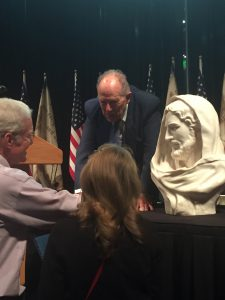
Dr. Chauncey Riddle delivers his latest paper entitled, “Human Knowing” at Firm Foundation Expo at Utah Valley University
Human Knowing
Thesis: We know little but believe much
Note: I suggest you not take notes but just concentrate on comprehension.
For further detail, see my book Think Independently
Think Independently, by Dr. Chauncey C. Riddle – Available in paperback or Kindle format on Amazon.com
Ways of Human Knowing: We will examine 7:
Perception: using the senses of the human body
Reason: using logic to produce conclusions
Experimentation: trial and error pragmatism
Authoritarianism: forming ideas by communicating with others
Imagination: creating ideas, hypotheses, theories
Knowledge of good and evil: The Light of Christ
Personal revelation: The Gift of the Holy Ghost
Perception: Using the senses of the human body to form ideas about the universe.
Key point: We perceive in our brain
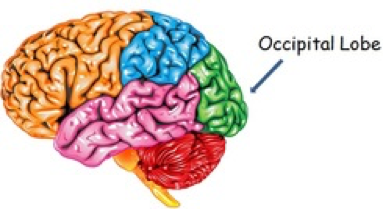
Vision: We see in the occipital lobe
Vision: We see in the occipital lobe
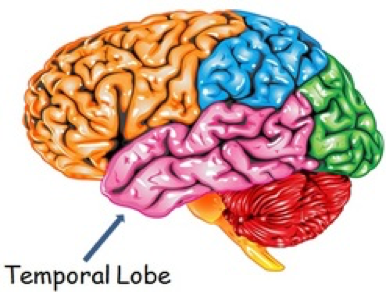
Hearing: We hear in the temporal lobe
Vision: We see in the occipital lobe
Hearing: We hear in the temporal lobe
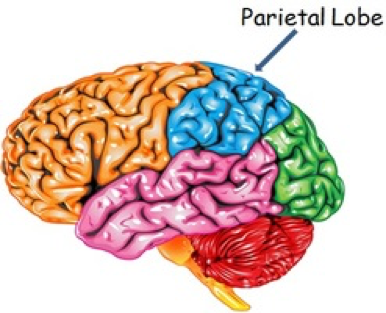
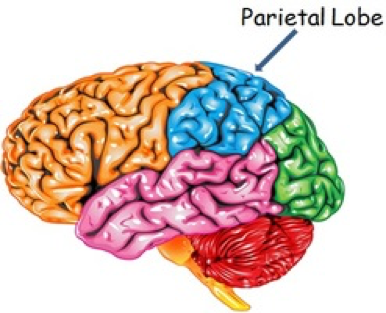
We taste, touch and smell in the parietal lobe
Hearing: We hear in the temporal lobe
We taste, touch and smell in the parietal lobe
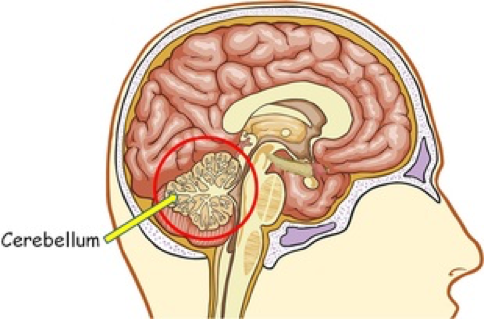
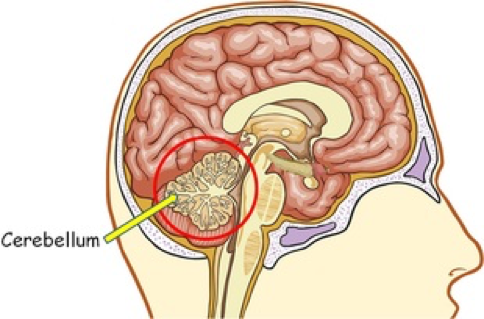
Walking, writing, balance we control in the cerebellum
We taste, touch and smell in the parietal lobe
Walking, writing, balance we control in the cerebellum
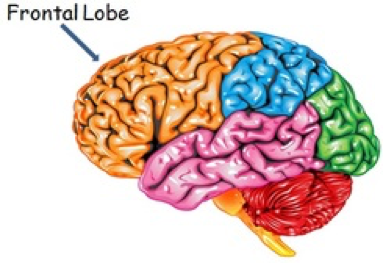
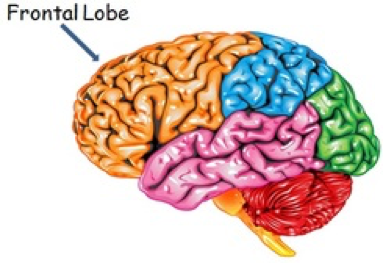
We think plan and speak from the frontal lobe
Walking, writing, balance we control in the cerebellum
We think plan and speak from the frontal lobe
We think plan and speak from the frontal lobe
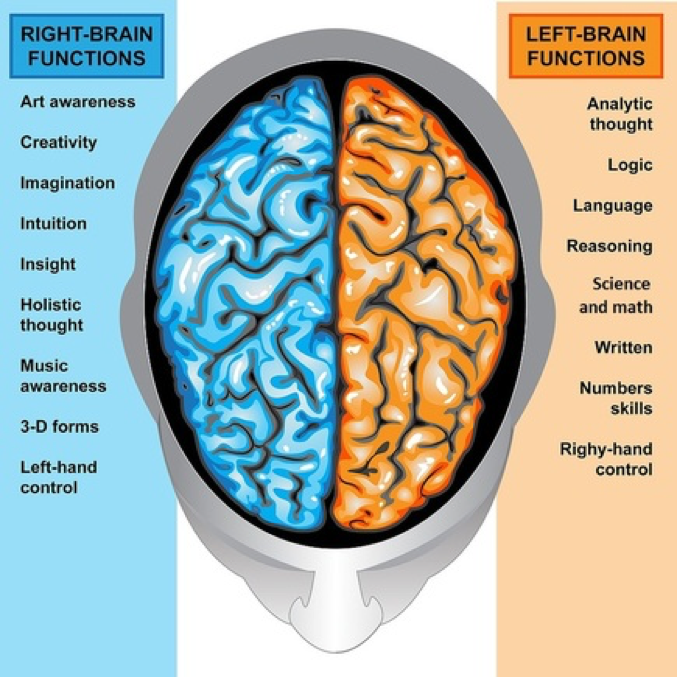
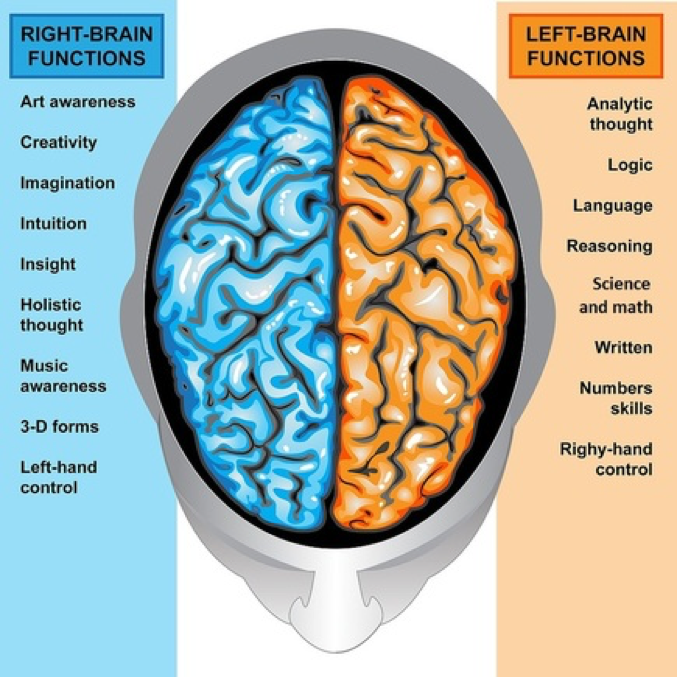
In the left brain (yellow) we think, control language, do science and math, control our right hand
In the right brain (blue) we do art, imagine, have intuition, 3-D forms, music, left-hand control
In the left brain (yellow) we think, control language, do science and math, control our right hand In the right brain (blue) we do art, imagine, have intuition, 3-D forms, music, left-hand control
In the left brain (yellow) we think, control language, do science and math, control our right hand In the right brain (blue) we do art, imagine, have intuition, 3-D forms, music, left-hand control
Sensations
Sensations are the nerve stimulation of our approximately 25 physical senses. (Yes, we have more than 5 senses.)
All sensations go from the sensing organ to specific brain locations.
All sensations traveling along the nerves from the sensing organ to the receptor part of the brain are of exactly the same type.
They are interpreted and differentiated by the location to which they travel.
The Synthesis
These we have shown are not all the parts of the human brain, but they are major components.
No one has yet satisfactorily scientifically explained how we see.
But we do see.
Somehow we put all the sensations together and form a world in
our imagination. Imaginations are most vivid when we are
actually sensing something.
We have the illusion that when we are sensing, we touch reality.
Reality
But reality is also a figment, a creature of our imagination.
To call something real is simply to say we are quite sure of it.
But we make enough mistakes that it pays to be humble.
When we are humble, we say “It seems to me that . . . “
When we are not humble we say “I am sure that . . . “
Sometimes our life depends upon being sure enough of our
sensations that we are able to avoid trouble, as when we step
out of the path of a speeding automobile.
Where we live
So we each live in the world of our imagination, inside our heads.
We form images of where we live and the surroundings of that place.
We form images of the people we know, ascribing to them various
character traits, personalities.
We form images of the rest of the world we do not now see.
We form images of the rest of the universe we do not now see.
We form images of the past, which we cannot see.
We form images of the future, which we cannot see.
And thus we live, move and have our being and doing in the world of our images.
Rebuttal
But, you say, there really is a reality out there that is not just our imagination. Let me prove it to you by punching your arm. Now, doesn’t that hurt? See, there really is a reality out there.
I must agree with you that there is a reality out there. It is just that we see that reality only through a glass, darkly. That glass we see through darkly is our flesh, our physical bodies. We thus know we are in a real world. But we are really sure about only some things, and those are not the most important things.
Example of an illusion: The Necker Cube: Which is the near corner, upper or lower?
Example of an illusion: The Necker Cube: Which is the near corner, upper or lower?
The world is full of Necker Cubes
Every person we meet is like a Necker Cube. We imagine a character for them. We tend to believe our imagination about them is the truth.
The future, the past, and everything we are not now sensing exist in our imagination, and we determine and control what we believe about them.
Most of what we think we know we only imagine. And a lot of what we perceive is like Necker Cubes where we must choose an interpretation.
Conclusions about perception:
Perception is absolutely necessary to relate to the real world around us.
Perceiving accurately and surely is done only in environments where we are very familiar with what we are sensing and doing.
If we are not familiar with what we are sensing and are unable to do anything in the situation, we need to be humble about what we believe we are sensing because we are only guessing.
Only what we can do over and over is sure to us. But we have no guarantee the future will be like the past. If we think we are sure about the future, we need to realize that that surety is only a hope.
Reason as a source of knowledge
There are three basic forms of reasoning:
Deduction: Drawing justified conclusions from given premises.
Induction: Drawing possible or probable conclusions from given arrays of data (observations, perceptions).
Adduction: Inventing premises for a conclusion we already have.
Examples of Deduction:
Given the premises:
All men are mortal.
James is a man.
We may surely conclude that:
James is mortal.
Thus deduction makes explicit the relationships of ideas we already have.
Other examples:
When you add up all your checks and deduct that amount from your bank balance, you can find out (become psychologically aware of) how much money you have in the bank.
If you know the weight of an object, you can calculate the energy required to lift it 10 feet.
Examples of Induction:
Given that your back yard has been visited by skunks the last four nights, you may reasonably conclude that skunks will visit again tonight. But you cannot be sure that they will.
You friend has lied to you several times about what he has been doing for the past month. You may reasonably conclude that he is lying to you now about something else. But you cannot be sure he is lying just because he lied before.
Your friend has remembered your birthday every year for the past ten years. You may reasonably expect him to remember again. But you cannot be sure he will.
Examples of adduction:
Given the conclusion that your friend is acting very strangely, you might think:
My friend has suffered the death of a beloved sibling.
When people suffer the death of beloved siblings they act strangely.
Therefore, my friend is acting strangely.
Or you might think:
My friend has been drinking too much.
When people are drunk they act strangely.
Therefore, my friend is acting strangely.
Conclusions about the three ways of knowing by reasoning:
Deduction is always sure but produces nothing not in the premises.
Induction is always guesswork, never sure, but can be very useful, producing ideas that often work.
Adduction: There are always an infinite number of reasons that can be invented to justify any given conclusion.
To use our power to reason is good, but it does not produce sure knowledge. It’s main help is to allow us to be consistent with ourselves.
Conclusions about reasoning:
It is usually good to be rational (consistent) in trying to know.
No one can be said to be totally rational about what he or she thinks they know. All reasoning begins with premises we cannot prove.
Anyone who claims to be totally rational about what they think shows a lack of understanding of what reason is and can do.
Since we cannot be totally rational about knowledge, we all live by faith. Faith, the things we believe but cannot prove, is where we get all of our initial premises for reasoning.
Experimentation as a way of knowing.
Doing is a form of knowing.
Doing what we can do, and doing it over and over, gives us surety that we know what we are talking about.
Experimenting is trying to do something for the first time.
When we experiment, we usually have a goal in mind, something we are trying to achieve.
If we achieve our goal, we think we have an understanding of one of the ways the universe works.
As we repeat the experience, we become settled in our confidence about what works. This is experimentation, or “pragmatism.”
A Human life is actually one big experiment:
A human baby lives by trying first one thing, then another.
First, it learns to breathe, and then to eat and sleep.
It looks around and begins to form images and expectations out of the sights and sounds and feelings and odors it experiences.
The baby learns to experiment to produce more of what it wants and less of what it doesn’t want.
The baby’s attempts to produce what it wants and avoid what it doesn’t want become habits.
Habits become a character, a personality, as the individual shapes himself or herself.
Personality (character) is the fruit of human living.
Every human life is a chain of successful and unsuccessful experiments.
The successful experiments lead us to repetition, which is the mother of learning.
As we learn to cope with the universe, we develop ideas: structures and sequences which we think are the reality of where we find ourselves.
The more successful is our coping with the universe to fulfill our desires, the more sure we become of the structures and sequences we have built as our understanding of the universe.
We turn our ideas of structure and sequence into what we call “knowledge.” This knowledge becomes part of our personality, our character.
The core of human knowledge is the result of successful experimentation.
What we really know in this world is the ideas we find help us to fulfill our desires, a core of ideas that “work” over and over.
We then add to that core of ideas, ideas formed by communicating with others. This is not knowledge, but rather belief.
If we can fit what others tell us is consistent with our core of knowledge, we tend to believe. If the things we are told don’t fit, we either accept those ideas as blind belief, reject those ideas, or experiment with them to see if we can make them fit with our core knowledge.
Until we have tried an idea for ourselves, it is not knowledge to us.
We humans are quite capable of being irrational:
When we have great respect or affection for persons who tell us things about the universe, some of us tend to believe those ideas, even when they do not fit with our core knowledge.
Some persons are “hard-headed,” “from Missouri,” and refuse to believe what does not fit with their experimentally produced core knowledge.
Gullibility, the willingness to believe others persons without experimenting on what they tell us, afflicts most human beings.
Gullibility makes propaganda a social force used to control populations.
We live in a sea of propaganda (lies and half-truths). Examples:
Much of the “news” we are given by media sources is propaganda.
A lot of what is taught in schools is propaganda.
A lot of the substance of gossip is propaganda.
A lot of what is taught in churches is propaganda.
A lot of history is propaganda.
A lot of so-called “science” is propaganda.
What politicians tell us is often propaganda.
What we tell ourselves is the real truth is often propaganda.
One cure for propaganda is personal experimentation, being “pragmatic.”
If someone tells us a certain medicine works, we can try it for ourselves to see if it works for us.
If someone tells us there is a formula for making money, we don’t have to believe them, we can just try it for ourselves.
If someone tells us a certain political expediency is what is best for our country, we can look for where the idea has been tried to see if it worked.
If someone tells us a certain religious practice is helpful, we can try it for ourselves to see if it really works that way.
Experimentation is a great help in knowing
Sooner or later, most humans learn that it pays to take what others say with a “grain of salt.” In other words, it is not usually useful to be gullible.
As we build up a store of ideas that really “work,” we begin to have confidence that we really are figuring things out.
Our store of ideas that “really work” is the basis of our life accomplishments. As we implement those ideas, what we do becomes our “works.”
Authoritarianism: Gaining ideas from other human beings.
As we watch what other humans do, we gain ideas as to what we might do ourselves. Example: We watch others ride a bicycle, then experiment ourselves until we can also ride a bicycle.
But most of our ideas from others come from verbal communication. We learn a “mother tongue,” and that becomes our major link to the world of people.
As others speak to us, we are busy in our imagination inventing meaning for the noises and gestures they display, and often find great pleasure in listening to them. Communication becomes a major part of our human living.
There are four parts to every communication:
If we really understand someone who is communicating with us, we must fix on four things:
What is the intent or purpose of the speaker.
What is the message of the speaker.
The power of this message: It’s truth or importance.
The consequences of accepting or rejecting this message.
But most humans do not carefully sort out these four things. We tend to be gullible and just accept as so what the speaker says. Because of this, most human minds contain a lot of garbage.
Conclusions about Human Communication:
We are flooded with communications from others.
That process of receiving communications often keeps us from thinking for ourselves and is always a mixture of good and bad.
It is difficult for humans accurately to sort out the good from the bad.
Any idea we accept from another person is always belief or faith. It may be their knowledge, but it is not knowledge to us, even if true.
We live in a communication jungle that helps or hurts us at every turn.
Imagination as a source of knowledge
We synthesize our sensations into a world we imagine, and fill in all the blanks with our imaginative inventiveness.
We look at the body of a person and imagine to ourselves what goes on inside them, their thinking and feeling, desires and future.
We see the present moment, and with the aid of memory and what others tell us, we invent all of the past and future in our imagination.
We hear of events in distant places, and imagine them.
We live in the world of our own imagination. And we tend to believe ourselves.
And our imagination is very useful:
We do all of our planning in our imagination.
We do all of our remembering in our imagination.
We do all of deciding in our imagination.
The universe we grasp only in our imagination.
We decide we have or do not have a Heavenly Father and a Savior in our imagination.
If we did not have an imagination, we would not be a human being.
Imagination makes Science possible
Science is man’s collective attempt to understand the universe using only perception, reason, experimentation, and imagination. Most scientists specifically try not to include any information from a spiritual source. Thus science is the delight of the natural man.
Being blind to all of spiritual existence, science does better when dealing with material things such as physics and chemistry.
But science stumbles when it ignores all spiritual existence, as in psychology, sociology, political science.
But social scientists do not think they stumble. They tend to think they are “emancipated” by pretending spiritual things do not exist.
Imagination makes History possible:
History is the imaginative invention of a story of the past. It is based in documentary evidence about the past, but its creation is always a controlled by the beliefs and imagination of the historian.
History is rewritten in every generation to satisfy the changing prejudices of historians.
In a real sense, all historical accounts are fiction. The word “fiction” comes from the Latin “faceo” which means to make or do. All historical accounts are made up by historians taking the beads of ideas gleaned from documents and stringing those beads on a narrative string of their own prejudices.
Shall we then discard Science and History?
No, we should not discard science and history. Both are interesting, often useful, often helpful, though sometimes disastrous.
Science and history should be taken with a grain of salt. That salt is the skepticism we should attach to all human endeavors.
In all human endeavors we are dealing three kinds of people: 1) the natural man who knows not God, 2) the natural man who thinks he knows God, and 3) the man who does know God. Each produces different beliefs, actions and societies.
Science and history are at their best when invented by men who know God.
Knowledge of Good and Evil:
Knowledge not only relates to what is true and false, what works and what does not work, but also to what is good and bad: values.
Some think that all values are environmentally stimulated by the persons who influence a given person.
But we see examples of people who are different from the persons of their environment.
Within each normal human being there is what is called a “conscience.”
Conscience is the Light of Christ, which lightens every person who comes into this world.
The Mission of Conscience:
Conscience gives us feelings about what is good and bad to do and say.
But the voice of Satan is always with us to give us a choice agency.
Choosing good over evil is what separates the sheep from the goats.
Conscience seems to be the key to all further spiritual knowledge.
When humans ignore their conscience often, it stops functioning. They are then “past feeling.”
Possibly those who are “past feeling” cannot escape being “the natural man.” Examples: Laman and Lemuel.
Personal Revelation as a way of knowing:
Personal revelation is communication of God to mankind through the Holy Ghost.
It comes in many forms: To heart (feelings); to mind (ideas), to strength (health), and to might (prospering). But illness and bankruptcy can also be revelations from God.
Those who really understand revelation see the hand of God in all things.
Different forms of Personal Revelation:
New understanding of a scripture.
Confirmation that what someone else is saying is true or false.
Feeling that something we plan to do needs more planning.
Understanding what unusual thing will happen next.
Confirmation that someone we are asked to sustain is the Lord’s choice.
Help with preparing a talk or a letter.
Help teaching a class.
Guidance as to what to say when speaking and praying.
Seeing a vision, having the heavens opened.
The Holy Ghost is the Pearl of Great Price
If we desire to be righteous (to bless others as God does), there is no greater aid than receiving the Gift of the Holy Ghost.
Having the Holy Spirit as our constant companion should be our Number 1 priority. We should try with all our heart, might, mind and strength to have the Holy Spirit as our constant companion.
Attaining the companionship of the Holy Spirit is what turns a Latter-day Saint (a member of the LDS Church) into a saint (a holy person, one who is forgiven of his or her sins and does only righteous acts).
”And by the power of the Holy Ghost ye may know the truth of all things.” (Moroni 10:5)
How to gain the constant companionship of the Holy Ghost: The Precious Gospel Formula
Faith in Christ: Put our whole trust in Him. This is what makes it possible to become whole, holy.
In that trust in Christ, repent of all of our sins.
Make a covenant with God to keep all of his commandments by being baptized.
Receive the right to the Gift of the Holy Ghost by the laying on of hands, then working until we actually receive the Gift of the Holy Ghost.
Why Receiving the Gift of the Holy Ghost is not the End but the Beginning of Salvation.
Receiving the Gift of the Holy Ghost is entering the gate.
We must also endure to the end.
The end we should all endure to become like Christ.
As we obey God through the Holy Spirit in all things, we become a new creature, remade in the image of Christ’s character.
But remember, there are three voices in our minds: Satan, our own ideas, and the Holy Ghost. Deciding which one to follow is our agency. Learning to follow only the Holy Ghost is the key to enduring to the end.
To become as Christ is the goal, the end to which we may all endure.
The Gospel of Christ is the Good News
The precious Gospel five-step formula is the greatest message on earth. No other compares with it in importance.
Part of that good news is that every normal human being can complete the precious five-step formula.
No one can complete the formula without help. That help is called the “grace” of God.
God is willing and able to bless us to complete the process of changing us from a natural man to the stature of Jesus Christ himself.
Summary of the ways of human knowing:
Through the ordinary human ways of knowing the truth about the universe in which we live, we see through a glass, darkly. We see enough to live our human, animal lives with some success.
This is a possible rank order of the ordinary ways of human knowing, most reliable to least reliable:
Experimentation
Perception
Reason
Authoritarianism
Imagination
But if we add ways of knowing from God
If we first pay attention to what is good and what is evil, and choose to do the good instead of the evil through the Light of Christ, then:
God will eventually, in this world or the next, make the fullness of the Gospel of Jesus Christ, the “good news” available to every human.
Then, if we so choose, we can receive the Gift of the Holy Ghost, which makes God our Senior Companion in all that we want, feel, say and do.
The Gift of the Holy Ghost then leads us to perform the best experiments, perceive truly, reason wisely, know what other persons to believe and who not to believe, and to imagine wisely and fruitfully.
Only using the Gospel of Jesus Christ can we fulfil our human potential.
When are you an expert witness, one whose testimony really counts?
Your are an expert witness when you are bearing testimony of something you can do, do do, and have done over and over.
When you are bearing testimony of something you have personally and often experienced: Seen, heard, touched, smelled or tasted.
You are not an expert witness about the things you hope for, desire, or dream about unless others want to know what you hope for, desire, or dream about.
When you bear testimony as an expert witness, you bless your hearers: They then have access to truth through you.
Conclusions about Human Knowing:
We human beings really know only two things:
That which we can do, do do, and have done many times.
The perceptions we have had about very familiar things.
Someone who has either of those two things is an expert witness.
Everything else we have in our minds is not knowledge, but rather belief.
We humans know very little, but believe a lot of things.
We would do well to treat all the statements of expert witnesses as something to be tested by our own experiments and experience.
“Prove all things; hold fast to that which is good.” 1 Thessalonians 5:21
Part Two: Applications of what we know about human knowing:
We will concentrate on four applications:
Organic Evolution as a theory of science.
Adam and Eve as the first human beings (history).
The attempt to solve human social problems.
The location of the Book of Mormon lands.
Organic Evolution
Organic Evolution is the scientific theory that life came to exist on this earth an by spontaneous generation (chance), and that all present living animals and plants are descended from that spontaneous generation as shaped by environmental forces.
Science is ideas about the universe consisting of:
Facts: Things sensed, perceived.
Laws: Generalizations of observed facts.
Theories: Ideas invented to explain laws and facts.
There are always and infinite number of theories possible to explain any given set of facts and laws.
Organic Evolution is one of many possible theories to explain the universe.
No scientific theory can be proved to be true because all theory consists of things which are purely imaginary, not perceivable.
Scientific theories can be falsified if their logical consequences are not observed.
Choosing among possible theoretical explanations of observed facts and laws is a personal choice of the persons choosing.
Every one who chooses to follow Darwin and to believe in organic evolution does so because they want to, not because any evidence makes that choice necessary.
Major problems with the Theory of Organic Evolution:
The theory depends upon the idea that life formed spontaneously. There are no examples of spontaneous generation of life known to mankind. (This is a major problem.)
The theory depends upon one species of life form changing into another species. There are no examples of one species changing to another species known to mankind. (This is a major problem.)
The theory depends upon there being an immense amount of time in the past since life on earth began to be: Millions of years. The age of the earth is a theory itself. (This is a major problem.)
The theory defies the Law of Entropy: Natural systems disintegrate (run down) as they lose heat. (This is a major problem.)
Why are some people willing to believe in the spontaneous generation of life?
Some believe that because so many other people believe it.
Some believe that because if it is true, there is no need for God and therefore no need to repent, and they don’t want to repent.
Some believe that because they think (mistakenly) that scientists are never wrong.
Some believe that because they do not think very carefully.
Why do people believe that species beget other species? (Speciation)
Some believe this because speciation is absolutely necessary to the theory of organic evolution, and they desperately want that theory to be true.
Some believe this because they are shown different animals and plants in the fossil record that resemble one another, and they want to believe that the change represents the natural emergence of a new species. But there is no way to know that one form is ancestral to another.
Some believe because so many other persons who they respect believe in this idea.
Why do people believe life has been on the earth for millions of years?
Some believe because they have been told this idea all of their lives.
Some believe in an earth millions of years old because it is necessary to the theory of organic evolution, and they desperately want the theory of organic evolution to be true.
There are many theories as to how long life has existed on earth, but there are no proofs of any of these theories.
Why do people disregard the Law of Entropy?
Some disregard it because they believe in evolution and use organic evolution as a proof that the Second Law of Thermodynamics (The Law of Entropy) is not true.
Some disregard it because they have limited experience with the natural world and suppose that order can naturally come out of disorder.
The watchmaker objection seems trite to some. To find a running watch on the beach and to suppose the winds and the waves put it together seems perfectly logical to some people.
Conclusion: The Theory of Organic Evolution is built upon other pure theories, not on facts or laws. It is wishful thinking.
Notwithstanding the theory of organic evolution is widely taught and believed, especially at universities, it remains suspect and unprovable.
There are no expert witnesses who can give evidence that the theory of organic evolution is true. (Though some would like to claim to be such expert witnesses.) No one can do evolution or has seen it.
The main present-day argument for the theory of organic evolution is that so many people believe it.
A great many people also believe in Santa Claus.
Adam and Eve as the first human beings (History)
To write history is to invent what happened in the past on the basis of evidence available in the present time.
To write prophecy is to invent what will happen in the future on the basis of evidence available in the present time.
To write history is much safer than writing prophecy, because the future will become the present and we will all know which prophecies are correct.
But history will never again become the present, so historians can say anything they want to and not be found out.
The story of Adam and Eve is automatically rejected by most historians.
To accept the story of Adam and Eve as the ancestors of the human race would be to accept the Bible a historical record, which almost no scholars are willing to do.
So historians fall in with the theory of organic evolution and postulate that human beings are one fruit of a long evolutionary process, having descended from some ape-like creature. The fact that there is less evidence for that evolutionary theory than for the Biblical account does not bother them. They of course reject the evidence for the Biblical account because the Biblical account has God and a supernatural spiritual realm as part of it, which things are anathema to the natural man.
Some people try to marry the story of Adam and Eve to the theory of Organic Evolution
Some postulate that Adam and Eve were ape-like creatures to whom God gave a conscience and superior intelligence and they then became human beings.
That postulate flies in the face of three things we are told about Adam and Eve and the Garden of Eden:
There was no death in the Garden (on earth?) until Adam and Eve fell. Adam became mortal because he transgressed. All nature became mortal with him.
Before the fall, Adam and Eve were celestial beings and had spirit matter in their veins, not blood.
Adam and Eve were literally of the race of the gods. (Otherwise, Mary could not have been the mother of Jesus.)
The Fall of Adam and Eve is central to Faith in Jesus Christ
There are three things about the story of Adam and Eve that are crucial to faith in Jesus Christ.
Adam chose to disobey God and therefore fell.
In his fallen state, Adam and all his posterity are dead to the spiritual existence around them.
Being fallen, therefore becoming carnal (trapped in a physical body), sensual (sensing only with the physical body), and devilish (subject to the temptation of Satan through the flesh), Adam and his posterity were in need of a redemption to spiritual life and the presence of God.
Redemption from the Fall of Adam comes only in and through Jesus Christ.
It takes supernatural power to restore humans to spiritual life and to be able to abide the presence of God.
It takes supernatural power to put humans beyond the power of Satan to continue to tempt them.
It takes supernatural power to rescue the physical bodies of mankind from mortal death.
These three things are principal features of what Christ does through his work of Atonement.
Conclusions about Adam and Eve:
Unless men and women have a correct idea of where they came from and what they are supposed to be doing in mortality, they will not accomplish what God sent them to do.
God tells men where they came from and why they are here in the accounts of the Fall of Adam and Salvation through Jesus Christ.
The world rejects both the correct understanding of Adam and Eve and the mission of Christ.
Part of coming out of this world and not being of it is to gain a true understanding from the Holy Ghost both of Adam and Eve and the Fall and of the Redemption made possible by Jesus Christ.
How can men create heaven on earth?
If there was no fall of Adam, there is no need for redemption.
If there is no need for redemption, there is no need for a Savior.
If there is no Savior, mankind must save itself.
The main salvation naturalistic thinkers envision is socialism.
Socialism is humans appointing themselves to be the saviors of mankind.
Socialists have only one goal: Total control of human society, using guns (force).
Socialists seek total control of human society because they theorize they can then solve all human problems:
Poverty, through government redistribution of wealth.
Ignorance, through government control of all education.
Disease, by government control of scientific endeavor.
Crime, by government control of all neighborhoods.
Opposition, by government control of all media.
Christian values (which they see as an enemy) by government control of the upbringing of all children.
Total Government Control is another name for Hell, the implementation of Satan’s plan
Satan proposed in the pre-mortal existence to save all of mankind.
Satan proposed to save all mankind by taking the power of God to force all mankind to live in a force-centered Utopia.
Satan has tried ever since Adam and Eve to set up a Utopia on earth.
Every attempt of Satan to establish Utopia has failed.
The advocates of socialism want to keep trying to establish Utopia because they see no alternative.
Present socialist half-measures are stepping stones to total control.
The proper alternative to Utopia is Zion.
Zion is a people who are pure in heart because of their own agency (choice) and the grace of Christ.
In Zion, people have one heart: They all have pure, unselfish hearts.
In Zion, people believe the same truths: they are of one mind.
In Zion, people voluntarily work righteousness: every man seeks the interest of his neighbor.
In Zion, there are no poor: those who have more voluntarily share with those who have less.
Zion has been created on earth many times, so it is a real possibility.
To make possible the establishment of Zion today is one of the main reasons the Gospel of Jesus Christ was restored in the latter days.
Why do we not have a Zion today?
We don’t have a Zion on earth today because so many Latter-day Saints are not willing to keep their covenants.
Latter-day Saints are working hard on the other reason for the restoration of the Gospel of Jesus Christ: To teach the Gospel to every nation, kindred tongue and people.
But Latter-day Saints will never fully witness the value of the Restored Gospel to the world until we establish a Zion.
We now say to the world “We have the wonderful, true Gospel of Jesus Christ to share with you. We can’t live it, but it really is true.”
When there is a true Zion on earth, the world will have its second witness of Christ.
The Restored Gospel of Jesus Christ is the one and only formula for saving mankind, both temporally and spiritually.
The Holy Ghost bears witness to everyone who will accept that witness that Jesus is the Christ, the Savior of all mankind.
Those who are saved by the Savior are different from those who are not saved. If they live the whole Gospel, they will establish a Zion. The existence of a Zion will become a witness that the Restored Gospel really does work and save people.
Until we have a Zion, we Latter-day Saints, as a people, are “Mene, mene, tekel upharsin,” weighed in the balance and found wanting.
But are there not some LDS people who live the whole Gospel of Jesus Christ?
Yes, there are some members of the LDS Church who live the whole Gospel of Jesus Christ.
If you put all of those people in one stake, they would establish Zion there.
But then the rest of the Church would fall apart.
The Authorities of the LDS Church are trying mightily to establish Zion.
When we members begin to fully implement what they ask us to do, we will have a Zion.
The engine that will finally create a Zion is the ordinances of the Temple.
There are two keys to the establishment of Zion:
Key #1: To study the Book of Mormon until we truly understand how to come to Christ and be perfected in Him. The Book of Mormon is the manual of instructions as to how to come to Christ and be perfected in Him.
Key #2: Because knowing how to come to Christ is not enough, we must also have the power to come to Christ and be perfected in Him. That power is only obtained through the ordinances of the New and Everlasting Covenant, focusing particularly in the blessings and covenants of the temple endowment and sealings.
Blessed are those who use these to keys unto perfect Faith in Christ.
What will it take to get LDS people to use those two keys?
God protects human agency above all else. Because he knows that only if his children voluntarily create Zion can they avoid creating Hell on earth and going to hell afterwards.
We will establish Zion only when enough LDS people freely choose to keep all of their covenants.
The Savior will never force anyone to create or live in Zion.
When we Latter-day Saints want Zion more than anything else, we will establish it. Right now, too many of us are overcome by worldliness. At most, only half of the LDS church members will overcome the love of the world before He comes again.
When we start loving our God and our neighbor instead of ourselves, we will have Zion.
Selfishness is the great enemy of our souls.
Selfishness is the gospel of Satan.
Jesus Christ would have us live “outside ourselves in love.” And that love must be pure, the gift of charity from Christ.
Therefore, seek after charity, for charity, the pure love from Christ, never fails.
Charity is the gift of God to all who seek to make their eye single to his glory with all of their heart, might, mind and strength.
If we gain charity, we will save our own souls and establish Zion.
The inhabitants of Zion are all expert witnesses to the truth of the Restored Gospel
Imagine if the world were flooded by expert witnesses who could say to the fallen people of this world: “Jesus Christ has come again and restored his true Gospel and Church. Look to Zion, and you can see that Gospel in action. It really does work. I know it saves mankind because I have participated in Zion and have there seen the Lord solve all human, mortal problems by helping them to have charity. You also can be part of a true heaven on earth by accepting Jesus Christ as your Savior and fully living His Restored Gospel in the Church of Jesus Christ of Latter-day Saints unto having this pure love from Christ.”
What a powerful expert witness that will be. Then the powers of hell will be shaken forever.
We turn now to the fourth application, the location of Book of Mormon lands.
This discussion has full meaning only to those who have received the witness of the Holy Ghost that the Book of Mormon is the work of God. Otherwise the discussion is purely academic.
Knowing the Book of Mormon is a true record of ancient peoples on this, the American Continent, we might then profitably wonder just where it all took place.
Joseph Smith’s statement about the Book of Mormon:
Joseph Smith said that the Book of Mormon is “the most correct of any Book on earth & the keystone of our religion & a man would get nearer to God by abiding by its precepts than by any other Book.”
(Wilford Woodruff journal, Nov. 28, 1841, Church History Library, Salt Lake City).
Notice that he did not say that the Book of Mormon is the keystone of the Church. He said it is he keystone of our religion. Our religion is our way of life, the habits of character we foster to endure to the end in our faith in Jesus Christ. That goal or end is to “come to the measure of the fullness of the stature of Christ.” Ephesians 4:13)
The first business of an LDS person is to make our calling and election sure:( See 2 Peter 1: 5-10)
Our calling is to become the children of Christ, become new crearures remade in His image, and to then inherit all he has and is.
We can receive this inheritance only as we build spiritual muscle that will enable each of us NEVER to give in to the temptations of Satan.
The commandments of God are given to us to build that spiritual muscle so that we could be trusted with godhood.
The Atonement of Christ makes forgiveness of breaking the commandments of possible, but until we stop sinning, we cannot receive full forgiveness.
Repentance is stopping sinning. Is that possible? Only in Christ.
Don’t be taken in by those who say one cannot become perfect in this life.
To become perfect means to become complete, whole, holy.
To say we cannot become perfect in this life is to say Christ cannot save us.
What he saves us from two things:
The weakness of our character that allows us to sin. He gives us the knowledge and power to learn to keep all of his commandments, thus to build the spiritual muscle necessary to be able to stand godhood.
Christ also saves us from the penalty due for having sinned.
Satan will try every way to divert us so that we will not fully repent.
Satan will fill our minds with lies (like: you can’t become perfect).
Satan will fill our hearts with lusts (like: you deserve to pleasure yourself)
Satan will try to destroy our physical tabernacle (like: you ought to try using tobacco, alcohol, or other drugs)
Satan will try to abort our mission in life (like: I’ll wait to have children until it is convenient)
The solution? To love God with all of our mind, heart, strength and might, first and foremost.
When our calling and election is sure:
When we as a people learn to live the Gospel of Jesus Christ as given in the Book of Mormon we will be able to know everything we need to know and do everything we need to do.
We will receive the sealed portion of the Book of Mormon plates. (This blessing is to the children of Lehi when they become faithful.)
We will receive the full record of the Jaredites. (This blessing is to the Gentiles when they become faithful).
Perhaps we will again have the Book of Lehi (the lost 116 pages)
And we will be able to establish Zion again on the earth.
In this setting, What about Book of Mormon Geography?
Book of Mormon geography is a fascinating subject.
I appreciate the scholarship of John Sorensen in his study of the archaeology of Meso-America and his contention that those are the Book of Mormon lands.
I also greatly appreciate the work of Rod Meldrum and others in bringing to our attention the remains of ancient civilization in North America, urging us that they are the Book of Mormon lands.
I find both of them giving interesting and compelling evidence and reasoning. But I honestly have to conclude that Book of Mormon geography is a red herring to me.
A Red Herring is a diversion. Be not diverted.
I lean towards the Heartland theory of Book of Mormon lands. Knowing where they are is important.
But there is something that is 100 times more important.
The priority of Latter-day Saints should be to:
Come unto Christ and be perfected in Him.
To establish His Zion.
When we have done those two things, we will not only know what are the true Book of Mormon lands, but a lot of other precious things also.
So let us be about doing those two things, first and foremost.
Conclusions about Human Knowing:
Humans know best what they can do. So treasure the testimony of the expert witnesses: the doers.
We humans know least about the things we cannot now experience. About those things we invent theories. Appreciate the ideas of those who talk theory. But take it all theory with grains of salt.
Remember: All human supposing of the past is theory. All human supposing of the future is theory. So learn about the past and the future only from God, for whom they are not theory.
Great doers:
The greatest doer is Jesus Christ himself: He lived a perfect life, He fulfilled his mission completely, he wrought the Atonement to reconcile every child of God who will receive it to come back to be with and live the life of God the Father, and brings about the best possible eternal happiness for each human being.
Joseph Smith was a great doer. He was able to bridge between God and man to restore the fullness of the Gospel of Jesus Christ to the earth and to establish the Kingdom of God on the earth for the last time.
Other great doers:
Brigham Young was a great doer. He was the down-to-earth doer who was able to secure the continuation of what Joseph Smith established, to help the Latter-day Saints continue the Kingdom of God in the desert, to meet with good sense the challenges of every-day life.
Thomas S. Monson is a doer who shows the way to love God by loving our fellowmen. As our leader-doer at the present day, he and the other General Authorities would have us reach out to all others in the pure love of Christ.
Recommendations for the writings of doers:
Dean Sessions is a doer who has learned to make fossils. I commend to you his Universal Model of science. His proofs of the Universal Flood are most impressive. If you want a fresh look at science and geology and to see good reasons why organic evolution is a false hypothesis, take time to investigate the Universal Model. See at https://universalmodel.com/
David Allan is a doer who has learned to measure and calibrate time. I commend to you his book It’s About Time, wherein he tells you how to measure time and to establish simultaneity. His work with time was a critical factor in establishing GPS and other navigational aids. And as a disciple of Christ, he tells you much about living the Gospel. See at http://itsabouttimebook.com
Other Doers
Stephen Covey, our deceased friend, had much good to say about doing our human life. His book The 7 Habits of Highly Effective People is a good manual for living life as an intelligent human being. It is great terrestrial wisdom.
But the greatest doer of all time is Jesus Christ. He create the heavens and this earth and all of us, and is our Savior. I commend to you all of his words about how to come to Him and to our Father in Heaven to become an eternal doer of righteousness. Please don’t accept any human being as your Savior.
My plea to you today: Come unto Christ
The best thing any of us can do for this world is to come unto Christ, all the way, until we are filled with and show His pure love.
Then we will establish Zion, get the rest of the scriptures that are promised to come forth, and each fill our missions.
Please show love and tenderness for those who do not believe in Christ, and for those who do believe in organic evolution, that Adam and Eve evolved, and that the solution to our political problems is socialism. And treat them that way even if they don’t treat you that way.
Above all, let us be humble before Christ and our Father in Heaven, that their will, not our will, be done on this wonderful earth.
Conclusion:
I bear my witness that Jesus is the Christ, that He lives and answers prayers, and that He tempers the elements for his sheep who are shorn of pride. There is no more intelligent thing to do for any human being than to search out a knowledge of this Christ. And then we can waste and wear out lives out in loving and serving Him with all of our heart, might, mind and strength by tirelessly sharing all we have with our neighbors in His pure love.
NOTE: I asked Dr. Riddle to define Philosophy, Science, Technology, Scholarship, History, and Religion. This is what he gave me back the next day. – Ken Krogue
Philosophy: The love of wisdom. Asking the right questions.
Epistemology: How can we know? What can we know.
Science: What is real in the world we can sense. What are the facts, laws. What are the theories that explain the facts and laws? What are the postulates which control the theories?
Legitimate science: What the majority of the scientists say. No necessary connection with truth.
Illegitimate science: What the majority of the scientists reject. No necessary connection with truth.
Scholarship: Controlling the documents to build a case for something out of what other persons have written.
History: What really happened in the past? (A branch of scholarship, a form of fiction.)
Prophecy: What will really happen in the future? ( More dangerous to do than history.)
Metaphysics: What is real beyond that which we can sense?
Ethics: What is right to do, and what is wrong to do, if anything?
Esthetics: What is beautiful? Is the beauty in the beholder or in the object?
Technology: The patterns of accomplishing specific goals. Art is one form of technology.
(Because our society is basically Greek in mentality, science is given much greater stature than is technology, and scientists are given greater acclaim than are engineers or artists.)
The Basic Cultural Mentalities:
Greek: Knowing (understanding) is the most important human activity. (Science)
Roman: Accomplishing physical tasks is the most important human activity. (Technology)
Trojan: Physical beauty is the most important human attainment. (Appearance)
Hebrew: Doing what is right (blessing others) is the most important human activity. (Righteousness, which is a dirty word to many of Greek and Roman mentality and to most of Trojan mentality.)
Religion: The pattern of thinking, believing and acting that make up a person’s character.
Every normal human being has one, and there are as many of them as there are people.
Church: A social organization which attempts to promulgate some religious pattern.
If it is true that God is all good and omnipotent how come the world is so evil?
It’s important to understand this problem. Why is this an important problem? But you see the question is, does it have to be this evil? Is it necessary that the world be this evil to accomplish its objective? For instance, during the millennium everyone will have just as much agency as they do now but the evil will be reduced on the order of 90%. So one wonders, we have to put the problem just right. It’s true that it’s related to agency and we must understand that.
Is God good?
Yes, he is. What do you mean by that? What does good mean? But if you say God is good and you don’t know what it means, what are you saying? What do you mean when you say God is good? OK, but what is evil? So God never promotes anything that hurts you? So God is mostly good. No he’s metaphysical to you. But you have an image of him in your mind. Is your image that he is all good or mostly good? All good. Then you have some explaining to do, don’t you?
Can he control the rocks?
Can he make a rock so big that he can’t lift it?
No. So there are some things that he can’t do. That’s an old catch question. You see that’s what you ask people when they say God is omnipotent, that he can do anything. Then you say can he make a rock so big that he can’t lift it? Which is what you see involving in something which he can’t do. Either he can’t make a rock so big that he can’t lift it. So there’s something he can’t do. So he’s not all powerful. How do you get out of that? You just point out that it’s a contradiction to start with. That’s just a bad question.
Don’t try to answer all questions. Only answer good questions, that’s a bad question. But anyway we have to come to some sense of how much power God has. So would you say that God could do everything or anything? Or is there something he can’t do? He can do everything but violate agency? It’s impossible for a human being to lose his agency? Is that what you’re saying? So you don’t want to say that. So the question comes back, are there any limitations on God’s power? Is there something he can’t do?
There is a rational back bone, that is to say there is a rule. The weakness of the moral sense philosophy is that just about anything can come out of it. Historically speaking much good came out the moral sense philosophy but also a good deal of evil. Because people would claim things for their conscience which were not true, either they were lying or they were mistaken. And there’s a real weakness in following conscience in that respect.
So Kant was trying to remedy that weakness by putting in a rational rule that people would follow that would keep them more in the path of good common sense than conscience seemed to be doing. The weakness in Kant’s system? Kant down-played the moral sense so much that it went into oblivion. He over-played the role that reason could play by hooking it to duty it became cast into things such as Hitler using it to get the Beirmauchen to be very obedient, which it was. Kant, I think he was a man of goodwill basically. But when you try to substitute things for the will of God you’ve got into trouble, that was his trouble. He may have done the best he could, I don’t know. But it’s plain, you see you need something more than that.
Let’s talk about utilitarianism. What is utilitarianism? The greatest pleasure to the greatest number of people is the goal of utilitarianism. So what is the good in utilitarianism? Pleasure. What kind of pleasure? What does utility mean? Usefulness. Usefulness for what? But what is the good? Utility is the principle or the means to get good but what is the good? Pleasure. What kind of pleasure? Sheer physical pleasure. This is a collective Scerinaicism. So the statesman has the job of figuring out what will bring the greatest pleasure to the greatest number of people. As a matter of fact that’s what most politicians try to do. They try to please the greatest number of their constituents they can so they can get re-elected. So we have some great national disasters in the making out of our selfishness.
(comment)
From my reading it seems the goal of utilitarianism is for well-being not pleasure. You see well-being is a perfectly ambiguous term, it only means what you make it mean. And what utilitarian mean by that is the greatest pleasure. Well-being is simply pleasure. And isn’t that what the average American seems to want. What’s the great ideal for most Americans? A cruise in the Caribbean, with all kinds of Epicurean delights at the table and warm weather and sunshine and swimming. Not to mention other kinds of physical pleasures. What is the great weakness of this system? Human reason failed at this point. There is no way to determine what’s the greatest pleasure to the greatest number.
Even if pleasure is the good there’s no human epistemology that enables one to deliver the answer to that question. Why? What would you have to know to deliver the greatest amount of pleasure to the greatest number of people? You would have to know virtually everything. You would have to know all the possibilities for action and how much pleasure each of those possibilities would bring to one individual. What else would you have to know? You’d have to be able to sum up all possibilities and calculate what would be the greatest good for the greatest number. Obviously it’s impossible. Isn’t it obviously impossible? So when men think they’re doing that, what are they doing? They’re arrogating to themselves what? They’re arrogating to themselves godhood. They’re pretending they are God and that they can do what no mortal can do. That is sheer pride, you see. That’s what the Lord says is the great barrier, the great sin that keeps more people from their blessings than any other thing, it’s simply that, pride. When men think they are wise of themselves.
What are the strengths of utilitarianism? All these are attempts to make an ethical system.. The strength to utilitarianism that none of the other systems has, yes some of the others do, most of the other don’t. It has a social concern. It recognizes that the group is important. And that is important. And there are many sensitive people in the world who recognize that philosophies that only take care of the individual have something lacking. There has to be a social concern. Human beings are no individuals, that is to say I am not just me. Myself, me, doesn’t end at the surface of my body.
We live in a world that has fostered individualism for so long that the idea of individualism has run amuck. And again, a perfect example of that is the idea of abortion. That a woman need have no feeling of responsibility for her child at all.
In the gospel frame what is the circle of a social concern that we must have? Are you aware? When you repent do you repent of only your own sins? No. If you wish to be celestial your circle has to be wider than that. How wide? Many of you may never of heard this. This is one point of the gospel that’s almost never talked about. I don’t know why. We are responsible for repenting for the sins of our ancestors back to the fourth generation.
Now, what does that mean? The sin carries down. We all know the statement, that the sins of the fathers are visited upon the children unto the third and fourth generations. That’s the negative of this positive thing. When we repent for them we have to repent for those sins. Because we are the heirs for those sins. Let’s make a graphic illustration, supposing that my great grandfather stole some money. He stole one thousand dollars. And he passed on the money to his children. They invested the money and it grew and it was passed on to their children and finally it comes down to me. And I’m the beneficiary of the thousand dollars. Now, that’s tainted money.
What have I got to do? If I wish to be a celestial being, what do I have to do? Repent of that by changing the course that it has taken. Now the repentance needs to go two directions. What two directions does it need to go? It has to begin with me so that I don’t
It is good to know. But it is better to know that you know.
From This People Magazine – Fall 1998
WE HUMANS DELIGHT IN KNOWING. We love to look, see, hear, understand and imagine. But there is a downside: We sometimes think we know something when we don’t, confusing a feeling of certitude with real certitude. We shall examine the ways humans know to build a picture of what we can and cannot, do and do not know.
The technical name for studying human knowledge is “epistemology,” a Greek term formed from “episteme,” meaning to know, and “logy,” meaning words about. Our survey of human knowing will cover all of the important kinds.
1
We begin with authoritarianism. This kind of knowing focuses on ideas gained from others by communication. This is the easiest of all the forms of knowing to use, and the one most people depend on; If you want to know something, just ask someone you consider to be an authority on the subject. For instance, we commonly ask our parents about things which happened to us before we could remember: where and when we are born, who our grandparents are, etc.
While authoritarianism is very convenient, it has pitfalls. The first is knowing who is an authority on a subject. If you personally really know who is and is not an authority on a given subject, you art probably an authority yourself on the subject and don’t need to ask. If you are not an authority on the subject, then you are forced to ask someone else (an authority) as to who is an authority, and you may or may not get a good answer. Once you have located someone whom you consider to be an authority, it is necessary to communicate with them, and when you have an answer you must ask yourself, Did that authority understand my question?, and, Did I understand the answer of the authority correctly?
But assuming that you have located a genuine authority and have successfully communicated with them, you can get some very good answers in a very economical manner.
This is why we go to doctors, lawyers, agricultural experts, mechanics, plumbers, and others to get good answers when we have trouble.
2
We next look at rationalism as a way of knowing. Rationalism uses human reason to compare and relate ideas. It presupposes three things:
A system of reasoning in which you have confidence,
Premises or ideas which you wish to reason about, and
Premises which are sufficiently general to allow you to reason.
For example,
might be the system of arithmetic;
might be your knowledge of your beginning bank balance at the first of the month and all of the checks you have written during the month; and
might be the knowledge that only you have the power and authority to withdraw funds from the account.
With those three things in place, you can use the system of arithmetic to subtract the checks written from the initial balance and have confidence that since no other person can withdraw funds, you now know how much you have left in the bank account.
Rationalism is a very sure way of coming to knowledge when all three of those factors are in place. But reason itself cannot assure you that those three factors are actually all in place. So reason is an important way of knowing, but it can never stand alone. It needs other epistemologies to furnish the wherewith to reason. Other examples of good rational knowing are the theorems of plane geometry, syllogistic and other logical systems, and predicting the trajectories of heavenly bodies once we know their past history.
Empiricism is a wonderful way of knowing if you are driving on the right side of the road, what time the clock says it is, locating your favorite tie, and for finding your wife In a crowd. But It won’t work for many important things because we cannot perceive those important things with our physical senses.
3
Third in our survey is the epistemology of empiricism. Empiricism is gaining knowledge by using our human physical senses of touch, sight, hearing, smell, taste, etc. There are about twenty-five identifiable human senses, but we depend mainly on the five mentioned. For example, if you want to know if the tomatoes in your garden are ripe enough to pick, it would be a good idea to go look at them. Their color is typically a good index to their ripeness. If they are indeed dark red, that is a good indication that they are ready to pick. You might look at the calendar and think, today is the 10th of August, and the tomatoes should be ripe (rationalism), or you could send someone out to look for you and report back (authoritarianism). But you are likely to be best satisfied by your own visual and gustatory inspection.
Empiricism is a very good way of knowing about our immediate physical environment, but it does little for the past, the future, the distant, or the unobservable. And when you can directly inspect what you want to know about, one must be sure that one is looking at something which is very familiar (the first time we see something we do not see it very well), that we are not being fooled by some aberration (it pays to look two or three times, as in the carpenter’s adage: measure twice, saw once), and that we are not dreaming (fur this we usually rub our eyes). Empiricism is a wonderful way of knowing if you are driving on the right side of the road, what time the clock says it is, locating your favorite tie, and for finding your wife in a crowd. But it won’t work for many important things because we cannot perceive those important things with our physical senses.
4
Now we come to statistical empiricism, which is a mixture of empiricism and rationalism. It is empirical because one uses one’s senses to collect a lot of observations, called data. But then one must manipulate that data by means of statistical formulas. The manipulation is rationalism.
For instance, if you want to know what brand of tires wears the longest, you must gather a lot of data. You might try putting new tires of ten varieties on ten different automobiles, the ten being the same make and model. Then you drive these automobiles until the tires are worn out (preferably over the identical routes at the same time), then see how many miles are recorded for each brand of tires. But wait! Perhaps some of the brands of tires had unusual samples. That means you must try three or four sets of each brand. Then when you look at the average (statistical manipulation) for each brand, it will be easy to discern which brand wears the longest.
Statistical empiricism works well where one can be empirical, but the rational manipulation of the data tells us things which sheer observation cannot. I cannot tell which brand of toothpaste is best for preventing cavities by brushing just my own teeth: I must have many persons using many brands to gain a reliable statistical result.
So if you need to know which paint holds up the best on the highway, or which kind of cleanser is most cost effective, or which high school students are most likely to do well academically in college, statistical empiricism is your friend. It only works, of course, for large populations which are adequately sampled, and where the data is properly interpreted. But if those factors are in place, it is most useful.
5
Next in our survey we come to pragmatism. Pragmatism is knowing what works. When we know what works we do not always know why it works, but when someone is desperate, they will settle for what works without knowing why. Most pragmatic knowledge is gained by sheer coincidence, observing what works as compared with what does not.
When people have ill health, they often are willing to try most anything to get relief. When something works for them and they actually do get relief, they then swear by whatever worked and sometimes want to tell others how to cure the malady which formerly beset them. But what works for one person does not always work for another. And what seems to work sometimes has serious side-effects which are worse than the original malady. But pragmatism holds a prominent place in epistemology simply because we do not understand all things yet we can do many things we do not understand.
So if you find that eating lots of spinach seems to give you added strength, you might continue, because perhaps the spinach really is the cause. Or if when you choke your lawnmower only three-fourths of the way, it always starts, and won’t readily start when choked to any other point, you would do well to continue choking it at three-fourths. That makes good pragmatic sense.
Pragmatism rescues all of us from our frustration and impotence at times. It is valuable.
It is the attitude of being careful, of rejecting anything where the evidence is slight or inconclusive, to be sure of knowing only that which is fully manifest and apparent.
6
Next in our repertoire of ways of knowing is mysticism. This mysticism is said to be a way of knowing “immediately” instead of “mediately,” Rather than knowing something through reason or sensation, one knows because one is part of the thing known, is it, and thus knows its being directly. Mysticism is difficult to describe because it is admittedly ineffable, not amenable to verbal representation.
Proponents of mysticism say that it is the way of knowing because it is more satisfying than any other epistemology. In mysticism, one does not just be aware of something, but partakes directly in its being; this is said to be the superior kind of knowing.
Mysticism is often associated with religious knowing, and is sometimes identified as the basis for revelation. This association does not hold for most Latter-day Saints for reasons which will be discussed below. But many in the world find their religious fulfillment in what they denominate as the mystical experience.
Some limitations of mysticism seem apparent. If it is not rational or has no rational content, how can it be understood? If it is non-empirical, how can persons compare experience? If the sole criterion for epistemological success is satisfaction, how can one have any assurance that the mystical state is not just self-induced aestheticism? But these limitations do not bother the avowed mystic. He points out that these are the very advantages which make mysticism the preeminent epistemology.
7
Our next candidate for a way of knowing is scepticism (French spelling: you may prefer the Germanic skepticism). Scepticism is more an attitude than a full-blown epistemology of its own. It is the attitude of being careful, of rejecting anything where the evidence is slight or inconclusive, to be sure of knowing only that which IS fully manifest and apparent. Thus one might be rightly sceptical of many advertising claims, even though they be clothed in the garb of legitimate statistical empiricism: how large was the sample, how random was the sample, was there a double-blind control set of data? One is often sceptical about empirical observations unless they see for themselves (I am from Missouri, so “Show Me!”). It is good to be sceptical of reasoning that is sheer rationalization (inventing the premises necessary for a desired conclusion, but not being able to show that the premises are true). It is often good to be sceptical about pragmatic results, or claims of pragmatic results, for often they represent only coincidence.
One can be reasonably sceptical and careful using any of the epistemologies, and experience with mistakes shows us the necessity of a healthy dose of scepticism in most epistemological adventures. But one can also be too sceptical, “throwing the baby out with the bath” as the saying goes. One can see and know, and still not believe, as when Laman and Lemuel saw and heard an angel but rejected the experience. One can have good reasoning and reject it, as when many reject the organization of the Primitive Church as being a key to the true church of Jesus Christ in the latter days, denying the restoration of all things. One can reject authority when the person truly is a demonstrated authority, as when the contemporaries of Jesus rejected him as a legitimate holder of the priesthood even while he was exercising that priesthood in the exact same manner as the prophets of old whom they accepted.
Scepticism can be a wonderful balance to overweening desire, but it can also be used to defy knowing of something obviously true but contrary to overweening desire. It is like dynamite: a powerful way to clear obstacles but also a means of destroying everything else. In ancient times the sceptics rejected the claims of the rationalists and idealists in favor of that which was preeminently empirically demonstrable, a safe position in the midst of extravagant claims, but they lost some of the wonder of what imagination can do.
We come now to two specialized epistemologies invented by the world because no single epistemology satisfied the needs of knowing. These special variations are scholarship and science.
8
Scholarship is the search for accuracy and truth in historical matters by limiting one’s evidence to that which is publicly documented. Thus the scholar must become the master of all extant documentary evidence related to a topic of choice, and from the massed evidence construct a picture of the past which contains as little interpolation (filling in the blanks) as possible while explaining all of the documentary evidence available. One example of good scholarly enterprise for Latter-day Saints is genealogical research, where every conclusion should be backed up by actual documentary evidence.
Scholarship is a great advance on ordinary story-telling, but it has its limitations as well. The documentary evidence may itself have been created by very biased persons who were not interested in the truth. No matter what language the documents are written in, interpretation of the recorded evidence introduces many chances for error. Sometimes documents have been deliberately destroyed to hide the truth, thus leaving only conjecture possible. And sometimes supposed documents are actually clever forgeries, as in the case of the Salamander Papers in recent LDS church history.
But notwithstanding the problems, scholarship is a legitimate and valuable tool in the hands of any person who will learn to use it carefully.
Conscience and personal revelation — they are rejected by the world because the results from them have been so varied and different for different persons, and because they demand moral living, which the world wishes to avoid.
9
Science is the creation of rationally consistent explanations of publicly observable phenomena. Publicly observable phenomena are the results of physical experiments or direct observations which any skilled person can observe or reproduce. Rationally consistent explanations are accountings for a set of phenomenal data which are consistent with other accepted theoretical explanations in the particular scientific field.
For instance, it had been noted that moldy bread when eaten by some persons seemed to improve their health. Most people were rightly sceptical that there was any connection between the eating of the moldy bread and improved health. But then when penicillin was developed it turned out that the moldy bread was actually a natural form of penicillin and penicillin contains a substance which has the ability to inhibit the growth of bacteria in the human body. So after the scientific explanation was developed, the eating of moldy bread to improve health was no longer such a far-fetched idea.
Science depends upon the statistical manipulation (rational use) of arrays of empirical data, coupled with theoretical explanations as to what is happening. Science has proved to be a powerful and valuable way of knowing, though not infallible. When science fails it is because the evidence observed was not sufficient or representative (though unscrupulous persons have sometimes “fabricated” evidence), or because the wrong premises were used in interpreting the data (e.g., it was once assumed that heat was an actual substance), or because the proponents of science overstep their bounds and claim that conjectures are truth in things that cannot be known scientifically (like the origin of life on the earth).
Technology is the ability to do things physical. Science is often confused with technology in the minds of persons who do not think much about epistemology. Technology is the “how to do things” knowledge of the human race, the sum of the pragmatic knowledge available, whereas science is the creation of explanations for what can be and is done technically. In today’s world, science has better press than technology, so science gets a lot of credit for doing things which are simply technical abilities.
For a long time in history, technology and science were quite separate disciplines. The craftsmen were the technologists and made steel even though they could not explain why what they did worked. Scientists were busy inventing theories to explain things but paid no attention to mundane things like making steel. But as scientific experiments grew more technical and demanding, scientists had to call on the craftsmen to build and operate their equipment. And as technology advanced, scientific explanations began to aid the development of technology (instead of the old try this and try that method of pragmatism), as when the atomic bomb was invented through theoretical calculations. Today science and technology, scientists and engineers, work hand in hand to increase the power of human beings to build and destroy.
There yet remain two ways of knowing. These are as important as the rest, but are usually neglected in the study of epistemology. These are conscience and personal revelation. They are rejected by the world because the results from them have been so varied and different for different persons, and because they demand moral living, which the world wishes to avoid.
10
Conscience is the Light of Christ which comes to all persons of normal mentality on this earth. It has the specific function to give a witness of what is good. Satan is also abroad and spreads ideas and feelings of evil in the hearts and minds of men. Thus all men are immersed in a sea of spiritual enticement being enticed to hurt one another, to steal, to lie, to commit sexual sin, etc., by Satan; and at the same time they are enticed to be good to one another, to share, to tell the truth, to be sexually pure and faithful, by the light of Christ. It is the opposition of these two enticements in each human life which creates agency, the opportunity to choose for oneself one’s course of life.
There is no other way to know what is good other than the light of Christ. True, someone may tell you what they think is good, as parents and friends usually do, but to know for sure what is really good comes only from the light of Christ One may reason what might be good, but that only works if the premises are good, which simply pushes the problem back one step. We cannot observe empirically what is good and bad. Pragmatism does not help. We are left to the enticing of our own heart. We are free because the good that comes from Christ and recognize good from evil. This matter of conscience and telling what is good and what is evil puts human beings on unequal ground: each person must go by the witness of his own heart as to which is the good and which is the evil. Those whose hearts are more evil than good think that evil is good. Those whose hearts are more good than evil tend to think that good is good. Thus all mankind are free to choose for themselves.
11
Personal revelation is the direct communication of God to the heart, and mind, or body of a human being by God. It generally follows the light of Christ and comes only to those who choose to accept and live by the light of Christ. Personal revelation is given to direct and empower the servants of God. Because it always has a rational message and discernable content, it is not mysticism (though some persons call it that anyway). Personal revelation is the key to knowing all things, and to know them in the best way; but it is available only to those who live by the light of Christ and choose good over evil. So it is relatively unknown by the world, and where it is known, it is usually despised as an aberration on human intelligence.
There is a great danger in personal revelation, for Satan can and does give personal revelation abundantly. The safeguard is in paying attention to the light of Christ: one who has mastered the difference between good and evil will easily discern the good revelations from God as distinct from the evil revelations of Satan. All these revelations come through the voice of conscience. but must be discerned by the heart.
A wise Latter-day Saint will know and use all of the epistemologies, employing each where most needed and most valuable. But the most important epistemologies are those of conscience, the light of Christ and personal revelation. To make a living, to subdue natural forces, to work in political situations among men, all require special epistemological techniques which one shares with the world. But to be righteous, to build an eternal family, to establish the kingdom of God on the earth and to further the eternal welfare of the souls of men require the light of Christ and personal revelation from God. All these epistemologies are treasures, but two are most valuable above all the others.
It remains now to discuss how each of these epistemologies relates to and contributes to the building of a testimony of the truth of the restored gospel of Jesus Christ and of the Church of Jesus Christ of Latter-day Saints. A testimony is two things: a personal knowledge of the truth of something, and the bearing witness of that knowledge. The first is the more important, but the second is one of the great building blocks of the Kingdom of God on the earth. When enough people have solid testimonies, and those solid testimonies have been witnessed to every soul on the earth, the earth will be ready for the second coming of its true king, Jesus Christ.
Authoritarianism is important to a testimony because if we know people who are reliable and responsible human beings and they bear testimony to us about the gospel, we have good reason to investigate seriously the possibility that we could also find out the truth of this matter. But we can never settle for the testimony of someone else. We must have our own light, our own independent evidence, to be sure.
Rationalism helps us with a testimony because the single important criterion for rational certitude is consistency. If we find that the gospel is consistent with itself, that is good. That does not of itself mean that we have established the truth, but if we were to discover actual inconsistencies in the doctrines of the gospel, we would have good reason to reject the message. The restored gospel of Jesus Christ has been attacked by the enemies of the church for over a century and a half in the attempt to find some inconsistency. But the enemies fail, because there are none, and any person who thinks he or she has uncovered one is showing that they do not yet understand what they are talking about. One of the wonderful things about the restored gospel is that it is a logical redoubt, a fortress of good ideas which are totally consistent with each other.
Empiricism is important to a testimony because there needs to be something physical, something tangible, to help us come to knowledge. The outstanding piece of physical evidence for the truthfulness of the gospel is the existence of the Book of Mormon. That volume is a living miracle. To read and understand it is to see the hand of God moving to bless all the people of this earth with true concepts about Jesus Christ and how to come to him. The enemies of the Church have tried for this century and a half to find out who “really” wrote the book, because all of Joseph Smith’s contemporaries knew he did not have enough background to have invented it. The only hypothesis which fits the known historical facts is the simple claim of Joseph himself: he translated it from ancient records by the gift and power of God.
Statistical empiricism makes its contribution to the work of the Lord in practical matters such as missionary work (coming to know what kind of person is most likely to listen to the message), but its contribution to a testimony is largely subsumed under empiricism. The practical help of statistical empiricism must always be counterbalanced against the witness of the Holy Spirit, for sometimes the most unlikely persons are the most receptive to the gospel message.
Pragmatism makes a magnificent contribution to a testimony. The gospel is the message that if we will put our trust in Jesus Christ (faith), change our ways to become like him (repentance), We will know of the doctrine’s truth because we will be given the constant companionship of the Holy Ghost. Everyone who has accepted baptism and the confirmational challenge to receive the Holy Ghost into their lives knows that the message really does have pragmatic value: the presence of the Holy Ghost in their lives is the manifest evidence that they are on the true path which leads to godliness.
Mysticism does not make a contribution to a real testimony of the truthfulness of the restored gospel, so far as I can ascertain. Mysticism seems to be a counterfeit of revelation. My advice is to be wary of its contribution to a testimony is largely it, and to seek divine revelation instead.
Scepticism does contribute to a testimony. It does so by getting us to check every piece of evidence we have and to discard that which is illusory or unreliable. False testimonies from other persons, false stories that sound like faith-promoting incidents, false interpretations of scripture and doctrine — all can tend to destroy the strength of an otherwise good set of evidence. So we need to be careful that we do not allow any “junk” into our treasury of evidences.
Science contributes to a testimony by discovering the grand order and design of the world in which we live. All physical things bear witness of their maker, our Father in Heaven and science can help us to understand and marvel at the goodness of our God in providing us with such a beautiful and intricately fashioned sphere of existence. Science of itself does not and cannot prove that there is a God or that he created this world. But if we know those things from other evidence, knowledge of science can strengthen our testimony.
Scholarship has its place in building testimony by showing us that in every culture and religion there are remnants of the true gospel and of the true ordinance. Adam and Eve knew the gospel and the ordinances, and their children have carried traces of those blessings unto the latest generation.
But the most important elements of a testimony come through our own personal spiritual experience. He who rejects the light of Christ will never have a testimony of the truth of spiritual things until it is too late, until he dies and discovers he is still alive or is resurrected and physically faces the Savior.
But those who do accept the light of Christ come to love good, and their love of good leads them to more good, which leads them to the witness of the Holy Ghost. That witness is the indispensable core and foundation of any real testimony. To know the truthfulness of the way of the restored gospel by the Holy Ghost after seeking good through the light of Christ is to grasp the iron rod which leads along the path to eternal life. (To seek revelation from the Holy Ghost without first clearly distinguishing good from evil by living by the light of Christ is to invite confusion and gives Satan power to give us false revelation which we cannot correctly identify.)
The person who is founded upon the rock of revelation from the Holy Ghost, and is surrounded by the additions of authority, reason, experience, pragmatism, science, and scholarship has built his own secure redoubt which can be the foundation of an eternal life and an eternal kingdom. It is a prize greatly to be desired, and one within the grasp of every child of God on this earth.
It is good to know. But it is better to know that we know.
Chauncey Riddle is a professor emeritus of Philosophy
Comment from Stephen:
Excellent article. His class was definitely one of my favorites. Several observations and questions:
1) How is skepticism it’s own epistemology? It seems more like a level of rigor, a threshold one imposes before accepting that one knows something, or a meta-framework that determines if the epistemologies applied to knowing something were sufficiently convincing.
If it is simply a level of rigor, then I don’t understand how it can be it’s own epistemology. To do so would be like saying the use of a tool constitutes a tool in and of itself. For example, I use force when I swing a hammer to pound a nail, but when talking about the tools of carpentry, force is the application of the tool, not the tool itself. If not so, then everything, and I mean everything from sunlight to gravity, from willpower or skill would be considered “tools” of the carpenter.
If it is a threshold one imposes before accepting that one knows something, then that seems to make choice or agency it’s own epistemology. The idea that our knowledge is conditioned by our agency is very insightful, but agency seems different than epistemology. Accepting or rejecting different forms of epistemological evidence does not in and of itself constitute a unique epistemology. Does it? Would a carpenter using a drill instead of a hammer to pound a nail mean there is a third tool, namely agency, involved? Put another way, where truth is knowledge of things, agency is different than truth. Agency is the light of truth, where knowledge is the truth.
Skepticism as a method for assessing the quality of the set of epistemological evidence may be worthy of being called its own epistemology, but it still smacks more of a guide to using the other tools rather than being its own and so falls under the concerns previously raised.
2) How are Science and Scholarship their own epistemologies? Both seem to be the aggregate or true epistemologies. Pragmatism, empiricism, and rationalism combine to make Science and authoritarianism and rationalism perhaps with some smattering of empiricism combine to make scholarship. Do unique combinations of epistemologies create unique, stand-alone epistemologies?
3) I loved the split between conscience and revelation.
4) I really enjoyed the comments made regarding mysticism. So much to unpack, from the social/communication implications regarding knowledge, the implied requirement that knowledge be analyzed in order to be validated, it’s potential as a counterfeit that blocks gaining truth, and more.
Any thoughts on the first set of questions would be great to hear.
Reply to Stephen from Chauncey Riddle:
Excellent questions. Congratulations! You are thinking.
What I have called epistemologies are tools of knowing. Some are positive tools for adding to our knowledge base, and others are negative tools to take away dross and shape our knowledge into a secure and fitting shape. Authoritarianism, Rationalism, Empiricism are examples of positive tools. Scepticism is an example of a negative tool.
Yes, agency is involved. Epistemology is one use of our agency, as ethics is another (to make rational our choice patterns), and esthetics is another (to make rational our reactions to art). Agency is the power to think and act for ourselves. Agency has two principal products: The things we create or destroy in choosing and acting, and the personal character we achieve through using our agency, character being the habit patterns we create through our choosing and acting.
Science and scholarship are also tools of knowing. They are complex tools, more like machinery than a hand tool. But they are tools for both crafting, adding to our knowledge, and carefully subtracting, skeptically rejecting that which the tools of the quest cannot substantiate or which the social group concerned rejects. Because of the social aspect of these two tools, individuals need to invest heavily in skepticism so as not to be swept up in the fads of science and scholarship. This skepticism needs to be applied to our own personal beliefs to be sure that we are not indulging in personal fads or self-justification.
Building a testimony is an example of creating a knowledge structure by using any epistemological tool that can help us in our personal quest to have knowledge of the unseen world (metaphysics, known in religion as theology). Theological knowledge is itself a tool which we build to channel our life efforts into causes and deeds which again change and build our character and thus affect our eternal destiny. Some people have very elaborate testimonies, others very simple ones. The question is not how elaborate or simple our testimony is. The real question is: Does our testimony accurately sum up our life experience and enable us to do the good for others that we desire to do? Many people have the materials for very strong testimony of the truthfulness of the Gospel of Jesus Christ but refuse to assemble their evidence into a testimony (e, g., Laman and Lemuel). Thus they miss the character development they could have had, using their agency to promote their own selfish desires rather than performing the sacrifices necessary to bless others after the pattern which the Savior showed us.
Philosophy (the “love of wisdom”) originated in the Western world in ancient Greece. The attempt to find wisdom by ancient thinkers such as Socrates, Plato, and Aristotle led them also to investigate the world (nature), the unseen world (metaphysics), and how we know (epistemology). Wonder about nature through progressively refined epistemological procedures led through the centuries to modern scientific methods. As philosophers developed standards for accurate description and generalization, new sciences were born and detached themselves from philosophy: the first was physics, and the latest is linguistics. But the basic problems of epistemology, metaphysics, and ethics (including aesthetics and the philosophy of religion) dominate present philosophy as much as they did in ancient times. Although the solutions are more varied now, the basic issues remain the same.
Latter-day scriptures do not present a philosophical system, but they do contain answers to many classic philosophical issues. These scriptures preclude ex nihilo creation, idealism (immaterialism), a chance theory of causation, and absolute determinism. They affirm the eternality and agency of the individual person, the necessary existence of evil apart from God, a nonrelativistic good (righteousness), and the doctrine that all mortals are the offspring and heirs of God. God is affirmed as a perfected physical being who governs all things in pure love and who continues to communicate with his children on earth by personal revelation.
Observers of the LDS position have ascribed philosophical labels and tendencies to it, but that position usually will not fit neatly into the stock answers. It is empirical, yet rational; pragmatic, yet idealistic; oriented toward eternity, yet emphasizing the importance of the here and now. Affinities are found with the Cartesian certainty of personal existence, the positivist insistence on sensory evidence, the Enlightenment emphasis on elimination of paradox, and the postmodern respect for the “other.” The ultimate standard for all being, truth, and good is Christ himself.
Contemporary analytic and existential movements in philosophy have had little impact on LDS thought, not because it is not aware of them, but because it has different answers to the questions they pose. The knowledge of God is established through careful experimentation with God’s promises, which results in tangible consequences, culminating in the possibility of seeing God face to face. Existential angst is recognized and met by personal guidance from God to establish a path to righteousness and fulfillment, the general features of which each person must follow, but with individual parameters. The relativism of situational ethics is answered in spiritual assurance and power to do those things that are eternally worthwhile. Mind-body dualism is answered by the material nature of spirit (more refined matter) (D&C 131:7).
Answers to the questions How may I know? What is the seen world? What is the unseen world? and How shall I be wise? are all answered personally for every fully participating Latter-day Saint. The equivalent of epistemology in an LDS frame is the ordinances, focusing on the ordinance of prayer. Through the ordinances and in connection with other epistemologies come all of the light and knowledge sufficient to live a spiritually successful life. Questions about the natural world are answered by one’s culture as corrected by personal revelation. One must have some guidance on questions of metaphysics, and such is found in holy scripture and confirmed to each individual through personal revelation. The ultimate question as to how to be wise is answered both in general and in particular. The general answer is that to be wise is to love God with all of one’s heart, might, mind, and strength, and to love our neighbor as God loves us (D&C 59:5). The particular answer is to repent of sinning and to live by the whisperings of the Holy Spirit and the counsels of the living prophet (Isa. 50:10-11).
While LDS culture does not encourage philosophizing directly, every LDS person is encouraged to become a profound theologian. Becoming such necessitates a heavy commitment to active study “in theory, in principle, in doctrine” to search out the weighty matters of time and eternity (D&C 97:14), which include the basic questions of the philosophers. The imperative “study it out in your mind” (D&C 9:7-8) is a standard for all LDS persons, not just for academics. “Time, and experience and careful and ponderous and solemn thought” (TPJS, p. 37) are not inimical to but are the preface to and foundation for personal revelation.
Madsen, Truman G. “Joseph Smith and the Ways of Knowing,” pp. 25-63. BYU Extension Publications, Seminar on the Prophet Joseph Smith, 1962.
Oaks, Dallin H. “Ethics, Morality, and Professional Responsibility.” In Perspectives in Mormon Ethics, ed. Donald G. Hill, Jr., pp. 193-200. Salt Lake City, 1983.
Yarn, David H., Jr. “Some Metaphysical Reflections on the Gospel of John.” BYU Studies 3 (Autumn 1960):3-10.
The title of these series of discussions is Language and Philosophy of Language, and their connection with religion. Yesterday we talked about communication, pointing out that everything we do is a communication. And our communication, or what we do, is the sum of our existence. We are what we do. In other words, we are how we communicate.
Today I would like to talk about languages. Each of us is adept at many languages, and it is important to understand these languages. This changed from the schedule, I hope you don’t mind. I had to put this one first to make sense of the one that comes up tomorrow, which is the one that is scheduled for today. I hope you will forgive me if this upsets your plans. But anyway, we are talking about languages of heart, might, mind and strength.
We assume this paradigm, which is fundamental in the scriptures. That human beings are composed of four aspects, that is to say that there are four parts of us that we control. And we are accountable for each of these four. Our heart and our mind are the spirit, that is to say they belong to our spirit body. We are talking about the heart of the spirit body.
Apparently the heart is the thing that makes decisions. It is that thing in us that is the real us. That’s the personality we bring from eternity.
The mind is what thinks, what understands, what plans, what executes the desires of the heart. Executes in the sense of giving signals to the body. The mind is the thinker, the place where ideas and representations are made.
The strength is the body, the physical tabernacle. Into which we are placed at birth, and which we are relieved of at death, and which we again have at the resurrection.
Our might is the trail of effects we leave in the world and the universe. Our might is the wake of our ship. It’s the swath we leave as we go through life, in other words, it’s the effects we have on the world. Now there are two aspects to might. One is our potential, which is sometimes spoken of as might. But the more real might is the actual thing we have accomplished.
So we will talk about language in each of these four aspects. Because there are languages of heart, languages of mind, strength and might. So, what is a language? A language is a patterned and socially normed set of assertions by which one being communicates with another. Now, let’s take that apart a little bit. It’s patterned, that’s to say there are repeated sequences. There is a discernable pattern.
If you were to record my voice you would find that I go through a repetition; certain phonemes, certain words, certain phrases, and these come up again and again as I speak. Every language has these patterns. We pick up on the patterns, the human brain is so constructed to pick patterns very readily. And things don’t have to be exactly the same. Our mind functions by analog, or by metaphor, which means it doesn’t have to be exactly alike to see a similarity. We are good at seeing similarities, at seeing patterns, Even though the details may not be exactly the same. Otherwise we couldn’t recognize each other from day to day.
We all look a little different; wear different clothes, wear our hair a little different, appear in different circumstances. And if we couldn’t see the patterns apart from some particulars, of course we wouldn’t do very well.
So languages are patterned, they are socially normed, in the sense that in a community (a community needs to be no larger than two people) the pattern begins to take a significant meaning which both the sender of the pattern and the receiver of the pattern understand to be associated with some idea or intention. And so to learn a language is to learn the social norms of a community. It is to acquire the culture of that community. There are no private languages in the technical sense. All languages are public, they are socially normed.
Now a set of assertion codes is simply a way of manifesting ourselves. The assertion codes that we use as human beings are almost all of our body. Some our not, some are our might. But they come through our body. The body reveals the things that go on in the heart and in the mind. And if you become very good at it, you can read a person’s body and detect things that are going on in their heart and mind. There is also a spiritual power of discernment. Whereby one may read a person’s heart. Or read a person’s ideas and mind. And if a person is gifted spiritually and has that power then there is a direct, (you don’t have to guess that way.) You can look at a person’s body, or the results of their efforts and infer what is going on in their heart and mind. That is guess work, but if you have the gift of discernment, you simply read directly what is in the heart and the mind.
Well, these assertion codes then, are the signals. Assertion codes for instance I am sending you a series of assertion codes which are noises I make with my vocal chords. And these are socially normed. You know approximately what I mean. By uttering each noise, and the sequence makes a difference to you and out of that you fabricate a meaning from these noises and attach some kind of set of ideas to this whole series of nonsense.
Well, now let’s talk about the different languages: HEART Heart language is patterned expression of the human heart. There are many dimensions, I am not sure how many dimensions there are of the heart language. Let me mention a few to you that you will recognize. Some people (these come in pairs) and we recognize different personality types, as different people have different heart language. For instance, some people are strong personalities, and some people are weak personalities. That is a function of the heart. That is to say the strength of the person. The heart is what determines that.
Some people are very sure of themselves, and move ahead. Other people are deterred by every wind that blows in their purposes. One is strong, the other is weak. To have courage (the word courage of course, cour is the french word for heart) courage is simply heart. Courage is being strong in heart, and to be afraid is to be weak in heart. And part of the gospel is to help us to have courage. And we are told that if the language we express is the language of fear that means we do not yet have faith, and if we do not have faith we cannot be saved. So those who fear are not saved. To be saved for one thing means to acquire something in which we can put our trust so that we don’t need to be afraid. So the heart speaks a language dependent on what it’s capabilities are internally and externally. If a person doesn’t know anything that is stable or good in the world, he can trust nothing, then the heart is automatically weak. If the heart can trust something, and as it trust in that, and it finds that trust vindicated, then the person grows strong.
Some people are steady, other people are pragmatic, or variable, Some people are constant in the sense that you can always depend that when you see them they will always have a certain attitude and stance. Other people you will never know if they will be up or down. Now that again is part of the language of the heart. This I think is closely related to the strength and weakness part of the language.
Now the person who is steady is the person again has something in which they can trust, they have an anchor for their soul. The gospel provides such an anchor in the Savior. Those who have come to know the Savior, know his work, and know his spirit, and find that he is eminently trustworthy, they are simply different people. They speak a different language. They speak differently because of the knowledge that they have.
Some people are sober, that is to say they are serious about serious things. That doesn’t mean they are always long-faced. But the opposite of being sober is to be light-minded. To be light-minded is to be flippant about sacred things. And some people find that the only way they can pursue life is to treat everything as if it were a joke, nothing is sacred to them. Again, you see, that is closely related to faith. And the heart expresses itself, and shows it’s faith or lack of faith in whether a person is sober or light- minded.
When Mormon was about ten years of age, Ammoron came to him and said “I perceive thou art a sober child” I presume what he meant by that was, `You take spiritual things seriously’. Therefore, I can trust you. That is the thing, of course, that we need to engender in ourselves, in our children. We can’t engender it directly, but we can encourage faith in the Savior. And faith in the Savior makes possible every good thing. Another attitude of the heart, is some person’s are proud or self-sufficient. That is to say, they are a law unto themselves, they have no trouble passing judgement on anything, anytime, anywhere. On setting the standard saying whether something is true or false, or right or wrong. They simply know of themselves, it is so because they say so. That is to say they are very self- sufficient.
Other people are humble. These people who are humble do not pretend to know all things. Sometimes you can be humble and strong for instance some people are humble and they don’t know very much, but what they do know they feel very strong about. They don’t know very much. But some people (there are all kinds of variations) You see, as talk all these kinds of characteristics, and get them in different kinds of combinations, you begin to weave personality. You find a personality pattern. And interestingly enough, it is easier to read the heart of a person than it is the mind. Because the heart really comes through. You can see it in a person’s demeanor. In what they do, in how they speak, how they act, what they do, and so forth. You can read that.
The final dimension of heart language is the person’s attitude toward good and evil. I say final dimension, I suppose there are many other dimensions of heart language. These are the ones that I have been able to identify surely to my own satisfaction. But I suppose there are others. But perhaps the most fundamental of all is simple the orientation toward good of evil. So a person either love’s righteousness, and seeks for equity and truth and justice and kindness and love, or they don’t. If they are casual about such things, and they don’t mind being good, if it suits their purpose, and they don’t mind being evil, if it suits their purpose; that is a special expression of the heart.
And so the heart expresses itself in everything we do, in everything we say. We can’t do anything without the heart, because the heart is the basic aspect of the human personality; the most fundamental thing of any person.
MIND Let’s move on to mind language then. Mind language is the patterned expressions of the human mind. We say these are harder to read. Father has given us the ability to hide our minds better than the ability to hide our hearts. The ability to hide is in a sense our agency. If everything were absolutely public and there were no place to hide, there would be no space for repentance.
It is my understanding that in the celestial kingdom, every inhabitant of the celestial kingdom reads hearts and minds directly. That is to say the discernment is so great everybody knows exactly what everybody else is thinking and feeling inside. They don’t have to say a word. I presume there is no verbal communication in the celestial kingdom. Simply people read each other, read each other’s intentions and thoughts and feelings directly. Well now, if you’ve had a chance to repent and get yourself in shape that’s wonderful. But here in this world we get to hide that a little bit. We don’t hide it from Heavenly Father, or from spiritually gifted persons, but most people aren’t awfully spiritual, and most people have to guess what is going on in our minds. It is easier as I say to guess what’s going on in the heart, because there is so many evidences of that.
But mind language is simply our ideas; what we think. And so we express our mind language in our concepts. We take concepts and put them together, for instance, if you’ve successfully navigated the various locations of these Education Week lectures the last few days that means you have some sense of a map in your mind about the BYU campus. And if it were not for that map in your mind, you couldn’t navigate the system. And so if you have a certain belief about the BYU campus, that belief doesn’t have to be exactly accurate. It can be skewed in various ways and you can still get to your destination on time as long as certain essential relationships are right. You might have the distances all wrong but the directions might be right etc. And so you eventually get there. But nevertheless, you’re mind language is simply the ideas in which you think about the universe.
Now mind language has several dimensions. We have in our mind what we call the truth, but we also have in our minds other variations of that which for the past would be “what might have been” and for the future it is “What could be”. So, we have in our minds what was, what is, and what will be. That’s one set of beliefs, but we have another set of beliefs: what might have been, in the past, what might have been right now, and what could be in the future. And so we do a great deal of thinking about what could be.
Now if we’re the recriminating type, we really like to lay it on people, and we go back and harbor in our minds all these “what might have beens”. When somebody challenges us and finds fault we lay on them “what might have been” had they done something different. That’s a way of counterattacking; defending ourselves. It isn’t especially effective, but it seems to be a rather popular way of acting.
But we spend a great deal of time thinking about what might be. We had this sense of what will be if nothing changes. But then if we do something maybe something else will happen. And so we have to have this in mind and this and this is our ability to plan and to project the future and shape the future according to our own desires. So if we don’t want to be hungry tonight, we make some kind of thought as to what to do to prepare for that contingency. There are fifty different ways to solve the problem. So we find some solution that happens to be attractive to us. And begin to set in motion those thoughts and feelings that will lead us to do the things that will produce the satisfaction we want. So our mind language is connected both with truth “what is” and with possibilities of things.
And so we express ourselves constantly. A little child, as soon as they come into the world, they begin to build an image of the universe. They are very good at it. Little children are extremely bright and quickly begin to construct a world to figure out what is going on, who’s good, who’s bad, what you can to depend on, can’t depend on, and so forth. Very soon, they have world all built in their mind. Now the interesting thing is when we actually think and act we don’t think and act in the real world, we think and act in our minds. That’s all our consciousness can get around.
Our consciousness is limited to our brains, apparently to a small portion of the brain. And so in our brains we live and move and have our being. Now this body is and extension of that brain, but we know we don’t touch with our hands when I reach out and touch this podium. I’m feeling it back here, I’m really sensing it back here. In my mind I’m projecting it out to here. But where I’m actually feeling it is right here as if it were out here. And similarly with everything we experience. It is actually taking back here in the back of our heads. And so in this we represent the world in our heads, it is where we live and think and move and judge.
Now it is true that our body is in the real world, but our body sends us sensations, some of which we can interpret, some of which we can’t. We make the best of these sensations, some noises we can’t interpret, some noises we can. Some sights we see we can get a significance for them and fit them into our pattern. Some we can’t. For different persons there is a different percentage of things they look at around them that they can understand. Some understand a lot some don’t understand very much. But everybody has to understand something to be able to survive as a human being.
So, we need to be able to have a mind that is adequate to our environment. There are then, languages of mind. And these languages are the ideas that we build in our minds to represent the universe so that we can live and make what we think are wise decisions. Consisting basically of beliefs, of strategies for achieving our desires, and for readings of other people and their intentions.
Now we build an image of each person we meet, and we interpret them in terms of that image. That image is our mind language expression or our caricature of that person somewhat like a cartoonist. Instead of drawing on paper we draw on our minds. We draw an image of the face, we draw an image of personality, we construct a heart with some of its variables that we talked about. We type the person as being smart or not so smart, linguistic or not very linguistic, and so forth. All kinds of things we characterize them as. Not that we are putting them down, we just have to know those things to know who it is we are talking to. Those are things we have to do to have a picture of one another. I say it is a caricature, because it is never exactly right. We are not given the ability to get the real absolute truth of things, we only approximate things. The more experience we have with people, the more our image of them comes in relationship to the truth. Each day it gets closer and closer. But we can be badly fooled. So we always have to be careful that’s why it pays to be humble. When we begin to suppose we know everything, that we’ve go everything figured out, that is when the roof is about to fall in.
So we have these different mind languages in which we express ourselves. All mind language is simply an expression of the desires of the heart. We build the kind of world which we think exists, which we want to believe in. We build the kind of possible world that includes the things we would like to achieve. We build the kind of people the caricatures of people around us into the kinds of persons we’d like them to be.
Again, we have to have a dose of reality with that and recognize we may be wrong. Well, anyway, that’s mind language. We use mind language constantly when we think. Some people have a rather narrowly developed mind language, others have widely developed. Vocabulary is a pretty good measure of mind language. It’s not the sole measure, because sometimes people are very good at thinking about things about which they have no words.
Now reading is a form of mind language. When you pick up a book, you normally see black marks on a white piece of paper. The marks have to be. But what you do is you sit there and study the marks, and see patterns in the marks. And you take the normal meanings of those patterns and begin to build an imaginative world out of them. And your ability to read is usually just a function of the development of your mind language.
The best way to teach somebody to read books is to talk to them a great deal. To expose them to a lot of verbal language so that they get used to building images in their mind. And then when they pick up a book and start looking at the black marks on the white page they use that same facility they’ve used with heard words to do it with the black marks and away they go.
Children that are read to, normally have a very good vocabulary, and have a very well developed imagination by the time they go to school. The ones that are not read to do not have as well-developed imagination because they have not been exposed to as wide a vocabulary nor as varied a scenery as people who have been read to have.
And so people who do a lot of traveling have a bigger mind vocabulary because they have all kinds of ideas in their mind about things and places other people just don’t have. To be parochial is to have a narrow mind language. To be broad means to have many experiences and to be able to interpret in many ways and variations.
STRENGTH Now we come to strength language. Strength language is what we do with our body. Expressions of the human physical body. The strength language of itself does not have meaning. It is only a signal, and the signal is always indeterminate. The meaning of the signal is what is going on in the heart and mind of the sender. Since most people can’t read the heart and mind of the sender they simply “invent” or “guess” the meaning of the signal. And they build a projection on the basis of that guess. So we hear each other’s noises, see each other’s faces, see each other’s hand gestures and we create and imaginative scenario as to what they might be saying in that process.
It’s amazing that we do well with language as we do. I’m convinced that in college classes the communication seldom rises above seventy-five percent. And the first day of class it is always about ten to twenty percent. As time goes on, things get better. But sometimes you read a book, or hear a talk in church, and the person is just talking way over your head and almost nothing gets through. We just don’t have the ability to imagine anything that fits with those words. So part of speaking, projecting language, is to size up what language your audience understands and speak in that language. It’s typical at times for people who don’t care about others for people not to do that. People who care, watch their audience, and try to read their attitudes by their reactions. As you sit there, you are reacting, every one of you to me as I speak. If I’m good at reading you, I can tell your positive input or negative input, and so forth. And if I’m wise I will use that to adjust what I say when I say it.
So there are different physical languages. There is first of all body language. Body language is simply how we control our body to indicate certain things. All of our verbal language exists in the context of body language. Verbal language cannot be understood except you put it in the matrix or context of a physical surrounding and a body language. It is the only way we can make verbal language mean anything is by ostensive definition, that is to say, some fundamental definitions you have to point, show, and then the person begins to figure out what the norms are. And the meanings for those symbols. Now, with that we build up our entire repertoire of language. But strength language is the basic fulcrum of our communication with each other through which we build up our understanding. Now spiritual language is there also, and that’s very important. In speaking after the human — our strength is the fulcrum on which everything turns when we communicate with each other.
So, there are different kinds of body languages. Dancing is a body language. Playing soccer is a body language. Carpentry is a body language. In each of these enterprises what we are doing is we are going through patterned expressions or motions of the human body by which to accomplish something in the physical world. And so, just about everything we do, we do by the way of the languages we have learned. It’s all patterns and norms and we express ourselves to achieve our desires. Not in a random haphazard way, that would not be a language. But in a specialized patterned way are our languages.
So there are all kinds of these languages, anything we do regularly, all forms of acting, are simply languages. Then there are colloquial human languages. These are the mother tongues of the human race. Strictly speaking, there is a mother tongue for each individual family. No mother teaches her children exactly the same language as any other mother. Because no two mothers speak exactly the same language. There is no such thing as `the’ English language. There are several hundred english languages that have something in common. But the one on this end is totally incomprehensible to the one on this end. Even though they’re both english. Bill Meyers has demonstrated this very well if you’ve seen his series on the english language.
So there is a family of languages. Languages are always familial. The same mother tongue is no accident. Mothers are the purveyors of language. It is the mothers that teach children language. The first language children learn from their mother is heart language. They learn whether the mother is afraid or confident, steady or not steady, and so forth. And the child picks up on that emotional pattern and begins to be like that from the moment of birth. The child picks up on body language, very quickly the child picks up on spoken language and begins to form ideas. And begins to build a mind world. A world where he can speak his own mind language. And by the time the child is two or three, it is well adapted into the human languages, doing very well with expressing itself in heart, mind and strength.
Then there is another kind of language, there are artificial human languages. Most artificial human languages are `technical’ languages, or `specialized’ languages which people use to communicate with each other for particular purposes. Colloquial language, or the mother tongue language are always deliberately vague, ambiguous. That’s one of the glories of language. That is both deliberate and not deliberate. That is to say, we do it sometimes deliberately so that we can’t be pinned down as to what we are saying. Sometimes we would like to express ourselves more particularly, but don’t have the vocabulary.
When human beings find themselves wanting to speak very precisely and do not want to be misunderstood, so that there can be absolute communication they always go to a technical language. And a technical language, there is only one meaning. And if the technical language allows two or more you haven’t got a good technical language. So you refine and refine and refine until the signals are all unambiguous. You can communicate exactly and know what your wants and needs of the situation are. So if you are a carpenter, and you go on the job, you have to speak the carpenters language. English will not do. If you are a basketball player, you go on the court, (Say you are a pro basketball player) you don’t speak english. The language of pro basketball is black english, and if you are white, you have to speak black english or you don’t play basketball. That’s all there is to it. And so forth.
There are specialized languages, the language of science over the whole world is the same…bad english. Broken english is the standard scientific language anywhere you go in the world. Anyone who pretends to be a scientist will speak to you about scientific things in broken english. Now your english might be better than that, but that is the standard scientific language. And it works, that is the beautiful part of it. That there is sufficient communication plus it is a technical language because the person is expressing himself very carefully in specialized terms. And the communication succeeds. The grammar doesn’t have to right. It’s the meaning that you get that you formulate in connection with what you say that has to be right. The grammar can be terrible.
Grammar is all artificial and invented anyway. There is no such thing as `correct grammar’. Grammar is always a matter of norms. Now that doesn’t mean to say I am against grammar. I am very much for good grammar. Because when you use a standard grammar you tend to stabilize a language. When you break the grammar patterns. You cause a change in the language. And change puts you out of touch with certain groups. Now some people do this deliberately. When you wish to have a clique of people that you control, what you do is you form a private language for that group. You invent new words for some common meanings, common terms, and speak in that language with the people in that group who know what you mean. And pretty soon you find that there are `insiders’ and `outsiders’ and that gives you a group identity. Because you have a language now.
Now, language is the vehicle for group identification. If you wish to join a group, the only way you can usually do it is first of all to master language. You may have to do some other things to but if you don’t master the language, you’re never in. So, if you are in a group of college graduates, if you don’t speak college language, they will not count you as one of their number. It doesn’t matter how many degrees you have. If you can’t handle the language, you don’t count. If you can handle the language, (there are people who have never been to medical school who fake being MD’s.) they’ve been around enough that they can handle the language. They get by with other doctors and do beautifully. Because they know the language. That is the main thing you learn when you go to medical school is the language. In any profession, that is what you learn.
I am a philosopher, what do we teach students in philosophy? The language of philosophy. And to become philosophical is simply to be able to express yourself in the normal historic philosophic patterns. Simply to learn the specialized jargon of philosophy. That is what constitutes being a philosopher. And so it is with almost every discipline in the world. These are artificial languages that people learn to accomplish specific tasks. The more languages a person knows, usually the more powerful they are. You can take any colloquial language and render it a technical language simply by being careful how you use it. So, if the need demands, you become careful. There are different ways of being careful. If you’re trying to meet somebody on campus that you’ve missed the last few times, you pretty soon get pretty good at doing it so that you don’t miss them. You have them say where they’re going to be and you say where you’re going to be and you repeat it about three times, you have a backup for where you’ll be if that fails, and so forth. Eventually you get to the point, if succeeding is important to you, you figure out a way to succeed. And the way to succeed is to be so technical about language that you cannot be misunderstood. So there are these strength languages.
MIGHT Lets go to might languages. Might language then, is the result of all that we do from the heart, mind, and strength languages. So if you were to go to my home and look at it you would see my trail, and my wife’s trail, and our children’s trail. It is a collective trail, but nevertheless, certain features of it are mine, certain features of it are my wife’s, certain features of it are my children’s. But you can read us in the trail that we have left in our home. The way the furniture is arranged, the kind of art-work that what we have on the walls, the kind of dishes that we collect, the kind of layout of the house, the way the grounds are kept, the way the automobiles look. (Just don’t look in the garage, that’s my territory).
But anyway, like it or not, all those things beray us, that is to say, they are our linguistic expression. And a person can look at those things and read us by looking at what we have left. So, to can read a person you see what is interesting to them, what is valuable to them, what isn’t interesting to them. Some people don’t care about clothing at all. They wear the craziest getup that don’t match at all. Other people are very conscious of clothing, and they leave a very different impression on us. The result on other people is the might language. Some people are orderly, and wish to be precise and careful about all things. Others are orderly about some things and not about others. And again, that is an expression of the self.
So, our might is the trail that we leave. Again, like it or not, the happiness of our spouse is one way you can read your own might language. If your spouse is happy, that means you are expressing yourself well to your spouse. If you’re happy, they’re expressing themselves well. Our children are might language. Children have their own individual identities, we cannot control them. Nevertheless, a great can be read about parents simply by looking at the children. You can’t read everything, but you can read a lot. Some people use priesthood as their might, they perform lots of ordinances and do lots of things in the power of God. And the trail that they leave is a language trail which can be read and linked back to the nature of the person that left the trail.
Now, the Savior tells us that we must assess people. He tells us to be careful about judging them. We must judge righteous judgement. If we have to judge the goodness or the badness we better do it by his power and his authority. We nevertheless have to assess what they are. And he tells us, “By their fruits shall ye know them.” Now the words people speak are not their fruits. The words people speak are their strength language. But the results of their deeds are their fruits. That’s their might language. The real way for us to read each other is the might language. And the Savior commends that to us.
Now again, he doesn’t read us that way alone, he reads that, he judges according to our deeds, but he also judges us according to the thoughts and intents of our heart. Which means our heart and our mind. They are visible to him, he reads them directly. And thus knows us completely, and makes no mistakes in judging us. He knows exactly what we are and therefore can succor us in our need exactly as we need it.
Well, these are the languages in which human beings express themselves. Repentance, to speak linguistically, is to change the way we express ourselves. Is to change our language so that our fruits are meet. That is to say so that they are more like those that Christ would produce.
Repentance is changing our expression so that achieve different might results in the world. To do that we normally have to change our heart language. That is to say, to assess our own hearts. To size ourselves up and to find where we are weak and where we are strong. And to be very candid about that. And then pray for those aspect of heart that will enable us to do better. If we are vacillating, we need to pray for steadiness. If we are weak, we need to pray for strength. Those are all spiritual gifts we can have if we will pray for them in the right way. When we get the heart language correct then we pray for the correct mind language.
The correct mind language means to really understand what is going on, to know the truth about things. And to see the real possibilities of things. Some of the possibilities are not real, that is to say we think that might happen but it really can’t. It isn’t in the cards we might say. But some things are possible that we don’t even dream of. More things can be done through the priesthood I think than most people ever suppose. Usually we have a rather limited view of what you can and can’t do with the priesthood. The possibilities, I think, are almost endless. And the time will come, when virtually all that we do, if not all, will be done through priesthood. As an expression of the language of God. It may turn out that the Adamic language is simply the priesthood language. I don’t know. Maybe just the language of God expressed in the pattern of God. To control things and accomplish results that are good using the principles of righteousness.
So, as we correct our heart language and our mind language then we make more precise our strength language. What we actually do. And that makes better fruit. That is to say, our might language will then improve. We can’t say we have repented until the fruits change. But when the fruits are good then we know that we have repented.
So, this is the message about languages. How many languages do you speak? Well, you speak many. And my understanding is it pays for us to be very good at language. We ought to study the expressions we make. We ought to study our own hearts, and correct our expression. We ought to study our own minds, and correct our minds as much as possible. We ought to study our own bodies, how we express ourselves, how well we communicate to others.
Study our might, take a candid assessment. What am I? looking at my achievements, my accomplishments, what am I really? Where do I need to repent, what’s the next thing I need to do. What’s the thing that hurts most in my kingdom that needs to be fixed. And since it depends on me, it has to be fixed in here in my heart and mind first. And I will fix me, and then it can be fixed. Well, that’s what repentance is.
Now we have a minute or two for questions:
Q: The question is, what was the Adamic language like? A: I don’t know, I suppose with you that with the Adamic language, expression is quite precise. We know that when we go back to the old languages, the further back we get, the more complicated the grammar is. That is to say, the more precise the expression is. As we come forward, the vocabularies increase, the number of words we have increases, but the grammar collapses. And so we aren’t quite sure what’s being said. Even though we know what we’re talking about. So, there are these variables in language that I don’t know.
Q: I a have heard that English has something like seven hundred thousand words, French has like two hundred thousand. I always assumed that English was there for (I can’t think of a better word right now) but a superior language. That there is more variation and that you can get more precise in your definitions.
A: The comment is that English has many more words than French and therefore English is a better language. That doesn’t necessarily follow. The reason English has so many words in it, (the number I had in mind was 450,000 but the difference is not important) the reason English has so many words is because it is a smash of so many languages. It has all of French essentially, all of Anglo-Saxon, which is the Germanic background. Plus a lot of other things tucked in there. And therefore it has a big vocabulary. That doesn’t mean you can say more things with it. The French pride themselves on expressing themselves rather exactly. They believe that is something important to them. They want to be very clear and precise when they speak. That’s why the language of diplomacy for a long time was French. Because that was cultivated in that language. The French are very careful not to let their language shift. They are very conservative about language. They have their national board that tries to hold things down, and not let all these foreign words creep in and adulterate the language and so forth. So they specifically hold it.
Now, the acting vocabulary of a normal American is about ten thousand words. That isn’t very many compared with the 250,000 say in French. The passive vocabulary of the normal American is about fifteen thousand words. Somebody who is really educated might have a passive vocabulary of about 30,000 words. But you see, none of us tap the language. We don’t use the power of the language. To be quite blunt about it, most of us don’t need to. The kinds of endeavors that we are engaged in from day to day don’t require a great vocabulary. Because you can make millions of combinations out of five hundred characters and that suffices for most things.
So, the power of language is not in the extent of it’s vocabulary. Usually in the extent in which you can be precise in expressing yourself. That is to say, to be understood very exactly. And that’s something again, that’s hard to come by.
Q: Sister Nello points out that in a dealing with people of foreign nationalities, when you are trying to teach them English, you have to begin with going on feelings and on emotions using body language. A: I think that’s very common. When two cultures meet there is always this inability to communicate. The people want to communicate, so when two cultures meet there is always an adaptation. That’s what is called pidgin. Pidgin language is where part of one language and part of another starts to be used by both of them so that they can begin to communicate. Pidgin is almost always all physically oriented. It is full of nouns, very few verbs, almost no adjectives at all, no adverbs and only one tense. People find that that doesn’t do very well. And so they develop it further. And you get the next stage of language which is creole. Creole language is the next stage. It is a language that has adjectives and adverbs and tenses. And then the full- blown language has all the cases.
So, we find that it takes a good many parameters to trust what we wish to express. But, sometimes we don’t wish to express. English, for instance, is losing the subjunctive. It’s virtually gone for all intents and purposes as a grammatical form. Now the function is maintained and people still can understand when we mean a subjunctive. But we have lost the ability to express it clearly. And so the language has degenerated in that sense, though the function we were still able to save.
Q: What is the relation of ordination in the priesthood to the expression of the priesthood as a language.
A: What is the explanation of ordination to the expression of the priesthood as a language. Well, my understanding is that ordination is simply an expression, one of the expressions of priesthood language. And that blessing is another. Sometimes they happen in the same speech, by the same laying on of hands. But that ordination is a specific transfer of some kind of power or authority.
Q: ?
A: The language, the occasion of the ordination as I understand it is the occasion by which the power is transmitted to the person by God. But the language itself does not transmit the power. It is simply the signal by which the power is being transmitted. If that makes sense.
One more and we have to quit. Brother.
Q: Here on this earth, can we be perfected in any of the languages.
A: Can we be perfected in any of the languages on this earth. Well, I think, yes, the important language to become perfected in is heart language. If we will study what the heart of the Savior is, and then work and work until we get that down. There are just a few parameters there. It is not a complex language. And if we go out of this life with that language learned everything else good will follow. But apparently if we fail on that, we have kind of missed the boat as a human being.
Q: In your opinion, would God’s language have a very limited vocabulary?
A: Does God’s language have a limited vocabulary. My answer is no. I take it that his language is different from ours. Our language is all generalizations. I use the word `chair’ and it covers fifty kinds of pieces of furniture. When he uses a word it always means a precise thing. Now he probably has the ability to use general words to. But he expresses himself, I take it the language is actually mind language, ideas. He shapes an idea in his mind and communicates it as an idea. It does not need to go through a symbolic vehicle. And therefore his communication is always precise and sure. When he gives a message he speaks to us in our heart and mind in our language. So that we cannot misunderstand. We don’t have to interpret, we know what he says. Does that make sense?
Q: That makes sense, but what that is saying to be is that he always speaks in generalities.
A: No.
Q: Because what you are saying is that if he has one word for `chair’ and we have one word for `chair’ we need to create a specific brown chair.
A: He tells us to build a chair, he will show us a specific chair to build, I think. Like he did Nephi with the boat. He showed him the boat he was to build. And it wasn’t a generic boat, it was a specific boat. And he built it and it worked beautifully. For whatever that’s worth.
Q: Well, he showed the brother of Jared to build a barge. And that barge was different from a boat, he used a different word there.
A: I agree, what’s your point?
Q: So you’re saying there is only one kind of boat.
A: No, I’m not saying that at all. I’m sorry, we’re over time, thank you very much.
Today’s question, what is the metaphysical point of this story? There was a maiden in Judea who was married to Heavenly Father and had a son. He was born Joshua, the name Jesus was attached to him by the Greeks. He was never called Jesus but that’s all right he answers to Jesus when you and I call upon him. We use that name, that is now one of his names.
All right, what’s the answer to the question? Yes, it does explain how Christ became both God and man. What’s another one? There’s a big metaphysical point to be made in that story, a tremendous metaphysical point. This is one of the big places where the restored gospel gives us information that’s absolutely essential for our understanding. This little story ought to set the world on its ear. But you see people don’t think about what it means. The world in general has no idea what … The story is told over and over again without any understanding. What is the fundamental metaphysical point made in this story?
One of your basic metaphysical questions was, what is the nature of man? Man was created by God. That’s true, but that’s not the point of this story. What is the great metaphysical point of this story? That’s what we’re after. Ah, thank you. Man and God are exactly the same species, the same kind. You see that is a tremendous metaphysical point. If you don’t know that you miss the whole point of what salvation is. The Christian world doesn’t believe that. Therefore, the Christian world misses the whole point. It doesn’t understand God, Jesus Christ, nor man. And all that the Christian world really gets out of Christ is some good ethical teachings. It does not understand salvation. Why? Because the metaphysics is all messed up. How did it get so messed up? You’d think that that story being told thousands and thousands of times in everybody’s lifetime would put a point across. Why doesn’t it? Because Satan has been very careful to sow lies in the minds of the children of men. Many of them want to believe the lies, so they do. They don’t inquire of God what the story really is. They just assume what they’ve always heard by some authoritarian source. That God is some non-material being. Therefore, man and God can’t possibly be of the same race.
This isn’t the origin of man, this is the origin of Christ who came so the rest of us could become as he is.
What does the `Son of Man’ mean?
What is God’s name? His name is the Man of Holiness. Jesus Christ is the son of Man of Holiness. You and I can also become sons of God or Man of Holiness. That’s what salvation is.
All right, are we all settled on that metaphysical point? What class do people belong to? That is a very important metaphysical question. What is the nature of man? What is the nature of God? The point is that they both have essentially the same nature. You see, that if Heavenly Father could actually beget a child by Mary in exactly the way you and I were begotten, we have to be the same species. That’s really good evidence in fact.
Because they can’t imagine that she was married. When the story starts she’s a virgin. They don’t know the whole story, they don’t know that she got married. You see therefore the big question in the minds of a lot of peoples, was he born an illegitimate child? We know he wasn’t. He was born under the covenant. There’s a great deal of difference, you see. No, the Father wasn’t around, so she had another husband for time. As often happens to sisters in this world they’re sealed to their husbands who are not around. They also have other husbands for time.
Now, do you have a Heavenly Mother? It’s a good metaphysical question, isn’t it? One of the important metaphysical questions about God is, does he have a wife? In the LDS situation the answer is, of course. Eliza R. Snow said, the thought makes reason stare. If you have any sense at all you know if there is a Father in Heaven, there has to be a Mother in Heaven. It’s just so simple. The world you see confuses this, it’s not using it’s own common sense. I can’t prove it to you but I believe it. And I have fairly good evidence. But the evidence isn’t your evidence. So why am I throwing it out to you for? As a hypothesis by which you might wish to seek evidence.
All right, we are discussing the nature of man.
Joseph was a good man. My guess is Joseph knew full well what he was doing. And he won’t miss out on his eternal blessings at all. He performed a very great service by being a good foster father to the Savior.
Well, where do children go? They go with the mother. So brethren, be good to your wife or you’ll lose your posterity. Seriously.
Now, what does that mean about the eternities? Do you know who Adam’s father is in the patriarchal order? Who is Adam’s father? His father in the patriarchal order is Jesus Christ. He is sealed to Jesus Christ. Who is the father of Jesus Christ? He is sealed to our Heavenly Father. Why are you and I trying to get our genealogy work done? So that you and I can also be sealed into that line. Because if we’re not sealed to Adam we cannot get sealed to Christ. And if we’re not sealed to Christ … it descends only from father to son. See, what we’re asked to declare ourselves for in this mortality, we’re asked if we wish to claim the race … the race to which we genetically belong. We belong to the race of the Gods. If we wish to relinquish that we may. That is man’s agency. We don’t have to inherit it. But anybody who’s willing to undergo training to inherit. What is the training to inherit? It’s schooling in righteousness of Christ through the laws and ordinances of the gospel of Jesus Christ.
Anybody who wishes to inherit may inherit. There’s no soul on this earth that can’t inherit and receive the full blessings of his rightful heritage. You see, if the world understood these things … take advantage but most people don’t know, they don’t know where to find them. It’s our job to get it out …
Now we need to ask some other questions about it. It’s important to know about the kind of being man is. The most important thing to know is, that man is of the race of the Gods. The key to theology is that they are of the same species. If you don’t understand that, you don’t understand theology because that’s the key to the whole thing. It’s the key to the whole understanding of salvation, of covenants, of everything that goes on in the kingdom of God.
OK, what are some other questions concerning the nature of God? We discussed last time, are we all the same or are we all different? Let’s ask the question a little bit differently. Let’s ask the question in this way. Sure we all have these individual … but does that mean we are actually different creatures in essence or are we all pretty much the same? For instance, do we all have the same heart? No. Since the heart is the independent variable, what does that tell us about ourselves? People come to the world different but can grow to become one with Christ, to look like Christ. (Al 5)
That’s right, sin is never justified. Why did the Father create the fall so we would sin? Why did the Father want us to sin? It’s not necessary to sin. A third of the people that come into the earth don’t bother to sin. They take a body and leave without sinning, they don’t need it. How come the rest of us need to? One of these days there will be a whole generation who will grow up without sinning. Not everybody who comes to earth needs to sin. Most of us are so hard headed, most of us apparently have to sin and see for ourselves how evil it is before we will not do it.
The world is Satan’s kingdom on this earth. The world was created, Satan was given a kingdom on this earth in the fall. So that we would sin and we are told exactly why that was done. Why was that done? So that all would taste the bitter and know the difference between the bitter and the sweet. So that when we make up our minds to choose either the bitter or the sweet we’re doing it out of our own power, not out of (supposition). That’s important.
Father doesn’t want us to sin, nevertheless, is it not true he put us into a situation where we have to sin. So that we could all taste the bitter and know it. So that we could choose by our own knowledge. Now, why? There has to be opposition. In the Celestial Kingdom there is no sin, but there is opposition. What’s the opposition in the Celestial Kingdom? Not evil desires, no one will be there who has evil desires. So where do you get the opposition? You see unless there is the opportunity to be evil, the opportunity to be good means nothing. The Celestial Kingdom could not be Celestial if there was not opposition. So where does in come from? Ah, yes. Just not outer darkness but the other kingdoms. All right, the opposition in the Celestial Kingdom is provided through the other places to go and those in the Celestial Kingdom see those other places constantly. They know, they know what’s going on there. That is the opposition in the Celestial Kingdom to go to some other place. That’s the option that’s there. that’s why there is opposition in the Celestial Kingdom. The only people who stay in the Celestial Kingdom are the ones that want to. Who choose to, thus they reject the opposite.
… point of doing good. There has to be the constant opportunity of doing evil. Can God lie? Yes, anytime he wanted to. Why is he God? Because he chooses to. He doesn’t do it because he’s beyond temptation. In the sense that he couldn’t do it. He does it by sheer will. He holds himself on the path of righteousness. It isn’t outside him that holds him there. He doesn’t have a big gyroscope that keeps him upright on the line. By his own will he chooses in every act he does to do what’s right. And you see, the only way you and I can qualify to be in that kind of a kingdom is also to learn in every act of will to choose what is exactly right and nothing else.
You see that’s what is … it makes it possible for us to be saved. We cannot be saved except by our own will power, we get on the path and choose what’s right, by our own choices. (Al. 5)
Every day is precious to fashion in ourselves a new character, to make the change in the time we have to do it.
Repentance is a strategy of religion, to stop sinning.
Redemption: Yield to the light of Christ, and choose good; it will lead one to the Holy Ghost, by which one learns the Gospel of Jesus Christ. Upon accepting it, the ordinances, and the Holy Ghost, one may know what to do in all cases. If one then does what one knows one should, one will be redeemed by Jesus Christ.
Rescue: Go to the best schools, learn the learning and wisdom of men, especially science. Science is a description of the universe which has been empirically grounded, rationally articulated and socially accepted by certified human beings.
Test: Power to be righteous.
Test: Power to do what one desires.
(This leads to a showdown of power.)
Evaluates the confirmed Humanist as hard-hearted.
Evaluates Book of Mormon mind as insane.
Fundamental Concepts
Book of Mormon Mind
Humanist Mind
God and Satan
Myself, and everyone else
Choosing good over evil
Attaining pleasure, avoiding pain
Saint/Natural man
Learned, powerful/ unlearned, impotent
Space for repentance
Long life to have much pleasure
Place to prosper
Turf to dominate
Redemption: To be restored to the presence of God
Advantage: Some edge on others by which to be superior to someone