What is a self? A self has a body, feelings, thought processes, desires, but is probably not any of these nor the collection. Perhaps a self is a consciousness that is aware of its body, its feelings, thinking and desiring. This consciousness has the power of attention. It can focus on anything within the stream of mental events. It is an active choosing force that we call “the real me.”
A healthy self is one that is ready to meet any happening in the world with aplomb. It is never afraid (though often prudent), never angry (sometimes wary), never self-pitying (though sometimes hurting), never envious (but have real desires). In short, the healthy self never entertains negative emotions (sometimes tempted to do so, but never allowing such to remain).
The unhealthy self is afraid. It fears its body will be hurt or not nourished or rested. It fears its feelings will be wounded. It feels its thoughts to be inferior, therefore is hesitant to be open. It fears its desires will not be fulfilled. It fears its actions will be rejected as wrong or insufficient.
The fear of the unhealthy self probably has root in rejection as a child. There was an experience of real hunger that was not met until fear of hunger had lodged deeply. There were unassuaged hurts that culminated in fearful anticipation of further wounds. There were situations of “put down” embarrassment which caused the self to wonder when such would happen again. There were unfulfilled desires that left the self wondering if this were perhaps a totally hostile universe.
These fear-engendering experiences of the self have given rise to a defense mechanism—self-love. The self essentially says, “No one else loves me, so I will undertake the cause of my own welfare. I will love me and take good care of me, then I will have nothing to fear.” The only trouble with this strategy is that it doesn’t work. The love of self never fully satisfies the fears of the self. And the self feels, deep down, that this is wrong, to boot.
When the self undertakes to love and care for itself because no one else is doing so, this course embarked upon is self-destructive. It becomes self feeding upon self. For the measure of love is always sacrifice. Whatever we give up of our own comfort and benefit to help another is the true gift of love. But when the “other” is oneself, one gives up comfort and benefit to give oneself comfort and benefit.
Self-love doesn’t work well because the resources of self-love are always poor; it therefore cannot satisfy. The conscience of a person tells him it is wrong to love self, so one is discomfited. Then we add that the resources of self-love is a depletion of self resources (thus, of self) and we have classic self-destruction.
Self-love leads to self-despising. For the impetus to self-love is being despised by others. We naturally tend to think less of ourselves when others around us despise us. The fact that self-love is insufficient to satisfy the needs of self further lowers our self-respect level. The fact that one’s conscience pricks him for self-love causes further self-shame. The self-destructiveness of self-love adds a final blow. Self-respect has sunk to an intolerable low point.
Being already wounded, the self-loving self is difficult to help. Such an one cannot openly discuss the problem because the wounds are so deep and painful. Discussion exacerbates the hurt. Nor can such brook criticism, for that is taken as further despising heaped upon deep self-despising which may well be more than one can bear.
The distraught self-loving, self-despising self has no comfort or peace. The antidote has become a torment. The tormented soul thrashes wildly, trying to find peace, comfort, and security. Typical attempts at compensatory behavior are as follows:
Stimulus of body: (I drown my sorrows.)
Overeating, High speed thrills, Seeking to be scared, Drugs, Sexual libertinism, Loud erotic music
Escape: (I’ll try to forget my sorrows.)
Television, Workaholic performance, Immersion in the peer group, Books, Professional student, Overzealous espousal of some cause
Hiding: (No one must know.)
Lying, Rejecting of help, Hypocrisy, Reclusiveness
Aggression: (You rejected me, world; I’ll get back at you.)
Sports (brutality), Hatred, War, Criticism of others, Strikes, Anger, Crime, Insult, Spite Terrorism
Compensations: (If I can’t have love, I’ll take….)
Money, Prestige, Fashion and clothing, Cosmetics, Arrogance, Power, Many possessions, Jewelry, Famous friends, Spendthriftiness (be the generous one)
A person who is bound down with self-love is in the bondage of sin. As in quicksand, every struggle to add more self-love takes him deeper.
The only cure for self-love (and thus for sin) is to be loved. When a person finds that instead of the usual patronizing love of another self-lover, he is confronted by an unconditional love which accepts him as he is (does not despise him), will not collude in causing him to sin or in accepting his sinning, and which sacrifices to be a friend to him, he is first overwhelmed. Then he doubts it and tries to disprove that it is the real thing. When the doubt and disproof attempts have failed, then the self-lover must make a fundamental choice. He must choose: (1) to admit that sin and self-love are not good and don’t work, therefore they must be rejected in order to become like the person who loves him unconditionally; or (2) he must choose to espouse sin and self-love as his preferred way of life, a conscious rejection of unconditional love and righteousness.
The only unconditional love in this world is the pure love of Christ as embodied in the Savior or in someone who is truly His servant. To encounter this love, accompanied by the witness of the Holy Spirit, (it always is), is the true and only full opportunity to repent, to come unto Christ, to change from sin to righteousness, that this world affords.
The person who loves himself as a desperate self-defense mechanism can relinquish self-love when he discovers that the Savior loves him unconditionally. As the Holy Spirit teaches him that the Savior knows all, and has power to control all things, he sees that to be loved by such a being means that he need fear nothing, ever again. Feeling the reality of that pure love through the Spirit, he yields himself as a little child into the care and keeping of the Savior, ready to obey every instruction the Savior gives him, willing to suffer humbly whatever the Savior sees fit to inflict upon him, ready to make any sacrifice necessary to love purely. He is again as a little child, ready to be reborn.
The lost child is reborn through the waters of baptism and in the warm spiritual cleansing of the Holy Spirit. No longer needing to love himself, this person focuses now a true and fulfilling love on the Savior. Guided by the Holy Spirit, he feasts upon the words, the feelings, the ideas, the actions of his new father, Jesus Christ. He yearns to be nearer to Him and spends his best moments in mighty prayer, striving to draw ever nearer to his father. Upon arising from prayer, he views the world with the eye of faith: it is his apple. The world is his grand opportunity to go forth with confidence to do the will of his new father: to love others unconditionally, to speak the truth in all humility, to visit the widows and the fatherless in their affliction, and to keep himself unspotted from the world.
Self-love has given way to love of God and love of neighbor. The newness of life is indeed not of this world. But he is grateful to be yet in the world where he can reach out to other souls tormented by self-love.
Chauncey C. Riddle Brigham Young University 24 February 1984
Riddle, Chauncey C. (1984) “A Taxonomy of Human Communication,” Deseret Language and Linguistic Society Symposium: Vol. 10: Iss. 1, Article 21. Available at: http://scholarsarchive.byu.edu/dlls/vol10/iss1/21
Riddle, Chauncey C. (1984) “A Taxonomy of Human Communication,” Deseret Language and Linguistic Society Symposium: Vol. 10: Iss. 1, Article 21.
Introduction
The purpose for this paper is to further clarify understanding of human communication. The main assertion is that all human communication may usefully be seen to belong to three and only three types: disclosure, directive, and description. The support offered is rational and intuitive. What is presented here is intended to be highly consistent within itself; it is also intended to be grounded in common sense with you as hearer as witness to that. The relevance intended is that by shedding light on the situation, the possibilities of human communication may be enhanced.
A Theory of Man
Fundamental to this discussion is the image of man presumed. It is here posited that man is a three-fold being, each part making possible a separate function. Man is a feeling, thinking and acting being. Though these are analyzed as three, it is important to see that they are integrated; one performs one function only in connection with the other two. Thus, when one feels or desires, one also thinks and prepares for action. When one thinks, one also feels or desires and prepares for action. When one acts, one is also feeling and thinking.
It is the feeling aspect which is most distinctive about man. A gear chain reacts to its environment by receiving power, acting to increase or to decrease that power with a corresponding change in velocity. A computer reacts to its environment by receiving data then outputting transformed data; it may be said to think and to act, though that thinking is surely less than the human kind. A human being receives input from many feeling sources, then creates a desire which is not simply a function of that input. A human being receives data about the world from many sources, then combines these to create a special personal construct of the universe. Feeling and thinking then combine to produce action. Feeling provides the what of action, thinking provides the how of action, and action delivers what feelings desire and the mind conceives.
Man is here considered to be free. He chooses his desires, his thoughts and his actions. His environment provides limits within which he functions, but what and how he acts within those limits is his choice. The purpose of receiving communication is to become aware of the possibilities for action and the limits of those possibilities. The purpose of sending communication is to act upon the universe to transform it into a place tore compatible with one’s personal desires.
The challenge for every human being is to communicate with sufficient effectiveness and efficiency that one becomes satisfied with what he creates through his own communication. It seems that one can do this best when his feelings and thoughts correspond with the way the universe really is, and when his actions are an integrated and effective force to change the universe in the direction he thinks is better. Sometimes we desire, but our thoughts and actions cannot deliver what we desire. Sometimes we desire and then are repelled by that which we thought we desired. Human life is the attempt to create in ourselves an integrity of feeling, thought, and action which accords with the reality of the universe and which enables us to create those satisfactions which we seek.
It may be said that a human being is under control when his thinking and acting are consistent with his feeling. The possibility of that consistency is the possibility of man’s freedom. Gaining that consistency is a skill learning which men gain only through much concerted effort in correct practice.
A Definition of Communication
Human communication is assumed to be dyadic: it may always be analyzed as the relationship between two and only two persons. Communication is here defined as the effect of A upon B. Human communication is the effect of person A upon any B, be it person, place or thing. Fully human communication is the effect person A has on person B. This communication may be isolated for a specific short time interval or it may be summed over an extended period of time. Normally communication is reciprocal: person A affects person B, then person B affects person A. Mass communication is the effectperson A has on many persons B, but each case may be analyzed individually.
This definition allows both verbal and non-verbal forms of communication. No attempt is here made to catalog all of the possible ways in which one person may affect another, but there are two examples which are noteworthy. Person A may affect person B by not sending a message at time T. Person A may affect person B by not growing, not becoming more capable, thus not affecting person B in the manner that would have been possible had A changed as was possible.
This definition is seen to be the broadest possible definition of communication. Any not so inclusive could not be used to give a full account of the communication situation. The concepts of message and meaning are not used in it even they are important to most communication. They are elements which are projected by a speaker and constructed by a hearer, but which never are assuredly common to both speaker and hearer, as we shall see below.
A Model of the Human Communication Process
We assume for our model of human communication that we begin in medias res. We take person A as he exists in the world, having received much communication from other human beings, having decoded that with some success; having well-formed opinions about the persons who communicate with him and about the world and the universe, and having some fairly definite ideas as to just what changes he wishes to effect in the world.
Person A is seen to be doing three things more or less simultaneously and continuously. First, person A is translating the verbal messages of others. To do this he creates an hypothesis as to the intent of a given speaker, then fleshes out that hypothesis according to the verbal-cultural context which unites person A and the speaker which he is translating. This is a creative, willful act for which he is responsible. This translating or decoding is essentially but not exclusively a function of the thinking of person A. That is to say, this translating reflects what he believes the person he is translating to have said; but it does not necessarily reflect what he believes the person he is translating to have meant. True meaning comes in assessment.
Person A is also assessing the nature of the world around him. He assesses the persons whom he translates, and decides whether they are trustworthy or not, whether they speak ironically or not, etc. Thus he decides what they really mean by what they have said. He assesses the total social context, the verbal and physical messages he has received and is receiving from all persons. He assesses the physical environment as to what it was, is, and portends. All of this assessing is the creature of the imagination of person A. Though he works with abundant input, the output of his assessment is of his own making. This assessing is essentially but not exclusively a function of the feeling of person A. That is to say, it reflects his desires.
The third function which person A is continually doing is forming intents or intentions. Out of what he has translated others to have said, and out of his assessment of what they really meant and his assessment of the past, present and future of the state of the world, person A is preparing to act to affect the world, either by speaking or not speaking, or by acting physically or not acting physically. That intention reflects the desires of person A and his thinkings, but is essentially the action part of his nature. Once the intention is formed, the actions of person A begin to reflect his intent.
The translations, assessments and intents of person A are the thrust of his personality in the world. The manifestations of that thrusting are the actual actions of the person, their intentions reflected in speaking and acting. According to the best of his skill, person A translates his intentions into code or act. He may act honestly or deceitfully, selfishly or selflessly, but in any case his words and acts taken as a whole and over time reflect whatever his intentions are, be they honorable or dishonorable, skillful or artless. Speech code or action, all that person A does is relevant to a cultural context, and the translation he makes of his intent is projected into that context. The context has some physical existence, but its principal existence is in the minds of the hearers or observers of person A.
In addition to the cultural context, the speech code or action also exists in and acts in a physical environment. Sign language in the dark or conversation by a waterfall are typical cases where communication or effect is lessened by the environment. The use of a megaphone or of video transmission are cases where the code and acts of person A are enhanced in their effect by the environment. The environment also provides referents which affect the interpretation of the code and/or act by the hearer, such as the presence of a charging bull when the cry goes out “Watch out for the bull!”
At this stage of communication, everything that retains is the responsibility of the hearer. The hearer must now perform his three functions. First he will translate any code into a message, using his understanding of the cultural context plus his personal knowledge of the speaker. Second he will assess the situation to decide what the speaker really meant, whether the speaker speaks truthfully or meaningfully, and the net import of what the speaker literally says but really means in the context of the physical environment. Third, the hearer will create out of his translations, assessments and desires his own intentions, what he will say and/or do to try to push the world in the “right” direction. As with person A, person B is creative about each of these three steps. He creates a literal interpretation of person A’s words and acts, he creates an assessment as to the true meaning and import, and he creates an intention to affect the world in some tanner so it will become more to his liking, all done as a creative reaction to the universe.
Person B then encodes his intent, using the cultural context, and projects that code into the physical environment. Another person, perhaps person A, then decodes, assesses and forms another intention. Thus the process of communication is a constant reverberation of codes and acts among feeling, thinking, acting creative individuals.
The Taxonomy of Human Communication
Having laid the groundwork which was necessary, we may now proceed to make explicit the taxonomy of human communication which is the heart of this paper,
It is posited that all human communication may profitably be classified in one of three basic types. These types match the functions of man. Thus, representing the feeling aspect of man we shall designate a category to be known as “disclosure,” Representing the thinking aspect of tan we designate a category known as “description,” Representing the acting aspect of man we designate a category known as “directive.”
Disclosures may be subdivided into four main types, these types being more representative than exhaustive. First is the subtype of expression, such as “I feel ill,” Second is the subtype of value judgments, such as “What a beautiful sunset.” Third are plans, such as “I’m going to run for governor.” Finally, we have preferences, such as “I really prefer a little less winter in the climate.”
Descriptions may also be placed in four subtypes, these here intended to be both representative and exhaustive. The first subtype is that of fact, which is a description or classification of a phenomenon which is present in the physical environment of the speech act describing it. An example of a factual type assertion would be “This dog has a broken leg,” Second is the subtype of law; a law-like assertion is one which is an induction from many related factual assertions. For example, after observing many dogs with broken legs, one might assert that “Injuries of this sort are readily healed with proper care,” The third subtype is that of theory, which is a wholly or partly fictional account created to take sense of the facts and laws of an area of thought. An example of such a useful fiction is Newton’s idea of gravity. Gravity is never perceived, and it is quite possible that no such thing exists, but until we can do better it provides a useful mental image. The fourth subtype of descriptive assertion is that of principle. A principle is a fundamental postulate of thought which aids in the construction of theories and in the explanation of laws and facts. An example of a principle is Newton’s idea that to every action there is an equal and opposite reaction.
Each kind of descriptive assertion may be used in the form of an hypothesis, which is an assertion of a fact, law, theory or principle which is seriously proposed for acceptance but which as yet lacks the necessary basis for acceptance. The basis for acceptance of a hypothetical fact is a pertinent observation. The basis for the acceptance of a hypothetical law is a series of observations of the phenomenon described by the proposed law, which series vindicates the statement as a reliable generalization. The basis for the acceptance of a hypothetical theory is its usefulness in forming a basis for deducing the accepted laws of an area and for leading to hitherto unobserved facts and laws. The basis for acceptance of principle is the usefulness such an hypothesis shows as a fundamental postulate in a useful body of thought. Needless to say, theoretical assertions and principles cannot be proved to be true,
The third basic type of assertion, that of directive, may also usefully be divided into four subtypes. The first subtype is non-verbal, and will be called “art.” This subtype includes all of those things which a human being may do physically to change the world around him. This area is subject to the laws of physics, wherein every effect must have a sufficient cause. Examples of this subtype are piano playing, carpentry, skydiving, sculpture and disguise. The next three subtypes are verbal forms, encompassing command, questions and definitions. In each of these verbal forms of directive the speaker is attempting to change the universe by using words only, leaving it to others to supply the force which physics requires for changes. In commands, person A tells person B what to do, how to move his muscles. In questions, person A is directing someone to make an appropriate response. In definitions, person A is directing how a certain symbol must or may be used. What all directive communications have in common is an attempt to change the nature of the world.
It is posited that every communication, verbal or non-verbal, may be formed into an assertion, which is a complete sentence expressing the hearer’s hypothesis as to what the initiator of the communication intends. Where no assertion can be formed, the observer or hearer has no understanding, correct or incorrect, to attach to the observation. Thus every communication can be interpreted in the form of an assertion.
By examining cases we observe that all assertion may be properly categorized as being primarily disclosures, descriptions, or directives. But we further observe that every assertion may also be interpreted as representing the other two types as well as its primary type. In fact, it appears that a formulation of all three forms of the assertion is necessary to establish complete meaning. Thus “meaning” is taken to be a resonance along the three types of assertions wherein each is represented in different strengths according the interpretation of the hearer. Just as intent involves feeling, thinking and acting, so interpretation involves attribution of feeling, thinking and acting as the hearer attempts to recreate the speaker’s intent.
Examples are necessary at this point. If a speaker says, “You’re all right,” after assessment we may form a disclosure assertion such as “I like you.” But also meant will be a description, such as “I believe you are a reliable person,” and a directive such as “You believe that I esteem you.”
If the original code is such as “Utah is a western state,” we have an assertion that is primarily a description. This may also be decoded and assessed as a disclosure: “I believe that Utah is a western state,” and as a directive: “You believe that Utah is a western state.” This resonance becomes more apparent when we move to the realm of theory. If the original code is “an evolved from a lower form of life,” the disclosure might be “I am convinced that an evolved from a lower form of life,” and the directive would be “You: believe also that man evolved from a lower form of life.”
If the original code is such as “Stand up,” we have a typical command form directive. But it also may be represented after assessment by the disclosure form: “I want you to stand up,” and the descriptive form: “You are a person who should stand up.”
Conclusions
1. Communication may be enhanced by understanding the resonance nature of meaning.
2. Assertions are better formed from assessments than from decodings, and that intent is more truly captured in assessments.
3. It is claimed that gods, little children and dogs understand principally by assessments, therefore interpret more effectively than those who do not recognize deceptive coding.
Chauncey C. Riddle Honors 204R & Religion 231 (c. 1984 – Later read at BYU Women’s Conference)
The purpose of this paper is to suggest the way by which one might avoid the practice of priestcraft in this world. We shall proceed to discuss this topic under the four following main headings.
First, the basic premises. Then we shall define priestcraft and priesthood. Thirdly, we shall suggest how not to practice it in various professions, and, finally, we shall assert some conclusions.
The context of this discussion is that of Latter-day Saints in this dispensation. The question is: how shall we, knowing the fullness of the restored gospel of Jesus Christ, be able to avoid practicing priestcraft?
Basic Premises
We make the following stipulations as part of the basic premises.
We are here on earth to become as the Savior. It is the intent of our Father that we should have the opportunity to acquire the Savior’s knowledge, skills, values and powers in this mortality with the ultimate possibility of becoming fully as He is. The work of the Lord is calculated to encourage us to become as close to Him as we wish to become, and to become as much like Him as we wish to be.
The scripture warns us that the Savior is our God, and we are not to take counsel—that is to say, we are not to take wisdom,—from our fellowmen. We read the following in Section 1 of the Doctrine and Covenants which is part of a series of comments as to why the gospel has been restored in these latter days. “That man should not counsel his fellow man, neither trust in the arm of flesh, but that every man might speak in the name of God the Lord, even the Savior of the world.” (D&C 1:19) We see, then, that it is not good for one man to try to tell another what is wise for him to do. We may teach each other. We may explain, but we should not pretend to give counsel to our fellowmen for that is the function of God, Himself.
We read in the scriptures that the Savior is the fountain of all righteousness. Quoting from Ether, chapter 12, verse 28: “Behold, I show unto the Gentiles their weakness, and I will show unto them that faith, hope and charity bringeth unto me—the fountain of all righteousness.” (Ether 12:28) The Savior is indeed the fountain of all righteousness, meaning that if we wish to be righteous we must go to Him, for He is the only source from which we can draw true wisdom. The scriptures also say that the wisdom of man is foolishness before God. For man does not know the beginning from the end. Man does not know very much about the complexities even of the moment which he in the world. To know true wisdom, that is to say, to find out how truly to do the right thing at any given time, we must come to consult One who does know all, who is infinitely good and wise in all things, and this is our Savior, Jesus Christ, the fountain of all righteousness.
We need to understand something about basic human roles. There are three basic human roles, one of which obtains every human relationship. In any given situation I am someone’s father, I am their brother, or I am their son. If you are a woman, in every situation you are either someone’s mother, you are their sister, or you are their daughter. Special relationships obtain between people when they have these relations. For instance, the proper relationship between father and child is that the father is to bless the child. That is to say, to help the child to grow, to develop, to come to be as the Father is. It is the glory of fathers to share with their children, to help the children to have all that they have, even as does our Father in Heaven. It is the glory of brothers to share with each other. Not to lord, not to dominate, not to be keepers, but to share one with another. To share joy and sorrow, riches and poverty, understanding, skills, possessions, whatever we might have, it is our opportunity to share with our brothers and sisters. Children have a special relationship with fathers: their role is to obey, for only as they obey and take counsel from those who are their fathers, either appointed by God or God, Himself, can they grow to their potential. Only in obedience to those instructions can they come to a fulness of what their Father would have them be. One of the great problems in the world is the confusion of these roles, of people assuming that they have the right to be fathers when they do not, assuming that to be a brother is to be a father, or keeper, which it is not.
Definition of Priestcraft and Priesthood
Finally, we need to point out from 2 Nephi, chapter 26, verse 29, the Lord’s definition of priestcraft as given through Nephi.
He commandeth that there shall be no priestcrafts; for, behold, priestcrafts are that men preach and set themselves up for a light unto the world, that they may get gain and praise of the world; but they seek not the welfare of Zion. (2 Ne. 26:29)
Without commenting further on this definition of priestcraft then we shall proceed to define the roles of the priest and then to give a refined definition of priestcraft in the context of true priesthood.
We will assert then that the true characteristics of a true priest are as follows. The priest is a righteousness person, he is a saint. A priest is called of God. He is a true light unto the world. That is to say, he dispenses truth and wisdom from God the Father and from our Savior, Jesus Christ, through the instrumentality of the Holy Ghost. The true priest does not speak of himself or his own wisdom, but he delivers to his fellow beings the wisdom that comes from God. To those who accept his message, he administers the ordinances of salvation. He also does suffering for the sins of his people; for in their weakness, in their ignorance, for they will sin, and the priest suffers with them and for them.
The Savior is our model in this matter of being a true priest. He, indeed, was righteousness and without sin. His Father sent Him into the world. The Savior did not call Himself but His Father sent Him and testifies to men of that sending. The Savior is the Light of the World. He is the Source of all Wisdom and all Righteousness to this world. He came and ordained and blessed and healed, thus administering the ordinances of salvation, both temporal and spiritual, to those who could profit from His blessings. He suffered for the sins of His people, indeed, for He performed the atonement in which He took upon Himself pain for the sins of all human beings, whoever had lived or would live on the face of the earth. In doing all this, He gave the glory to His Father, accepting none for Himself.
A true priest, one appointed after the order of Christ, will have similar characteristics to the Savior. The true priest strives to be righteous. He confesses and forsakes his sins. He loves his brothers and his sisters. He is one with his file leader and is a saint. He does not call himself or set himself up but is ordained and set apart by his file leader in the priesthood. He teaches the commandments of God, not his own wisdom. He helps people to be wise by delivering to them wisdom from God and thus helps them to come to happiness which is the fruit of true wisdom. He administers the ordinances of salvation. The power of God flows as the true priest administers the saving ordinances as he heals and blesses. He forgives all men their personal trespasses and against himself suffers the indignities and evils that men heap upon him because he is a servant of Christ, thus helping to bear their sins. He gives the glory to the Savior.
The false priest, in contrast to the true priest, covers his sins, gratifies his pride. His love for men waxes cold. He is an apostate: he stands apart from those who hold the true priesthood, and will not accept their counsel. He is not called of God but sets himself up to be a light unto the world. He pretends that his light is good and teaches men that they should do as he says, but he does not teach the commandments of Christ. He teaches doctrines of man and of devils and sorrow results. Sometimes, of course, he mixes what he teaches with the statements of the scriptures, giving some good along with the bad, thus confusing people. He administers empty ordinances: most of the ordinances he performs, if they are saving ordinances, have pretended efficacy in the next life only. By this he shields himself from having to pay the consequences of ordinances performed without power. Should he heal, he likely will do so by Satan’s power, surely not by that of Christ. When he has opposition, he will not suffer it, but he seeks to punish the opposition and thus brings persecution upon his enemies (as the history of religion has so many examples to offer). He gladly accepts praise and/or gain for his priesthood functions.
Having thus defined the true priest and the false priest, we can now say particularly what it is we are talking about. When any person has every characteristic of the true priest then he is a true priest. Should he partake of any one characteristic of the false priest, then that person is a false priest. Priestcraft is one subdivision of being a false priest. It is that subdivision wherein one sets one’s self up as a light unto the world and takes praise or gain for doing so. Having thus defined priestcraft we will now proceed to show some examples of both priestcraft and the possibility of not practicing priestcraft.
How to Avoid Practicing Priestcraft
Let us posit first of all the worst possible case. Let’s take an LDS man who has grown up in the Church but rejects many of the teachings of the gospel and rejects the Brethren as his file leaders. Because he does not accept the gospel, he has not repented of his sins and he is selfish and unrepentant. He lies about his sins, perhaps even accepting the priesthood for social reasons. He goes to a university and there he gets what he considers to be “real authority” in this world, a Ph.D. and a M.D., and becomes a psychiatrist. As he goes out to practice psychiatry, he teaches and uses the theories of men. He perhaps teaches permissiveness, situational ethics, humanist doctrines, all of which are contrary to the gospel of Jesus Christ. He conducts therapy sessions to relieve persons of guilt and of shame for sin by telling them there is no such thing as guilt and there should not be shame. He attacks and belittles faithful people and priesthood authority in the true Church, and perhaps becomes wealthy and famous from his priestcraft.
Let us show now how this same person with the same occupational opportunity could proceed not to practice priestcraft. If the psychiatrist were a humble LDS person who fully accepted the priesthood authority in the Church, if he repented of all his sins, and sought to serve the Lord with all of his heart, might, mind and strength, then he might go to a university and learn much of the theories and practices and skills of man, receiving his Ph.D. and his M.D. Having learned all the good that he could from the wisdom of men he would search also into the things of God and would become skilled and knowledgeable in all the way of godliness. Then when people came to him with their problems, he would teach them both the understanding of the world and the understanding of the gospel; he would allow them to take their choice and select the kind of treatment they would like to have. He would make no pretense to cure. He would help people to repent, if they choose the Lord’s way. He would administer appropriate therapy if they chose the world’s way. He would not do anything that would be contrary to the teachings of the gospel of Jesus Christ. He would be fully respectful of all persons, including his client. If someone were to abuse him for his faith in Christ or for any of his professional notions, he would accept that abuse without retaliation. He would charge modest fees, and those only for teaching and for administering therapy; never for telling people what they should do. He would reject the praise of man, giving the glory to God.
Let us now proceed to discuss a series of occupations showing how people in each of these occupations would act so as to avoid priestcraft. We shall assume that in all cases the person is a righteous LDS person and has received sufficient training from the world to be able to understand and practice the ways of the world.
Let us take then the case of the lawyer. The lawyer would learn the ways of law and then would teach his clients the ways and words of the law. He would teach probable options, probable outcomes, and possibilities that the client might choose. Then he would assist the client in executing whichever choice the client makes in preparation of documents, in trial procedures, etc. The lawyer would take money only for teaching and for applying his skills, never for telling people what they should do for that is the role of the true priest.
How would the M.D. act? The M.D. would learn all he could about the functions of the human body and the nature of the diseases which are common to human beings. When someone came to him with a malady he would teach them the ways of their body and the options for treatment and probable outcomes. When the patient had made a choice that seemed to the patient to be wise, then he would help the patient execute the choice, performing surgery or therapy according to the patient’s instructions. He would take money for teaching and performing professional skills, but not for telling people what they should do.
Let us then take the case of the teacher, say a teacher in a university. The teacher would learn and then teach skills and knowledge. He would never force his values or any values on students, leaving them the honor of being agents unto themselves to make their own choices. But he would teach them the knowledge and skills which they came to him to receive and requested of him. He would teach parents and students options for education so that they could understand the various possibilities and then would proceed to help them implement those options as chosen. He would take money for teaching, never for telling people what they should do or what they should believe, leaving that to their own personal agency.
How would a financial counselor operate? A financial counselor would make himself very much aware of the possibilities available for his clients, and then would teach his clients the options for investment plus probable consequences. He would assist his clients to understand what they needed to know to make wise decisions. When the clients had decided what to do, then he would assist them to execute their choice, if requested. He would take money for teaching and for executing choices, but never telling them what they should do.
How would an architect operate? The architect would learn the possibilities for beauty and utility in buildings. When a client came to him, he would make proposals showing the client various options. When the client was prepared to make a choice and did make one, then he would prepare specifications and detailed drawings and assist with architectural supervision in the construction of the building as the client desired. He would apply his skills and teach, but would never take money for telling people what they should do.
The engineer would learn and teach cost-effectiveness options in accomplishing various kinds of practical projects in the world. He would acquaint his clients with options available, possible costs, and the probable effectiveness of various projects. When the client had made a choice of a system, he would design and perhaps build the system to fulfill the client’s choice. He would take money for teaching, designing and building, but not for telling his clients what to do.
As a scientist, a person would learn all he could about the current sciences of his time, about the hypotheses on which people were working. He would then propose to various people projects where he might further explore these hypotheses to either add to their confirmation or to try to falsify them, to add somehow to the store of human capability. He would use the very best of hypotheses available for experimentation. He would take money only for teaching, for his technical accomplishments, and for his ideas in creating new hypotheses. He would never take money for propounding truths or for telling people what they should do or what they should believe.
The farmer would operate by learning the options for effective farming. Then he would farm effectively and would take money for produce, not for telling people what to do. The case of the farmer is relatively a simple one, and is matched by that of the artisan in many professions.
The senator is a more difficult case. The senator would learn and teach the options and probable outcomes for public policy. He would make it his business to inform his public as fully as possible on the problems that face them and the possible options for action. When called upon to make a decision as to what policy to follow, he would either execute the people’s choice or if delegated to make the choice himself would go before the Lord and seek from the Lord that which was most wise and would vote for or enact that which the Lord asked him to do. He would take money for teaching and for implementing, but never for telling people what they should do.
Admittedly, this problem of the senator is more complex than most of the rest. There is much yet here to be explored. For the senator gets into moral difficulties because he must vote to force people to do and not to do certain things. He thus begins to act in the role of the priest or in the role of God, which is, of course, always a dangerous business. We will leave that exploration to another time and place.
The final case that we will draw is that of the salesman. The salesman will learn all he can about the options available to his buyer, to fill to buyers needs. Then he will help his client to understand all the options available and will help the client to procure the clients choice. This would involve sometimes, of course, featuring the goods of some other person rather than the goods the salesman might be wishing to sell himself. This means that salesmen might have to become buying agents rather than representatives of particular products if they were to avoid unrighteousness in being salesmen. They would take money for teaching, not for psychologically forcing someone into what they did not want or need, nor for telling them what they should do.
Conclusions
Now, let us sum up and conclude on the matter that we have been discussing. The pattern shows up plainly. It is the glory of mankind to share with one another, to teach one another both skills and knowledge. But men should not try to counsel one another, nor to pretend to be one another’s keepers or priest, unless we have been personally appointed by God to the true priesthood to preside. Everyone might thus see the importance of becoming a highly skilled learner and teacher since this is what the professional life of many people would consist of doing. It seems then that to love God is to take His counsel, never the counsel of man, and to learn all of God’s thoughts and ways that we can. To love our neighbor is to share our learning and skill with our neighbor but never to force or lord it over our neighbor by practicing priestcraft. To be a good neighbor is also not to demand or even to submit to priestcraft.
We Latter-day Saints give glory to God and hearken carefully to the voice of his true priests who are the presiding authorities of The Church of Jesus Christ of Latter-day Saints. For they truly represent Jesus Christ, who is the fountain of all wisdom and all righteousness. By our own revelation, each of us can know that what they say is the word of the Lord. Because of the goodness of our Lord, who gives liberally to all who ask for wisdom in faith, each of us can be wise.
1 This was a class handout for several years when I helped Chauncey teach a 6 credit Honors class from 1981 to 1988. The course number changed a few times during those years. Chauncey presented a revised version of this paper sometime later at a BYU Women’s Conference. (Monte F. Shelley)
Because we are blessed with knowing the Restored Gospel of Jesus Christ, we understand that there are five basic irreducible purposes of our mortal existence. Only the first is absolutely essential. To fulfill the others makes a fulness of blessing. The five are as follows:
To gain a mortal tabernacle for our spirit. This is the necessary prelude to immortal life in a tabernacle of flesh and bone, which is the heritage of all human beings.
To develop a Christ-like character. To learn to act righteously, responding to the spiritual influences from the Savior and learning not to be controlled by the physical forces around us is our goal. Every human situation is rich with opportunity to learn to be honest, true, chaste, benevolent, and to do good to all men. Either sex, any race, any age, any educational level, any economic level, affords an almost overwhelming opportunity to add good habit to good habit, correct preference to correct preference, true idea to true idea, all done following the Savior. Each soul is given the light of Christ to guide him or her in this quest for perfect character. But one cannot finish the task except one receives the fulness of the Restored Gospel and the ordinances of the new and everlasting covenant.
To relieve suffering. The world is full of sorrow and suffering because of the sins of men. But that sorrow and suffering becomes an opportunity to those who have learned the unselfishness of the Savior. With heart, might, mind, and strength, they labor to feed the hungry, to clothe the naked, to heal the sick, to comfort the tormented, to assure the bereaved, to plead for the unjustly accused, to teach the unlearned. All of this is done under the Savior’s direction, never by using their own or any other man’s wisdom. Their goal is to be sure that they produce more good in this world than that which they consume, and that they share their surplus.
To pass on the seed. To marry in the Lord’s covenant and to bring the souls of men and women to this world is the fourth task. To forebear having children by artificial means subverts both character and the plan. “Children are an heritage of the Lord. Blessed is he who has his quiver full.”
To pass on the gospel. To bring up our children in the nurture of the Lord, transmitting the faith which is precious above all other ideas or messages in this world, constitutes the fifth great opportunity. We are not limited to sharing with our children, but sharing our faith fully with them is essential.
When our lives are finished, only these five things will be important for eternity:
We gained a mortal tabernacle, and therefore can be resurrected to immortality, becoming just and true in all things.
We gained a Christ-like character, and therefore can be trusted with the same glory the Savior has.
We relieved suffering. We showed that as with our Master, we lived to serve and to help, not to “lord” it over anyone.
We sacrificed to bring others into mortality and therefore we can be trusted to continue to bear souls in eternity.
We taught and showed the way of the Savior in all things to all who would listen.
Because we will have done these five things faithfully, we can be trusted with stewardship over all that the Father has, becoming joint heirs with our Savior.
The name of 2, 3, 4, and 5 is “charity,” the pure love of Christ.
Wherefore, my beloved brethren, if ye have not charity, ye are nothing, for charity never faileth, Wherefore, cleave unto charity, which is the greatest of all, for all things must fail—(Moroni 7:46)
Symbols: (Symbols associated with concept in its variant forms.) wise, wisdom
Base: (language/culture/time frame of inquiry) Gospel/scriptural
Etymology: AS, wis=discerning + dom=judgment
Dictionary definition:
Webster’s Collegiate: “Quality of being wise; ability to judge soundly and deal sagaciously with facts, esp. as they relate to life and conduct; discernment and judgment; discretion; sagacity.”
Oxford English: “Capacity of judging rightly in matters relating to life and conduct; soundness of judgment in the choice of means and ends. …”
5. Examples: (Examples in base on other side.)
’Tis a wise man who knows his own father. Wisdom is justified of her children.
6. Correlations
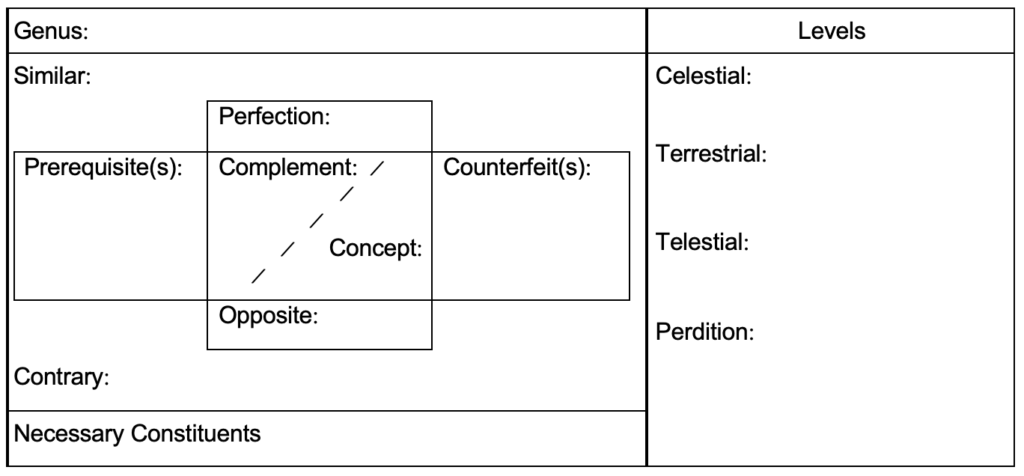
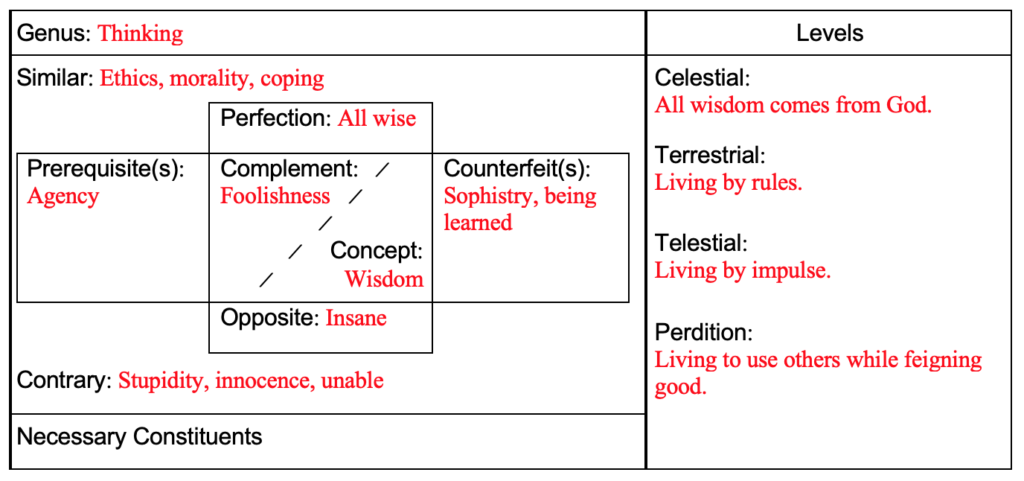
Genus: Thinking
Levels
Similar: Ethics, morality, coping
Celestial
Perfection: All wise
All wisdom comes from God
Pre-requisite (s)
Comple-ment:
Counter-feit(s)
Terrestrial
Agency
Foolishness
Sophistry, being learned
Living by rules
Concept:
Telestial
Wisdom
Living by impulse
Opposite: Insane
Perdition
Contrary: Stupidity, innocence, unable
Living to use others while feigning good
Necessary Constituents
(table above can scroll side to side)
7. Key questions: (Questions and answers to illuminate the concept. Use other side.)
What is the connection between wisdom and ethics? Ethics is the study of the different approaches to wisdom in the world.
How many kinds of wisdom are there? Nearly as many as there are individuals.
8. Definition: Wisdom is the ability to achieve one’s goal at a tolerable price and never to have to look back and be sorry.
9. Examples: (Positive/negative examples to demonstrate or test concept.)
Examples: The man who built upon a rock. The man who works hard and saves.
Non-examples: The man who built upon sand. The man who is lazy and a spendthrift.
10. Relevance: (The difference this concept should make in my life: heart, mind, strength, might.)
There seem to be many short-run wisdoms, but only one long-term wisdom.
This paper is an attempt to clarify the spiritual functions of language, communication, and morality as seen in the framework of the Restored Gospel of Jesus Christ. The hope is that you who receive this message will be able to say about it both “How correct” and “How obvious.” We shall proceed by stating a series of these ideas, demonstrating each as we go.
Thesis 1. All human action is the expression of the desires of a spiritual self. Each human being is a self, a spirit body, which spirit body has a physical tabernacle. The heart and mind of each person are functions of his spirit body. The heart is the seat of desire and the decision-maker. The mind is the power to perceive, to understand, to plan. A person’s strength is the ability of the physical tabernacle to respond to the desires and plans of the heart and mind. Strength involves health, physical stamina, skills, and procreative power.
The paradigm for human action seems to follow this pattern:
a. The mind perceives the self in some spiritual and physical relationship with the external universe.
b. The heart desires a satisfaction, either of the flesh or of the spirit, which the mind has envisioned in the relationship of the self to the universe.
c. The desire of the heart triggers the mind to invent a course of action to attempt to satisfy the desire. d. The mind creates a course of action and implements it, largely through its control of the physical tabernacle.
e. The mind perceives the result of the action taken and reports satisfaction or non-satisfaction of the desire to the heart.
(Step e is the beginning of the second cycle, recapitulating step a.)
Thus all human action is the attempt of the spirit of the person to gain some satisfaction.
Thesis 2. The actions of a person are his spiritual language. All human action is the attempt to change the perceived relationship between the spirit of the person, the self, and the external universe, which external universe includes his or her own physical body.
There are two basic ways of doing that. One is for the heart to ignore the perceptions of the universe which the mind presents to the heart and to instruct the mind to create a more desirable universe out of imagination. That is what we call insanity. The other way to change the relationship between the spiritual self and the universe is for the heart and mind to seek to change the external universe so that perception of the universe will later reveal the desired change. For example, if my stomach reports hunger and my heart chooses to satisfy that hunger, it instructs my brain to plan and execute an action through my physical body which will eventually cause perception of gustatory satisfaction as a replacement for the present perception of hunger.
We now stipulate that every human action, every attempt to change the perceived relationship between the self and the universe, is an example of the person’s language. Action is language as language is action. Part of that action may be verbal, but it need not be. Language is the expression of self, the revealing of the desires of the self as it struggles with the universe for satisfaction. Taken as a totality, the actions of a person become a total revelation of the nature and desires of the self. If we are not able to perceive the nature of a self directly, another way to form a correct idea of what a person is is to observe his or her total expression of desires as revealed in the totality of action, his or her language. All human action is communication of a self with the universe, the attempt to make the universe a more satisfying place for the self. Non-verbal action is classed as language along with verbal functions because both kinds of action have identical origin and goal, differing only partly in the form of the means to the goal.
Thesis 3. Communication is to affect and/or to be affected by another being by interlocking with that being. All action is for the sake of effect. All action is language. One cannot correctly interpret the verbal expressions of another person apart from the totality of that person’s actions, which are the totality of his language. Language expression is the communication of the desire of the actor to affect the universe in the hope that the universe will change to in turn affect the actor in such a way as to fulfill his desire. A man plants a tree, which communicates his desire for shade and beauty, in the hope that later the tree will communicate back to him shade and beauty.
Communication between two beings is thus the totality of all the effects they have upon each other. Communication is not the transfer of ideas. It is simply affect. That affect may have many dimensions. What one person does may affect the feelings and desires of another, or the perceptions, understandings, plans, and concepts of another; or the pain, pleasure location or disposition of the physical body of another being. The first may affect something that in turn affects the body and/or spirit of the second being.
Communication must have an effect to exist. The effect need not be consciously intended or consciously received. If nothing is sent when there is an expectation of something being sent, that too is a communication, a message, for that lack can affect the non-recipient. One message may be intended and quite another received, but that is still communication as long as there is an effect. Communication is the creation of change and therefore must exist in time as well as space. If there is no space there is no being, but if there is no time, there can be no communication.
Communication is an interlock of one being with another being, a form and degree of union. That interlock may be physical, or spiritual, or both. The interlock increases with space shared, time spent, increase of number of avenues of affect, number of contacts and degree of change created by affect. Perhaps the ultimate communication is between husband and wife who share and affect each other in all things, physical and spiritual. But spiritual affect is always more important, more profound, than physical affect.
Thesis 4. All communication is translation. For the sender, communication is the encoding or translation of desire into action which affects the universe. That desire has at least three dimensions in normal communication. First is the meaning or the intention of the sender; this may be seen as the result the sender desires to have on the universe. Second is the truth of the message, the correctness of its representation. Third is the rightness or morality of the message. For example, suppose I say to you, “Provo will experience a severe flood in the next twenty-four hours.” I say it because I desire to affect you; I speak either truly or falsely; and I speak either in righteousness or not. When I speak or act, I translate at least these three aspects of my spiritual self out into the universe.
You as the receiver of my message must translate whatever spiritual and physical impact my action of sending you a message has upon you. You must create a meaning for what I say, guessing at my intention; you must assign some degree of truth-value or credibility to that meaning, and you must decide whether I was right or wrong to say it. You translate whatever effect I have on you, inventing this three-fold impact on your own spirit.
Translation, sending and receiving, is a spiritual phenomenon. For one has intentions, relates to truth, and is moral or righteous or not according to the desires of his or her own spirit at the moment. It is not uncommon for a hearer to receive one meaning, truth and rightness translation for a message, then shortly afterward ascribe a quite contrary meaning, truth-value and rightness translation because his or her own spirit has changed during the interim and now ascribes other meaning-values to the affect of the sender.
Thesis 5. There are two kinds of human spirits revealed in communication. One kind of spirit perceives the universe as being filled with other beings at least as important as himself, having desires of their own which are as important in his own eyes as are his own desires in his own eyes. Esteeming the desires of others to be as important as his own, he does not insist on the total satisfaction of all of his own desires, but hopes rather that all can be satisfied, others as well as himself. To that end he is willing to be only partly satisfied himself if such sacrifice will help others to gain some of their basic desires. He hopes to find a way to communicate with others and with the universe so that everything and everyone will be fully satisfied; or failing that, to achieve a situation wherein everything and everyone will have as much basic satisfaction as possible. This kind of being perceives himself as holy, as special, but also perceives other beings to be at least as holy and special in their own being as he perceives himself to be.
The other kind of spirit revealed in communication is the being who sees himself and his own personal desires as being preeminently important above all else in the universe. He sees other people and other things as beings which exist for his own personal satisfaction only. He may acknowledge that they have their own personal desires as he does, but he will not accord the satisfaction of their desires as having any necessary value relative to his own satisfaction. Thus he sees the satisfaction of his own desires as the only really good thing in the universe. He takes account of others’ desires only as data which may affect as means or deterrents the fulfilling of his own desires. He uses other beings as means, to his own end, helping them to the satisfaction of their own desires only as means to achieving his own desires, sacrificing their satisfaction wherever expedient to the fulfilling of his own desires. This kind of being perceives only himself and his own desires to be holy or special.
The first kind of spirit communicates to make the universe a better place for everyone. In an LDS frme, this is to be moral. If this action is done in willing obedience to Jesus Christ, it is righteousness. The second kind of spirit communicates to make the universe a better place only for himself. In an LDS frame, this is selfishness, sin.
Thesis 6. Communication with God assists those who esteem others. Our being, verbal and non-verbal, essential and unfolding, is fully perceived by our God and Father. We are interlocked nearly fully with him in that everything we are, feel, think, do, and say, is translated fully and immediately to him, directly through our actions as they affect his other sons and daughters and creatures. He, of course, perceives our being, directly, as well as our actions. The extent of that interlock is unbeknownst to most of us, however, for we do not perceive him to the same degree that he perceives us.. We are told that in him we live, move, and have our being, but the consciousness of what that means comes to few and is believed by yet fewer. If our eyes and understandings were opened, we would see that we are in his arms, enfolded in his love and being, already.
But generally we humans do not perceive that interlock because he, God, has left part of the interlock incomplete. He is in full communication with each of us, with our heart, might, mind, and strength. But he treats as holy, as special, our hearts and minds. He is the first kind of spirit. Though he perceives all, he does not attempt to control our hearts and minds. Rather, he lets us become aware of his heart and mind in our hearts and minds only at times, only by degrees, only on special topics. The fact that he does let us know his heart and mind somewhat makes us free to become as he is. The fact that we do not always have that influence with us unless we seek and cultivate it makes us free to become something unlike God. Because he loves and esteems us, holds us as being holy, he sets us free, to become as he is or not to become as he is.
If we esteem him as holy and respect his heart and mind when it comes to us, we learn a most remarkable thing: when we yield our hearts and minds to God, he affects us to be able to desire, to think, and to act in such a way that we are then able to assist all others around us to have more opportunity and power to fulfill the desires of their own hearts. We find further that the more we communicate with God and seek to interlock our heart and mind fully with his, the more we can help others. We soon realize that the ideal is a full, explicit conscious interlock of our being with his being. That full communication makes us one with him. Then we have all of his heart, might, mind, and strength at our disposal to assist us to help others to fulfill their desires, even as he has then all of our heart, might, mind, and strength of each of us at his disposal to help others. Through love, full communication has brought us to become one with him. Then as we communicate with others, it is the love of God which we communicate, which shines out of us to all others, inviting them also to share in the goodness of God.
Communication with God poses a problem for those who see only themselves as holy. He is an affront to them. He tells them that what they are doing is wrong, and that unless they change they will be very sorry about themselves in the long run. If they do not desire to change, they scrupulously avoid discussion or thinking of the long run and try to see how they can turn the influence of God—his words, his priesthood, his church—to the present satisfaction of their own personal desires, regardless of what happens to anyone else in the process, including God himself.
Thesis 7. Communication with Satan assists in this life those who esteem only themselves. Satan is not in full communication with anyone, for he would need to cooperate fully with them to do that. But he has been given by God the freedom to communicate something of his mind and will to every accountable human being. His net message to them is to encourage them to be selfish, to esteem only themselves and to use all human beings and other creatures only as instruments to their own personal satisfactions. He treats all humans this same way, using them to achieve his own ends, then discarding them whenever they lose the power to further his own selfishness. Though not full, Satan’s communication is sufficient to entice every human being to evil, to selfishness. Those who accept that enticement are rewarded by heightened feelings of self-desire and the revelation of ingenious means of using and abusing others to fulfill that selfish desire. The more a person interlocks with Satan, the more such a person rejects communication with the Lord. He or she becomes more and more selfish until mortal probation is over. Then, having denied the Lord when he spoke to them, they are delivered to eternal torment to use and be used by the selfish dregs of the universe to all eternity.
Thesis 8. Every accountable human being is influenced both by God and by Satan. The point of this thesis is that there is no middle ground. Every accountable person is in communication with God and Satan. The only question is: What is the person’s reaction? Some are strong in the Lord and do great good in the earth. Some are strong in Satan and do great evil in the earth. Many are swayed to and fro, do a little good and do a little bad, but do nothing outstanding. At any given moment, any accountable person is in communication with Satan or the Lord and acts accordingly. All actions, words and deeds, are the acts of selfishness or of righteousness. The sum of actions may be a mixture, but each specific action is either of the Lord or of Satan.
Thesis 9. To communicate with another human being is to interlock either with Satan or with the Lord. To be in the presence of another human being is to interlock, to communicate with him or her to some degree. We carry into that interlock the influence of God or the influence of Satan. The influence, good or bad, of one person is stronger than the influence of the other. The weaker person must reject the interlock and flee unless he or she wishes to be influenced by the stronger, for as time and contiguity increase, communication or the flow of influence increases, flowing from the stronger to the weaker. “Charisma” is the worldly term for the strength of strong people, which can be either good or bad. People like charisma, for they feel strength flow to them in its presence.
Thus, when we enter into an association, whatever spirit we take into the association retreats if the other person has an opposite and stronger influence. If both enter with the same spirit, that spirit is strengthened in both. The situation need not be another individual, of course. We can enter into communication with a group of people, a book, a TV program, a mountain, etc. The principle of spiritual flow remains constant in all of these situations. Spirit always flows from stronger to weaker whether it be a good or an evil spirit. Whatever spirit possesses us than determines what we do. We always represent and influence others either for the Lord or for Satan. When two people communicate, Satan and/or the Lord are always part of that interlock of being.
Thesis 10. To be a moral person one must be strong as well as good. It follows then that to be moral, one must not only have the Spirit of the Lord but have it in sufficient strength that he will not be overwhelmed. Perhaps anyone can be righteous in the presence of the Lord. Who then can be righteous when he leaves the presence of the Lord and enters the presence of great evil? Only he who carries with him the presence and the power of the Lord when he goes into the presence of great evil. The basic ways in which this is done are:
a. To have incorporated the Lord God into our feelings, thinking, strength, and might, so that we are one with him. This we do by seeking his presence and his influence, letting that strength flow into our self, stronger to weaker, until we have built up a great reservoir of his strength. The reservoir is the good deeds we have done and the good words we have said in obedience to him which have strengthened our fiber and changed our being.
b. To be on his errand at all times. While on his errand we have his continuing presence with us and the promise that we will never be tempted above our ability to withstand. But if we ever depart from his errand and begin to seek our own selfish desires, we lose our protective shield. Should we then encounter an evil influence stronger than that residual good which we retain in our fiber and being, we would then lose our agency to resist Satan. He could then sift us as wheat.
To be a “good” person, that is, never having done great evil, is a good thing but not the best thing. Much better is the good person in whom the Spirit of the Lord has welled up until he or she is a tower of strength. To be a “good” but weak person and then deliberately to seek our evil influences to “find out what the world is all about” is to commit spiritual suicide. Wisdom would have us seek out the very best in all things and to hold fast to that which is good. Those who seek the Lord and become strong in him, increase thereby their ability to communicate with him, to receive strength from him. Strength thus begets strength. To be moral and righteous one must be good and strong in the Lord.
Thesis 11. Communication among humans is good only for those who are in communication with God. We humans need to communicate with each other to solve our problems, to make a better world. What is it that we need to communicate?
First, we need to discern, to understand one another. To understand a person is to discern both the ideas and intentions of his heart and the kind of spirit which possesses him, either God or Satan. That discernment is a gift of the spirit, fully known to and used by only those who seek and find a full communication or interlock with the Lord.
We need to communicate about truth. We need to have a common and true understanding of the way things are and were and will be. Since we each can observe directly only a small portion of what is real and not at all what was or will be, we have no direct personal access to enough truth to achieve the common true understanding which we need. We are then thrust back to our spiritual resources. If it is our desire to be selfish, then Satan rules us and he distorts and falsifies the communications we give and receive as to what is, was, and will be. That is why the world of ideas is awash in a sea of falsehood and personal opinion. Only when we deliberately turn to the Lord and deliberately interlock with his being can we gain those true ideas of what is, what was, and what will be to be able to ground our labors in reality. But truth is a stranger, an unwanted interloper, in a world of selfish people. Only the righteous cherish truth, the whole truth, and nothing but the truth.
We need to communicate about what is best to do and how best to do it, that we might gain the advantage of working in concert in making this world a better place. No one of us knows enough about truth or about what is possible, let alone what is best, to become the guide. So the programs of the world must find spiritual resources. Those stimulated by selfish personal interest are abetted by Satan: their promise is false and their glory fades as time passes. Witness all of the political kingdoms of the earth in all of its history. Those leaders stimulated by righteous desires know that they of themselves are not wise, and must turn to God himself who is the fountain of all righteousness. In him, the strong in righteousness find wisdom and success in earthly ventures that build forever and increase in beauty into eternity. Witness the eternal families of those that know and love the Lord.
Should human beings strive to discern, to find truth and to find wisdom but do not do so in the Lord, then their communication is prospered only in Satan. They may indeed communicate and accomplish things, but their creations will represent degradation and will enthrone selfishness. Such was the situation at the time of the flood, when the thoughts of each heart were only to do evil continually. Such will be the state of the world in these last days. The sum of the matter is that the only intelligent thing to do in this world for any person who desires happiness for anyone other than himself is to seek first to find the true and living God. One must come into full communication with him, then in the strength which flows only from him, to seek to establish his righteousness wherever and whenever possible in this earth. Then the language of such an one will become pure and holy, perhaps even Adamic. Then his communication with all other righteous beings will be full and joyous. Then he will never be overcome nor thwarted by the strength of selfish beings. Then he will speak and do all that is true and right, and in that communication will find that joy which his Creator had in mind as the reason for his existence.
Preliminary draft 8 (CCR) 15 Feb. 1983 (Latest Version. Read at Women’s Conference 17 Feb. 1983) Appendix A
I. Introduction
I appreciate the opportunity to contrast in this paper the two principal rootstocks onto which are grafted the works of mankind. The good root is the Royal Law; if it nourishes our life and work, everything we touch is uplifted. The evil root is noblesse oblige; all human acts that draw nourishment from it result in degradation. Living by the Royal Law is the most difficult and most important feat which any human being can perform. Living by noblesse oblige is the counterfeit which is natural, easy, and widespread.
We shall focus the contrast between these two rootstocks by noting the difference each makes to the miseries of mankind. The catalogue of human misery is long: hunger, malnutrition, poverty, foolishness, disease, birth defects, oppression, unhappiness, ignorance, insanity, etc. Every person of conscience in this world is gripped by the enormity of this misery and seeks to alleviate it. There are only two main ways to alleviate those miseries. The two ways are the Royal Law and noblesse oblige, the feat and its counterfeit.
II. The Royal Law.
The Royal Law is the first and second great commandments as given by God to men in the Old Testament, the New Testament, and the Doctrine and Covenants. The first law is that we should love the Lord our God, with all of our heart, might, mind, and strength. The second is that we should love our neighbor as our self. We shall here interpret this Royal Law in the framework of the Restored Gospel of Jesus Christ. In this interpretation, we reword the first law to say that we should love, emulate, and obey our God in the exact pattern in which our Savior, Jesus Christ, loves our Father. We reword the second law to say that we should love our neighbor in the exact pattern in which our Savior loves us. Our Savior loves us by loving, emulating, and obeying the Father in all of his love for us. Thus the second law is like unto the first, and stems from it. By living these laws we may become like unto our Savior. For the Savior is our great exemplar, the high priest of our profession, the father of all those who are born again unto God. To love as he loves should be our ideal. He is the way, the truth, and the life. Only in him can salvation from sin, misery, and oppression come unto mankind. Only in him can we become like the Father.
That all mankind may know and understand the exact pattern of his love, our Savior has given to man three grand windows by which to learn of him and his ways. The first is the scriptures, which are the testimonies of dead prophets concerning how he loved. The second is the testimonies of the living prophets today who tell us how he loves. The third is the whisperings of the Holy Spirit which tells us how he will love and how we may love our God and our neighbor as he does. These three witnesses are not separable. If we search and pray until we see the unity of witness among them, we rise above our own private interpretation to a true understanding of the way of Christ. No man is saved faster than he gains this true understanding. Let us point out how the Saviors love fulfills the Royal Law.
The Savior loved our Father with all of his heart. He relinquished all of his personal desires and chose to do nothing and say nothing except that which his father instructed him to do. He loved our Father with all of his mind. He learned and believed all that the Father taught him, declining instruction from any human being. He loved our Father with all of his strength. He gave all of his energy and skill to fill completely the mission which our Father gave him, culminating in the voluntary giving up of his life. He loved the Father with all of his might. He used his priesthood power, his persuasion with men, his ability to control people, spirits, animals, plants, the waters, the earth, and the universe, to order all things exactly as the Father wanted them to be. His love was complete, perfect.
Our Savior loved our Father so because of the goodness, the righteousness, the fullness of the Father’s love for him. The Father is a perfect man. Man of Holiness is his name. He is a god of righteousness, for his only work and glory is to share all that he has with others to help them to become as happy as they can stand to be. The Father loves personally, fully, purely, with an intensity that rights every wrong, heals every wound, comforts every grief. All the perfection of soul that eternity could contain is fully represented in our Father. He is loved by every intelligent being. Our Savior, more intelligent than any of us, loved him fully, returning the fullness of his love. Thus our Savior keeps the first and great commandment.
Each of us is neighbor to the Savior. So the Savior loves us as his Father loves him. Acting under the Father’s love and instruction, the Savior loved us by volunteering to fill the Father’s plan in the council in heaven. He, our Savior, created this earth and all things in it to show forth the Father’s love to us. Because we are fallen, he shows us the way back to the Father’s presence, building a bridge for us with his own pain, spirit, and life-blood. He it is who pleads with each of us to turn from the world to love the Father. He pleads with the Father that our Father might accept our imperfect love. Our Savior tries to share with us all that the Father has given him. His ultimate hope for us is that we might turn from our sins and become one with our Father, even as he is, even as he has shown us the way, even as he loves. There is no stone in all eternity that the Savior does not turn to help us to attain our own individual greatest happiness. Thus the Savior loves us, his neighbors, just as the Father loves him. Thus he fulfills the Royal Law. Our Savior has shown us the way. It is now our turn to live the Royal Law.
We come to mortality with our minds and memories clouded over so that the choosing we do will be with our hearts, not our minds. We are born into this world with body, mind, and opportunity greater than any other creature we see. We are given a home of beauty, regularity, and abundance on this earth. we can think and feel, speak, laugh, cry, strive, and overcome. We have power to create heaven on earth; or hell.
For our Father has given us a choice. We may choose between righteousness and selfishness. To make that choice more explicit, our Father has sent our Savior to show us the way of righteousness and to witness to us of the Father’s love for us. the Father also sent Satan to intensify the way of selfishness; Satan urges and inspires us to do just as we please on this earth as long as we don’t love the Father and our neighbor as the Savior does.
Let us now summarize the truths of the Restored Gospel which highlight this mortal opportunity and the importance of the Royal Law.
“1. In God we live, move, and have our being. we are not “”natural”” creatures of the earth. Our breath, our strength, our health, our intelligence, our freedom, are all gifts of God to each of us, moment by moment. Our God is the author of all we call “”good”” in our lives. He is also the author of all we call “”evil”” in our lives.”
“2. The evil in our lives is sent from that we might clearly see the difference between good and evil. The good is sent from God that we might choose it over evil.”
“3. The great probation of this life is to see if we choose good[1] over evil only for ourselves, or do we choose it for others also. Those who choose good only for themselves are the selfish, the children of Satan. Those who choose good for others are the righteous, the children of our Savior.”
“4. The way of selfishness is easy to find. It is a broad path. To find it one only has to act naturally, to yield to whatever desire one happens to have.”
“5. The way of righteousness is difficult to find. It is a strait and narrow way. To find it one must hunger and thirst after righteousness. One must search and strive until one finds the very best way to help others.”
“6. The very best way to help others is to find the way of Christ, which is to love God and our neighbor as the Savior did. It is the Royal Law.”
“7. No human being can implement the Royal Law by his own power. That power comes only through the ordinances of the Gospel of Jesus Christ.”
“8. The essence of the Gospel of Jesus Christ is to have faith in Jesus Christ. This faith is to receive direct revelation from him, to believe it, and to obey it.”
“9. What the Savior reveals is how to replace our desires for good, for ourselves and for others, with righteousness. Then instead of doing what pleases us we begin to turn to the Royal Law, to love and please the Father instead of ourselves.”
“10. As we act in faith and begin to love God with all of our heart and mind, his love begins to shower blessings upon us. A blessing is something that enables us to become more like God. Our breath, our strength, our health, our wealth, are not blessings to us until we begin to live the Royal Law through faith in Jesus Christ. If we are faithful, everything becomes a blessing to us.”
“11. If we are faithful servants of Jesus Christ, he shares with us his power through the ordinances of the Gospel of Jesus Christ. Then, because we love the Father with all of our heart, might, mind, and strength, the Savior gives us the knowledge and power to love our neighbors as he loves us, to share our blessings with them.”
“12. As we share our blessings with our neighbors in his love, we bear witness of the Father’s love for them. If they hunger and thirst after righteousness, they too will learn of the Father’s love, become grateful for it, and have the opportunity to turn and to live the Royal Law themselves.”
“13. On the day of judgment, every soul will look back to his probation and acknowledge:”
” a. that he was in the hand of God at all times;”
” b. that God’s love was showered upon him; and”
” c. that his sorrow, if any, is that he did not return God’s love sooner.”
“14. If we are really interested in relieving the suffering and the miseries of mankind, here and now, we will realize that man’s resources and abilities to do so are insufficient. But Gods resources and abilities are infinite. Man does not have the understanding, the wisdom, the goodness, the strength, or the might, to solve man’s problems. But God has all the resources necessary to solve every human problem and is only waiting for men to live the Royal Law through faith in Jesus Christ so that relieving their misery would be a blessing and not a curse.”
III. Mortal examples of living the Royal Law
Moses was born into the misery of the slavery of the children of Israel in Egypt. Because God loved Abraham, Isaac, and Jacob, he looked carefully after their children and saved Moses: life. He saw that Moses was raised as an Egyptian then drew him to Midian where he learned the Royal Law and the Gospel of Jesus Christ. Moses was grateful for God’s love and loved him in return. Keeping that first commandment enabled Moses then to love his neighbors, the Egyptians and Israel, as he was loved. But Moses did not pretend to the power to bless Egypt or Israel. He went to teach them of the true and living God, that each might be blessed of God if they would love him.
Moses taught the Egyptians of God and his power, and gave them a chance to serve God by letting Israel go. They chose selfishness over righteousness. Moses taught Israel of God and his power. Israel learned enough to become barely obedient, and were made free. Acting on faith in God, Israel went under the sea walls and was saved. Acting in the satanic anger of selfishness, Egypt went under the sea walls and was destroyed.
In Sinai Israel lacked water and food. Moses implored the Lord, and God sent water, manna, and meat. Their clothing did not fail, nor their shoes wear for forty years. Moses loved Israel, his neighbors, but what he gave them did not save them. He gave them his time, and his strength. He gave them witness of the true and living God. As Israel learned to love God as Moses did they were saved. Those that did not return God’s love were left in misery.
In Moses’ last great labor with Israel, the Book of Deuteronomy, he implored them to love the Lord, to keep the Royal Law. He told them of the blessings they and their children would receive for that faithfulness. He told them of the misery which would come upon them if they turned away from God and served selfishness. But Israel had rejected the higher law, the Gospel of Jesus Christ and its ordinances. The lesser law which took its place was to point their minds to the higher law but did not give them the power to live the Royal Law. Thus Israel suffered in misery down through the centuries, embracing the idea of the Royal Law but rejecting the power which made living it possible.
The Savior himself came in flesh and blood to show Israel the way. He reaffirmed the Royal Law and restored the Gospel and its ordinances. `Most’ of Israel rejected him and his Gospel, even while professing to love God, to live the Royal Law.
In these latter days the Lord has set his hand again to gather and restore Israel to the Royal Law through the preaching of the restored Gospel of Jesus Christ. He sent the Prophet Joseph to show the way. The Father and the Son loved Joseph for his faith, and Joseph loved them with all of his heart, might, mind, and strength. Through Joseph the Lord restored the Gospel message and all of the ordinances which pertain to salvation. Joseph loved his neighbors as God loved him, and sought to share his knowledge and power from God wherever it was appropriate in God for him to do so. The love of God and of the Prophet Joseph and of all others who love God continue to reach out today to invite every soul on earth to come to the feast of God’s love and partake without money or price.
To emphasize again the nature of the Royal Law we note the following. Love of the Lord must precede love of neighbor because no man of his own wisdom knows how to do what is best for his neighbor. When a person loves the Lord as the fountain of all righteousness, that fountain flows unto him as living water, so that he never hungers nor thirsts again. His gratitude for this living water is so great that he has then a great desire to share his blessings with his neighbors. He implores the Lord for guidance, then imparts of whatever riches he has according to the Lords instructions, never fearing diminution of his fountain. His fountain is endless, infinite: he knows that his personal needs will always be met as he obeys the Lord. So he gives and shares without worry, for love. He give’s and shares that his neighbor might know of the goodness of God. He knows that whatever he gives his neighbor, it is a pittance compared with the love of God that neighbor will know if the neighbor turns to love God. The purpose of the Royal Law is identical with the work and glory of God, which is to bring to pass the immortality and eternal life of man. Men on earth become participators with God in the grand design as they beget children to a mortality that leads to immortality and as they love their neighbors in a world full of misery in a way which presages the blessings of God. This world that abounds in misery is the handiwork of a kind and loving Father who has carefully allowed this misery that he might teach his children the true riches of time and eternity. The misery exists for two basic reasons: 1) that those who love God will have ample opportunity to share what God has given them with their less fortunate neighbors as they witness of God’s love, and 2) that-those who reject God might better realize that there are consequences for having done so here in this life as well as hereafter.
In summary, keeping the Royal Law is what every man can and should do to help to relieve the miseries of mankind. As any man keeps it, he opens the channel of godly love that flows between God and himself, and between his neighbor and himself. Thus every human misery that should be relieved will be relieved. Each will be relieved when faith in God makes that relieving a blessing. Every man who keeps the Royal Law voluntarily makes himself a servant of God and also a servant to his neighbor.
III. Noblesse Oblige
Having given a basic explanation of the Royal Law, the living of which is the greatest and most rewarding feat which any human being or god can perform, let us turn briefly to the counterfeit which is noblesse oblige. Noblesse is the French word for nobility: oblige means `oblige’. Together they mean that to be of the nobility obliges one to do good for others.
To begin our account we must make a few observations about nobility.
There is a striking propensity in every human society for people to stratify, to establish a pecking order. Almost every person who exists desired to be able to look down on someone else, anyone else. The desire to look down on someone seems to be almost as basic as the need for human company. In many people it is matched by a desire to look up to someone, a “hero” to worship. Much of what we see in human relationships is varieties of this look-up, look-down syndrome.
One outgrowth of that syndrome has been the creation of a noble caste or class in almost every society, an “in” group to which not everyone can belong. Devices which have been used to create nobility or “in” groups are: age, blood line, language spoken (e.g., French over Anglo-Saxon), clubs, clothing, priesthood, physical strength, physical prowess, education, degrees, physical possessions of land, money, technical devices (e.g., possession of a Rolls Royce), skin color, height, obesity or lack of it, etc. We see the same drive for superciliousness influencing the royalty of a country to see themselves as being far superior to commoners as we see when third- graders taunt the “kindergarten babies.” For many people, success in this world is just having someone to look down upon. This is a worldwide psychological Ponzi scheme to live psychologically high the expense of those at the bottom of the social pyramid. We note that the nobility are self-appointed. Their noble line began in case when some ancestor had power, either military or economically monopoly power, and through that power obtained holdings that ensure family wealth. Family wealth has been exploited to differentiate the noble family from others in perpetuity.
Because they believe they are nobler, thus better than whoever else is beneath them in the social pyramid, the nobility believe they have obligations to make up for the deficiencies of the “great uneasy” Because their actions are typical and world-wide, we will focus on the obligations which historically have attached to the nobility of Europe.
The first obligation is to maintain a clear line of difference between themselves and their inferiors. They are obliged to do this because they perceive that the world would be worse off if they were not true and loyal to the inherent betterness of their class. Devices used to institutionalize that line of difference are:
a. Distinctive dress, speech, gracious manners, and demeanor in all public appearances. This is what they call “breeding.”
b. Fostering differential and deferential behavior in their underlings; such as bowing, kneeling, sitting lower than, saying “sir” and “maam.”
c. Controlling their public image by getting the “right reports of their being seen and being mentioned at “right” occasions.”
d. Recognizing and making much of each other.
e. Total avoidance of productive manual labor. That would utterly disgrace them.
f. The need to appear to be affluent even if the family fortune has fallen on hard times.
The second obligation is to be influential in government to protect the interest of the “people,” the community, the nation. They do this by wielding “influence” in whatever government currently stands. Should the government be threatened and military force become necessary or expedient they, because of their inherently super wisdom and because of their breeding, always become the officers. They seize the government for themselves, where possible.
A third obligation is the need to support “fine art.” Fine art is the art of the medieval court. If they, the nobility, did not support it, it would die, since the masses have little taste for it. So it is the obligation of the nobility to support opera and ballet companies, symphony orchestras, art museums, etc., in order to preserve what is “noble” in art for the benefit of all mankind.
(Note: Their support of science is a practical matter, science has commercial and military technical applications which make its support necessary. But because fine art is not in the same sense necessary, voluntary support of fine art is a truer test of “nobility than is support of science.)
A fourth obligation of the nobility is the need to be charitable, be involved in good causes to help the poor. This obligation manifest in three main ways:
a. They support charitable organizations which engage in the immediate physical relief to the suffering, such as hospitals, and soup kitchens.
b. They support government welfare programs which will maintain the quietness and steadiness of the masses to be ready to serve in the military or in industrial enterprises should the need for their labor arise.
c. They support compulsory public education so that the masses will be sufficiently educated that they can serve well in the military and industrial occasions of the society. Professional training of the brightest persons is essential so that they can run the government bureaucracies, the military organizations and the industrial complies with greater efficiency.
Thus do the nobility preserve their status and fortunes.
The occupations of the nobility traditionally were war and government. Now they are war, government, and business. Part of their success (that not due to their power and wealth) has been due to the mystique which they have engendered about themselves. Non-nobility traditionally look Lip to the nobility as the wisest, the bravest, the best of persons. The never-never land of all fairy tales and romantic literature is for some low-born person to join the nobility and live happily ever after. Low-born persons, not esteeming themselves, attempt to imitate the speech, the dress, the sports, the vacations of the nobility. When a low-born person gets wealth, he often will immediately seek to acquire the eternal trappings of the nobility and will try to join them. If his son or daughter can marry someone of “noble” blood, he has succeeded. But the nobility resist penetration. They are careful to count as “their own” only pedigreed persons of ancient wealth; interlopers are disdainfully regarded as nouveau riches (the newly rich).
An interesting application of the nobility mystique is seen at the wedding receptions in our own LDS culture. Not esteeming ourselves because we believe we are not nobility, LDS families seize upon this one special occasion to become kings and queens, knights and dukes, for a day. We rent the tuxedo trappings of the nobility and parade before all of our family and friends in the accoutrements of the “noble” rich to make the occasion “very special,” to be somebody. But of course we do homage in other ways, such as buying designer clothes, desiring the “right” kind of automobile, desiring to live as high on the hill as possible, etc.
An historic example will help to clarify the meaning of what we are saying as to the pervasive nature of the “nobility” frame of mind and its obligations. In the 19th Century, Tsarist Russia was a typical European kingdom ruled by a nobility which fitted the general descriptions given above. During the second half of the century (1861-1907), in response to great internal pressure, reforms were undertaken to abolish serfdom and to institute some representative government. But the outrageous inequity and inefficiency of the government as run by the nobility forced the abdication of Tsar Nicholas II in 1917.
In the power struggle which ensued, the Bolsheviks eventually gained control of all of Russia. And how did they govern? By creating a new aristocracy. They replaced an aristocracy of blood and power and money by an aristocracy of intellect and power, the members of the Communist Party. The years since 1917 have shown; insufficiency of the intellectual claim of Communism, so now Russia ruled by another aristocracy of blood, money, and power, who have all of the attributes of a traditional nobility anywhere and respond under exactly the same obligations. They differentiate themselves socially from the masses, run the government, support the same fine art, and practice the same condescending charity as the nobles whom they smashed in 1917 to 1920. They, too, rule by noblesse oblige.
Now it is time for a caveat. We desire to be understood as speaking in types, and average when we talk about the historic nature of aristocracy, the so-called nobility. Among the nobility doubtless there have been pure souls who recognized and attempted to live the
Royal Law, and their good works were genuine selfless help to those less fortunate than they. Had such souls been a majority, the history of the earth would have been very different, much happier. But such have not been in the majority. As a class, the influence of the nobility has always been more that of Satan than of God.
Recognition of that generalization caused the Founding Fathers of the United States expressly to forbid the establishment of a peerage. The wisdom of that move has been plain, at least to those who see with Restored Gospel eyes. But their refusal to recognize a nobility did not prevent the assembling of a defacto peerage which has carried on the European traditions of the nobility wherever enough money could be assembled to launch a dynasty.
While it can correctly be said that the world might be worse off were it not for the rule of the nobility (anarchy has few devotees), our point is that there is an alternative to aristocracy and noblesse oblige; the alternative is the Royal Law. To sharpen the contrast between these two approaches to solving the problems of mankind, let us now sum this feit and the counterfeit to make clear their striking differences.
1. In the Royal Law, God is loved and worshipped because of his righteousness, and the worshipper counts himself as nothing without God. In noblesse oblige, God is far, far away, if he exists at all. The nobility must take the place of God to the people.
2. In the Royal Law, God showers spiritual and temporal blessings upon all those who love his name and diligently keep his commandments. To be saved is to learn to love as God loves.
In noblesse oblige, one must amass and maintain fortune and power as one can. The end justifies the means of slavery, tyranny, oppression, and all manner of legal extortion. To be saved is to be of the nobility, to lord it over others.
3. In the Royal Law one loves ones neighbor as Christ loves him. He goes to the Father and seeks direction to know how, when, and where he should share what the Father has given him to help to relieve his neighbor’s misery, and is willing to share, to give, all that he he has.
Under noblesse oblige one is obliged to do something for the suffering, struggling masses. So one gives them policemen to establish order, government to promote trade so they can have jobs, medical programs so they can have better health, schools so they will not be illiterate. But very little, if any, of the family fortune every goes into any of these causes unless it can be recouped in good will or tax advantage. To be noble is to fling coins at the masses.
4. In the Royal Law, the main hope in sharing one’s wealth with the poor is the hope that one can help the poor turn to the Father and that they can learn to keep the Royal Law themselves. For if the poor do that, all of their problems will be solved. They will inherit all that the Father has, both temporally and spiritually, in both time and in eternity. Then they will be wealthy in a way that no earthly or mortal system could possibly match.
In noblesse oblige the main hope in helping the poor is to keep them fed, pleasured, working, and obedient, so that they will not disturb the status quo. Or if the nobility are religious, the reason for helping the poor is so that the poor can successfully endure the miseries of this world long enough to do their serf work; then God will reward them for their goodness and suffering in the next world.
It surely is true that God will reward the righteous poor. But a rich person rarely has a heavenly future.
As we turn to the world in which we live for examples of noblesse oblige, we see them everywhere. All are varieties of: I am noble. In condescend to relate to you who are inferior, e.g.,
Professional people who condescend to relate to laymen.
People in expensive homes who condescend to admit that people in hovels are human beings also.
Professors who condescend to teach students.
Elders who condescend to relate to younger people.
Younger people who condescend to acknowledge that the elderly are human beings.
The cultured who condescend to admit that the uncultured people do exist.
The strong that lord it over the weak.
The literate that lord it over the illiterate.
The married that lord it over the single.
Men who lord it over women.
Parents who lord it over their children.
The professional women who lord it over the housewife.
The housewife who feels superior to the professional woman.
The people high on the hill who look down on the people in the lowlands.
The athletes who swagger around those who didn’t make the team.
The verbal who tease those who struggle to speak.
The fortunate who note how the misery of the unfortunate is well-deserved.
The beautiful people who feel sorry for ordinary people.
The white people who look down on people of other colors.
The Mormons who look down on non-Mormons.
The government official who deigns to render a service to a citizen.
The “saved” who look down on the sinners.
It is plain that the list is virtually endless. It is also plain that most humans would gladly have some edge on others so they could lord it over others. All instances of this noblesse oblige have two things in common which are the perverse parallels to the Royal Law.
The first law of the nobility is to love and perpetuate that difference that sets one off from the masses. The second law of the nobility is to flaunt that difference which sets them off from the masses by displaying the difference whenever possible, but always in a condescending way. Noblesse oblige is the epitome of arrogance and selfishness, even as the Royal Law is the epitome of godly love.
It remains now in this paper to make plain how certain specific human miseries are to be cured through the ministrations of those who live the Royal Law. (We take it for granted that noblesse oblige never will nor never could solve any of these problems on a societal scale: the evidence for that is six thousand years of one miserable failure after another as the miseries and oppression of mankind have been perpetuated by the self-styled lords and landlords of humanity.)
IV. Solutions to Human Misery
Misery #1. Poverty.
Under the Royal Law every covenant servant of God sets the totality of his earthly goods in reserve to be ministered unto the poor. He holds nothing back, knowing that should he need to give away or lose all of his earthly substance to fulfill the Lord’s plan, then the Lord would yet make it possible for the labor of his two hands and the sweat of his brow to provide for the needs of his family. Having put all he has in reserve, he then makes diligent inquiry of the Lord as to whom the Lord would have him give what. Having received instructions he will give away his substance, directly or through the Church, as the Lord directs. If so instructed, he will bear witness of the goodness of God to the recipient and will encourage the recipient to faith in the Lord Jesus Christ; but if instructed not to say a word, he will give and not say a word. But he will pray mightily for that recipient, hoping that the Spirit of the Lord will penetrate to his heart, that he, the recipient, might turn and begin to love the Lord with all of his soul through the Restored Gospel.
Only thus will humanity see the world-wide end of poverty.
Misery #2. Ignorance.
Under the Royal Law, every covenant servant seeks after and treasures truth. He searches out the ways of nature and of the world until his faith in God is crowned with great understanding. He does not believe the opinion of any man, but tests all of the ideas he receives by the Spirit and by experiment, then holds fast to that which proves to be true and good. Then he consecrates all he has learned to the Lord and humbly seeks to know what to do with that knowledge. Usually his instruction will be to conduct his stewardship ably through the understanding he has gained and the further instruction he receives from day to day. But also, if so directed, he will share part of his truth with his neighbor. In so doing, he will warn the neighbor not to accept his human witness. He commends his neighbor to seek God: the Spirit of Truth, for in God that neighbor will find the greater treasures that he, the covenant servant, does not yet know. If the neighbor turns to love the Lord and to accept the Restored Gospel, that neighbor will then have access to the truth of all things in and through the Holy Ghost.
Thus can the ignorance and the chains of falsehood that bind mankind be dispelled and replaced by truth forever.
Misery #3. Foolishness.
Under the Royal Law, every covenant servant knows that the wisdom of the wisest man is foolishness before God. God sees all, knows all, understands all, but man sees little, and of himself knows and understands almost nothing. The covenant servant knows that God give liberally and upbraideth not when his servants ask in faith. So the servant asks, frequently, and obeys always and immediately. That obedience causes him to prosper, and his purposes fail not, because he loves that true and living God who purposes fail– not. In his success he sees a foolish neighbor who knows not God. The covenant servant seeks wisdom of God to know how to minister to the neighbor. The Lord may say “do nothing;” the servant will forebear. The Lord may say “give him money”! The servant will obey. The Lord may say “teach him how to avoid the pitfall that troubles him;” the servant will do so in all humility. The Lord may say “teach him the Restored Gospel of Jesus Christ. That I may make him wise;” the servant will comply. In every case, the servant prays mightily for the neighbor that the neighbor might come to know and love the Lord and partake of his wisdom.
Thus can the foolishness and failure of every human enterprise be turned to success and accomplishment of things eternally worthwhile by the living of the Royal Law.
Misery #4. Ill Health
Under the Royal Law, every covenant servant knows that health is primarily a spiritual but also a physical matter. It makes a difference what and how he eats, drinks, and exercises, but it makes more difference whether he is filled with the love of God or if he lets Satan rage within him in anger, self-justification, and punishment of others. So he attempts to love the Lord with all of his soul, that he might cleanse the inward vessel, knowing that is his real hope for strengthening the outward vessel. When his body is renewed and strong, he places that strength at the Lord’s disposal. He perceives a neighbor who is ill, and implores the Lord as to how to help. Having received the Lord’s instruction, he nurses the neighbor, expending his own strength. But in addition he prays for the neighbor, and if so further instructed, shares with the neighbor the Restored Gospel truths. If asked, he lays on hands and speaks the Lord’s blessing upon the head of the neighbor. The servant hopes in all this that the neighbor will turn and love the Lord, that the shower of love coming back from the Lord will heal the neighbor in heart, mind, and body. Then the neighbor will know exactly what to do for himself, to have faith inwardly and outwardly, that he too might be renewed and make his strength part of the hand of God in all things.
Thus may all of the ill-health of mankind be cured?
Misery #5. Lack of Power
The covenant servant of the Lord finds himself in a world where men have a great deal of muscle power and mental power but are not thereby able to solve many of the most pressing human problems. This servant, because of his love of the Lord, has sought and received additional power, the power of the Holy Priesthood. That priesthood is effective and operative exactly to the degree that the covenant servant hungers and thirsts after righteousness and places the Lord’s will above his own in all things. When he keeps his covenants, that servant can control fire, flood, earthquake, climate, storm, disease, pestilence, mountains, rivers, the rotation of the earth, etc. Anxious to share this power with his neighbor who does not enjoy the same, the covenant servant implores the Lord to know how and what to share. If the neighbor has not received the Gospel, under the Lord’s direction he shares with the neighbor the Gospel message. As that is received, and as the neighbor is able to receive, and as it is fitting in the Lords authority in his earthly kingdom -The Church of Jesus Christ of Latter-day Saints-, the neighbor is brought to faithfulness and then to a sharing of the priesthood power and authority. Then the neighbor has the power to solve every problem situation that confronts him in the stewardship God gives him in mortality.
By this same means can the lack of power to solve earthly problems be overcome for all mankind.
Until June 8, 1978, the opportunity to receive this power was not open to all men. On that day came a marvelous change. Why did the change come then? It had been prophesied that the change would come eventually, but why then? Two factors are important to mention: First, it was the Lord’s will, the right thing to do. Second, those who held the priesthood were very anxious to share the priesthood with every brother, who would love the Lord. The prayers of those who held the priesthood in behalf of their less fortunate brethren were undoubtedly a powerful influence to bring about the change. Their prayers and desire to share were a key aspect of making it right to make the change so that the Lord could instruct his prophet to make the change.
Misery #6. Being alone
Every righteous, healthy male covenant servant of the Lord of sufficient age is or has been married. Not so with many righteous female covenant servants of the Lord who desire to be married to a strong, good man and do not have that opportunity. It is one thing to tell them that they will get their reward in heaven. That is true. But it is like saying to the poor that the Lord has no power to lift their lot now, to the unlearned that the hidden treasures of knowledge are all reserved for the next world, or to the diseased and infirm that their cause is just but there is no healing power to help them. Following the principle that those who are rich have the opportunity to implore the Lord to know how to share with the poor, the changes which will enable the single righteous sisters of the Church to begin to fulfill their full earthly opportunities are much in the hands of the married sisters of the Church. When they who are rich implore the Lord that somehow the poor might be blessed in this regard, then it will become more right for the Lord to show forth his mighty arm. The poor in temporal resources in the Church yet languish because the rich do not yet love the Lord enough to implore him in their behalf. The ill in the Church yet languish because the healthy are not yet as concerned about them as they should be. The unlearned of the Church and the world are yet unlearned partly because the learned of the Church do not yet love the Lord enough to share more with them as the Lord directs.
May I now share with you the conclusion foregoing?
Conclusion #1: The measure of our love for the Lord is the degree to which we keep his commandments. To each of us he gives a mission as part of his commandments. He gives us a “what” and a “how.” Basically the “what” and the “how” are the same for each of us. The “what” of our missions is always to bear witness of him, to help to turn souls to him as we share our temporal blessings with them. The “how” of our missions is to do all that we do in righteousness, in and through covenants of the Restored Gospel and in the name of the Savior.
Conclusion #2: The measure of our love for our neighbor is the personal sacrifice we make to fulfill our mission to relieve our neighbor’s misery and to bear witness of the goodness of God to him. Whatever we get paid for doing, either in honor or money, is no sacrifice, and does not count as the work of God. Nor does it count if it is not done in the Lords own way. The work of God is always the free gift of love borne in sacrifice. The sacrifice always involves acting with a broken heart and a contrite spirit before God, and a giving up of our own time, strength, and substance to minister to genuine need. My belief is that it is the full-time mothers of this world who best perform this sacrifice and thus bust fulfill the Royal Law.
Conclusion #3: I have felt great anguish in my life because as a parent, spouse and neighbor I have been so imperfect. I have glimpsed the way of godliness but have been unable to exemplify it. Consideration of the Royal Law has brought me a new hope. That hope is in Christ. For I see that though my love and witness to my children is not perfect and I will never be able to minister fully to their miseries, I believe my love and witness have been sufficient to invite them to love the Lord. No man or men will ever be able to heal all of their wounds and troubles. But if each of them loves the Lord and fulfills his Royal Law, the Lord, who is perfect, will give them complete healing and blessing such as the people of this world have never dreamed. To pretend that man can save man, that the services one man can perform for another are sufficient for his needs, is as great a blasphemy as I know.
Conclusion #4: There is a worse hypocrisy in the earth than aristocracy. It is when the covenant servants of the Lord love him with only half of their heart, might, mind, and strength. They sit down in the gate of glory and will not go in themselves, nor will they help others to find the gate who would and could enter were the gate not blocked by double-minded carcasses. The kingdom has come a long way in 153 years. But the Royal Law yet beckons us to continue in faith unto the end.
The great truth of the Restored Gospel is that each human being can have a direct, personal, daily, saving relationship with God, now, in this world. If this relationship is sought humbly and intelligently by us through the laws and ordinances of the Restored Gospel, each of us shall know that bread of life, that fountain of living water, and shall never hunger nor thirst again. Unto this true nobility was each of us born. Thank you.
Chauncey R. Riddle Preliminary draft 14 January 1983
Table of Contents
Part I Introduction
Part II Models of the Nature and Action of Gods and Man
Part III Religion
Part IV Education and Communication
Part V The Conversion Model
Part VI The Kingdom of God
Part VII Proselyting
Part VIII Obstacles to Conversion
Part IX Summary
Part I: Introduction
The purpose of this work is to construct a model of the religious conversion of human beings in a frame of thought which arises from the scriptures of The Church of Jesus Christ of Latter-day Saints. It is intended that this model should be sufficiently detailed that it will provide many practical hypotheses which are susceptible of empirical validation or refutation. It is here assumed that conversion is a real process in a real world, and that intelligence applied to the process can make a significant difference in the efficacy and efficiency of any proselyting program.
Of necessity, such a model must be built within a context of an understanding of the reality of God, man, nature, and their dynamic interactions, which understanding must be at least as detailed as the model. That is a way of saying that this model must be true in-detail and be based on truth to be valuable. Since truth is primarily the domain of the gods and their prophets, a careful attempt is made here to interpret and construct only in accord with the mind and will of our God. Needless to say, the assertions made here will conflict with the received opinions of the world. But it is hoped that thoughtful Latter-day Saints, servants of Jesus Christ, will read it with interest and profit and perhaps add their own increments of light and truth where it is lacking, that all of us who pray day and night for Zion to come again upon the earth may be one step closer to seeing eye-to-eye.
A final reality important to note in this introduction is that you, the reader, are entering into a personal conversation with me, the writer. This writing is undertaken as a gift of my esteem for you, whoever you are. It is my hope to write truly, but I know that I can only express my heart and my mind. You will read this with your heart and mind and thus, in the process, will judge my heart and mind and my love for you. I have two regrets already. One, that I am sure my model is not final or definitive, for my heart and mind are not yet what they could be. I have learned so much in the last year, and especially in the last month, that while I exult in the goodness of our God, I have a sense of the greater treasures that lie yet beyond the veil. Secondly, I regret that I probably will not learn from you those things which you clearly see which I do not yet see, this because of the difficulties and proprieties of communication. But if you and I serve God so that His purposes prevail, all of our regrets are swallowed in His love.
(Because this is yet a preliminary draft, much of it is written in outline form to expedite (1) exposure of the ideas, and (2) your opportunity to skip over parts which might not interest you.)
Part II: Models of the Nature and Action of Gods and Men
A. A god is:
1. An independent being (self-existing).
2. An intelligent being (makes choices which are not externally controlled).
3. A righteous being (righteousness: acting only for the welfare of others).
4. A holy being (wholly dedicated to the work of righteousness).
5. A possessor of a body (having a personal material nature through which to work).
6. A gendered being (male and female).
7. A social being (dwells with and works with other gods and other intelligent beings).
8. An omniscient being (knows and understands everything, everywhere, past, present and future).
9. An omnipotent being (having power to do anything that can be done).
10. A united being (acts in perfect harmony with every other god).
11. A family being (has a father and a mother).
12. An obedient being (does only that which his father tells him to do).
13. A permanent being (not subject to dissolution, death or retrogression).
B. A God is:
1. A god who is a father to another being.
2. A group of gods who preside over other beings.
C. There are two kinds of gods:
1. Those who have only spirit bodies.
2. Those who have also bodies of flesh and bone (male and female), who beget children.
D. Man is:
1. An independent being (self-existing).
2. An intelligent being (able to make choices which are not externally controlled).
3. A spirit being (begotten in a spirit body by the gods).
4. A physical being (begotten in flesh and bone by the gods)
5. A temporary being (subject to change: death, progression, or retrogression).
6. A being presided over by a God (the Father, the Son and the Holy Ghost).
E. The natural man (fallen man) is:
1. A man who knows not or who has rejected his God.
2. Subject to a pretended god (Satan) who:
a. Fills his mind with lies.
b. Entices him to do his or her own will if that choice opposes God’s will.
c. Brings distress and disease upon him.
d. Brings death upon him.
3. Touched by the light of Christ (which guides him to know the best of his options of choice).
F. The first man and woman, Adam and Eve:
1. Were created by God to populate this earth and to work out their own probation.
2. Were created spiritually alive (the sensory organs of their spirit bodies were fully functional to perceive spirit beings).
3. Were placed in a paradisiacal (terrestrial) environment which also contained Satan.
4. Were free agents in one thing: to partake, or not, of the forbidden fruit.
5. They partook of the forbidden fruit, which resulted in their becoming natural, involving:
a. Immediate spiritual death.
b. Change of their environment from a terrestrial to a telestial state.
c. Satan gaining power over them (See E 2, above).
6. Their becoming natural gave them the opportunity to have mortal children, who are all born innocent but also spiritually dead.
7. As God does (sooner or later) for all natural men, He gave Adam and Eve the Gospel of Jesus Christ that they might regain their spiritual life.
8. They accepted and lived the Gospel to the end and were restored to Eternal Life.
G. The essential parts of every man are:
1. His mind, which is part of his spiritual body and which allows him to:
a. Perceive his natural surroundings.
b. Conceive of possible understandings of himself and his surroundings.
c. Conceive of possible objects of desire and possible means by which to attain those desires.
d. Receive falsehoods and misunderstandings from Satan. Receive the light of Christ and the Holy Spirit.
e. Communicate with other men and other beings.
2. His heart, which is part of his spirit body and which allows him to:
a. Entertain the desires and emotions of his own flesh (intensified by Satan).
b. Entertain the directions and emotions of the light of Christ and/or the Holy Spirit (the influence of God).
c. Choose whether to seek the desires of his flesh, or to follow the influence of God.
d. Select a means by which to try to attain a particular choice.
3. His strength, which is the powers of his physical body, including:
a. His muscle power by which to transport and dispose himself and to alter his environment.
b. His brain, which enables him to learn physical skills.
c. His memory, which records all of his feelings, understandings, decisions, and actions.
d. His powers of procreation, by which to beget children.
e. His power of speech and other forms of communication.
4. His might, which includes all of his influence in the world which is past the surface of his physical body, including:
a. His influence on other people through communication.
b. The accumulation of his physical efforts in time and space, the fruit of his skills (wealth).
c. His influence on the physical world, especially including that impact he makes through tools, machines, devices.
d. His influence on the world through supernatural (priesthood) power, be it good or evil.
H. Every man acts in this world in the following pattern:
1. His mind perceives the physical (and sometimes spiritual) environment of his own body and the state and relationship of his body relative to that perceived environment.
2. His mind understands something of the potentials of what he perceives for satisfying his desires (positively and/or negatively).
3. His mind conceives of many courses of action, things he might choose to do in and to his environment.
4. The light of Christ (his conscience), if he still has it, shows him a best goal to seek and one or more good means to that goal for his given environment.
5. The power of Satan tells him to seek what he, the chooser, personally desires rather than to do what he feels is best, and may enlarge to his mind evil goals and means to these goals which he, the chooser, has not hitherto considered.
6. If the chooser chooses what is best (goal and means), he acts as a little child does, simply and delightedly choosing what is obviously good to do. So choosing, the implementation is direct and always a good learning experience even if the means fails to attain the goal.
7. If the chooser chooses to accede to his own personal desires (which choice is abetted and commended by Satan) in opposition to his feeling as to what is best, he will be bothered by going against his conscience. He then may consider the matter further, arguing with his conscience, rationalizing “good” reasons for acceding to his personal desires (the flesh). This continues until his mind is cloudy, cluttered with many reasons and options, so that which is best is no longer plain. At that point, what he personally desires has no real rival, so he proceeds to implement his plan to fulfill his own desire, thinking to himself that it remains the only reasonable thing to do.
8. If enough choices against conscience are made by a person, his conscience becomes seared, and bothers him less. But it almost never gives up completely; its influence remains to remind the person that he is not doing the best he knows. Recognition of that contrariness brings a self-torment, divides the person, to cause him to struggle against himself, and may result in “neurosis”, “psychosis” or “psychosomatic” illness.
9. As a person chooses, repeated choices form habits. Habits make it possible for choice of goals, choice of means, and skills of implementation to be mastered so well that reactions to an environment can become almost instantaneous and without conscious thought. Every habit has been established in connection with choices. “Accountability” is to be old enough and mature enough to have an even opportunity to choose between conscience and the flesh (Satan) in a new area of choice and action.
10. Novel choices cannot be made by habit. Ordinary situations reveal a person’s habits. It is often the case that extraordinary situations allow a person little choice.
Part III: Religion
A. Personal religion. Personal religion is the habits a person has acquired for making and executing choices. A person’s personal religion and his character are identical. The more habits one has, the more even novel situations are reacted to by habitual choice patterns. The four basic areas of habit are:
The habits of mind:
a. The concept patterns with which one perceives and conceives the world, especially one’s concepts of self, man, and God.
b. The understanding one has of the interactions and interrelationships of the things one perceives and conceives to exist.
c. The possible goals one conceives relative to given perceived environments.
d. The possible means to possible goals one conceives relative to given perceived environment.
e. The mental skills one uses in thinking.
2. The habits of heart:
a. The esteem or value and emotions one has relative to things he perceives and conceives.
b. The habit of preferring conscience over the flesh or vice versa in a typical choosing opportunity.
c. The habit pattern one employs to confuse choosing situation when one does not choose to follow conscience.
3. The habits of body:
a. Habits of hygiene, nourishment, posture, sleeping, etc.
b. Habits of speaking, communicating, manners.
c. Habits of pleasure seeking.
d. Work habits.
e. Physical skills mastered.
f. Habits of pain seeking/avoidance/suffering.
4. The patterns of might:
A person’s habits of mind, heart, and body are reflected in the patterns of his might, such as:
a. The happiness of his spouse and children and the order in their lives.
b. The range and character of his friends and cooperators.
c. The treasures which he does or does not lay up.
d. What he does with his surplus.
e. The order or disorder found in his home and personal property.
It is to be emphasized that every choosing, accountable human being has a religion. His own religion, his character is his primary stewardship (dominion) in this life.
B. Institutional Religion. Institutional religions are social organizations (groups of people) which act to influence the personal religion (personal habits) of themselves and/or other persons. There are always four basic elements or devices by which institutional religions attempt to influence individuals:
1. Leadership: Someone must direct the group functions and transmit that religion to the young.
2. Theology: A theology is an understanding of men, society, the universe: all things that exist. Central to every theology is a god. The god in every theology is the greatest good, the final decision-maker, the being most esteemed. A god is necessary in every theology so that there can be an ultimate arbiter of all decisions which must be made (practical decisions; many traditional theological issues are not related to practical decisions, which has tended to devalue theology in many people’s eyes). The name for theology in philosophy is “metaphysics;” in science it is “theory.”
3. Moral prescriptions: Moral directives are the do’s and don’ts for individual personal choice which the institution (the leader of the institution) enjoins upon its members. The moral directives are the “heart” of every religion. Theology is basically the rationale for the do’s and don’ts. If the moral directives change, the theology must change to properly rationalize that change. Institutional religions which fail to affect the conduct of individual members, which fail to gain obedience to the prescribed moral directives, are failures; they die.
4. Ritual: Rituals are the physical and social patterns of action which are constantly repeated to initiate and intensify habit patterns of thought, feeling, and action in the individual adherents of a religion. The staying power of a religion, which enables it to endure from one generation to the next, is in its rituals, not in its theology. The hoped for result of ritual is belief in the theology and conformance to the moral directives of the religion, though sometimes orthodoxy in theology is (unwisely) taken as a token of moral compliance.
C. Types of institutional religion. The three basic types of institutional religions are churches, cultures, and governments. (Every social organization has a religious purpose.) An example of each will be given:
1. Example of a church: The Church of Jesus Christ of Latter-day Saints.
a. Leadership: Our Church is an example of a social organization wherein the presiding authorities attempt to influence the choices of members and non-members by encouraging them to accept particular ritual observances and certain theological views ultimately to help them live godly lives. The older members try to influence the younger members in the same manner to the same end.
b. Theology: The LDS view of God and man (see Part II, above).
c. Moral prescriptions:
1) Of the heart: Love the Lord with all of one’s heart, might, mind, and strength and love one’s neighbor as oneself.
2) Of the mind: Counsel with the Lord in all thy doings and lean not to thine own understanding and He will lead thee in the paths of righteousness.
3) Of strength: Be ye clean that bear the vessels of the Lord.
4) Of might: Thou shalt offer an acceptable offering unto the Lord: tithing, consecration, beneficence.
d. Rituals:
1) Private Rituals (worship):
a) Prayer: Speaking to our God very personally.
b) Scripture study: Seeking out an understanding of the Lord’s law and ways.
c) Meditation: Receiving the whisperings of the Holy Spirit and pondering upon them to achieve understanding and to discern the path of action before us.
d) Beneficence (alms): Searching out the poor (the hands that hang down, the feeble knees) and ministering to them according to the Lord’s instructions.
2) Public rituals (worship):
a) The ordinances of the priesthood.
b) Family prayer, family scripture reading, family home evening, family council.
c) Ward meetings, stake and general conferences.
d) Proselyting.
Note: It is plain that the strength of the LDS religion lies in the private rituals, for unless they are faithfully executed all else will be empty forms.
2. Example of a culture-type institutional religion: New York City Judaism.
(A culture is distinct from a church in that the culture has a widely dispersed, almost accidental leadership, whereas a church has a centralized hierarchy.)
a. Leadership: Basic leadership in cultural Judaism is provided by the mothers who instill in the young the fundamental values and habits of the religion. (The rule: a person is Jewish if his mother was Jewish.)
b. Theology:
1) No belief in the God of the Old Testament; human “intellect” has become god.
2) Veneration of Einstein, Freud and Marx.
3) Science as the key to knowledge.
4) Success in becoming intellectual, cultured and wealthy greatly valued.
5) Value placed in blood line.
c. Moral prescriptions:
1) Intellectual contribution to society is the greatest good.
2) Marry within the culture and blood.
3) Within the culture, share money, cooperate, but no usury.
4) Make lots of money, spend carefully.
5) Frankness, courage, persistence, aggressiveness, and problem solving are highly valued.
6) Lie if necessary.
7) Chastity less valued once a person leaves home, divorce looked down upon.
d. Ritual:
1) Private rituals:
a) Study (do well in school).
b) Think (figure out how to get what you want).
2) Public rituals:
a) Family discussion: setting of goals and values.
b) Bar Mitzvah (cash given by friends to a boy upon coming of age).
c) Weddings (very social occasions; expensive presents and cash given).
d) Hebrew school (special language training sets people apart).
3. Example of a Government institutional religion:
[Note: All governments tend to have an “established” religion because no government can endure which does not rest upon a common cultural tradition (religion). This is because not all matters can be legislated and there must be some cultural commonality for the success of matters which are legislated. The established religion in the United States of America originally was the Protestant cultural religion; that nation’s established religion today is the cultural religion of Humanism. This change was wrought in the main by gaining control of the school system (making it “public”) and then requiring compulsory attendance at the lower levels.]
Example of a government religion: Soviet Russia.
a. Leadership: The leadership in practical matters is provided by members of the Communist Party (which is a church within the government), who hold the principle offices in the government. Leadership in theoretical matters is provided by the university professors (the universities are another church within the government).
b. Theology (straight Humanism):
1) The leader of the government is the god. The intelligentsia are his priesthood.
2) There is no supernatural.
3) Science is the means to all knowledge; technology is the means to all accomplishment.
4) Man evolved from lower forms of life.
5) The group is more important than the individual.
c. Moral prescriptions:
1) Loyalty to the government (the collective) is the greatest good.
2) Traditional religions, especially churches, are to be stamped out.
3) Traditional “church” morality has no meaning. Lying, stealing, fornication are legitimate means by which to achieve the government’s goals.
d. Ritual:
1) Private rituals
a) Study of Communist theory.
b) Hard work to achieve the government’s goals.
2) Public rituals
a) Mass indoctrination (all media, schools, cultural events).
b) Parades featuring military power, giant pictures of leaders.
c) Graduation from universities and schools as an ordination to the approved state priesthood.
Part IV: Education and Communication
A. Education
1. Education is the process of acquiring a religion.
a. Acquiring habits of heart: Values
b. Acquiring habits of mind: Beliefs, thinking
c. Acquiring habits of body: Strength, skills
2. There is no education which does not involve values, beliefs, thinking patterns, and skills.
3. In all education the educator is communicating his values, beliefs, and thinking patterns to the young.
4. Therefore, there is no such thing as secular education. All education is religious education.
B. Communication
1. Communication is the process whereby one person influences the feelings, beliefs, and thinking patterns of another person.
2. Every person has a religion. A person’s religion is always the basis and is usually the substance of any communication he sends or receives (interpretations he makes).
3. Therefore, all communication is religious communication. There are no such things as objectivity, unbiasedness, neutrality, or pure information.
4. All educational processes are communication.
5. Communication is the basic public ritual of every institutional religion.
C. Schools
1. All schools are forms of institutional religion wherein either a cultural religion or the personal religions of the instructors are communicated to and enjoined upon the students by the teachers.
2. Ordinarily, schools are the second most powerful form of institutional ritual (the family communications are first, peer communication and media vie for third/fourth).
3. To control the religion of a people, those in power find it most effective to:
a. Destroy family communication as much as possible.
b. Have mandatory attendance at controlled schools.
c. Control the media communications.
d. Disallow non-government meetings.
The factor hardest for governments or other institutions to control is peer communication.
D. Training
1. Training is education which maximizes teacher control and minimizes student initiative in the acquisition of habits of mind, heart, and body.
2. Emphasis on training in education tends to destroy creativity unless there is a studied rewarding of student initiative.
3. Repressive religions (persons, churches, cultures, and governments) tend to emphasize training in education and tend to reward creativity negatively.
4. Repressive religions survive only as long as they have physical power superior to all rivals, for only then can they control the training of the young.
5. The most enduring institutional religions in free situations are the ones which successfully foster private (personal) ritual. This fostering is achieved only through training (public ritual).
Examples of institutional religions which have endured in politically free or adverse situations are Buddhism and Judaism.
Part V: The Conversion Model
A. Definition of Conversion. Conversion is the process wherein an individual person breaches his own present habit patterns by choosing to believe, feel, say, and do things differently than he previously has done, repeating those new choices until they are firmly established as new habit patterns. Another way of saying this is that the person by deliberate effort has reformed his own character. This change can be an improvement (to become more like our God), a degradation (to become more like Satan) or simply an exchange (one good or bad habit replaced by another good or bad habit).
1. Strength of character is the number and strength of one’s habits. A person of strong habits is said to do what he does “very religiously.” A person of strong character tends to shape his own environment (for good or evil), whereas a person of weak character (few and weak habits) tends to be controlled by his environment.
2. The counterfeit of conversion is conformity. Conformity is the acquiring and manifesting of outward habits of strength and might (body and stewardship) which are not the result of changes of mind and of heart. Conformity is resistive response to strong environmental pressure and thus will endure only as long as the environmental pressure is maintained. Conversion and conformity are easily distinguished if one can observe a person in a situation where that person feels free to do anything he desires to do with no human penalty attached. The Savior has told us to judge men by their fruits.
3. Persons most susceptible to environmental pressures are little children. Children naturally and easily acquire the habits of their parents. As they learn language they also learn values (how their parents feel about things), a theology (what the parents believe about the universe), habits of body (how they walk, talk, sit, dress, etc.), and patterns of might (order, disorder, etc.). When evil parents fix falsehood, bad emotional patterns, bad body and might patterns on their children, these are the “chains of hell.” Though Satan cannot tempt little children directly, he can impose the shackles of evil character on them very efficiently through evil parents.
Example: Parents who say “I will not impose religion upon my children. When they are of age they may choose for themselves.” are actually imposing their own personal religion, their feelings, ideas, words, and action patterns on their own children. They are teaching their children to dislike churches and to like iconoclasm, among other things.
4. Training is a means of gaining conformity in adults. It is effective to the degree which rewards and punishments are great and swift. In little children, training usually is accepted in mind and heart as well as body, since there are no previous habits of mind and heart to cause resistance.
B. Causation in conversion. Since true conversion must always be self-conversion of mind and heart, what causes conversion? The cause can never, by definition, be a factor of the person’s external environment. Crucial to this model is the following understanding:
1. The cause of conversion is always the uncovering of a latent desire within the heart of an individual. The desire has been latent because the individual did not previously understand that a certain option even existed, or, because he previously did not think it possible or wise to choose that option even though it was known and desired.
2. The occasion of conversion is always a new understanding of the world wherein a person perceives (learns of) a new option for choice and a means to implement that choice or simply a new and possible means to implement a choice previously desired.
Example: It always troubled the heart of Person X when a little child of his group was exposed to the elements to die; but he could not resist because this was the long established practice of his culture and was supported by seemingly incontrovertible reasoning. But upon hearing the Restored Gospel of Jesus Christ, he found new strength for his feeling that exposing children was wrong because he now had a new source of ideas, comfort, and revelation from God through the Holy Ghost, to help him to know how to implement a change within his own stewardship.
Note: The net result of this aspect of the model is that converts are discovered, never made. The process of uncovering latent hope and desire is to bring to people new options for believing, feeling, speaking, and acting.
C. Stages of conversion. Assuming the natural man as the reference stage, we may postulate both positive and negative changes from that level. The levels are arbitrary, for the range of conversion in life is a continuum, the increments of which are discernible changes of habit in mind, heart and strength and might. Change of mind may lag while changes of heart and strength progress, for instance. But the positing of typical stages can be convenient guide posts just as mile markers note the accumulation of many increments of distance on a highway.
1. The natural man is taken to be a person who alternates almost randomly between doing what he knows is best and what he personally desires to do. He exhibits benevolence or malice alternately.
2. Stages of positive conversion. These are the result of choices to yield to the divine influence in one’s life which enable one to respond to become more like God. Each one of these stages is a measuring point of the divine spiritual continuum which begins with the light of Christ, develops into the gift of the Holy Ghost and culminates in the open vision of the seer.
a. Conversion to morality. Change of the mind to accept the witness of one’s own conscience and thus to recognize that there is a right and a wrong discernable in most situations. That change must be accompanied by a change of the heart to prize the right, therefore to desire it and choose it consistently. This is taken to be the most important of all conversion steps for it is the instrumentality by which each succeeding positive step is taken. The necessary requisite for this change is to be honest in heart.
b. Conversion to social responsibility. Change of the mind to recognize the existence of God and the importance of acting to honor God and other men. Change of the heart to choose responsible action consistently is the prerequisite for this new level, which is to keep the standards of the Ten Commandments.
c. Conversion to The Church of Jesus Christ (of Latter-day Saints, in this dispensation). Change of the mind to recognize the authority of God in the priesthood authority of the Church. Change of the heart to prize and identify with the Church. Change of the body to keep the word of wisdom and become a participant in Church meetings and functions. To keep the Ten Commandments is the prerequisite to change to this stage of conversion.
d. Conversion to the Gospel of Jesus Christ. Change of the mind to understand the Gospel pattern of faith, repentance, baptism, receiving the Holy Ghost and endurance to the end as the pattern for making every decision in life. Change of the heart to rely alone upon the merits of Christ. Change of the body to give strength only to those causes which are good. This stage is marked by the adoption and daily practice of the private rituals (prayer, scripture study, meditation, beneficence) of the Savior’s religion. Conversion to the Church is prerequisite to conversion to the Gospel.
e. Conversion to godliness. The mind has changed to a rather complete understanding of the ways of God and of one’s own stewardship before him. The heart has changed to become pure, to have no selfish prizing of any kind. The body has changed to reflect the countenance and actions of the Savior because it has been renewed. The might has changed to become a little celestial kingdom.
3. Stages of negative conversion. These steps lead one from the state of the natural man to become more like Satan.
a. Conversion to immorality (selfishness). Changes from the vacillating of the natural man to a studied rejection of one’s conscience and all that is good (hardening of one’s heart) in favor of consistent choosing of one’s own personal desires.
b. Conversion to depravity. Change of mind and heart to study out means to take deliberate advantage of other people to fulfill one’s own personal desires.
c. Conversion to secret combinations. Change of strength and might to make league with other depraved and immoral persons to form social organizations to increase one’s own might in satisfying personal desires.
d. Conversion to Satanic priesthood. Change of mind to foster direct contact with Satan. Change of heart to do whatever evil thing Satan suggests. Receiving of strength and might from Satan, both natural and supernatural, to build an evil dominion.
e. Conversion to perdition. This final stage can be taken only by one who has previously been converted to the Gospel of Jesus Christ and who then deliberately rejects all that is divine as to heart, might, mind and strength. Such an one delivers himself knowingly and totally to become like Satan.
D. Conversion of the mind. To convert one’s own mind is to change one’s beliefs and one’s thinking processes (skills and practices in imagining real and imaginary structures and events). The following items are the important parameters of conversion of the mind.
1. One’s concept of himself is critical: Who he is, where he came from, what his potentials are, what he can and cannot change about himself and his environment; these are the most important concepts of the mind.
2. One’s concepts of other people is the important context factor relative to one’s concept of self.
3. The most important “other” person is one’s god (one’s greatest good). Everyone has one: his god is the person he finally defers to in making crucial decisions. This may be himself, another living human being, the true and living God, or Satan (there are no other possibilities, for a person’s god must communicate with him, answer his questions, to function as his god).
4. The understanding one has of the status, nature, and functioning of plants, animals, the earth, and the cosmos, is important.
5. The thinking habits of conceptualizing, separating reality from fantasy, categorizing, predicting, planning, creating, etc., are each an integral part of each person’s character and the habits that control them are subject to his own will.
6. The care and deliberateness with which a person perceives, conceives, and establishes his arrays of options for action is a matter of chosen habit (the manner of use of his thinking skills).
The following table suggests possible changes in the mind of man as he passes through the different stages of conversion:
Table- Chauncey Riddle – Changes in the mind of a person as they go through conversion – 14 Jan 1983
E. Conversion of the heart: To convert one’s heart is to change what one prizes (one’s treasure). That change will result in change of what one chooses both as to ends and the means to those ends. The following items are important parameters of prizing and choosing.
1. The basic prizing is how one feels about the relative worth of one’s own feelings as to what he wishes to do (the desires of his own flesh supported by Satan’s encouragement) as opposed to his feelings as to what is right to do, what he ought to do in that situation (the influence of the light of Christ/the Holy Ghost as manifest in his own conscience).
2. Next is the prizing one does of other persons around him, as to whether he feels they are holy or not (actually or potentially); beings whom he should respect or not; beings whom he could (should) use as means for his own ends, or not.
3. The prizing of material objects and functions, possessing and using plants, animals, the earth, and the artifacts of man.
4. As the correct prizings take their place, feelings of pure love (charity), can and will grow in the heart both for God and for all of His creatures.
The following table suggests possible changes in the heart of man as he passes through the different stages of conversion:
Table- Chauncey Riddle – Changes in the heart of a person as they go through conversion – 14 Jan 1983
F. Conversion of the physical body (strength). The body can be converted only as the mind and the heart are converted and control it. Important parameters of conversion of the body are:.
1. Change of habits of hygiene (especially cleanliness); eating habits, dress and grooming habits, sleeping habits, etc.
2. Change of habits such as to the ability to focus attention, to do sustained mental and physical labor.
3. Change of skill development in physical skills (walking, talking, foreign languages, athletic skills, work skills).
4. Change of physical strength and endurance.
The following table suggests possible changes in the strength (body actions) of man as he passes through the different stages of conversion:
Table- Chauncey Riddle – Changes in the strength of a person as they go through conversion – 14 Jan 1983
G. Conversion of might. If a person’s (stewardship) dominion includes other persons, animals, plants, etc., he is responsible to train them. As a righteous steward he will train them in the skills necessary to become servants of the Lord (good communication skills, reverence, obedience, industry, cleanliness, etc.) and will encourage them to present their own hearts and minds to the Lord as a living sacrifice, that the Lord might then write His law in their minds and in their hearts. As a brother and son, he will exemplify in these stewardships all he teaches and will attempt to emulate the Savior in every way.
The conversion and/or consecration of a person’s might testifies of the conversion of the steward.
The following table suggests possible changes in the might of man as he passes through the different stages of conversion:
Table- Chauncey Riddle – Changes in the might of a person as they go through conversion – 14 Jan 1983
H. Factors that influence conversion. Though all conversion is a matter of deliberate choice, there are factors outside the heart and mind of the person which affect the choice options of the person and are therefore important to the conversion process. These factors operate to open and close options of choice in both good and evil directions.
1. Factors for good in conversion. This sequence is intended to proceed from weakest to strongest. These are factors outside the body of the individual which provide a second witness in addition to that of the divine influence felt internally in one’s conscience. The internal divine influence consists of the light of Christ and the gift of the Holy Ghost.
a. Nature. The order, symmetry, and beauty of nature are revealed to men by the light of Christ, in their conscience. Nature is part of the might of God and bespeaks His hand, mind, and heart. To open one’s mind and heart to recognize the hand of God in all things is one step towards accepting the divine influence of Christ in one’s life.
b. The words and deeds of godly men and women. Men and women who act morally provide an occasion for the conscience of the observer to register approval both of the act and of the spiritual influence which such people radiate at that moment. Acceptance of that approval of one’s conscience strengthens the power of conscience and makes it easier for the observer to follow conscience, to be moral himself.
c. The Holy Scriptures. Reading the scriptures provides an opportunity for the conscience to witness to the individual of the existence and goodness of God and of His way, the way of righteousness. Thus the mind may be better furnished with essential truth about all things and about the options for righteous action. When the scriptures have been altered by man, these truths and options are clouded or confused, causing men to stumble; but even such altered scriptures contain enough good for the influence of God to become stronger in the life of any reader who is converted to morality.
d. The words and deeds of living prophets and prophetesses. These are persons truly representing the true God because they are commissioned by Him and act under His guidance. Their words and deeds provide an exceptional occasion for the conscience of the individual to learn of the nature and ways of God and to feel His spiritual influence.
e. Angelic messengers. These persons are sent by God when a work is to be done that cannot be done by living prophets. Usually angels are sent to bestow instruction or power; but these can be received only by persons who are already converted to following the Lord. In exceptional cases, they are sent to over whelm the mind and heart of a person because he or she has hardened his heart (rejected his conscience) and has not accepted the living prophets (such as did Saul and Alma the Younger).
f. The appearance of God. There is no stronger witness or evidence of the truth or rightness of conscience than a visitation from God Himself. He appears to a man or woman to provide a strong influence to stabilize the mind and heart of a prophet (Moses, Joseph Smith), or to give a condemning witness to the ungodly (the Second Coming).
2. Factors for evil in conversion. This sequence again is intended to proceed from weakest to strongest. These are factors outside the body of the individual which provide a second impetus to evil in addition to the internal selfish desires as aided and intensified by revelation from Satan (which are collectively called the “lusts of the flesh”).
a. The words and deeds of natural men and women. These persons exhibit a vacillation and double-mindedness which strengthens the selfish urge in the beholder as the beholder sees the deeds and feels the spiritual influence of such persons.
b. The words and deeds of depraved and conspiring men and women. The steady, strong evil aura of these persons and the audacity of their evil words and deeds appeal to the fleshly desires of the person, strengthen the impetus to selfishness, and abets the temptation of Satan within individuals who observe them.
c. The writings of natural and depraved men and women. The satanic “scriptures” portray and commend falsehood and evil in an authoritative and forceful manner, an impetus which further abets the inclinations to selfishness and satanic action in the flesh of the observer. (Classic example: pornography.)
d. The words and deeds of the representatives of Satan’s priesthoods. These who practice priestcraft, often feigning righteousness, perpetrate and amplify evil and incite observers to evil in a powerful, pervasive way, enjoining the chains of hell upon all who will listen to them. They act for power, praise, and gain and offer to share power, praise and gain with those who will make league with them.
e. Demonic messengers. Evil spirits who come at the invitation of the living to do the bidding of Satan to furnish gifts and power to perpetuate evil. These cause fear and awe, cowing the will of those who are not strongly committed to following the divine influence, strengthening the selfish in their carnal desires (encouraging them to lift up their heads in wickedness).
f. The appearance of Satan. Apparently a suave gentleman, the master of deceit, the eternal champion of selfishness, lies, and perversion, who comes to use, then to cast off his admirers who have converted themselves to some degree of immorality (e.g., as he did with Korihor).
I. The key to conversion. The simple key to conversion, the change of one’s habits, is what one chooses to do when one has the alternative of heeding one’s conscience (the divine influence), or of heeding one’s selfish desires (the lusts of the flesh as aided and strengthened by Satan). To choose conscience consistently is to build character towards becoming like God. To choose one’s own desires (selfishness) is to build character towards becoming like Satan. The great and powerful truth in this matter is that no one is tempted by Satan or his own flesh except in and through his own desires. Whatever a person allows his heart to prize, he can and will be tempted by it. Whatever we prize or treasure ultimately controls us. The only prizing which will save a person from evil is to prize only the will of God (to have an eye single to the glory of God), which is the only way to give up selfishness. The narrow path to that end is to listen to one’s own conscience. If followed faithfully, every man’s conscience will lead him unfailingly to accept the influence of God in his life, step by step, until he can finally make that final glorious step wherein he not only says but actually does nothing but the Father’s will. Then truly he has reshaped his own character in the image of Jesus Christ. Another name for that reshaping is “repentance.”
J. Apostasy. Apostasy means to stand away from the group. Whenever an individual changes his personal religion to be more and more different from some (any) institutional religion, he is apostatizing from that institution. An individual cannot apostatize from his own personal religion for whatever he does is his religion. An individual can convert himself from one personal religion to another by forming new habits by using his power to prize and choose differently. But no person can ever escape from himself (from his own character, from his own religion).
K. The eternal consequence of conversion to godliness. Our character which is all of our habits of mind (memory), heart (desires), strength (purity) and might (dedication) is all we take with us through the veil of death, for we are our own personal religion. If our character has become godly during our probation, then we may claim in eternity all those special family relationships which have been dear to us in our probation and wherein we have sought permission that they might become eternal. That is done by seeking and receiving the requisite godly ordinances and then sealing these ordinances with the pure love of Christ.
Part VI: The Kingdom of God
The kingdom of God is the earthly dominion of our God. It includes 1) all of nature, 2) all human beings who are either not accountable (his little ones), or who are accountable and have converted themselves at least to the level of morality, 3) the handiwork created by those who are converted to morality (and which is yet in the stewardship of those who are converted to that stage), and 4) The Church of Jesus Christ of Latter-day Saints.
A. Nature. Nature is clean, orderly, powerful, fruitful, and an ideal habitat for man’s probation. Through it God sends His rain on the just and on the unjust, giving the unjust space for repentance. But there is a difference: Nature obeys those who obey God, but is the master of those who defy God.
B. Human beings.
1. Those not accountable. Over the unborn, the young, the ill, and the demented, those who are accountable as stewards hold a godly power, and for the use of that power they are accountable to God. Evil men use that godly dominion to further their own selfish purposes, either to let live or to kill, to help to heal or to leave alone, whichever furthers their selfish purposes. This is what the scriptures call “offending” God’s little ones; unless there is repentance, such evil men can only dwell with Satan, here and hereafter. Godly men and women take special care for those little ones, shielding, nurturing and protecting them under God’s direction until God makes those little ones accountable or takes them into eternity.
2. Those who are accountable and are converted to morality. Every soul on the earth who is accountable receives a probation. No man is left entirely to Satan except at his own insistence. The power of God (the light of Christ) is with every man to give each the opportunity to turn to the light from darkness, to morality from selfishness. Every soul on earth who honestly abides his own conscience is an ally to and servant of God, thus an ally to The Church of Jesus Christ of Latter-day Saints.
C. The handiwork of honorable men and women. The human artifacts of the world, on all levels, are neither good nor bad in and of themselves, but are instruments to be used for good or ill by good or evil persons. But there is a difference between the handiwork of a good man and that of an evil man.
1. A good man crafts under the influence of the light of Christ. He therefore produces objects and instruments intended for good purposes (to help mankind) and he works to do well in his art, that his artifact may serve well and serve long in the use for which it is intended. The light of Christ urges him to excellence in both function and structure, substance and appearance. If appropriated by an evil man, the handiwork of the good man usually will serve the evil man better for his evil purposes than will the handiwork of an evil man. (A piano made by a good man will serve an evil man longer and better than one made by an evil man.)
2. An evil man crafts under the influence of the spirit of Satan, which means that he produces things with as little effort as possible, more for appearance than for quality, more for immediacy than for future reliability, and seeks a maximum reward for his effort. (The piano made by an evil man shines but has a poor sounding board, will not stay in tune, nor hold together long, either in the hands of a good or an evil man.) Only when he crafts an instrument of evil does an evil man work with sacrifice, care, and diligence for quality.
3. Anyone who works diligently with heart and mind and body to produce high quality artifacts for the peaceful and honorable uses of mankind serves God and builds the kingdom of God. Such persons may not be moral in some ways, but being moral in any way, such as producing honorable work, is an important step in the right direction. The work of such persons can belong to the kingdom of God even if they themselves are sufficiently immoral in another part of their lives that they do not belong to the kingdom of God.
D. The Church of Jesus Christ of Latter-day Saints. Though there are good men and women in many other churches who are part of the kingdom of God because they are moral persons, there is but one church organization on the earth at the present time which is part of the kingdom of God. The Church of Jesus Christ is those people who are converted far enough that they can be called “saints” or holy ones because they have wholly dedicated themselves to the work of Christ in the earth. They may not be perfect yet, but they are trying, having entered in at the gate. The gateway to this part of the kingdom is baptism, and anyone who wills not to be baptized when the opportunity is available so wills not to pass an impenetrable barrier to further steps of conversion. The essential aspects of the Church are its priesthood structure, the Gospel of Jesus Christ, the ordinances, and church meetings.
1. The priesthood structure. The priesthood is the power and authority to represent God. It’s mission is to open succeeding and appropriate opportunities so that every human being may be able to choose to come unto God, to become as He is. The essential works of the priesthood are to teach, to preach the Gospel of Jesus Christ, to judge the conversion of men, to administer the ordinances, and to organize the Church and conduct its affairs.
a. To teach. Teaching the Restored Gospel and all other truths important to the welfare of mankind is a priesthood function. Many outside the priesthood would pretend to this calling. Teaching is to be done only under the immediate direction of the Holy Spirit as to whom what is taught and when. This teaching takes place in the homes of the Saints, in the meetings of the Church, and in the missionary labors of every servant of God, and anywhere else that the work of God can be pursued.
b. To preach. To preach is to bind a witness, by divine commission, of the true and living God, of the Restored Gospel, and of The Church of Jesus Christ of Latter-day Saints, upon those who will not willingly be taught about these things.
c. To judge. Judging is a priesthood function enjoined by God in order that ordinances and callings might be administered only to those persons for whom such could be a step forward. A person who is not converted to morality is not a proper candidate for baptism, though repentance can lift him successively to the stage of being converted to morality and then to social responsibility. After that if he can believe in Jesus Christ and receive a sufficient witness of the divinity of the priesthood authority of the Church, being baptized could take him a step forward. When he is truly converted to the Church, then receiving the offices of the priesthood could be a step forward. When he is truly converted to the Gospel, then receiving the temple ordinances could be a step forward. All these judgments must be made by men, holding the priesthood, but not as men. By the gifts of God they must render God’s judgment in each case.
d. To administer the ordinances. Ordinances are occasions of enlarging the mind, the strength, and the might of those who have godly hearts. As such persons thus gain understanding, health, and power, they may more fully and more ably serve the Lord. If the ordinances are properly administered by god-fearing men and women, and are properly received by the recipient, the recipient is always lifted to new options and opportunities.
e. To organize the Church and to conduct it’s affairs. Appointing officers in the Church organization and the conducting of the meetings and other public matters of the Church are essential in order to continue the instructing and motivating of those who have entered in at the gate. Only those who are already instructed and motivated can instruct and motivate others. If there are too many to be helped and too few helpers, the tree begins to produce strange fruit. If there are many to instruct and motivate but few to be instructed and motivated, those branches produce little fruit. The end of all Church organization activity is to help every person in this world to have increased options for becoming more like God, whatever he presently may be.
2. The Gospel of Jesus Christ. The Gospel of Jesus Christ is the information one must believe and accept to be in a position to profit from accepting baptism into The Church of Jesus Christ of Latter-day Saints. But to believe the Gospel and to live it are two quite different stages of conversion. Those who are converted to the Church are as newborn infants, spiritually, and must be loved, protected, and nourished. The members of the Church and the Holy Spirit provide the love of God, the Church organization and the priesthood provide the protection of God, and the words of God provide the nourishment.
To be converted to the Gospel one must learn to:
a. Feast upon the words of Christ (through the scriptures and the living prophets) until he can rely alone upon the merits of Christ. This is faith indeed.
b. Eliminate every violation or transgression of his conscience (repent of his sins).
c. Keep the promises of the baptismal covenant which means to:
1) Bear the Savior’s name, gratefully and honorably, always.
2) Always remember Him.
3) Keep all of the commandments which He gives them.
d. Accept and live by every word that cometh out of the mouth of God (to have received the Holy Ghost and be hearkening to its influence always).
e. To live fully all one knows, hoping for and praying for further instruction (enduring to the end).
3. The ordinances:
a. Baptism: To allow the recipient to affirm solemn promises to the Lord, thus to obey the commandment.
b. Laying on of hands for the gift of the Holy Ghost: To confirm the person as a member of The Church of Jesus Christ of Latter-day Saints, to entitle the recipient to the constant companionship of the Holy Spirit, and to enjoin initial instruction upon the newly-baptized member.
c. Partaking of the sacrament: To renew our covenants and to receive again the Holy Spirit by partaking of the emblems of the Savior’s flesh and blood.
d. Bestowal of the Aaronic priesthood: To empower the recipient to be an authorized teacher of truth, to be able to preach the Gospel of Jesus Christ, and to work, judge, and to preside in temporal matters of the kingdom of God.
e. Bestowal of the Priesthood of Melchizedek: To empower the recipient to fill all of the functions of the Aaronic Priesthood; to be able to labor, judge, and preside in the spiritual affairs of the kingdom of God; to receive the mysteries.
f. Temple ordinances: To strengthen the mind and heart of the individual to enable him to succeed in enduring to the end.
g. Other ordinances: To strengthen mind, heart, and body and might and to be able to endure the opposition of this world in serving our God.
4. Church organizations and meetings. The Church is organized into wards, stakes, regions, areas and missions to facilitate administrative matters. The administrative matters focus upon converting the membership to live the Gospel (the perfecting of the Saints), making possible the ordinance work for the dead, and teaching the Gospel to all the world. The purpose of the meetings:
a. Sacrament meeting: To partake of the sacrament and to feast upon the words of Christ.
b. Sunday School/Primary: To provide opportunity for free discussion concerning understanding and living the Gospel.
c. Priesthood/Mutual/Relief Society: To teach the duties and opportunities of priesthood service and to organize the work of administering to the poor (poor in spirit, in knowledge, in health, in wealth, etc.).
d. Conferences: To check the spiritual harmony of family, ward, stake, and general authorities with each other.
The Church also fulfills many social needs for members. But the social aspect is incidental: the essential purpose is to prepare every member to go forth to do the works of righteousness (beneficence in particular).
5. Conclusion: The function of every aspect of the kingdom of God on the earth is to witness to every human being of the goodness of God and to invite each receiver of that witness to convert himself into the image of God.
Part VII: Proselyting
A. Our commission. We are instructed to preach the Gospel to the ends of the earth, to every nation, kindred, tongue and people. In our day all must hear the Gospel to be prepared for the great (for the righteous) and dreadful (for the wicked) day of the Second Coming of the Lord. As in the days of Noah, every soul who willnot hearken to His voice will be cut off. The world today ripens in iniquity, even as it did in the days of Noah, which process sharpens the contrast between the way of God and the way of Satan, making this a most exciting and fruitful time in which to live and to bear witness.
B. Our witness. We hope to bear witness in every honorable manner possible. The following are our principal opportunities:
1. Our individual personal witness opportunities:
a. To communicate only the truth with our mouths and our writing, in order to touch minds.
b. To radiate the warmth of the Holy Spirit, to touch hearts.
c. To dress, groom, and comport our bodies honorably to show the strength of the Lord.
d. To care for our property, beautify our homes, honor our contracts, and lift up the poor, to show the Lord’s might.
2. Our family witness opportunities:
a. To demonstrate love and fidelity between husband and wife.
b. To demonstrate that children are an heritage of the Lord by hoping for and raising, where possible, large families of loved and well-trained children.
c. To show responsibility as good neighbors, making people glad they live near us.
d. To promote the causes of morality, social responsibility, and righteousness wherever possible and as appropriate in community, business, cultural, educational and civic affairs.
3. Our institutional witness as a church:
a. We satisfy minds by having a “complete” theology which squares with the Bible and offers a greatly expanded horizon of understanding.
b. We offer a corrected version of the Bible, a second ancient witness of Christ, a testament of Father Abraham, and modern and current revelation, all of which is self-consistent, all of which bears witness of God and of his ways.
c. We offer living prophets who teach us the Restored Gospel and who offer specific guidance on many practical problems of our time. They give the general guidance which, if followed, would eventuate in the solution to every human problem.
d. We satisfy body needs by taking care of our own in disasters and extending such aid to many others.
e. We deploy our might to achieve a financially sound and strong base for the operations of the Church, one which practices principles of restraint, responsibility, and conservation. This witness serves as a model for every person, family and institution everywhere.
f. We beautify our buildings and grounds so that all who see or visit are uplifted.
4. Our cultural witness as a people (ideals as much as reality, as yet, for this is our weakest area of witness):
a. We prize education, hard work, and problem solving.
b. We prize art, creativity, and excellence in all skills.
c. We prize everything which is virtuous, lovely, of good report, or praiseworthy.
d. We prize freedom, representative government, individual responsibility, economic self-sufficiency.
e. We prize integrity, modesty, chastity, benevolence, and peace.
C. The essentials of accepting the witness. There are certain steps which must take place for anyone outside the Church to become a member of the Church, and have this change be a positive experience in his or her life. The following steps are taken to be essential in receiving the witness that God lives, that the Restored Gospel is true and that The Church of Jesus Christ of Latter-day Saints is the only true and living church upon the earth at the present time.
1. His or her attention must be attracted in some honorable way.
2. He or she must pay attention. A witness is always received in time and space. The space must be small enough and the time long enough that two things can happen. There must be:
a. Receiving enough information (the truth about Gospel religious matters) that the recipient can understand the message and out of that message conceive a significant experiment which he or she could perform in a short time with the resources which are available. This experiment will vary according to the present habits, standards, and beliefs of the recipient. Some principal initial possibilities are:
1) To pray about the truthfulness of the Restored Gospel (for one who already lives by prayer).
2) To read the Book of Mormon and pray about it (for one who already cherishes reading the Bible).
3) To have the opportunity to ask theological questions and to pray about the answers (for one who is troubled about death, evil in the world, etc., and who prizes clear and consistent answers to such questions).
4) To search the scriptures and pray about the First Vision of the Prophet Joseph (for one who is already religious but believes that the heavens are closed).
5) To associate with and test the spirit of those who say they have already received and accepted this witness.
Whatever is the crucial test of other important matters in life for that (unique) individual is the test which should be employed initially by that person. This because that is the methodology he or she already trusts. But whatever else is done, he or she must pray about the matter also, for there can be no conversion without prayer. Only personal revelation is rock foundation evidence, a sufficient test; all other tests leave one upon the sand, even though they may be helpful.
b. Receiving a manifestation of the warmth and love of God through the presence of the Holy Spirit. In the end, intellectual matters and tests do not convert; they serve the necessary and important service of getting a person to have enough time with and experience of feeling the Holy Spirit to decide to prize or to reject it. The essence of every conversion to righteousness is prizing of the Spirit of God. The purpose of insisting upon private personal prayer is that the recipient must discover that the Holy Spirit is not unique to the source where first encountered (the missionaries, the message, the meeting, the scriptures), but can be gained also on one’s knees in one’s own closet.
3. He or she must personally perform this experiment which has been conceived. No matter how well-conceived the theory of the experiment might be or how delightful the warmth of the Holy Spirit have been to the recipient, he or she cannot be profited if there is no investment and no further benefit. Each must go and do that thing which they conceive, including praying. If the experiment is performed as conceived, there will always be an immediate consequence.
4. They must evaluate the result of that personal experiment. The results of the experiment are either positive or negative.
The following table shows the basic possibilities:
The possible results of an experiment with interpretation and consequence
Whatever the result, the recipient uses his or her agency to pursue light and truth or to reject light and truth.
5. He or she must conceive, execute, and evaluate a second experiment under the influence of the Holy Spirit, guided by the missionaries or not. The person must heed the guidance of the Lord to do the thing that is plainly best to do next. If they perform the second experiment faithfully and like the result, they are on track to conversion of themselves to be more like God.
6. At some point after a finite number of experiments, the recipient must acknowledge the influence of the Holy Spirit to be the voice of God to them. Then the weak faith of the experiment turns to strong faith as he or she hears further instruction, believes it is of God, and diligently obeys in the name of Jesus Christ. Now he or she is on the rock and can and will go as far in the conversion process as is desired, even unto becoming gods themselves.
D. The essentials of proselyting. The steps of proselyting are simply the complements of those which the investigator must take to convert himself. The work of the proselyter is to bring the freedom to change to the recipient by opening new options of thinking and feeling. It is almost never necessary or desirable for the missionary to destroy. The new avenues will give the recipient his own power to change his own thinking and feeling as is necessary.
1. The missionary must get the attention of the recipient. The space must be small enough (so that they are close enough) and the time must be long enough for the two essential messages to be communicated. Traditional devices for getting attention are:
a. Tracting
b. Street meetings
c. Tracts
d. Referrals
e. Hall meetings
f. Teaching English etc.
Ingenuity and propriety are the great guides to attention getting.
2. The message must be delivered. While the investigator is paying attention the missionaries must:
a. Communicate enough information that the recipient willbe instructed and can conceive of a meaningful first experiment about the truthfulness and/or efficacy of the Restored Gospel.
b. Communicate enough of the Holy Spirit that the recipient will have tasted the spirit and thereby be able to identify it when it returns during his or her experiment.
3. The recipient must be so convinced of the need to perform the experiment, including praying, that he/she actually does perform it. Nothing else can succeed if this step fails. For greatest success, the experiment must be performed by the investigator in private (not in front of the missionary nor in front of his family or friends).
4. The missionary must encourage a candid evaluation by the investigator of the results of the experiment as soon as possible after it is performed. The result is the cue to the missionary as to whether to continue his proselyting effort with this individual or not.
5. The missionary must assist the investigator to conceive, execute, and evaluate a second experiment if the investigator has not already done so. Usually this second experiment willarise naturally out of further discussion of Gospel principles.
6. When the experiments become faith in the Lord Jesus Christ, the person is ready for baptism (previously committed to baptism or not). When faith has taken root in the scriptures, in prayer and in beneficence, the missionaries’ work is done. There are branch presidents, bishops, stake presidents and others in the Church to assist in the perfecting of that faith.
Part VIII: Obstacles to Conversion
A. The world. The world (the kingdom of Satan on the earth, which includes his devotees and their hearts, might, minds, and strength, his governments, his cultures, his church) is not of itself an obstacle to conversion, but rather creates the occasion and opportunity for conversion. That is why we must be in the world (to make converts) but not of it. If we are of (belong to, are converted to) the Lord, He will give us power that the gates of hell (the powers of the kingdom of Satan to take and keep prisoners) will not prevail against us: we will be able to bring the blessings of the Lord, through the priesthood, to Satan’s prisoners. The difficulty in conversion is not the world itself, but it is worldliness in us, as individuals, as we attempt to convert ourselves so that we might represent our God faithfully and well in honoring His priesthood.
B. The world in our minds. The Gospel was restored at the peak strength of the Protestant Worldview in America. The early embers of the Church were firmly based in that tradition and the Restoration in many ways simply built bigger and better things on that foundation. That Protestant World view, which was essentially the foundation used by the founding fathers in the framing of the U. S. Constitution, began its downhill slide from influence in the first half of the 19th Century and has steadily lost ground for 130 years. The LDS Church has emerged as the champion of most of the causes Protestantism once espoused such as the integrity of the U. S. Constitution, hard work, thrift, and self-sufficiency. The demise of Protestantism is being brought by incessant attacks on the two support pillars of Protestantism: the divinity of the Bible (especially the New Testament) and the divinity of the human conscience.
The engines which are battering these pillars down are scholarship and science in the hands of those of the Humanist worldview persuasion. Scholarship has been used (with considerable bias and skill) to destroy the claim that the Bible is an authentic historic document: the Humanist version is that the Bible is a collection of pleasant but sometimes gory myths. (For those founded upon the rock, the Bible still has its integrity and the attacks upon the Bible willeventually be seen to be but the opinions of ungodly men.) Science has been used (with considerable bias and skill) to assert the relativity of conscience to social context: the Humanist prescription is to get rid of conscience wherever and whenever possible, substituting collectivist and rationalist norms. (Again, those founded upon the rock are not swayed by this intellectual dissimulation.)
The rise of Humanism in the United States came as the university system of Europe was imported (the rise of Humanism in Europe was the Renaissance). Today the overwhelming majority of university professors, students and graduates are Humanist in outlook. The Protestant churches have become more and more Humanist, substituting political action as their cause to supplant the old emphasis on personal morality. The Catholic Church has abandoned its Medieval Worldview and now has an essentially Humanist face (the present Pope seems to be holding back the change somewhat). There is a remnant of Protestant strength among the Lutherans, the Methodists, and the Baptists (recently galvanized into the “Moral Majority”) but that waning power cannot last long. The average American youngster does not know who Matthew, Mark, Luke, and John are (some Rock group?).
The rise of Humanism in the United States has seen a rise in Humanism within the LDS Church. Before World War II, a solid majority of the people of the Church who took advanced degrees in the Social Sciences and Humanities became at least partly Humanist in their outlook. A turning point came in 1938 with the talk given by President J. Reuben Clark entitled “The Charted Course of the Church in Education.” Since World War II Humanism has not been as powerful an influence on Church members studying for advanced degrees. Since the 1950s, Humanism in the Church has had to go on the defensive side as a resurgence of the Restored Gospel worldview has seen a cessation of the honoring of Humanism in the Church.
The basic problem that all of the above is pertinent to is that faith and intellect have never been fully and successfully yoked together in the Church in this dispensation in very many individuals. Sometimes the artists are more artist than Latter-day Saints; sometimes the educationists, historians, the philosophers, the social scientists, the biologists, and the other natural scientists are likewise afflicted; seemingly least afflicted are the engineers.
A special false idea which plagues our people, educated and uneducated alike, is the “romantic” frame of mind. The romantic notion is that great things can be accomplished with little causes, that one can get something for nothing, or that an insufficient means can bring about a desired result. The fairy tales and cultural traditions of western civilization are shot through with romantic notions which lead to such things as the belief that the public treasury is inexhaustible, that well-being is due to luck, that romantic infatuation without repentance will bring marital bliss etc. Humanism and socialism are both species of the romantic fallacy. One glaring example in the Church is people who think that the temple ordinances will “save” them, make them perfect in the next life, without the necessity of their own painstaking and deliberate repentance to rid their own minds, hearts and flesh of every ungodly habit in this life.
When these problems are solved and the “educated” people of the Church begin to serve the Lord with all of their hearts and minds, then the witness the Church bears to the world will greatly increase. Then we will be as far ahead in science as we are in theology. Then it will be much easier to get the attention of the educated people of the world to show them a better way.
C. The world in our hearts. For the first eight years of this dispensation the Lord sought diligently to get the members of His Church to love Him enough that they would trust in His instruction as to how to gain their temporal well-being. With some notable exceptions the members could not convert themselves that far and that fast; most preferred to gain temporal security by relying on their old stand-by; every-man-for-himself. So the Lord withdrew the active implementation of the law of consecration. A later notable attempt in the West to begin active implementation of consecration had some remarkable and hopeful successes, but each experiment ended in failure and we returned to every-man-for-himself. Hearts and minds failed as the influence of the world welled up among us.
The Depression of the 1930s saw another attempt to get the members to love the Lord with the beginning of the Church Welfare Plan. Augmented by later increased emphasis on fast offering, there is now more caring than there previously appeared to be. The Church has become a model for the world not of real caring for the poor but of a-step-in-the-right-direction of caring for the poor. It is still mostly every-man-for-himself in the Church.
The rival way, the way of the world to care for the poor, is socialism, which is the political and economic arm of Humanism. Socialism is winning hands down in the world because the moral base which made the every-man-for-himself system have a great deal of brotherly kindness has eroded and virtually disappeared with the demise of the Protestant worldview and its (Humanist despised) work ethic.
The step-in-the-right-direction of the Church is good, but it does not bear full witness to the world of the pure love of Christ. In fact, it does not solve the whole problem even in the Church. But should the faithful members of this Church ever unitedly implore the Lord that His full kingdom truly be implemented, because of their love for Him, the full implementation of the law of consecration would bear a witness that would set the world on its ear. That would plainly show socialism for what it is: feeble human theory captured in every practical example for another species of tyranny. But the world will never see a full alternative to tyranny until Latter-day Saints so love the Lord that they implement His full plan. Then the world will have witness indeed, for that would put us as far ahead of the world in economics and politics (and thus, in heart) as we are in theology. Then, too, we would enjoy the abundance of the gifts of the spirit, which would further increase our dissimilarity from the world.
Another malaise of heart which affects our people is worldly feelings about feelings. The world would have everyone believe that we humans are not responsible for what we feel, but are passive objects worked upon by environmental forces that control our moods, values, etc. They tell us that human beings are not free agents and that either God or one’s psychiatrist will have to step in to save one. The LDS perversity along this line is to feel put-upon by Church authorities, to justify anger in “righteous” causes, to justify lust for another and adultery when one’s spouse is not perfect, to be envious of the wealthy, to despise the poor to be forever unsatisfied with one’s lot. All of these sins are manifestations of yielding one’s heart to Satan, even though one may be an active member of the Church. The Lord would have us forgive all men, that the sin of any other person would never become either a mental self-justification for sin nor an emotional occasion for feeling sorry for oneself. The mark of love for God is gratitude, for everything, and fear of nothing. But because we do not forgive and do not love God as we should, the world has great purchase upon us.
D. The world in our strength and in our might. While the leadership of the Church has directed us to be distinctive in our dress and grooming it has never directed us to be drastically different. The missionary look is our standard, but adherence to the standard suffers. Not every member believes in “every member a missionary.”
As a Church we are somewhat distinctive as to our standard of the Word of Wisdom. Adherence to the standard seems to improve with each added generation in families in the Church. The standard is minimal (for the weakest of the Saints), but higher standards fall on hard times because some members want to become the voice of the Lord in announcing higher standards (their own version for everyone). Withal, there remains a serious Word of Wisdom problem among Church members which dilutes our witness of the Lord to the world.
For all of our problems with the Word of Wisdom area, the Church appears to have greater distinctive difference from the world in that area than it does in the most important area of strength, that of chastity. One of the sorrowful burdens of being a judge in Israel is to come to know the enormity of this problem. Our witness falters when our statistics on divorce, abortion, non-temple marriage, and childbirth out of wedlock are reviewed by the world. To be better than most is not really good enough to bear a valid witness of love of the true and living God.
These matters of our strength—dress and grooming, Word of Wisdom, chastity—are parallel to our problems of might. Our problems of might are avarice (we are the swindle capital), slovenliness (some of these barns and fences Brigham Young wanted painted still are not), ostentation (mansions now, not when heaven comes), mediocrity (it’s the thought that counts), procrastination (who needs a garden?), etc. These problems of strength and might which dilute and defeat our witness are symptoms, not causes. When our hearts and minds become pure, these symptoms will disappear. Apparently the Lord expects that half of the Church will become pure. Then that half will bear an unimpeachable witness; to the world that will touch every nation, kindred, tongue, and people.
E. Conclusion. Not only can we have too many chiefs and not enough Indians, we can also have too many Indians and not enough chiefs. It is possible that the success of the missionary program of the Church could actually set the Church back in the future because we might not have enough leadership in the Church which is converted to more than the Church to draw the new converts up to the higher stages of conversion by their love. Attention to every stage of conversion simultaneously might help. At any rate, the Church will do better if the worldliness among us is reduced by further self-conversion through following the authorities of the Church as they lead us step-by-step toward our goal. Heaven is our home, and we must create that heaven here, and (hopefully) now, through the opportunity of self-conversion using the power of God which is among us.
Part IX: Summary
Conversion is a change of habits. It begins in an honest heart which admits that the Spirit of God has prompted it to change, to repent. The mind must begin to understand the way of the Lord. The heart must choose the way of the Lord. The body must act in the way of the Lord. These changes of heart, mind and strength will result in visible changes in the stewardship (dominion, might) of every converted person.
But conversion is not a one-time thing. It is an uphill battle, proceeding in small daily steps each of which must be taken by the deliberate choice of a free agent. There is no “great help” upward. To change from the natural man to become like God is to repent (to change, to convert each step) as the Lord shows us how, line upon line, grace upon grace, until we receive a fulness. There is as much conversion that needs to take place within the Church as there is outside the Church as each person goes to his God and implores Him for permission and direction to take one more step each day. Anyone can begin to repent (to educate, to improve himself) anywhere, at any time, simply by beginning to be fully faithful to what he himself knows is right (by hearkening to his own conscience).
Potential additions to this study.
1. An explanation of the Medieval, Protestant, Humanist, and Restored Gospel worldviews as referred to in Part VIII.
2. A description of the social class structure of the Church and how it helps and impedes the work of conversion in and to the Church.
3. A description of LDS culture, differentiating which parts are Gospel-oriented and which are not.
4. Pattern of institutional religions in addition to the ones given.
5. A section on practical suggestions for proselyting work to reach special populations such as:
Humanists
Artists
Intellectuals
Lower class
Etc.
6. A description of empirical studies which could be conducted to verify and clarify aspects of the conversion process.
Comparison of Personal Characteristics of Persons on Rock and Persons on Sand
On Rock
On Sand
Faith
Loves the Lord with all
Says he loves the Lord, but
Heart
Has yielded heart to the Lord. Desires nothing for self.
Pursues his own desires
Might
Totally consecrated.
Perhaps pays minimum basic contributions.
Mind
Think in the Lord’s language, concepts, truth and understanding.
Thinks about everything, self and gospel included, in worldly understanding.
Strength
Every ounce of energy is language, concept, truth and spent in fulfilling each day’s mission. Looks to Jesus Christ alone for truth, guidance and help.
Divides strength between pleasure, earning a living, family, church, etc. Looks to the wisdom and learning help of men in most things.
Repentance
Constantly strives to perfect his love of the Lord in every feeling, action, thought and word.
Gave up gross sins long ago.
Covenant
Reviews the covenant daily, affirms it by ordinance weekly.
Takes the sacrament with mind wandering.
Companionship
Strives to be guided in all things by obeying every instruction he has received. Lives by conscience.
Desires not to be instructed and guided in all things, only wants revelation when he wants it. Defies his conscience frequently.
Enduring
Will not look on any of his own sins with the least degree of allowance. Without being hard on others, he constantly strives to become perfect in every way.
Has met the minimum requirements for a temple recommend and feels he is assured of exaltation.
RESULT
Lives Restored Gospel both outwardly and inwardly.
Lives Restored Gospel only outwardly.
Comparison of Reactions of Persons on Rock and Persons on Sand to Korihor’s Arguments.
Korihor
On Rock
On Sand
Hope in Christ is vain, cannot know the future.
Christ is a present reality in his life.
Believes in Christ, but no personal contact. Wonders.
Prophesies are foolish traditions; one knows only what one sees.
Has a personal witness of the prophesies. Has prophesied.
Wonders if some prophesies are man-made.
Idea of forgiveness of sins is a derangement.
Has experienced the debilitation of sin and the increase of power after forgiveness.
Hopes for forgiveness at the day of judgment.
No atonement for sin. of restitution and forgiveness in action.
Has felt the Savior’s power of the Atonement.
Doesn’t understand the how or why
Strong prosper, weak fail.
Sees might triumph over right only temporally and only short run. Knows the power of God to succor the righteous.
Sees might prevail over right.
When we die, that is the end; therefore, sin!
Sin causes us to die spiritually now, immediately. Does not want to die spiritually; enjoys spiritual life.
Hopes we won’t be held accountable for our sins.
Ordinances are foolish rituals.
Has gained great insight and power through the ordinances.
Doesn’t understand the ordinances; maybe they are foolish.
Children not guilty because of Adam.
Children not guilty but do sin because of Adam; then they are guilty.
Says: Why blame everything on the Fall and Satan.
Priest glut on labors of the people.
Knows priests are the servants of the people.
Wonders about these people who tell him to repent.
Priest pretends to have visions, revelations.
Also has visions, revelations which agree with those of priests.
Wonders if revelations are just wishful thinking.
Show me a sign!
Knows that Korihor has rejected the Spirit of the Lord.
Would like to see some signs, too.
RESULT:
Korihor believed his own lies.
Unmoved from the path of righteousness.
Swayed to commit sin.
Conclusions.
We sin because:
we are ignorant of the Gospel of Jesus Christ, or
we are on the sand, not having lived the Gospel yet, or
we desire to sin
Everyone will know the Gospel and have ample opportunity to found their house on a rock. Thus, eventually, the only cause of sin will be the desire to sin.
We can help to decrease the sin in this world by
getting ourselves upon the rock
teaching the Gospel whenever, wherever we can
encouraging those who know the Gospel to get upon the rock
We cannot tell about other persons whether they sin because they are on the sand or because they desire to sin.
We should treat all who know the Gospel and yet sin as if the cause is that they are yet on the sand.
We are sure we ourselves will not fall only after we have lived the Gospel fully (are founded upon the rock).