Category: Courses

  • Philosophy of Language 313 (BYU)

    Index to Syllabus

    Item                    Description
    Lesson      1           Introduction
    Lesson      2           Communication
    Lesson      3           Language
    Lesson      4           Languages of HMMS
    Lesson      5           Meaning
    Lesson      6           Translation
    Lesson      7           Symbols
    Lesson      8           Truth
    Lesson      9           Value
    Lesson      10         Logic
    Lesson      11          Sanity
    Lesson      12         Ordinary Language
    Lesson      13         Hermeneutics
    Lesson      14         Deconstruction

    Appendix

    [[No course material provided for the lessons]]

  • Lesson 16: Education (Epistemology 218)

    Definition: Education is the self-creation of a person who is learning to solve his problems. Principles of education:

    1. Learning, not teaching is paramount in importance. Learning is the adaptive response of an intelligent being to his environment. Enough learning results in education. Teaching is the attempt to help people learn but it can guarantee nothing.
    2. Learning values is the most important learning. Values guide all & person learns, thinks, and does.
    3. Skill learning is second in importance. Skills are the ability to do everything a person does.
    4. Knowledge learning is third in importance. With the correct values and skills, a person can get the knowledge he needs.
    5. All education is religious education. A person’s religion is his habits, his character, centering on his values. All educational enterprises are value laden.
    6. Learning is always a do-it-yourself project. No one can learn anything for anyone else.
    7. The hallmark of good learning is over-learning. Anything over-learned is used reflexively. Sometimes people think they have learned when they have only understood. (Understanding is the counterfeit of learning.)
    8. Teaching is facilitation of learning. But there is no guarantee that it can be done.
    9. The most important facilitation of learning is to engender confidence in the learner. Then the do-it-yourself ability has the best chance to go into motion.
    10. The criterion of being educated is the ability to solve problems, not credit or degrees. There are many degreed people who can’t really do anything.
    11. Education should produce individuality, not conformity. Yet the grading system of our culture principally rewards conformity.
    12. The truly educated person is one who solves his problems in such a way as to benefit maximally all whom he affects. This is righteousness, the highest attainment possible for any human being. The only way to accomplish this is to become as Christ is through the laws and ordinances of the New and Everlasting Covenant.

    Question:   What are your principles of education?

  • Epistemology Honors 218 (BYU)

    Index to Syllabus

    Item                     Description
    Lesson      11          Self-Justification
    Lesson      12         Justification
    Lesson      13-1      Stewardship and Covenants
    Lesson      13-2
    Lesson      13-3
    Lesson      13-4     How to Avoid Priestcraft
    Lesson      14         Science/Scholarship/Technology
    Lesson      15         The Arts
    Lesson      16         Education
    Lesson      17         Economics and Politics

    Appendix

    [[Only 1 course lesson provided]]

  • “Well, Mr. Taylor, I Can Say Nothing” (Philosophy 110)

    John Taylor was called in 1849 to take the gospel to France.

    Shortly after the discussion Elder Taylor left Boulogne for Paris, where he began studying the French language and teaching the gospel. Among the interesting people whom he met there was M. Krolokoski, a disciple of M. Fourier, the distinguished French socialist.

    Krolokoski was a gentleman of some standing, being the editor of a paper published in Paris in support of fourier’s views. Another thing which makes the visit of this gentleman to Elder Taylor interesting is the fact that it was the society to which he belonged that sent M. Cabet to Nauvoo with the French Icarians, to establish a community on Fourier’s principles. At his request Elder Taylor explained to him the leading principles of the gospel. At the conclusion of that explanation the following conversation occurred:

    Krolokoski: “Mr. Taylor, do you propose no other plan to ameliorate the condition of mankind than that of baptism for the remission of sins?”

    Elder Taylor. “This is all I propose about the matter.

    Krolokoski: “Well, I wish you every success; but I am afraid you will not succeed.”

    Elder Taylor: “Monsieur Krolokoski, you sent Monsieur Cabet to Nauvoo, some time ago. He was considered your leader — the most talented man you had. He went to Nauvoo shortly after we had deserted it. Houses and lands could be obtained at a mere nominal sum. Rich farms were deserted, and thousands of us had left our houses and furniture in them, and almost everything calculated to promote the happiness of man was there. Never could a person go to a place under more happy circumstances. Besides all the advantages of having everything made ready to his hand. M. Cabet had a select company of colonists. He and his company went to Nauvoo — what is the result? I read in all your reports from there — published in your own paper here, in Paris — a continued cry for help. The cry is money, money! We want money to help us carry out our designs. While your colony in Nauvoo with all the advantages of our deserted fields and homes — that they had only to move into — have been dragging out a miserable existence, the Latter-day Saints, though stripped of their all and banished from civilized society among savages — among the peau rouges as you call our Indians — which Christian civilization denied us — there our people have built houses, enclosed lands, cultivated gardens, built schoolhouses, and have organized a government and are prospering in all the blessings of civilized life. Not only this, but they have sent thousands and thousands of dollars over to Europe to assist the suffering poor to go to America, where they might find an asylum.

    “The society I represent, M. Krolokoski,” he continued, “comes with the fear of God — the worship of the great Eloheim; we offer the simple plan ordained of God, viz: repentance, baptism for the remission of sins, and the laying on of hands for the gift of the Holy Ghost. Our people have not been seeking the influence of the world, nor the power of government, but they have obtained both. Whilst you, with your philosophy, independent of God, have been seeking to build up a system of communism and a government which is, according to your own accounts, the way to introduce the Millennial reign. Now, which is the best, our religion, or your philosophy?”

    Krolokoski:

    “Well, Mr. Taylor, I can say nothing.”

    Roberts, Life of John Taylor, pp 225-27

  • The Marks of a Saint (Philosophy 110)

    The Savior said that signs (physical evidences, marks) would follow his disciples who truly believe in Him.

    And he said unto them, Go ye into all the world, and preach the gospel to every creature. He that believeth and is baptized shall be saved; but he that believeth not shall be damned. And these signs shall follow them that believe: In my name shall they cast out devils; they shall speak with new tongues;

    They shall take up serpents; and if they drink any deadly thing, it shall not hurt them: they shall lay hands on the sick, and they shall recover. (Mark 16:15-18)

    What are the marks of a latter-day saint?

    The hallmark of a true disciple of the Savior is success. Such an one will not put his hand to doubtful or unworthy causes. He seeks a commission from the Lord, and when so commissioned the Lord assures that he need not fail, and will not, if faithful. Essential individual marks are as follows:

    1. Self control. A latter-day saint is not given to highs and lows, to anger or depression, to compulsive action of any kind. Eating, sleeping, exercise, personal appearance, and properties are all well-ordered, Health and strength are sufficient to the tasks undertaken. Learning, giving and becoming a better person all during life.
    2. Family oriented. Being a father or mother is seen as the greatest mission in this world. The sacrifices necessary to being part of a good family are gratefully made.
    3. Priesthood oriented. Learning and faithfully fitting into the priesthood structure of the family and the church as evidenced by faith acceptance and discharge of callings. Missionary, genealogy, welfare and church service are pursued with enthusiasm and ingenuity. Concern for the poor is always evident.
    4. Skilled in subduing the earth. An honorable occupation will be pursued to provide economic benefits for family and for the kingdom. Whatever one’s profession, one will be skilled in doing many things with one’s hands.

    Active in promoting political freedom. Will be supportive of causes that increase the freedom and agency of man, including just punishment of those who misuse that freedom and agency. Will honor every man in his station but recognize no one worthy to rule mankind except Jesus Christ.

    [CCR]

  • Lesson Seven: Strategies (Philosophy 110)

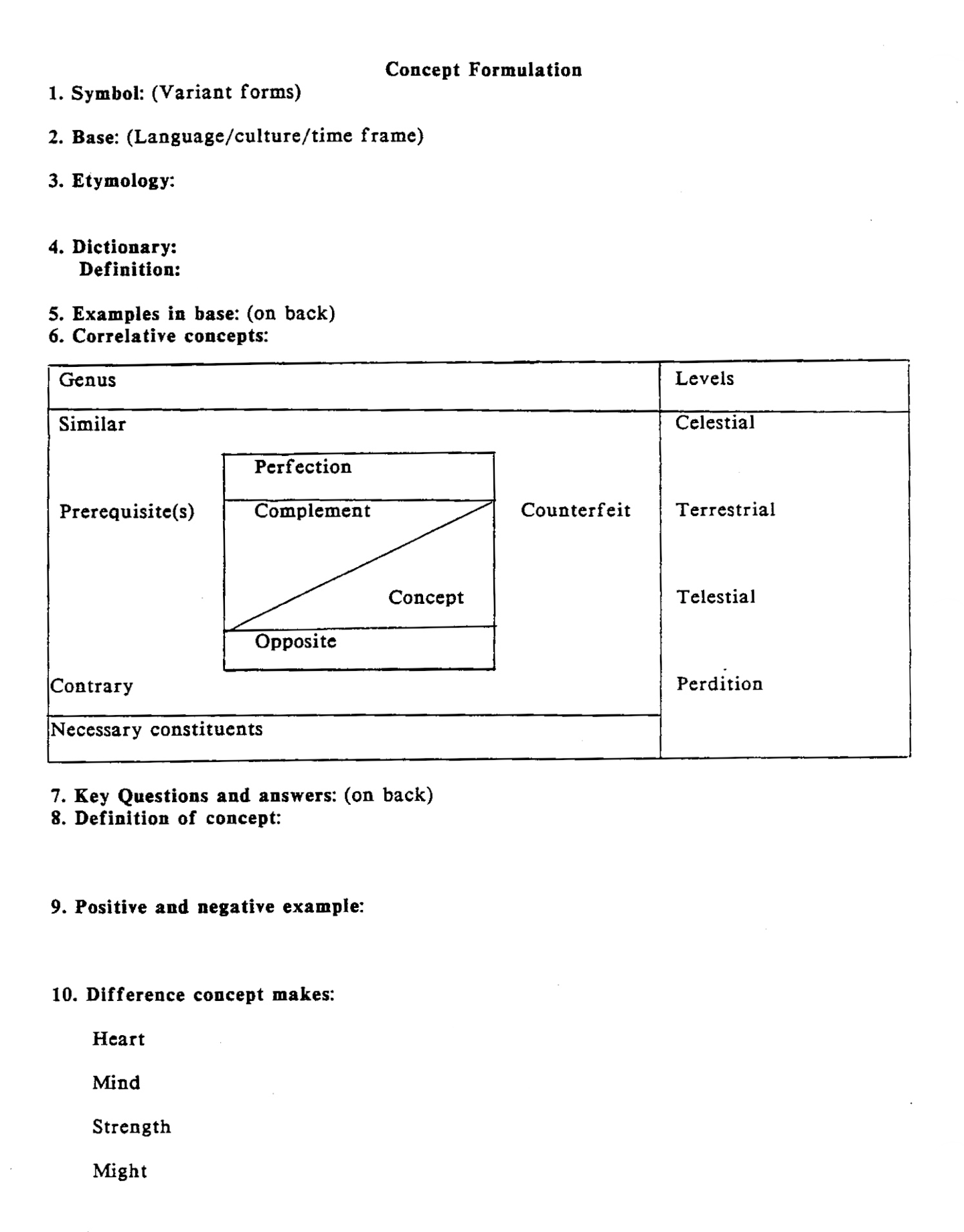
    The concept: Strategy

    1. Symbols: Strategic, stratagem, strategist.
    2. Base: Scientific/humanistic, with Restored Gospel applications
    3. Etymology: Gk strategos, a general of an army; fr stratos, army + agein, to lead
    4. Dictionary: Webster’s Collegiate

    Definition: The science and art of employing the armed strength of a belligerent to secure the objects of war, esp. the large-scale planning and directing of operations in adjustment to combat area, political alignments, etc.; also, an instance of it.

    1. Examples in base:
    • The general’s strategy was first to destroy the enemy’s supply bases.
    • Every person should have a well-thought-out strategy to secure his retirement objectives.
    • The overall health strategy is to build general immunity rather than to attempt to suppress the causes of every individual disease.
    1. Correlative concepts:
    • Genus: Plans
    • Constituents: Resources, opposition, plan, tactics, assessment, evaluation
    • Prerequisites: Problem
    • Consequences: Better productivity
    • Similar: Intelligent action, methodology
    • Contrary: Winging it, blundering
    • Perfection: A plan that meets every possible contingency with greatest efficiency
    • Opposite: Happenstance
    • Counterfeit: Irrelevant busywork
    • Levels:
      • Celestial: Reason out plan under direction of the Holy Spirit
      • Terrestrial: Work out plan by reason
      • Telestial: Minimal planning, mostly impulse
      • Perdition: Work out plan to benefit self, betray others
    1. Key Questions:
      1. What makes a plan into a strategy?
        1. Through systems thinking.
      2. Are strategies unique plans or standardized?
        1. May be unique to one situation or standardized approaches to meet standard problems.
    2. Definition: A strategy is a systems design created to solve a problem after a systems analysis of that problem, both carried out with all the care and acuteness one can muster.
    3. Positive example: Slipping and falling on ice with a learned strategy of failing.
      1. Negative example: Slipping and falling on ice without a strategy of falling.
    4. Effects of this concept:
    • Heart: One might desire to learn many strategies to meet the problems of life more intelligently.
    • Mind: One might study out and overlearn many valuable strategies.
    • Strength: One might employ strategies wherever feasible to hone the skills of implementing them.
    • Might: One might encourage others in his stewardship to learn strategies.

    A “person of accomplishment” is one who has mastered several important strategies and has applied them to the problems of his or her life.

    There are some strategies which everyone should master:

    • Reading
    • Science
    • Persuading
    • Writing
    • Scholarship
    • Courting
    • Personal hygiene
    • Philosophy
    • Parenting
    • Personal nutrition
    • Religion
    • Dying

    Question: Why is each of the above important for every person in a Restored Gospel frame?

    There are hundreds of other standard strategies which one would do well to master, some of which will be necessary to a specific course of life. E.g.:

    • Music
    • Translation
    • Manufacturing
    • Sports
    • Predicting
    • A profession
    • Public speaking
    • Classifying
    • Legislating
    • Budgeting
    • Farming
    • Judging

    It is clear that the ultimate strategy is the strategy of righteousness.

    Question: What is the pattern of the strategy of righteousness?

    What systems thinking steps are part of the development of a strategy?

    At least four analysis factors must be carefully delineated:

    1. The problem: Exactly what is the difficulty to be overcome?
    2. The environment: Exactly what are the static and dynamic elements of the environment in which the problem is found and in which the strategy to solve the problem must take place?
    3. The opposition: What aspects of the environment will make it difficult to overcome the problem?
    4. Resources: What aspects of the environment will be especially helpful in resolving the problem?

    What systems design steps must be added to the above to complete good strategy thinking?

    1. Strategy: What overall plan will best use the resources available to overcome the opposition and solve the problem as effectively and as efficiently as possible?
    2. What specific tactics will best implement the strategy selected?
    3. What work must be done to implement the strategy and tactics?
    4. What assessment procedures should I adopt to be sure that I attain my goal?
    5. What evaluation procedures should I adopt so that I will learn from having performed this experiment?

    Example: What strategy might one develop to do well in this course?

    1. The problem: To overlearn the target skills of the course while upgrading one’s value commitments and knowledge.
    2. The environment: The university, the other students, the professors, roommates, family, friends, the cultural milieu of Utah, the influence of the Church, the American cultural scene, the world-wide cultural influence.
    3. Opposition: External: Lack of time, money, space; lack of access to people who could assist by example and by instruction. Internal: bad habits, impure desires, poor health, lack of previous development, laziness, sloth, not enough recognition of the guidance of the Holy Spirit.
    4. Resources: External: Encouragement of parents and friends, class time and discussions afterwards, instructors, the library, intelligent and learned friends; time, space and money. Internal: Intense desire to learn, the companionship of the Holy Spirit, good habits, all previous learning.
    5. Strategy: Attend every class session; pay careful attention in class; discuss the assigned material with someone else on a regular basis; study out and execute each assignment soon after class; carefully formulate each piece of written work and turn it in on time; don’t believe anything to which the Holy Ghost does not attest; believe and do everything commended by the Holy Ghost.
    6. Tactics: Learn to take careful notes, neither writing everything down nor missing any key ideas, challenge everything said and done by the instructors, classmates and self, but voice those challenges only when appropriate; humbly seek the help of the Holy Spirit to understand what is being said, to learn what is true, and to acquire the skills an values which are important; develop a review plan, reviewing main ideas after one day, seven days and thirty days to fix the main ideas in mind forever; use and test the values, skills and knowledge being developed In this course In other courses and everywhere else it is possible to do so.
    7. Work: Work hard, consistently, joyously to do the best one knows.
    8. Assessment: Express what is being learned to others, to see if what one is learning is viable and valuable. Keep track of cumulative score on class assignments to see if one is headed for the grade one needs and desires.
    9. Evaluation: Weigh the benefits of what one is learning against the costs involved to see if what is being done is of eternal value.

    What are the general features of the strategy of scholarship?

    1. Problem: To construct on the basis of record evidence a useful and accurate image of some past or distant event which one cannot perceive.
    2. Environment: A world where the past and future are unavailable for direct inspection, where they must be imagined by me to gain an idea of what they are. A world where other people are imagining the past and the future as I am, where we exchange ideas by speaking and writing, and where much of what is said about same is not very valuable.
    3. Opposition: Forgetfulness of witnesses, difficulties of communication, accidental nature of what records are preserved and which are not, lack of real understanding as to bow the world works.
    4. Resources: Memories, written records, knowledge of language(s), ability to read, ability to imagine, some understanding as to how the world works, understanding of how to be careful In evaluating what others say and In creating imaginary reconstructions of the past. (Primary sources are eye-witness or contemporary first-person accounts of historical events. Secondary sources are accounts of the past made up from primary or other secondary sources.)
    5. Strategy: Control the documents.

    Create a bibliography of every primary documentary source on the topic; examine and interpret from the original language every document on the bibliography; record all salient information in a manner that captures its essence and makes rechecking the source most convenient; read what others have had to say (secondary sources) about the topic with a grain of salt; construct one’s own account of what happened and communicate it in acceptable form; present that account to others for their acceptance or rejection.

    1. Tactics: Be honest, imaginative, inquisitive, and skeptical. Write well.
    2. Work: Work diligently, concentrating solely on one project as much as possible.
    3. Assessment: Be sure that one has completed one’s account having observed the world’s canons of good scholarship, which are:
      1. Be rational (consistent).
      2. Account for every primary source.
      3. Discount the supernatural.
      4. Tell all.
      5. Acknowledge no right or wrong.

    If one does not wish to abide the world’s canons of scholarship, one may employ the canons of good Restored Gospel scholarship, which are:

    1. Be rational (consistent).
    2. Account for every primary source.
    3. Use the help of the Holy Spirit to learn the truth of the matter.
    4. Tell only that part of the truth which the Holy Spirit instructs me to tell.
    5. Assume there is a right and a wrong; publish what is learned only if it is right to do so.

    Or one might settle for the usual student path of less resistance:

    1. Try to be consistent.
    2. Use the most convenient sources, primary or secondary.
    3. Try to please the reader in creating the account.
    4. Do no more than is necessary for the assignment.
    5. Bend to the value commitments of the instructor.
    6. Evaluation:

    Worldly standard: Accept the evaluation of one’s peers; or, accept one’s own self-evaluation.

    Restored Gospel standard: Listen to the evaluation of one’s companion, but hearken only to the evaluations of one’s presiding authorities and of the Holy Spirit.

    Student standard: Accept whatever the instructor says

    What are the general features of the strategy of science?

    1. Problem: To create reliable and accepted descriptive assertions about the world.
    2. The environment:
      1. The physical universe as observed and reported by myself and others (phenomena and facts).
      2. The physical universe as interpreted by myself and others (laws, theories, principles).
      3. The society of my peers.
      4. The Spirit of Truth (the Holy Spirit), and the evil spirit.
    3. The opposition:
      1. Inaccessible phenomena and incorrect facts.
      2. False interpretations of myself and others.
      3. Evil intent of myself and peers.
      4. Counterfeits from the spiritual adversary.
    4. The resources:
      1. Huge data base and the opportunity to observe and experiment.
      2. Some correct understanding of the universe.
      3. Opportunity to cooperate with others.
      4. Opportunity to choose the Holy Spirit as my guide.
    5. Strategy: Control the data.
      1. Ground oneself in the received traditions of men as to the truth about the world (current science).
      2. Form a hypothesis as to facts, laws, theories or principles not now part of science.
      3. Deduce the empirical consequences of the physical system envisioned in the hypothesis.
      4. Observe or experiment and observe data relevant to the empirical consequences of the hypothesis.
      5. Decide whether the data gathered confirms or denies the hypothesis. If you decide that the data denies the hypothesis, start over with a new hypothesis.
      6. If you decide that the data gathered confirms the hypothesis, publish your hypothesis with its supporting data.
      7. Accept the judgment of your peers as to whether you have made a contribution to science, or not.
    6. Tactics:
      1. Control your observations and experiments. Vary only one factor at a time as much as is possible. Be careful.
      2. Rethink every scientific interpretation (fact, law, theory, principle) hitherto accepted in science; take nothing for granted. Be skeptical.
      3. Strive first for effective hypotheses, then for efficient ones. Be creative.
      4. Know and be known by your peers. Be communicative.
    7. Work:
      1. Stay current in the literature of the field.
      2. Constantly rethink the “edges” of your field.
      3. Sharpen your mathematical tools continuously.
      4. Garner funding or resources to pursue data collection.
    8. Assessment: Be sure that you abide the canons of worldly science:
      1. Be rational (consistent).
      2. Ground your ideas in a body of “public” phenomena.
      3. Be sure your hypothesis accounts for every pertinent previously accepted hypothesis of less generality.
      4. Your hypothesis must be more general than a rival to outlast it.
      5. Your hypothesis must allow the prediction of supporting phenomena not hitherto observed.
      6. Your hypothesis must construct a monistic universe.
      7. Your hypothesis must reject the supernatural.
      8. Your hypothesis must assume uniformity, cause and effect, and least effort.
      9. Your hypothesis must be accepted by your peers.
    9. Evaluation: Your hypothesis must be evaluated and accepted by your peers to count as science. They will judge it on the basis of power (d and e above), elegance (as simple as possible), timeliness (fits current interests and ability to comprehend it), ad prejudices (f and g above, at least).

    Question:   How can one do science from a Restored Gospel frame? What would one need to change of the above?

    What are the general features of the strategy of religion?

    1. Problem: How can I shape and mold my own character to become what I desire to become?
    2. Environment: The physical/social/cultural/spiritual milieu in which I find myself.
    3. Opposition: Inertia of old habits; lack of change in those around one; the temptation to do worse instead of better, social pressure to conform to the world.
    4. Resources: Scripture, the Holy Spirit, priesthood leaders who understand and can give advice and blessings, noble examples, great achievements. One’s own desires and agency, friends and parents who are like-minded.
    5. Strategy: Control the choices.
      1. Select the traits of character one wishes to attain.
      2. Select a sequence in which to acquire them.
      3. Overlearn each habit in the sequence designated.
    6. Tactics:
      1. Start with an easy, much desired habit, so that success will assist further change.
      2. Implement at least five kinds of reminders to change the habit.
      3. Implement a system of rewards and punishments for success and failure in changing.
      4. Seek divine assistance for each change and for reminders.
      5. Keep a journal of success, failures, and progress on each habit.
      6. Set a realistic deadline for each habit change.
      7. Find out what triggered each old habit; use that trigger for the new habit when possible; or, get a new, more powerful trigger.
    7. Work: Pour heart, mind, strength and might into the fray.
    8. Assessment: Note when one can go through the triggers for the old habit many times without implementing the old habit. Have a friend tempt and try one to see if the new habit is really reflexive. 9. Evaluation: Count the cost and determine whether the new character was worth the effort.

    What are the general futures of the strategy of philosophy?

    1. Problem: To ask better questions so as to obtain better answers to the basic problems of mankind.
    2. Environment: A shadowy world were truth is difficult to come by except for immediate particulars (and it is sometimes difficult even to get truth there). A world where there are thousands of religions, each person having a slightly different religion, and where there are seemingly endless varieties of philosophic pronouncements.
    3. Opposition: The difficulty of establishing true universals. The difficulty of knowing what is good or right. The welter of opinions. The fact that one grows up in a religion and philosophy not realizing that they might be seriously flawed.
    4. Resources: The guidance of the Holy Spirit. The writings of intelligent men who have written on philosophy. Experience, which is a great teacher, but which has a high tuition. The advice and counsel of wise persons of one’s acquaintance. The opportunity to ponder and experiment.
    5. Strategy: Control the questions.
      1. Select an area of interest, narrow it to manageable proportions.
      2. Thank, pray and experiment with ideas in the subject.
      3. Search out the best thinkers in this area and acquaint yourself with their works.
      4. Formulate powerful questions and potential answers.
      5. Test those questions and answers against life, experimentation, friends and other philosophers.
      6. Write and publish your better ideas.
    6. Tactics:
      1. Question everything in a friendly, careful way.
      2. Establish some criteria for differentiating between ideas to be kept and pursued, and those which are to be discarded.
      3. Capture and record the main ideas of every thinker you encounter, making a permanent file.
      4. Keep a journal where you record your flashes of insight in a systematic way.
      5. Seek clues from the scriptures and from spiritual people.
    7. Work: Think, read and write on a regular basis.
    8. Assessment: Test your ideas and writing against those of the accepted great thinkers of your day. Ask people for reactions. Above all, consult the Holy Spirit as to how you are doing.
    9. Evaluation: Has your thinking brought greater insight and power of thought? Does it help you to see the gospel plan better? Does your thinking make you a kinder, better neighbor and a more faithful servant to the Father? Weigh the benefits against the cost.
  • Lesson Eight: Epistemology (Philosophy 110)

    Concept: Epistemology

    1. Symbols: Epistemological, epistemologically
    2. Base: Scientific/humanistic, with Restored Gospel applications
    3. Etymology: Gk. episteme, knowledge + logia, words or discourse about
    4. Dictionary: Webster’s Collegiate

    Definition: The theory or science of the method and grounds of knowledge, esp. with reference to its limits and validity.

    1. Examples in base:

    Epistemology is the most fundamental of the philosophic disciplines.

    If you wish to understand someone, track down his epistemology.

    On what epistemological grounds do you make that assertion?

    1. Correlatives:
    • Genus: Inquiry
    • Constituents: Questioning, considering, evaluating
    • Prerequisites: Doubt, wonder, blundering
    • Consequences: Skepticism, carefulness, acuity
    • Similar: Support, knowledge, verification, ascertainment
    • Contrary: Ignorance, leaping-to-conclusion, assuming
    • Perfection: Omniscience
    • Opposite: “It is said…”
    • Counterfeit: Wordiness
    • Levels:
      • Celestial: Prove all things by the Holy Spirit
      • Terrestrial: Wise use of all sources except revelation
      • Telestial: Depend on word of mouth
      • Perdition: Deliberately to mislead and to misconstrue
    1. Key Questions:
      1. Why is epistemology the most fundamental philosophic discipline? Because any discussion of metaphysics or ethics (the other parts of philosophy) depends on prior epistemological commitments.
      2. How can one learn to be keen about epistemology? By learning the various methods and combinations, then practicing them.
      3. What are the various methods? That is what this lesson is about.
      4. What is the place of epistemology in thought? Every human assertion is grounded in some human evidence or assurance. Epistemology is the technical study of actual and potential groun ds for making assertions.
    2. Definition: Epistemology is the study of human knowing through natural and divine means, with special reference to the powers and limits of each method and each combination of method.
    3. Positive example: Alma’s discussion as to how one gains a testimony.
      1. Negative example: Laman’s and Lemuel’s unwillingness even to inquire.
    4. Effects of this concept: What might and should result.
    • Heart: A desire to be founded on the rock in all things.
    • Mind: A willingness to find and treasure the truth, no matter how arduous the task.
    • Strength: Acquisition of those skills which will facilitate finding and learning truth.
    • Might: \A beginning of a godly perspective.

    Establishing a ground for an assertion is always a very personal thing.

    The following are possible positive components of a ground or basis for making an assertion:

    1. The witness of other persons.
    2. Reasoning it out for oneself.
    3. Personally sensing the thing in question: eyewitness.
    4. Observing the matter over time and different circumstances.
    5. Trying an idea to see if it works.
    6. Receiving personal revelation on the matter.

    There is also a negative force or power which enables us to discard any basis material which we judge to be faulty or insufficient: Skepticism.

    The positive and negative possibilities for support each give rise to a separate epistemological stance, each having strengths and limitations.

    Building a basis for an assertion is much like establishing a foundation for a house. One starts with what is already there, then imports whatever materials are available to make a sure and stable foundation, casting out any material which will prove to be unstable and undependable.

    The assembling of support material for an assertion depends upon the heart, mind, strength and might of the individual person. Thus each person’s basis for making an assertion having the identical form will be very different. Example: Many persons say, “I know that the Restored Gospel of Jesus Christ is true,” but no two persons will have exactly the same experiences and other evidences as a basis for that assertion, even though different bases may be equally adequate for making that assertion.

    Authoritarianism: Accepting the testimony of other human beings.

    Definition: Forming and accepting ideas on the basis of the witnes of other human beings.

    Etymology: F autor; L auctor, fr augere to increase, produce

    Complements:      Authoritative/untrustworthy

    Authoritarian/cooperative

    Levels of authoritarianism:

    • Celestial: None (see personal revelation, below)
    • Terrestrial: Reason, tradition, agreement (as in civil law)
    • Telestial: Brute force (police and military power)
    • Perdition: Deception and coercion.

    Example: Parents teaching their children to speak their mother tongue.

    Relevant citations:

    Cursed is he that putteth his trust in man, or maketh flesh his arm, or shall hearken unto the precepts of men, save their precepts shall be given by the power of the Holy Ghost. (2 Nephi 28:31)

    And now Alma began to expound these things unto him, saying: It is given unto many to know the mysteries of God; nevertheless they are laid under a strict command that they shall not impart only according to the portion of his word which he doth grant unto the children of men, according to the heed and diligence which they give unto him. And therefore, he that will harden his heart, the same receiveth the lesser portion of the word; and he that will not harden his heart, to him is given the greater portion of the word, until it is given unto him to know the mysteries of God until he know them in full. And they that will harden their hearts, to them is given the lesser portion of the word until they know nothing concerning his mysteries; and then they are taken captive by the devil, and led by his will down to destruction. Now this is what is meant by the chains of hell. (Alma 12:9-11)

    To ponder:

    1. About 90% of what most persons believe has only authoritarian support.
    2. Human witness has value on a sliding scale:

    Most valuable:          Disclosures of a person’s heart and mind.

    Directives as to how to do things the speaker has done.

    Descriptions of things here and now. (Facts)

    Descriptions of the past. (Laws)

    Descriptive hypotheses about the unseen world. (Theories)

    Least valuable:   Directives as to how to solve human problems. (Wisdom)

    1. The greatest problem about using authoritarianism is knowing whom to trust as an authority. One must be an authority on a subject to know who is an authority, and then they don’t need the witness of that other authority.
    2. Devices of the world used to get ignorant persons to trust others as authorities:
    • Official position
    • Familiarity
    • Age
    • Jargon
    • Prowess
    • Testimonials
    • Honors of men (degrees)
    • Printed words
    • Blood (blue)
    • Official stationery
    • Past triumphs
    • Clothing (vestments)
    • Force, strength
    • Lavish surroundings (banks)
    1. Warrant: Other good evidence (not including any of the above) that what a person says is true or trustworthy. Examples:

    Corroborated by the testimony of other persons who are known to be reliable. Fits with what you already know.

    Squares with what you see and hear.

    You have tried it and it works.

    Attested to by the Holy Spirit.

    1. The Savior restored his gospel in these latter days so that no man would need to accept the testimony of another person on any matter. If one lives that gospeL the only sufficient warrant for believing anything is the testimony of the Holy Spirit.
    2. We accept the human General Authorities of the Church of Jesus Christ of Latter- day Saints only because their words and deeds are given supporting warrant by the Holy Spirit.

    Questions:

    1. What is our principal clue that most human beings are untrustworthy witness about most important things?
    2. Why are the honors of men a trap?

    What would happen to our civilization if everyone suddenly was consciously in communication with the Savior and believed him, and thus no longer accepted the sole witness of another human being as a sufficient basis for believing anything?

    Rationalism: Using reason as a basis for certifying an idea. 

    Definition: Certifying an idea because it agrees with or is deducible from premises we already believe.

    Etymology:        L ratio a reckoning, a relation

    Complements:      Rational/Emotional

    Rational/Empirical

    Opposite:         Reasonable/irrational

    Example:    If all men are mortal, and I am a man, then it will occur to me to deduce the assertion that I am mortal.

    Relevant citations:

    And even so I have sent mine everlasting covenant into the world, to be a light to the world, and to be a standard for my people, and for the Gentiles to seek to it, and to be a messenger before my face to prepare the way before me. Wherefore, come ye unto it, and with him that cometh I will reason as with men in days of old, and I will show unto you my strong reasoning. (D&C 45:9-10)

    And now come, saith the Lord, by the Spirit, unto the elders of his church, and let us reason together, that ye may understand; Let us reason even as a man reasoneth one with another face to face. Now when a man reasoneth he is understood of man, because he reasoneth as a man; even so will I, the Lord, reason with you that you may understand. (D&C 50:10-12)

    To ponder:

    1. Rationalism is based on the notion that there are clear and definite fundamental assertions which are directly self-evident to intelligent persons from which all truth could be deduced. (The model for this was Euclidean geometry.)
    2. The weakness of rationalism is that it must begin with premises, and no more can be gained from the conclusions than was originally found in the premises. If one starts with wrong premises, then nothing is sure.
    3. Educated people usually pride themselves on being rational about what they do. They have (or can quicKly make up) a rationale for everything they do and don’t do.
    4. The strength of rationalism is that it can show inconsistency, which is usually a sign that something is drastically wrong. Thus it functions in practice as a negative, rather than as a positive test of truth.
    1. The basic processes of reasoning are:
    2. Deduction: Deriving a necessary conclusion from given premises by given rules of inference.

    Example: Given the premises: All A is B, and All B is C, one may conclude by the rules of syllogistic reasoning that All A is C.

    1. Induction: Deriving a conclusion about a whole class of things (anything) on the basis of evidence about characteristics of part of that same class or population.

    Example: If by inspection I see that one of a pair of shoes is worn out, I may conclude that the other one of the pair is also worn out (the pair is worn out). (This, as induction always is, is a guess.)

    1. Adduction: Creating premises from which a given conclusion may be deduced in accordance with given rules of inference. (There are in most systems of thinking an infinite number of sets of premises from which a given premise may be deduced.) As an individual uses this process to find or to create the reasons why he does something, we call the process rationalization. In science, the process is called hypothesization, and usually is the process of theory construction. In detective work, it is also called creating a hypothesis.

    Example: If I am given the conclusion that All men are mortal, I may then search for premises and come up with All men are children of Adam and Eve. All children of Adam and Eve are mortal. From those premises I may then draw the given conclusion by the given rules of the categorical syllogism.

    1. Reason is at its best when we have an extra-rational source of true general propositions (assertions) which we can use as premises in our reasoning. From particular propositions (assertions) one can deduce nothing.
    2. Important rationalists:

    Rene Descartes: French soldier and mathematician (1596-1650). He developed cartesian coordinates, analytical geometry. Principal philosophic work: Discourse de Ia methode.

    Gottfried Wilhelm Leibniz: German mathematician, diplomat, historian, theologian (1646- 1716). Principal philosophic works: Discourse de Ia metaphysique, 1686, and Monadolo, 1714.

    Questions:

    Why is it good to be rational but not as good to be a rationalist?

    In what ways does a university education support rationalism?

    Empiricism: See for yourself.

    Definition: The use of sensory experience to certify ideas. (But these ideas are usually embedded in an authoritarian/rationalistic frame of thought.

    Etymology: Gr empirikos fr Ln + peira, experiment

    Example: Bringing rocks from the moon to see what it is made of.

    Relevant citations:

    And after eight days again his disciples were within, and Thomas with them: then came Jesus, the doors being shut, and stood in the midst, and said, Peace be unto you. Then saith he to Thomas, Reach hither thy finger, and behold my hands; and reach hither thy hand, and thrust it into my side: and be not faithless, but believing. And Thomas answered and said unto him, My Lord and my God. (John 20:26-28)

    Verily, thus saith the Lord: It shall come to pass that every soul who forsaketh his sins and cometh unto me, and calleth on my name, and obeyeth my voice, and keepeth my commandments, shall see my face and know that I am. (D&C 93:1)

    To ponder:

    1. The strength of empiricism is that for things capable of being sensed it provides an excellent test of assertions. Unfortunately, many important things cannot be sensed (such as the future, the past, spirits, causes, etc.).
    2. Empiricism is helpful when one is already well experienced in a matter and has well-developed concepts. An experienced horseman can tell much about a horse just by looking at it. But empiricism is not very useful when there are no concepts m place, such as when most persons look under the hood of an automobile.
    3. Empiricism may mislead, either because we cannot sense with clarity or we do not have a clear concept to start with.
    4. The great flaw in empiricism as an epistemology is that it must have a non-empirical concept base in which to operate.
    5. Gathering empirical information by observation is the process of pattern recognition (seeing familiar things, the concepts we already have) and at the same time seeing or forming new patterns of things we have not before observed, or seeing old concepts in new arrangements.

    Example: A hunter must know and understand the terrain to be successful. The terrain is the old and familiar. He seeks game, also an old and familiar concept, but he seeks to observe where a specimen is right now. This latter is the new.

    1. Some of the laws/rules that characterize empirical observation:
    2. We tend to ignore more than we bring to the focus of consciousness.
    3. We sense and report patterns, not individual and unique experience.
    4. We report new things by making them analogies to familiar things.
    5. We observe and report with a purpose, which greatly affects what we see and report, and what we ignore or take for granted.
    6. The more developed is our concept bank, the more we can see when we look.
    7. We tend to see only what we are willing to believe. For example, people who do not believe in miracles usually do not see any.
    8. Empiricism thus provides reliable truth about the universe only when:
    9. We have correct concepts, formed out of much experience and instruction.
    10. We have full and undistorted sensory impressions.
    11. We are not biased in what we wish to see.

    Important empiricists:

    John Locke, English physician (1632-1714).

    Two Treatises on Government, 1689 (Ideas relevant to the U. S. Constitution.) Essay on Human Understanding, 1690 (All ideas originate in sensation.)

    George Berkeley, Irish clergyman (1685-1753).

    Treatise on the Principles of Human Knowledge. 1710. (Matter does not exist, but is only a concept in our minds.)

    David Hume, Scottish philosopher (1711-1776).

    Enquiry Concerning Human Understanding. (Our idea of causation is not empirical; therefore, not all ideas are empirical.)

    Questions:

    1. How do the requirements for empiricism (#7 above) map to heart, mind, strength?
    2. Why must every painter be an empiricist?

    Statistical empiricism: Arrays of empirical data.

    Definition: Certifying ideas on the basis of correlations of arrays of empirical data in an authoritarian/rationalist/empiricist frame.

    Example: Testing several brands of tires under severe controlled wear conditions to determine which brand is the best.

    Relevant citations:

    O Jerusalem, Jerusalem, thou that killest the prophets, and stonest them which are sent unto thee, how often would I have gathered thy children together, even as a hen gathereth her chickens under her wings, and ye would Dot! Behold, your house is left unto you desolate. For I say unto you, Ye shall not see me henceforth, till ye shall say, Blessed is he that cometh in the name of the Lord. (Matt 23:37- 39)

    We have learned by sad experience that it is the nature and disposition of almost all men, as soon as they get a little authority, as they suppose, they will immediately begin to exercise unrighteous dominion. Hence many are called, but few are chosen. (D&C 121:39-40)

    To ponder:

    1. Empiricism tells us what things happen, but only statistical empiricism can tell us under what regular conditions things happen. This is not a knowledge of causation, but of correlation.
    2. A false concept can cause one to gather data only to confirm that concept. For example, those who believe that the dole is good for people tend to see only the data that supports that view.
    3. In every statistical inquiry one must make many assumptions or hypotheses. Sometimes these are so powerful that they overwhelm any data gathered. Doing a valid statistical study is a difficult task.
    4. All statistical data must be manipulated by some rational process to produce any result. The rational process should be chosen with great care before the data is gathered.

    Important statistician:

    Karl Pearson, British biologist (1857-1936), the father of modern statistics.

    The Grammar of Science. 1911. (The world is our construct.)

    Questions:

    1. Why is it better to use the concept of correlation than to use the concept of causation in science?
    2. Why is statistical empiricism a rich man’s epistemology?
    3. When you read a study which comes to conclusions based on statistics, why should you read the whole report, not just the conclusions?

    Pragmatism: It works!

    Definition: Accepting as sufficient support for an idea that it seems to work, to be useful.

    Etymology: Gr pragmatikos, fr pragma, a thing done, business; fr prassein, to do

    Example: Believing that cod-liver oil helps because you feel better when you take it.

    Relevant citations:

    Now, we will compare the word unto a seed. Now, if ye give place, that a seed may be planted in your heart, behold, if it be a-true seed, or a good seed, if ye do not cast it out by your unbelief, that ye will resist the Spirit of the Lord, behold, it will begin to swell within your breasts; and when you feel these swelling motions, ye will begin to say within yourselves–It must needs be that this is a good seed, or that the word is good, for it beginneth to enlarge my soul; yea, it beginneth to enlighten my understanding, yea, it beginneth to be delicious to me. (Alma 32:28)

    And all saints who remember to keep and do these sayings, walking in obedience to the commandments, shall receive health in their navel and marrow to their bones; And shall find wisdom and great treasures of knowledge, even hidden treasures; And shall run and not be weary, and shall walk and not faint. (D&C 89:18-20)

    To ponder:

    1. Pragmatism is most valuable in areas where we either have no truth, or where the received truth does not seem to work.
    2. Pragmatism is a substitute for a firm grasp on the truth. But it may be an important beginning of finding the truth. When all else fails, each of us tends to become pragmatic.
    3. The danger in pragmatism is that we may settle for it, not recognizing that we must seek further. For instance, evil persons can do many powerful things using the power of the adversary. But one would not want to accept them as prophets of God just because they have power. We must also use other epistemologies to find out just what kind of a power we are dealing with.
    4. Pragmatism leads one to indulge in the fallacy of post hoc, ergo propter hoc: after this, therefore because of this. Example: I become ill after dinner, but was it really what ate that made me ill?
    5. Pragmatism also may lead one to comfort oneself with the idea that the end justifies the means. If I get my way every time I become angry, I am tempted to use anger to get my way, then to comfort myself by justifying the anger because it produces such desirable results.

    Important pragmatists:

    Charles Sanders Pierce, American scientist and philosopher (1839-1914).

    Collected Papers

    William James, American psychologist and philosopher (1842-1910)

    Pragmatism

    John Dewey, American philosopher, (1859-1952).

    How We Think

    Question:

    1. Why is pragmatism the most fundamental epistemology?

    Skepticism: Let’s be sure!

    Definition: Rejection of all assertions for which there is contrary or insufficient support.

    Etymology: F sceptique, fr L scepticas, fr Gr skeptikos, thoughtful, reflective

    Opposite: Skeptical/assured

    Complement: Sceptic/believer

    Example: Only when one becomes dissatisfied with one’s traditional religion will one search out and accept the Restored Gospel of Jesus Christ.

    Relevant citations:

    Cursed is he that putteth his trust in man, or maketh flesh his arm, or shall hearken unto the precepts of men, save their precepts shall be given by the power of the Holy Ghost. (2 Nephi 28:31)

    Wherefore, it shall come to pass, that if you behold a spirit manifested that you cannot understand, and you receive not that spirit, ye shall ask of the Father in the name of Jesus; and if he give not unto you that spirit, then you may know that it i~ not of God. (D&C 50:31)

    To ponder:

    1. Skepticism is the backbone that unites all religions, philosophies, science, and thoughtful inquiry. They all reject the idea that man in his natural state is sufficient. But of course they differ greatly as to the best cure.
    2. One can be too skeptical, rejecting even those things for which there is abundant good evidence.
    3. Anciently to be a Sceptic was to belong to a certain school of philosophy. They rejected all religions and philosophies and dogmatism of every sort. Such sought to live a quiet, peaceful life by living according to appearance, custom, habit and environment. Their plea was to avoid the excess speculations of the other philosophers.
    4. To be skeptical one need not be a Sceptic. It behooves everyone to be skeptical lest they be taken in by unscrupulous men or the snares of the adversary, or even by their own superficiality or carelessness. But to live and act as a normal human being one cannot be skeptical about everything.
    5. Extreme skepticism leads to cynicism, which is the idea that nothing is good, or holy or worthwhile in this world. A true cynic would soon die, for he would be cynical about even eating. Most cynics are very selective about what they wish to reject. That cynicism becomes a posture of rebellion, and usually destroys good as well as bad.

    Important sceptic:

    Francois Marie Arouet de Voltaire, French dramatist, historian, encyclopedist (1694-1778). Dictionaire philosophique.

    Question:

    1. What is the relationship between skepticism and free agency?

    Mysticism: Feeling is better.

    Definition: Rejection of thinking as a basis for knowing reality and substituting feeling in its place.

    Etymology: L mysticus, fr Gr mystikos, secret rites, fr mystes, one initiated

    Opposite: Mystic/hard-headed realist

    Complement: Mystical/effable

    To ponder:

    1. Mysticism is skepticism towards reason and sensory experience. It hopes for satisfaction is some non-rational, non-empirical feeling of euphoria.
    2. Mystical experience can be approached through any medium, including reason and sensory experience. But at some point there must be a transcendence, a crossing to another realm which cannot be described in words or captured in rational concept systems.
    3. Every major religion and philosophy have had adherents who have turned to mysticism to find fulfillment.
    4. The Restored Gospel of Jesus Christ is not mystical in any way, for one of the requirements for something to be of God is that it must be intelligible, understandable, of light and truth.
    5. It is possible that what some people call mystical fulfillment is revelation from the adversary.

    Questions:

    1. Why is mysticism not a very social enterprise?
    2. Why do “artistic” types of persons often drift off into mysticism?
    3. Why are little children not inclined to be mystics?
    4. What is the connection between mysticism and the drug culture?

    Fabrication: Inventing ideas to fill in the holes in our knowledge.

    Definition: Fabrication is the making of ideas, using imagination, to satisfy our desire to know the answer to some question.

    Etymology: L fabricatus, to build, for’ fr fabrica, a fabric or workshop

    Complement: Fabricate/find

    Opposite: Natural occurrence

    Example: My friend is late for work and has grease on his hands. I hypothesize (fabricate) that he had a flat tire on the way.

    Relevant citation:

    They seek not the Lord to establish his righteousness, but every man walketh in his own way, after the image of his own god, whose image is in the likeness of the world, and whose substance is that of an idol, which waxeth old and shall perish in Babylon, even Babylon the great, which shall fall. (D&C 1:16)

    To ponder:

    1. Fabrication under the names of hypothesizing, guessing, formulating a theory, estimating, etc., is an important part of the life of every human being. It is troublesome only when a person believes a fabrication without further evidence.
    2. The name for fabrication in science is “theory construction.”
    3. Systems design is all fabrication.
    4. Artistic creation is fabrication of a material expression which is usually guided by a prior mental and emotional fabrication within the artist.
    5. All manufacturing is fabrication, as is all creativity. What we here are most concerned with is fabrication of ideas to stand in the place of things known to be so by other evidence. Sometimes we must make guesses and act on the basis of them because we cannot do better.

    Science: the fabrication of assertions to describe the universe.

    Description: Science is a compound or complex epistemology. It combines authoritarianism, rationalism, empiricism, statistical empiricism, skepticism, pragmatism and fabrication. Each of these separate epistemologies is used in the production of reliable descriptive assertions: factual assertions, law assertions, theory assertions, and principle assertions. (See the theory of descriptive assertions in Lesson Six for a fuller discussion of those assertions. See Lesson Seven where science is discussed as a strategy.

    It is important to realize that science, as a complex epistemology, is important in the epistemological arsenal of every educated person.

    Many persons believe that science is the ultimate epistemology. What ever is supported by scientists is the truth, and whatever is not supported by scientists is superstition. (This ignores the fact that scientists disagree much of the time.)

    Scholarship: the fabrication of assertions about the past

    Description: Scholarship is the fabrication of assertions about events which cannot be presently seen, mainly the past, on the basis of the record evidence available. The main strategy of scholarship is the control of extant documents, which is to find, translate, interpret, and formulate ideas using documents, then to fabricate an account of the events to which the documents relate in such a way as to account for all of the documentary evidence in a way that accords with some set of canons. This complex epistemology uses authoritarianism, rationalism, empiricism (minor), statistical empiricism (evidence about authenticity of documents, etc), skepticism, and pragmatism. Scholarship is to the world of history what science is to the natural or present physical world. (See Lesson Seven for a discussion of scholarship as a strategy.)

    Before the rise of science, to be a scholar was a great honor. To flatter someone, he would be referred to as a “gentleman and a scholar.”

    Scholarship is also important in the epistemological arsenal of every educated person.

    Knowledge of good and evil: the ability to make moral choices.

    Description: Good is the righteousness of God; evil is any alternative to the righteousness of God, especially as promoted by Satan. This knowledge is guaranteed to every human being because of the fall of Adam. Everyone knows the good to some degree because everyone is touched by the light of Christ, which is the vehicle by which the knowledge of good comes to them. Everyone knows the evil because everyone is under the influence of the Fall, wherein Satan was given a stewardship to tempt Adam and Eve and all of their posterity.

    The knowledge of good and evil comes to each person as an awareness that there is an important difference between things. The good and the evil do not come labeled. What we sense is the difference. It is the agency of man to call one of them “good” and the other “evil.” A person who is good in his heart will call good “good” and evil “evil.” But an evil person will call some evil things “good” and some good things “evil.” It is the agency of mankind to make that choice. Every human being is forced to make that choice between good and evil many times every day.

    Many people in the world would like to pretend that there is no way to know good and evil, that good and evil are not “objective” categories. The world substitutes that which pleases me for good and that which displeases me for evil, then says all values are relative (what pleases individuals is relative). But each person knows in his heart that there is a real good and a real evil. Children have no trouble admitting this. But as people are acculturated in this world, that education tends to substitute cultural standards for the light of Christ, confusing nearly everyone.

    Knowledge of good and evil is the fundamental epistemology. It is primary, or fundamental, because no one can surely grasp the truth or the goodness of anything without using this epistemology. Someone who tries to use personal revelation as an epistemology will almost invariably accept revelation from the wrong source unless they have paid careful attention to the difference between good and evil and have practiced choosing only the good in their daily lives. Even pragmatism will not work fully unless one has a prior knowledge of good and evil.

    Relevant citation:

    Now we will compare the word unto a seed. Now, if ye give place, that a seed may be planted in your heart, behold, if it be true seed, or a good seed, if ye do not cast it out by your unbelief, that ye will resist the Spirit of the Lord, behold, it will begin to swell within your breasts; and when you feel these swelling motions, y e will begin to say within yourselves–It must needs be that this is a good seed, or that word is good, for it beginneth to enlarge my soul; yea, it beginneth to be delicious to me. (Alma 32:28)

    Personal Revelation: Communication with another world.

    Definition: Ideas, feelings and directives which come from usually unseen, always non-human sources.

    Etymology: F reveler, fr L revelare, to unveil; fr re + velue, to veil, fr velum, a veil.

    Complement: Reveal/ hide, conceal

    Example: The First Vision of the Prophet Joseph Smith in the grove.

    Relevant citations:

    God shall give unto you knowledge by his Holy Spirit, yea, by the unspeakable gift of the Holy Ghost, that has not been revealed since the world was until now; Which our forefathers have awaited with anxious expectation to be revealed in the last times, which their minds were pointed to by the angels, as held in reserve for the fullness of their glory; A time to come in the which nothing shall be withheld, whether there be one God or many gods, they shall be manifest. All thrones and dominions, principalities and powers, shall be revealed and set forth upon all who have endured valiantly for the gospel of Jesus Christ. (D&C 121:26-29)

    For thus saith the Lord–I, the Lord, am merciful and gracious unto those who fear me, and delight to honor those who serve me in righteousness and in truth unto the end. Great shall be their reward and eternal shall be their glory. And to them will I reveal all mysteries, yea, all the hidden mysteries of my kingdom from days of old, and for ages to come, will I make known unto them the good pleasure of my will concerning all things pertaining to my kingdom. (D&C 76:5-7).

    And when ye shall receive these things, I would exhort you that ye would ask God, the Eternal Father, in the name of Christ, if these things are not true; and if ye shall ask with a sincere heart, with real intent, having faith in Christ, he will manifest the truth of it unto you by the power of the Holy Ghost. And by the power of the Holy Ghost ye may know the truth of all things. (Moroni 10:4-5)

    To ponder:

    1. There are two kinds of personal revelation: good from God and evil from Satan. Because there are two, man is free, for he may choose between the two, to follow whichever one pleases him.
    2. Every human being receives an abundance of personal revelation. Everyone, good and bad, has revelation from Satan. But some persons are so evil that the good spirit has ceased to strive with them.
    3. Sooner or later every human being receives a full understanding of the gospel of Jesus Christ through the Holy Spirit. This is the heritage of every child of God. Whether one receives that gospel into his life or not is up to each person. When one receives it (as opposed to hearing it is also up to each individual. Every human being receives that gospel sooner or later, though some then renounce that acceptance and become sons of Perdition.
    4. Sin is disobedience to the word, which is the law, of God. But sin is imputed only when the individual has been given that law by God in personal revelation and then disobeys.
    5. Most Latter-day Saints are virtually immersed in personal revelation from both sources yet are usually oblivious to the presence of either kind. To become conscious of these two kinds of revelation, to detect and to distinguish them with accuracy is one of the most important skills any person can have.
    6. Faith in Jesus Christ is to depend on the information received from Him through personal revelation. To be faithful is to depend solely on Him in that way.

    Questions:

    1. What is the relationship between mysticism and the mysteries of God?
    2. How can one learn to distinguish the good spirit from the evil spirit?
    3. Why cannot some individuals get the revelations they desire to have?
    4. Why do some persons try not to get revelation from God?
    5. What is the etymology of the word wicked?
    6. To consider the support for an assertion is to ask: How do you know? and, How do you know you know?
    7. Every assertion has a support component.
    8. To evaluate the internal and external support for an assertion requires that one be a master of epistemology and its various modes of verifying assertions. The wise person is one who understands them all and uses each as it is appropriate.
    9. An intelligent person will use authoritarianism, rationalism, empiricism, statistical empiricism, pragmatism and skepticism in conjunction with personal revelation from the Lord, the latter being the most important factor, the rock on which his knowledge and action is based.
    10. A servant of Jesus Christ should always be able to tell another person how he knows what he knows. This is part of bearing a valid testimony.
    11. We know that we know because we can receive and to do those things which God has instructed us to do. (1 John 2:3)

    Epistemologies

    Type
    Description – Forming and cert. ideas on basis of:
    Strength
    Weakness

    Authoritarianism
    Description: Testimonies of other human beings
    Strength: Easy
    Weakness: Most human beings overstate their knowledge

    Rationalism
    Description: Ideas consistent with accepted ideas
    Strength: When premise is true usually conclusion is true
    Weakness: Difficult to know when premise is true

    Empiricism
    Description: One’s own sense
    Strength: Directly related to impressions around us
    Weakness: Cannot sense many important things

    Statistical Empiricism
    Description: Mathematical manipulation of arrays of empirical data
    Strengths: Establishes correlation
    Weaknesses: Correlation often confused with causation: bad samples, bad manipulations

    Pragmatism
    Description: Ideas that work
    Strength: Last resort, but a good one
    Weaknesses: May be coincidence

    Fabrication
    Description: Inventing ideas to answer questions
    Strengths: Creates hypothesis to fill in the holes
    Weaknesses: May come to be believed

    Science
    Description: Combination of rationalism, statistical empiricism, pragmatism, fabrication, based on empirical data
    Strengths: Powerful aid to technology
    Weaknesses: Theory comes to be considered law, even fact

    Scholarship
    Description: Combination of rationalism, pragmatism, fabrication, based on documentary evidence
    Strengths: Facilitates construction of histories
    Weaknesses: Histories may be taken as truth

    Skepticism
    Description: Doubting all ideas not sufficiently supported
    Strengths: Enables one to shed bad ideas
    Weaknesses: May go too far and turn into cynicism

    Knowledge of good and evil
    Description: Perception of value differences of among things
    Strengths: Enables one to make choices
    Weaknesses: Choices can be good and bad

    Personal Revelation
    Description: Testimony of non human beings
    Strengths: Richest source of ideas: source of all metaphysical truth
    Weaknesses: Two sources; God and Satan
  • Lesson Six: Communication (Philosophy 110)

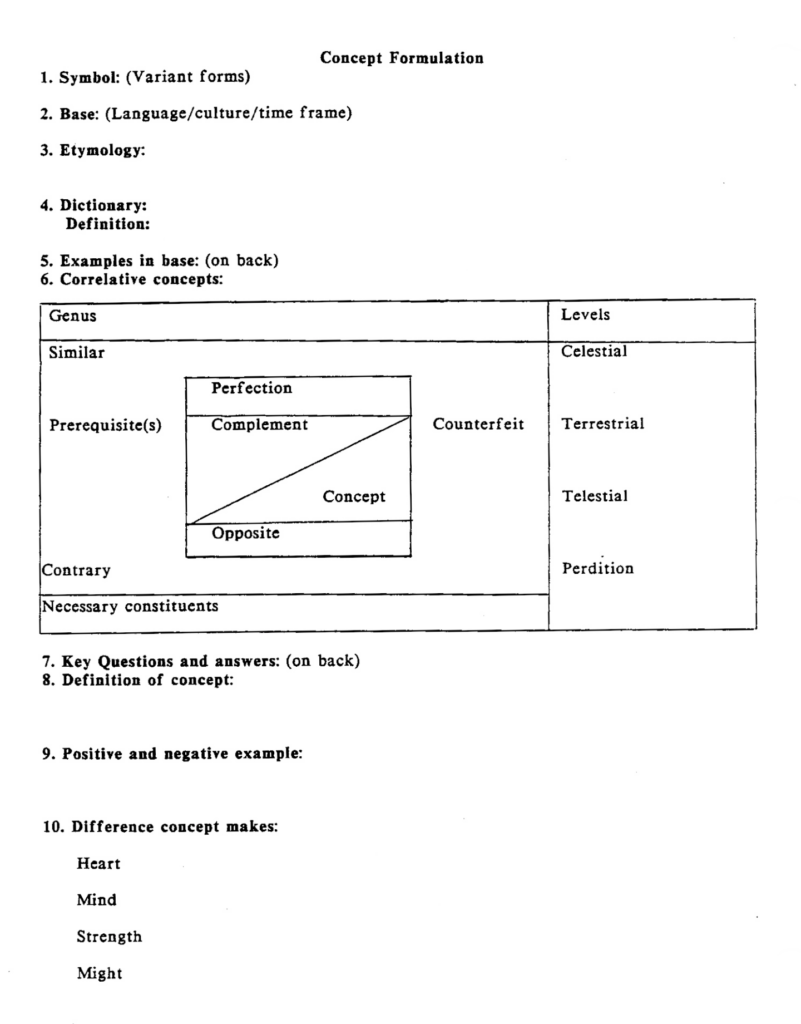
    Concept: Communication

    1. Symbol: Communicative, communicator, communicatee, communicating.
    2. Base: Restored Gospel
    3. Etymology: L. communis, fr. com + munio, to build a wall, to enclose together, to be together inside, thus to be together in ideas, feelings and actions.
    4. Dictionary: Oxford English Dictionary

    Definitions:

    • To give to another as partaker, transmit.
    • To impart (knowledge or information).
    • To impart a material thing.
    • To share in or use in common.
    • To converse with.
    • Vessels, spaces, rooms which open into each other.

    Examples in base: To communicate a disease. The parlor communicates with the study. The king killed the bearers of the unwanted communication. His expression communicated great distress.

    1. Correlative concepts:
    • Genus:    Relationships
    • Constituents:   At least two things in some relationship.
    • Prerequisites:  At least two things.
    • Consequences:   Possibility of moving from one place to another.
      • Effect of one thing on another.
    • Similar:       Influence, sharing, effect.
    • Contrary:       Passive, inert, self-contained, closed.
    • Perfection:     Total union with.
    • Opposite:       Private, alone.
    • Complement:     Aloof.
    • Counterfeit:    Deceive.
    • Levels:
      • Celestial: Communicate love.
      • Terrestrial:      Communicate truth.
      • Telestial:  Communicate material things only.
      • Perdition:  Communicate to destroy (hate, lies, bombs, etc.)
    1. Key Questions:
      1. Why do intelligent beings communicate?
        1. to fulfill desires.
      2. What is righteous communication?
        1. Where all parties are better off as a result.
      3. Why is not sending a message a powerful form of communication?
        1. It says “I don’t care about you.”
      4. Why is too much communication at times an evil?
        1. Because what is important tends to get lost in the mass.
    2. Definitions:
    • Static communication: The physical connection of one thing with another.
    • Dynamic communication: The effect one being has upon another.
    1. Negative/Positive Examples:
      1. Negative example: Saul was unaffected by Stephen’s testimony.
      2. Positive example: Saul was greatly affected by Jesus’ testimony.
    2. Desired effect of this concept:
    • Heart: I should desire to have a good effect on every being I influence.
    • Mind: I should thoroughly understand the communication process and communicate only truth wherever possible.
    • Strength: I should master good communications skills.
    • Might: I should surround myself with good things, thus assuring that my stewardship communicates encouragement to do good things to all who see it.

    To exist is to communicate.

    To be an intelligent being is to have desires and to seek to fulfill them. Desire is occasioned by an adverse environment. Dynamic communication is the attempt of an intelligent being to get the environment to change to fulfill its desires. Thus all deliberate action is communication.

    Whatever one does or does not do has an effect on one’s environment, even if the action is quite inadvertent. Inadvertent action is thus a communication.

    Non-intelligent beings also affect their environment. Example: A drive line communicates (transmits) power. Thus all action is communication.

    Passive beings also affect their environment. Example: The mountain just sits there; but it affects everything around it. Thus it also communicates.

    Thus to exist is to communicate. Every action and non-action has an effect on the environment, intended or unintended.

    The unit of communication by intelligent beings is the message.

    A message is the effect an intelligent being has upon the occasion of a given act.

    All messages have at least four parts:

    1. The sender’s purpose. What the sender is trying to accomplish.
    2. The sender’s assertion. What the sender does.
    3. The sender’s support. The strength or power of the assertion.
    4. The sender’s relevance. The effect the sender’s given act has and will yet have on the environment because of the assertion made.

    Example a: You are watching an archer shoot an arrow. To understand him you must:

    1. Hypothesize what he is trying to hit.
    2. Observe what kind of an arrow he is shooting.
    3. Estimate the power of the bow he is using.
    4. Observe or hypothesize the effect his arrow will have on whatever it strikes.

    Example b: You see red and blue flashing lights in your rear-view mirror. To understand those lights you must:

    1. Guess who the lights are intended to affect.
    2. Know that such lights mean to pull over to the roadside.
    3. Wonder what authority the user of the lights has.
    4. Remain in ignorance until you see what comes of this.

    Example c. Someone is speaking in sacrament meeting. To understand this person you must;

    1. Hypothesize his real intent.
    2. Hear the actual words he says and form them into meanings, then boil the total communication down to a single assertion.
    3. Observe the evidence that he speaks the truth, both out of the support he offers for his message and that which you have in your mind which confirms or denies the truth of what is said.
    4. Observe the effect of the message on yourself and others and guess what the future effects will be, if any.

    Simple capture is the delineation of the four factors of a message:

    1. Purpose. (Your hypothesis as to the intent of the communicator.)
    2. Main assertion. (Your summary of what the communicator does/says to fulfill that intent.)
    3. Support. (Your summary of the evidence given for the speaker of the value of what he says [internal support], and the relevant evidence of which you are aware from the present environment and from your prior knowledge [external support]).
    4. Relevance. (Your estimate of the present effect or importance of the main assertion [proximate relevance] and also of the long-range relevance [ultimate relevance].)

    Simple capture is the minimum adequate understanding of a communication.

    Total communication occurs when there is a full, complete capture of a message.

    Total communication is the complete understanding of an assertion. To achieve this the observer must:

    1. Know the speaker’s purpose as one aspect of all of his desires.
    2. Fully comprehend the speaker’s assertion in the context of all his past and present assertions.
    3. Fully grasp the value or strength of the speaker’s assertion in the context of a knowledge of the truth and value of all things.
    4. Fully understand the total of the proximate relevance and of the ultimate relevance of what the speaker says.

    Thus total communication is a full grasp not only of the message of a speaker but of the speaker and also of the universe. Needless to say, total communication is reserved only for the gods.

    Those who are in training to become gods would do well to attempt total capture as one part of learning to be as God is.

    Question: Since there are only two beings any mortal has a real opportunity to begin to capture fully, it would be well to know who those two beings are. Who are they?

    Full capture is the human attempt at total communication.

    Full capture is the elaboration of the basic questions of simple capture.

    The following is a suggested set of questions to be asked and answered in a “full” capture:

    1. What is the author’s purpose?
      1. Who is the author?
      2. What is the author’s background?
      3. What are the author’s overall goals?
      4. What are the author’s culture and language?
      5. What is the author’s audience, time/place of delivery?
    2. What is the author’s main assertion?
      1. What is the problem which prompted this assertion?
      2. What type of assertion is this?
      3. What is the feeling component of the message?
      4. What is the author doing about this message himself?
      5. What else has this author said?
    3. What is the support for this assertion?
      1. What internal support does the author proffer?
      2. Is the internal support appropriate and authentic?
      3. What environmental (external) support is there for or against this assertion?
      4. How does my own knowledge and experience support this assertion?
      5. What support do my fellow listeners have for or against this assertion?
      6. What is the structure of the author’s argument?
    4. What is the relevance of this assertion?
      1. This message is part of what system of thought?
      2. Does this message build or tear down that system of thought?
      3. What am I doing by way of reaction to this assertion?
      4. What are others doing to react to this message?
      5. Will this message be remembered or forgotten?
      6. If remembered, what will be the long-term reaction to it?
      7. If this message is correct, what are the benefits/penalties for acceptance/non-acceptance of it?
      8. If this message is incorrect, what are the benefits/penalties for acceptance/non-acceptance of it?

    Communication has integrity when the speaker/author has integrity.

    The four aspects of a message map onto heart, might, mind and strength:

    1. Purpose maps to heart.
    2. Main assertion maps to mind.
    3. Support maps to strength.
    4. Relevance maps to might.

    Integrity of communication is that state of affairs which obtains when a speaker’s purpose, main assertion, support and relevance are all honest and going the same direction. Examples to the contrary: In flattery and sarcasm, the speaker’s communication factors are at odds with one another; he says one thing but intends another.

    Since all actions of a person are but the expression of his heart, might, mind and strength, his communication will have integrity only when his heart, might, mind and strength are all focused in concert in the right direction, in the direction of righteousness and truth. Then and only then will that person’s communication have integrity.

    Messages may be sent by a variety of means.

    The variety of means available for communication extends to every kind of act or non-action which a person may execute. These include:

    1. Body language
    2. Spoken language
    3. Dress
    4. Where one locates himself in space at special times
    5. How one conducts his business or professional life
    6. The location, type, furnishings and upkeep of one’s home
    7. The causes one supports and opposes
    8. Silence or other inaction at critical junctures
    9. The art forms and objects one creates, and one’s reactions to the art forms others create

    The principal communication vehicle of humanity with which we will further concern ourselves in this lesson is spoken and written language.

    Language is a many-layered vehicle for communication.

    Well-developed linguistic structures always have at least four layers:

    1. A set of values.
    2. A set of beliefs. 1 and 2 together constitute a culture.
    3. A language, which consists of:
      1. A grammar (patterns of speech) and a lexicon (defined words).
      2. Sets of codes in which the language may be symbolized:
        1. A phoneme code (spoken language)
        2. A graphic code (written language)
        3. Specialized codes: Morse, semaphore, sign language, cryptographic types, etc.
    4. Patterns of customary response to language structures (these responses may or may not be linguistic).

    When two languages meet and are mutually unintelligible, three layers of language develop with time:

    1. Pidgin: Very basic language to facilitate cooperation; many gestures, much pointing, mostly basic verb forms, few nouns, no other parts of speech. Spoken by first-generation contacts.
    2. Creole: Tensed verbs, many nouns, some adjectives and adverbs. Spoken by second generation contacts; developed to allow greater communication.
    3. Full language: an amalgam of the two languages which allows full expression of ideas. Modern English is an example of a language which developed through these stages from the meeting of French and Anglo-Saxon.

    Another layering of language takes place in regard to the complexity and sophistication of the ideas involved:

    1. There is a common-sense version of the language which people speak to be understood by everyone.
    2. There is an erudite version of the language when there are “educated” people in a culture. (Universities produce people who speak this kind of English.)
    3. There are the specialized languages of the trades and professions, usually mutually unintelligible in their specialized terms. This level is known as “jargon.”

    Layering of language takes place in many cultures through dialect:

    1. Every village has a dialect which becomes the “mother tongue” of each individual born there.
    2. Each province has a provincial language which facilitates commerce over a larger area.
    3. Each nation or kingdom has a national language which is the vehicle of cultural inheritance and political power. (It has been kings who usually insist on a national language.)
    4. Sometimes there is a separate language of learning, as Latin functioned in medieval Europe across all national boundaries.

    Another way of dividing language is in the nature of the symbols used to represent ideas:

    1. One end of the spectrum uses symbols which are highly representational. In some way they “look” like the thing they are symbolizing. Examples are musical notation and onomatopoeic words. These words require little definition and usually are not capable of representing very complex ideas.
    2. At the other end of the spectrum are symbols which are highly referential; they refer to something which must be understood independently. The symbol affords no clue as to what kind of thing it represents. Examples are the words “water” and “mind.” These words require much definition but can carry an immense amount of meaning.

    Every communication may he described as an assertion.

    An assertion is any act performed by a person, an agent. As a person acts under choice or could be acting under choice, one is said to be asserting oneself.

    One asserts oneself to attempt to change or control aspects of one’s environment.

    There are four basic kinds of assertions: Disclosures, descriptions, directives, and declarations.

    Disclosure is the reporting of one’s values and value decisions.

    There are two basic kinds of disclosure assertions:

    1. Value judgments. (Related to historic particulars.) Examples:
    2. The sonata was beautifully rendered.
    3. Her beauty was fading noticeably.
    4. This is the greatest triumph of all!
    5. The last hour seemed like a year.
    6. Statements of value. (Abstract generalizations.) Examples:
    7. Honesty is the best policy.
    8. Procrastination is a great evil.
    9. He is unworthy of your support.
    10. I would rather be an engineer.

    The basic question about disclosures is: Are they genuinely representative? When a person states his or her values, is that how he or she really feels? The best clue as to the correct answer to these questions is to watch what the person does.

    Description is the reporting of one’s beliefs.

    There are four basic kinds of descriptive assertions:

    1. Facts. These report the interpretation of phenomena.
      1. Common-sense facts: Interpretive report of any phenomena. Examples:
        1. He was a huge man.
        2. There was cat hair on the carpet.
        3. The witness testified that he couldn’t remember the event.
      2. Strict facts: Interpretive report of one’s own present phenomena. Examples:
        1. This speck is a crabgrass seed. Which is for most purposes the same as saying: I believe this is a crabgrass seed.
        2. The color in the flask has turned bright red.
        3. The document says that Bonaparte did not die on Elba.
      3. Laws. These are generalizations upon fact.
        1. Common-sense laws: Culturally accepted generalizations of common-sense facts. Examples:
        2. A watched pot never boils.
        3. Heavier objects fall faster than light ones.\
        4. Whatever can go wrong will go wrong. (Murphy’s law).
      4. Strict laws: Scientific (careful, justified) generalizations of strict facts. Examples:
        1. Free falling objects accelerate in a vacuum at the rate of 1/2gt2.
        2. Pure water freezes at 0 degrees centigrade.
        3. A stream can rise no higher than its source.
      5. Theories. These are fictive creations to explain laws.
        1. Common-sense theories: Personal conjecture. Examples:
        2. He must have had an unhappy childhood.
        3. Maybe he has cancer.
        4. He must hate women.
      6. Scientific theories: These involve fictive elements but are rigorously controlled by the related scientific facts and laws. Examples:
        1. Greek and Sanskrit descend from a common origin.
        2. Wasps have a nest-building instinct.
        3. Most people desire to look down on someone.
      7. Principles. These are basic, unproved premises which guide thought.
        1. Common-sense principles: Cultural axioms. Example:
        2. Whatever ends has a beginning.
      8. Scientific principles. Ideas which have proved useful in the construction of scientific theories. Example:
        1. There is a cause for everything.

    Directives are the attempt to control the actions of others.

    Directives are of four basic kinds:

    1. Commands: Obvious literal instructions to a hearer. Examples:
      1. Pay attention!
      2. Sign on the dotted line.
    2. Definitions: Instructions as to how to use symbols. Examples:
      1. “Avarice” means greed.
      2. A “trustee” is a person who is legally responsible for a given trust.
    3. Questions: Instructions to another as to what to say. Examples:
      1. What time is it?
      2. Why won’t you help me?
    4. Art forms. These are guides for sensation and imagination. Examples:
      1. The Mona Lisa
      2. Beethoven’s Ninth Symphony
      3. “Once upon a time …

    Declarations are words spoken by a person in authority which change the status of something or someone over whom that person has authority.

    Declarations are of one type only.

    Examples:

    1. The boss says “You’re hired.” And by that you are hired.
    2. The preacher says “I now pronounce you man and wife” and you by those words changed from a single to a married state.
    3. The professor says “A term paper is required for this course,” and by those words the requirement is set.

    Some linguistic formulations are mixtures of the types.

    Every assertion has elements of valuation, belief and directive in it. To classify an assertion is to see how much of each element is present. Example:

    1. “I don’t believe in miracles.”

    This assertion is a disclosure in that it reveals that the person places no value on miracles (disclosure), and therefore does not believe them (description), and wants you to believe that he or she does not believe in them (directive). Which element is the principal emphasis must be judged by context.

    Capture Exercise

    Directions: Perform a simple capture for each of the following units.

    1. (John 8:28-36)

    Then said Jesus unto them, When ye have lifted up the Son of man, then shall ye know that I am he, and that I do nothing of myself; but as my Father hath taught me, I speak these things.

    And he that sent me is with me: the Father hath not left me alone; for I do always those things that please him,. As he spake these words, many believed on him.

    Then said Jesus to those Jews who believed on him, If ye continue in my word, then are ye my disciples indeed; And ye shall know the truth, and the truth shall make you free.

    They answered him, We be Abraham’s seed, and were never in bondage to any man: how sayest thou, Ye shall be made free?

    Jesus answered them, Verily, verily, I say unto you, Whosever committeth sin is the servant of sin. And the servant abideth not in the house forever: but the Son abideth ever.

    If the Son therefore shall make you free, ye shall be free indeed.

    1. (Montgomery, LDS Hymn Book)

    A Poor Wayfaring Man of Grief

    A poor wayfaring man of grief hath often crossed me on my way, Who sued so humbly for relief that I could never answer, Nay. I had not power to ask his name, where-to he went, or whence he came; Yet there was something in his eye that won my love; I knew not why.

    Once, when my scanty meal was spread, he entered, not a word he spake;
    Just perishing for want of bread, I gave him all; he blessed it, brake,
    And ate, but gave me part again; mine was an angel’s portion then,
    For while I fed with eager haste, the crust was manna to my taste.

    I spied him where a fountain burst clear from rock; his strength was gone;
    The heedless water mocked his thirst; he heard it, saw it, hurrying on.
    I ran and raised the sufferer up; thrice from the stream he drained my cup,
    Dipped and returned it running o’er; I drank and thirsted never more.

    `Twas night; the floods were out; it blew a winter hurricane aloof;
    I heard his voice abroad and flew to bid him welcome to my roof.
    I warmed and clothed and cheered my guest, and laid him on my couch to rest,
    Then made the earth my bed, and seemed in Eden’s garden while I dreamed.

    Stript, wounded, beaten night to death, I found him by the highway side;
    I roused his pulse, brought back his breath, revived his spirit, and supplied
    Wine, oil, refreshment — he was healed; I had myself a wound concealed,
    But from that hour forgot the smart, and peace bound up my broken heart.

    In prison I saw him next, condemned to meet a traitor’s doom at morn’
    The tide of lying tongues I stemmed, and honored him `mid shame and scorn.
    My friendship’s utmost zeal to try, he asked if I for him would die;
    The flesh was weak; my blood ran chill; but the free spirit cried, “I will!”

    Then in a moment to my view the stranger started from disguise;
    The tokens in his hands I knew; the Savior stood before mine eyes.
    He spake, and my poor name he named, “Of me thou has not been ashamed;
    These deeds shall thy memorial be, fear not, thou didst them unto me.”

    1. (Hugh Nibley, Commencement Address, Summer 1983)

    What took place in the Graeco-Roman as in the Christian world was that fatal shift from leadership to management that marks the decline and fall of civilizations.

    At the present time, Captain Grace Hopper, that grand old lady of the Navy, is calling our attention to the contrasting and conflicting natures of Management and Leadership. No one, she says, ever managed men into battle. She wants more emphasis in teaching leadership. But leadership can no more be taught than creativity or how to be a genius. The Generalstab tried desperately for a hundred years to train up a generation of leaders for the German army, but it never worked, because the men who delighted their superiors, i.e. the managers, got the high commands, while the men who delighted the lower ranks, i.e. the leaders, got reprimands. Leaders are movers and shakers, original, inventive, unpredictable, imaginative, full of surprises that discomfit the enemy in war and the main office in peace. For the managers are safe, conservative, predictable, conforming organization men and team players, dedicated to the establishment.

    4, (Hugh Nibley, ibid.)

    That Joseph Smith is beyond compare the greatest leader of modern times is a proposition that needs no argument. Brigham Young recalled that many of the brethren considered themselves better managers than Joseph and were often upset by his economic naivete. Brigham was certainly a better manager than the Prophet (or anybody else, for that matter), and he knew it, yet he always deferred to and unfailingly followed Brother Joseph all the way while urging others to do the same, because he knew only too well how small is the wisdom of men compared with the wisdom of God.

    1. (Monte Shelley)

    It is “pleasing to the carnal mind” to believe that the Lord through the Holy Ghost communicates rarely because this allows one to “do whatsoever (his `natural’) heart desireth.” Laman and Lemuel believed this. In contrast, Nephi taught that the “Holy Ghost…will show unto you all things what ye should do.” (2 Nephi 32:5) In response Laman might say: “Yes, but there are very few things that I should do.” Laman might also say that free agency requires that there be few personal commandments. But the Lord’s servants teach that free agency requires opposing commandments, not an absence of commandments. Laman might also expect personal righteousness to be irrelevant to the amount of communication from the Holy Ghost; but Nephi stressed that “diligence in keeping (the Lord’s) commandments” is a prerequisite to obtaining more commandments.

    1. (C. C. Riddle)

    That all mankind may know and understand the exact pattern of his love, our Savior has given to man three grand windows by which to learn of him and his ways. The First is the scriptures, which are the testimonies of dead prophets concerning how he loved. The second is the testimonies of living prophets today who tell us how he loves. The third is the whisperings of the Holy Spirit which tells us how he loves us also how we may love him and our neighbor even as he loves us. These three witnesses are inseparable. If we search and pray and obey until we see the unity of these witnesses, we will rise above our own private interpretation to a true understanding of the way of Christ. No man is saved faster than he gains this true understanding.

    Assertion Analysis Exercise

    Directions: 1. Rewrite each sentence to form it with crystal clarity into what you think is really being asserted.

    1. Designate the type (disclosure, description, directive).

    (Note that for descriptions it will be necessary to give two analyses: a common-sense analysis and a technical analysis.)

    1. Damn the torpedoes!
    2. Gravity is the attraction of every object for every other object.
    3. No man is an island.
    4. We will overcome.
    5. Men are that they might have joy.
    6. Am I my brother’s keeper?
    7. Love your neighbor as yourself.
    8. Blessed are they that mourn.
    9. How oft would I have gathered you.
    10. You shall be as the gods.
    11. Paul Bunyan was the First president of the United States.
    12. George Washington was the first president of the United States.
    13. Do not vote for that polygamist!
    14. John D. Rockefeller was a robber baron.
    15. It is not meet that I should command in all things.
    16. I name this river “Lemuel.”

    Notes on Truth

    • Etymological considerations:
    • AS treowe: fidelity, faith, troth
    • GR alethia: not hidden
    • HEB ken: set upright
    • emeth stable
    • FR vrai fr L verus: true: real, not counterfeit or illusory

    Coherence theory: Consistent with a system of correct ideas.

    Correspondence theory: The words (concepts) map accurately onto the real (sensory) world.

    Descartes: Private clarity about that which I cannot doubt.

    Pragmatic theory:

    Pierce: Ultimately agreed upon by all who investigate.
    James:      The true is the expedient.
    Dewey:      the truth is warranted assertability.

    Performance theory: “I attest that..

    Revelatory theory: That to which the Holy Spirit attests; it becomes knowledge when subsequently personally sensed.

  • Lesson Five: Concepts (Philosophy 110)

    Definition: Concepts are the standard thought patterns which each human being creates as the units of imagination. These units are used to create larger (combinations of) concepts, some of which are denominated “reality,” others “pretend,” “what will be,” and “what might have been,” etc.

    An elementary concept has no parts, such as the concept green or garlic odor. Combinations of concepts to form larger concepts are called “constructs.” The universe is such a construct in our minds.

    Constructs in and of themselves are neither true nor false; they just exist as a creatures of our minds. It can be demonstrated that no concept of a human being matches reality exactly, but most persons think of the concepts which they call “reality” as truth. A wiser course would be to see our constructs as art forms which do represent reality to us even though never exactly the way things really are.

    Whatever we sense, feel or imagine can be captured in a concept. Thus there are concepts of the visual form of a dog, the barking sound of a dog, the smell of a dog, the touch of a dog, the warmth of a dog, (for some perrophiles, the taste of a dog), fear or love for a dog, the hope that the ill dog will live, the ancestry of the dog, the idea of a dog heaven, etc. Concepts which pattern sensation are called “percepts.”

    Whatever and whenever one thinks, one does so with concepts. They are the habit patterns of mind, the standard ways of reducing the “blooming, buzzing confusion” of the universe to an understandable order.

    Concepts are socially created and adjusted. We tend to share concept patterns with those with whom we frequently associate. Were it not for a concept base which we share with others, we could not communicate.

    Connections among constructs are known as understanding.” Knowledge is of two kinds: understanding knowledge and personal acquainticeship. Saber, savoir, and wissen knowledge is understanding: connections among concepts and constructs. Conocer, connaitre, kennen and erkennen knowledge is perceptual, a relating of sensations to concepts and constructs, thus being personal acquainticeship.

    The goal of every servant of Jesus Christ is to gain concepts and percepts which are correct (adequate to faithful obedience to Christ). This would enhance the ability of that person to be righteous, because they would then be meeting real needs rather than their own imaginary constructs as to other person’s needs. But the commitment to righteousness must come first, then correct constructs may be created by the servant of Christ with the help of the Holy Spirit.

    Some persons say, “I would accept righteousness if first I could have it proved to me that the Gospel is true.” But notice the following connections of ideas:

    Jesus Christ is the Spirit of Righteousness. For this earth he is the sole fountain (source) of righteousness.

    Jesus Christ is the Spirit of Truth. To know the truth of anything which one cannot immediately sense, one must do it through Jesus Christ (through the Holy Spirit, which is his messenger.)

    The Savior commands all men to put righteousness ahead of truth. If they will accept and establish the Savior’s true righteousness, then he will give them the correct ideas (concepts) about things they cannot otherwise know.

    Conclusion: If a person thinks he will judge righteousness by the truth, he is mistaken. Anyone who rejects the righteousness of Christ also rejects the Spirit of Truth, and thus will be limited to error for all but the most fundamental concepts of physical things.

    Another way to state this matter is to point out that righteousness is of the heart. The mind can never perfect the heart. But the heart can correct the mind. If the heart accepts righteousness, then it can use that same Spirit or feeling to relieve the mind of error, replacing it with God-given ideas.

    The point of all this is that concepts are never neutral. They are value laden and value oriented. A person’s commitment to good or evil will always govern his ability to recognize, accept and learn truth by way of concepts, constructs and principles.

    There are five basic types of concepts:

    Type                                     Examples

    •       Structures               House, mountain, Celt, person, month, garlic
    •       Functions                Washing, dancing, evaporating, being ashamed
    •       Qualities                  Leud, red, righteous, quickly
    •       Relationships         Under, older, cause
    •       Values                      Beautiful, insipid, exciting

    Question:   Is this taxonomy exhaustive and unambiguous?

    Concepts are learned, stored and used in connection with symbols.

    A symbol is anything (but usually a human artifact) which is habitually associated with any other thing (its referent). There is a triadic relationship among a concept (a meaning), the symbol associated with it, and the physical object(s) or experiences (the referent(s)) associated with them. Thus:

    Symbol                                Meaning (concept)       Referent

    •       “Gibraltar”             stability                           the physical rock
    •       “fleur-de-lis”         idea of France                iris
    •       “line”                       Idea of a line                   ———
    •       “lilac”                      idea of fragrance            the fragrance

    The symbol-referent relationship is always at least potentially reciprocal. For example, anger and the color red may be symbols of one another, the one stimulating the concept of the other.

    All symbol-referent relationships are arbitrary. No symbol is inherently related to any concept and any symbol may refer to any concept.

    • Ambiguity obtains when a symbol represents two or more concepts.
    • Redundancy obtains when a concept is represented by two or more symbols.

    A vocabulary test serves as a good intelligence test because it is essentially a measure of the concept development of the person.

    One form of learning is to make valuable associations among concept complexes and their associated symbols. When one enters a new field of study, the first thing one usually does is to acquire or to invent a new (mental) lexicon for that subject, which involves new names and a new concept for each new name.

    It is possible to think by manipulating concepts, or symbols, or both at the same time. Example: Mathematics could not advance very far until parametric notation was invented.

    Definition is the process of creating a concept to associate with a given symbol. No person can actually define a concept for another; what we call defining is simply the attempt to facilitate concept formulation in another person.

    There are four basic modes of defining:

    1. Ostensive: Physically pointing to an appropriate experience
      Example: Showing someone a tick to define “tick”
    2. Synonymous: Employing a different symbol for the same concept
      Example: Escargot = snail
    3. Denotative: Verbally pointing to an appropriate experience
      Example: I-I5 is a freeway
    4. Connotative: Using words to establish a genus (larger class) and a differentia which separates it from other members of the same genus
      Example: A moped is a bicycle with a small gasoline engine attached

    There is a precise skill to concept formulation.

    The following steps are one mode of precisely formulating a concept. You are challenged both to use it and to find a better mode if you can. The steps of this mode are here outlined:

    1. Select a symbol/concept to be formulated/clarified. List the variant forms of the symbol in use. These are your keys to information about the concept.
    2. Select a concept base. A concept base is a cultural milieu. The same symbol can mean very different things in different cultures. To be conversant with the concept systems of several cultural bases is an advantage, for then one begins to understand each one better by the comparison afforded. Most people select a home base, the frame in which they do their most personal and most important thinking and communicating. Some persons hit from base to base as the social occasion demands, never establishing a strong self-identity in a home base. Not all bases are equal. One should carefully, deliberately select his or her home base as the one which affords the most truth and the most power.
      1. There are three cultural bases important to most LDS persons:
        1. The LDS scriptural “Church” culture.
        2. The scientific/humanistic culture found on university campuses.
        3. The American cultural base found among non-college, non-religious persons.
      2. Example: The word “sin” is used in all three for very different purposes.
        1. In LDS culture, sin is a serious thing, any transgression of the law of God. It becomes an absolute barrier to the celestial kingdom if one does not repent.
        2. In the scientific/humanistic culture, sin does not exist, but “sin” is a word used in archaic religions to create fear among backward peoples.
        3. In the American cultural base, a sin is something one feels is naughty but which one often takes delight and pride in doing anyway.
      3. For formulating a concept, one should select a base, then stick to it to avoid confusion. Sometimes it is useful to formulate the different concepts associated with a given symbol as suggested in the example above.
    3. Find the etymology of the word. Knowing the roots and their historic meanings can be very helpful.
    4. Discover dictionary definitions of the symbol. Dictionaries reflect modal usage of words, so a word may mean something quite different in a given context. Do not settle for the dictionary formulation as your formulation unless careful thought yields no alternative.
    5. Note important usage of the symbol in the literature of the base, paying special attention to users who are important and/or influential. This further helps to give one an understanding of historic usage.
    6. Establish the correlative concepts to the target you seek to formulate. No concept exists in isolation, and the concept neighbors of your target concept help to define it. Each correlative slot is a question one might ask to understand the target concept better, though there may not be an answer, or a good answer, to some of the questions. Categories which should be objects of inquiry are:
      1. The genus: The larger class to which the concept belongs
        1. Constituents: Any classes which make up the concept being formulated
        2. Prerequisites: Concept(s) of things necessary for the referent to exist
        3. Consequences: Concept(s) of things which are caused to be by the target concept.
        4. Similar: Concepts like but not identical
        5. Contrary: Concepts most unlike the concept being formulated
        6. Perfection: The ultimate implementation of the concept
        7. Opposite: The ultimate unlike concept
        8. Complement: The X which decreases/increases as the referent increases/decreases (example: dark is the complement of light)
        9. Counterfeit: A thing which appears to be the referent but is not
        10. Levels: (These apply to Gospel concepts only. What the referent would be like in each respective kingdom):
          1. Celestial
          2. Terrestrial
          3. Telestial
          4. Perdition
    7. Ask and answer key questions which will help to illuminate the concept.
    8. Formulate your own concluding definition using any or all of the modes of definition to attempt to portray your concept as fully and as precisely as possible.
    9. Give a positive and negative examples (clear historic examples of the concept in question, and something which may appear to be like it but is actually not it as a negative example). This helps to define and communicate your concept.
    10. Show what difference your concept makes to important things such as heart, might, mind, and strength. This also helps to define and communicate your concept.

    A store of well-formulated concepts is a key to good thinking, and therefore a key to real success in this world.

    To master any subject matter it is necessary to have well-formulated concepts that adequately represent reality. Well-formulated concepts are a creation of the self by the self. Thus mastery of any subject matter or skill is self-mastery at the same time.

    The most important concepts any person ever grapples with are those which define his God, mankind, himself or herself, the future, success in this world, and salvation. The following list gives examples of specific concepts which are very useful:

    Gospel Concepts:

    • God
    • sacrifice
    • charity
    • stewardship
    • contrite
    • righteousness
    • consecration
    • hope
    • command
    • spirit
    • priesthood
    • iniquity
    • wicked
    • obey
    • revelation
    • god
    • inequity
    • good
    • HolyGhost
    • peace
    • justice
    • family
    • evil
    • Christ
    • revile
    • man
    • freedom
    • eternal
    • pride
    • flatter
    • self
    • faith
    • everlasting
    • murmur,complain
    • covet
    • time
    • repentance
    • prayer
    • lust
    • eternity
    • baptism
    • pondering
    • hearken
    • mercy
    • agency
    • fasting
    • broken heart

    Social Concepts:

    • cooperation
    • contract
    • equality
    • equity
    • franchise
    • democracy
    • republic
    • constitution
    • socialism
    • communism
    • right
    • self-interest
    • poverty
    • opulence
    • freedom
    • public virtue

    Financial Concepts:

    • budget
    • record
    • tax
    • shelter
    • net worth
    • leveraged
    • scam
    • pyramid
    • balance sheet
    • credit
    • insurance
    • capital
    • free market
    • needs
    • wants
    • integrity

    Scientific Concepts:

    • mass
    • inertia
    • gravity
    • atom
    • molecule
    • cell
    • organism
    • entropy
    • unity of
    • science
    • fauna
    • evolution
    • kinship

    Question:   Do you understand how a concept is a system and how concept formulation is systems thinking?

    Concept Formulation Worksheet

  • Lesson Four: Success (Philosophy 110)

    Definition of success: that which follows in this life and in the next. But there are two aspects of what follows:

    1. actual consequences,
    2. desired consequences.

    Everyone succeeds (everyone reaps consequences of his or her acts). But not everyone has actual consequences that match his or her desired consequences. How does one assure that one’s desires will be fulfilled? This is the problem which faces every human being.

    • Machiavelli said success depends on learning to wield power.
    • Confucians say you must live by the customs of society.
    • Jews say you must meticulously observe the Law of Moses.
    • Buddhists say you must get rid of your desires.
    • Christian Scientists say it is all in your mind.
    • Catholics say works (sacraments) will bring success in the next world.
    • Protestants say grace will bring believers success in the next world.
    • American Indians say you must be one with nature, thus one with God.
    • Hindus say you must be reborn to frustration until you accept Karma.
    • Communists say you must yield your desires to the state.
    • Muslims say you must live a life of piety.

    But what is the truth about success?

    The scriptures say that every man does that which is right in his own eyes (does that which he believes will bring him the success he desires). But most men do not lead very happy or contented lives. In other words, most men fail to gain the desires of their hearts.

    Is there a formula which will guarantee men the success they desire?

    Every normal human being is guaranteed short range freedom: We are free to choose and seek that which we desire among the possibilities at hand at a given moment. But we do not always attain what we desire. Every human being may desire and choose the good to do in his or her environment, because each has been given the special gifts of God to do so. Anyone who consistently chooses only the good will find that his or her desires for good will be completely fulfilled in the long run. Real success is counted only in the long run, though some are wining to sell the long run for short range success.

    The World’s Laws of success (some good, some bad):

    1. Buy low, sell high.
    2. Prioritize your goals, review them at least daily.
    3. You get no more than you pay for.
    4. Discipline wins over native ability.
    5. Early to bed, early to rise …
    6. Pray as if it all depended on God, work as if it all depended on you.
    7. No pain, no gain.
    8. Never give a sucker an even break.

    Must we be simple, sentimental or cynical? Or just wrong?

    The fundamental mistake of the thinking of the world is to believe that success and happiness is somehow produced by physical or external things such as pleasure, wealth, power, eminence and immortality. Those who gain any of the above quickly learn than no one of them nor any combination of them brings happiness or real success. But most persons would rather have any and all of the above if they have to be miserable anyway.

    What is man? Who are we?

    All men are the children of God, begotten unto him through two births, a spiritual one and a physical one. Each birth is the receiving of a body of a special order of material. Thus man is a dual being: “And the spirit and the body are the soul of man.” (D&C 88:15)

    The spirit of man has two parts: heart and mind.

    • The heart is the decision maker.
    • The mind is the understander and facilitator.

    The physical nature of man has two parts: strength and might.

    • The strength is the physical tabernacle, the body.
    • The might is everything which a person controls or influences through his body.

    The character of a person is his or her habits, the patterns of choice, thought, action and stewardship which he or she displays. Habits are created by choices. We come to this world to make choices and thus to build our own character.

    Mortals who eventually attain a celestial character have the character of God:

    • A heart which is righteous.
    • A mind which is omniscient.
    • A body which is immortal.
    • A might which is in perfect celestial order.

    All of which makes it possible for him and her, becoming one, to become omnipotent and possessor of all things. (Cannot be done by one person alone.)

    Mortals who have attained a perdition character have a character like that of Satan.

    The following table suggests the pattern for a celestial character:

    Aspects     Description      Function                   Character         Celestial
    Heart        Decider             Choosing between  Pure (selfless) Righteous
    –                  –                         good and evil                                      desires
    Mind          Understander  Thinking, planning Knowledge      Omniscient
    Strength    Doer                   Acting                        Skills, able      Omnipotent
    Might         Dominion         Presiding                   Order               Possessor of  all

    Question: What would the pattern for terrestrial, telestial and perdition character look like?

    Question: Do the possibilities for heart, mind, strength and might constitute a menu from which each person chooses his eternal character by choosing his actions each day?

    Question: The order of the four human factors is listed above in logical order. What is the psychological order? (Logical order: Most fundamental First. Psychological order: The order in which humans must actually act.)

    1. If every human being is a son or daughter of God, perhaps God has given men a formula for success. Is this true? Our Savior has told us that the goal for each man or woman is to conquer his or her own soul. He also pointed out that no one can do this without divine assistance. The laws of success in this world as given by God are the laws of the Restored Gospel of Jesus Christ. They are:
      1. A person must put his or her whole trust and belief in Jesus Christ.
      2. Under the direction of Jesus Christ, that person must repent of his or her sins.
      3. The person must then covenant to become perfect in Jesus Christ.
      4. The person must then receive the right to the constant companionship of the Holy Ghost by the laying on of hands of one who has divine authority.
      5. The person must then endure to the end in the New and Everlasting Covenant, which is to attain the same character as Jesus Christ.

    Question: Can a leopard change its spots? Can I become like the Savior in heart, mind, strength and might?

    One very interesting thing to note: Living the Restored Gospel does not require any special status except the ability to understand that gospel and to choose to follow the Holy Spirit. Thus it does not matter whether one is rich or dirt poor, healthy or sickly, male or female, old or young, bond or free, white or black, married or unmarried. Starting from any human condition, a person can achieve success in this world through the laws and ordinances of the Gospel of Jesus Christ.

    Question: If the way is open to every human being to become as Jesus Christ, why do so few find the narrow gate and enter into life?

    1. There is a powerful opposition to the work of Jesus Christ. The opposition has four factors, which might be described as follows:
      1. A heart which is set upon the things of this world.
      2. A mind which knows not God.
      3. A body which is easily habituated to ease and pleasure.
      4. An influence on others which promotes selfishness in them.

    The principal opposition to the work of God is not Satan. It is simply every human being in the world. The description above is that of the “natural man” which the scriptures discuss. The only real enemy any person has is himself or herself. Salvation is thus the process of rescuing each person from his own slothfulness. Salvation through Jesus Christ and his New and Everlasting Covenant is the only true and eternal success available in this world.

    The following table summarizes the contrast between the spiritually successful person (the saint) and the natural man:

    Factor                  Saint                                          Natural Man
    Heart                   Pure, desiring only                 Hardened, unwilling
    –                             to do the will of God              to be entreated by                                                                                                                                 conscience
    Spirit Body         Disciplined, good skills,        Disciplined only for
    good habits                              personal benefit
    Feelings               Appetites controlled by        Appetites rule for
    the Holy Spirit                        pleasure, thrills, power
    Brain                     Active, clear,                          Geared to fulfillment
    coordinated                            of desire
    Physical Body     Physically strong, hard         Suited to desire
    working, able to endure

    Problem: Show how the basic laws and ordinances of the Restored Gospel map on to heart, might, mind and strength.

    • Faith maps to:
    • Repentance maps to:
    • Baptism maps to:
    • Receiving the Holy Ghost maps to:
    1. The means to become as God is to love him with all our heart, might, mind and strength, and in the name of Jesus Christ to serve him (D&C 39:5).

    Question: The above sentence is possibly the most important sentence in all the universe. Can you think of one that is more important, more powerful?

    This sentence defines the human system (heart, might, mind and strength) and tells us how to perfect that system (by love of God by every aspect of our individual system). Gospel thinking is systems thinking.

    The beginning of wisdom is to fear God. This is to respect him, realizing that he is perfect, has overcome every temptation we face, and cannot look upon sin with the least degree of allowance.

    The end of wisdom is to love God. This is to devote the whole affection of our heart towards him, to dwell on him and his ways in our minds, to serve him with all of our strength, and to set our stewardship in the precise order which he instructs. To love the Lord is to recognize in him the only true good, the sole source of righteousness, the only hope of man, the kind and loving Father in whom we live and move and have our being, drawing every breath by his power and permission.

    As we love the Lord by keeping his commandments, he can bestow upon us his truth, his righteous desires, his skills, his priesthood, and his dominion. There is nothing greater to desire or receive in all eternity.

    1. Man is an agent. To be an agent one must have three prerequisites.
    2. One must be an intelligent being (goal oriented).
    3. One must have understanding of alternatives and choose among them.
    4. One must have power to carry out the choices made.

    God gives men their understanding and the power to carry out their choices. Should he withdraw either, the person would lose his agency.

    As men and women obey God, he increases their knowledge and power bit by bit. If they waver and retreat, their powers decline. But if they press on to serve God with all of their heart, might, mind and strength, he can bestow all of his knowledge and power upon them. Thus they can become gods, fully free agents as the Father is.

    To be like God is to:

    1. Have a pure heart, to desire only righteousness. This is 90% of the human problem.
    2. Have a mind which clearly discerns truth from error and comprehends all truth. This is 9% of the human problem.
    3. Have a body as disciplined and capable as that of God. This is 1% of the human problem.

    This course is concerned with both the heart and the mind problem, but the latter will consume most of our attention as we focus on intellectual skills.

    1. Skill learning is a specialized art which involves three essential steps.
      1. Clear comprehension of the skill to be learned. (The easiest and best way to this comprehension is to study a role-model who e::habits the skill desired.)
      2. Role-playing the skill until the basics have been mastered. This may require the assistance of a mentor.
      3. Fine tuning one’s performance by self-evaluation and correction.

    The test of adequacy of skill learning is whether or not we have overlearned the skill so well that we can succeed in our tasks under great pressure and adversity.

    The most important mentor in the development of any skill is God himself. That is why each covenant servant of Jesus Christ is promised that he or she can have the constant companionship of the Holy Ghost. The next most valuable mentor is a human being who has overlearned the skill desired and acts under the influence of the Holy Spirit.

    Question: What skills are important to human beings? –

    Human Skills

    Heart: Feeling Skills

    Type                                            Description

    • Compassion                          Ability to sense others’ feelings and to feel for them
    • Pain tolerance                     To allow pain to work its beneficence without masking it
    • Self-motivation                   To generate out of one’s own desire impetus to gain a goal
    • Purity of heart                     Discern needs of others without concern for self
    • Spirituality                           Identity both the Holy Spirit and the evil spirit unerringly
    • Discipline                             Strength to do what one knows one should when one should
    • Judging, Evaluating           Ability to establish a good or right for any situation

    Might: Social skills based on communication

    Type                                            Description

    • Motivating others               Using others’ desire to achieve a common goal
    • Manners                               Protocol to avoid unpleasant surprises in social relations
    • Management                       Coordinate the activities of others
    • Friendship/enmity             Ability to maintain warm/cold personal relations
    • Love/hate                             Ability to sacrifice for/injure another person
    • Priesthood                            Authorized sharing of light, truth, power from God
    • Mentor/Master                   Guiding the development of another person w/wo consent.
    • Disciple/slave                      Receiving regimen from another person w/wo consent
    • Business/extortion             Exchange of goods for mutual/one-sided benefit
    • War/assault                         Forcible deprivation of another group/person
    • Diplomacy/negotiation     Verbal process of reaching agreement
    • Training                                Programming the reaction patterns of another person

    Mind: Intellectual skills

    Type                                             Description

    • Philosophy                            Asking questions which elicit understanding
    • Science                                   Form of peer-acceptable assertions about the natural world
    • Scholarship                           Creation of imaginary accounts of past on record evidence
    • Mathematics                         Creation and use of systems of order
    • Engineering                          Ability to achieve specific goals using current technology
    • Thinking                                Relating patterns in the mind
    • Perceiving                              Identification of sensory phenomena
    • Comprehending                    Relating an idea to a matrix of relevant ideas
    • Systems                                   Representing things as organized parts of organized wholes
    • Deduction                               Deriving necessary conclusions from given premises
    • Induction                                Supposing the whole to be like the part
    • Adduction                               Creation of premises to deduce a given conclusion

    Strength: Physical Skills

    Type                                               Description

    • Walking/running                  Ability to change spatial location
    • Carpentry                                Ability to create structures of wood
    • Music                                       Ability to create patterned noises
    • Observation                            Ability to summarize sensory perception
    • Experimentation                   Observation of controlled experiment

    All: Skills which specially involve heart, might, mind and strength

    Type                                              Description

    • Learning                                 Achieving desired changes in one’s habits (religion)
    • Communication                    Achieving desired reactions in another person
    • Righteousness                       Achieving the action patterns of a god with help from God