Category: Conceptual Analysis

  • Zion and Theology

    1. Definition: Zion is a people who have become pure (celestial) by accepting and living the Gospel of Jesus Christ.

    a. They hear and accept the gospel message.
    b. They partake of the covenants.
    c. They organize themselves under the priesthood.
    d. They meet their own needs and relieve the suffering of others by living the celestial law.
    e. They implement the full law of consecration.
    f. They have become pure in heart, of one mind and heart.
    g. Having become like the Savior; they are privileged to see and to know him.

    Thesis: No amount of correct theology can make a Zion. It is true religion (implementation of correct theology) that makes Zion a reality.

    Thesis: The amount of correct theology needed to establish Zion is relatively small. A fullness of correct theology is possible and desirable only after Zion is an established order.

    Hypothesis: The following is the core of correct theology necessary to establish Zion:

    A. Our Gods are the Father, the Son Jesus Christ, and the Holy Ghost.

    1. They are one: the Son and Holy Ghost do only the Father’s will.
    2. They are righteous: their work is only to bless others. (They are love: unselfishness.)
    3. They know all: nothing in the universe surprises them.
    4. They control all: their hand is in everything.
    5. They do not change: their character, principles, and labor are the same, always.

    B. The Son, Jesus Christ, is sent by the Father to save us from unrighteousness.

    1. He teaches us how to act righteously (how to bless others.)
    2. He pays the debt for all unrighteous acts, thus being able to forgive us when we forsake sinning (the suffering and the atonement.)
    3. He makes it possible to continue to act righteously into eternity. (The resurrection, made possible by the sacrifice of the atonement.)He is the great example of righteous living set for all mankind: complete faith in his God, personal purity, witness of the truth, full discharge of priesthood calling, relief for suffering persons.

    C. We mortals are all the children of the Gods.

    1. We lived as immortal spirits before coming to this earth.
    2. We are fallen creatures, spiritually dead, sinners, and need a Savior.
    3. Even being fallen, we have received a partial divine inheritance: knowledge, agency, body.
    4. Every soul in mortality or in the spirit world has the gospel message carried fully into his or her heart by the divine power of the Holy Ghost.
    5. The Gospel of Jesus Christ gives us the knowledge to activate our agency and invites us to change to be as the Gods, one with them, to inherit all they are.
    6. If a person accepts and lives the Gospel of Jesus Christ, all else they need to know to receive a fullness if revealed to them through the Holy Ghost and through the priesthood structure of the Church of Jesus Christ.
    7. We humans will all stand before our Gods to be judged and rewarded for what we did when we heard the gospel.
    8. The judgment we receive shall be final: our status will not change (as far as the kingdom we are placed in) for the remainder of eternity.
    9. Whatever we receive, from a fullness of the glory of the Gods to less than we now have, depends solely upon our personal desires and actions.

    D. Contained in the gospel message is the formula for action which enables us to repent and to grow to become as the Savior is:

    1. We must exercise full faith in Jesus Christ, relying alone upon his merits to solve every and all problems we have by:

    a. Hearing his word: personal revelation of his will.
    b. Believing his word: personal, wholehearted acceptance of him and his will.
    c. Doing his will completely.

    2. We must repent of all sinning: turning from whatever we have been to do nothing but the Savior’s will.
    3. We must make the covenant of baptism: be buried  in a watery grave, promising to:

    a. take upon us the name of the Savior, to be known as his servant before all men,
    b. always remember him and the covenant we have made,
    c. keep fully every commandment which he gives us.

    4. We must receive the Holy Ghost by the laying on of hands, being quickened to a new spiritual life in hearkening to the voice of God in all things as he speaks to us in our conscience and through our priesthood leaders.
    5. We must endure to the end of becoming fully as the Savior is, joyfully striving to perfect ourselves, each moment, each day, in him.

    E. The gospel formula is not only for once-a-lifetime action, but it is the key to spiritually successful action in each problem of each day.

    1. Fame and fortune in this world do not measure spiritual success. Spiritual success is measured by:

    a. our exercise of complete trust in Jesus Christ,
    b. personal purity of mind, body and spirit,
    c. the witness we bear of the truth as directed by the Holy Spirit,
    d. the full, faithful discharge of our priesthood callings,
    e. the relief for suffering that we bring to our fellow creatures.

    2. Applying the gospel formula in every decision in life is the essence of faith. Faith in Christ involves repentance, obedience, sacrifice, consecration, chastity, and every other gospel principle. Entering into a formal stewardship arrangement to implement the full law of consecration is but a slight difference in format for the person who is already a wise steward and a faithful laborer.

    F. The greatest priesthood stewardship in this world is to be a faithful father or mother in the New and Everlasting Covenant.

    1. The family is the basic social unit for establishing Zion.

    Faithful parents will:

    a.Teach their children the gospel and all of the knowledge skills and values necessary to live it.
    b. See that the children gain adequate cultural and vocational education.
    c. Provide the basic unit for economic production, consumption and security.
    d. Provide the missionary force for the church.
    e. Provide the record-keeping and genealogical force for the church, though the Church itself will provide the record keeping structure for all ordinances.
    f. be the base for helping the poor, oppressed, the widowed and the fatherless.

    2. The ultimate seal of eternal family relationships is placed upon each family link by the exercise of the pure love of Christ in that relationship.

    G. The Church of Jesus Christ with its priesthood framework:

    1. Is the sole source of the ordinances that make personal righteousness and                                       eternal families possible.
    2. Gives guidance and strength to the whole world in every field of righteous endeavor and for every problem inasmuch as individuals are willing to receive it.
    3. Is the Savior’s instrument for blessing every people upon the earth as he brings in his millennial reign of peace and truth.

    H. The pattern for daily life for one who applies the gospel formula should include the following:

    1. Feasting upon the words of Christ: pondering the words of the living and dead prophets, searching the Holy Spirit;
    2. Praying mightily: praying with all energy of heart for others, and also praying for purity, for charity, for intelligence, for the commission of objectives for the day, and most especially, giving thanks.
    3. Enduring to the end of each assignment, striving to be perfect as the Savior is, in all things relying alone upon the merits of Christ.

      Thesis: There is a core theology such as the above which is necessary to the establishment of Zion.

      Thesis: Undue concern for ideas other than the core can destroy finding the core, being unified in it, and living it.

      Thesis: Individuals are entitled to and encouraged to go beyond the core for their own personal development, but until a person accepts and lives the core, concern for the mysteries is a detrimental diversion.

      Thesis: The test as to whether any individual or society has mastered the core is: has the Savior manifested himself unto them in person?
  • Temptation

    Temptation is an opportunity to sin to which we are strongly attracted. We have opportunity to commit many sins which we find not at all attractive. Why the difference? What tempts us is our own desires. If we have thought upon some act, some object, some experience, and have thought how delicious that would be, we have thus desired that thing. Having desired something, we have lowered the barriers of judgment and good sense which normally keep us out of trouble. When that trouble suddenly stares us in the face as we turn some corner, we embrace it because we have already embraced its idea. The only cure for sinning is to purify our desires, to search with honesty the depths of our souls, and to reject every evil thing whose idea we have ever embraced.

  • Bondage

    Human bondage: The condition wherein a given human being lacks the ability to choose and/or to act relative to a certain opportunity, as seen by an omniscient observer or as approximated by human understanding Bondage is the complement of agency.

    1.   Physical bondage

    Synonyms: Slavery, serfdom, imprisonment

    • Definition:
    • a.   The location, change of location, and physical activities of a normal adult human being are controlled by some agency other than his own will.
    • b.   A person is deprived of a physical body and thus cannot do those things which a physical body makes possible.

    Ultimate: Death

    • Examples:
    • Russian peasant, 1784, 1984
    • U.S. Negro in Georgia, 1820
    • Feudal serf, England, 1100
    • Inmate in a penitentiary.
    • An unembodied spirit.
    • Drug addict.
    • Non-examples:
    • A small child being carried by his or her mother.
    • A patient in intensive care.

    Controls: Food, freedoms, guns, chains, iron curtains, promises.

    Opposite: Freedom to go anywhere and to do anything that can be done physically.

    Release: Increase of strength and/or might.

    2.   Intellectual bondage

    Synonyms: Intellectual blindness, being brain-washed.

    Definition: The knowledge, ideas, and thinking of a normal human being are controlled by other agent(s), possibly against his will and possibly unbeknownst to him.

    Ultimate: Lobotomy

    • Examples:
    • Cuban subject for whom all media presentations and educational opportunities are carefully controlled.
    • A member of a church who is prevented from learning of other churches and religions.
    • Non-examples:
    • Students in a university class who are exposed to a variety of ideas and positions on the same subject.
    • A child who believes his father and mother, knowing other beliefs which other people have which differ from his parents’ beliefs.

    Controls: Opportunities to learn, shame, rejection, grades.

    Opposite: To have a thorough understanding of all options on an issue. To have a complete understanding of all existence, of all possibilities and of all issues.

    Release: Increase of mind.

    3.   Emotional bondage

    Synonyms: Neurosis, psychosis, self-pity, self-justification.

    Definition: The feelings of an adult human being are self-controlled to create misery, the condition of an unhappily divided self. This self-destruction is often performed unconsciously, unbeknownst to that person himself.

    Ultimate: Insanity

    • Examples:
    • One who is enraged at the economic injustices of his society.
    • One who feels unloved.
    • One who is bitter about how his family treats him.
    • Non-examples:
    • Feeling temporary grief at the loss of a loved one.
    • Feeling sorrow for one’s sins.
    • Feeling sorrow for another person’s sins.

    Controls: Authorities, culture, which teach a person that he is not responsible for his own feelings, that feelings are just things which “happen” to a person.

    Opposite: A person who through correct ideas and habits has achieved the ability to feel any way he desires to feel, regardless of any influence his environment may have on him.

    Release: Increase of mind to understand every person feels only that which he desires to feel (speaking of emotion, not of sensation), plus increase of self-discipline to feel only positive emotions (gratitude, love, forgiveness).

    4.   Spiritual bondage

    Synonyms: Spiritual death, spiritual impotence, the bondage of sin.

    Definition: The spiritual experiences and powers of a person are limited to evil sources because of his sins.

    Ultimate: To suffer the second death.

    • Examples:
    • One who prays and receives no answer from the Lord.
    • One who lays his hands on to heal, but nothing good happens.
    • One who wonders but cannot gain a testimony of the Restored Gospel.
    • Non-examples:
    • One who gives up a promising career to fulfill a church calling.
    • One who does everything which the scriptures suggest.

    Controls: Pleasure taken for its own sake, social power and esteem, physical strength used selfishly, indulging in evil thoughts and feelings, not using one’s might to serve God.

    Opposite: To have a fullness of spiritual gifts and spiritual power such that the powers of Satan and the powers of the earth can restrain that person no longer.

    Release: Increase of heart, might, mind and strength through forgiveness of sins (thus not to have to carry the weight of those sins and to suffer the lack of spiritual opportunity which those sins make necessary). This forgiveness is made possible only through the atonement of Jesus Christ and is available to men only through accepting and living by the laws and ordinances of the Restored Gospel.

    5.   The bondage of desire

    Synonyms: Selfishness, perversion, self-indulgence.

    Definition: The situation of a divided person, part of whom desires that which is good, the other part desires that which is evil. Desiring that which is evil is the bondage of desire.

    • Examples:
    • A medical doctor who smokes.
    • A poor man who desires to be righteous, but who lusts after is neighbor’s wealth.
    • A missionary who desires to help people understand the Restored Gospel but who thinks lascivious thoughts.
    • Non-examples:
    • A poor man who wishes he could help his equally poor neighbor.
    • An ill person who desires to have the strength to fill a mission.

    Controls: Habit, past history.

    Opposite: One who has first reduced his needs and desires to zero, and then has come to desire with all of his heart that which is good and right in the sight of the Lord.

    Release: Increase of understanding until one understands that which is good and right, then increase of self-discipline until one desires only that which is good and right. This is the achieving of a pure heart.

    6.   The ultimate (and independent variable) bondage is the bondage of desire. The bondage of desire is always the self-imposed bondage of desiring evil. As a Latter-day Saint disciplines himself to reduce his own personal needs (desires) to nothing, and at the same time learns fervently to desire those godly things which are shown to him by the Holy Ghost, he begins to be one person (to have integrity), to be a whole person (to be sanctified), and to be a new person, born again as a child and servant of Jesus Christ. That process is of course partly unavailable to a person who does not have the opportunity to accept the Restored Gospel. They may learn this unselfishness and implement it to a degree through the light of Christ, but one needs the gift of the Holy Ghost to find the fullness.

    7.   But if a person hears and accepts the Restored Gospel and then is born again of the water and of the Spirit, the Holy Spirit then teachers him what is good and right that he may be able to desire what is good and right in all things eventually. He then has the opportunity to achieve a pure heart. A pure heart is a heart so trained to choose only that which is good and right that it never deviates from that choice. That training is done by each individual person as he allows himself only to desire that which is good and right. This is the agency of man: to choose what is good and right through the Savior, or to choose captivity and death through the flesh (and with the help of Satan). A pure heart is not the result of one such choice. It is the result of a long, unbroken series of such choices. Another way to describe such a long series is to say it is to learn to love the Lord with all of our heart, might, mind and strength.

    8.   A person who has a pure heart is able to bring himself to do the very best he knows to do in any and every situation of choice in his life. The first thing which a pure heart enables him to do is to gain control of his feelings so that he never feels any emotions except gratitude, love and forgiveness. This sets him free emotionally. Being free emotionally, he can then of his own present power minimize the intellectual and physical bondage in his life. If the Restored Gospel is available to him, it is possible for him to achieve elimination of the spiritual bondage altogether. But what can a person do if he does not know the Restored Gospel? He can do the best that he knows to do. The best one knows is to respond to the light of Christ rather than to the adversary. As one responds to that light, desiring and choosing the best he knows to do, one begins to feel better about himself and to be able to see the truth of things about himself and the Savior more clearly. Eventually that spiritual discipline of doing the best that he knows to do will lead him to accept the Restored Gospel of Jesus Christ when it is presented to him. Through the Restored Gospel and its ordinances (through the gifts and mercy of the Savior), he may obtain eventual release from every degree of each bondage. To know the truth is to become free, and to be free indeed.

    9.   In the beginning man is not free. Each person suffers two versions of each kind of bondage except the bondage of desire, which is always totally self-imposed. The other bondages consist of bondage imposed upon him by others and also of bondage imposed upon himself by himself. The real freedom which this world affords it to desire and to choose what is right, this to be released from all self-imposed bondage. He who thus releases himself is then a candidate to be released from all other bondage by the Savior.

    10. To reject the light of the Savior is to reject all of the good in one’s self, to reject righteousness, to reject freedom, and to reject increase. In other words, to reject that light is to be damned. Because our God is what and who he is, that damnation is always self-imposed. We conclude that though every human being is born to self-awareness, each being is fettered in the chains of multiple bondages, and ultimately each of these bondages is self-imposed.

    11. He who avails himself of the freedom to increase through the Savior will be able to enjoy increase forever, even eternal increase. All of which begins with the freedom to desire what is good and right.

  • The Book of Mormon Mind vs the Humanist Mind

    Chauncey C. Riddle
    25 May 1988

    1. Assumptions:
      1. Book of Mormon Mind—The mind of the Book of Mormon prophets
      2. The Book of Mormon prophets were of one mind.
      3. We understand by comparison: The Book of Mormon mind will be compared with the mind of contemporary Humanism (which is not of one mind).
      4. It is impossible to separate a description of mind from theology (theology is metaphysics).
      5. This study creates a social commentary.
    2. Epistemology
    Book of Mormon MindHumanist Mind
    Heart fundamental, mind importantMind fundamental, heart said not to be important
    Vertical orientation: manticHorizontal orientation: sophic
    Base: Natural man: Carnal, sensual devilish unless redeemedBase: Ordinary man: superstitious, inept unless educated
    Redemption: Yield to the light of Christ, and choose good; it will lead one to the Holy Ghost, by which one learns the Gospel of Jesus Christ. Upon accepting it, the ordinances, and the Holy Ghost, one may know what to do in all cases. If one then does what one knows one should, one will be redeemed by Jesus Christ.Rescue: Go to the best schools, learn the learning and wisdom of men, especially science. Science is a description of the universe which has been empirically grounded, rationally articulated and socially accepted by certified human beings.

    Test: Power to be righteous.Test: Power to do what one desires.
    (This leads to a showdown of power.)
    Evaluates the confirmed Humanist as hard-hearted.Evaluates Book of Mormon mind as insane.

    Fundamental Concepts

    Book of Mormon MindHumanist Mind
    God and SatanMyself, and everyone else
    Choosing good over evilAttaining pleasure, avoiding pain
    Saint/Natural manLearned, powerful/ unlearned, impotent
    Space for repentanceLong life to have much pleasure
    Place to prosperTurf to dominate
    Redemption: To be restored to the presence of GodAdvantage: Some edge on others by which to be superior to someone
    (No human competition)(Based on human competition)

    Dichotomies

    Book of Mormon MindHumanist Mind
    Good/evilGood/bad
    Righteousness/sinSuccess/stupidity
    Righteous/ wickedAdvantaged/disadvantaged
    Nephites (covenant people)/ Lamanites (non-covenant)Enlightened/backward
    Throne of God/ gulf of miseryAll the latest technology/primitive conditions
    Tree of Life/spacious buildingHonors of men/ignominy
    Heaven/hellWealth/poverty
    Happiness/miseryPleasure/pain
    Church of Jesus Christ/secret combinationsLiberal civilization/reactionary persons
    Liberty/captivityFreedom from economic concerns/ fending for oneself
    Records of prophecies/ records of kings and warsReligious/ secular

    3. Metaphysics

    Book of Mormon MindHumanist mind
    Time is finite for the group and the person.Time is infinite for the group, finite for the person.
    Eternity is infinite for each person.Eternity does not exist.
    Space is finite, assigned by God for repentance.Space is infinite, waiting to be conquered.
    Causation: God creates all opportunities. Man determines those opportunities. No such thing as luck or chance.Causation: Blind chance creates all opportunities. Man chooses according to his conditioning. Luck and chance important.
    History: All is foreknown: men act out the play.History is not determined; men create history in existential angst.
    Groups exist to help individuals.Individuals exist for the sake of the group.
    Reality is spiritual and physicalReality is only physical
    Universals are guides to particulars.Particulars are guides to universals.
    Particulars are the true and the good, to be treasured.Universals are the true and the good, to be treasured.

    4. Ethics

    Book of Mormon MindHumanist Mind
    Man should rejoiceBlue is the common theme
    Wisdom is Faith in Jesus ChristWisdom is prudence
    Means to wisdom: Yield heart to GodMeans to wisdom: Shake off traditional religion and embrace the learning of men.
    Duty of man: To love God with all of one’s heart, might, mind and strength.Duty of man: To thine own self be true.
    Classes of men: Servants and those served.Classes of men: Leaders (intelligensia) and masses.
    Social mobility: attained by personal repentance (abundance economy).Social mobility: attained by gaining some advantage over others (scarcity economy).
    Success is to gain a pure heart.Success is to attain pleasure, acclaim, and might.
    Lineage is all important.Belonging to the right contemporary group is important; lineage is only a burden.
    Doing is most important.Knowing is most important.
    The good: RighteousnessThe good: Pleasure, acclaim and might.

  • The Bearing of Philosophy on Theorizing about Language – March 1985

    1. Philosophy is the study of the questions and answers that pertain to the fundamental issues of human life. The three most basic questions to ask and answer for any human being in any problematic situation are: How do you know? (Epistemology); What is the reality of the situation (Metaphysics); and, What is good or right to do in the situation (Ethics). We shall explore each of these provinces of philosophy noting how each bears on thinking about language.
    2. Epistemology: The study of how human beings succeed and fail in attempting to come to knowledge about themselves and their universe. The main and standard means of knowing for any individual are as follows:
      a. Authoritarianism: Establishing belief on the basis of information obtained from other humans.
      b. Rationalism: Establishing belief on the basis of what is logically consistent with what we  already believe.
      c. Empiricism: Establishing belief on the basis of what I can sense here and now (in the frame of prior beliefs).
      d. Statistical Empiricism: Establishing: Establishing belief on the basis of arrayed masses of sensory evidence.
      e. Pragmatism: Establishing belief in those ideas which cannot otherwise be verified but which are functional in fulfilling present desire.
      f. Mysticism: Satisfaction of the hunger to know the truth by substitution of a feeling about things.
      g. Revelation: Personal communication from a person who is not a human being to establish belief about the universe.
    3. Scholarship: Construction of belief about things not present using documentary evidence available.
      Principle constraints: (Current rules of the community of scholars.)
      1) All extant relevant documents must be examined and accounted for.
      2) Primary sources are to be given precedence over secondary sources.
      3) All interpretation and construction must be done in a naturalistic frame. (No supernatural, no right or wrong, no secrets.)
      4) All extant relevant documents must be examined and accounted for.
      5) All theory construction must be rational (self-consistent).
    4. Science: Construction of beliefs (facts, laws, theories and principles) about the present state and the nature of the universe and its parts on the basis of statistical empiricism and adduction of   theory.
      Principle constraints: (Current rules of the community of scientists.)
      1) Every science must be based in empirical data. (No private or mystical evidence.
      2) Laws and theories must account for the facts in a consistent manner.
      3) All data must be accounted for in construction.
      4) All observations must be repeatable (at least in principle); all experiments must be reproducible.
      5) Construction must be done in a monistic, naturalistic frame.
      6) Construction must assume uniformity of space, time, causes and rates.

    Epistemological considerations relevant to linguistics:
    1) Can a theory of language be built without allowing introspection?
    2) Is the real test of a theory of language peer acceptance or pragmatic power? (Science or technology?)
    3) Is there an intellectual test for truth? (There are intellectual tests for error.)
    4) What is the relationship between concepts and words? Message and code? Meaning and assertion?
    5) Is there such a thing as knowing what someone thinks? Knowing that we know such?

    4. Metaphysics: The search for the ultimate reality of things, asking questions which cannot be decided on the basis of reason or empirical facts. It is necessary to have a metaphysics to think, but one can never prove that his answers are correct. The metaphysical stance of most persons is usually determined socially. Standard answers to metaphysical questions usually take one side of a polarity.

    Important questions and their standard polarities:
    a. Is the universe one or many systems? Monism vs. dualism (or pluralism).
    b. Is the universe Matter or idea? Materialism vs. idealism.
    c. Is there a supernatual? Naturalism vs. supernaturalism.
    d. Does law govern the universe? Determinism vs. tychism.
    e. Does a God exist? Theism vs. atheism. If one does, what kind of being is he/she/it?
    f. Is man natural or supernatural? (Evolution or divine creation).
    g. Is man an agent? Agency vs. mechanism.
    h. Limited or infinite variety in the universe? Types or individuals only.

    Metaphysical considerations relevant to linguistics:
    1) Is there a unique human neural linguistic facilitator? If so, what are its limits?
    2) Does language have a natural or supernatural origin?
    3) Are humans agentive or mechanical in using language?
    4) Are the universe and language determined or indeterminate, nomothetic or idiosyncratic?
    5) What is the status of universals and particulars? Do names always refer to universals or not?
    6) Is there a spiritual component to some or all communication?

    5. Ethics: Consideration of what men should, could or ought to do to be wise. What is good for man and how is it to be obtained? Is good the same as right, and if not, how is it discerned and obtained?
    Standard answers:
    a. Cyrenaicism: The good is maximal physical pleasure guided by desire.
    b. Platonism: The good is to know the truth guided by reason.
    c. Aristotelianism: The good is the mean between excess and defect in those things appropriate to the nature of man, to be found through reason.
    d. Stoicism: The good is to be unperturbed by pleasure or pain, to be achieved through reason in seeing that all things are rigidly predetermined.
    e. Epicureanism: The good is a proper balance between higher pleasures (intellectual and social) and lower pleasures (physical), to be discovered by reason and experimentation.
    f. Moral sense: The good is to do the will of God as found by following one’s conscience.
    g. Kantianism: The good is a good will, to be achieved by doing that which everyone should do if in your situation, as discovered through reason.
    h. Utilitarianism: The greatest sum of physical pleasure for the greatest number as found by reason and science.
    6. Restored Gospel: Good is what each person wants, right is the will of God learned through personal revelation.

    Ethical Considerations relevant to linguistics:
    1) Is there a connection between morality and linguistic ability?
    2) What is the lesson of the Tower of Babel?
    3) What does it mean to bear false witness?
    4) Is goodness/badness rightness/wrongness part of all communication?
    5) Should language be stable?
    6) Should language be regular?
    7) Should there be a universal language?
    8) Is every person entitled to hear the Restored Gospel in his own tongue? What is a tongue?
    9) Should linguistics be prescriptive as well as descriptive? (Is it science or technology?)
    10) Is there a divine language? Is it the same as the Adamic language? Is it conceptual only?

  • Concept Clarification Template

    Concept Formulation/Clarification/Definition

    Chauncey C. Riddle, 1983
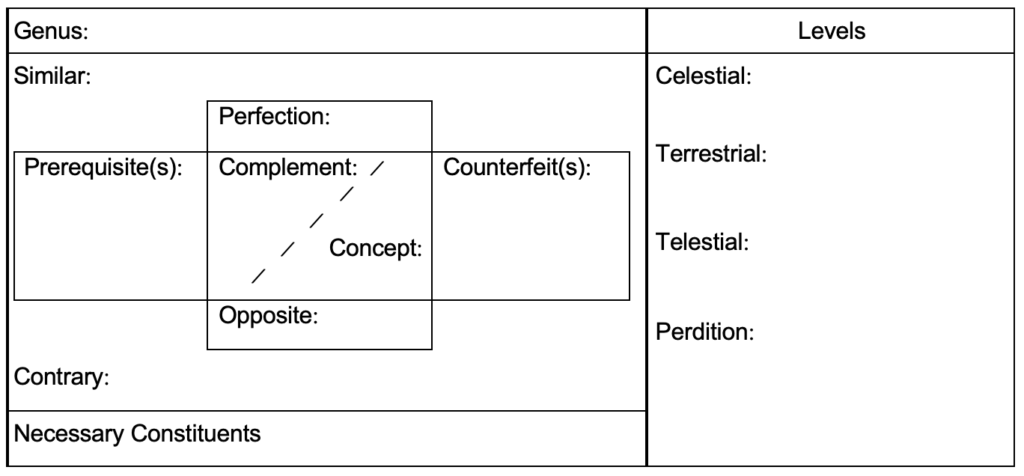
    Blank Template

    Click to see example: Wisdom

    1. Symbols: (Symbols associated with concept in its variant forms.)
    2. Base: (language/culture/time frame of inquiry)
    3. Etymology:
    4. Dictionary definition:
    5. Examples: (Examples in base on other side.)
    6. Correlations (see graphic below)
    7. Key questions: (Questions and answers to illuminate the concept. Use other side.)
    8. Definition:
    9. Examples: (Positive/negative examples to demonstrate or test concept.)
    10. Relevance: (The difference this concept should make in my life: heart, mind, strength, might.)
    Actual Concept Clarification Template from Chauncey’s Course Outline – 1983
  • Concept Clarification Example: Wisdom

    Concept Formulation/Clarification/Definition

    Chauncey C. Riddle,
    1983 Class handout

    Example: Wisdom

    Click to see blank template

    1. Symbols: (Symbols associated with concept in its variant forms.) wise, wisdom
    2. Base: (language/culture/time frame of inquiry) Gospel/scriptural
    3. Etymology: AS, wis=discerning + dom=judgment
    4. Dictionary definition:

    Webster’s Collegiate: “Quality of being wise; ability to judge soundly and deal sagaciously with facts, esp. as they relate to life and conduct; discernment and judgment; discretion; sagacity.”

    Oxford English: “Capacity of judging rightly in matters relating to life and conduct; soundness of judgment in the choice of means and ends. …”

    5. Examples: (Examples in base on other side.)

    ’Tis a wise man who knows his own father.
    Wisdom is justified of her children.

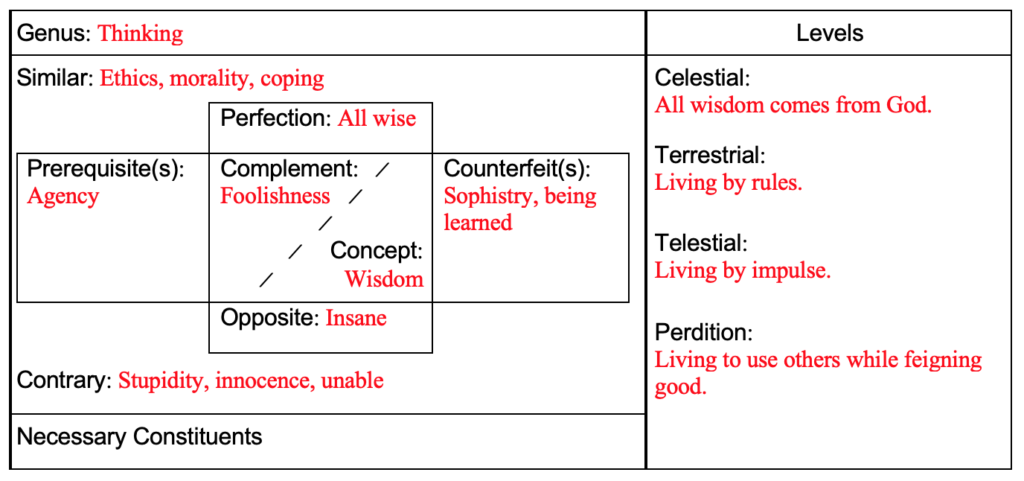
    6. Correlations

    Genus: ThinkingLevels
    Similar: Ethics, morality, copingCelestial
    Perfection: All wiseAll wisdom comes from God
    Pre-requisite (s)Comple-ment:Counter-feit(s)Terrestrial
    AgencyFoolishnessSophistry, being learnedLiving by rules
    Concept:Telestial
    WisdomLiving by impulse
    Opposite: InsanePerdition
    Contrary: Stupidity, innocence,
    unable
    Living to use others while feigning good
    Necessary Constituents

    (table above can scroll side to side)

    7. Key questions: (Questions and answers to illuminate the concept. Use other side.)

    1. What is the connection between wisdom and ethics?
      Ethics is the study of the different approaches to wisdom in the world.
    2. How many kinds of wisdom are there?
      Nearly as many as there are individuals.

    8. Definition: Wisdom is the ability to achieve one’s goal at a tolerable price and never to have to look back and be sorry.

    9. Examples: (Positive/negative examples to demonstrate or test concept.)

    1. Examples: The man who built upon a rock. The man who works hard and saves.
    2. Non-examples: The man who built upon sand. The man who is lazy and a spendthrift.

    10. Relevance: (The difference this concept should make in my life: heart, mind, strength, might.)

    There seem to be many short-run wisdoms, but only one long-term wisdom.