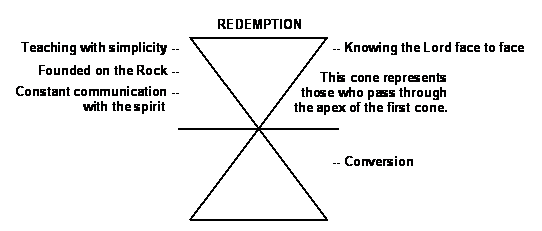
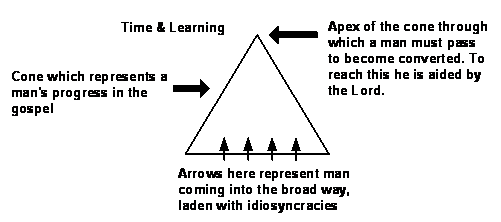
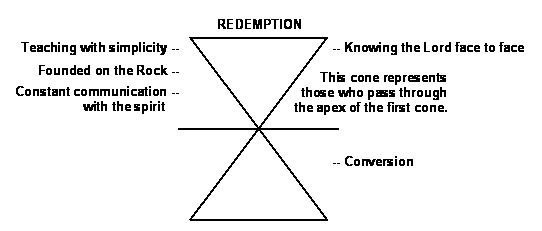
Redemption: Yield to the light of Christ, and choose good; it will lead one to the Holy Ghost, by which one learns the Gospel of Jesus Christ. Upon accepting it, the ordinances, and the Holy Ghost, one may know what to do in all cases. If one then does what one knows one should, one will be redeemed by Jesus Christ.
Rescue: Go to the best schools, learn the learning and wisdom of men, especially science. Science is a description of the universe which has been empirically grounded, rationally articulated and socially accepted by certified human beings.
Test: Power to be righteous.
Test: Power to do what one desires.
(This leads to a showdown of power.)
Evaluates the confirmed Humanist as hard-hearted.
Evaluates Book of Mormon mind as insane.
Fundamental Concepts
Book of Mormon Mind
Humanist Mind
God and Satan
Myself, and everyone else
Choosing good over evil
Attaining pleasure, avoiding pain
Saint/Natural man
Learned, powerful/ unlearned, impotent
Space for repentance
Long life to have much pleasure
Place to prosper
Turf to dominate
Redemption: To be restored to the presence of God
Advantage: Some edge on others by which to be superior to someone
Chauncey C. Riddle Honors 204R & Religion 231 (c. 1984 – Later read at BYU Women’s Conference)
The purpose of this paper is to suggest the way by which one might avoid the practice of priestcraft in this world. We shall proceed to discuss this topic under the four following main headings.
First, the basic premises. Then we shall define priestcraft and priesthood. Thirdly, we shall suggest how not to practice it in various professions, and, finally, we shall assert some conclusions.
The context of this discussion is that of Latter-day Saints in this dispensation. The question is: how shall we, knowing the fullness of the restored gospel of Jesus Christ, be able to avoid practicing priestcraft?
Basic Premises
We make the following stipulations as part of the basic premises.
We are here on earth to become as the Savior. It is the intent of our Father that we should have the opportunity to acquire the Savior’s knowledge, skills, values and powers in this mortality with the ultimate possibility of becoming fully as He is. The work of the Lord is calculated to encourage us to become as close to Him as we wish to become, and to become as much like Him as we wish to be.
The scripture warns us that the Savior is our God, and we are not to take counsel—that is to say, we are not to take wisdom,—from our fellowmen. We read the following in Section 1 of the Doctrine and Covenants which is part of a series of comments as to why the gospel has been restored in these latter days. “That man should not counsel his fellow man, neither trust in the arm of flesh, but that every man might speak in the name of God the Lord, even the Savior of the world.” (D&C 1:19) We see, then, that it is not good for one man to try to tell another what is wise for him to do. We may teach each other. We may explain, but we should not pretend to give counsel to our fellowmen for that is the function of God, Himself.
We read in the scriptures that the Savior is the fountain of all righteousness. Quoting from Ether, chapter 12, verse 28: “Behold, I show unto the Gentiles their weakness, and I will show unto them that faith, hope and charity bringeth unto me—the fountain of all righteousness.” (Ether 12:28) The Savior is indeed the fountain of all righteousness, meaning that if we wish to be righteous we must go to Him, for He is the only source from which we can draw true wisdom. The scriptures also say that the wisdom of man is foolishness before God. For man does not know the beginning from the end. Man does not know very much about the complexities even of the moment which he in the world. To know true wisdom, that is to say, to find out how truly to do the right thing at any given time, we must come to consult One who does know all, who is infinitely good and wise in all things, and this is our Savior, Jesus Christ, the fountain of all righteousness.
We need to understand something about basic human roles. There are three basic human roles, one of which obtains every human relationship. In any given situation I am someone’s father, I am their brother, or I am their son. If you are a woman, in every situation you are either someone’s mother, you are their sister, or you are their daughter. Special relationships obtain between people when they have these relations. For instance, the proper relationship between father and child is that the father is to bless the child. That is to say, to help the child to grow, to develop, to come to be as the Father is. It is the glory of fathers to share with their children, to help the children to have all that they have, even as does our Father in Heaven. It is the glory of brothers to share with each other. Not to lord, not to dominate, not to be keepers, but to share one with another. To share joy and sorrow, riches and poverty, understanding, skills, possessions, whatever we might have, it is our opportunity to share with our brothers and sisters. Children have a special relationship with fathers: their role is to obey, for only as they obey and take counsel from those who are their fathers, either appointed by God or God, Himself, can they grow to their potential. Only in obedience to those instructions can they come to a fulness of what their Father would have them be. One of the great problems in the world is the confusion of these roles, of people assuming that they have the right to be fathers when they do not, assuming that to be a brother is to be a father, or keeper, which it is not.
Definition of Priestcraft and Priesthood
Finally, we need to point out from 2 Nephi, chapter 26, verse 29, the Lord’s definition of priestcraft as given through Nephi.
He commandeth that there shall be no priestcrafts; for, behold, priestcrafts are that men preach and set themselves up for a light unto the world, that they may get gain and praise of the world; but they seek not the welfare of Zion. (2 Ne. 26:29)
Without commenting further on this definition of priestcraft then we shall proceed to define the roles of the priest and then to give a refined definition of priestcraft in the context of true priesthood.
We will assert then that the true characteristics of a true priest are as follows. The priest is a righteousness person, he is a saint. A priest is called of God. He is a true light unto the world. That is to say, he dispenses truth and wisdom from God the Father and from our Savior, Jesus Christ, through the instrumentality of the Holy Ghost. The true priest does not speak of himself or his own wisdom, but he delivers to his fellow beings the wisdom that comes from God. To those who accept his message, he administers the ordinances of salvation. He also does suffering for the sins of his people; for in their weakness, in their ignorance, for they will sin, and the priest suffers with them and for them.
The Savior is our model in this matter of being a true priest. He, indeed, was righteousness and without sin. His Father sent Him into the world. The Savior did not call Himself but His Father sent Him and testifies to men of that sending. The Savior is the Light of the World. He is the Source of all Wisdom and all Righteousness to this world. He came and ordained and blessed and healed, thus administering the ordinances of salvation, both temporal and spiritual, to those who could profit from His blessings. He suffered for the sins of His people, indeed, for He performed the atonement in which He took upon Himself pain for the sins of all human beings, whoever had lived or would live on the face of the earth. In doing all this, He gave the glory to His Father, accepting none for Himself.
A true priest, one appointed after the order of Christ, will have similar characteristics to the Savior. The true priest strives to be righteous. He confesses and forsakes his sins. He loves his brothers and his sisters. He is one with his file leader and is a saint. He does not call himself or set himself up but is ordained and set apart by his file leader in the priesthood. He teaches the commandments of God, not his own wisdom. He helps people to be wise by delivering to them wisdom from God and thus helps them to come to happiness which is the fruit of true wisdom. He administers the ordinances of salvation. The power of God flows as the true priest administers the saving ordinances as he heals and blesses. He forgives all men their personal trespasses and against himself suffers the indignities and evils that men heap upon him because he is a servant of Christ, thus helping to bear their sins. He gives the glory to the Savior.
The false priest, in contrast to the true priest, covers his sins, gratifies his pride. His love for men waxes cold. He is an apostate: he stands apart from those who hold the true priesthood, and will not accept their counsel. He is not called of God but sets himself up to be a light unto the world. He pretends that his light is good and teaches men that they should do as he says, but he does not teach the commandments of Christ. He teaches doctrines of man and of devils and sorrow results. Sometimes, of course, he mixes what he teaches with the statements of the scriptures, giving some good along with the bad, thus confusing people. He administers empty ordinances: most of the ordinances he performs, if they are saving ordinances, have pretended efficacy in the next life only. By this he shields himself from having to pay the consequences of ordinances performed without power. Should he heal, he likely will do so by Satan’s power, surely not by that of Christ. When he has opposition, he will not suffer it, but he seeks to punish the opposition and thus brings persecution upon his enemies (as the history of religion has so many examples to offer). He gladly accepts praise and/or gain for his priesthood functions.
Having thus defined the true priest and the false priest, we can now say particularly what it is we are talking about. When any person has every characteristic of the true priest then he is a true priest. Should he partake of any one characteristic of the false priest, then that person is a false priest. Priestcraft is one subdivision of being a false priest. It is that subdivision wherein one sets one’s self up as a light unto the world and takes praise or gain for doing so. Having thus defined priestcraft we will now proceed to show some examples of both priestcraft and the possibility of not practicing priestcraft.
How to Avoid Practicing Priestcraft
Let us posit first of all the worst possible case. Let’s take an LDS man who has grown up in the Church but rejects many of the teachings of the gospel and rejects the Brethren as his file leaders. Because he does not accept the gospel, he has not repented of his sins and he is selfish and unrepentant. He lies about his sins, perhaps even accepting the priesthood for social reasons. He goes to a university and there he gets what he considers to be “real authority” in this world, a Ph.D. and a M.D., and becomes a psychiatrist. As he goes out to practice psychiatry, he teaches and uses the theories of men. He perhaps teaches permissiveness, situational ethics, humanist doctrines, all of which are contrary to the gospel of Jesus Christ. He conducts therapy sessions to relieve persons of guilt and of shame for sin by telling them there is no such thing as guilt and there should not be shame. He attacks and belittles faithful people and priesthood authority in the true Church, and perhaps becomes wealthy and famous from his priestcraft.
Let us show now how this same person with the same occupational opportunity could proceed not to practice priestcraft. If the psychiatrist were a humble LDS person who fully accepted the priesthood authority in the Church, if he repented of all his sins, and sought to serve the Lord with all of his heart, might, mind and strength, then he might go to a university and learn much of the theories and practices and skills of man, receiving his Ph.D. and his M.D. Having learned all the good that he could from the wisdom of men he would search also into the things of God and would become skilled and knowledgeable in all the way of godliness. Then when people came to him with their problems, he would teach them both the understanding of the world and the understanding of the gospel; he would allow them to take their choice and select the kind of treatment they would like to have. He would make no pretense to cure. He would help people to repent, if they choose the Lord’s way. He would administer appropriate therapy if they chose the world’s way. He would not do anything that would be contrary to the teachings of the gospel of Jesus Christ. He would be fully respectful of all persons, including his client. If someone were to abuse him for his faith in Christ or for any of his professional notions, he would accept that abuse without retaliation. He would charge modest fees, and those only for teaching and for administering therapy; never for telling people what they should do. He would reject the praise of man, giving the glory to God.
Let us now proceed to discuss a series of occupations showing how people in each of these occupations would act so as to avoid priestcraft. We shall assume that in all cases the person is a righteous LDS person and has received sufficient training from the world to be able to understand and practice the ways of the world.
Let us take then the case of the lawyer. The lawyer would learn the ways of law and then would teach his clients the ways and words of the law. He would teach probable options, probable outcomes, and possibilities that the client might choose. Then he would assist the client in executing whichever choice the client makes in preparation of documents, in trial procedures, etc. The lawyer would take money only for teaching and for applying his skills, never for telling people what they should do for that is the role of the true priest.
How would the M.D. act? The M.D. would learn all he could about the functions of the human body and the nature of the diseases which are common to human beings. When someone came to him with a malady he would teach them the ways of their body and the options for treatment and probable outcomes. When the patient had made a choice that seemed to the patient to be wise, then he would help the patient execute the choice, performing surgery or therapy according to the patient’s instructions. He would take money for teaching and performing professional skills, but not for telling people what they should do.
Let us then take the case of the teacher, say a teacher in a university. The teacher would learn and then teach skills and knowledge. He would never force his values or any values on students, leaving them the honor of being agents unto themselves to make their own choices. But he would teach them the knowledge and skills which they came to him to receive and requested of him. He would teach parents and students options for education so that they could understand the various possibilities and then would proceed to help them implement those options as chosen. He would take money for teaching, never for telling people what they should do or what they should believe, leaving that to their own personal agency.
How would a financial counselor operate? A financial counselor would make himself very much aware of the possibilities available for his clients, and then would teach his clients the options for investment plus probable consequences. He would assist his clients to understand what they needed to know to make wise decisions. When the clients had decided what to do, then he would assist them to execute their choice, if requested. He would take money for teaching and for executing choices, but never telling them what they should do.
How would an architect operate? The architect would learn the possibilities for beauty and utility in buildings. When a client came to him, he would make proposals showing the client various options. When the client was prepared to make a choice and did make one, then he would prepare specifications and detailed drawings and assist with architectural supervision in the construction of the building as the client desired. He would apply his skills and teach, but would never take money for telling people what they should do.
The engineer would learn and teach cost-effectiveness options in accomplishing various kinds of practical projects in the world. He would acquaint his clients with options available, possible costs, and the probable effectiveness of various projects. When the client had made a choice of a system, he would design and perhaps build the system to fulfill the client’s choice. He would take money for teaching, designing and building, but not for telling his clients what to do.
As a scientist, a person would learn all he could about the current sciences of his time, about the hypotheses on which people were working. He would then propose to various people projects where he might further explore these hypotheses to either add to their confirmation or to try to falsify them, to add somehow to the store of human capability. He would use the very best of hypotheses available for experimentation. He would take money only for teaching, for his technical accomplishments, and for his ideas in creating new hypotheses. He would never take money for propounding truths or for telling people what they should do or what they should believe.
The farmer would operate by learning the options for effective farming. Then he would farm effectively and would take money for produce, not for telling people what to do. The case of the farmer is relatively a simple one, and is matched by that of the artisan in many professions.
The senator is a more difficult case. The senator would learn and teach the options and probable outcomes for public policy. He would make it his business to inform his public as fully as possible on the problems that face them and the possible options for action. When called upon to make a decision as to what policy to follow, he would either execute the people’s choice or if delegated to make the choice himself would go before the Lord and seek from the Lord that which was most wise and would vote for or enact that which the Lord asked him to do. He would take money for teaching and for implementing, but never for telling people what they should do.
Admittedly, this problem of the senator is more complex than most of the rest. There is much yet here to be explored. For the senator gets into moral difficulties because he must vote to force people to do and not to do certain things. He thus begins to act in the role of the priest or in the role of God, which is, of course, always a dangerous business. We will leave that exploration to another time and place.
The final case that we will draw is that of the salesman. The salesman will learn all he can about the options available to his buyer, to fill to buyers needs. Then he will help his client to understand all the options available and will help the client to procure the clients choice. This would involve sometimes, of course, featuring the goods of some other person rather than the goods the salesman might be wishing to sell himself. This means that salesmen might have to become buying agents rather than representatives of particular products if they were to avoid unrighteousness in being salesmen. They would take money for teaching, not for psychologically forcing someone into what they did not want or need, nor for telling them what they should do.
Conclusions
Now, let us sum up and conclude on the matter that we have been discussing. The pattern shows up plainly. It is the glory of mankind to share with one another, to teach one another both skills and knowledge. But men should not try to counsel one another, nor to pretend to be one another’s keepers or priest, unless we have been personally appointed by God to the true priesthood to preside. Everyone might thus see the importance of becoming a highly skilled learner and teacher since this is what the professional life of many people would consist of doing. It seems then that to love God is to take His counsel, never the counsel of man, and to learn all of God’s thoughts and ways that we can. To love our neighbor is to share our learning and skill with our neighbor but never to force or lord it over our neighbor by practicing priestcraft. To be a good neighbor is also not to demand or even to submit to priestcraft.
We Latter-day Saints give glory to God and hearken carefully to the voice of his true priests who are the presiding authorities of The Church of Jesus Christ of Latter-day Saints. For they truly represent Jesus Christ, who is the fountain of all wisdom and all righteousness. By our own revelation, each of us can know that what they say is the word of the Lord. Because of the goodness of our Lord, who gives liberally to all who ask for wisdom in faith, each of us can be wise.
1 This was a class handout for several years when I helped Chauncey teach a 6 credit Honors class from 1981 to 1988. The course number changed a few times during those years. Chauncey presented a revised version of this paper sometime later at a BYU Women’s Conference. (Monte F. Shelley)
Symbols: (Symbols associated with concept in its variant forms.) wise, wisdom
Base: (language/culture/time frame of inquiry) Gospel/scriptural
Etymology: AS, wis=discerning + dom=judgment
Dictionary definition:
Webster’s Collegiate: “Quality of being wise; ability to judge soundly and deal sagaciously with facts, esp. as they relate to life and conduct; discernment and judgment; discretion; sagacity.”
Oxford English: “Capacity of judging rightly in matters relating to life and conduct; soundness of judgment in the choice of means and ends. …”
5. Examples: (Examples in base on other side.)
’Tis a wise man who knows his own father. Wisdom is justified of her children.
6. Correlations
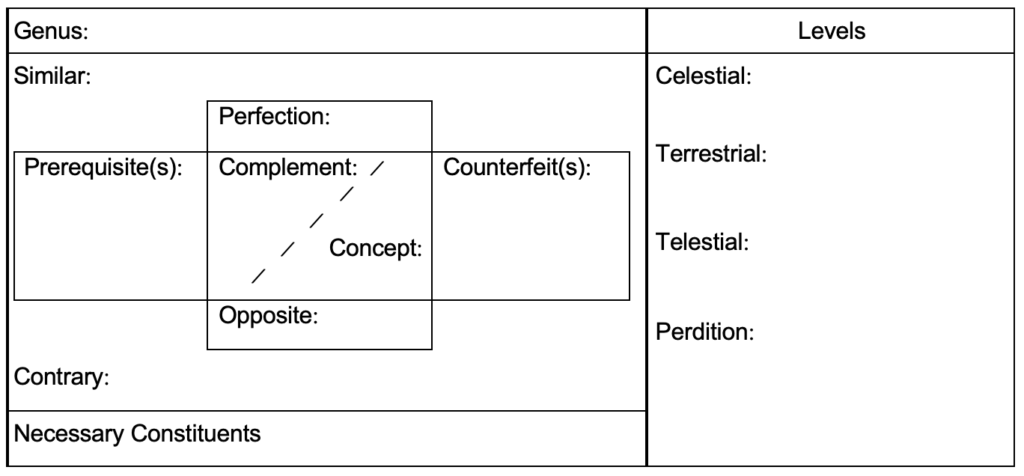
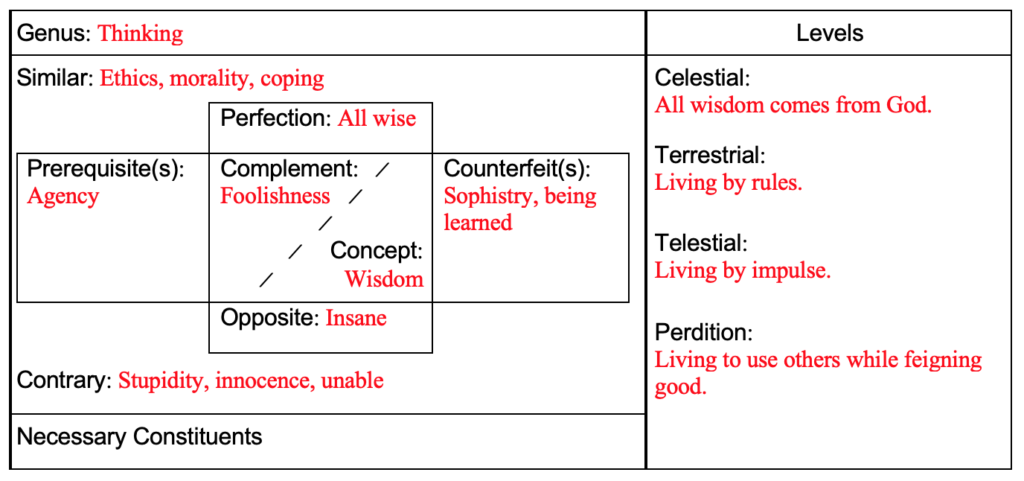
Genus: Thinking
Levels
Similar: Ethics, morality, coping
Celestial
Perfection: All wise
All wisdom comes from God
Pre-requisite (s)
Comple-ment:
Counter-feit(s)
Terrestrial
Agency
Foolishness
Sophistry, being learned
Living by rules
Concept:
Telestial
Wisdom
Living by impulse
Opposite: Insane
Perdition
Contrary: Stupidity, innocence, unable
Living to use others while feigning good
Necessary Constituents
(table above can scroll side to side)
7. Key questions: (Questions and answers to illuminate the concept. Use other side.)
What is the connection between wisdom and ethics? Ethics is the study of the different approaches to wisdom in the world.
How many kinds of wisdom are there? Nearly as many as there are individuals.
8. Definition: Wisdom is the ability to achieve one’s goal at a tolerable price and never to have to look back and be sorry.
9. Examples: (Positive/negative examples to demonstrate or test concept.)
Examples: The man who built upon a rock. The man who works hard and saves.
Non-examples: The man who built upon sand. The man who is lazy and a spendthrift.
10. Relevance: (The difference this concept should make in my life: heart, mind, strength, might.)
There seem to be many short-run wisdoms, but only one long-term wisdom.
Chauncey R. Riddle Preliminary draft 14 January 1983
Table of Contents
Part I Introduction
Part II Models of the Nature and Action of Gods and Man
Part III Religion
Part IV Education and Communication
Part V The Conversion Model
Part VI The Kingdom of God
Part VII Proselyting
Part VIII Obstacles to Conversion
Part IX Summary
Part I: Introduction
The purpose of this work is to construct a model of the religious conversion of human beings in a frame of thought which arises from the scriptures of The Church of Jesus Christ of Latter-day Saints. It is intended that this model should be sufficiently detailed that it will provide many practical hypotheses which are susceptible of empirical validation or refutation. It is here assumed that conversion is a real process in a real world, and that intelligence applied to the process can make a significant difference in the efficacy and efficiency of any proselyting program.
Of necessity, such a model must be built within a context of an understanding of the reality of God, man, nature, and their dynamic interactions, which understanding must be at least as detailed as the model. That is a way of saying that this model must be true in-detail and be based on truth to be valuable. Since truth is primarily the domain of the gods and their prophets, a careful attempt is made here to interpret and construct only in accord with the mind and will of our God. Needless to say, the assertions made here will conflict with the received opinions of the world. But it is hoped that thoughtful Latter-day Saints, servants of Jesus Christ, will read it with interest and profit and perhaps add their own increments of light and truth where it is lacking, that all of us who pray day and night for Zion to come again upon the earth may be one step closer to seeing eye-to-eye.
A final reality important to note in this introduction is that you, the reader, are entering into a personal conversation with me, the writer. This writing is undertaken as a gift of my esteem for you, whoever you are. It is my hope to write truly, but I know that I can only express my heart and my mind. You will read this with your heart and mind and thus, in the process, will judge my heart and mind and my love for you. I have two regrets already. One, that I am sure my model is not final or definitive, for my heart and mind are not yet what they could be. I have learned so much in the last year, and especially in the last month, that while I exult in the goodness of our God, I have a sense of the greater treasures that lie yet beyond the veil. Secondly, I regret that I probably will not learn from you those things which you clearly see which I do not yet see, this because of the difficulties and proprieties of communication. But if you and I serve God so that His purposes prevail, all of our regrets are swallowed in His love.
(Because this is yet a preliminary draft, much of it is written in outline form to expedite (1) exposure of the ideas, and (2) your opportunity to skip over parts which might not interest you.)
Part II: Models of the Nature and Action of Gods and Men
A. A god is:
1. An independent being (self-existing).
2. An intelligent being (makes choices which are not externally controlled).
3. A righteous being (righteousness: acting only for the welfare of others).
4. A holy being (wholly dedicated to the work of righteousness).
5. A possessor of a body (having a personal material nature through which to work).
6. A gendered being (male and female).
7. A social being (dwells with and works with other gods and other intelligent beings).
8. An omniscient being (knows and understands everything, everywhere, past, present and future).
9. An omnipotent being (having power to do anything that can be done).
10. A united being (acts in perfect harmony with every other god).
11. A family being (has a father and a mother).
12. An obedient being (does only that which his father tells him to do).
13. A permanent being (not subject to dissolution, death or retrogression).
B. A God is:
1. A god who is a father to another being.
2. A group of gods who preside over other beings.
C. There are two kinds of gods:
1. Those who have only spirit bodies.
2. Those who have also bodies of flesh and bone (male and female), who beget children.
D. Man is:
1. An independent being (self-existing).
2. An intelligent being (able to make choices which are not externally controlled).
3. A spirit being (begotten in a spirit body by the gods).
4. A physical being (begotten in flesh and bone by the gods)
5. A temporary being (subject to change: death, progression, or retrogression).
6. A being presided over by a God (the Father, the Son and the Holy Ghost).
E. The natural man (fallen man) is:
1. A man who knows not or who has rejected his God.
2. Subject to a pretended god (Satan) who:
a. Fills his mind with lies.
b. Entices him to do his or her own will if that choice opposes God’s will.
c. Brings distress and disease upon him.
d. Brings death upon him.
3. Touched by the light of Christ (which guides him to know the best of his options of choice).
F. The first man and woman, Adam and Eve:
1. Were created by God to populate this earth and to work out their own probation.
2. Were created spiritually alive (the sensory organs of their spirit bodies were fully functional to perceive spirit beings).
3. Were placed in a paradisiacal (terrestrial) environment which also contained Satan.
4. Were free agents in one thing: to partake, or not, of the forbidden fruit.
5. They partook of the forbidden fruit, which resulted in their becoming natural, involving:
a. Immediate spiritual death.
b. Change of their environment from a terrestrial to a telestial state.
c. Satan gaining power over them (See E 2, above).
6. Their becoming natural gave them the opportunity to have mortal children, who are all born innocent but also spiritually dead.
7. As God does (sooner or later) for all natural men, He gave Adam and Eve the Gospel of Jesus Christ that they might regain their spiritual life.
8. They accepted and lived the Gospel to the end and were restored to Eternal Life.
G. The essential parts of every man are:
1. His mind, which is part of his spiritual body and which allows him to:
a. Perceive his natural surroundings.
b. Conceive of possible understandings of himself and his surroundings.
c. Conceive of possible objects of desire and possible means by which to attain those desires.
d. Receive falsehoods and misunderstandings from Satan. Receive the light of Christ and the Holy Spirit.
e. Communicate with other men and other beings.
2. His heart, which is part of his spirit body and which allows him to:
a. Entertain the desires and emotions of his own flesh (intensified by Satan).
b. Entertain the directions and emotions of the light of Christ and/or the Holy Spirit (the influence of God).
c. Choose whether to seek the desires of his flesh, or to follow the influence of God.
d. Select a means by which to try to attain a particular choice.
3. His strength, which is the powers of his physical body, including:
a. His muscle power by which to transport and dispose himself and to alter his environment.
b. His brain, which enables him to learn physical skills.
c. His memory, which records all of his feelings, understandings, decisions, and actions.
d. His powers of procreation, by which to beget children.
e. His power of speech and other forms of communication.
4. His might, which includes all of his influence in the world which is past the surface of his physical body, including:
a. His influence on other people through communication.
b. The accumulation of his physical efforts in time and space, the fruit of his skills (wealth).
c. His influence on the physical world, especially including that impact he makes through tools, machines, devices.
d. His influence on the world through supernatural (priesthood) power, be it good or evil.
H. Every man acts in this world in the following pattern:
1. His mind perceives the physical (and sometimes spiritual) environment of his own body and the state and relationship of his body relative to that perceived environment.
2. His mind understands something of the potentials of what he perceives for satisfying his desires (positively and/or negatively).
3. His mind conceives of many courses of action, things he might choose to do in and to his environment.
4. The light of Christ (his conscience), if he still has it, shows him a best goal to seek and one or more good means to that goal for his given environment.
5. The power of Satan tells him to seek what he, the chooser, personally desires rather than to do what he feels is best, and may enlarge to his mind evil goals and means to these goals which he, the chooser, has not hitherto considered.
6. If the chooser chooses what is best (goal and means), he acts as a little child does, simply and delightedly choosing what is obviously good to do. So choosing, the implementation is direct and always a good learning experience even if the means fails to attain the goal.
7. If the chooser chooses to accede to his own personal desires (which choice is abetted and commended by Satan) in opposition to his feeling as to what is best, he will be bothered by going against his conscience. He then may consider the matter further, arguing with his conscience, rationalizing “good” reasons for acceding to his personal desires (the flesh). This continues until his mind is cloudy, cluttered with many reasons and options, so that which is best is no longer plain. At that point, what he personally desires has no real rival, so he proceeds to implement his plan to fulfill his own desire, thinking to himself that it remains the only reasonable thing to do.
8. If enough choices against conscience are made by a person, his conscience becomes seared, and bothers him less. But it almost never gives up completely; its influence remains to remind the person that he is not doing the best he knows. Recognition of that contrariness brings a self-torment, divides the person, to cause him to struggle against himself, and may result in “neurosis”, “psychosis” or “psychosomatic” illness.
9. As a person chooses, repeated choices form habits. Habits make it possible for choice of goals, choice of means, and skills of implementation to be mastered so well that reactions to an environment can become almost instantaneous and without conscious thought. Every habit has been established in connection with choices. “Accountability” is to be old enough and mature enough to have an even opportunity to choose between conscience and the flesh (Satan) in a new area of choice and action.
10. Novel choices cannot be made by habit. Ordinary situations reveal a person’s habits. It is often the case that extraordinary situations allow a person little choice.
Part III: Religion
A. Personal religion. Personal religion is the habits a person has acquired for making and executing choices. A person’s personal religion and his character are identical. The more habits one has, the more even novel situations are reacted to by habitual choice patterns. The four basic areas of habit are:
The habits of mind:
a. The concept patterns with which one perceives and conceives the world, especially one’s concepts of self, man, and God.
b. The understanding one has of the interactions and interrelationships of the things one perceives and conceives to exist.
c. The possible goals one conceives relative to given perceived environments.
d. The possible means to possible goals one conceives relative to given perceived environment.
e. The mental skills one uses in thinking.
2. The habits of heart:
a. The esteem or value and emotions one has relative to things he perceives and conceives.
b. The habit of preferring conscience over the flesh or vice versa in a typical choosing opportunity.
c. The habit pattern one employs to confuse choosing situation when one does not choose to follow conscience.
3. The habits of body:
a. Habits of hygiene, nourishment, posture, sleeping, etc.
b. Habits of speaking, communicating, manners.
c. Habits of pleasure seeking.
d. Work habits.
e. Physical skills mastered.
f. Habits of pain seeking/avoidance/suffering.
4. The patterns of might:
A person’s habits of mind, heart, and body are reflected in the patterns of his might, such as:
a. The happiness of his spouse and children and the order in their lives.
b. The range and character of his friends and cooperators.
c. The treasures which he does or does not lay up.
d. What he does with his surplus.
e. The order or disorder found in his home and personal property.
It is to be emphasized that every choosing, accountable human being has a religion. His own religion, his character is his primary stewardship (dominion) in this life.
B. Institutional Religion. Institutional religions are social organizations (groups of people) which act to influence the personal religion (personal habits) of themselves and/or other persons. There are always four basic elements or devices by which institutional religions attempt to influence individuals:
1. Leadership: Someone must direct the group functions and transmit that religion to the young.
2. Theology: A theology is an understanding of men, society, the universe: all things that exist. Central to every theology is a god. The god in every theology is the greatest good, the final decision-maker, the being most esteemed. A god is necessary in every theology so that there can be an ultimate arbiter of all decisions which must be made (practical decisions; many traditional theological issues are not related to practical decisions, which has tended to devalue theology in many people’s eyes). The name for theology in philosophy is “metaphysics;” in science it is “theory.”
3. Moral prescriptions: Moral directives are the do’s and don’ts for individual personal choice which the institution (the leader of the institution) enjoins upon its members. The moral directives are the “heart” of every religion. Theology is basically the rationale for the do’s and don’ts. If the moral directives change, the theology must change to properly rationalize that change. Institutional religions which fail to affect the conduct of individual members, which fail to gain obedience to the prescribed moral directives, are failures; they die.
4. Ritual: Rituals are the physical and social patterns of action which are constantly repeated to initiate and intensify habit patterns of thought, feeling, and action in the individual adherents of a religion. The staying power of a religion, which enables it to endure from one generation to the next, is in its rituals, not in its theology. The hoped for result of ritual is belief in the theology and conformance to the moral directives of the religion, though sometimes orthodoxy in theology is (unwisely) taken as a token of moral compliance.
C. Types of institutional religion. The three basic types of institutional religions are churches, cultures, and governments. (Every social organization has a religious purpose.) An example of each will be given:
1. Example of a church: The Church of Jesus Christ of Latter-day Saints.
a. Leadership: Our Church is an example of a social organization wherein the presiding authorities attempt to influence the choices of members and non-members by encouraging them to accept particular ritual observances and certain theological views ultimately to help them live godly lives. The older members try to influence the younger members in the same manner to the same end.
b. Theology: The LDS view of God and man (see Part II, above).
c. Moral prescriptions:
1) Of the heart: Love the Lord with all of one’s heart, might, mind, and strength and love one’s neighbor as oneself.
2) Of the mind: Counsel with the Lord in all thy doings and lean not to thine own understanding and He will lead thee in the paths of righteousness.
3) Of strength: Be ye clean that bear the vessels of the Lord.
4) Of might: Thou shalt offer an acceptable offering unto the Lord: tithing, consecration, beneficence.
d. Rituals:
1) Private Rituals (worship):
a) Prayer: Speaking to our God very personally.
b) Scripture study: Seeking out an understanding of the Lord’s law and ways.
c) Meditation: Receiving the whisperings of the Holy Spirit and pondering upon them to achieve understanding and to discern the path of action before us.
d) Beneficence (alms): Searching out the poor (the hands that hang down, the feeble knees) and ministering to them according to the Lord’s instructions.
2) Public rituals (worship):
a) The ordinances of the priesthood.
b) Family prayer, family scripture reading, family home evening, family council.
c) Ward meetings, stake and general conferences.
d) Proselyting.
Note: It is plain that the strength of the LDS religion lies in the private rituals, for unless they are faithfully executed all else will be empty forms.
2. Example of a culture-type institutional religion: New York City Judaism.
(A culture is distinct from a church in that the culture has a widely dispersed, almost accidental leadership, whereas a church has a centralized hierarchy.)
a. Leadership: Basic leadership in cultural Judaism is provided by the mothers who instill in the young the fundamental values and habits of the religion. (The rule: a person is Jewish if his mother was Jewish.)
b. Theology:
1) No belief in the God of the Old Testament; human “intellect” has become god.
2) Veneration of Einstein, Freud and Marx.
3) Science as the key to knowledge.
4) Success in becoming intellectual, cultured and wealthy greatly valued.
5) Value placed in blood line.
c. Moral prescriptions:
1) Intellectual contribution to society is the greatest good.
2) Marry within the culture and blood.
3) Within the culture, share money, cooperate, but no usury.
4) Make lots of money, spend carefully.
5) Frankness, courage, persistence, aggressiveness, and problem solving are highly valued.
6) Lie if necessary.
7) Chastity less valued once a person leaves home, divorce looked down upon.
d. Ritual:
1) Private rituals:
a) Study (do well in school).
b) Think (figure out how to get what you want).
2) Public rituals:
a) Family discussion: setting of goals and values.
b) Bar Mitzvah (cash given by friends to a boy upon coming of age).
c) Weddings (very social occasions; expensive presents and cash given).
d) Hebrew school (special language training sets people apart).
3. Example of a Government institutional religion:
[Note: All governments tend to have an “established” religion because no government can endure which does not rest upon a common cultural tradition (religion). This is because not all matters can be legislated and there must be some cultural commonality for the success of matters which are legislated. The established religion in the United States of America originally was the Protestant cultural religion; that nation’s established religion today is the cultural religion of Humanism. This change was wrought in the main by gaining control of the school system (making it “public”) and then requiring compulsory attendance at the lower levels.]
Example of a government religion: Soviet Russia.
a. Leadership: The leadership in practical matters is provided by members of the Communist Party (which is a church within the government), who hold the principle offices in the government. Leadership in theoretical matters is provided by the university professors (the universities are another church within the government).
b. Theology (straight Humanism):
1) The leader of the government is the god. The intelligentsia are his priesthood.
2) There is no supernatural.
3) Science is the means to all knowledge; technology is the means to all accomplishment.
4) Man evolved from lower forms of life.
5) The group is more important than the individual.
c. Moral prescriptions:
1) Loyalty to the government (the collective) is the greatest good.
2) Traditional religions, especially churches, are to be stamped out.
3) Traditional “church” morality has no meaning. Lying, stealing, fornication are legitimate means by which to achieve the government’s goals.
d. Ritual:
1) Private rituals
a) Study of Communist theory.
b) Hard work to achieve the government’s goals.
2) Public rituals
a) Mass indoctrination (all media, schools, cultural events).
b) Parades featuring military power, giant pictures of leaders.
c) Graduation from universities and schools as an ordination to the approved state priesthood.
Part IV: Education and Communication
A. Education
1. Education is the process of acquiring a religion.
a. Acquiring habits of heart: Values
b. Acquiring habits of mind: Beliefs, thinking
c. Acquiring habits of body: Strength, skills
2. There is no education which does not involve values, beliefs, thinking patterns, and skills.
3. In all education the educator is communicating his values, beliefs, and thinking patterns to the young.
4. Therefore, there is no such thing as secular education. All education is religious education.
B. Communication
1. Communication is the process whereby one person influences the feelings, beliefs, and thinking patterns of another person.
2. Every person has a religion. A person’s religion is always the basis and is usually the substance of any communication he sends or receives (interpretations he makes).
3. Therefore, all communication is religious communication. There are no such things as objectivity, unbiasedness, neutrality, or pure information.
4. All educational processes are communication.
5. Communication is the basic public ritual of every institutional religion.
C. Schools
1. All schools are forms of institutional religion wherein either a cultural religion or the personal religions of the instructors are communicated to and enjoined upon the students by the teachers.
2. Ordinarily, schools are the second most powerful form of institutional ritual (the family communications are first, peer communication and media vie for third/fourth).
3. To control the religion of a people, those in power find it most effective to:
a. Destroy family communication as much as possible.
b. Have mandatory attendance at controlled schools.
c. Control the media communications.
d. Disallow non-government meetings.
The factor hardest for governments or other institutions to control is peer communication.
D. Training
1. Training is education which maximizes teacher control and minimizes student initiative in the acquisition of habits of mind, heart, and body.
2. Emphasis on training in education tends to destroy creativity unless there is a studied rewarding of student initiative.
3. Repressive religions (persons, churches, cultures, and governments) tend to emphasize training in education and tend to reward creativity negatively.
4. Repressive religions survive only as long as they have physical power superior to all rivals, for only then can they control the training of the young.
5. The most enduring institutional religions in free situations are the ones which successfully foster private (personal) ritual. This fostering is achieved only through training (public ritual).
Examples of institutional religions which have endured in politically free or adverse situations are Buddhism and Judaism.
Part V: The Conversion Model
A. Definition of Conversion. Conversion is the process wherein an individual person breaches his own present habit patterns by choosing to believe, feel, say, and do things differently than he previously has done, repeating those new choices until they are firmly established as new habit patterns. Another way of saying this is that the person by deliberate effort has reformed his own character. This change can be an improvement (to become more like our God), a degradation (to become more like Satan) or simply an exchange (one good or bad habit replaced by another good or bad habit).
1. Strength of character is the number and strength of one’s habits. A person of strong habits is said to do what he does “very religiously.” A person of strong character tends to shape his own environment (for good or evil), whereas a person of weak character (few and weak habits) tends to be controlled by his environment.
2. The counterfeit of conversion is conformity. Conformity is the acquiring and manifesting of outward habits of strength and might (body and stewardship) which are not the result of changes of mind and of heart. Conformity is resistive response to strong environmental pressure and thus will endure only as long as the environmental pressure is maintained. Conversion and conformity are easily distinguished if one can observe a person in a situation where that person feels free to do anything he desires to do with no human penalty attached. The Savior has told us to judge men by their fruits.
3. Persons most susceptible to environmental pressures are little children. Children naturally and easily acquire the habits of their parents. As they learn language they also learn values (how their parents feel about things), a theology (what the parents believe about the universe), habits of body (how they walk, talk, sit, dress, etc.), and patterns of might (order, disorder, etc.). When evil parents fix falsehood, bad emotional patterns, bad body and might patterns on their children, these are the “chains of hell.” Though Satan cannot tempt little children directly, he can impose the shackles of evil character on them very efficiently through evil parents.
Example: Parents who say “I will not impose religion upon my children. When they are of age they may choose for themselves.” are actually imposing their own personal religion, their feelings, ideas, words, and action patterns on their own children. They are teaching their children to dislike churches and to like iconoclasm, among other things.
4. Training is a means of gaining conformity in adults. It is effective to the degree which rewards and punishments are great and swift. In little children, training usually is accepted in mind and heart as well as body, since there are no previous habits of mind and heart to cause resistance.
B. Causation in conversion. Since true conversion must always be self-conversion of mind and heart, what causes conversion? The cause can never, by definition, be a factor of the person’s external environment. Crucial to this model is the following understanding:
1. The cause of conversion is always the uncovering of a latent desire within the heart of an individual. The desire has been latent because the individual did not previously understand that a certain option even existed, or, because he previously did not think it possible or wise to choose that option even though it was known and desired.
2. The occasion of conversion is always a new understanding of the world wherein a person perceives (learns of) a new option for choice and a means to implement that choice or simply a new and possible means to implement a choice previously desired.
Example: It always troubled the heart of Person X when a little child of his group was exposed to the elements to die; but he could not resist because this was the long established practice of his culture and was supported by seemingly incontrovertible reasoning. But upon hearing the Restored Gospel of Jesus Christ, he found new strength for his feeling that exposing children was wrong because he now had a new source of ideas, comfort, and revelation from God through the Holy Ghost, to help him to know how to implement a change within his own stewardship.
Note: The net result of this aspect of the model is that converts are discovered, never made. The process of uncovering latent hope and desire is to bring to people new options for believing, feeling, speaking, and acting.
C. Stages of conversion. Assuming the natural man as the reference stage, we may postulate both positive and negative changes from that level. The levels are arbitrary, for the range of conversion in life is a continuum, the increments of which are discernible changes of habit in mind, heart and strength and might. Change of mind may lag while changes of heart and strength progress, for instance. But the positing of typical stages can be convenient guide posts just as mile markers note the accumulation of many increments of distance on a highway.
1. The natural man is taken to be a person who alternates almost randomly between doing what he knows is best and what he personally desires to do. He exhibits benevolence or malice alternately.
2. Stages of positive conversion. These are the result of choices to yield to the divine influence in one’s life which enable one to respond to become more like God. Each one of these stages is a measuring point of the divine spiritual continuum which begins with the light of Christ, develops into the gift of the Holy Ghost and culminates in the open vision of the seer.
a. Conversion to morality. Change of the mind to accept the witness of one’s own conscience and thus to recognize that there is a right and a wrong discernable in most situations. That change must be accompanied by a change of the heart to prize the right, therefore to desire it and choose it consistently. This is taken to be the most important of all conversion steps for it is the instrumentality by which each succeeding positive step is taken. The necessary requisite for this change is to be honest in heart.
b. Conversion to social responsibility. Change of the mind to recognize the existence of God and the importance of acting to honor God and other men. Change of the heart to choose responsible action consistently is the prerequisite for this new level, which is to keep the standards of the Ten Commandments.
c. Conversion to The Church of Jesus Christ (of Latter-day Saints, in this dispensation). Change of the mind to recognize the authority of God in the priesthood authority of the Church. Change of the heart to prize and identify with the Church. Change of the body to keep the word of wisdom and become a participant in Church meetings and functions. To keep the Ten Commandments is the prerequisite to change to this stage of conversion.
d. Conversion to the Gospel of Jesus Christ. Change of the mind to understand the Gospel pattern of faith, repentance, baptism, receiving the Holy Ghost and endurance to the end as the pattern for making every decision in life. Change of the heart to rely alone upon the merits of Christ. Change of the body to give strength only to those causes which are good. This stage is marked by the adoption and daily practice of the private rituals (prayer, scripture study, meditation, beneficence) of the Savior’s religion. Conversion to the Church is prerequisite to conversion to the Gospel.
e. Conversion to godliness. The mind has changed to a rather complete understanding of the ways of God and of one’s own stewardship before him. The heart has changed to become pure, to have no selfish prizing of any kind. The body has changed to reflect the countenance and actions of the Savior because it has been renewed. The might has changed to become a little celestial kingdom.
3. Stages of negative conversion. These steps lead one from the state of the natural man to become more like Satan.
a. Conversion to immorality (selfishness). Changes from the vacillating of the natural man to a studied rejection of one’s conscience and all that is good (hardening of one’s heart) in favor of consistent choosing of one’s own personal desires.
b. Conversion to depravity. Change of mind and heart to study out means to take deliberate advantage of other people to fulfill one’s own personal desires.
c. Conversion to secret combinations. Change of strength and might to make league with other depraved and immoral persons to form social organizations to increase one’s own might in satisfying personal desires.
d. Conversion to Satanic priesthood. Change of mind to foster direct contact with Satan. Change of heart to do whatever evil thing Satan suggests. Receiving of strength and might from Satan, both natural and supernatural, to build an evil dominion.
e. Conversion to perdition. This final stage can be taken only by one who has previously been converted to the Gospel of Jesus Christ and who then deliberately rejects all that is divine as to heart, might, mind and strength. Such an one delivers himself knowingly and totally to become like Satan.
D. Conversion of the mind. To convert one’s own mind is to change one’s beliefs and one’s thinking processes (skills and practices in imagining real and imaginary structures and events). The following items are the important parameters of conversion of the mind.
1. One’s concept of himself is critical: Who he is, where he came from, what his potentials are, what he can and cannot change about himself and his environment; these are the most important concepts of the mind.
2. One’s concepts of other people is the important context factor relative to one’s concept of self.
3. The most important “other” person is one’s god (one’s greatest good). Everyone has one: his god is the person he finally defers to in making crucial decisions. This may be himself, another living human being, the true and living God, or Satan (there are no other possibilities, for a person’s god must communicate with him, answer his questions, to function as his god).
4. The understanding one has of the status, nature, and functioning of plants, animals, the earth, and the cosmos, is important.
5. The thinking habits of conceptualizing, separating reality from fantasy, categorizing, predicting, planning, creating, etc., are each an integral part of each person’s character and the habits that control them are subject to his own will.
6. The care and deliberateness with which a person perceives, conceives, and establishes his arrays of options for action is a matter of chosen habit (the manner of use of his thinking skills).
The following table suggests possible changes in the mind of man as he passes through the different stages of conversion:
Table- Chauncey Riddle – Changes in the mind of a person as they go through conversion – 14 Jan 1983
E. Conversion of the heart: To convert one’s heart is to change what one prizes (one’s treasure). That change will result in change of what one chooses both as to ends and the means to those ends. The following items are important parameters of prizing and choosing.
1. The basic prizing is how one feels about the relative worth of one’s own feelings as to what he wishes to do (the desires of his own flesh supported by Satan’s encouragement) as opposed to his feelings as to what is right to do, what he ought to do in that situation (the influence of the light of Christ/the Holy Ghost as manifest in his own conscience).
2. Next is the prizing one does of other persons around him, as to whether he feels they are holy or not (actually or potentially); beings whom he should respect or not; beings whom he could (should) use as means for his own ends, or not.
3. The prizing of material objects and functions, possessing and using plants, animals, the earth, and the artifacts of man.
4. As the correct prizings take their place, feelings of pure love (charity), can and will grow in the heart both for God and for all of His creatures.
The following table suggests possible changes in the heart of man as he passes through the different stages of conversion:
Table- Chauncey Riddle – Changes in the heart of a person as they go through conversion – 14 Jan 1983
F. Conversion of the physical body (strength). The body can be converted only as the mind and the heart are converted and control it. Important parameters of conversion of the body are:.
1. Change of habits of hygiene (especially cleanliness); eating habits, dress and grooming habits, sleeping habits, etc.
2. Change of habits such as to the ability to focus attention, to do sustained mental and physical labor.
3. Change of skill development in physical skills (walking, talking, foreign languages, athletic skills, work skills).
4. Change of physical strength and endurance.
The following table suggests possible changes in the strength (body actions) of man as he passes through the different stages of conversion:
Table- Chauncey Riddle – Changes in the strength of a person as they go through conversion – 14 Jan 1983
G. Conversion of might. If a person’s (stewardship) dominion includes other persons, animals, plants, etc., he is responsible to train them. As a righteous steward he will train them in the skills necessary to become servants of the Lord (good communication skills, reverence, obedience, industry, cleanliness, etc.) and will encourage them to present their own hearts and minds to the Lord as a living sacrifice, that the Lord might then write His law in their minds and in their hearts. As a brother and son, he will exemplify in these stewardships all he teaches and will attempt to emulate the Savior in every way.
The conversion and/or consecration of a person’s might testifies of the conversion of the steward.
The following table suggests possible changes in the might of man as he passes through the different stages of conversion:
Table- Chauncey Riddle – Changes in the might of a person as they go through conversion – 14 Jan 1983
H. Factors that influence conversion. Though all conversion is a matter of deliberate choice, there are factors outside the heart and mind of the person which affect the choice options of the person and are therefore important to the conversion process. These factors operate to open and close options of choice in both good and evil directions.
1. Factors for good in conversion. This sequence is intended to proceed from weakest to strongest. These are factors outside the body of the individual which provide a second witness in addition to that of the divine influence felt internally in one’s conscience. The internal divine influence consists of the light of Christ and the gift of the Holy Ghost.
a. Nature. The order, symmetry, and beauty of nature are revealed to men by the light of Christ, in their conscience. Nature is part of the might of God and bespeaks His hand, mind, and heart. To open one’s mind and heart to recognize the hand of God in all things is one step towards accepting the divine influence of Christ in one’s life.
b. The words and deeds of godly men and women. Men and women who act morally provide an occasion for the conscience of the observer to register approval both of the act and of the spiritual influence which such people radiate at that moment. Acceptance of that approval of one’s conscience strengthens the power of conscience and makes it easier for the observer to follow conscience, to be moral himself.
c. The Holy Scriptures. Reading the scriptures provides an opportunity for the conscience to witness to the individual of the existence and goodness of God and of His way, the way of righteousness. Thus the mind may be better furnished with essential truth about all things and about the options for righteous action. When the scriptures have been altered by man, these truths and options are clouded or confused, causing men to stumble; but even such altered scriptures contain enough good for the influence of God to become stronger in the life of any reader who is converted to morality.
d. The words and deeds of living prophets and prophetesses. These are persons truly representing the true God because they are commissioned by Him and act under His guidance. Their words and deeds provide an exceptional occasion for the conscience of the individual to learn of the nature and ways of God and to feel His spiritual influence.
e. Angelic messengers. These persons are sent by God when a work is to be done that cannot be done by living prophets. Usually angels are sent to bestow instruction or power; but these can be received only by persons who are already converted to following the Lord. In exceptional cases, they are sent to over whelm the mind and heart of a person because he or she has hardened his heart (rejected his conscience) and has not accepted the living prophets (such as did Saul and Alma the Younger).
f. The appearance of God. There is no stronger witness or evidence of the truth or rightness of conscience than a visitation from God Himself. He appears to a man or woman to provide a strong influence to stabilize the mind and heart of a prophet (Moses, Joseph Smith), or to give a condemning witness to the ungodly (the Second Coming).
2. Factors for evil in conversion. This sequence again is intended to proceed from weakest to strongest. These are factors outside the body of the individual which provide a second impetus to evil in addition to the internal selfish desires as aided and intensified by revelation from Satan (which are collectively called the “lusts of the flesh”).
a. The words and deeds of natural men and women. These persons exhibit a vacillation and double-mindedness which strengthens the selfish urge in the beholder as the beholder sees the deeds and feels the spiritual influence of such persons.
b. The words and deeds of depraved and conspiring men and women. The steady, strong evil aura of these persons and the audacity of their evil words and deeds appeal to the fleshly desires of the person, strengthen the impetus to selfishness, and abets the temptation of Satan within individuals who observe them.
c. The writings of natural and depraved men and women. The satanic “scriptures” portray and commend falsehood and evil in an authoritative and forceful manner, an impetus which further abets the inclinations to selfishness and satanic action in the flesh of the observer. (Classic example: pornography.)
d. The words and deeds of the representatives of Satan’s priesthoods. These who practice priestcraft, often feigning righteousness, perpetrate and amplify evil and incite observers to evil in a powerful, pervasive way, enjoining the chains of hell upon all who will listen to them. They act for power, praise, and gain and offer to share power, praise and gain with those who will make league with them.
e. Demonic messengers. Evil spirits who come at the invitation of the living to do the bidding of Satan to furnish gifts and power to perpetuate evil. These cause fear and awe, cowing the will of those who are not strongly committed to following the divine influence, strengthening the selfish in their carnal desires (encouraging them to lift up their heads in wickedness).
f. The appearance of Satan. Apparently a suave gentleman, the master of deceit, the eternal champion of selfishness, lies, and perversion, who comes to use, then to cast off his admirers who have converted themselves to some degree of immorality (e.g., as he did with Korihor).
I. The key to conversion. The simple key to conversion, the change of one’s habits, is what one chooses to do when one has the alternative of heeding one’s conscience (the divine influence), or of heeding one’s selfish desires (the lusts of the flesh as aided and strengthened by Satan). To choose conscience consistently is to build character towards becoming like God. To choose one’s own desires (selfishness) is to build character towards becoming like Satan. The great and powerful truth in this matter is that no one is tempted by Satan or his own flesh except in and through his own desires. Whatever a person allows his heart to prize, he can and will be tempted by it. Whatever we prize or treasure ultimately controls us. The only prizing which will save a person from evil is to prize only the will of God (to have an eye single to the glory of God), which is the only way to give up selfishness. The narrow path to that end is to listen to one’s own conscience. If followed faithfully, every man’s conscience will lead him unfailingly to accept the influence of God in his life, step by step, until he can finally make that final glorious step wherein he not only says but actually does nothing but the Father’s will. Then truly he has reshaped his own character in the image of Jesus Christ. Another name for that reshaping is “repentance.”
J. Apostasy. Apostasy means to stand away from the group. Whenever an individual changes his personal religion to be more and more different from some (any) institutional religion, he is apostatizing from that institution. An individual cannot apostatize from his own personal religion for whatever he does is his religion. An individual can convert himself from one personal religion to another by forming new habits by using his power to prize and choose differently. But no person can ever escape from himself (from his own character, from his own religion).
K. The eternal consequence of conversion to godliness. Our character which is all of our habits of mind (memory), heart (desires), strength (purity) and might (dedication) is all we take with us through the veil of death, for we are our own personal religion. If our character has become godly during our probation, then we may claim in eternity all those special family relationships which have been dear to us in our probation and wherein we have sought permission that they might become eternal. That is done by seeking and receiving the requisite godly ordinances and then sealing these ordinances with the pure love of Christ.
Part VI: The Kingdom of God
The kingdom of God is the earthly dominion of our God. It includes 1) all of nature, 2) all human beings who are either not accountable (his little ones), or who are accountable and have converted themselves at least to the level of morality, 3) the handiwork created by those who are converted to morality (and which is yet in the stewardship of those who are converted to that stage), and 4) The Church of Jesus Christ of Latter-day Saints.
A. Nature. Nature is clean, orderly, powerful, fruitful, and an ideal habitat for man’s probation. Through it God sends His rain on the just and on the unjust, giving the unjust space for repentance. But there is a difference: Nature obeys those who obey God, but is the master of those who defy God.
B. Human beings.
1. Those not accountable. Over the unborn, the young, the ill, and the demented, those who are accountable as stewards hold a godly power, and for the use of that power they are accountable to God. Evil men use that godly dominion to further their own selfish purposes, either to let live or to kill, to help to heal or to leave alone, whichever furthers their selfish purposes. This is what the scriptures call “offending” God’s little ones; unless there is repentance, such evil men can only dwell with Satan, here and hereafter. Godly men and women take special care for those little ones, shielding, nurturing and protecting them under God’s direction until God makes those little ones accountable or takes them into eternity.
2. Those who are accountable and are converted to morality. Every soul on the earth who is accountable receives a probation. No man is left entirely to Satan except at his own insistence. The power of God (the light of Christ) is with every man to give each the opportunity to turn to the light from darkness, to morality from selfishness. Every soul on earth who honestly abides his own conscience is an ally to and servant of God, thus an ally to The Church of Jesus Christ of Latter-day Saints.
C. The handiwork of honorable men and women. The human artifacts of the world, on all levels, are neither good nor bad in and of themselves, but are instruments to be used for good or ill by good or evil persons. But there is a difference between the handiwork of a good man and that of an evil man.
1. A good man crafts under the influence of the light of Christ. He therefore produces objects and instruments intended for good purposes (to help mankind) and he works to do well in his art, that his artifact may serve well and serve long in the use for which it is intended. The light of Christ urges him to excellence in both function and structure, substance and appearance. If appropriated by an evil man, the handiwork of the good man usually will serve the evil man better for his evil purposes than will the handiwork of an evil man. (A piano made by a good man will serve an evil man longer and better than one made by an evil man.)
2. An evil man crafts under the influence of the spirit of Satan, which means that he produces things with as little effort as possible, more for appearance than for quality, more for immediacy than for future reliability, and seeks a maximum reward for his effort. (The piano made by an evil man shines but has a poor sounding board, will not stay in tune, nor hold together long, either in the hands of a good or an evil man.) Only when he crafts an instrument of evil does an evil man work with sacrifice, care, and diligence for quality.
3. Anyone who works diligently with heart and mind and body to produce high quality artifacts for the peaceful and honorable uses of mankind serves God and builds the kingdom of God. Such persons may not be moral in some ways, but being moral in any way, such as producing honorable work, is an important step in the right direction. The work of such persons can belong to the kingdom of God even if they themselves are sufficiently immoral in another part of their lives that they do not belong to the kingdom of God.
D. The Church of Jesus Christ of Latter-day Saints. Though there are good men and women in many other churches who are part of the kingdom of God because they are moral persons, there is but one church organization on the earth at the present time which is part of the kingdom of God. The Church of Jesus Christ is those people who are converted far enough that they can be called “saints” or holy ones because they have wholly dedicated themselves to the work of Christ in the earth. They may not be perfect yet, but they are trying, having entered in at the gate. The gateway to this part of the kingdom is baptism, and anyone who wills not to be baptized when the opportunity is available so wills not to pass an impenetrable barrier to further steps of conversion. The essential aspects of the Church are its priesthood structure, the Gospel of Jesus Christ, the ordinances, and church meetings.
1. The priesthood structure. The priesthood is the power and authority to represent God. It’s mission is to open succeeding and appropriate opportunities so that every human being may be able to choose to come unto God, to become as He is. The essential works of the priesthood are to teach, to preach the Gospel of Jesus Christ, to judge the conversion of men, to administer the ordinances, and to organize the Church and conduct its affairs.
a. To teach. Teaching the Restored Gospel and all other truths important to the welfare of mankind is a priesthood function. Many outside the priesthood would pretend to this calling. Teaching is to be done only under the immediate direction of the Holy Spirit as to whom what is taught and when. This teaching takes place in the homes of the Saints, in the meetings of the Church, and in the missionary labors of every servant of God, and anywhere else that the work of God can be pursued.
b. To preach. To preach is to bind a witness, by divine commission, of the true and living God, of the Restored Gospel, and of The Church of Jesus Christ of Latter-day Saints, upon those who will not willingly be taught about these things.
c. To judge. Judging is a priesthood function enjoined by God in order that ordinances and callings might be administered only to those persons for whom such could be a step forward. A person who is not converted to morality is not a proper candidate for baptism, though repentance can lift him successively to the stage of being converted to morality and then to social responsibility. After that if he can believe in Jesus Christ and receive a sufficient witness of the divinity of the priesthood authority of the Church, being baptized could take him a step forward. When he is truly converted to the Church, then receiving the offices of the priesthood could be a step forward. When he is truly converted to the Gospel, then receiving the temple ordinances could be a step forward. All these judgments must be made by men, holding the priesthood, but not as men. By the gifts of God they must render God’s judgment in each case.
d. To administer the ordinances. Ordinances are occasions of enlarging the mind, the strength, and the might of those who have godly hearts. As such persons thus gain understanding, health, and power, they may more fully and more ably serve the Lord. If the ordinances are properly administered by god-fearing men and women, and are properly received by the recipient, the recipient is always lifted to new options and opportunities.
e. To organize the Church and to conduct it’s affairs. Appointing officers in the Church organization and the conducting of the meetings and other public matters of the Church are essential in order to continue the instructing and motivating of those who have entered in at the gate. Only those who are already instructed and motivated can instruct and motivate others. If there are too many to be helped and too few helpers, the tree begins to produce strange fruit. If there are many to instruct and motivate but few to be instructed and motivated, those branches produce little fruit. The end of all Church organization activity is to help every person in this world to have increased options for becoming more like God, whatever he presently may be.
2. The Gospel of Jesus Christ. The Gospel of Jesus Christ is the information one must believe and accept to be in a position to profit from accepting baptism into The Church of Jesus Christ of Latter-day Saints. But to believe the Gospel and to live it are two quite different stages of conversion. Those who are converted to the Church are as newborn infants, spiritually, and must be loved, protected, and nourished. The members of the Church and the Holy Spirit provide the love of God, the Church organization and the priesthood provide the protection of God, and the words of God provide the nourishment.
To be converted to the Gospel one must learn to:
a. Feast upon the words of Christ (through the scriptures and the living prophets) until he can rely alone upon the merits of Christ. This is faith indeed.
b. Eliminate every violation or transgression of his conscience (repent of his sins).
c. Keep the promises of the baptismal covenant which means to:
1) Bear the Savior’s name, gratefully and honorably, always.
2) Always remember Him.
3) Keep all of the commandments which He gives them.
d. Accept and live by every word that cometh out of the mouth of God (to have received the Holy Ghost and be hearkening to its influence always).
e. To live fully all one knows, hoping for and praying for further instruction (enduring to the end).
3. The ordinances:
a. Baptism: To allow the recipient to affirm solemn promises to the Lord, thus to obey the commandment.
b. Laying on of hands for the gift of the Holy Ghost: To confirm the person as a member of The Church of Jesus Christ of Latter-day Saints, to entitle the recipient to the constant companionship of the Holy Spirit, and to enjoin initial instruction upon the newly-baptized member.
c. Partaking of the sacrament: To renew our covenants and to receive again the Holy Spirit by partaking of the emblems of the Savior’s flesh and blood.
d. Bestowal of the Aaronic priesthood: To empower the recipient to be an authorized teacher of truth, to be able to preach the Gospel of Jesus Christ, and to work, judge, and to preside in temporal matters of the kingdom of God.
e. Bestowal of the Priesthood of Melchizedek: To empower the recipient to fill all of the functions of the Aaronic Priesthood; to be able to labor, judge, and preside in the spiritual affairs of the kingdom of God; to receive the mysteries.
f. Temple ordinances: To strengthen the mind and heart of the individual to enable him to succeed in enduring to the end.
g. Other ordinances: To strengthen mind, heart, and body and might and to be able to endure the opposition of this world in serving our God.
4. Church organizations and meetings. The Church is organized into wards, stakes, regions, areas and missions to facilitate administrative matters. The administrative matters focus upon converting the membership to live the Gospel (the perfecting of the Saints), making possible the ordinance work for the dead, and teaching the Gospel to all the world. The purpose of the meetings:
a. Sacrament meeting: To partake of the sacrament and to feast upon the words of Christ.
b. Sunday School/Primary: To provide opportunity for free discussion concerning understanding and living the Gospel.
c. Priesthood/Mutual/Relief Society: To teach the duties and opportunities of priesthood service and to organize the work of administering to the poor (poor in spirit, in knowledge, in health, in wealth, etc.).
d. Conferences: To check the spiritual harmony of family, ward, stake, and general authorities with each other.
The Church also fulfills many social needs for members. But the social aspect is incidental: the essential purpose is to prepare every member to go forth to do the works of righteousness (beneficence in particular).
5. Conclusion: The function of every aspect of the kingdom of God on the earth is to witness to every human being of the goodness of God and to invite each receiver of that witness to convert himself into the image of God.
Part VII: Proselyting
A. Our commission. We are instructed to preach the Gospel to the ends of the earth, to every nation, kindred, tongue and people. In our day all must hear the Gospel to be prepared for the great (for the righteous) and dreadful (for the wicked) day of the Second Coming of the Lord. As in the days of Noah, every soul who willnot hearken to His voice will be cut off. The world today ripens in iniquity, even as it did in the days of Noah, which process sharpens the contrast between the way of God and the way of Satan, making this a most exciting and fruitful time in which to live and to bear witness.
B. Our witness. We hope to bear witness in every honorable manner possible. The following are our principal opportunities:
1. Our individual personal witness opportunities:
a. To communicate only the truth with our mouths and our writing, in order to touch minds.
b. To radiate the warmth of the Holy Spirit, to touch hearts.
c. To dress, groom, and comport our bodies honorably to show the strength of the Lord.
d. To care for our property, beautify our homes, honor our contracts, and lift up the poor, to show the Lord’s might.
2. Our family witness opportunities:
a. To demonstrate love and fidelity between husband and wife.
b. To demonstrate that children are an heritage of the Lord by hoping for and raising, where possible, large families of loved and well-trained children.
c. To show responsibility as good neighbors, making people glad they live near us.
d. To promote the causes of morality, social responsibility, and righteousness wherever possible and as appropriate in community, business, cultural, educational and civic affairs.
3. Our institutional witness as a church:
a. We satisfy minds by having a “complete” theology which squares with the Bible and offers a greatly expanded horizon of understanding.
b. We offer a corrected version of the Bible, a second ancient witness of Christ, a testament of Father Abraham, and modern and current revelation, all of which is self-consistent, all of which bears witness of God and of his ways.
c. We offer living prophets who teach us the Restored Gospel and who offer specific guidance on many practical problems of our time. They give the general guidance which, if followed, would eventuate in the solution to every human problem.
d. We satisfy body needs by taking care of our own in disasters and extending such aid to many others.
e. We deploy our might to achieve a financially sound and strong base for the operations of the Church, one which practices principles of restraint, responsibility, and conservation. This witness serves as a model for every person, family and institution everywhere.
f. We beautify our buildings and grounds so that all who see or visit are uplifted.
4. Our cultural witness as a people (ideals as much as reality, as yet, for this is our weakest area of witness):
a. We prize education, hard work, and problem solving.
b. We prize art, creativity, and excellence in all skills.
c. We prize everything which is virtuous, lovely, of good report, or praiseworthy.
d. We prize freedom, representative government, individual responsibility, economic self-sufficiency.
e. We prize integrity, modesty, chastity, benevolence, and peace.
C. The essentials of accepting the witness. There are certain steps which must take place for anyone outside the Church to become a member of the Church, and have this change be a positive experience in his or her life. The following steps are taken to be essential in receiving the witness that God lives, that the Restored Gospel is true and that The Church of Jesus Christ of Latter-day Saints is the only true and living church upon the earth at the present time.
1. His or her attention must be attracted in some honorable way.
2. He or she must pay attention. A witness is always received in time and space. The space must be small enough and the time long enough that two things can happen. There must be:
a. Receiving enough information (the truth about Gospel religious matters) that the recipient can understand the message and out of that message conceive a significant experiment which he or she could perform in a short time with the resources which are available. This experiment will vary according to the present habits, standards, and beliefs of the recipient. Some principal initial possibilities are:
1) To pray about the truthfulness of the Restored Gospel (for one who already lives by prayer).
2) To read the Book of Mormon and pray about it (for one who already cherishes reading the Bible).
3) To have the opportunity to ask theological questions and to pray about the answers (for one who is troubled about death, evil in the world, etc., and who prizes clear and consistent answers to such questions).
4) To search the scriptures and pray about the First Vision of the Prophet Joseph (for one who is already religious but believes that the heavens are closed).
5) To associate with and test the spirit of those who say they have already received and accepted this witness.
Whatever is the crucial test of other important matters in life for that (unique) individual is the test which should be employed initially by that person. This because that is the methodology he or she already trusts. But whatever else is done, he or she must pray about the matter also, for there can be no conversion without prayer. Only personal revelation is rock foundation evidence, a sufficient test; all other tests leave one upon the sand, even though they may be helpful.
b. Receiving a manifestation of the warmth and love of God through the presence of the Holy Spirit. In the end, intellectual matters and tests do not convert; they serve the necessary and important service of getting a person to have enough time with and experience of feeling the Holy Spirit to decide to prize or to reject it. The essence of every conversion to righteousness is prizing of the Spirit of God. The purpose of insisting upon private personal prayer is that the recipient must discover that the Holy Spirit is not unique to the source where first encountered (the missionaries, the message, the meeting, the scriptures), but can be gained also on one’s knees in one’s own closet.
3. He or she must personally perform this experiment which has been conceived. No matter how well-conceived the theory of the experiment might be or how delightful the warmth of the Holy Spirit have been to the recipient, he or she cannot be profited if there is no investment and no further benefit. Each must go and do that thing which they conceive, including praying. If the experiment is performed as conceived, there will always be an immediate consequence.
4. They must evaluate the result of that personal experiment. The results of the experiment are either positive or negative.
The following table shows the basic possibilities:
The possible results of an experiment with interpretation and consequence
Whatever the result, the recipient uses his or her agency to pursue light and truth or to reject light and truth.
5. He or she must conceive, execute, and evaluate a second experiment under the influence of the Holy Spirit, guided by the missionaries or not. The person must heed the guidance of the Lord to do the thing that is plainly best to do next. If they perform the second experiment faithfully and like the result, they are on track to conversion of themselves to be more like God.
6. At some point after a finite number of experiments, the recipient must acknowledge the influence of the Holy Spirit to be the voice of God to them. Then the weak faith of the experiment turns to strong faith as he or she hears further instruction, believes it is of God, and diligently obeys in the name of Jesus Christ. Now he or she is on the rock and can and will go as far in the conversion process as is desired, even unto becoming gods themselves.
D. The essentials of proselyting. The steps of proselyting are simply the complements of those which the investigator must take to convert himself. The work of the proselyter is to bring the freedom to change to the recipient by opening new options of thinking and feeling. It is almost never necessary or desirable for the missionary to destroy. The new avenues will give the recipient his own power to change his own thinking and feeling as is necessary.
1. The missionary must get the attention of the recipient. The space must be small enough (so that they are close enough) and the time must be long enough for the two essential messages to be communicated. Traditional devices for getting attention are:
a. Tracting
b. Street meetings
c. Tracts
d. Referrals
e. Hall meetings
f. Teaching English etc.
Ingenuity and propriety are the great guides to attention getting.
2. The message must be delivered. While the investigator is paying attention the missionaries must:
a. Communicate enough information that the recipient willbe instructed and can conceive of a meaningful first experiment about the truthfulness and/or efficacy of the Restored Gospel.
b. Communicate enough of the Holy Spirit that the recipient will have tasted the spirit and thereby be able to identify it when it returns during his or her experiment.
3. The recipient must be so convinced of the need to perform the experiment, including praying, that he/she actually does perform it. Nothing else can succeed if this step fails. For greatest success, the experiment must be performed by the investigator in private (not in front of the missionary nor in front of his family or friends).
4. The missionary must encourage a candid evaluation by the investigator of the results of the experiment as soon as possible after it is performed. The result is the cue to the missionary as to whether to continue his proselyting effort with this individual or not.
5. The missionary must assist the investigator to conceive, execute, and evaluate a second experiment if the investigator has not already done so. Usually this second experiment willarise naturally out of further discussion of Gospel principles.
6. When the experiments become faith in the Lord Jesus Christ, the person is ready for baptism (previously committed to baptism or not). When faith has taken root in the scriptures, in prayer and in beneficence, the missionaries’ work is done. There are branch presidents, bishops, stake presidents and others in the Church to assist in the perfecting of that faith.
Part VIII: Obstacles to Conversion
A. The world. The world (the kingdom of Satan on the earth, which includes his devotees and their hearts, might, minds, and strength, his governments, his cultures, his church) is not of itself an obstacle to conversion, but rather creates the occasion and opportunity for conversion. That is why we must be in the world (to make converts) but not of it. If we are of (belong to, are converted to) the Lord, He will give us power that the gates of hell (the powers of the kingdom of Satan to take and keep prisoners) will not prevail against us: we will be able to bring the blessings of the Lord, through the priesthood, to Satan’s prisoners. The difficulty in conversion is not the world itself, but it is worldliness in us, as individuals, as we attempt to convert ourselves so that we might represent our God faithfully and well in honoring His priesthood.
B. The world in our minds. The Gospel was restored at the peak strength of the Protestant Worldview in America. The early embers of the Church were firmly based in that tradition and the Restoration in many ways simply built bigger and better things on that foundation. That Protestant World view, which was essentially the foundation used by the founding fathers in the framing of the U. S. Constitution, began its downhill slide from influence in the first half of the 19th Century and has steadily lost ground for 130 years. The LDS Church has emerged as the champion of most of the causes Protestantism once espoused such as the integrity of the U. S. Constitution, hard work, thrift, and self-sufficiency. The demise of Protestantism is being brought by incessant attacks on the two support pillars of Protestantism: the divinity of the Bible (especially the New Testament) and the divinity of the human conscience.
The engines which are battering these pillars down are scholarship and science in the hands of those of the Humanist worldview persuasion. Scholarship has been used (with considerable bias and skill) to destroy the claim that the Bible is an authentic historic document: the Humanist version is that the Bible is a collection of pleasant but sometimes gory myths. (For those founded upon the rock, the Bible still has its integrity and the attacks upon the Bible willeventually be seen to be but the opinions of ungodly men.) Science has been used (with considerable bias and skill) to assert the relativity of conscience to social context: the Humanist prescription is to get rid of conscience wherever and whenever possible, substituting collectivist and rationalist norms. (Again, those founded upon the rock are not swayed by this intellectual dissimulation.)
The rise of Humanism in the United States came as the university system of Europe was imported (the rise of Humanism in Europe was the Renaissance). Today the overwhelming majority of university professors, students and graduates are Humanist in outlook. The Protestant churches have become more and more Humanist, substituting political action as their cause to supplant the old emphasis on personal morality. The Catholic Church has abandoned its Medieval Worldview and now has an essentially Humanist face (the present Pope seems to be holding back the change somewhat). There is a remnant of Protestant strength among the Lutherans, the Methodists, and the Baptists (recently galvanized into the “Moral Majority”) but that waning power cannot last long. The average American youngster does not know who Matthew, Mark, Luke, and John are (some Rock group?).
The rise of Humanism in the United States has seen a rise in Humanism within the LDS Church. Before World War II, a solid majority of the people of the Church who took advanced degrees in the Social Sciences and Humanities became at least partly Humanist in their outlook. A turning point came in 1938 with the talk given by President J. Reuben Clark entitled “The Charted Course of the Church in Education.” Since World War II Humanism has not been as powerful an influence on Church members studying for advanced degrees. Since the 1950s, Humanism in the Church has had to go on the defensive side as a resurgence of the Restored Gospel worldview has seen a cessation of the honoring of Humanism in the Church.
The basic problem that all of the above is pertinent to is that faith and intellect have never been fully and successfully yoked together in the Church in this dispensation in very many individuals. Sometimes the artists are more artist than Latter-day Saints; sometimes the educationists, historians, the philosophers, the social scientists, the biologists, and the other natural scientists are likewise afflicted; seemingly least afflicted are the engineers.
A special false idea which plagues our people, educated and uneducated alike, is the “romantic” frame of mind. The romantic notion is that great things can be accomplished with little causes, that one can get something for nothing, or that an insufficient means can bring about a desired result. The fairy tales and cultural traditions of western civilization are shot through with romantic notions which lead to such things as the belief that the public treasury is inexhaustible, that well-being is due to luck, that romantic infatuation without repentance will bring marital bliss etc. Humanism and socialism are both species of the romantic fallacy. One glaring example in the Church is people who think that the temple ordinances will “save” them, make them perfect in the next life, without the necessity of their own painstaking and deliberate repentance to rid their own minds, hearts and flesh of every ungodly habit in this life.
When these problems are solved and the “educated” people of the Church begin to serve the Lord with all of their hearts and minds, then the witness the Church bears to the world will greatly increase. Then we will be as far ahead in science as we are in theology. Then it will be much easier to get the attention of the educated people of the world to show them a better way.
C. The world in our hearts. For the first eight years of this dispensation the Lord sought diligently to get the members of His Church to love Him enough that they would trust in His instruction as to how to gain their temporal well-being. With some notable exceptions the members could not convert themselves that far and that fast; most preferred to gain temporal security by relying on their old stand-by; every-man-for-himself. So the Lord withdrew the active implementation of the law of consecration. A later notable attempt in the West to begin active implementation of consecration had some remarkable and hopeful successes, but each experiment ended in failure and we returned to every-man-for-himself. Hearts and minds failed as the influence of the world welled up among us.
The Depression of the 1930s saw another attempt to get the members to love the Lord with the beginning of the Church Welfare Plan. Augmented by later increased emphasis on fast offering, there is now more caring than there previously appeared to be. The Church has become a model for the world not of real caring for the poor but of a-step-in-the-right-direction of caring for the poor. It is still mostly every-man-for-himself in the Church.
The rival way, the way of the world to care for the poor, is socialism, which is the political and economic arm of Humanism. Socialism is winning hands down in the world because the moral base which made the every-man-for-himself system have a great deal of brotherly kindness has eroded and virtually disappeared with the demise of the Protestant worldview and its (Humanist despised) work ethic.
The step-in-the-right-direction of the Church is good, but it does not bear full witness to the world of the pure love of Christ. In fact, it does not solve the whole problem even in the Church. But should the faithful members of this Church ever unitedly implore the Lord that His full kingdom truly be implemented, because of their love for Him, the full implementation of the law of consecration would bear a witness that would set the world on its ear. That would plainly show socialism for what it is: feeble human theory captured in every practical example for another species of tyranny. But the world will never see a full alternative to tyranny until Latter-day Saints so love the Lord that they implement His full plan. Then the world will have witness indeed, for that would put us as far ahead of the world in economics and politics (and thus, in heart) as we are in theology. Then, too, we would enjoy the abundance of the gifts of the spirit, which would further increase our dissimilarity from the world.
Another malaise of heart which affects our people is worldly feelings about feelings. The world would have everyone believe that we humans are not responsible for what we feel, but are passive objects worked upon by environmental forces that control our moods, values, etc. They tell us that human beings are not free agents and that either God or one’s psychiatrist will have to step in to save one. The LDS perversity along this line is to feel put-upon by Church authorities, to justify anger in “righteous” causes, to justify lust for another and adultery when one’s spouse is not perfect, to be envious of the wealthy, to despise the poor to be forever unsatisfied with one’s lot. All of these sins are manifestations of yielding one’s heart to Satan, even though one may be an active member of the Church. The Lord would have us forgive all men, that the sin of any other person would never become either a mental self-justification for sin nor an emotional occasion for feeling sorry for oneself. The mark of love for God is gratitude, for everything, and fear of nothing. But because we do not forgive and do not love God as we should, the world has great purchase upon us.
D. The world in our strength and in our might. While the leadership of the Church has directed us to be distinctive in our dress and grooming it has never directed us to be drastically different. The missionary look is our standard, but adherence to the standard suffers. Not every member believes in “every member a missionary.”
As a Church we are somewhat distinctive as to our standard of the Word of Wisdom. Adherence to the standard seems to improve with each added generation in families in the Church. The standard is minimal (for the weakest of the Saints), but higher standards fall on hard times because some members want to become the voice of the Lord in announcing higher standards (their own version for everyone). Withal, there remains a serious Word of Wisdom problem among Church members which dilutes our witness of the Lord to the world.
For all of our problems with the Word of Wisdom area, the Church appears to have greater distinctive difference from the world in that area than it does in the most important area of strength, that of chastity. One of the sorrowful burdens of being a judge in Israel is to come to know the enormity of this problem. Our witness falters when our statistics on divorce, abortion, non-temple marriage, and childbirth out of wedlock are reviewed by the world. To be better than most is not really good enough to bear a valid witness of love of the true and living God.
These matters of our strength—dress and grooming, Word of Wisdom, chastity—are parallel to our problems of might. Our problems of might are avarice (we are the swindle capital), slovenliness (some of these barns and fences Brigham Young wanted painted still are not), ostentation (mansions now, not when heaven comes), mediocrity (it’s the thought that counts), procrastination (who needs a garden?), etc. These problems of strength and might which dilute and defeat our witness are symptoms, not causes. When our hearts and minds become pure, these symptoms will disappear. Apparently the Lord expects that half of the Church will become pure. Then that half will bear an unimpeachable witness; to the world that will touch every nation, kindred, tongue, and people.
E. Conclusion. Not only can we have too many chiefs and not enough Indians, we can also have too many Indians and not enough chiefs. It is possible that the success of the missionary program of the Church could actually set the Church back in the future because we might not have enough leadership in the Church which is converted to more than the Church to draw the new converts up to the higher stages of conversion by their love. Attention to every stage of conversion simultaneously might help. At any rate, the Church will do better if the worldliness among us is reduced by further self-conversion through following the authorities of the Church as they lead us step-by-step toward our goal. Heaven is our home, and we must create that heaven here, and (hopefully) now, through the opportunity of self-conversion using the power of God which is among us.
Part IX: Summary
Conversion is a change of habits. It begins in an honest heart which admits that the Spirit of God has prompted it to change, to repent. The mind must begin to understand the way of the Lord. The heart must choose the way of the Lord. The body must act in the way of the Lord. These changes of heart, mind and strength will result in visible changes in the stewardship (dominion, might) of every converted person.
But conversion is not a one-time thing. It is an uphill battle, proceeding in small daily steps each of which must be taken by the deliberate choice of a free agent. There is no “great help” upward. To change from the natural man to become like God is to repent (to change, to convert each step) as the Lord shows us how, line upon line, grace upon grace, until we receive a fulness. There is as much conversion that needs to take place within the Church as there is outside the Church as each person goes to his God and implores Him for permission and direction to take one more step each day. Anyone can begin to repent (to educate, to improve himself) anywhere, at any time, simply by beginning to be fully faithful to what he himself knows is right (by hearkening to his own conscience).
Potential additions to this study.
1. An explanation of the Medieval, Protestant, Humanist, and Restored Gospel worldviews as referred to in Part VIII.
2. A description of the social class structure of the Church and how it helps and impedes the work of conversion in and to the Church.
3. A description of LDS culture, differentiating which parts are Gospel-oriented and which are not.
4. Pattern of institutional religions in addition to the ones given.
5. A section on practical suggestions for proselyting work to reach special populations such as:
Humanists
Artists
Intellectuals
Lower class
Etc.
6. A description of empirical studies which could be conducted to verify and clarify aspects of the conversion process.
Chauncey C. Riddle Campus Education Week Lectures 12 June 1968
Note: This is the version that Chauncey Riddle handed out in his BYU class.
The basis of establishing Zion is the perfecting of the souls of individuals. As individuals accept the gospel and live it, they become sanctified, which is to say, they are forgiven of their sins, or they are made holy, pure, and spotless. The two basic characteristics of such a person, I would take it, are:
(1) the fact that a person who comes to this state finds that prayer is his greatest asset and resource in his life. He lives by prayer, because through prayer, he gains the strength and help he needs to govern and direct his life according to the will of the Lord;
(2) this person is blessed by the abundance of the spirit of the Lord that is manifest in the gifts of the spirit.
Now there are many spirits and there are people who pray and get the wrong spirit. But as a person takes the time and the opportunity to make sure that he is following the right spirit this will not be a problem.
One of the important ways that we can know that we are not on the track, or have the wrong spirit, is that there is such a thing on the earth as priesthood. When we square in our views, our revelations, with the priesthood authority over us, then we have a right to believe that we are on the right track. Experience will bear this out.
But when a person finds himself going contrary to those who preside over him because of supposed revelation and he insists on believing it is from the Lord, he will go on to his sorrow to discover it is not so, because this is one of the plain, appointed checks the Lord has given that people need not be misled by the wiles of the adversary.
Once a person has understood the basis of the gospel, and has decided to embark on a life of service to the Lord Jesus Christ, a life of righteousness—that is to say, if a person has entered into a strait gate—then they must go along that narrow way and endure to the end. I believe the next big challenge they must face in their lives is to learn to live in the order of the priesthood. Now this is an almost overwhelming challenge. I say almost overwhelming because when we contemplate the greatness of this challenge, it begins to be overwhelming as we understand the importance and magnitude of the task.
We might approach the notion of learning to live in the priesthood order through the doctrine of stewardship.
Stewardship is being given a responsibility by someone where we do not have ownership or right to absolute dominion in our own right, but where we receive it as a charge from someone else who does. It is the nature of our existence that we are stewards. For instance, we do not own the bodies we inhabit. They are not ours. We did not create them; they were created by God and given to us as a stewardship, as a charge. We have been loaned them for the purpose of executing the will of the owner. Nevertheless, it is given unto us to have agency to defy the owner if we will. But, if that is the case, we must reap the consequences of that defiance.
We are given our minds as stewardships. The mind we have is a mind somewhat like the mind of God, except that it is very small, infantile, compared to the adult. Nevertheless, we have intelligence given to us that we can think and act and create and move and accomplish; and also destroy, hurt do evil things according to our own will. But we are given specific instructions by our Maker as to how to use this mind—what to take into it, what to believe, on what basis we should make our decisions.
The talents we might have, whatever they might be, the money we have, the property we might have—everything which the world counts as being in our discretionary power is really not ours. It is only a stewardship from the Lord.
Many people of this world, of course, do not believe in this stewardship, nor accept it. When a person is baptized as a member of this Church, however, this is one thing that they accomplish. They accept the Lord as the owner and governor of all things, and acknowledge themselves as stewards. They take upon themselves the name of Christ, not willing to be known simply as themselves. The important name they bear henceforth is not their own name but the name of their Master, Jesus Christ. They promise that henceforth they will not do their own will, but do His will to keep all of the commandments which He gives unto them. They promise from henceforth that they will not neglect this stewardship, but will remember the Master always, that they might receive His instruction constantly, and be faithful and wise stewards in executing their charge.
Doctrine and Covenants, Section 104, elaborates on this idea. Beginning with verse 11, the Lord says:
It is wisdom in me; therefore, a commandment I give unto you, that ye shall organize yourselves and appoint every man his stewardship; That every man may give an account unto me of the stewardship which is appointed unto him, (DC 104:11–12.)
This, of course, is a very necessary and important part of having been given a stewardship; namely, that we may be called at any moment to account for the stewardship. If we have been doing faithfully and well according to the instructions given by the Master, there will be no regrets. If we have been slothful, if we have procrastinated obedience to the commandments, or if we have been doing our own will instead, then there is considerable reason to fear the presence of the Master.
The scriptures commend to us that if we keep the commandments of the gospel, our confidence shall wax strong in the presence of the Lord, which is simply another way of saying we will be delighted to see Him come at any time to receive accounting of our stewardship. But if we are not ready to give an account of our stewardship, if we cannot say, “Lord, I have faithfully fulfilled Thy will in all things,” it simply means we have not yet fully applied the gospel in our lives.
One of the tests, then, as to whether the gospel is our way of life is if we are ready to account to our Master at any time. Each day is sufficient to its own problems and if we live each day as the Lord would have us do, there would never be a moment of any day when we would not be ready to make that accounting.
For it is expedient that I, the Lord, should make every man accountable, as a steward over earthly blessings, which I have made and prepared for my creatures. I, the Lord, stretched out the heavens, and built the earth, my very handiwork; and all things therein are mine. And it is my purpose to provide for my saints, for all things are mine.
I, the Lord, stretched out the heavens, and built the earth, my very handiwork; and all things therein are mine.
And it is my purpose to provide for my saints, for all things are mine, [All things,in heaven and in earth.]
But it must needs be done in mine own way; and behold this is the way that I, the Lord, have decreed to provide for my saints, that the poor shall be exalted, in that the rich are made low. [Not by force, but by the doctrine of stewardship,]
For the earth is full, and there is enough and to spare; yea, I prepared all things, and have given unto the children of men to be agents unto themselves.
We keep hearing about the fact that there is a terrible famine imminent, that the world is about to be overpopulated, or perhaps is now. But these statements are all made by people who know not God. If we understand the nature and the work of God, He has plenty to spare for each of His children. The only reason there ever has been famine on the earth or difficulty or trouble for the children of God is the fact that they have rejected their Maker. They have not been willing to account to Him who is the owner and master of all things. They have not been willing to be stewards. Had they been willing there would have been abundance for all.
Therefore, if any man shall take of the abundance which I have made, and impart not his portion, according to the law of my gospel, unto the poor and the needy, he shall, with the wicked, lift up his eyes in hell, being in torment, (DC 104:13–18, Italics added.)
Now this particular section relates specifically to the law of consecration practiced in the Church in the early days, but the general principle of stewardship is also there. Let’s read on a little bit in the last part of this section, beginning with verse 54:
And again, a commandment I give unto you concerning your stewardship which I have appointed unto you, Behold all these properties are mine, or else your faith is vain [if there is anything we think we own that does not belong to the Lord Jesus Christ, that simply means that we do not have faith in Him, that He is not our Master, we have not really made the covenant with Him], and ye are found hypocrites, and the covenants which ye have made unto me are broken; And if the properties are mine, then ye are stewards; otherwise ye are not stewards, But, verily I say unto you, I have appointed unto you to be stewards over mine house, even stewards indeed, (DC 104:54–57, Italics added,)
There are some wonderful things about a stewardship. One of the greatest blessings of being a steward for Christ is that we are responsible only for our stewardship. We are not responsible for things that lie outside the boundaries. For instance, supposing we think of our stewardship as a plot of ground. We are not responsible for what goes on anywhere in the world except within the limits of that plot which the Lord has designated as our stewardship. If we are faithful in that stewardship, the Lord might give us a supervisory stewardship not only over our plot but over some of our neighbor’s and their plots, too. And then it will be our great opportunity to be in the chain that blesses these stewards; that is to say, to help them be good stewards in their own area, but we never have to worry about anything except exactly that which the Lord has designated as the boundary of our responsibility. It is not necessary for us to go off dashing throughout the world solving all the world’s problems. We can’t do it anyway. But we can solve the problems of our own stewardship.
Satan, of course, is active in this situation, trying to get people to neglect the matters of their own stewardships and to try to go about solving the problems of other people’s stewardships. By that means he can thoroughly mess up the world. Sometimes we have difficulty getting revelation for our own stewardship, but almost always we think we see clearly what our neighbor should do about his stewardship. But it is important to pause. If we don’t see clearly what we ought to do about our own problem, that will be because we lack the spirit of the Lord, right? And if we lack the spirit of the Lord for our own stewardship, would the Lord ever give us revelation for our neighbor’s stewardship? Obviously not. So if we think we see clearly how to solve our neighbor’s problems and we can’t solve our own, who is telling us how to solve our neighbor’s problems? It obviously is Satan. And he delights to do this. So he goes around fouling up the lines of stewardship changing the markers so that people don’t know where they belong. And so they get out of bounds.
There is a very classic example of this that has influenced people’s thinking and is one of the most misinterpreted circumstances in scripture; this relates to the story of Cain. Cain killed Abel and then the Lord came to Cain and said, “Where is Abel, thy brother?” Cain retorted. “How should I know? Am I my brother’s keeper?” Ordinarily the correct answer to Cain’s question is what? No. The plain answer is that Cain was never given to be Abel’s keeper. A brother is never a keeper. But nevertheless, by taking Abel’s life, Cain had stepped out of his stewardship and had usurped the stewardship of God Himself. He arrogated to himself to be Abel’s keeper. So it is quite appropriate the Lord should come and ask Cain, where Abel was, because Cain had taken it upon himself to become Abel’s keeper, but wrongfully. Cain tried to get out of it by pleading innocence and ignorance of the situation by going back to the standard law that he was not Abel’s keeper. Then the Lord, of course, reminded him that He knew all things by saying, “Thy brother’s blood crieth unto me from the ground.” And then Cain started to make lame excuses as to why he had usurped this stewardship.
But you see, it is an interesting thing that Satan has been able to take this little story and ever since then most Christians, most people who read the Bible, have thought they ought to be their brother’s keeper when it was never given it to be that way. Possibly by this little technique more damage has been done in the world than by any other device, because people take this story and say, “Well, I need to be my brother’s keeper,” so they go out of their stewardship and over to their brother’s yard and start fixing up his problems—not by the revelation of God, but by the revelation of Satan.
Every tyrant since the world began has simply been his brother’s keeper. He has been solving problems for his brother that his brother couldn’t solve for himself. If you look in the history books, almost every ruler who has taken great power to himself has done it under the guise of blessing his brothers, whom (he thought) knew not how to take care of themselves. He who had some special gift or insight and was going to bless them and take care of them because they were not wise enough. And 1968 is no different from the time of Stalin or the time of Caesar, or going back to the first tyrant, who was Cain.
You see, it is the same story ever since the beginning of stepping out of the stewardship and trying to solve problems and fix things. If humanity could learn this one lesson, it would go a great way toward solving the problems of humanity. If every man would learn to worry about his own problems and not try to mess up someone else’s life and stewardship, it would greatly free humanity. But apparently we haven’t learned that yet. And so throughout the world we have a continuing series of attempts on the part of people who think they know best how to enlighten the minds of others and to “save” them.
What is a “keeper”? If you lived in a zoo and you had a keeper, what would you have? Somebody who fed you, who closed the gates on you and opened the gates when he wanted to. He would be your master. A keeper is a master. He is the one who calls the shots, who gives the orders, who says what goes on. It was never given in this world that any man should be his brother’s master. Now it is given to some to be masters. But brothers are supposed to treat brothers as brothers and not as masters. A proper relationship of brother to brother is to live together and bear one another’s burdens, which is what Alma says: When my brother suffers, I should go suffer with him. When he rejoices, I should rejoice with him. (Mosiah 18:8–9.)
But I am not to tell him what to do. I am not to instruct him or to chastise him or tell him where to get off. There will be people who will be sent to do that. And they will be masters or keepers. But they will have a specifically appointed stewardship to do that given by the Lord Himself. But it was never appointed that any brother should go around pointing out his brother’s faults to him.
If your brother has a problem, do you go talk to him about it and try to tell him what to do? That is exactly the temptation I am talking about! If the Lord won’t give you revelation for your stewardship, will He for someone else’s stewardship? Now suppose yougo to a friend of yours and say, “I have a problem. Will you help me with this?” What are you doing in that circumstance? You are letting that person be your keeper, temporarily.You are yielding to them a stewardship to counsel you, and in that circumstance, if they are wise they might be able to help you a great deal. If someone asks you for help, then, indeed, it might be perfectly appropriate for you to help. But suppose they don’t ask? Would you, then—nevertheless—give your counsel? If you did, you see, you would be overstepping the bounds of your stewardship.
Who are keepers? Fathers and mothers are keepers. Bishops, stake presidents, general authorities—they are keepers. They have specifically appointed responsibilities and authority over the people over whom they preside. But they cannot get outside that stewardship and do any good! If a stake president goes from one stake into another stake and tries to preside, he does nothing but create havoc!
This is how the Lord orders his kingdom. This is one of the reasons I am talking about this subject. We need to learn the order of priesthood. And until we learn the order of priesthood and learn to live in it—both up and down the line—to honor those who are above us, to respect the stewardship we have below us and faithfully execute our duties, we cannot be Zion. It is not enough for us to be a good person by ourselves. We have to learn to live together in an harmonious arrangement, but the only way that the arrangements can be harmonious is if it is a God-ordered arrangement. This is the purpose of priesthood and stewardship; that everybody will know what his lines of authority are and what his area of responsibility is. Then we don’t get all messed up by doing things that are not appropriate. The Lord’s kingdom is a kingdom of order, and this is the order that we are talking about.
I suppose that much unhappiness and misery has come out of the problem of stewardship between husband and wife with people who are trying to live the gospel as with any other one things. And so I would like to make some suggestions on this which I hope will be helpful in living this relationship.
Basically, there are three stewardship relationships that we have to any human being in the world. For any human being we are either their father or their mother, we are their brother or their sister, or we are their son or their daughter. These are the basic interpersonal relationships that exist between people. Can you think of any relationship that does not fit one of those three?
Now the question: which one of these relationships is the husband-wife relationship? Is it a brother-sister relationship? The answer is no. It never was and never will be intended to be a brother-sister relationship. What relationship is it? It is a father-daughter relationship. All that I am saying is that it is a father-daughter relationship in that the husband presides over the wife and the wife does not preside over the husband. The husband’s stewardship includes the wife, but the wife’s stewardship does not include the husband. Therefore it is a father-daughter relationship in the priesthood.
Because this stewardship relationship is not understood, a great deal of difficulty arises when people try to relate to each other. If people would listen when they take their temple covenants, they would perhaps understand more. But many do not listen and therefore they do not understand how this relationship works.
Any time we have a father or mother relationship with someone, that is, if we preside over them in the authority of the priest hood, our priesthood responsibility is to be instruments in the hands of the Lord to administer His blessings to them. This means to help them to develop as strong, righteous individuals. Whatever it takes to help them develop and grow as strong, righteous individuals—that is the responsibility of one who presides in the priesthood. It is not to dominate, it is not to govern in the usual sense!’ but it is to be a resource of information, of strength, of power, of courage. Whatever is needed that the person cannot furnish himself, he should be able to go to the person over him and get because that person has gone to the Lord and has received. If he cannot get it from that person than he will have to go higher.
God is not slack. God is good, and therefore we all know that we will get what we need if we go higher. But, you see, the people in between will lose their blessings if they don’t give us what we need. And therefore, each of us works at our salvation in part by learning to be a good steward and to be an administrator of good things.
When the Lord comes in the second coming and He finds His steward giving meat in due season, He has found a wise and faithful steward. What does that mean? It simply means this steward is measuring out the blessings of the Lord and giving those in his stewardship what they need when they need it as they need it. That’s the due season—so they can grow, so that they can be nourished spiritually, physically, socially—whatever it takes.
Now the power of God is sufficient for all the needs of human beings, and if we would live under the order of God we would need nothing but the government of God for the perfection of our souls. It would suffice for every need that we have.
The role of the husband, then, is to be a reservoir of God’s goodness, a source of everything that she would need that she cannot herself supply to fulfill her stewardship.
What is her stewardship? Her stewardship is to be a reservoir of God’s goodness, a source, a help, to bless her children. It is the role of the wife to bring children into this world, to bear the souls of men, and to teach them and nurture them. And whatever she needs that she cannot supply herself she should go to her husband to get it. If her children are sick and she cannot heal them with herbs or whatever knowledge and power she has, she should go to her husband and ask of him that his priesthood might be invoked to heal these children. If she needs knowledge as to how to handle them in difficult psychological circumstances, she has the right to go to him and seek counsel as to what she ought to do.
He can fulfill his role only if he is a man of God, only if he is on good enough terms with the Lord so that he, in turn, can go to the Lord and say, “Lord, please tell me what to tell my wife.” Or if he can go to the Lord and say, “Lord, I need power to give this blessing.” If he is a righteous man, the Lord is not slack. He will give the power and the blessing will be delivered, and the mother will be satisfied that her stewardship, then, is in good order. Likewise, the children have a right to go to their mother and to their father to receive the blessings they need. It seems that before we can perfect ourselves in these relationships we must become so strong in the power of the Lord in righteousness that we will never need anything from anybody beneath us in our stewardship. If we have need of something, we always go up the line to get the need fulfilled.
Now let me be specific. When a man becomes what he ought to be as a man of God, he will never need the support of his wife. This doesn’t mean he wouldn’t enjoy it if he had it. But if she chooses not to support him, not to comfort him, not to sustain him, he needs to be able to get along without it. He has to be that strong. It can be a great blessing to him to have that comfort, but he must not need it. The Lord is in that relationship to us. The Lord cannot afford to need you and me. If He did, then we would be boss. We would be lord, if He needed us. Now He is grateful when we are obedient, and when we do the work we are supposed to do we build His kingdom. But He does not need us. If we choose to go on our way and defy Him, He can get along quite nicely without us. He may not have as much glory; He may not be as happy. But He will never have to come begging to us something. He is not in that position.
Similarly, we need to be in that position in the priesthood authority—to delight in receiving support from the meek but never needing it. Again, have you seen others who so desperately needed their children that they will give their children whatever their children want and thereby destroy their children? But if the mother does not need those children, if the mother is secure enough in her relationship with her husband, and on up the line with the Lord, that she doesn’t need the children, then she is in the position to do the very best job with the children that is possible. If the children defy her, she doesn’t have to get on her knees and plead with them to do something. Then she deals from a position of strength. She can deal with them and bless them and discipline them in a way she never could if she had to have their help or their support.
A servant of God is this way in relation to food, for instance. If I need food, then I am not a servant of Christ. If I can get along without food, if I am willing to starve to death, if necessary, then I can be a servant of Christ, but not until then. Because if I need food and I have to have it, then whoever controls my food controls me. And I am not a servant of Christ. I am a servant of whoever controls my food.
Food is a small thing. If I am a servant of Christ, I could care less if I should die tomorrow. What a great blessing and relief that would be. There is nothing in this world that I can afford to need as a servant of Christ except to obey my Lord. And He will see to it that I always have power to do that. There is no one in this universe that can stop me from doing that except Him, and He won’t. Therefore, I need not fear. I will be able to fill my mission and do what I need to do. And if it is my calling to die tomorrow because nobody would give me food anymore, that’s fine. I must not mind.
The same with any other need. We cannot afford to need anything that comes from beneath us in our stewardship. Now, that is pretty strong medicine, I know. But I hope you will, as I said, be sympathetic: in taking it, and you will try to understand what I am saying, because I honestly believe what I am saying is right. On the other hand, you can’t afford to believe me. You have to find out for yourself whether it is right or not.
There were times in the Prophet’s life [Joseph Smith] when he didn’t get the support of his wife. And yet that didn’t stop him from fulfilling his mission. If it had stopped him from fulfilling his mission, he would not have been a servant of Christ. It is that simple.
How can we gain the strength to do this? First of all we must obtain the foundation for being servants of Christ. We have to be servants of Christ: we have to be responsive to Him in the spirit. Then, one of the gifts of the spirit that we will receive is the gift of love. And if these relationships are worked out and perfected in a pure, self-sacrificing, long-suffering love—the pure charity that Paul talks about—it will work. If you try to work this on a hardnosed, puritanistic, business-like arrangement, it will never work. It has to be done in love.
The pure love that I am talking about is strictly a gift of the spirit. Nobody has it naturally. There are some people who are very kind and loving, but their love is not pure until they become servants of Christ and receive that pure gift.
What would you do when somebody over you in authority is not a very good steward? Suppose they are abusing their stewardship. This becomes a real test; this becomes a trial. And I have a very simple formula as to what to do about it. This again is a little drastic: so I hope you will bear with me.
Let me use an analogy. Suppose you had some books that were very valuable to you. You had them in a ten cent box and the box was falling apart. What would you do? You would replace the box wouldn’t you so that you could take care of the books? Suppose that the box was just filled with excelsior—and you didn’t care whether you had the excelsior or not—what would you do? Would you replace the box? Probably not. You would probably let it stay as it is.
All right, now let’s try a different level. Suppose there was a ward where there was a bishop and the bishop was doing a very poor job. He wasn’t a servant of the Lord; he was just riding high and mighty in his authority and power exercising unrighteous dominion. But, suppose the people of the ward were very faithful people and they tried to follow his leadership. What do you suppose the Lord would do to that bishop? He would replace him. On the other hand suppose that the people under the same bishop were slothful and didn’t care what the bishop said; they didn’t do what the bishop said anyway. What would the Lord do about that bishop? Probably nothing. Do you see why?
If you have a bishop you think is wrong, what is the best thing you can do to help that bishop? The best thing you can do is to support him. Do everything he says to do as faithfully as you can. Now, when you do that, if you and the other members of the ward became faithful to that bishop and honored him in his priesthood something powerful would happen to that bishop. Do you have any idea what it would be? The Lord would begin to work upon that bishop, and he would harrow up the soul of that man until he either got in line or He (the Lord) would get rid of him. That is the way it works. But remember there are limits. No person has to follow any bishop to hell. It is within the stewardship of each ward member to be able to inquire of the Lord to find out how and how far to follow that bishop.
But if the people aren’t doing what you say, as the bishop you just go on bumbling along—you, and the people, all the same. It doesn’t then matter, does it?
What is your conscience? It is the spirit of the Lord. I was told by my bishop once to stand at the door of the church and physically throw out a certain person if that person came. That was hard for me to take. But I prayed about it and I got confirmation. Yes, that is what I ought to do. Fortunately, the person didn’t show up.
I have been in that circumstance at least a dozen times, where there was something very important that I was told to do by the presiding authority over me that I didn’t think was right. In every case, when I have gone to the Lord, the Lord has said to do it. Now, I admit, there might be a circumstance where He might say don’t do it. But, if that ever came I would immediately check with the authority over the person speaking to me to find out if I was out of line or if the one I was questioning was out of line. I never yet have been told to go against an authority in the Church, although I have surely wondered sometimes. But as I have sought the will of the Lord the always has been to support that man.
So I believe if a wife has a husband and she doesn’t think he is a very good servant of the Lord, the best thing she can do is to go to the Lord. The Lord will probably say for her to obey him as if he were perfect. That is pretty strong medicine. But that is her stewardship. And if she does that, the Lord is going to get busy on him. The Lord will begin to work on him. The Lord has marvelous ways to bring husbands around. But if the wife isn’t paying any attention to the husband anyway, and the husband isn’t very faithful, and the wife wants the husband to get faithful so that she will have some point in being faithful, it probably will never come to pass.
All of this, of course, pertains to people married in the temple. I am not talking about any other circumstance, because unless people are married in the temple they have no stewardship in marriage. That is to say, their marriage is not appointed of God and is not, strictly speaking in the eyes of the Lord, a marriage.
No woman has to follow any man to hell. You see, the crux of the matter is this. When a girl accepts a man as her husband, she must be willing to accept him as the lord. Now, if she doesn’t think enough of him, if he isn’t that good, she hadn’t better marry him. If he isn’t that grown up yet that he is a servant of God and able to speak for the Lord to her and to be the source of blessing that she needs to fill her role as a wife and mother, she is jumping off the cliff to marry him. If young people would get married right, you see, most of this problem would be eliminated.
Supposing they are already married and she didn’t know this before she got married. Then, what does she do? The solution, generally, is to honor the covenant that has been made, and to serve as righteously and as faithfully, as sweetly and as humbly, as is possible.
If the point comes where the Lord tells her that she ought to depart from him, she can go to her bishop, and if that is right, he will get the same counsel. And there again she is going to those who have stewardship over the matter.
When she gets married in the first place, she ought to counsel with those who have stewardship over her, namely her father and mother. And if a girl has a righteous father and mother and can counsel with them and be assured, both through the spirit of the Lord and through her parents, that she is marrying a man of God who will lead her to exaltation, blessed is she. But I am afraid some marriages aren’t made that way.
How long should a wife endure an unhappy marriage? As long as the Lord directs her to stay with him. She ought to stay with him and be as faithful to him as she can be. Her own salvation rests not on what he does but on how faithful she is in fulfilling her stewardship.
As I have watched couples recently in the Church, I find that one of the biggest problems that active LDS couples are having is that the wife doesn’t think the husband is very righteous and therefore she won’t do what he says. This is the source of endless misery and grief. I believe that as long as the wife is bound by the temple covenant she will do the very best thing by the Lord and by righteousness to obey her husband faithfully. This may be difficult. But, nevertheless, this is the kind of trial and faithfulness in stewardship by which we show that we are worthy of exaltation. If a woman can serve faithfully under an evil man, she surely has demonstrated she can serve faithfully under a righteous man, and some day she will be given a righteous man to be her head and her guide if her husband rejects the opportunity. But I have seen marvelous transformations in brethren when their wives have been faithful. The brethren have seen that there is really some point in being a servant of the Lord, because they have responsibility. When their wife does everything they say, they get a little bit scared lest they tell their wife the wrong thing to do. And being a little bit scared, they get on their knees and ask the Lord, and then they try to become righteous, then mighty and powerful. When their wives come to them for blessings in the priesthood they get shaken up a little bit. So they repent of their sins and try to be righteous. It is marvelous what can happen.
Lehi got a little out of line in the Book of Mormon, and he began to rear up against the Lord for the terrible afflictions they were having. So what did Nephi do? He went to Lehi and asked that he act as the father. He said, “Father, tell me where to go that we might have food?”
Lehi was in no shape to get revelation at all because he had been railing against the Lord, but he had to humble himself and pray to the Lord. He received revelation and he told Nephi where to go and Nephi went and got the meat and they were saved.
Now this is a marvelous principle; the principle of obedience in stewardship. If we can learn to live it, it is one of the great keys in the establishment of Zion.
When a young man marries, his stewardship relationship to his father doesn’t change one bit. When a young lady marries, her stewardship relationship changes drastically. That is to say, she passes from the stewardship of her father to the stewardship of her husband. And that is why there should be agreement by all parties concerned in the stewardship—by the Church, by the father and mother, by the groom, and, of course, on the part of the girl, herself—that this transfer is all right.
The more I learn about marriage the more I see the importance of knowing what we are getting into. Only through perfecting ourselves in these stewardship relationships in marriage can we ever have a faint hope for exaltation. Exaltation is the perfection of the marriage relationship.
We are to become one with Christ—not two, but one. But Christ is the head. We are the hands and the feet. We take our direction from him. We are members of His body. In exactly the same sense as that relationship, the husband and the wife must be one—the husband the head and the wife the body, as it were—but they should function in perfect harmony and unity and love to accomplish the purposes of the family.
Now the purpose of the family is the begetting and rearing of children unto the Lord. If the parents are together, if they are completely united in that particular goal, then they will be greatly blessed by the Lord in executing that task, and they can act as one.
There are also stewardships in political matters. If we have political stewardship, then we become bound as servants of Christ to do His will in that stewardship. President McKay has instructed us as Latter-day Saints to do what we could do to get the principles of Section 121 operative in every stewardship in the world, not just the Church stewardships but the civil stewardships as well. The point is not to operate on the basis of force, but on the basis of persuasion and kindness and love.
When many people get a stewardship, they assume unrighteous dominion; they forget that the powers of the priesthood are inseparably connected with the powers of heaven. The power of heaven through which the power of the priesthood becomes operative is the Holy Ghost, and when any man becomes unrighteous or any woman becomes unrighteous and exercises unrighteous dominion and if they seek to cover their sins and gratify their pride and their vain ambitions, the spirit of the Lord is grieved. And when it is withdrawn from them, amen to their priesthood. They have lost their priesthood and authority. They might be able to get it back, but in anything they do without it, they are exercising unrighteous dominion, they are outside their stewardship, which is another very important thing we want to remember. We can act as stewards only under the direction of the Lord. If we try to do this by ourselves, through our own wisdom, we are simply serving the adversary, which is to say, we have broken the lines of stewardship.
In conclusion, let me simply say, will you please not take anything I have said as the final word. I am here to throw out suggestions to you, but I hope you will find the suggestions worthy of thought and prayer. I hope you will find them valuable in the sense of correct understanding of the relationship the Lord would have us come into.
I bear you my testimony of the truthfulness of the gospel of Jesus Christ. And I feel with all my soul the importance and necessity of our making these relationships right in the spirit of the Lord, in the power of the pure love of Christ. And I bear you this testimony in the name of Jesus Christ. Amen.
Chauncey C. Riddle was professor of philosophy and chairman of the Department of Graduate Studies in Religious Instruction at Brigham Young University. Dr. Riddle published frequently in Church magazines. The following is a close reproduction of a talk given by Brother Riddle, August 12, 1965, at Brigham Young University. Brother Riddle came in very concerned about an incident which had just occurred in his office, which incident is described below. The following has been taken from the notes of Molly Johanneson and Carma Moore, September 2, 1965 and though they believe what is said, the thoughts are those of Brother Riddle, unless otherwise indicated.
A young man who used to be a student here at Brigham Young University and who has been in the east for the past four years was just in my office. He told me that since leaving the “Y”, he and his wife had experienced a ‘deadening sensation’ in relation to the gospel. He said that he had held a number of jobs in the church; so had his wife, and his wife had supported him in all the things he had done. They had paid their tithing and they still did. They had done everything asked of them. Still he felt that there was not much that the church had to offer him anymore. His wife felt the same way. How is it that a person could come to feel this way? Have you ever had the same feeling? He said that he has a number of friends who commiserate with him and his feelings – a number who felt the same way.
Why is it that a person who is active in the church, who is doing the things which he is asked to do by the church leaders, who is trying to keep his testimony alive, could find that the church could mean less and less to him? Is this the way that it should be? Are there not many missionaries especially who find this same thing? Are there not many fine men who have at one time been bishops, etc., who were at one time considered “A-l” Mormons who have found that the church has lost its meaning and who are today straying from the straight and narrow? What is the answer to these questions? Do these things need to happen?
First I would say that there is a need in the lives of all of us to outline clearly in our own minds what the role of the church is in our lives. It is necessary to point out that there are two kinds of people in the church. There are those who go to church to be inspired, to be fed and strengthened, and there are those who go to inspire, to give, and to help. This latter group get their strength elsewhere, and then they are able to go to church and give the strength they have received. The church serves as an important instrument to build, up the individual. The more he participates in the organization, the less he is going to get out of it. This is because the more he accumulates the knowledge disseminated there, the less there is for him to receive in the limited scope of that particular phase of the gospel. Most of the things that are given there, he will have already received.
Now because he has received these things, is it the Lord’s intention for him to reach that pinnacle of knowledge, starve to death, and leave the church? Impossible! It isn’t the Lord’s intention for any man to starve. When ordinary Church association doesn’t inspire a man, he is supposed to have been converted by this time; he should have been changed, transformed to the point where the Spirit can direct him and inspire him. This is that other source from which he receives strength. The message of the church is to change over our basis of living from a material to a spiritual basis. The converted are those who receive the real message which the church has to give; if people are looking to the church for inspiration, they will see that the message is more than merely going to church and doing the job asked of them. They will see that they are supposed to read the scriptures and perform other acts to gain wisdom, so that they might find the Lord as their source of strength personally; they will seek the Lord many times a day. Those who find the Lord and receive personal inspiration from him do not experience this “lack”, this “deadening sensation”. Those who never shift over to this personal, spiritual basis are never really converted to the Lord; they fall away, as they have come to a dead end. The man I was talking to said, “The shoe fits, all I saw was the church.” He never really got converted over to the Lord.
Another phenomenon had occurred at the same time. I look at it this way. When people come into the church, they are in a “Broad Way”. All that a man must do to be baptized is say that he will accept the gospel. Perhaps he will have to give up smoking, but few other demands are made on him immediately. Each man brings many of his idiosyncrasies with him.
Let us take, for example, the man who teaches religion professionally. He is usually the young, fireball type who is most energetic and also most naive – he knows very little about the world and the ways of religion. I think we can class most young returned missionaries in this group. They are not learned, but as they teach, they find that they do learn very rapidly. And as they learn, they begin to experience a squeezing-in sensation. They begin to see that there are fewer and fewer things they can get away with and still obey the spirit and the knowledge which they have received. The way becomes very narrow. They finally come to the point where they realize that in the gospel of Jesus Christ it is all or nothing. If they wish to continue up through the nose of the cone pictured below, they must choose to devote themselves wholly and completely to the Lord Jesus Christ. This is supposed to be the covenant that we make at baptism, but few realize that this is the promise they are making, and even fewer keep the covenant.
Arrows here represent man coming into the broad way, laden with idiosyncracies
Now when one reaches the apex of the cone, one of two things happens. (1) The individual decides that he does not want to sacrifice. He knows that he can go on living in the church apparently as a Latter-day Saint (doing what everyone else is doing). So, HE ESSENTIALLY RENOUNCES COMPLETE SERVICE TO THE LORD JESUS CHRIST. When a man does this, something else occurs. In order to be able to live with his conscience, he begins to water down the doctrines, so he can live them better. He starts broadening the gospel. These people who were once on the upgrade meet themselves on the downgrade and thus experience a deadening effect. I refer to this situation as “spoiling”. Many spoil to the point that they become rotten; others fluctuate all their lives in this state of incomplete service. They have backed off to a terrestrial level; the celestial demands everything.
(2) This man realizes that if he is to go ahead, he must devote himself to the Lord – 100 percent. After much struggling he will go ahead, and pass through the apex of the cone. And there is the wonderful thing about passing through the apex. As one passes through the apex of the first cone, he finds himself emerging into another cone where the Lord enlightens his mind to a new undreamed of knowledge which forever expands.
The Redemption Apex
As one passes through the apex, one also sees a change in the teachings of that man. They- teach less and less. In other words, their teachings become more and more simple. They emphasize the spirit. This is the foundation on the rock. They teach the fundamentals, the things that are necessary to get through that gate into the new world of knowledge, the things that are necessary to lead a man to redemption. Once a man has made the decision to go ahead, he discovers that other cone on top of the first one. This is a cone in which his spiritual power increases, yet he is still in the same channel of doing what the Lord tells him to do, and only what the Lord tells him to do. Paul says that he is the prisoner of Christ. Not that he minds being the prisoner of Christ! This is the most delightful, most wonderful experience that he has ever had…, in the world. It is by becoming a prisoner of Christ that we truly become free. It is in this way that the power of godliness comes to the world and a man begins to really do good for people. Remember the scripture which says, “If ye continue in my word then ye are my disciples indeed. And ye shall know the truth and the truth shall make you free.” (John 8:31-32) The truth is the Savior himself! (See John 14:6 and John 16:13). By knowing the Savior, one may gain complete freedom by obedience, freedom from Satan’s power, though he, will still be bombarded by temptations as long as he remains on this earth.
What is it that would keep a person from going through that nozzle? (People refer to the apex as the nozzle of a hose.) One must give himself up completely to the Spirit. He could never eat another meal,never take another drink, unless the Lord told him to do so. (This is a very real thing. I am not exaggerating) But a person will find certain other things on which to feast. It isn’t “HARD” but he can do it.
IT IS NOT NECESSARY FOR ANYONE TO SPOIL UNLESS HE WOULD RATHER HAVE WORLDLINESS THAN RIGHTEOUSNESS. The decision is up to every man personally. He has his free agency.
People who never rise above this apex in this life will probably go to the terrestrial kingdom. It is likely that they will see in the spirit world the opportunity they missed because of their desire for worldliness, but they will not be able to enter into the celestial kingdom if they knew and rejected in this life. The decision that we must make in this life is whether we will listen to the voice of our conscience or not.
Now getting back to going to church. Why would it be necessary for a man who has passed through the apex to go to church? He is just the man who can give. Does this mean that he needs to preach the sacrament sermon every week? No! A man can give much by just sitting in the group. A good man, a good spiritual man will pull out of the speaker all the spirit he has; he will be a catalyst to the man who is speaking, so that he can give to the audience every bit of knowledge and spirit which they need to receive, and both the speaker and the righteous man as well as the people who hear will rejoice. The righteous man is a benefit to all.
The formal business of the church is meaningless except that it accomplishes its grand purpose which is to bring us together so that we can be exposed to each other. If we don’t learn that this is the most important part of the gospel, then the church will begin to become very boring to us. If we don’t get past the formalism, we will begin to dislike the church. If we only see what the speaker didn’t bring with him – that he is unprepared, if we only see uncouth deacons, then we are not seeing the real meaning of the church.
Some ask if we are not losing our freedom by doing all things which the Lord directs us to do. I say, and President McKay says also that it takes more determination, more intelligence to do this than to do the things that our own carnal nature tells us to do. Those who deliberately choose to serve the Lord are free. While those who think that they are free when they are doing what they want to do are being led about by Satan. There is only one way not to be a robot. The person who thinks himself free is being led by a power “unbeknownst” to him. Those who choose to serve the Lord are the only ones who are not robots.
(Someone then asked Dr. Riddle if it was wrong for one who wished to pass through the apex to work for material wealth.) Anyone who has material wealth as a goal, if he is a righteous man, this goal will be a secondary one; I can say that much. He will be working first to build up the kingdom of God. Remember the man who is first working to have money to build up the kingdom after he has the money is strongly influenced by Satan. The worldly influence of Satan is more than just physical; but, so is the influence of the Lord. (However, the first influence that the Lord must have is influence over the spirit. That is why the Church does not go out and feed all the millions of the earth. Our missionaries go out to feed the people spiritually; for when they – any person – receive the gospel, they are fed spiritually and then intellectually and physically. We give people the gospel and then they can learn to handle their own physical needs.
Too many people think what their profession is going to be first. They should think first how their life will include the spiritual and then all things will follow in their places. This is the message of John the Baptist. Stop being material. Work becomes not the end to the means, but a means to the end. However, we must also remember that with following the gospel there is no guarantee to each man for material wealth and success.
Now here is my whole point. The gospel is worthwhile to every man. Church is the means whereby we as the children of our Father may meet together and help one another. No matter how righteous you are, what revelation you are receiving personally, you will have your ultimate blessing of exaltation taken from you unless you share your blessings with the other children of our Father in Heaven. (Charity is the greatest gift of all, and without it all else will fail.) If we had any idea what is really in store for us, we would not waste our time on the undesirable.
Getting through that apex and staying there takes concentrated day-by-day effort of a lifetime. There are recorded instances of people who did it while they were still in their teens. They have to do the first things first. You can do it; I can do it. There is no need for anyone to spoil. There is no need for the church to mean less and less to anyone. There is no need for a deadening sensation to occur, if a person will only understand the real essence of the gospel. And if this deadening sensation does take place, it is not too late. The important thing is for us to discover what we like. Do we like to listen to the prompting of the Lord better than eat that piece of cake, or work overtime when the Lord is telling us to do something else also? If we do, then fine. That choice is yours, my brothers and sisters, and mine. And the Lord will allow us to have whatever degree of freedom we really desire. And now is the time that we must make the choice.
Notes By Mary Alice “Molly” Johanneson Carma Marie Moore September 2, 1965
The Deadening Sensation
The following is a close reproduction of a talk given by Brother Chauncey C. Riddle, August 12, 1965, at Brigham Young University. Brother Riddle came in very concerned about an incident which had just occurred in his office, which incident is described below. The following has been taken from the notes of Molly Johanneson and Carma Moore, and though they believe what is said, the thoughts are those of Brother Riddle unless otherwise indicated.
***
A young man who used to be a student here at Brigham Young University and who has been in the east for the past four years was just in my office. He told me that since leaving the “Y” he and his wife had experienced a “deadening sensation” in relation to the gospel. He said that he had held a number of jobs in the church; so had his wife, and his wife had supported him in all the things he had done. They had paid their tithing and they still did. They had done everything asked of them. Still he felt that there was not much that the church had to offer him anymore. His wife felt the same way. How is it that a person could come to feel this way? Have you ever had this same feeling? He said that he has a number of friends who commensurated with him and his feelings — a number who felt the same way.
Why is it that a person who is active in the church, who is doing the things which he is asked to do by the church leader, who is trying to keep his testimony alive, could find that the church could mean less and less to him? Is this the way that it should be? Are there not many missionaries especially who find this same thing? Are there not many fine men who have at one time been bishops, etc., who were at one time considered “A-1” Mormons who have found that the church has lost its meaning and who are today straying from the straight and narrow? What is the answer to these questions? Do these things need to happen?
First I would say that there is a need in the lives of all of us to outline clearly in our own minds what the role of the church is in our lives. It is necessary to point out that there are two kinds of people in the church. There are those who go to church to be inspired, to be fed and strengthened, and there are those who go to inspire, to give, and to help. This latter group get their strength elsewhere and then they are able to go to church and give the strength they have received. The church serves as an important instrument to build up the individual. The more he participates in the organization, the less and less he is going to get out of it. This is because the more he accumulates the knowledge disseminated there, the less there is for him to receive in the limited scope of that particular phase of the gospel. Most of the things that are given there, he will have already received.
Now because he has received these things, is it the Lord’s intention for him to reach that pinnacle of knowledge, starve to death, and leave the church? impossible! It isn’t the Lord’s intention for any man to starve. When ordinary Church association doesn’t inspire a man, he is supposed to have been converted by this time; he should have been changed, transformed to the point where the Spirit can direct him and inspire him. This is that other source from which he received strength. The message of the church is to change over our basis of living from a material to a spiritual basis. The converted are those who receive the real message which the church has to give; if people are looking to the church for inspiration, they will see that the message is more than merely going to church and doing the job asked of them. They will see that they are supposed to read the scriptures and perform other acts to gain wisdom, so that they might find the Lord as their source of strength personally; they will seek the Lord many times a day. Those who find the Lord and receive personal inspiration from him do not experience this “lack” this “deadening sensation.” Those who never shift over to this personal, spiritual basis are never really converted to the Lord, they fall away, as they have come to a dead end. The man I was talking to said, “The shoe fits.” “All I saw was the church.” He never really got converted over to the Lord.
Another phenomenon had occurred at the same time: I look at it this way. When people come into the church, they are in a “Broad Way.” All that a man must do to be baptized is say that he will accept the gospel. Perhaps he will have to give up smoking, but few other demands are made on him immediately. Each man brings many of his idiosyncrasies with him.
Let us take for example the man who teaches religion professionally. He is usually the young, fireball type who is most energetic and also most naive — he knows very little about the world and the ways of religion. I think we can class most young returned missionaries in this group. They are not learned, but as they teach, they find that they do learn very rapidly. And as they learn, they begin to experience a squeezing–in sensation. They begin to see that there are fewer and fewer things they can get away with and still obey the spirit and the knowledge which they have received. The way becomes very narrow. They finally come to the point where they realize that in the gospel of Jesus Christ it is all or nothing. If they wish to continue up through the nose of the cone pictured below, they must choose to devote themselves wholly and completely to the Lord Jesus Christ. (This is supposed to be the covenant that we keep at baptism, but few realize that this is the promise they are making, and even fewer keep the covenant.
Time & Learning
Cone which represents Apex of the cone through /\ man’s progress in the gospel. / \ which a man must pass to / \ become converted–to reach / \ this he is aided by the / \ Lord. / \
Arrows here represent man coming into the broad way laden with idiosyncrasies.
Now, when one reaches the apex of the cone, one of two things happens. (1) The individual decides that he does not want to sacrifice. He knows that he can go on living in the church apparently as a Latter-Day Saint (doing what everyone else is doing.) So, HE ESSENTIALLY RENOUNCES COMPLETE SERVICE TO THE LORD JESUS CHRIST. When a man does this, something else occurs. In order to be able to live with his conscience, he begins to water down the doctrines, so he can live them better. He starts broadening the gospel. These people who were once on the upgrade meet themselves on the downgrade and thus experience a deadening effect. I refer to this situation as “spoiling.” Many spoil to the point that they become rotten; others fluctuate all their lives in this state of incomplete service. They have backed off to a terrestrial level; the celestial demands everything.
Many who fluctuate back and forth but who never enter through the apex in this life will probably be good enough to go the terrestrial kingdom.
Many who decide not to devote themselves completely try to broaden the way.
Many of the spoilers turn to rotters and exit through the broad way through which they once entered.
(2) This man realizes that if he is to go ahead; he must devote himself to the Lord 100 percent. After many strugglings he will go ahead and pass through the apex of the cone. And there is the wonderful thing about passing through the apex. As one passes through the apex of the first cone, he finds himself emerging into another cone where the Lord enlightens his mind to a new undreamed of knowledge which forever expands.
REDEMPTION
teaching with simplicity \ / constant communication \ / with the spirit \ / founded on the rock \/ knowing the Lord __________ face to face / \ This cone represents / \ conversion those who pass / \ through the apex / \ / \
As one passes through the apex, one also sees a change in the teachings of that man. They teach less and less. In other words their teachings become more and more simple. They emphasize the spirit. This is the foundation on the rock. They teach the fundamentals, the things that are necessary to get through that gate into the new world of knowledge, the things that are necessary to lead a man to redemption. Once a man has made the decision to go ahead, he discovers that other cone at the top of the first cone. This is a cone in which his spiritual power increases; yet he is still in the same channel of doing what the Lord tells him to do; and only what the Lord tells him to do. Paul says that he is the prisoner of Christ. Not that he minds being the prisoner of Christ! This is the most delightful; most wonderful experience that he has ever had…, in the world. It is by becoming a prisoner of Christ that we truly become free. It is in this way that the power of godliness comes to the world and a man begins to really do good for people. Remember the scripture which says, “If ye continue in my word, then ye are my disciples indeed. And ye shall know the truth and the truth shall make you free.” (John 8:31-32) The truth is the Savior himself! (See John 14:2 and John 16:13) By knowing the Savior, one may gain complete freedom by obedience freedom from Satan’s power, though he will still be bombarded by temptations as long as he remains on this earth.
What is it that would keep a person from going though the nozzle? (People refer to the apex as the nozzle of a hose.) One must give himself up completely to the Spirit. He could never eat another meal., never take another drink, unless the Lord told him to do so. (This is a very real thing. I am not exaggerating!) But a person will find certain other things on which to feast. It is “HARD” but he can do it.
IT IS NOT NECESSARY FOR ANYONE TO SPOIL UNLESS HE WOULD RATHER HAVE WORLDLINESS THAN RIGHTEOUSNESS. The decision is up to every man personally. He has his free agency.
People who never rise above this apex in this life will probably go to the terrestrial kingdom. It is likely that they will see in the spirit world the opportunity they missed because of their desire for worldliness, but they will not be able to enter into the celestial kingdom if they knew and rejected in this life. The decision that we must make in this life is whether we will listen to the voice of our conscience or not.
Now getting back to going to church. Why would it be necessary for a man who has passed through the apex to go to church? He is just the man who can give. Does this mean that he needs to preach the sacrament sermon every week? No! A man can give much by just sitting in the group. A good man, a good spiritual man will pull out of the speaker all the spirit he has; he will be a catalyst to the man who is speaking, so that he can give to the audience every bit of knowledge and spirit which they need to receive, and both the speaker and righteous man as well as the people who hear will rejoice. The righteous man is a benefit to all.
The formal business of the church is meaningless except that it accomplishes its grand purpose which is to bring us together so that we can be exposed to each other. If we don’t learn that this is the most important part of the gospel, then the church will begin to become very boring to us. If we don’t get past the formalism, we will begin to dislike the church. If we only see what the speaker didn’t bring with him — that he is unprepared, if we only see uncouth deacons, then we are not seeing the real meaning of the church.
Some ask if we are not losing our freedom by doing all things which the Lord directs us to do. I say, and President McKay says also that it takes more determination, more intelligence to do this than to do the things that our own carnal nature tells us to do. Those who deliberately choose to serve the Lord are free. While those who think that they are free when they are doing what they want to do are being led about by Satan. There is only one way not to be a robot. The person who thinks himself free is being led by a power “unbeknownst” to him. Those who choose to serve the Lord are the only ones who are not robots.
(Someone then asked Dr. Riddle if it was wrong for one who wished to pass through the apex to work for material wealth.) Anyone who has material wealth as a goal, if he is a righteous man, this goal will be a secondary one; I can say that much. He will be working first to build up the kingdom of God. Remember the man who is first working to have money to build up the kingdom after he has the money is strongly influenced by Satan. The worldly influence of Satan is more than just physical; but, so is the influence of the Lord. However, the first influence that the Lord must have is influence over the spirit. That is why the Church does not go out and feed all the millions of the earth. Our missionaries go out to feed the people spiritually; for when they– any person–receive the gospel, they are fed spiritually and then intellectually and physically. We give people the gospel and then they can learn to handle their own physical needs.
Too many people think what their profession is going to be first. They should think first how their life will include the spiritual and then all things will follow in their places. This is the message of John the Baptist. Stop being material. Work becomes not the end to the means, but a means to the end. However, we must also remember that with following the gospel there is no guarantee to each man for material wealth and success.
Now here is my whole point. The gospel is worthwhile to every man. Church is the means whereby we as the children of our Father may meet together and help one another. No matter how righteous you are, what revelation you are receiving personally, you will have your ultimate blessing of exaltation taken from you unless you share your blessings with the other children of our Father in Heaven. (Charity is the greatest gift of all, and without it all else will fail.) If we had any idea what is really in store for us, we would not waste our time on the undesirable.
Getting through that apex and staying there takes concentrated day-by-day effort of a lifetime. There are recorded instances of people who did it while they were still in their teens. They have to do the first things first. You can do it; I can do it. There is no need for anyone to spoil. There is no need for the church to mean less and less to anyone. There is no need for a deadening sensation to occur, if a person will only understand the real essence of the gospel. And if this deadening sensation does take place, it is not too late. The important thing is for us to discover what we like. Do we like to listen to the prompting of the Lord better than eat that piece of cake, or work overtime when the Lord is telling us to do something else also? If we do, then fine. That choice is yours, my brothers and sisters, and mine. And the Lord will allow us to have whatever degree of freedom we really desire. And now is the time that we must make the choice.
***
Brother Riddle took an hour of precious class time to relate this incident and its solution to us in our class. Not being one to spend time on extraneous things, and because of the way and the spirit with which he explained this to the class, we cannot but think that he was under the direction and guidance of the spirit to do so. Everything Dr. Riddle has ever taught us has been with the spirit, so far as we can discern, and his teachings are always in accordance with the teachings of our prophet, David O. McKay. For instance, read President McKay’s editorial in the September Improvement Era. Brother Riddle has testified to us many times the importance of the individual testimony and of individual revelation as he has in the above statement. He says that if each man uses the spirit and the gospel actively working in his life, that no matter what things seem inconsistent in the formal working of the church, the individual will find no reason or need for doubt. And through his faith and prayers he will soon find that all things are made clear. Being an extremely intellectual man, Dr. Riddle has been in many situations, especially at eastern schools where he studied philosophy, to question the church and the gospel. He told an audience once that just after President McKay was put in as President of the church, “he did something which I, at the time, thought just couldn’t be right. I thought, that man just cannot be a man of the Lord and do that. And I seriously doubted that President McKay could be following the voice of the Lord and do a thing which in as far as I could see was entirely against all previous teachings of the church. But, the Lord was helping me in my life. And so I began to pray about this thing. But I did pray daily for three long years. And when the answer came–and it did come, my brothers and sisters–it was clearer and more beautiful than anything I had received before.” It is our opinion that Dr. Riddle is truly a man of God. He teaches and lives by the spirit. And if the above talk did not have much meaning, we ask you to read it again, prayerfully, carefully, that you may find the beautiful message which we found there.