Category: About Chauncey Riddle

  • Quotes

    These quotes are both about Dr. Riddle and by Dr. Riddle, often mentioned in passing by others.

    *****

    “A real test of a man’s words are his works.”
    Chauncey Riddle

    *****

    “Our religion is the sum total of our habits.”
    Chauncey Riddle

    *****

    His Father in Heaven asks Cain, “Where is Abel thy brother?” and Cain fires back, “I know not: Am I my brother’s keeper?” (Genesis 4:9)  Maybe the answer to that question is—as Professor Chauncey Riddle once said to me—”No, Cain, you are not expected to be your brother’s keeper.  But you are expected to be your brother’s brother.”  (On Earth As It Is in Heaven, p. 142) – Jeffrey R. Holland

    *****

    Brother Chauncey Riddle in the Philosophy Department made the statement that “the greatest kept secret in the Church is the gospel.” – Robert L. Millett

    *****

    Among the debates sponsored by the Academic Emphasis Committee was a thoughtful exchange between University of Utah dean of students Lowell Bennion and BYU philosopher Chauncey Riddle regarding “The Liberal and Conservative View of Mormonism.” The two participants concluded that liberal Mormons tend to stress the spirit of ecclesiastical law rather than the letter of the law, submitting everything to “the test of reason.” Conservatives, on the other hand, were said to submit to priesthood authority, whether right or wrong, and to emphasize faith over intellect.

    Brigham Young University
    A House of Faith
    Gary James Bergera and Ronald Priddis

    http://signaturebookslibrary.org/?p=13957

    *****

    Philosophical Love

    I recently discovered a blog written by three BYU students combining their study of philosophy with that of the scriptures. It reminded my of one of my favorite classes while I was there: Philosophical Skills and Doctrines of the Gospel, taught by Chauncey Riddle. The following quotation from Riddle captures one of Dr. Riddles perspectives very nicely.

    A new insight in one area of ideas sheds light and new perspective on every truth hitherto discovered. Thus, one must constantly readjust his thinking to new and grander perspectives as the panorama of the Father’s marvelous love for his children slowly takes shape and detail. This is exciting to experience. Of all the experiences a person can have, I suppose that learning the ways of God is perhaps next to the greatest of all experiences. I believe that the greatest experience is to have the privilege of putting those newly learned truths into action, to do the work of righteousness that correct concepts and true understanding make possible.

    Author: Chauncey Riddle, Source: http://speeches.byu.edu/reader/reader.php?id=6980&x=22&y=10

    That was such an awesome class. “If this class is not the focus of your semester, I suggest you don’t take it,” he told us the first session. A number of students did not return. Thankfully, Patricia did return. She and I spent many hours that semester studying, reading, and writing for Riddles class. Our discussions of the gospel served as rich soil in which our mutual respect and friendship would flourish. Eleven years into our marriage, we still talk about that class rather often. Needless to say, she got the better grade. I did get the girl, though. Thanks Dr. Riddle.

    http://bitemyshirt.blogspot.com/2008_06_01_archive.html

    POSTED BY AARON 0 COMMENTS

    *****

    A new insight in one area of ideas sheds light and new perspective on every truth hitherto discovered. Thus, one must constantly readjust his thinking to new and grander perspectives as the panorama of the Father’s marvelous love for his children slowly takes shape and detail. This is exciting to experience. Of all the experiences a person can have, I suppose that learning the ways of God is perhaps next to the greatest of all experiences. I believe that the greatest experience is to have the privilege of putting those newly learned truths into action, to do the work of righteousness that correct concepts and true understanding make possible.

    Author: Chauncey Riddle, Source: http://speeches.byu.edu/reader/reader.php?id=6980&x=22&y=10

    *****

    Quote ~ Chauncey Riddle

    June 27, 2010

    We bring to every encounter our very essence. If we love and care and are concerned, those feelings go forth to bless others and return to bless you. You are twice blessed. Love is the greatest healing force and power in the universe.

    ~ Chauncey Riddle
    http://www.womanofworth.co.za/blog/?p=3014

    *****

    Contemporary philosopher Chauncey Riddle also acknowledged this human tendency to adjust responsively to each particular life-context; he maintained, “We create ourselves in every relationship.” Again, this responsive influence of behavior occurs not only through the passive physical presence of others, but also the imagined presence of others. And when relations become proactive, the impact increases commensurately. In both active and passive scenarios, behavior is mutually influenced and altered.

    *****

    http://www.calldrmatt.com/ExcerptsShort.htm

    As Chauncey Riddle reasoned, “the self is a myth to the self,” meaning, every person develops a theory of who they think they are based upon feedback from others. In his pithy statement, Riddle uses of the word “self” two times. His first mention of “self” refers to self-identity, and the second mention of “self” refers to the tangible, touchable self of body and being. It is self-identity, . . . or who you imagine yourself to “be,” that is a myth to the self. The word “myth” comes from a Greek word meaning “tale, talk, or speech” and is defined as:

    1) A story of such a nature as to explain certain customs, beliefs, or natural phenomena;
    2) A person or thing existing only in one’s imagination.

    People indeed develop a “story” that wraps around and supports who they think they are; a story that helps keep a personal sense of identity and worth in balance. This story about self is what forms and justifies one’s self-identity (self-worth, and/or self-esteem), which in turn is a product pieced together in one’s imagination using fragments of meaning-full feedback from others.

    *****

    Over the years I have been in?uenced, guided, and mentored by a great number of individuals who have earned Ph.D.s. I would like to make a particular mention of the following: Mikal McKinnon, Doug Lemon, Chauncey Riddle, Melvin
    Luthy, Larry Christensen, Tony Martinez, Walt Hensley, Harry Miley, Deborah
    Frincke, Karen DePauw, Lane Rawlins, and Rollin Hotchkiss.

    By
    ARCHIBALD DAVID MCKINNON
    A dissertation submitted in partial ful?llment of
    the requirements for the degree of
    DOCTOR OF PHILOSOPHY

    http://research.wsulibs.wsu.edu/xmlui/bitstream/handle/2376/123/a_mckinnon_093003.pdf?sequence=1

    *****

    I must confess that I enjoyed his Philosophy and the Mirror of Nature back in college. I still have a copy. Originally I was pointed his way by some strange figure in the rows of book at the BYU library while a freshman researching a paper for Chauncey Riddle’s Epistemology class. I’ve no idea who this person was, but he seemed to think this would be very funny. I heard a rumor, which I’ve never verified, that Riddle was Rorty’s home teacher when he lived back east. In any case he never commented to me about it and I lost touch with Riddle over the years. Still Rorty was my introduction to pragmatism although I grew out of him before I even graduated from college. He just never seemed rigorous enough for me. One of the more enjoyable reads though was a debate between Umberto Eco and Richard Rorty over the limits of interpretation using Eco’s novel Foucalt’s Pendulum. The debate was published as Interpretation and Overinterpretation. The debate was a thoroughgoing attack or defense of what Eco considers the “hermetic hermeutic.” Ironically the debate was one of the O. C. Tanner Lectures – a rather notable rich Mormon who has a store across from the temple in Salt Lake City. (And many of the lectures involved noted “Mormon” philosopher Sterling M. McMurrin)

    http://www.libertypages.com/clark/00010.html

    *****

    It is one thing for a professor friend of Chauncey Riddle (a BYU professor of philosophy who I admire) to spend seven years praying an hour a day to get an answer from God.  It was great advice when Dr. Riddle passed that along to freshmen in college as a guide.  Or for Alma to have the Church gather together to fast and pray for his son, Alma the Younger. – Steven R. Marsh
    http://ethesis.blogspot.com/2012/02/what-would-you-suggest.html

    *****

    Chairman of religious education was Dr. Chauncey Riddle, 1962 Professor of the Year.

    *****

    Chauncey C. Riddle
    “Though there be gods many and lords many, there is but one God, and that God is the priesthood-ordered community of all the righteous, exalted beings who exist . To be invited to join them by hearing the gospel of Jesus Christ is to receive the greatest message in the universe; to be enabled to join them by receiving the new and everlasting covenant is to have the greatest opportunity in the universe; to be joined with them is the greatest gift in the universe, which gift is life eternal, sharing with them all the good they have and are.

    “This good that they share is righteousness. Righteousness is that necessary order of social relationships in which beings of knowledge and power must bind themselves in order to live together in accomplishment and happiness for eternity. They bind [seal] themselves to each other with solemn covenants to become predictable, dependable, and united so that they can be trusted. They bind themselves to be honest, true, chaste, and benevolent so that they can do good for all other beings, which good they do by personal sacrifice to fulfill all righteousness.” (emphasis added) (The New and Everlasting Covenant;” Doctrines for Exaltation: 1989 Sperry Symposium on the Doctrine and Covenants, p. 225)

    *****

    The author Chauncey Riddle is a Doctor of Philosophy from Columbia, one of America’s prestige universities.  Of his academic credentials, this philosopher told me once, “The only reason to get a doctorate is that some people won’t listen to anybody who doesn’t have some letters after his or her name.”

    Of truth, Dr.Riddle references scripture, saying that truth is a knowledge of things as they were, are, and will be.  That immediately places it beyond the reach of the most brilliant mind working solely with its own resources.

    That makes sense to me. We don’t even have a full knowledge of things that are in our everyday world.  Our senses can deceive us.  Our Minds can play tricks on us.  Our biases and prejudices filter the incoming data.

    How much confidence then can we have in histories, archaeologies, geologies of the past?  How reliable are prognoses of the future?  Yet the experts speak with finality on these subjects as if they knew.  I like the story of the museum guide telling the visitors, “That dinosaur  is eight billion and 14 years old.”

    A visitor said, “That’s incredible.  How can they date it with such precision?”

    The guide replied, “When I started working here they told me it was eight billion years old, and I’ve been here for fourteen years.”

    Fortunately, so we are told, we don’t have to depend on authoritative pronouncements today because we have science.  We can examine the research and test the experiments ourselves to assess the truth of the claims.  This works great if you happen to have a hundred mile circular atom smasher or a billion dollar medical research lab.

    Oh, and it also helps if you know how to operate that stuff.  Science and authorities are valuable, yea verily (truly) essential in our complicated world and so we trust the experts and hope they are telling us the truth.

    Dr. Riddle’s contention is that we have a conduit to pure truth from a source that never lies, and who is anxious to share the truth with us.  In these mixed up times I am heartened to know that such a source and system exists.  And actually, I kid you not, to tell you the truth, I’ve tried it, and it works.

    http://duanehiatt.com/#ixzz1tbHRoTjW

    *****

    It is such an important issue that a favorite college philosophy professor of mine once commenced a course by asking, “What is a good question?”

    We spent the entire class on the subject. My professor’s answer was that a good question is always on the edge of what an individual knows—on the edge of one’s construct (or schema) of reality. To be able to see that edge—to recognize when one is approaching it—is the beginning of all inquiry and a necessary skill.

    Author’s recollection of Professor Chauncey C. Riddle’s opening remarks to an honor’s philosophy seminar taught at Brigham Young University in winter 1986 (originally discussed in Callister, supra note 11, at 34). – Paul D. Callister

    *****Stephen M (Ethesis)

     says:

    December 31, 2011 at 8:35 am

    That was poetic.

    Though, if like the wild geese you were true to your essential, eternal, nature, what would you do? Chauncy Riddle used to teach at BYU (in the 70s) that mortality really just let us sort out our enduring, eternal natures.

    An interesting approach.

    Angie — you need to look to Jesus, all the rest only helps give you a framework and direction. Remembrances.

    *****

    Callister referred to Chauncey C. Riddle who said once that the scriptures are our Urim and Thummim.

    “Indeed they are,” Callister said.

    *****

    Keith on November 1, 2004 at 3:46 am

    http://timesandseasons.org/index.php/2004/11/reverence/

    Here’s my thought on this:

    I agree that there is something more “communal” about what happens at Church (but for that matter, so is the Temple). It is at the same time very personal and the connection with God should give personal help to the individual _and_ tie him closer to the Saints who are collectively the Temple of God, the body of Christ. So maybe we should just expand what we mean by “spiritual experience.” I don’t want to just feel the spirit of my neighbors or have them simply feel my spirit. If this is all Church is then what we have, as Chauncey Riddle used to say, are desperate and inept people trying to help each other. That may be an admirable in many circumstances, but not here because we can’t save each other. And a mutual support society without God’s Spirit is not what the Church ought to be–that isn’t what priesthood and the authority of the Church is for. We come to partake of the emblems of the atonement, something we do individually but also together. We come praying for the gifts of the Spirit, so all may be benefited–gifts that Moroni says are essential to doing good. We should come hoping for God’s Spirit–for me and for us.

    *****

    Clark Goble [Member] says:

    January 1st 2006 at 9:56 pm

    Justin (#36), it seems to me that one can be wise without a knowledge of good or evil quite easily. But I’d suggest that it isn’t at all clear, despite what Tim says, what exactly Adam and Eve’s thinking capabilities were like before or after the fruit let alone the fall. I think the idea that Adam and Eve went from being totally unwise to totally wise rather a dubious assertion.

    Further I’d suggest (and this is a point Chauncey Riddle often brought up) knowing good from evil doesn’t imply wisdom after. After all nearly all humans know good from evil in some level, yet we’re not exactly a wise race.

    Regarding what knowledge Adam and Eve had of the plan of salvation. Once again I’d simply suggest we don’t know much about what Adam experienced or knew in the garden. Little children are also innocent, but I think if you visit Primary you’ll find a lot of little children younger than 8 who have a fairly robust understanding of the plan of salvation – often in certain ways better than some adults.

    http://www.millennialstar.org/sin-and-transgression/

    *****

    I was department chair for nine years. But first I was chairman
    of the Undergraduate Department and then I became the chairman of the
    Graduate Studies Department. We had “Undergraduate” and “Graduate.”
    Those were the departments. We didn’t have Old Testament, New
    Testament, so forth. So it was different then. Chauncey Riddle was the
    chairman of the Graduate Studies Department in the College of Religion,
    and when they made him graduate dean over the whole university, I took his
    place as Graduate Studies Department Chairman. Later, we changed the
    departmental names and we had the Department of Church History and
    Doctrine and the Department of Ancient Scripture. I was the chair of the
    Department of Church History and Doctrine. So I was chairman three different times in three different departments in nine years. – Lamar C Barrett

    *****

    My next big project is our vegetable garden. I am so excited about this. Our current landlord has been gracious enough to grant us plenty of space to do so, and has even scheduled trimmers to take out a few trees to enable more sun and beautify the space a bit.

    As for the vegetables, I will be learning as I go. I’ve only done a little gardening with a lot of help and guidance from a master gardener, our previous landlord and friend, Chauncey Riddle. I’m really planning on trying a lot of stuff and just seeing what works.

    http://bricolorful.wordpress.com/

    *****

    I [had] attended a two week seminar at BYU where I had learned to “capture.” The teacher, Brother Chauncey Riddle, had said, “When you read the scriptures, don’t just underline the standard verses. Pray for the Spirit to highlight the verses–or even single words or phrases that you need to pay attention to. And then pay attention by taking the time and effort to write out the thoughts that are coming to you through those words and phrases.” Then he gave us an assignment to go home and practice by capturing every verse in the 32nd chapter of 2 Nephi. (There are nine.)

    I did the assignment, and I could not believe the difference it made to me and how much the scriptures opened up to my mind and made sense and made a difference in my thinking. It was as if I had finally taken my finger off the fast forward button on my CD player and let the words slow down enough that I could actually understand them.

    http://valleyforgewoman.blogspot.com/2011/08/lesson-personal-revelation-and.html

    *****

    President Hinckley once teased Elder Maxwell that his handwriting was “unreformed Egyptian,” getting a roar from Elder Maxwell and the others present (I don’t know who was in the group, but some of the Brethren). Elder Maxwell’s penmanship was notoriusly difficult to decipher, even for his experienced personal secretary. It seems to me that the key would be the same principles governing other types of relationships (closing verses of D&C 121). We need a sound relationship to start with; the person needs to feel secure and trusted. And whenever there’s teasing, it should be followed with an “increase of love.”Teasing can be an effective means of strengthening bonds. It can also be an effective means of gentle correction. Of course, that presupposes that the teasing is well-intentioned, not mean-spirited.Chauncey C. Riddle, deceased (I better inform her he is alive) philosophy professor at BYU and one of the brightest, most humble men I’ve ever met, commented once about the “devastating cruelty” of elementary schools. He was speaking to a relatively small group, mostly home-schoolers, and it was clear from his words and their intensity that he had been the subject of extremely cruel teasing as a boy.For me, that raises the question: If there is no (well-intentioned, love-filled) teasing at home, are we adequately preparing our children for what they’ll encounter at school and elsewhere?

    http://thingsofmysoul.blogspot.com/2009/07/teasing-can-i-do-it-while-following.html
  • About Chauncey Riddle

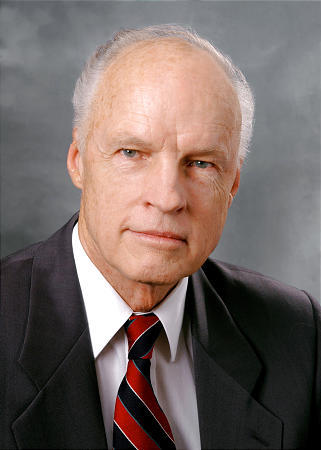
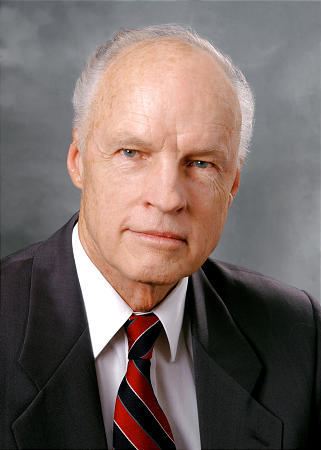
    Chauncey Cazier Riddle graduated from Brigham Young University and received his MA and PhD degrees in philosophy from Columbia University in the city of New York. He taught at BYU for 40 years, serving as Professor of Philosophy, Chairman of the Department of Graduate Studies in Religious Instruction, Dean of the Graduate School, and Assistant Academic Vice President.

    He has written articles for the Ensign, This People, FARMS, Sunstone, Brigham Young University Studies, Deseret Language and Linguistics, the Encyclopedia of Mormonism, as well as other publications.  While his Education Week and Sperry Symposium loyal following always packed the halls of the larger rooms at BYU for more than three dozen years.

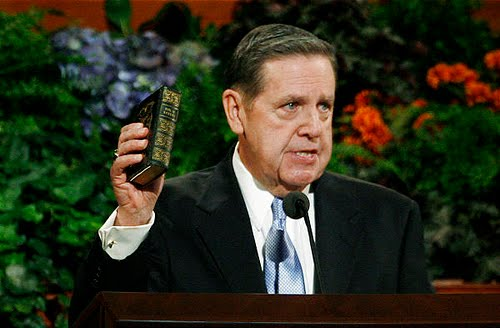
    He is quoted by apostles like Jeffrey R. Holland,

    Jeffrey R. Holland – speaking at Conference

    “His Father in Heaven asks Cain, “Where is Abel thy brother?” and Cain fires back, “I know not: Am I my brother’s keeper?” (Genesis 4:9)  Maybe the answer to that question is—as Professor Chauncey Riddle once said to me—”No, Cain, you are not expected to be your brother’s keeper.  But you are expected to be your brother’s brother.”  (On Earth As It Is in Heaven, p. 142)

    One of Chauncey Riddle’s Friends and Colleagues was Truman Madsen

    One of his many close friends was Dr. Truman Madsen, of whom Dr. Riddle used many of his publications in his philosophy classes.

    Dr. Riddle had many student teachers that worked closely with him like Monte F. Shelley who taught a course with Dr. Riddle for six years:

    “For several years I had the privilege of helping Chauncey teach an Honors philosophy course. He discussed three key questions of both philosophy and religion: How do we know? What is the nature of God, man and the universe? and What is good or right? He then contrasted the basic answers of philosophers with those of the restored gospel of Jesus Christ. The students and I gained a greater understanding of, appreciation for, and testimony of the gospel. This book introduces readers to the questions and answers Chauncey discussed in class. These ideas significantly improved my thinking and my life. Now I can share these ideas more easily with family and friends” — Monte F. Shelley

    He debated Lowell L. Bennion at a much heralded debate entitled “Liberalism vs Conservatism,” and Richard Poll on campus in the early sixties.

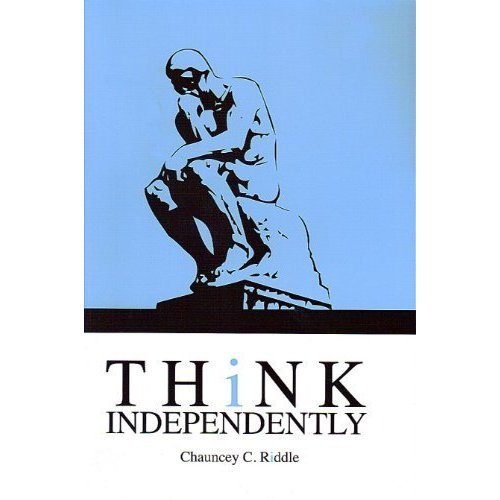
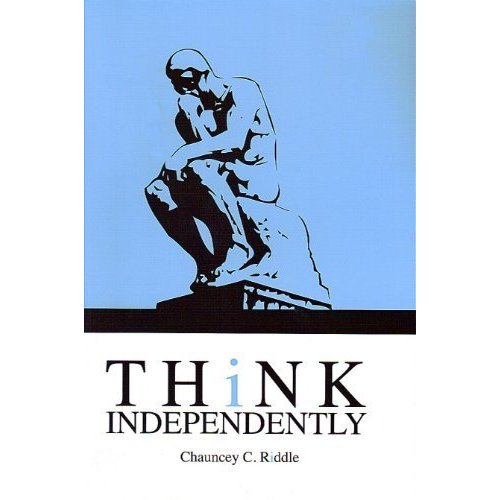
    In 2009, he finally broke down and wrote a book, called THiNK INDEPENDENTLY, How to Think in this World but Not Think With It.

    THiNK INDEPENDENTLY – How to Think in this World but Not Think With It

    The back cover of his book says:

    Skepticism is the backbone that unifies all religions, philosophies, science, and thoughtful inquiry.  They all reject the idea that life without thinking and patter is sufficient. The purpose of all religions, philosophies, science and thoughtful inquiry is to allow human beings to better their life and situation by looking skeptically at whatever exists at the moment and asking how the situation could be made better.

    Chauncey Riddle has done something other bright and capable people such as Hugh Nibley have done for me, opened the door to a complex subject to a layman. I think many who don’t share LDS beliefs will consider it dogmatic, but to a believer as I am, it provides a very useful comparison of traditional philosophy to what I believe. I am not sure I completely accept what is written, but neither do I reject it out of hand. I need more time to consider it. Thank you, Dr. Riddle. I miss your son, Mark.

    Wade W. Fillmore

    His students went on to do many great things. Some like Jon D. Green, published the impact he had on them in the same publications as Chauncey had done decades later:

    I also remember Chauncey Riddle’s beginning philosophy class because he used a modified Socratic method: probing for our answers to philosophical issues rather than loading us with information that we would likely soon forget. The final paper required us to formulate our own philosophy: our own ethics, epistemology, logic, aesthetics, and metaphysics. It was a revelation to me that philosophy involved me in a deeply personal way, that I even had a personal philosophy. – Jon D. Green – Zion and Technology: A Not-So-Distant View – 7 May 1996 – Brigham Young University 1995-96 Speeches


    Comment from Roy: Hi Dr. Riddle. I’ve just read your essay ‘As a Prophet Thinketh in His Heart, So Is He: the Mind of Joseph Smith’. I have been captivated by what you have said, and I will still be reading it until my goal is met. There is one paragraph that starts “One measure 0f the degree of evil a person is perpetrating…….But a being cannot become righteous until he is willing to share with everyone – with his enemies…….and also with God, Satan, rocks, trees…….” I wonder if you could explain to me your inclusion of Satan? I need to feel comfortable doing that! Thank you. Kindest regards, Roy

    Response to Roy: Roy: If I were writing this today I would not include Satan in that list, especially for the reason that it raises questions such as yours. I think my original intent was to point out that since Satan is our brother from our pre-mortal spiritual existence, we need to show respect for him, at least. We are supposed to love our enemies, and Satan is our greatest enemy. Thanks for the question. C. C. Riddle


  • Chauncey’s Life

    The Positive Effects of the GI Bill

    The Positive Effects of the GI Bill.” 123HelpMe.com.

    In 1944 the world was caught in one of the greatest wars of all time, World War II. The whole United States was mobilized to assist in the war effort. As history was being made overseas, as citizens learned to do without many amenities of life, and as families grieved over loved ones lost in the war, two students on BYU campus were beginning a history of their own. Chauncey and Bertha Riddle met in the summer of 1944 and seven months later were engaged to be married. Chauncey was eighteen and a half and Bertha nineteen as they knelt across the altar in the St. George temple five months after their engagement. Little did they know that in just the first years of marriage they would be involved with the effects of a significant historical event, the atomic bomb, as well as government legislation, the GI Bill, that would not only affect the course of their lives but also the course of the entire country.

    Chauncey and Bertha honeymooned in the Grand Canyon late in the summer of 1945. Upon returning to Cedar City, they learned the news that “the United States [had] developed this wonderful bomb and [they’d] dropped it and it hopefully [would] shorten the war greatly.” The first bomb was dropped on Hiroshima on August 7, and the second on Nagasaki on August 9. The official surrender came on August 11, 1945, officially ending the bloody campaign in Japan. The climate in the country was not one of alarm, in reaction to the bomb, but of tired relief. Bertha reflected this attitude. “Those people of our generation saw how many of their friends had died in bloody combat with the Japanese so they were grateful to see it ended.” The atomic bomb seemed the long-awaited answer to concluding the war quickly.

    The bomb was not without its controversies and consequences, however. Before it was dropped, Leo Szilard, leading scientist in the development of the bomb, “opposed it with all [his] power” (Truman 68). His close contact with the destructive weapon caused him and others to argue against its use. It didn’t take long after the end of the war for scholars to assess the atom bomb and its potential in future warfare. In the Yale Review, 1946, Bernard Brodie looked in depth at its future implications and influence on the security of all nations. He recognized that the world could not fully defend itself against such a weapon (Brodie). Within a year of its use, the political effects of the atom bomb were felt. Its immediate result, the end of the war, was almost wholly embraced. However, the climate of the country began to change. Americans sensed there was less security in the world, especially as the beginnings of the Cold War began to take shape in American politics and society. The atom bomb and the end of the war affected the Riddles in quite a different way.

    Before marrying in July, Chauncey was drafted into the military. He had previously tried to enlist and was turned down because he was myopic, or had poor eyesight. “A few months later they called [him] back and gave [him] exactly the same test with exactly the same results and drafted [him].” Chauncey entered the army the day after the war ended. The atomic bomb’s influence on ending the war made it unnecessary for Chauncey to fight in combat. Instead, for one year he worked mostly as a clerk in Salt Lake City. His first responsibility for six months was to separate servicemen, or write out job descriptions of duties performed in the army so they could take their credentials to prospective employers. All the servicemen from Utah, Montana, Idaho, Wyoming came to be separated from the military at Fort Douglas in Salt Lake. Nationwide, 1,000 servicemen and women were discharged within a month after the war’s end. By 1946, only a fourth, three million from twelve million, were still in the service (Bennett 5). After six months Chauncey was transferred to company headquarters to work on personnel records. By years end he was discharged from the army and free to return to his education.

    The Riddles now found however, that they were returning to BYU under very different circumstances. Chauncey had just one year remaining before completing his BA but many of his school expenses were now covered by a pivotal piece of legislation: the Servicemen’s Readjustment Act of 1944, or the GI Bill. Under the bill, those who had served in the armed forces on or after September 16, 1940 and before the end of the war whose education had been “impeded, delayed, interrupted or interfered with” were “eligible for and entitled to receive education or training.” Restrictions such as a necessary honorable discharge, a minimum of 90 days of service, and a maximum age requirement (related to the full education benefit), were the only barriers between millions of servicemen and a golden opportunity (Readjustment Act 288). Any veteran over the age limit for a full education was allowed to take a refresher course no matter his or her age or educational background (Manning 1003). Those who were under twenty-five years of age were allowed up to four years of schooling based on the amount of time spent in the service (Readjustment Act 288). These new students were given eight years after their discharge, or the end of the war, to take advantage of their benefits (Levitan and Zickler 42). For one year of service in the army, Chauncey now had assistance to help him complete his education.

    One of the best benefits associated with the GI Bill was the money allotted to each GI. A “subsistence allowance” of $50 per month, $75 if there were dependents, was awarded on top of tuition up to $500 a year (Readjustment Act 289). Later, in 1948, the sum was raised to $75 a month (Levitan and Zickler 52). Veterans with a spouse received $105 and families received $120 (Bennett 243). The sum was small but the help was appreciated. “It wasn’t very much- fifty dollars or something to live on. But it was something.” There were plenty of veterans to help. Around 3.5 million servicemen and women were demobilized in one year (Donaldson 5). In 1945 1.6 million veterans entered the educational system and in the fall of 1946, 2.1 million were attending school. This made up 45% of students attending universities (Bennett 2). Many of these students would never have had the opportunity of going to school and receiving a higher education had it not been for the G.I. Bill’s assistance.

    Chauncey especially benefited from the GI tuition money two years after graduating from BYU. After graduation in the spring of ’47, Chauncey and Bertha moved to Nevada where Chauncey worked as a taxi driver and a tour guide for his father. His father was the owner of Yellow Cabs of Nevada and Chauncey was the assistant manager. After two years working with his father’s businesses, Chauncey decided to further his education at Columbia University in New York. In 1945 Columbia had stated that it was open to veterans, when many other colleges were wary of the sudden influx, on the assumption that these veterans were entering school with the same education goals as every other student (Columbia 214). Chauncey would have to prove himself capable of excelling at the demanding university. At the time, political scientists believed that most veterans would go into vocational courses and register less in academic courses (Manning 1003). However, veterans were free to go into whatever field they wished. Chauncey chose to study philosophy in hopes of teaching at a university. Columbia’s high tuition was no longer a barrier. “When [he] got back to Columbia where the tuition was very high [the GI Bill] paid that too. [He] couldn’t have gone there without that.” Many other GI’s, it seemed, followed a similar path since 52% of veterans choose often more expensive and difficult private institutions (Bennett 19).

    The Riddles were still starting out though, and they did not have the money to live in New York. While the GI Bill covered limited expenses, the income was not sufficient to support the whole family in New York City. Consequently for a school year Chauncey lived in New York and went to school while Bertha stayed part time with her parents and part time with his. Without the GI Bill, many men would have ended up working straight out of the service. However, because of the assistance from the government, a high percentage was able to pursue higher education. While this became a positive force for the future, it created many hardships. “[The Riddle’s] third child was born while Chauncey was at Columbia and [Bertha] was still in Nevada and that little boy died which was a very difficult experience.” Chauncey returned from Columbia to attend the funeral and spend Christmas holiday with his little family, but after Christmas he returned to Columbia to continue his studies and make up missed final exams. Once again the couple was separated for four months.

    A full quarter of the students in higher educational institutions were still veterans at this time. That number had fallen from 49.2% in 1947, but Veterans were still a major force in the nation’s schools and the colleges were still trying to meet the extra demands placed on them. Students were placed in packed dorms, fraternities, sororities, boarding houses, ex-army barracks, and three trailer camps (Douglas 112). Housing, food, money, and teachers were all in short supply (Walters). “[BYU] jumped from 700 to five thousand a year and it kept on growing.” This was a typical scenario of U.S. colleges at the time. The huge influx of millions of veterans helped prevent strains on the job market but the strain on schools was tremendous. Many students were forced to accept substandard living conditions from universities that could not house them. However, the schools finally began to catch up to the growth and house more of their students.

    Housing was a concern for those in and out of school. Predicting the desires of many young men to get a new start, the GI Bill provided housing subsidies for veterans. The immediate demand for housing was curbed by the large number of students not ready to invest in their own homes (Bennett 15). However, the bill provided guaranteed loans up to $2,000, and many veterans took advantage of the government’s offer (Readjustment Act 291). Housing starts in 1944 numbered around 136,000. They were increased to 325,000 in 1945, but jumped drastically to 1,015,000 in 1946 (Bennett 15). The sharp increase in demand was larger than the market’s capacity to fill the need. However, “the GI Bill created and filled the suburbs” (24). The housing industry began to reach proportions equal to the car industry, mainly due to a man named William J. Levitt (24). His entrepreneurial ideas about building quick, sturdy houses provided a way to keep pace with demand. Levitt’s company began building over 30 houses in a day. While they were all alike they were efficient and filled the need and even had trees, parks and playgrounds (Douglas 148). The economy responded to the needs of the veterans as it continued to expand.

    However, in other ways the economy was slow to respond to postwar demands. Newsweek reported in 1946 the great frustration Americans had due to continued shortages of mainly household goods (Goods: Sorry). It was not surprising that the economy hadn’t fully switched back to peacetime production from the war machine it had been for the last four to five years. From 1940 to 1945, factories produced 300,000 aircraft, almost 75,000 naval ships, over 40 billion rounds of ammunition, and over 2,000,000 trucks. While war products never exceeded 40% of the gross national product, war production was a major force in American economics (Douglas 5). Citizens were not only worried about empty store shelves but rising prices. Worries about inflation came in response to a 22% price hike from June of 1946 to December of 1948. Even though wages also went up and unemployment stayed below 41/2%, Americans worried over rising costs on basic goods (Bennett 14). There was also initial concern that there would be another recession similar to the one that followed the First World War. However, the GI Bill “painlessly reabsorbed 12 million veterans into the economy” (14) thus preventing many of the previous generation’s problems. Seven point eight million veterans went to school and the rest, if they were unemployed, collected benefits of $20 a week and generally were working within a short period of time (14).

    The GI Bill’s solution to the Veteran’s rush on the economy had another great effect. Just after the war, labor problems broke out. What began as a Ford supplier strike in 1945 led to a GM, steel worker, soft coal worker, and railroad strike in subsequent months.

    Without the GI Bill, if the veterans hadn’t been absorbed in getting on with their lives, drawing unemployment while applying for school, looking for a job, or starting a business or profession, the automobile, rail and coal strikes might well have had cataclysmic effects. Idle, without money or prospects, the veterans would have inevitably been drawn into the rail and coal strikes on one side or the other. (17)

    Without the GI Bill to distract veterans, the country might have taken a completely different course with a great deal of confusion and disorder. Instead, the economy survived the influx in the workforce and even grew exponentially.

    Families were greatly affected by the GI Bill. The Riddles were finally able to afford moving together to New York. They packed up their wood body station wagon and drove from Utah to New York City. Because GI housing was 25 miles away, the little family lived in the bell tower of an old chapel that had been purchased by the LDS church. Not only were they given the apartment but also a custodial job for the building. This provided extra income and the apartment’s convenient location made it east to get to meetings on time. They lived in their tiny apartment for two years with three children. Bertha never finished college but instead focused on raising her family. She took the children to Hudson River, Central and Riverside Parks as well as to the American Museum of Natural History and the Metropolitan Museum of Art. She exposed her children to as many diverse experiences as she could. Because most museums were free, her limited budget was not strained yet the children were well entertained. Millions of women chose to return home to their families as soon as the veterans returned. Between 1945 and 1947, 2.5 million women quit their jobs (Bennett 13). However, from 1947 to 1952, the percent of working mothers was up 400% (Douglas 98). While Bertha chose to stay home with her children, many other women were choosing to enter the work force. Still, families boomed after the war. In 1948, one out of every five students was married as opposed to one out of every twenty one just nine years earlier (98). The birth rate went from 2,315 per 10,000 of the population in 1936 to 3,817 in 1947 (Bennett 24). Families all over the nation were growing and experiencing many challenges, similar to the Riddles, in making a start for themselves.

    A great difficulty for many young couples was the strain of school demands on the family. While Bertha watched the children, Chauncey was still working toward his degree in Philosophy. Because he hadn’t studied philosophy at BYU, he had to catch up while he was learning his current class material. He also met up with fierce competition. The students were “90% Jewish, very hard workers and very bright. [He] had to stay up all night to keep up with them.” He would often study 12-14 hours a day. At the end of his schooling he was required to take comprehensive exams. There were two of them and each lasted two days for eight hours each. “[Chauncey] passed the first one and the second one everybody flunked. So [he] had to slow down and re-study everything and take it again. That time three passed- everybody else failed. [Students] only get two chances so it was a real weeding out.” Chauncey was lucky to be one of the three. He had finally completed his education largely due to assistance from the GI Bill.

    While there was much praise of what the GI Bill was doing for veterans like Chauncey, there were also concerns and complaints related to the new legislation. American Magazine reported that veterans were running into red tape from administrators that were keeping them from receiving their full-entitled benefits (28). On the other hand, educators often worried about the effects of free education. William Randall of the University of Missouri speculated that GI’s would see education as a “reward for past services” rather than a reward for academic achievement (Randel 412). Most universities had reservations concerning the large influx of veterans but found the majority of GI’s were good students. The immense benefits to the country and to the veterans far outweighed the concerns voiced by various small groups of critics.

    Little of what society is today is independent of the GI Bill’s effects. From education to economic security, the GI Bill laid the foundation for post war expansion. It also paved the way for social change. “The GI Bill was America’s first color-blind social legislation” (Bennett 26). It was a means whereby many future Civil Rights leaders were educated (26). John W. Manning could not have been more correct when he speculated in 1945 that “the veterans will be a factor to be considered in public life after the war. . . . Many of these will take advantage of the free education offered them under the GI Bill.” The education provided by the bill, that might not have been available otherwise, led to a more educated and independent generation of Americans who shaped postwar society and culture.

    Six years after graduating from Columbia, Chauncey returned to earn his doctoral degree with a dissertation on Carl Pearson’s philosophy of science. Without the atomic bomb to end the war, Chauncey might have seen combat. Instead, his service amounted to enough work to pay his way through school at BYU and also Columbia. The GI Bill and its many provisions was a springboard to the Riddles’ lives. The nation’s history intertwined with their own to shape their future. The GI Bill was one of the greatest pieces of legislation to come out of the government because of its far-reaching positive effect on the country’s development. It was the proper solution to the close of a historic period of history.

    Works Cited

    Bennett, Michael J. When Dreams Came True: The GI Bill and the Making of Modern
    America. Washington: Brassey’s, 1996.

    Brodie, Bernard. “American Security and the Atomic Bomb.” Yale Review 35 (1946):
    399-414.

    “Columbia University’s Policies as to the Admission of War Veterans.” School and
    Society 2 Apr. 1945: 214.

    Donaldson, Gary A. Abundance and Anxiety: America, 1945-1960. Westport,
    Connecticut: Praeger, 1997.

    Douglas, George H. Postwar America: 1948 and the Incubation of Our Times. Malabar,

    Florida: Krieger Publishing, 1997.

    “Goods: Sorry, We’re Our of It.” Newsweek 1 July 1946: 65-8.

    Levitan, Sar A., and Joyce K. Zickler. Swords into Plowshares. Salt Lake City: Olympus, 1973.

    Manning, John W. “Political Scientists and GI Education.” The American Political Science Review Oct. 1945: 1002-5.

    “President Truman Did Not Understand,” U.S. News & World Report 15 Aug. 1960:

    68-71. Atomic Bomb: Decision 26 Jan. 1996 8 Dec. 2000 <http://www.peak.org/~ danneng/decision/usnews.html>.

    Randel, William. “Implications of the ‘GI Bill.’” School and Society 8 June 1946: 412-13.

    Riddle, Chauncey and Bertha. Personal interview. 18 Sept. 2000.

    Riddle, Chauncey and Bertha. Personal interview. 14 November. 2000.

    “The Talk of the Town.” New Yorker 15 Dec. 1945: 23-4.

    Scheiberling, Edward N. “GI Gripes on the GI Bill.” American Magazine Aug 1945: 28-9.

    “Servicemen’s Readjustment Act of 1944” (PL 78-346, 22 June 1944), 58 United States Statutes at Large, pp. 284-301.

    Walters, Raymond. “Veterans’ Education and the Colleges and Universities.” School and Society 16 Nov. 1946: 337-40.

  • Welcome – Introduction to chaunceyriddle.org

    WELCOME! This is a collection of the works of Dr. Chauncey C. Riddle.

    It has been said that three of the greatest teachers to grace the halls of Brigham Young University in our generation were Hugh Nibley, Arthur Henry King, and Chauncey Riddle.

    I have to be careful. He may not let me publish this site if I praise him too highly, (that is partly why I keep the password to this blog!)

    The Education of Zion-Conversations with Arthur Henry King, Chauncey Riddle, and Hugh Nibley

    He has been likened to a modern day Socrates; a latter-day Socrates. Socrates taught with questions; Chauncey taught with questions. Socrates never wrote much that was published. In fact, if it wasn’t for his more famous students Aristotle and Plato, the world may not have known much about Socrates. But Socrates inspired the greatest philosophical thinkers throughout all of history. His students sat daily face to face with greatness.

    As far as I know Chauncey wrote a book called “A Generalization of  Tolstoy’s Theory of Art” in 1951, his unpublished doctoral dissertation at Columbia University in 1958 called, “Karl Person’s Philosophy of Science,” and “Think Independently” in 2009, long after his retirement from BYU.

    When I was sixteen years old I was given a printed collection of notes that two students took from a class of Dr. Riddles in 1965, the year before I was born. The top of the talk was ripped off but it was about what he called “The Deadening Sensation.” I later found the title of the paper was “The Path to Redemption” and it was a class taught by Dr. Chauncey Riddle. It changed my life. I got to know several of his students who passed me another talk now and again and I was enthralled with the clarity of his thought process. I went to an Education Week lecture or two of his and was even more amazed at the bright light of his understanding.

    Chauncey says his entire mission is to turn people to Christ by getting them to think.

    I tried a few times to play golf. I can actually pick up the ball and throw it better than hitting it with those sticks. One technique that worked for me was to look far down the fairway at the hole, then to find a small item as a landmark that was much closer to me. If I focused on the small landmark, I was hitting in the same direction as the hole, but I could keep it in sight while I swung the club. That is what Chauncey is to me and countless others in relation to becoming like Christ and finding truth, and turning us in the direction of Christ and truth.

    I heard he was about to retire. I had just finished my degree at the University of Utah after two years at the United States Naval Academy and two years on an LDS mission to South Carolina. I decided to move my family to Provo, Utah, so I could take one class from Dr. Riddle. I was compelled to. I enrolled and audited the class during the summer prior to his final year of teaching. It was Philosophy 110.

    I was told (or warned) that it would be rigorous, but I had no idea.

    The first day of class Dr. Riddle told us of his  unorthodox grading regimen. He graded from 0 to 12. If I remember a 9 or 10 was considered to be an A. He told us that he wasn’t sure that anybody would be able to get a 12 on an assignment. I learned later that to receive a 12, he had to receive revelation that the student had received revelation or inspiration about the assignment. My first grade on a paper was a 2. I had a 0 or two. I was half way through the course and my highest grade was a 6. I had considered myself rather bright.

    He taught us how to ask questions; all different kinds of questions. He taught us about systems thinking, strategies, metaphysics, epistemology, language, and worldviews. He helped us compare summaries of each philosophical and theological thought process and models to each of the others. We had to come to class fully prepared by having read the entire assignment(s) and having three well thought out questions written out and prepared. He cared more about thoughtful questions than answers.

    I was putting in more time on this class than my full time workload at the U of U or Annapolis, and loving it. I was learning. I was thinking. I wasn’t cramming for a test, or psyching out a professor.  I was lifting heavy loads with merely my neurons. I honestly remember my brain hurting. I was obsessed with getting a 12. I had finally achieved an 8, then one 9.

    Dr. Riddle said sometimes an idea was so strong it might be a pure concept. He said sometimes it didn’t need lots of words. Towards the end of the class he gave us an especially difficult assignment. I saw other students finish it early. Some with as little as 8 pages, or as much as 25. I couldn’t get around the fact that I strongly felt I could encompass everything he was asking me on one single piece of paper; in a table, almost a picture. I understood it completely, and it was simple. Too simple for a long drawn out writing assignment; just because I could. I remembered Mark Twain, “I didn’t have time to write you a short letter.” But now I had time. And I knew.

    I knew he would know.

    I turned it in.

    I got a 12.

    I’ve never forgotten that day.

    I am no Aristotle or Plato. I am just Ken Krogue, my former role was President and Co-Founder of InsideSales.com. I’m the volunteer webmaster for this site, and a former student of Dr. Riddle who convinced him to let me make this site available to future generations of students. I spent several years and over 350 hours transcribing his talks and audio recordings into this collection. If there are typing or grammatical errors, they are mine. I learned to type 75 words per minute in the process and gained temporary discipline to get up day after day at 5am. I call it my “Masters Degree in Thinking.”

    The views contained on this site are merely thoughts and reflections on the doctrines of Christ and philosophy. Dr. Riddle does not claim to speak for the Church of Jesus Christ of Latter-day Saints. His only goal (and he has reminded me of this even this week) is not to focus on Chauncey Riddle, but to turn people to Christ.

    I welcome any and all other students, friends, and colleagues of Dr. Riddle to join me in this celebration of his life’s work by making it available to others.

    We are pulling together an Editorial Board of interested parties to work on this blog and another website called www.RiddleAcademy.com that will be based loosely on the Khan Academy concept.

    We hope to make the curriculum and thought process Dr. Riddle taught through his own version of the Socratic method and by the Spirit of Christ for 40 years, available to future generations. Please email me at kkrogue (at) gmail.com if you want to help, just want to read, or have additional materials, thoughts, ideas, or questions.

    Why am I doing this? I want more people (including my kids) to learn to think.

    Like I did.

    Come join me on the journey.

    –Ken Krogue, a student of Dr. Riddle and follower of Jesus Christ