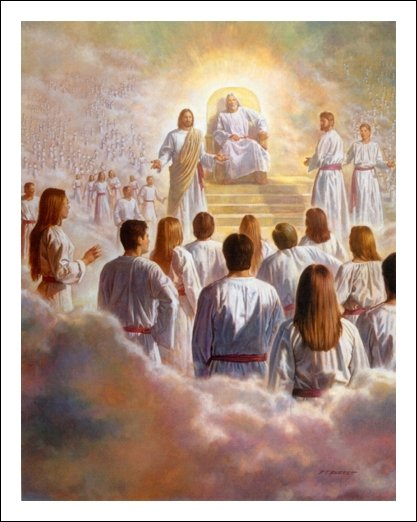
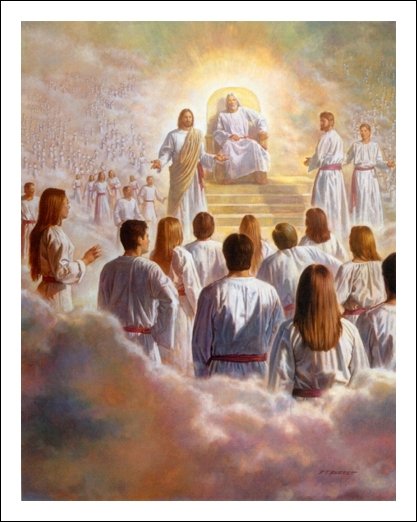
The suffering: Christ took upon himself all of the pain ever suffered by any and all human beings, but especially that caused by anyone sinning (breaking the commandments of God).
The sacrifice: Christ voluntarily gave up his potentially non-ending mortal life. Because he was the literal son of God the Father, he inherited the ability to live forever as a human being. Because he was the son of mortal Mary, he could die a mortal death if he so chose. He chose to die on the cross, thus sacrificing all the good he could have done in an unending mortal life.
The restitution: Every sin (breaking a commandment of God) involves a damage to someone or something. Before any sinning of any human being can be fully forgiven, the damage created by the sinning must be reversed. In His atonement, Christ restores to each human being the damage done by all of the sins committed against him or her. Only as this restitution is fulfilled can any person sinned against receive his or her full blessings in eternity. For any sinner to be forgiven of his or her sins, the sinner must at least attempt full restitution to the person sinned against. This full restitution usually cannot be done be the sinner, and the power of Christ must make up the difference. Thus Christ’s atonement must be invoked in the restitution of most human sinning.
Goal of the atonement: To enable each human being to love God with all of one’s heart, might, mind, and strength, to become perfect (3 Nephi 12:48, D&C 59:5); thus to enable the person to dwell in Father’s presence (Moses 6:47) and to inherit all that he has (D&C 84:37–39).
We are saved only by putting our whole trust in Jesus Christ (2 Nephi 32:19–20), who was sent into the world to draw all men unto himself (3 Nephi 27:14–16), that thereby he might present to the Father in a perfected, spotless condition all persons who will become faithful to Him (D&C 76:107).
What the Savior does and has done to be able to draw us to Father:
Heart: He is completely humble and loves Father with that same pure love with which he is loved. (John 5:19–20)
Mind: He believes, accepts and obeys Father in all things, and has been glorified in all truth. (D&C 93:11–14)
Strength: He descended below all things, suffering all temptation; He suffered in Gethsemane the pains of sin for every man, woman and child; and he continues to suffer with each human being their own pain. (D&C 19:16–19)
Might: He sacrificed his power, life and opportunity to bless men in his mortal sojourn so that he could seize the keys of death and bring to pass the resurrection of all mankind. He continues to sacrifice all that he might otherwise do to do Father’s will. (Alma 34:14–15)
How the Savior’s atonement is daily extended to each of his covenant children:
Heart: He sheds forth his pure love upon us, giving us light unto wisdom, enabling us to love purely, eventually giving us a pure heart of our own if we are faithful to the end. (Mor. 7:46–48)
Mind: He glorifies our minds in truth, that we might become persons of understanding, comprehending the way of God. (D&C 93:26–28)
Strength: He gives us life, health and strength from moment to moment that we may be free to do good and to grow into His stature. (Mosiah 2:20–21)
Might: He gives us forgiveness of sins from moment to moment as we are faithful, that we might be able to continue to receive his light and truth; and he increases our might until we can do all that he did on earth, and even more. (John 14:11–12)
What the child of Christ will do daily to accept the atonement:
Heart: Yield his heart to God and good, being easily entreated, yearning for the welfare of all mankind, but especially for the welfare of his neighbors. (Hel. 3:35)
Mind: Accept ideas as true only as attested to by the Holy Spirit. Search the mind of God in scripture study, prayer and meditation. (2 Nephi 28:31)
Strength: Do all that can be done to sanctify self, to then minister to the needs of others as led by the Holy Spirit. (D&C 88:68)
Might: Use all that one has to serve and bless others as guided by the Holy Spirit. (Mosiah 4:26–27)
What the atonement of Christ will do for each covenant child of His who endures to the end:
Heart: Purification, the receiving of a new, pure heart. (Mosiah 5:2–3)
Mind: Glorification, the receiving of all truth. (D&C 93:28)
Strength: Resurrection: To be renewed in the flesh, then to receive a perfected celestial body in the resurrection. (D&C 88:22–29)
Might: Sanctification: To be forgiven of all sinning, thus to be able to share with Christ and Father the full power of God. (D&C 50:28–29) Justification: To grow in righteousness, a just person who keeps all the laws of God, and thus becomes a just (justified) man made perfect. (D&C 76:69)
The steps of gifts and power by which Christ draws all mankind into the fullness of his stature, accomplishing at-one-ment.
The light of Christ: Enables all men to choose to do good. (John 1:1–9)
The Gospel of Jesus Christ: The message as to how to learn to do only good through Jesus Christ. (Acts 2:37–40)
The witness of the Holy Ghost: Enables all men to know that he, Christ, is the son of God, and that they may repent through Him. Accompanies the message of the Gospel. (Matt. 16:13–17)
Covenant of baptism: Enables all men to become children of Christ, to begin to inherit all that he is through faith in him. This is the gate to the path that leads to eternal life. (2Nephi 31:17–18)
The gift of the Holy Ghost: The right to the constant companionship of the Holy Ghost, which, if claimed, will enable the person to walk in light and truth, on the path to perfection. (D&C 121:46)
The gifts of the Holy Ghost: Special powers which enable the children of Christ to do more good. (D&C 46:10–11)
Ordination to the Priesthood: Receiving the power of God to do His good using supernatural power. (D&C 84:35–38)
Setting Apart: Receiving the stewardship to use the power of God in specific responsibilities. (D&C 68:2–4)
The endowment: Receiving further gifts from God in the oath and covenants of the priesthood. (D&C 105:12)
Temple Marriage: Receiving further gifts and the ultimate stewardships of husband, wife, and father and mother. (D&C 132:12–20)
The stages by which one partakes of salvation and atonement: (2 Pet.1:5–8)
Faith: Putting one’s whole trust in Jesus Christ
Virtue: Gaining godly strength in faith in Christ
Knowledge: Gaining increased understanding of the ways of godliness.
Temperance: Becoming steady on the faith of Christ in all seasons and conditions.
Patience: Being able to wait upon the Lord’s timetable in all things; being able to let others repent at their own speed.
Brotherly kindness: Better translated as the love of the brethren, the willingness to serve faithfully in the priesthood structure of the church.
Godliness: Becoming concerned for the welfare of every soul, trembling that any should not know of the goodness of Christ.
Charity: the end, having endured until one has received a new heart, the pure heart of Christ.
Let us begin by dividing up reality. The first part of reality is the natural world, that which is created and governed by the hand of God; this is the terrain, the flora and fauna and the atmospheric events in which we exist. The second is the artifactual world, that which is created and governed by the hand of mankind; this is the realm of clothing and computers, automobiles and armed forces, factories and farms. The third world is the symbolic world, that which is created and enjoyed in the heart and mind of each human being as he or she contemplates the verbal and artistic productions of mankind. It is this third world which we in the humanities emphasize.
How are these three worlds interrelated? The natural world is the home base, that which makes the other two possible. The artifactual world is the arena of our comforts and conveniences. But it is in the symbolic world that we human beings come to full flower and fill the measure of our creation.
The measure of our creation is that we have been sent by our Father in Heaven into this natural world of His to create a heaven out of a fallen world, which is essentially a hell, for Satan largely rules here.
We are in hell because of the fall of Adam. This hell is carefully designed to try the soul of every individual, to prove for each of us whether we most desire our own personal pleasure or rather desire the welfare of all. In this hell where selfishness abounds, righteousness is a singular achievement, attained only by walking humbly with God, to attain a genuine accomplishing concern for the welfare of all.
Now the interesting thing about this situation is that everyone claims to be working in behalf of heaven and earth. The Serbian snipers in Bosnia fancy that they do the world a favor when they gun down Croatian children. The marauding bands of Somalia are grasping at heaven by stealing everything they can lay hands on. Every candidate for political office touts himself or herself as the savior who will really do things right. Advertisers would have you believe that what keeps you from heaven is your body odor or your beverage selection. Madness all.
All of these human attempts to create heaven run afoul of two things. First, heaven is never an individual attainment. If I seek only for my personal heaven, I will fail. I may indeed gain some momentary pleasure. Indeed, some manage a mortal lifetime of selfish advantage. But personal privilege always fails in the long run. Heaven is a corporate venture, and cannot be attained for some at the expense of others. If heaven is to be real and lasting, everyone must have the opportunity to participate, and all who enjoy it must labor in concert to perpetuate it.
The second problem which human beings face in establishing heaven is that we humans do not know how to be wise. Even if we were to solve the first problem and all work together, we would and do miscarry because we do not know enough about our problems and the future to bend our energies in precisely the right way. What the quest of heaven needs is a God, one who is wise and omniscient, who will direct a people intelligently to meet every contingency in time and eternity.
So mankind has two great problems. Some think they can create heaven for themselves without worrying about everyone else who is suffering, and some think that they are smart enough to figure out how to create heaven on their own. The former problem is selfishness, and the latter is pride.
But how to quell selfishness and pride? This is where we return to our three worlds. Selfishness and pride cannot be successfully confronted in either the natural world or the artifactual world. They can be understood and dealt with only in the third world of the symbolic development of the human imagination. What is needed is art forms and arguments which clearly show forth the reality of the human situation, that show selfishness and pride for the great stumbling blocks which they are.
The problem is that much of the symbolic transaction of the human community is the celebration of selfishness and pride. That which could be used to cure is deftly and artfully wielded in behalf of the enemy. Many who could show the correct way mock what will help and glorify this hell in which we find ourselves.
So, what is the solution? I offer the following suggestions:
We who are Latter-day Saints and skilled in the disciplines of the humanities can make a difference. If we make it the business of our lives to seek out everything that is virtuous, lovely, of good report and praiseworthy, and to create the same. If we promulgate and celebrate that good, we can accomplish that difference. There are many on the earth who are tired of the world and worldliness, who would welcome a stand for principle and virtue, but know not where to find it.
We Latter-day Saints who would assist in the creation of heaven on earth must have no illusions about the order in which things must be done. The Savior has made it plain that no one can assist in this work until they themselves are clean from their own sins and those of the generation in which they live and work. We can become free from sin only through the Atonement of our Savior in partaking of the New and Everlasting Covenant and in living the law of the Gospel. If you and I will not first eschew selfishness and pride, there is little we can do to help others.
We must not be snared by the pernicious doctrine of “art for art’s sake.” This doctrine of the world is the very embodiment of both selfishness and pride. It is selfish because it puts the desires of the artist ahead of the result his work creates in the rest of mankind. It is proud because it rejects the mortality of God and good. No one ever created heaven by courting Satan. Yet much of what the world hails as great art, technically superb and thoroughly titillating, is the worship of being carnal, sensual and devilish.
As Latter-day Saints we can have the power to do good in all of the world of symbols if only we will go humbly before the throne of the author of all good, which is Jesus Christ, and faithfully do His will. The trouble is that to promote good one has to be much more skilled than one needs to be to promote evil.
Evil is always short-sighted and short-lived. To be intelligent is to look to the long-run happiness of all. In other words, to be evil is to be unintelligent, though perhaps clever, and to be good is the only real intelligence.
The only real source of intelligence in this life for us is Jesus Christ. He will not save us unless we first save ourselves in the symbolic world. He comes to us as the Word, the messenger of salvation, to excite our minds to hunger and thirst after that which is good and holy. We then begin to treasure that which is good and holy, then and only then can we as persons begin to be good and holy and intelligent. Only as we persist in making every sacrifice to cleanse our minds and hearts of that which is base and evil can we help to create and dwell in a heaven with other persons of good will.
Your graduation today shows that you have been able to meet the requirements of this university for your degree. The question remains, did you meet those requirements with cleverness or with intelligence? Whichever it was, we shall all be found out. For in the not too distant future there will be another commencement day, the day when our mortal probation is past and we commence our individual eternities.
At that time some of us will be told, “Well done, thou good and faithful servant. Enter into my rest.” These souls will then have the delight of laboring successfully to build heavens for others for all of the future. But some will be told, “Depart from me, ye that work iniquity.” These are they who celebrated selfishness and pride in their mortal probation, who sought comfort and aggrandizement only for themselves at the expense of others. They will be sent out into the darkness to say anything they please, no matter how foul or perverse, and to depict evil in all of its gore, to their hearts content. But let us hope that none of this company will then be found weeping and wailing and gnashing teeth. Thank you.
The first is the natural realm; our physical bodies and activities share this realm with the earth, plants and animals, and the events of the atmosphere.
The second realm is the artifactual; this is our tools and machines, and all that we humans do with them to create our own non-natural environment and to provide comforts for ourselves.
The third realm is the realm of imagination and ideas, the special province manipulated using symbols which records the hopes and fears, dreams and aspirations, the amusements and indulgences of the human race.
The fourth realm is the spiritual wherein each human being struggles with good and evil and makes the choices of his or her mortal existence.
The interactions of these four constitute the whole person, and the more developed each of us is in each of these areas, the more powerful a person we are. We in the humanities specialize in the third realm, that of ideas and imagination.
I now wish to make a number of points about the humanities and their place in the mortal scheme of realms.
Contrary to the oft asserted idea, the humanities cannot and will not save the world. It is popular to contrast the progress of science and technology, which seem to develop unfettered, with the humanities, which must catch up with and give a conscience to science and technology. This cannot and will not happen, because the humanities is the realm of possibility, and by itself encompasses all possibilities, good and evil. The humanities may feed science and technology with new ideas for creative achievement, but cannot harness or control.
Contrary to what many in the humanities believe, the humanities is not the most real of all the realms. Each realm is real, including the humanities. It is the natural realm which is the ground of our being. We do our work in the artifactual realm. We contemplate in the intellectual realm of the humanities, and we choose in the spiritual realm. The ultimate proof of our choosing and our imagining of ideas is found in what we do in the artifactual realm; in this latter come the fruits of all that we are, and by these fruits we shall be judged. The natural realm will claim us at the end of our mortal probation. The special mission of the humanities and the realm of ideas is to explore what is possible. We loop out from the natural and the artifactual to see what could be. Our flight of fancy always returns to the natural and artifactual realms to achieve that of which we first dream and choose. It is this dreaming through the use of symbols which makes us specifically human. And if we choose good over evil in our dreaming, that means we have accepted the invitation to join the gods in their celebration of all is possible and good. Those who pursue the humanities see the humanities as an end in itself at their peril. One of the pernicious teachings of our world is the notion of art for art’s sake, treating the humanities as if they were autonomous and could indulge in anything without answering to anyone.
Those who pursue the humanities see the humanities as an end in itself at their peril. One of the pernicious teachings of our world is the notion of art for art’s sake, treating the humanities as if they were autonomous and could indulge in anything without answering to anyone. Every human idea eventually has an impact in the artifactual world. If we celebrate evil in the intellectual world, we will do evil in the artifactual world. Satan is very real, and those who glorify evil are in concert with him. No one ever established a heaven by consorting with a devil. The freedom the humanities enjoy must be matched by responsibility in each person. Superb technique does not sanctify service to Satan. Rather it makes it more devilish.
Thus it is overwhelmingly important that those who pursue the humanities come to grips with the spiritual realm. To come to grips with the spiritual realm is to learn unerringly to discern good from evil and to identify correctly which is which. Only then can one choose the good. We humans were placed in this mortal probation with the possibility of doing both good and evil, but we are under strict command not to choose and do the evil. To pretend that there is no difference between good and evil, or that we must carefully give equal time to both in our creation and consumption in the humanities is to have capitulated to evil. The most difficult and demanding intellectual task facing any Latter-day Saint is to discern unerringly between the whisperings of the Holy Spirit and the enticings of Satan. By careful attention and constant experimentation any of us can solve that problem. Only then can we depart from the ways of the world and join forces with all others who have chosen the good over evil.
The solution to what to do in the humanities is for each person who partakes of the humanities to become Christ-centered. Our Savior is the source of all that is good and true in this world. If good and truth are beautiful to you and to me, we will choose him as our master and celebrate and promote only his good and his truth. But we are agents unto ourselves. We are free for the time being to call evil beautiful if we so choose. But for that, we will answer. There are many in the humanities who do not believe that we will need to answer for promoting evil. These are they who are not mature in the spiritual realm. They match power in the humanities against only wishful thinking is the spiritual realm, and some of them carefully lead their brothers and sisters down to hell. But no one leads or is led to hell who does not somewhat enjoy the process. Whatever we enjoy tells the state of our spiritual progress.
We latter-day Saints have a mission to establish Zion. Zion cannot and will not be established without the support of the humanities. To work for Zion is to be a revolutionary, rebelling against everything in this world which is degrading and degraded. No revolution can succeed unless it is carefully articulated in the symbols of language, and music and art add that much more. When our use of the humanities becomes wholly Christ-centered, we become fit participants in this most glorious of all revolutions.
Finally, we note that not to work for Zion is to fight against Zion. Those who are not for Christ are against him. Those who believe in equal time for good and for evil are promoting evil and are fighting against Zion. Hopefully each of us will seek after and celebrate all that is virtuous, lovely, of good report or praiseworthy. In the fairly near future, all of us here today will meet at another commencement exercise as we commence our individual eternal existences. All that each of us has done in our probation will be publicly reviewed. If we sought good, good will be rewarded to us; if we sought evil, evil will be our prize. Let us hope that there will be no weeping and gnashing of teeth among us on that great occasion. Thank you.
As we celebrate the accomplishments today of those who have graduated it is appropriate that we also celebrate the greatness of ideas, for it is ideas that make a university a meaningful institution. For a moment I would like to draw our attention to a famous and momentous pair of ideas and dwell upon their significance. These ideas are fact and value.
First, the nature of facts. Facts relate to truth. They are concerned with states of affairs in the universe. States of affairs are things that exist and how they are related: as they were, as they are and as they are to come.
Some facts are easily obtained. We are not in doubt at this moment that we are in the Marriot Center, that the present season of the year is summer, that gasoline explodes, and that not all of our politicians can be telling the truth. The facts that are easily obtained are mostly items we can observe, here and now, and each man for himself.
But the large majority of facts are not thus easily accessible. The whole of the past, the whole of the future and well over 99% of the present are not available to our individual observation. But notwithstanding the difficulty of knowing this majority of facts, it is most important that we nevertheless gain true ideas about some things in the past, in the future and in the unseen present, and it is desirable and useful to know as much as possible.
The difficulty of our gaining most facts for ourselves plus the desirability of having many facts difficult to obtain have caused us human beings to create a division of labor. We commission historians to tell us about the past, scientists to tell us about the large and the small and the existence and processes of our physical surroundings. We hope for prophets to tell us of the future, and there are many candidates for the calling of prophet, but few who are found to speak truly.
This division of labor creates then what we call experts. Experts are persons of training and judgment who attempt to wrest the truth from the universe and who relay that truth for the benefit of non-experts. One of the reasons that each of you graduates are here today is because you have become an expert in some field. You know things the majority of us do not know, and more importantly, you have learned how to obtain and use this esoteric information. Thus armed you are prepared to make significant contributions to knowledge and understanding as you go out into the world. Though there are many kinds of experts in the world, experts in facts have a primary role because we cannot solve our problems effectively and efficiently unless we have a command of the facts of situations as they really are.
To say that we understand things “as they really are” reminds us that sometimes there is no human way to gain needed facts and that sometimes the experts are wrong. Notwithstanding these important limitations, it is satisfying to know that men are making impressive inroads into the unknown as our body of facts doubles now about every ten years.
Let us turn then to the realm of value. Whereas facts have an objectivity to them, values do not. Values are personal reactions of individuals to things. Values relate to desire. Whatever a man desires, that thing is valuable to him. Thus we choose and reject food according to one’s taste, which is part of our desire. We act politically according to that which we think will fulfill our desires. We plan for the future according to the desires we have for a thing to come to pass or not to come to pass.
Nothing has value in and of itself. Value, positive or negative, accrues to something only as an agent has feelings about it. When we use the words “good”, “beautiful”, “appropriate,” “boring”, etc., we are not saying anything factual, but rather are we speaking about our desires, about whether the thing in question pleases us or not.
Historically speaking, many persons have assumed that value is as objective as fact, that there is a “good” and a “beautiful” which is as objective as is the “true”. The obvious falsehood of that assumption is shown in that men have made significant progress in achieving progressive and more inclusive agreement as to facts or truths, but have made not a shred of progress in recorded history in agreeing on what is good or beautiful. Admittedly, some romantic souls yet cling to the idea of an objective “good” and “beauty”, but all they really assert is the desire that all men might have the same “noble” perceptions as they do. Such temerity and arrogance we can do nicely without.
One possible source of confusion that has led some to consider value to be objective is the failure to distinguish the good and the beautiful from that which is right or righteous. Righteous is the activity of blessing others. To make a long story short, righteousness relates to the fact side of the universe, not to the value side. It is objective, not subjective. This confusion of good with right has been natural since most men, I suppose, have desired that their desires be also righteous. The great honor and distinction accorded to the honest in heart is because of their rare ability to perceive and admit that their desires have not hitherto been righteous.
But now to come to the point of all this. Recognizing that value is subjective, as distinguished from fact, we can see immediately that there is no such thing as an expert in the realm of values. Each man, because he is an agent, is sovereign and supreme as to what is good and beautiful. Any person who pretends to say for others what is or should be good or beautiful for those others is strictly a charlatan or a monster. To pretend to expertise in the realm of value is absolute intellectual dishonesty, for there is no process other than tyranny which makes one man’s desires more desirable than another man’s desires.
Yet the world abounds in tyranny. In self-appointed experts who pretend to lead the masses to what is good and beautiful. This indeed out Herod’s Herod, and on every hand we see this intellectual knavery. Almost everywhere men say to others, “You should do this,” “X is beautiful,” “Y is desirable,” “We ought to believe Z”. This type of monstrosity is called by the scriptures, priestcraft. It is men setting themselves up before the world as a light unto the world for praise and for gain. It is the tyranny of Satan translated into this world. It is a temerity that even God himself cannot and will not partake of, for He, God, lets men choose for themselves their own good. If God Himself is content to honor each man with choice in relation to value, how much more ought men to respect and honor the personal desires of other men. But no: self-appointed Saviors abound in religion, politics, medicine, education, business, in every field of human endeavor. Thus we see that Satan’s plan, which was rejected in the council in heaven, is implemented far and wide here on earth.
But some of these self-appointed Saviors say, “We only speak that which is right. We have the absolute, the objective, so all men of intelligence will do our bidding and those who are not intelligent must be forced to do our bidding for their own good.” The pretension to be an expert in righteousness is of course worse than the pretension to be experts in the realm of the good and the beautiful. It can quickly be shown that only an omniscient being can have any hold on knowing what is righteous. Any man who claims to know what is right of himself is thus pretending to be God. And when he then enforces his opinion upon others, he is admitting to be an accomplice of Satan.
Oh, how great and glorious it is to live in a day when there are among us true prophets of God. For true prophets are never found practicing priestcraft. They are not self-appointed. The do not pretend to tell any man what is good for him, let alone enforce that supposed “good” on him. They do state to all men that which is right, but they do not pretend to say it of their own knowledge. Rather do they speak humbly for God, and they invite all men to inquire of God, directly, for attestation of the correctness of what they say.
We as mortals have a simple choice. We may follow the prophets of God in pursuing righteousness and heaven, or we will be subject to priestcraft and its varieties of hell. For God is the fountain of all righteousness. Only through acceptance of him and his prophets can we gain righteousness. But if men will not accept God as their leader, they are inevitably doomed to suffer under some man who thinks he knows what is good or right and is willing to use power to promote and enforce his ideas.
The application of all this is simple. As you go out into the world to be experts in facts, be wary of either practicing or being subject to priestcraft. Recognize that every man is honorable before God and esteem his desires for himself as being as valuable as yours are to you. Recognize that the only real expert in government is God, and that if we do not choose to be governed by God, the only other reasonable alternative is to do business by the voice of the people, for the majority of the people will seldom desire that which is evil. And above all, avoid giving power to any many or group of men whereby they can enforce on others what they think is “good” or “right”. Let us cherish persuasion, long-suffering, pure knowledge and love unfeigned so that we labor to assist and to honor one another.
If our education has done us some real service, may we ever cherish the distinction between fact and value, remembering that there are not and cannot be human experts in the realm of value. And perhaps that solemn realization will help us always to remember Him who is the fountain of all righteousness and through whom we may lay hold upon every good thing, even Jesus Christ, the Savior of Mankind. Of Him I bear witness, of His holiness and of the greatness of His holy prophets. I believe that the most intelligent thing any man, educated or not, can do, is to accept the true prophets of God and to be led by them to know the Master. With all my love and devotion I bear witness of them and especially of Him. In the name of Jesus Christ, Amen.
Philosophy (the “love of wisdom”) originated in the Western world in ancient Greece. The attempt to find wisdom by ancient thinkers such as Socrates, Plato, and Aristotle led them also to investigate the world (nature), the unseen world (metaphysics), and how we know (epistemology). Wonder about nature through progressively refined epistemological procedures led through the centuries to modern scientific methods. As philosophers developed standards for accurate description and generalization, new sciences were born and detached themselves from philosophy: the first was physics, and the latest is linguistics. But the basic problems of epistemology, metaphysics, and ethics (including aesthetics and the philosophy of religion) dominate present philosophy as much as they did in ancient times. Although the solutions are more varied now, the basic issues remain the same.
Latter-day scriptures do not present a philosophical system, but they do contain answers to many classic philosophical issues. These scriptures preclude ex nihilo creation, idealism (immaterialism), a chance theory of causation, and absolute determinism. They affirm the eternality and agency of the individual person, the necessary existence of evil apart from God, a nonrelativistic good (righteousness), and the doctrine that all mortals are the offspring and heirs of God. God is affirmed as a perfected physical being who governs all things in pure love and who continues to communicate with his children on earth by personal revelation.
Observers of the LDS position have ascribed philosophical labels and tendencies to it, but that position usually will not fit neatly into the stock answers. It is empirical, yet rational; pragmatic, yet idealistic; oriented toward eternity, yet emphasizing the importance of the here and now. Affinities are found with the Cartesian certainty of personal existence, the positivist insistence on sensory evidence, the Enlightenment emphasis on elimination of paradox, and the postmodern respect for the “other.” The ultimate standard for all being, truth, and good is Christ himself.
Contemporary analytic and existential movements in philosophy have had little impact on LDS thought, not because it is not aware of them, but because it has different answers to the questions they pose. The knowledge of God is established through careful experimentation with God’s promises, which results in tangible consequences, culminating in the possibility of seeing God face to face. Existential angst is recognized and met by personal guidance from God to establish a path to righteousness and fulfillment, the general features of which each person must follow, but with individual parameters. The relativism of situational ethics is answered in spiritual assurance and power to do those things that are eternally worthwhile. Mind-body dualism is answered by the material nature of spirit (more refined matter) (D&C 131:7).
Answers to the questions How may I know? What is the seen world? What is the unseen world? and How shall I be wise? are all answered personally for every fully participating Latter-day Saint. The equivalent of epistemology in an LDS frame is the ordinances, focusing on the ordinance of prayer. Through the ordinances and in connection with other epistemologies come all of the light and knowledge sufficient to live a spiritually successful life. Questions about the natural world are answered by one’s culture as corrected by personal revelation. One must have some guidance on questions of metaphysics, and such is found in holy scripture and confirmed to each individual through personal revelation. The ultimate question as to how to be wise is answered both in general and in particular. The general answer is that to be wise is to love God with all of one’s heart, might, mind, and strength, and to love our neighbor as God loves us (D&C 59:5). The particular answer is to repent of sinning and to live by the whisperings of the Holy Spirit and the counsels of the living prophet (Isa. 50:10-11).
While LDS culture does not encourage philosophizing directly, every LDS person is encouraged to become a profound theologian. Becoming such necessitates a heavy commitment to active study “in theory, in principle, in doctrine” to search out the weighty matters of time and eternity (D&C 97:14), which include the basic questions of the philosophers. The imperative “study it out in your mind” (D&C 9:7-8) is a standard for all LDS persons, not just for academics. “Time, and experience and careful and ponderous and solemn thought” (TPJS, p. 37) are not inimical to but are the preface to and foundation for personal revelation.
Madsen, Truman G. “Joseph Smith and the Ways of Knowing,” pp. 25-63. BYU Extension Publications, Seminar on the Prophet Joseph Smith, 1962.
Oaks, Dallin H. “Ethics, Morality, and Professional Responsibility.” In Perspectives in Mormon Ethics, ed. Donald G. Hill, Jr., pp. 193-200. Salt Lake City, 1983.
Yarn, David H., Jr. “Some Metaphysical Reflections on the Gospel of John.” BYU Studies 3 (Autumn 1960):3-10.
In LDS discourse, the term “devil” denotes anyone who promotes the cause of evil, but it is especially applied to those unembodied spirits who rebelled against God in the premortal life and were cast down from heaven to this earth. The devil, who leads them, is also known by the personal names of Lucifer in the premortal existence and Satan since being cast down.
The name Lucifer means “light bearer” in Latin and is a translation of the Hebrew Heylel ben Shakhar, which means “herald son of dawn” or “morning star.” In the premortal life, Lucifer was an angel having authority in the presence of God. He played a prominent role in the Council in Heaven. After the Father in Heaven offered the plan of righteousness to help his children become as he is, Lucifer countered with an alternative plan.
The Father’s plan was to save and exalt all of his obedient children. To be obedient, they must keep his commandments and do good. In the Father’s plan, it was foreknown that many would reject exaltation and therefore would receive lesser glories.
Lucifer’s plan proposed to “save” all of the Father’s children by forcing each to obey the Father’s law in all things. Lucifer desired that he be rewarded for this great feat of saving everyone by having the Father’s honor and glory given to him personally. Because mortals can be saved only in their own freely chosen repentance, Lucifer’s proposal was rejected. In the ensuing war in heaven, he gained the allegiance of a third of the Father’s spirit children. Lucifer and his followers were then cast out of heaven to earth, where he became Satan and they all became devils (Moses 4:1-3; D&C 29:36-37;76:25-38).
The name Satan comes from a Hebrew root meaning “to oppose, be adverse,” hence “to attack or to accuse” (see Rev. 12:10). On this earth the role of Satan and his fellow devils is to attack the working of righteousness and to destroy it wherever possible (Moses 4:4; D&C 10:20-23;93:39).
Righteousness is the condition or action of accomplishing the greatest possible happiness for all beings affected. The attainment of full righteousness is possible only with the help of an omniscient and omnipotent being. This full righteousness is the special order of the Celestial Kingdom where the Father dwells. When the Father’s will is done and his order is in place, every person and every thing attains, or is attaining, the potential he, she, or it has for development and happiness. This righteousness is the good of “good and evil.” It is to be contrasted with those human desires that are contrary to the Father’s order and will.
A good (righteous) person is an agentive being who chooses and accomplishes only righteousness. No mortal is intrinsically and perfectly good, nor can a mortal alone rise to that standard (Matt. 19:17). But mortals can do righteous acts and become righteous through the salvation provided by Jesus Christ. Christ is the fountain of all righteousness (Ether 12:28). The children of God can achieve the Father’s order of righteousness through Christ if they choose that order in explicit rejection of evil.
Evil is any order of existence that is not righteous. A state of affairs, an act, or a person not in the order of righteousness is thus evil. Letting one’s neighbor languish in abject poverty while one has plenty, or stealing, or desiring harm for another person are all evils. Satan promotes evil everywhere he can, to thwart the righteousness of God (see D&C 10:27). Thus, Satan tempts people to do evil instead of the Father’s will. Satan himself is not necessary to evil, but he hastens and abets evil wherever he can.
Satan’s first targets on earth were Adam and Eve in the Garden of Eden. Knowing that the Father had commanded Adam and Eve not to partake of the forbidden fruit on penalty of death, Satan sought to destroy the Father’s work by enticing Adam and Eve to partake of it anyway. Satan’s success marked the beginning of the world (as distinct from the creation of the earth), of Satan’s kingdom on this earth (see JST, Matt. 1:55).
By obeying Satan, Adam and Eve opened the way for him to have partial dominion over them, over the earth, and over all of their children (see Fall of Adam). Examples of his partial dominion over the earth granted by the Father are his ability to possess the bodies of animals (Matt. 8:28-32) and to use water to destroy people (D&C 61:14-19). Satan gained the power to tempt those who are accountable to do evil (D&C 29:39), to communicate with individuals to teach them things (usually but not always lies), to possess their bodies, to foster illness and disease, and to cause mortal death. He promotes sin, the doing of evil, which brings spiritual death to the sinner and misery to all those affected. In each of these opportunities, Satan’s power is limited: He can do only what he has specific permission from God to do (D&C 121:4; Luke 8:30-33). His power may be taken away by individuals as they hearken to God and as they correctly use the holy priesthood to limit his operations (D&C 50:13-35).
What Satan did not realize in Eden was that what he did in attempting to destroy the Father’s work was actually the very thing needed to fulfill the Father’s plan (Moses 4:6). People could not demonstrate their love of God and their willingness to do the work of righteousness sufficiently to qualify them for exaltation unless they were subject to, and able to overcome, evil and devil adversaries, such as Satan and his hosts (2 Ne. 2:11-22).
On earth Satan is thus the father of deception, lies, and sin-of all evils-for he promotes them with vigor. He may appear as a counterfeit angel of light or as the prince of darkness, but his usual manifestations to mortals come as either evil revelation to one’s heart and mind or indirectly through other persons. His mission is to tempt everyone to choose evil so that each accountable human being’s choices can serve as an adequate basis for a final judgment.
This earth life is a mortal probation for all those who have the opportunity to accept and live by the new and everlasting covenant while in the mortal flesh. Those who do not have a full opportunity in this earth life will have their probation extended through the spirit world existence that follows it. By the time of resurrection, each of the Father’s children will have made a final choice between good and evil, and each will be rewarded with the good or the evil chosen during the probation (Alma 41:10-15).
When Satan tempts a person to do evil, there are limits to what Satan can accomplish. He can put before a person any kind of evil opportunity, but that evil is enticing only if the person tempted already desires that thing. When people are tempted, it is actually by their own lusts (James 1:12-15).
Satan has power on earth only as individual persons give it to him by succumbing to his temptations (TPJS, p. 187). The agency of human beings is to choose righteousness through the Holy Spirit of God or to choose selfishness through the flesh by succumbing to Satan’s temptations (2 Ne. 2:26-29). (Human flesh is not evil, but Satan may tempt humans through their flesh.) Individuals who repent in this life are nevertheless tempted by Satan until their death; then Satan has no power over them ever again. Those who die unrepentant are still in Satan’s power in the spirit prison (Alma 34:34-35). All except the sons of perdition will eventually accept Christ and obey him, and thereby escape the dominion of Satan (D&C 76:110). Thus is the Father’s plan of agency fulfilled.
Satan’s three temptations of the Savior may be seen as paradigmatic of all human temptation (see David O. McKay, Gospel Ideals, p. 154, Salt Lake City, 1953). The temptation to create bread and eat it when he should not represents the human temptation of the flesh, to sate the senses unrighteously. The temptation to cast himself down from the temple and to be saved by angels when he should not represents the human temptation of social acclaim. The temptation to receive the kingdoms of this world when he should not represents the temptation to have unrighteous dominion or power over others. The Savior did not yield to any of these temptations because his heart was pure and he knew that the way of righteousness lay only in doing the Father’s will in all things.
All accountable mortals are tempted, even as our Savior was tempted. As mortals succumb, Satan gains power and earth life becomes a hell. Every person may resist temptation by choosing good over evil. But misinformation, evil cultural traditions (D&C 93:39), despair, and desperate human need all make the choosing of good difficult, even if the person does not particularly desire a given evil (cf. 2 Ne. 28 for an extensive description of the ploys of Satan).
Through Jesus Christ and the partaking of his new and everlasting covenant, mortals have the opportunity to gain power to choose good over evil unerringly and always. As they do so, they are able to establish the righteousness of God and thus heaven on earth (Moses 7:18; D&C 50:34-35; see alsoZion).
Human beings resist Satan and evil by controlling their desires-that is, (1) by not desiring the evil that Satan proffers; (2) by gaining more knowledge so that they will be able to see that Satan’s temptations are not what they really want; and (3) by having their hearts purified by Jesus Christ so that they will no longer desire any evil but desire instead to do the Father’s will in all things (Moro. 7:48; cf. the Savior’s answers in Matt. 4:1-10).
The great help in resisting temptation is the Holy Spirit. It is Satan’s business to dwell in and with all individuals who do not have the Holy Spirit with them, sometimes even gaining total possession of a person’s body, so that he or she loses agency for a time. Partial possession may also occur, for whenever a human being becomes angry, he or she is at least partially possessed by Satan (James 1:20).
In his role as the destroyer, Satan can cause illness and death, but only with permission from God. He cannot take people before their time unless they disobey God and thus forfeit their mission (Job 1:6-12).
As the father of lies, Satan has a disinformation campaign. He spreads false notions about himself, about God, about people, about salvation-all for the purpose of defeating acts of faith in Jesus Christ. Mortals believe his lies because the lies are pleasing to the carnal mind and because they promote or support the selfish desires of the individual who believes them. About himself, Satan tells people that there is no devil, that such an idea is wild imagination (2 Ne. 28:22). About God, Satan desires human beings to believe either that he does not exist or that he is some distant, unknowable, or forbidding being. He tells people that they are to conquer in this world according to their strength and that whatever anyone does is no crime (Alma 30:17). Favorite lies about salvation are either that it comes to everyone in spite of anything one does (Alma 21:6) or that it is reserved only for a special few insiders (Alma 31:17). These erroneous creeds of the fathers, fastened upon their children in the form of false creeds, are called in the scriptures “the chains of hell” (Alma 12:11; D&C 123:7-8).
Secret combinations are another devilish device for spreading misery and obstructing the cause of righteousness (Ether 8:16-26; Hel. 6:16-32). Satan tempts selfish individuals to use others to their own oppressive advantage. Secrecy is essential to prevent retaliation by the victims and just execution of the laws against such combinations. Secret combinations involve personal, economic, educational, political, or military power that controls or enslaves some persons for the pleasure and profit of others.
Satan also has influence over the spirits of wicked persons who have passed from mortality by death and who inhabit the spirit prison (sometimes called Hades). The inhabitants of this prison do not yet suffer cleansing pain, which will later come, but continue to be subject to Satan’s lies and temptations (Alma 40–41). They also have the opportunity to hear the servants of Christ (D&C 138:28-37), and if they did not have the opportunity on earth, they now may repent unto exaltation. If they did have the opportunity on earth but did not use it, the spirit prison opportunity again allows them to reject Satan and his lies and temptations, but with the reward of a lesser glory (D&C 76:71-79).
During the Millennium, Satan will be bound (Rev. 20:2). He will still be on earth, attempting to tempt every person, as he has since the Fall of Adam, but he will be bound because no one will hearken to his temptations (1 Ne. 22:26).
Toward the end of the Millennium, Satan will be loosed (D&C 88:110-115) because people will again hearken to him. But he will be vanquished and sent from this earth to outer darkness, where he and his followers, both spirits and resurrected sons of perdition (Satan is Perdition, “the lost one”), will dwell in the misery and darkness of selfishness and isolation forever.
Bibliography
For a more complete treatment of the concept of the devil from an LDS point of view, see LaMar E. Garrard, “A Study of the Problem of a Personal Devil and Its Relationship to Latter-day Saint Beliefs” (Master’s thesis, Brigham Young University, 1955). EspThe Devil: Perceptions of Evil from Antiquity to Primitive Christianity (Ithaca, N.Y., 1977), Satan: The Early Christian Tradition (Ithaca, N.Y., 1981), Lucifer: The Devil in the Middle Ages (Ithaca, N.Y., 1984), and Mephistopheles: The Devil in the Modern World (Ithaca, N.Y., 1986) constitute a comprehensive history of the concept of the devil traced through literature, art, and philosophy from ancient times to the modern day. The presentation is a thorough and scholarly treatment but does not derive from an LD
Receiving personal revelation is a vital and distinctive part of the LDS religious experience. Response to personal revelation is seen as the basis for true faith in Christ, and the strength of the Church consists of that faithful response by members to their own personal revelations. The purpose of both revelation and the response of faith is to assist the children of men to come to Christ and learn to love one another with that same pure love with which Christ loves them.
TYPES OF REVELATION. A dispensation of the gospel of Jesus Christ is a series of personal revelations from God. These revelations may be direct manifestations from God, as in the following typical cases:
1. theophanies (seeing God face-to-face), as in the first vision of the Prophet Joseph Smith, which came at the beginning of the present dispensation (JS-H 1:15-20)
2. revealed knowledge from the Father that Jesus is “the Christ, the Son of the living God” (Matt. 16:13-17; see alsoSpirit of Prophecy)
3. visitations of angelic persons, such as the appearance of the angel Moroni to Joseph Smith (JS-H 1:30-32)
4. revelations through the Urim and Thummim, by which means Joseph Smith translated the book of mormon
5. open visions, as when Joseph Smith and Sidney Rigdon were shown the kingdoms of the hereafter (see Doctrine and Covenants: Section 76)
6. physically hearing the voice of God, as is recorded in 3 Nephi 11
7. receiving the still, small voice of the Holy Spirit, as in the experience of Elijah (1 Kgs. 19);
11. manifestations of the Light of Christ, by which all men know good from evil (Alma 12:31-32; D&C 84:46-48).
Such direct manifestations of the mind and will of God are known as gifts and are contrasted with signs. Gifts always have a spiritual component, even when they have a physical aspect. Signs are physical manifestations of the power of God and are a form of revelation from God, though they may be counterfeited and misinterpreted. Signs may show that God is at work, but spiritual gifts are required to know how one should respond.
REVELATION TO THE CHURCH. In every dispensation, God appoints his prophet to guide his people. The prophet’s purpose is not to be an intermediary between God and others, though a prophet must often do so. His purpose is, rather, to assist others to receive from God the personal revelation that he, the prophet, has taught God’s truth, which will show the way to Christ.
The prophet as head of The Church of Jesus Christ of Latter-day Saints and all other persons who preside in the Church, including General Authorities, stake presidents, bishops, general presidencies, and parents, may receive revelation for the benefit of those over whom they preside. These revelations can be passed on to the membership of the Church through conference and other talks and in personal counsel. But each individual is entitled to know by personal revelation that these messages given through presiding authorities are truly from the Savior himself. President Brigham Young expressed concern that the Latter-day Saints would “have so much confidence in their leaders” that they would “settle down in a state of blind self-security,” abandoning the responsibility to obtain their own revelation: “Let every man and woman know, by the whispering of the Spirit of God to themselves, whether their leaders are walking in the path the Lord dictates, or not” (JD 9:150).
Presiding quorums in the Church are entitled to revelation for the Church on matters of doctrine, policies, programs, callings, and disciplinary actions, as each might be appropriate to a given quorum. Decisions of these quorums are to be made only by the personal, individual revelation of God to each member of that quorum. “And every decision made by either of these quorums must be by the unanimous voice of the same; that is, every member in each quorum must be agreed to its decisions, in order to make their decisions of the same power or validity one with the other” (D&C 107:27).
The scriptures contain the inspired writings of God’s appointed prophets and are provided to others for their edification (D&C 68:2-4). By this means, people have received the inspired words recorded in the Old and New Testaments. Through revelation, the Prophet Joseph Smith translated the Book of Mormon (see Book of Mormon Translation By Joseph Smith) and received those things set forth in the Doctrine and Covenants and the Pearl of Great Price. Latter-day Saints anticipate that more prophetic scripture will yet be revealed and that scripture written by past prophets but now lost to the world will be restored (2 Ne. 29:11-14; D&C 27:6; see alsoScriptures: Forthcoming Scripture). The true meaning of all scripture is to be revealed by the power of the Holy Ghost to the individual reader or hearer (2 Pet. 1:20; D&C 50:17-24).
PERSONAL REVELATION. After baptism and confirmation, each member has the right, when worthy, to the constant companionship of the Holy Ghost (see Gift of the Holy Ghost). Through that companionship all the gifts of the Spirit are revealed to faithful individuals, who accomplish their mortal works in righteousness through the gifts and power of God revealed to and through them (Moro. 10:25). The challenges of living by personal revelation include (1) distinguishing revelation from God through his Holy Spirit from personal thoughts and desires, and from the influences of Satan (see Devils); (2) following the teachings and directions of the living prophet of God; and (3) living by every word that proceeds from the mouth of God (Matt. 4:4; John 3:5-8; D&C 50:13-24;98:11-13; Deut. 8:3).
In modern societies, the idea of divine revelation is widely discounted for many reasons, including the violent acts that some have perpetrated while claiming divine direction. But God has made it known through the restoration of the gospel that revelation is available to all who seek it and that failure to seek spiritual guidance and direction is itself a mistake and a form of wishful thinking. Humans have eternal spirits, and each person experiences the supernatural influences that work upon his or her own spirit. Better than to ignore the spiritual side of oneself is to study one’s personal spiritual experiences until they make sense. Those who acknowledge spiritual experiences are called the “honest in heart,” and they are candidates for the revealed riches of godliness (D&C 8:1;97:8).
The fundamental revelation from God is the knowledge of good through the Light of Christ (John 1:9). The prophet Lehi taught his children that because of the choices made by Adam and Eve, their descendants receive supernatural knowledge of both good and evil, making a choice between the two necessary in fulfillment of the purpose of earth life. After mortality God returns to each human being eternally the good or evil each chose in life (Alma 41:1-5; 2 Ne. 2:27).
But before any final judgment, each person will be taught the gospel of Jesus Christ by the power of the Holy Spirit. This gospel is the good news that the Son of God will assist all persons to stop doing evil and will save them from the consequences of all the evil they have done if they will believe in him and repent. Acting to accept this revelation constitutes faith in Jesus Christ, which, if it continues, may bring additional revelation from God: more instruction; the gifts of the Spirit; the knowledge imparted through saving ordinances of the new and everlasting covenant; angelic visitations; visions; the revelation to know God himself face to face; and finally, the revelation to be given the fulness of godhood, to be made joint-heirs with Christ (D&C 121:29).
The LDS concept of individual revelation as fundamental to all human experience helps explain other distinctive LDS teachings. The key to making the proper distinction between supernatural revelation and its counterfeit is that fundamental knowledge of good and evil. Individuals must experiment, being as honest in heart and mind as they can, until they can see clearly what is good and what is evil. Those who learn to distinguish good from evil in this life can then distinguish the good spirit from the evil spirit. They then can distinguish the true gospel of Jesus Christ from its counterfeits, the true path of righteousness from the byways of covenant breaking and bending, and the true and living God from the image of God produced by their own wishful thinking (Moro. 7:5-19).
Joseph Smith taught the Saints how to recognize and receive revelation: A person may profit by noticing the first intimation of the spirit of revelation; for instance, when you feel pure intelligence flowing into you, it may give you sudden strokes of ideas, so that by noticing it, you may find it fulfilled the same day or soon; (i.e.) those things that were presented unto your minds by the Spirit of God, will come to pass; and thus by learning the Spirit of God and understanding it, you may grow into the principle of revelation, until you become perfect in Christ Jesus [TPJS, p. 151].
To learn to communicate with others by the gifts of that Holy Spirit makes it possible for one to be a prophet or prophetess of God. Latter-day Saints believe that through divine revelation every child of Christ may, and should, become a prophet or a prophetess to his or her own divinely appointed stewardship (Num. 11:29), holding fast to that which is good and rejecting that which is evil (1 Thes. 5:19-21).
Thus, the human problem is not to get revelation, but to understand the revelation one receives, to respond only to that which is good, and to minister only that which is good. The servants of Christ are counseled to look to him and to him only for light and truth. They are told not to take counsel from any human being or to hearken to any person unless he or she speaks by the power of the Holy Spirit. Truth, light, righteous power, and salvation come from above, from God himself, through divine revelation, and not from human beings or from below (2 Ne. 28:30-31).
Chauncey C. Riddle, “Days of Wickedness and Vengeance: Analysis of 3 Nephi 6 and 7,” in The Book of Mormon: Helaman Through 3 Nephi 8, According To Thy Word, ed.Monte S. Nyman and Charles D. Tate, Jr. (Provo, Utah: Religious Studies Center, Brigham Young University, 1992) 191–206.
Days of Wickedness and Vengeance: Analysis of 3 Nephi 6 and 7
Days of Wickedness and Vengeance, by Chauncey Riddle, quoted from The Book of Mormon: Helaman Through 3 Nephi 8
Chauncey C. Riddle
Chauncey C. Riddle was professor of Philosophy at Brigham Young University at the time this was published.
In the Doctrine and Covenants the Lord comments upon the conditions of the world in these last days and his reaction to those conditions as follows:
And it shall come to pass, because of the wickedness of the world, that I will take vengeance upon the wicked, for they will not repent; for the cup of mine indignation is full; for behold, my blood will not cleanse them if they hear me not. (D&C 29:17)
We learn from this passage that there are times when the patience of the Lord comes to an end. Though he often endures the typical wickedness of the world with great longsuffering, there are times when he will not so endure. These times are marked by three factors: (1) human wickedness is great; (2) the Gospel of Jesus Christ has been preached to the wicked persons and they deliberately reject it; (3) the Lord invokes a temporal punishment upon these wicked people which destroys them off the face of the earth.
The Lord also specifically designates two time periods as “days of wickedness and vengeance” (Moses 7:46, 60). One such designated time is the meridian of time, as we see in the response to Enoch’s plea to know when the Savior will perform the Atonement:
And it came to pass that Enoch looked; and from Noah, he beheld all the families of the earth; and he cried unto the Lord, saying: When shall the day of the Lord come? When shall the blood of the Righteous be shed, that all they that mourn may be sanctified and have eternal life? And the Lord said: It shall be in the meridian of time, in the days of wickedness and vengeance. And behold, Enoch saw the day of the coming of the Son of Man, even in the flesh; and his soul rejoiced, saying: The Righteous is lifted up, and the Lamb is slain from the foundation of the world; and through faith I am in the bosom of the Father, and behold, Zion is with me. (Moses 7:45–17)
Wickedness of those to whom the Gospel had been preached characterized the meridian of time both at Jerusalem and in the new world, and in both cases was followed by the temporal vengeance of God.
The other days of wickedness and vengeance specifically denominated by the Lord are the latter days:
And Enoch beheld the Son of Man ascend up unto the Father; and he called unto the Lord, saying: Wilt thou not come again upon the earth? Forasmuch as thou art God, and I know thee, and thou has sworn unto me, and commanded me that I should ask in the name of thine Only Begotten; thou hast made me, and given unto me a right to thy throne, and not of myself, but through thine own grace; wherefore, I ask thee if thou wilt not come again on the earth. And the Lord said unto Enoch: As I live, even so will I come in the last days, in the days of wickedness and vengeance, to fulfil the oath which I have made unto you concerning the children of Noah; and the day shall come that the earth shall rest, but before that day the heavens shall be darkened, and a veil of darkness shall cover the earth; and heavens shall shake, and also the earth; and great tribulations shall be upon the children of men, but my people will I preserve. (Moses 7:59–61)
With these two times as “days of wickedness and vengeance” in mind, let us now turn to a close inspection of 3 Nephi 6 and 7.
Analysis of 3 Nephi 6 and 7
The Nephite “days of wickedness and vengeance” came at the end of a prolonged war with the Gadianton robbers. To defeat their enemies the Nephites had gathered into one city, taking all their possessions and their flocks and herds and their stores of provisions. This forced the Gadianton robbers to attack the gathered forces of the Nephites since the robbers could not exist without being parasitic on someone who would work hard to produce food and other goods (3 Nephi 3–6). The Gadianton robbers attacked the main stronghold of the Nephites and were defeated. The crucial factor in this victory was the hand of God:
And it came to pass that the armies of the Nephites, when they saw the appearance of the army of Giddianhi, had all fallen to the earth, and did lift their cries to the Lord their God, that he would spare them and deliver them out of the hands of their enemies. And it came to pass that when the armies of Giddianhi saw this they began to shout with a loud voice, because of their joy, for they had supposed that the Nephites had fallen with fear because of the terror of their armies. But in this thing they were disappointed, for the Nephites did not fear them; but they did fear their God and did supplicate him for protection; therefore, when the armies of Giddianhi did rush upon them they were prepared to meet them; yea, in the strength of the Lord they did receive them. (3 Nephi 4:8–10)
After the victory, the Nephites recognized the source of their strength:
And it came to pass that they did break forth, all as one, in singing, and praising their God for the great thing which he had done for them, in preserving them from falling into the hands of their enemies. Yea, they did cry: Hosanna to the Most High God. And they did cry: Blessed be the name of the Lord God Almighty, the Most High God. And their hearts were swollen with joy, unto the gushing out of many tears, because of the great goodness of God in delivering them out of the hands of their enemies; and they knew it was because of then-repentance and their humility that they had been delivered from an everlasting destruction. (3 Nephi 4:31–33)
That recognition on the part of the Nephites is important because it is plain that they knew what they were doing and what God had done. The record further reports:
And now behold, there was not a living soul among all the people of the Nephites who did doubt in the least the words of all the holy prophets who had spoken; for they knew that it must needs be that they must be fulfilled. And they knew that it must be expedient that Christ had come, because of the many signs which had been given, according to the words of the prophets; and because of the things which had come to pass already they knew that it must needs be that all things should come to pass according to that which had been spoken. Therefore they did forsake all their sins, and their abominations, and their whoredoms, and did serve God with all diligence day and night. (3 Nephi 5:1–3)
The record continues to note the blessings of God upon the Nephites:
And they began again to prosper and to wax great; and the twenty and sixth and seventh years passed away, and there was great order in the land; and they had formed their laws according to equity and justice. And now there was nothing in all the land to hinder the people from prospering continually, except they should fall into transgression. (3 Nephi 6:4–5)
Unfortunately, they did fall into transgression, notwithstanding the great deliverance and blessings which the Lord had poured out upon them in the very recent past:
But it came to pass in the twenty and ninth year there began to be some disputings among the people; and some were lifted up unto pride and boastings because of their exceeding great riches, yea, even unto great persecutions;
For there were many merchants in the land, and also many lawyers, and many officers.
And the people began to be distinguished by ranks, according to their riches and their chances for learning; yea, some were ignorant because of their poverty, and others did receive great learning because of their riches.
Some were lifted up in pride, and others were exceedingly humble; some did return railing for railing, while others would receive railing and persecution and all manner of afflictions, and would not turn and revile again, but were humble and penitent before God.
And thus there became a great inequality in all the land, insomuch that the church began to be broken up; yea, insomuch that in the thirtieth year the church was broken up in all the land save it were among a few of the Lamanites who were converted unto the true faith; and they would not depart from it, for they were firm, and steadfast, and immovable, willing with all diligence to keep the commandments of the Lord. (3 Nephi 6:10–14)
We note that the beginning of the trouble among the Nephites was disputation; they ceased to see eye to eye because some became lifted up in pride and arrogated to themselves a self-rightness that was a rejection of the ways of the Lord. Rejecting the Lord is the beginning of pride; pride is enmity towards God. Having pride leads to boasting and glorying in the greatness of some persons, in their riches, in their stations in society, and in their learning. Boasting and pride lead to putting many others down and elevating the few, which is the basis of persecution.
Mormon notes that the people began to be distinguished by ranks according to their riches and their chances for learning. When the Nephites were righteous, even the kings labored with their own hands to provide for the temporal support of their own households so as not to bring unnecessary burdens upon the people and to be equal with those over whom they reigned. (Mosiah 2:14; 6:7) When the priests and teachers of the Church were righteous they labored with their own hands for their own support and taught for nothing; teacher and hearers would leave their labors, savor the word of God together, and return to their labors rejoicing:
And there was a strict command throughout all the churches that there should be no persecutions among them, that there should be an equality among all men; that they should let no pride nor haughtiness disturb their peace; that every man should esteem his neighbor as himself, laboring with their own hands for their support. Yea, and all their priests and teachers should labor with their own hands for their support, in all cases save it were in sickness, or in much want; and doing these things, they did abound in the grace of God. (Mosiah 27:3–5)
In Alma we read:
And when the priests left their labor to impart the word of God unto the people, the people also left their labors to hear the word of God. And when the priest had imparted unto them the word of God they all returned again diligently unto their labors; and the priest, not esteeming himself above his hearers, for the preacher was no better than the hearer, neither was the teacher any better than the learner; and thus they were all equal, and they did all labor, every man according to his strength. And they did impart of their substance, every man according to that which he had, to the poor, and the needy, and the sick, and the afflicted; and they did not wear costly apparel, yet they were neat and comely. (Alma 1:26–27)
We observe in Nephite history the typical pattern in the societies of “natural men.” Society is stable and prosperous when there is a religious piety and humility among a people. But when pride enters, people reject God and morality and begin to fashion their own designs to foster their personal interests. Those who are proud forget that every person is a beggar before God, dependent upon him for life, breath, and prosperity. They begin to think that their good fortune in being richer or more learned or more refined than other people is due to their intelligence, or their hard work, or their superior genes. They begin to say of the poor, in the words of King Benjamin: “The man has brought upon himself his misery; therefore I will stay my hand, and will not give unto him of my food, nor impart unto him of my substance that he may not suffer, for his punishments are just” (Mosiah 4:17).
King Benjamin then comments upon this foolish thinking: “But I say unto you, O man, whosoever doeth this the same hath great cause to repent; and except he repenteth of that which he hath done he perisheth forever, and hath no interest in the kingdom of God” (Mosiah 4:18). No interest in the kingdom of God? Surely, some will say, if a people are moral and upright and attend church faithfully, God will find a celestial abode for them. But King Benjamin makes it clear that taking care of the poor, even making ourselves equal with them is a necessity and not a nicety for discipleship unto Christ:
For behold, are we not all beggars? Do we not all depend upon the same Being, even God, for all the substance which we have, for both food and raiment, and for gold, and for silver, and for all the riches which we have of every kind?
And behold, even at this time, ye have been calling on his name and begging for a remission of your sins. And has he suffered that ye have begged in vain? Nay; he has poured out his spirit upon you, and has caused that your hearts should be filled with joy, and has caused that your mouths should be stopped that ye could not find utterance, so exceedingly great was your joy.
And now, if God, who has created you, on whom you are dependent for your lives and for all that ye have and are, doth grant unto you whatsoever ye ask that is right, in faith, believing that ye shall receive, O then, how ye ought to impart of the substance that ye have one to another.
And if ye judge the man who putteth up his petition to you for your substance that he perish not, and condemn him, how much more just will be your condemnation for withholding your substance, which doth not belong to you but to God, to whom also your life belongeth; and yet ye put up no petition, nor repent of the thing which thou hast done.
I say unto you, wo be unto that man, for his substance shall perish with him; and now, I say these things unto those who are rich as pertaining to the things of this world. . . .
And now, for the sake of these things which I have spoken unto you—that is, for the sake of retaining a remission of your sins from day to day, that ye may walk guiltless before God—I would that ye should impart of your substance to the poor, every man according to that which he hath, such as feeding the hungry, clothing the naked, visiting the sick and administering to their relief, bom spiritually and temporally, according to their wants. (Mosiah 4:19–23,26)
Now it is clear that the Book of Mormon peoples, the Nephites in particular, had a very clear understanding of this necessity to impart to the poor and to be humble before God. The generation that we have been examining had been rescued from an everlasting destruction only four years before they again began to wallow in the mire of sin and selfishness, caring neither about their less fortunate neighbors nor about the eternal welfare of their own souls.
What could cause so great and so quick a lapse from faith in Christ and bring total rejection of discipleship? Mormon provides the answer to this question:
Now the cause of this iniquity of the people was this—Satan had great power, unto the stirring up of the people to do all manner of iniquity, and to the puffing them up with pride, tempting them to seek for power, and authority, and riches, and the vain things of the world. And thus Satan did lead away the hearts of the people to do all manner of iniquity; therefore they had enjoyed peace but a few years Now they did not sin ignorantly, for they knew the will of God concerning them, for it had been taught unto them; therefore they did wilfully rebel against God. (3 Nephi 6:15–16,18)
The next stage of this drama was that another opportunity for repentance was given to these people who had been greatly blessed by God and knew it and yet did wilfully rebel against him. For he sent prophets unto them who plainly spoke of their transgressions and rebellions:
And there began to be men inspired from heaven and sent forth, standing among the people in all the land, preaching and testifying boldly of the sins and iniquities of the people, and testifying unto them concerning the redemption which the Lord would make for his people, or in other words, the resurrection of Christ; and they did testify boldly of his death and sufferings. (3 Nephi 6:20)
At this point the wickedness of the wayward Nephites increased, for some in leadership positions murdered those prophets, thus shedding innocent blood and giving the ultimate rejection of the Savior:
Now there were many of those who testified of the things pertaining to Christ who testified boldly, who were taken and put to death secretly by the judges, that the knowledge of their death came not unto the governor of the land until after their death. Now behold, this was contrary to the laws of the land, that any man should be put to death except they had power from the governor of the land. (3 Nephi 6:23–24)
The final episode in this saga of evil-doing was that those who murdered the prophets also conspired to murder the governor and to set up their own kingdom. They preferred the rule of evil dictators to a government of good laws and just rulers, a further rejection of all that the Savior stands for: “And they did set at defiance the law and the rights of their country; and they did covenant one with another to destroy the governor, and to establish a king over the land, that the land should no more be at liberty but should be subject unto kings” (3 Nephi 6:30).
The result of all of this wickedness was the destruction of the government and the Church and the division of the people into tribes or kinship groups:
And it came to pass in the thirty and first year that they were divided into tribes, every man according to his family, kindred and friends; nevertheless they had come to an agreement that they would not go to war one with another; but they were not united as to their laws, and their manner of government, for they were established according to the minds of those who were their chiefs and their leaders. But they did establish very strict laws that one tribe should not trespass against another, insomuch that in some degree they had peace in the land; nevertheless, their hearts were turned from the Lord their God, and they did stone the prophets and did cast them out from among them. (3 Nephi 7:14)
In this final state of wickedness the Lord sought yet a third time to recover his people, the Nephites. He sent his faithful servant Nephi, and others, to bear a final witness before the day of wrath and vengeance:
Thus passed away the thirty and second year also. And Nephi did cry unto the people in the commencement of the thirty and third year; and he did preach unto them repentance and remission of sins . . . And there were many in the commencement of this year that were baptized unto repentance; and thus the more part of the year did pass away. (3 Nephi 7:23,26)
Thus the human part of the drama had come to an end. The Lord in his kindness had blessed the people when they called upon him and his name. But when they became worldly and wicked in the peace and prosperity with which the Lord blessed them, he sent prophets to them, whom they slew. Finally, the Lord sent his most faithful servant unto them. Through all of this came a final separation of the righteous from the wicked. The few who were righteous hearkened to the words of the prophets and Nephi; the many who were wicked stonily rejected both them and God, ultimately rejecting their own redemption. Now it was time for the Lord to do his great work of vengeance.
In the beginning of the thirty and fourth year, at the time of the crucifixion of the Savior in Judea, there arose a great storm in the land of the Nephites, worse than had ever before been experienced. By fire and tempest, by the opening and closing of the earth, by the sinking and rising of parts of the land, all but the more righteous part of all of the people of the Nephites were destroyed. And these included the humble followers of Christ, who had already repented (3 Nephi 8). The day of vengeance came as the Lord destroyed of the more wicked among the Nephites, thus fulfilling the days of wickedness and vengeance among this people.
Of course, that is not the end of the story. After the visitation of the Savior among them, the Nephites entered into that blessed era of Zion, an era of such faithfulness as had never been before seen among so many. They lived in righteousness and peace for the full lifetimes of two generations (4 Nephi 1:22–23). The days of wickedness and vengeance were thus designed for a purpose: to cleanse the earth in preparation for ushering in a special era of righteousness.
The Last Days: Also Days of Wickedness and Vengeance
It remains for us now to trace the parallels and differences between the former and the latter days of wickedness and vengeance:
1. Key participants in both occasions are segments of the house of Israel. The house of Israel is the “chosen” people, those who have been commissioned by the Savior for a special mission in the history of the world. The mission of Israel is to bear witness of Christ in both word and deed, that all the world might know to come unto him and through him partake of life and salvation. But most of the time in the history of the world, Israel has not been able to get itself into any great faithfulness, let alone perform its mission to the remainder of humanity. In the meridian of time in Jerusalem, John the Baptist was sent as a special messenger to prepare the Jews for the advent of the Messiah. John did his work well, for all of Judah knew of him and of the Messiah about whom he taught. To those who accepted John’s message, the Savior came in glory and with blessings. To those who rejected John, the Savior was a stumbling block. Their rejection of John was a rejection of Jesus. When they demanded Jesus’ blood, they sealed their own fate and brought upon themselves the destruction of Jerusalem and of the last vestige of the kingdom of Judah, vengeance following upon wickedness.
Among the Nephites in the meridian of time, the wickedness and vengeance came before the Savior appeared to them. The Nephites were blessed to have prophets. And as they hearkened to God under the instructions of those prophets, they were blessed. But when they deliberately rejected God, knowing his goodness, they too reaped just vengeance as a consequence of their choosing wickedness.
In the last days, Israel is again front stage in the Lord’s great drama. Again the mission is the same, to bear witness of Christ in word and deed that all the world might know how to come to Christ and find rest in him. But in these last days there is a special warning which necessarily accompanies the invitation. Not many days hence the world will be cleansed by fire, and every corruptible thing, of man or of nature, will be swept from the earth. The invitation to come unto Christ is also the invitation to become pure, to be able to pass through the fire unscathed. The fire is the Lord’s vengeance in these latter days. If Israel were not to do its work in these latter days, then neither the world nor Israel would be prepared for the Second Coming of Christ, and the world would then be “utterly wasted” at his coming (D&C 2).
2. A second parallel between the meridian of time and the last days is the increased fury of Satan. It seems to be a general principle that before great blessings come strong temptations and trials. We see this in the attack of Satan on the boy prophet Joseph Smith in the grove (JS-H 1:15–17); had he yielded in fear to being possessed of Satan, he would not have received the blessing of the vision. Satan worked mightily with the Jews of Jerusalem to blind them to the gifts and signs from heaven, both spiritual and temporal, which led the majority of the blood of Israel to reject both John and Christ, notwithstanding the fact that they came in explicit fulfillment of plain prophecy which the children of Israel themselves also accepted.
Among the Nephites, it is a marvel to see that in the space of three years the majority of the people could turn from universal gratitude to God for preserving their lives to gross immersion in worldliness and the abandonment of Christ and his teaching. Such can only be accounted for by extraordinary pressure from the adversary, and the prophets acknowledge Satan’s success.
In the last days, Satan will also be unleashed in devastating fury. We are told that people will be as bad as they were in the days of Noah, when the thought of every man’s heart was only to do evil continually. In Noah’s time the people “were eating and drinking, marrying and giving in marriage; and knew not until the flood came, and took them all away; so shall also the coming of the Son of Man be” (JS-M 1:42–43). Because they knew not the Lord in the time of Noah, they lived according to their own will and pleasure, rejecting righteousness. The call of Israel to the world in these last days is that everyone should seek the Lord and his righteousness to know that all things must be done in the Savior’s way to be good or righteous and that to do otherwise is to reap the whirlwind of vengeance and destruction. The world today, as it moves toward the Second Coming, is full of gross wickedness and selfishness in abusing others, particularly children and spouses, committing abortions, taking drugs, wantonly destroying, and the flaunting of all that is holy and sacred. This great success by Satan is to be expected, for it is the spiritual fire through which all of the righteous must pass; they deliberately reject and refuse to participate in the evil which is all around them. That rejection enables them to be worthy to pass through the temporal or physical fire which will come to cleanse the earth of all wickedness at the Second Coming. Those who successfully pass through both of these fires will then be able to endure the joy of the Savior’s presence and blessings during the millennium.
3. A third major parallel of these two times of “wickedness and vengeance” is the coming of the Savior following each of them.
When the Savior came to Judea in the meridian of time, his mission was to complete his atonement, to fulfill our Father’s plan by which every human being might be reconciled to him. The Savior had volunteered to come and do our Father’s will in all things, by which obedience he might show all of us the way back to Father’s presence. Our Savior accomplished three of the four requisites which comprise the Atonement
The Savior came to Judea first to descend from his exaltation to go below all things, that he might then again rise above all things and be the judge of all things. To fulfill this part of his mission, our Savior was bom of Mary but fathered by our Heavenly Father, that in his mortal life he might have the dual heritage of mortality and immortality. Then, commanding and controlling both of these opportunities, he molded them together in perfect obedience to Father, thus showing the ultimate pattern which all people must seek to attain. This living a perfect life in mortality qualified him to become the perfect and pure sacrifice for the sins of all humanity. Thus in living a perfect life every day, our Savior wrought the Atonement.
Having lived a perfect mortal life enabled our Savior to do the suffering which was necessary for atonement, to pay for all sins so he might forgive each human being who will sincerely repent. Without being forgiven of our sins, none of us could again stand in our Heavenly Father’s presence, for in him there is not the least degree of allowance for sin (Alma 45:16). All who enjoy his presence must be pure, free both from sin and from all trace of sin. Thus our Savior took upon him the sins of every man, woman, and child, suffering for each of us individually in Gethsemane and upon the cross. By doing so, he fulfilled Father’s will and completed the Atonement.
In his death, our Savior worked out a third aspect of his great atonement, the sacrifice of a mortal life which was pure, without spot or blemish. By offering this sacrifice, our Savior seized the keys of death and hell from Satan. This makes it possible for every human being to be resurrected to an unending physical existence after this mortal probation is over, after the temporary body we have in mortality has been returned to the earth.
The fourth aspect of the Atonement which our Savior wrought was fulfilled not only in time but also in eternity, in the eternality of existence which was the envelope of his moral sojourn. As the premortal Jehovah, as the mortal Jesus of Nazareth, and as the resurrected Christ, our Savior presides over the process by which the Holy Spirit labors to eventually witness to every human being of the righteousness of God, the atoning mission of Christ, and the opportunity and means by which each one may come personally unto the fulness of the measure of the stature of Christ, thus to share with him all that he and Father have in eternity. This is the fourth and final aspect of the Savior’s atonement.
Thus the coming of the Savior to the Jews was to make possible the eternal blessings for all humankind. Our Savior wrought his work well, and prepared the way, but most of the Jews rejected him in his sojourn to earth. That rejection was great wickedness, which was visited on their heads with vengeance, the righteous and just vengeance, recompense of a just God.
The coming of our Savior to the Nephites was part of his eternal rather than his temporal assignment. He came to the Nephites not to atone, but to bless. For the days of wickedness and vengeance had already passed for them, and he came to reward those who had passed through the fire of vengeance spiritually unscathed because of their righteous faithfulness in him. And he did bless them. In time, they were all converted to him and came to have one heart, one mind, to dwell in righteousness, without having any poor person among them (4 Nephi 1:1–22). This period of Zion was indeed the precursor and pattern of the Second Coming in which his presence will bless the whole world with this same opportunity to partake of the heavenly gift and to dwell in Zion.
Our Savior’s mission at his Second Coming in the last days is to do just as he did with the Nephites: He will bless all of us who manage to pass through the fire of the days of wickedness and vengeance and the fire of his temporal destruction with the joy of his presence and the opportunity to dwell safely in Zion forever. But instead of coming only to Israel to offer them such a delight as he did with the Nephites, in these last days every nation, kindred, tongue, and people is being invited to the wedding feast. Admission to the feast comes in having the good sense to listen to the voice of the Holy Spirit as the Restored Gospel of Jesus Christ is preached in these last days and to come into the fold of the Good Shepherd and partake of the fulness of the New and Everlasting Covenant. By hearkening to the Holy Spirit, we will receive safe passage through the fires of wickedness and vengeance to enter into the joy of the Lord.
The conclusion to this whole matter is to see that the days of wickedness and vengeance are in reality the days of righteousness and blessing. The wickedness through which each of us must pass is but the fire which proves our love for the Lord and his righteousness; it is the special opportunity to be especially righteous in these last days. The vengeance is itself a blessing, a cleansing of the earth that greater blessings may follow, even as being in hell is a blessing which makes possible the greater blessing of inheriting glory afterwards. All that God does is a blessing to those who will receive a blessing at his hand. To live in the days of wickedness and vengeance is thus to live in the very days of the greatest faith, righteousness, and blessing which the world has ever seen, albeit on the part of but a few. Each of us individually chooses for himself or herself whether these will be days of wickedness and vengeance or days of righteousness and blessing.
1. Definition: Communication: The effect or relationship one being has on or with another.
Kinds: Static: One thing contiguous with another. Dynamic: One thing affecting another.
Static communication is always reciprocal. Dynamic communication may or may not be reciprocal.
Intentional communication = agentive communication.
2. Definition: Human communication: One human being affecting the body of another human being.
Static human communication: One human body being contiguous to another. Dynamic human communication: Acting with one’s body to change the body of another human being.
Kinds of active human communication:
a. Visual affect
b. Auditory affect
c. Substance affect
1) Taste
2) Smell
3) Chemical
4) Solid object
5) Addition or deprivation of heat
d. Kinetic communication (hitting, pushing, etc.)
Prominent myth about communication: Human communication is the exchange of ideas.
3. Spiritual communication: One (at least partly spiritual) being affecting another (at least partly spiritual) being by non-physical means.
Principle kinds:
a. Good: Radiating the good spirit, thus influencing other beings to do godly (righteous) things.
b. Evil: Radiating the evil spirit, thus influencing other beings to do evil (selfish) things.
Postulate: Human beings are always spiritual beings and always under the influence of at least one other spirit, either the spirit of God or the spirit of Satan, or both, plus the possible spiritual influence of other persons.
4. Communication between human beings is always a combination of human communication and spiritual communication. (The effect of spiritual communication gives rise to the myth of transfer of ideas.)
5. Agent communication always has specific parts:
a1. Sender intention: what the sender desires to accomplish.
b1. Sender main idea: the mental image which prompts the sender’s action.
c1. Sender assertion: the physical action launched by the sender to affect the target of communication.
d1. Sender affect: the net result of what the sender accomplished in asserting.
a2. Receiver intention: what the receiver desires to achieve as a response to what the receiver believes the sender intends.
b2. Receiver main idea: what the receiver thinks as a result of what the receiver thinks the sender had as a main idea.
c2. Receiver assessment: the urgency or importance or strength which the receiver places on the communication from the sender in light of what he or she knows and imagines.
d2. Receiver affect: the specific response of the receiver to the sender’s communication.
6. Postulates of communication:
a. To exist is to communicate. Not to affect anything nor to be affected by anything is not to exist. All real beings communicate with something other than themselves. Reality is the sum of all communications.
b. How a being communicates defines its being, since anything exists only in communicating.
c. In a given situation, one being may not act, but only be acted upon by another. But to be a being, it must be potentially able to act. If it is never able to act for itself, it is not a separate being but only a part of the being which acts upon it.
d. The effects of communication upon agents are effects only of accident. Ordinary human communication never does or can change an agent’s essence. Only God can change a being’s essence.
e. An agent being has two potentials, one good, the other evil. The choices and actions (the communications) of the agent fix upon that agent one of the two potentials. Thus the agent partly creates himself or herself.
f. Salvation is communication from the Savior to an agent who has consistently chosen good over evil, inasmuch as he or she was able to do so, to make the person wholly good (holy).
g. Agentive communication, sending or receiving is always good or evil. (There are no value-neutral actions.)
h. Communication is always an entropic process. More is sent than is ever received.
7. Total communication: Two beings interact so completely that they become as one being.
Satan attempts total communication, but cannot succeed long run.
God never attempts total communication, but honors the agency of the other person.
Humans who follow Satan attempt to control, mold, shape other persons or things.
Humans who follow God always respect the individuality and agency of every person and thing with which they cooperate.
8. Ways to improve communication:
a. Communicate in more ways than before.
b. Communicate about more things.
c. Communicate in more and different environments.
d. Be redundant.
e. Communicate only good (unselfishness).
Exercises for communication:
1. Why is no human communication intelligible?
2. When is there too much communication? Give examples.
3. When is there too little communication? Give examples.
4. What is the connection between communication and reality?
5. What is the connection between communication and morality?
6. What is the connection between communication and epistemology?
7. What are examples of total communication?
8. How does one communicate love?
9. Devise a strategy for communicating to any other person your concept of faith in the Lord Jesus Christ. Implement your strategy. Test and evaluate your strategy. Learn something from the process.
Argument-1: A conclusion accompanied by supporting ideas.
Argument-2: An antagonistic conversation between two people.
This work will deal only with Argument-1 and will use the word “argument” to refer to Argument-1.
2. Why would anyone want to produce an argument?
The purpose of argument is the attempt of one person to persuade another person (or persons) to believe or to do something.
3. What is there about this world that makes arguments important?
Human beings are often in doubt as to what to believe or what to do. Arguments are the attempts of one person to persuade someone (including oneself) as to what to believe or what to do.
4. Why is this world that way?
Father designed the world and his children so that they could come to truth (knowing what to believe) and wisdom (knowing what to do) on their own only with difficulty. He has prepared means by which each of His children may gain a fullness of truth and wisdom through our Savior. But many humans would rather stumble in the dark rather than to go to Father through His Son to learn truth and wisdom.
5. When we try to find truth and wisdom using only human resources, we find that some matters are easy, some are very difficult.
Learning what to believe about what is immediately and physically around us is truth that is fairly easy to come by. Learning how to deal wisely with the physical things around us is also at the easy end of the scale. But even at this easy end of the scale, human beings make mistakes which can cost them their physical and spiritual lives when they rely on human means to gain truth and wisdom.
Learning what to believe and what to do to satisfy our immediate needs for nourishment and protection is also at the easy end of the scale.
Learning what to believe and what to do to be successful and happy in this life is mid-range in difficulty.
Learning what to believe and what to do to claim our full eternal inheritance as children of God is at the very difficult end of the scale of learning truth and wisdom.
6. What are the options human beings have for learning what to believe and what to do?
Human beings have two basic options:
a. Accept the opinions of other human beings, or
b. Make contact with God and learn from Him.
7. Why do most human beings learn mostly from human beings?
Because:
a. God asks men to be obedient when He teaches them. Some men do not want to be moral (obedient to God), so they do not seek to learn from God.
b. There are always plenty of human beings ready to tell others what to believe. And to communicate with human beings is easier, at first, than communicating with God. But communicating with human beings is not a hundredth part as profitable as is communicating with God if one is willing to be moral.
8. Where does argument fit into this picture?
Human beings have noticed that some human beings are better sources of ideas about things to do and to believe than others are. The ones who are better sources usually can explain why they say what they say. These explanations are arguments.
The human being who says to others, “You believe and do what I say without questioning!” are pretending to be gods, but following any of them around for a day proves they aren’t up to much as gods.
Human beings who try to persuade others to believe and do as they say by argumentation are honoring the intelligence and the agency of their hearers.
Argument appeals to the minds of men and is meaningful to those who try to approach life using their minds to help themselves.
9. How does argumentation fit in with being skeptical?
To demand and argument (support for an idea) is the essence of skepticism. Skepticism is the unwillingness to believe or do anything where there is insufficient evidence to support the correctness of the belief or the action.
We are under instruction from the Lord to be skeptical of the sayings of every human being. But we are also under instruction to pay special attention to those whom we know are called of God and preside over us in His priesthood authority, but to believe and do only that which the Holy Spirit confirms to us is the mind and will of the Lord.
If we do not know the Holy Spirit (cannot tell when it is speaking to us), then we are trapped in the opinions of men.
10. Does God also present arguments to human beings?
God does honor men with arguments. He sends His missionaries out armed with arguments such as the continuity of the Restored Gospel of Jesus Christ with the Biblical account of that gospel, as opposed to other current “Christian” versions of the gospel. The purpose of such arguments is to provide an occasion for the missionary to commend the hearer to pray to Father in the name of Jesus Christ in the attempt to establish a personal communication relationship with God. When one has come to know that he is truly communicating with God, the human being must then be willing on some occasions to accept what God says for him or her to believe and to do without demanding proof (argument) that what God says is correct. To act on the word of God which results from having prayed earnestly in the name of Jesus Christ, without demanding antecedent proof of truth or wisdom from God is what constitutes faith in Jesus Christ. Only in faith in Jesus Christ can any human being be saved (brought back into Father’s presence to share with Father and our Savior all that they have).
11. What is Father’s purpose in this freedom of choice which men have?
Father wishes to prove who can be trusted with great knowledge and power and who cannot. Thus He leaves His children free to choose between His truth and wisdom and the so-called truth and wisdom of men.
When human beings accept Father’s truth and wisdom, they also accept His righteousness. When a human being has become fully righteous, then Father can then bestow a fullness of light (wisdom) and truth (correct belief) upon that person.
But if men do not desire Father’s righteousness, He leaves them the option to accept whatever they can get by way of beliefs and wisdom from other human beings and from Satan.
12. Are there other alternatives for getting things done with human beings other than those of accepting the arguments of men or having faith in Jesus Christ?
A favorite human alternative for “getting things done” is brute force. War, police, law and personal assault are force alternatives to persuasion.
13. Is there a counterfeit to persuasion?
Genuine persuasion (presenting of an argument) is done in love, kindness, and pure knowledge of the truth. The counterfeit to this honorable persuasion is to use lies, half-truths and threats of brute force to get people to agree.
14. What is the best use to which human arguments can be put?
The best use of human arguments is to persuade all men to come to Christ. For in Christ come all good things: all light, all truth, and the only way back to Father. For a person who is full of light and truth from Christ has no further need to receive the arguments of men except to counter such arguments with better arguments from Christ by which to lead his hearers also to put their faith in Jesus Christ.
The goal of all honorable presentation of arguments is to bring other human beings to light and truth. But the best way to bring human beings to light and truth is to encourage them to come unto Christ, the earthly source of all light and truth.
15. Should all human arguments which do not persuade men to come to Christ be rejected by those who are servants of Christ?
The scriptures bear plain witness: Whatsoever does not promote good (Father’s righteousness) and testify of Christ is not of Christ (and therefore is not good).
Any servant of Christ who wishes not to be misled will take every idea to Father, in the name of Christ, to find our whether to believe and to do it or not. This is part of the strait and narrow path of which the scriptures speak.
The arguments of men are mixtures of truth and error, good and evil. To accept any human argument at face value without going to Father to discern the true worth of that message is folly. For thus the blind lead the blind.
Through the power of Christ His servants may select what is true and righteous from every human message and leave that which is dross (false and evil) behind.
16. Why then learn to argue?
Argument is the “coin of the realm” in the academic world. The academic measure of any contribution is judged by the arguments which men produce to persuade their fellowmen.
If you wish to succeed in the academic world, you must learn to judge well the arguments of others and to argue well yourself.
The greatest single help to learn to judge the arguments of others and to learn to argue well is to have the Holy Spirit to be one’s guide, which can only come to covenant (baptized) servants of Christ.
And if you learn to argue well, you can use that power to persuade other human beings to come to Christ. But one must remember that no human argument can “prove” Christ. What our human arguments do is catch the attention of other persons and get them to pray to Father in the name of Christ to see if He has any message for them. It is Father, and our Savior, and the Holy Ghost who are the ultimate persuaders. Their persuasion will eventually win the assent and love of all humans, even if not so right now.
17. How does Satan work upon human beings?
Satan’s only direct access to human beings is to persuade them. But his persuasion is never honorable. For though he teaches some truth, he also uses lies whenever it suits his purpose, and thus is an unreliable witness; and he never encourages good, but strictly and carefully pursues an undeviating course to persuade men to do evil.
Satan’s only real leverage is to whisper to men encouragement to believe what is pleasing to them and to do what pleases them. Satan can only tempt or try to persuade us through our own lusts.
Any human being who tries to persuade others to believe something which is not true or to do something which is not righteous is in the service of Satan, whether he or she knows it or not.
The only way to avoid being a servant to Satan is to come unto Christ. One cannot serve two masters. The only way to completely stop serving Satan is to come unto Christ through the New and Everlasting Covenant and through it to be perfected in Him. Then one’s faith and one’s arguments of persuasion will be pure and holy, even as the person is holy, even as Christ is holy.
18. What then is to conclusion of this conversation?
The conclusion is that argumentation is a very important human academic skill which all persons in academia must master. All of the technical professions employ this methodology. Using this skill one can either do evil or righteously apply it to eternal purposes.
Part II: The Kinds of Argumentation
1. There are five kinds of arguments (to use one taxonomy):
Arguments are used to:
a. Clarify (interpret)
b. Verify (establish the truth or probability of truth)
c. Understand (tell how something works)
d. Evaluate (establish the worth of some belief or action)
e. Apply (this is how you do X)
2. Example of an argument of clarification:
Question: What does it mean to be “pure in heart?”
Argument:
Conclusion: To be pure in heart means to have the pure love of Christ in our hearts for all others.
Premises:
To be “pure” means to be unmixed.
The business of hearts is choosing.
To be “pure in heart” means that with our hearts we choose only one kind of thing (choosing is unmixed).
Hearts choose between good and evil.
Pure hearts choose only good.
The only good thing is to love Father and our neighbor with all of our heart, might, mind and strength.
To love Father and our neighbor with all of our heart, might, mind and strength is to have the gift of charity, which is the pure love of Christ.
To love Father and our neighbor is to love all others.
Therefore: To be pure in heart means to have the pure love of Christ in our hearts for all others.
3. Example of an argument of verification:
Question: Is it true that this earth is the most wicked of all the earths Father has created?
Clarification: Earths are not wicked. Only children of God on His earths can be wicked.
Conclusion: The most wicked of all of God’s children who had ever been given mortality up to the time of the life of Enoch upon this earth were human beings living on this earth at that time.
Premises:
a. Moses 7:35–36 says: Behold, I am God; Man of Holiness is my name; Man of Counsel is my name; and Endless and Eternal is my name, also. Wherefore, I can stretch forth mind hands and hold all the creations which I have made; and mine eye can pierce them also, and among all the workmanship of mine hands there has not been such great wickedness as among thy brethren.
b. The scriptures of the Pearl of Great Price reveal the truth.
Therefore: It is the truth that the most wicked of all of God’s children who had ever been given morality up to the time of the life of Enoch upon this earth were human beings living upon this earth at that time.
4. Example of an argument of understanding:
Question: How does one become a son or daughter of Jesus Christ?
Conclusion: One becomes a son or daughter of Jesus Christ by obeying His instruction to believe in Him and His gospel, to repent of one’s sins, and to be born again of water and Spirit through authorized servants of Christ.
Premises:
a. To become a son or daughter of Jesus Christ is to become an authorized inheritor of what Christ is and has.
b. To become an authorized inheritor of what Christ is and has, one must hear the Gospel of Jesus Christ taught by the power of the Holy Ghost, and one must believe that divine witness.
c. If one believes that divine witness, he or she will repent of sinning (which is to say, one will confess one’s sins and forsake them).
d. If one believes in Christ as explained in the gospel of Christ, and has repented, one is prepared to take the covenant of baptism.
e. If one is prepared to take the covenant of baptism, an authorized servant of Jesus Christ (bearing the Holy Priesthood) will interview the person to ascertain the fulness of that preparation, and when satisfied that one is prepared, will administer the ordinance of baptism by water.
f. In accepting baptism by water under the power of an authorized servant of Christ one promises to: 1) Be willing to take upon them the name of Christ; 2) To always remember Him; and 3) Keep every commandment which He (Christ) gives unto them.
g. Baptized persons who have actually made the promises specified above are ready to be confirmed members of the Church of Jesus Christ of Latter-day Saints.
h. An authorized servant lays his hands upon the head of the one who is ready to be confirmed and commands them in the name of Christ to receive the Holy Ghost and announces that they are now members of the Church of Jesus Christ of Latter-day Saints.
i. If the person confirmed does not receive the companionship of the Holy Ghost at the moment of confirmation, they should pray and seek for it until they receive it.
j. When the person actually receives the companionship of the Holy Ghost after confirmation they have then been baptized with fire.
k. Every person who is truly born of the water and of the Spirit has kept the commandment of God and is now a son or daughter of Jesus Christ and will remain so as long as they keep the promises they made in receiving the covenant of baptism.
Conclusion: One becomes a son or daughter of Jesus Christ by obeying his instruction to believe in Him and His gospel, to repent of one’s sins, and to be born again of water and Spirit through authorized servants of Christ.
Note that this argument of understanding does not consist of proofs of the correctness of individual steps: that would make argument one of verification. An argument of understanding is a careful explanation as to how to do something. If one applies the formula and gains the desired result, then the explanation has worked. In this example, one knows that one has become a son or daughter of Jesus Christ if he or she fulfills the understanding given and thereafter enjoys the companionship of the Holy Spirit.
5. Example of an argument of evaluation:
Question: What is the worth of a human soul?
Conclusion: A saved human soul is worth more that the life time of labor of an ordinary human being.
Premises:
a. The lifetime labor of an ordinary human being is not worth a great deal, because of themselves, no human being can do any fully good thing. If human beings do fully good things, it is because they have come unto Christ and do His good (righteousness).
b. No human soul can be saved by a lifetime of unaided human labor, because that labor is not good (not worth saving).
c. A saved human soul will do the work of Christ. This work is eternally worthwhile, and the fruits of this work will last into all eternity. And this soul will go on in eternity doing good to all eternity.
d. A single mortal work of a saved soul which will have eternal good consequences is worth more than a whole mortal lifetime of human work which will be destroyed at death and not be remembered any more.
Therefore: A saved human soul is worth more than the life time labor of an ordinary human being.
Note that arguments of evaluation are all comparative. Something is established as a standard or as better, and a judgment is then made about value or worth.
6. Example of an argument of application:
Question: What should one do with love?
Conclusion: One should learn to love better and better until that love is pure and complete, as is Father’s love. Then one can help wayward souls.
Premises:
a. Every person on earth once did what was right because they felt Father’s love for them.
b. Some persons on earth now do not do what is right because they no longer feel Father’s love for them.
c. The best thing one can do for a neighbor is to gain Father’s kind of love and then love our neighbor.
Therefore: One should learn to love better and better until that love is pure and complete, as is Father’s love. Then one can help wayward souls.
Part III. What Makes a Quality Argument?
1. A quality argument is complete.
All must be explicit. There should be no suppressed premises.
2. A quality argument must be valid.
The argument must be formally correct. The premises must make the conclusion to be warranted.
3. A quality argument must be based in truth.
The premises must be true, and known to be true. Plausible premises only allow plausible conclusions.
4. A quality argument is audience centered.
The language, figures of speech, clarity and tone must be appropriate to the intended hearers of the argument.
5. A quality argument must be delivered in suitable rhetorical device.
If delivered by an essay, a poem, or a play, they must be well written lest they mask their message. If delivered by the actions of a person, they must be consistent and competent.
Connotations are also important. A hymn loses its spiritual force when sung in nightclub style. The vehicle must not be too long (to lose the audience) nor too short (to fail to convey the full weight of the message).