The core of living the Gospel of Jesus Christ is to act always in faith in Jesus Christ. Faith in Jesus Christ is to trust Jesus Christ in all things and willingly and gladly obey the instructions that He gives us as attested by the Holy Ghost. Trust is essential, the same trust we give as we cross the bridge spanning a deep canyon. Obedience is not enough, for the devils also obey Christ, but not willingly. It must be done gladly for a grudgingly given gift is not given for the right reason. And one does not pick and choose among the instructions given, pleasing only oneself, for that is opportunism, not faith.
The core act of living by faith in Jesus Christ is repentance. Repentance is changing our actions from whatever we have been doing to act in faith in Jesus Christ. Repentance is complete when one acts only in faith in Christ. It involves changing motives and actions until faith in Christ only becomes our deeply ingrained habit of action. It is not done in a day, but may be done rapidly if one tries with all of one’s heart, might, mind, and strength. The goal of repentance is to become a new creature, transformed into the same character and actions as Christ Himself. Our character is our habits. We form habits each time we choose a thought, a feeling, an action. As we choose the same way repeatedly, the choice becomes a habit. Most of our daily actions are performed out of habit. Our habits are our character, who and what we have chosen to be.
Two factors are of special importance in relation to repentance. The first is sanctification. The word “sanctification” means to make whole, or holy. It is a gift from God to those who sincerely repent and it happens when we have the gift of the Holy Ghost as our companion after baptism and confirmation. It is in essence the forgiveness for past sins we have committed. A sin can be forgiven only if there is a firm determination never to commit that sin again accompanied by recompense for the damage caused by that sin in the past. If an individual makes recompense for having damaged another person or thing, they must restore at least one for one: eye for eye and tooth for tooth. But if the person making restitution for a sin really wants to do it a celestial way, they will restore four-fold. We human beings cannot make restitution for some sins, but it is important that we do so where we can, and the sooner the better. Full restitution for sins is possible only through the mercy of Jesus Christ, He making restitution for us where we cannot.
Our Savior can and will and does make recompense to each individual for every sin committed against them whether we repent or not. That restitution counts for our sins only if we are faithful covenant servants of Christ. Thus sanctification is real and complete only in Christ and only for His faithful servants. Those who will not put their trust in Christ and thus be forgiven of their sins must personally pay the debt of justice which thy have incurred in each of the sinful acts of their mortal lives. They do this by going to hell, the place of suffering for sin, and there personally receive the same amount of suffering that they have caused others to suffer by their sins. Thus going to hell and suffering for the sins one has committed is a blessing and a privilege, for then one can become clean and inherit glory from God. But those who do it this way will never be trusted like those who have repented in Christ.
The second factor of special importance to repentance is justification. The word means “to make just.” There are two kinds of justification: human and divine. Human justification is doing wrong and then finding a good reason for having done that wrong. It is pretending to be just. Divine justification is replacing the character flaws that cause us to sin. It comes as we repeatedly act in faith in Christ to gain the habits and character of Christ. Living the Gospel of Jesus Christ is the indispensable key to both sanctification and divine justification. Knowing the Gospel lays out the path one must follow to gain each of them, and the temples of Jesus Christ give the specific knowledge and power to obtain divine justification.
Sanctification normally comes at the time of baptism by water and the spirit. It leaves whenever we sin after baptism and can be regained only by partaking worthily of the sacrament. Being in a state of sanctification and having the constant companionship of the Holy Ghost are the same thing. And that companionship, sanctification, is necessary for any of the process of justification to take place. Complete justification normally consumes a lifetime of strict and conscientious endeavor to come into the measure of the stature of the fulness of the character of Jesus Christ. But only those humans who use their probation time to acquire full justification can ever be fully trusted. These are they who are just men made perfect, the only heirs of exaltation through Christ.
Some members of this Church think that justification is something Christ will bless a person with if they give keeping their covenants a good try but can’t really keep all of His commandments. I think that idea is whistling in the dark, hoping for something that is impossible. That makes God a liar, saying someone is just when they are not. The point of justification is to become perfect, completely like Christ so that we can be trusted always to do the right thing with no one looking over our shoulder to mop up for any mistakes we make. Only such a person can be exalted. Real justification is to make righteousness our unshakable character through step by step repentance, changing ourselves from a natural man into the likeness of Christ Himself. We cannot do this by ourselves, no matter how hard we might try. But the power and grace of God assisting us make it possible if we will love and obey God with all of our heart, might, mind and strength. We are saved to exaltation by grace, but only after we have done all we can do.
Every person in every kingdom of glory is there because they do keep some of the law of God. Some keep a lesser law, and the good they produce is like starlight. Some keep a greater law, and good they produce is like moonlight. Some keep most of God’s law, and the good they produce is like sunlight. Those who keep all of God’s law produce a good and light that is brighter than the noonday sun, for they are exalted, and their course is one eternal round of creating and blessing. Sanctification is all or nothing, but justification is a matter of degree.
The capstone question is, does one have to keep all of God’s law in mortality to receive exaltation? The answer is no. But what one does have to do is to give everything they have to God. This is to learn to love Him with all of our heart, might, mind and strength. One does not have to become exactly like Christ in mortality to be exalted, except in one regard: To give ourselves completely to God in that we always do His will and not our own.
Thus every human has an equal opportunity to be exalted. What each must do is to obey God, live His law, until one can finally deliver all of one’s will to God. Those of lower gifts or quickness of mind are thus on the same footing as those having great gifts and great intelligence. They may not be equal in earthly attainments, but they can be equal in giving all they have to God. Giving all they have to keep God’s law makes them just persons. Then in eternity God can add upon them until they are perfect, complete in all the abilities, powers, and dispositions of a god. Thus we have just men made perfect. And only just men made perfect can be trusted with exaltation.
The most important thing for any human being to understand: We humans are all literal children of the Gods who control this universe, and because we have their DNA in us and they have made us free to choose, we have the potential to become gods also or any lesser thing of our own choosing. The most important thing for any human being to do: Pray to the Father, using the key name of his Son, Jesus Christ, with a broken heart and a contrite spirit, asking and seeking what we most desire. If we are persistent enough to show them we really mean what we ask for, they will bless us, and if we do what they say through the Holy Spirit, we will inherit all we can stand to receive.
Know ye that in the Latter Days There will be only two churches. The one will serve the Lamb of God The other will serve the devil. The first will be few in number The second will dominate every land and people. How to tell the difference between the two?
By their fruits shall ye know them. One creates a Master State to save everyone temporally (except those who are unwanted). The other raises up a people whose are sent to bless everyone Especially with eternal blessings from the Lamb.
One church creates converts by force and by controlling information, The other creates converts by revelation. The one insists upon a party line, The other leaves each person to conscience. The one operates on pride and glory, The other grows on humility and service to others. Neither can prove it is correct by science; Both prosper only by faith in the unseen.
Know ye that you are free to choose either church And that your choice will last forever. By the end of this mortal scene You will have chosen your eternal path. Forever hence you will seek to please yourself Even as Satan does Or you will lose yourself in the service of others Even as Christ does.
A lecture was given by Dr. Melvin Morse, 28 October 2018 at the IANDS meeting in Salt Lake City. He is a pediatrician in Washington State who is studying near-death experiences in young children (10 and under). He is attempting to get the scientific world to recognize the validity (the reality) of what these children experience when they die and then come back and bring reports back of their experiences while dead. At issue is the question: What is real? What follows here are my answers to that question.
The scientific definition of reality is usually something like: Something is real if it is observable by more than one person, testified to by more than one person, can be reproduced at will by some procedure, and can be quantified (measured in some way). The purpose of these strictures originally was to separate false traditions and claims from things that really are so and do work. The germ theory of disease is a good example. Many people once thought that disease was a spiritual matter, caused by evil spirits. Since evil spirits are not observable nor measurable, that explanation was rejected in favor of the germ theory which postulates that disease is caused by microbes which are observable and measurable: the identifiable germs are present and observable in every instance of a given disease. So the germ theory is scientifically acceptable, and the evil spirit theory is rejected as unsubstantiated folklore. (The germ theory does falter a bit because sometimes the germs are present and the individual carrying them does not get sick.)
The problem that then arises, however, is that there are many things we want to think of as real that are not observable by more than one person and do not have a perceivable (materialistic) cause. The love of one person for another is such a matter. So shall we say that a specific love-bond is not real because it is personal and limited to one subject and perhaps to one object? Those who feel love for another person are often convinced it is very real, even more real than the material things on which scientists focus their attention.
To understand and clarify this question of reality we must explore human knowing.
We understand the following things about human knowing:
1. To know something is to be assured by evidence that our ideas are correct. Sensory experience is one of those evidences.
2. There are about 25 human senses which report evidence about the universe to our human minds.
3. But we do not see in our eyes, hear in our ears, touch with our skin. Our human organs of eyes, ears and skin all report their sensations to the cerebral cortex in the back of the human brain.
4. The cerebral cortex assembles all of the sensory evidence that comes to it from the 25 human senses and sorts and groups those sensations into an image of what might have caused those sensations. The brain thus forms a hypothesis as to what might have caused the sensations reported by the body. The brain then usually tests the hypothesis by asking questions such as:
a. Can I predict what sensations I will have next?
b. If I move my hand or foot to the object I think I perceive, can I predict what will happen?
c. Do repeated observations give me the same hypothesis as to what I am experiencing?
5. The short version of this account of human knowing is that our consciousness of the universe we live in is all invented by us, an attempt of a sometimes rational mind to imagine the universe in which it finds itself.
Conclusion: This I have given is a very short account of an important, complex matter. But it must suffice for present purposes. Moving from that description, I now state the following conclusions about human knowing and “reality.”
1. We do not really know anything about the universe (that which exists beyond our selves) we live in for sure. The fact that we are sure about some things about the universe is a measure of the strength of our belief in something. If I am really sure about something “out there,” that is simply to say that I really believe it. I believe that this mortal state was carefully designed by a loving Heavenly Father so that we would have to live our lives according to our beliefs, not knowledge. His purpose is to give us an opportunity to find out who we, ourselves, really are, by allowing us to construct a universe in our minds as to how we think the universe really is.
2. The best we can do in imagining the universe is to be able to do something again and again. So you and I believe strongly that we understand the universe in relation to what we can accomplish. Rene Descartes, the French philosopher, took this tack by saying: “I think, therefore I exist.” The thing we are most sure about is our own existence, because we can think and plan and do things. Even here we sometimes are not successful, not being able to do something we have done before many times. What this teaches us is to be humble. We are not great “knowers.” But we are good believers, even convincing ourselves that we are so right that we can tell others what to believe. Some people believe what others tell them, but the more thoughtful people are, the less they tend to believe what others say.
3. The purpose of human life, I believe, is for each of us to construct a universe in our minds, then to live in the universe to see if we can become happy persons. I love the Gospel of Jesus Christ because it is the plan of happiness, and those who live it fully are the happiest people I know. Those who reject it or who play around the edges of it, never fully embracing it, are less happy in my observation (my belief) than those who fully embrace and live it.
4. One marvelous blessing the Christ brings to our lives is understanding. He gives us a set of beliefs that make sense as to who we are, where we came from, what we can and cannot do, and where we may likely find ourselves in the future. The Gospel message makes full “sense” to me. All of my life I have sought to make “sense” of this world and all that goes on in it. The Gospel, the scriptures, the revelations of the prophets of God fill in the blanks so beautifully that I am able to live my life in a very satisfying way. Obviously, what is true and real for me, that which I believe and live by, is not true and real for many others around me, including many in my own family. But, thankfully, what I believe and live by is true and real for some others also, including many in my own family.
5. The bottom line is that each of us is constructing and living in a universe of our own choosing. I think God designed our existence to be this way so that we would be able to choose our own future out of a myriad of possibilities. I believe God will give us to live for the rest of eternity in just that universe we choose and want, and thus each of us will be as happy as he or she can possibly be. That happiness will be God’s gift to each of us, His children.
6. Meanwhile, we get to live, act and believe according to our own choosing. I believe that there is a universe out there that is real. We interact with it all of the time. But we do not “know” it. We simulate what we think it is and act accordingly. Some of us are very successful in accomplishing what we desire to accomplish, I think because those who are successful have better beliefs and better discipline to do what they think should be done than those who are not so successful. But all of us are successful in building and living in a universe that suits our desires, and we each call that universe of our desires “reality.”
7. No person can know what is “real” to another person unless it is revealed to them by God. The Holy Ghost is specifically sent to us to bear testimony of what is true and what is not true. The only way that you and I can know that Jesus is the Christ or that Joseph Smith is the head prophet of this dispensation is to have those truths revealed to us by the Holy Ghost. The only way we can know that the gospel taught in the Book of Mormon is the true doctrine of Christ is to have it revealed to us by the Holy Ghost. The only way I can know if someone who is telling me of their experiences is telling the truth is if the Holy Ghost reveals that to me. That is why the gift of the Holy Ghost is the Pearl of Great Price. Anyone who understands what that gift is and does and who has good sense would be willing to give all else he possessed to obtain that most precious gift.
So, are the experiences people have of near-death experiences real or not? They are very real to the persons who have them. But of course such experiences could also be “pretended,” conjured up by a vivid imagination, and possibly some are.
The answer is that one person cannot be the final judge of the experiences of any other person. Each of us is the master of what we ourselves believe and do, and none of us is or can be the master of what any other person believes and does.
Isn’t it comforting to believe that an omniscient, divine being, a loving Heavenly Father, will be our judge at the end of our mortal lives? He will see things as they really are, and because He is pure, will judge those things and reward each of us as the best we can be judged and rewarded. No partial, twisted view of us will be the basis of how we will be judged.
That is why I try with all my heart, might, mind and strength to serve that God whom I worship. I just wish I could fully deliver in that attempt.
1. We are the literal children of an all-knowing, all-powerful Heavenly King and Queen who love us with a pure love and want to share with us all they have and are.
“So God created man in his own image, in the image of God created he him; male and female created he them.” (Genesis 1:27)
“And then shall the angels be crowned with the glory of his might, and the saints shall be filled with his glory, and receive their inheritance and be made equal with him.” D&C 88:107
2. We can inherit all our Heavenly Parents have and are only if we change our natures to become as they are. Otherwise that inheritance would crush us.
“And he gave some, apostles; and some, prophets; and some, evangelists; and some, pastors and teachers; for the perfecting of the saints, for the work of the ministry, for the edifying of the body of Christ: till we all come in the unity of the faith, and the knowledge of the Son of God, unto a perfect man, unto the measure of the stature of the fulness of Christ.” (Eph. 4:11-13)
“For our light affliction, which is but for a moment, worketh for us a fur more exceeding and eternal weight of glory.” (2 Corinthians 4:17)
3. The good news of the Gospel of Jesus Christ is that if we put our full trust in Jesus Christ through baptism and actually receiving the Holy Ghost, our Savior will help us change to become like our Heavenly Parents so that we can inherit all things as he did (save us from ourselves). He also saves all of us from the grave in resurrection, and might save us from having to pay for our sins in hell, depending on our own actions.
“And now, my beloved brethren, after ye have gotten into this strait and narrow path, I would ask if all is done? Behold, I say unto you, Nay; for ye have not come thus far save it were by the word of Christ with unshaken faith in him, relying alone upon the merits of him who is mighty to save. Wherefore, ye must press forward with a steadfastness in Christ, having a perfect brightness of hope, and a love of God and of all men. Wherefore, if ye shall press forward, feasting upon the word of Christ, and endure to the end, behold, thus saith the Father, Ye shall have eternal life.” (2 Nephi 31:19–20)
4. Whatever we make of ourselves by our choices and actions in our mortal probation determines how we will spend the rest of eternity. We will live forever in a level of knowledge and power, happiness or misery, of our own choosing.
“Wherefore, men are free according to the flesh; and all things are given them which are expedient unto man. And they are free to choose liberty and eternal life, through the great Mediator of all men, or to choose captivity and death, according to the captivity and power of the devil; for he seeketh that all men might be miserable like unto himself.” (2 Nephi 2:27–29)
5. Righteousness is blessing others, usually at a sacrifice of ourselves. Prayer, scripture reading, taking the sacrament, etc., are good preparations for being righteous but are not righteousness.
“Pure religion and undefiled before God and the Father is this, To visit the fatherless and the widows in their affliction, and to keep himself unspotted from the world.” (James 1:27)
6. Everything that happens to us is God’s hand helping us to receive all the blessing we can stand.
“And in nothing doth man offend God, or against none is his wrath kindled, save those who confess not his hand in all things, and obey not his commandments.” (D&C 59:21)
7. The family: husband, wife and children, is the most important social unit in time and eternity.
“The family is ordained of God, … is the fundamental unit of society.” (Proclamation, 1995)
8. Rejoicing and profound gratitude should be the daily stance of every human being. (Psalm 32:11)
“Be glad in the Lord, and rejoice, ye righteous, and shout for joy, all ye that are upright in heart.”
In 2 Nephi 2:25 we read the following: “Adam fell that men might be; and men are, that they might have joy.” Then we read in D&C 101:36 “Wherefore, fear not even unto death; for in this world your joy is not full, but in me your joy is full.” What is this joy for which mankind was created, and why can worldly persons never know it?
Continuing the topic of joy, we read in Alma 29:13–14 where Alma says: “Yea, and that same God did establish his church among them; yea, and that same God hath called me by a holy calling, to preach the word unto this people, and hath given me much success, in the which my joy is full. But I do not joy in my own success alone, but my joy is more full because of the success of my brethren, who have been up to the land of Nephi.” I interpret this passage to say that Alma received great joy in fulfilling his priesthood calling as he ministered the blessings of Christ to his people. And his joy was made even greater in understanding the success of the sons of Mosiah in blessing the Lamanites in Christ.
Another question we might ask is: What is the glory of God? God answers that himself by saying in Moses 1:39 “For behold, this is my work and my glory—to bring to pass the immortality and eternal life of man.” And we read in John 17:1–10 the following about glory: “These words spake Jesus, and lifted up his eyes to heaven, and said, Father, the hour is come; glorify thy Son, that thy Son also may glorify thee: As thou hast given him power over all flesh, that he should give eternal life to as many as thou hast given him. And this life eternal, that they might know thee the only true God, and Jesus Christ, whom thou hast sent. I have glorified thee on the earth: I have finished the work which thou gavest me to do. And now, O Father, glorify thou me with thine own self with the glory which I had with thee before the world was. I have manifested thy name unto the men which thou gavest me out of the world: thine they were, and thou gavest them me; and they have kept thy word. Now they have known that all things whatsoever thou hast given me are of thee. For I have given unto them the words which thou gavest me; and they have received them, and have known surely that I came out from thee, and they have believed that thou didst send me. I pray for them: I pray not for the world, but for them which thou hast given me; for they are thine. And all mine are thine, and thine are mine; and I am glorified in them.” I interpret this passage to say that Christ glorified the Father by gratefully doing the Father’s will on earth to bless mankind, and asks the Father to now glorify him, which is to be grateful that Christ has fulfilled the Father’s will in blessing mankind.
We read in D&C 29:11 “For I will reveal myself from heaven with power and great glory, with all the hosts thereof, and dwell in righteousness with men on earth a thousand years, and the wicked shall not stand.” I interpret this passage to say that power and glory are different things, but the Savior will enjoy an abundance of glory when he comes again, which glory he did not enjoy in his mortal sojourn.
Again, we read in 1 Nephi 14 “And it came to pass that I, Nephi, beheld the power of the Lamb of God, that it descended upon the saints of the church of the Lamb, and upon the covenant people of the Lord, who were scattered upon all the face of the earth; and they were armed with righteousness and with the power of God in great glory.” I interpret this passage to say that men can also have glory as they minister to others in Christ.
Conclusions: Joy is the feeling enjoyed by a true servant of Christ who successfully ministers the blessings of Christ to others. Worldly persons cannot know joy because of the hallmark of worldliness is selfishness. Joy comes only in obedience to Christ as sacrifice of self to bless others. Happiness is contentment and gratitude for one’s blessings. Glory is the gratitude which blessed beings give to those who bless them in Christ. And those who know true joy give the greatest glory to God. True joy is to be one with Christ while serving Him and our neighbor with all of our heart, might, mind and strength.
Glory to God in the Highest for sending Jesus Christ to bless us.
“Neither have angels ceased to minister unto the children of men. For behold, they are subject unto him, to minister according to the word of his command, showing themselves unto them of strong faith and a firm mind in every form of godliness.” (Moroni 7:29–30) Please read the following list from the bottom up because all below is foundational to attaining a pure love of Christ.)
Pure Charity: Ministering in the pure love from Christ.
Full Hope: In a glorious future of serving others.
Full Faith: Unto overcoming every temptation.
The covenants of temple sealing of husband and wife.
Consecration: Using all control to further righteousness and Zion.
Chastity: Using the divine gift only to serve God.
Live The Law: Love God with all heart, might, mind and strength.
Obedience and Sacrifice: (obedience without sacrifice is mere convenience).
Receiving the Melchizedek Priesthood.
Receiving the companionship of the Holy Ghost by laying on of hands.
Making the promises of the covenant of baptism by immersion.
Repenting of all our transgressions of the law of God.
Faith, trusting in the Lord Jesus Christ.
Thou shalt not covet anything that is thy neighbor’s.
Thou shalt not bear false witness.
Thou shalt not steal.
Thou shalt not commit adultery.
Thou shalt not kill.
Thou shalt honor thy father and thy mother.
Thou shalt keep the sabbath day holy.
Thou shalt not take the name of the Lord Thy God in vain.
Thou shalt not worship any graven image.
Thou shalt have no other gods before Me.
These steps are the strait and narrow path. But they are all preparation for charity. One can go through the motions, but unless the heart and mind are changed and purified through this process, going through the motions is but vanity. The prepared can then fill the forms, the works, of godliness:
To create: To build farms, factories, businesses, inventions, art, records, etc., all to bless mankind.
To beget: To engender children in temple sealing and to nurture them in the pure love of Christ.
To entice: To teach the ways of righteousness and to encourage all to enjoy living those ways.
To organize: To establish Zion, so that a people have one mind, one heart, are righteous, and no poor.
To bless: To scan the environment each day to uplift and bless everyone and everything around one.
“The glory of God is intelligence, or in other words, light and truth.” (D&C 93:36) Truth is knowledge of things as they really are, were, and will be. But even greater than truth is light. Light is wisdom, knowing what to do in the midst of truth to be wise, to be righteous in all things. To be fully or wholly righteous is to bless everything and everybody one has influence over, which is the way of godliness. To bless someone or something is to increase their freedom and happiness. God acts only to bless His children in righteousness, thus He is wholly righteous, holy. And he wants His children to be holy also. God said to ancient Israel: “For I am the Lord your God: ye shall therefore sanctify yourselves, and ye shall be holy; for I am holy.” (Leviticus 11:44) Again Jehovah said to Israel: “Now therefore, if ye will obey my voice indeed, and keep my covenant, then ye shall be a peculiar treasure unto me above all people: for all the earth is mine: And ye shall be unto me a kingdom of priests, and an holy nation.” (Exodus 19:5–6) Israel failed to keep God’s covenant at that time, and has mostly failed to do so since then. Every time the children of God are wholly faithful and keep the New and Everlasting Covenant, they are able to and do establish Zion.
How can we of Israel sanctify ourselves, become a holy people? Knowing what to do is easy. Doing it is what is difficult. What we need to do is simply to obey God in all things. When we are obedient to all His commandments we will be wholly given to Christ, holy. The New and Everlasting Covenant maps out the strait and narrow path we may follow to become holy, sanctified. We follow that path by simple steps: Repentance in Jesus Christ, faith in Jesus Christ, Hope in Jesus Christ, and charity in Jesus Christ.
Repentance in Christ is turning from the ways of the world and focusing wholly on the path Christ has shown us.
Faith in Christ is striving every minute to discern and do the will of Christ, wholly giving up ourselves to His tasks and will.
Hope in Christ is desiring and working wholly for the goals and blessings Christ has laid out for us.
Charity in Christ is seeking in mighty prayer to attain unto this the greatest of all gifts, the pure love from Christ to be able to bless all others with a pure intent, motive and gift.
When we have finally laid a sure foundation for the pure love of Christ through repenting, faith, and hope, we will then gain that charity and cut a swath of godliness wherever we pass.
The ordinances of the New and Everlasting Covenant are helps to attain the power of godliness that God gives us so that we really can repent and have faith, hope and charity in Christ.
If and when we press on till we gain the prize, we will then have power in the priesthood of God to do everything God asks us to do. Then we also can control the waves of the sea, turn rivers out of their course, move mountains, and establish Zion.
Then we shall have health in the navel of our children, that they also may have the opportunity to grow up unto the fulness of the stature of Christ through the New and Everlasting Covenant.
Then we shall have marrow in our bones to produce the life blood that sustains us in all our acts of faith in the New and Everlasting Covenant, and spirit matter to sustain our bodies in the resurrection.
Then we shall have strength in our loins unto the begetting of all the children the Lord will bless us with in the New and Everlasting Covenant, and will not deny their coming.
Then we shall have strength in our muscles and sinews to perform all the acts of faith in Christ that He would have us do in His New and Everlasting Covenant.
Then we shall have power in the Holy Priesthood to establish Zion on this earth and to prepare to administer light and truth to our own kingdoms on earths we are privileged to create and people with our own children to all eternity.
Then the New and Everlasting Covenant will not have been wasted upon us.
A presentation by Chauncey C. Riddle, 7 April 2017, Firm Foundation Expo held at Utah Valley University. (Originally a Powerpoint presentation.)
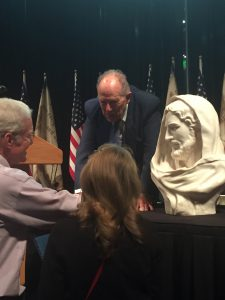
Dr. Chauncey Riddle delivers his latest paper entitled, “Human Knowing” at Firm Foundation Expo at Utah Valley University
Human Knowing
Thesis: We know little but believe much
Note: I suggest you not take notes but just concentrate on comprehension.
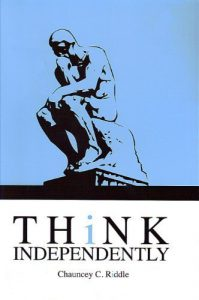
For further detail, see my book Think Independently
Think Independently, by Dr. Chauncey C. Riddle – Available in paperback or Kindle format on Amazon.com
Ways of Human Knowing: We will examine 7:
Perception: using the senses of the human body
Reason: using logic to produce conclusions
Experimentation: trial and error pragmatism
Authoritarianism: forming ideas by communicating with others
Imagination: creating ideas, hypotheses, theories
Knowledge of good and evil: The Light of Christ
Personal revelation: The Gift of the Holy Ghost
Perception: Using the senses of the human body to form ideas about the universe.
Key point: We perceive in our brain
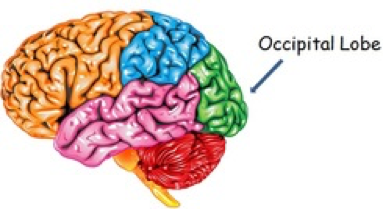
Vision: We see in the occipital lobe
Vision: We see in the occipital lobe
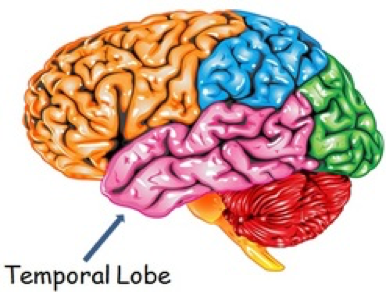
Hearing: We hear in the temporal lobe
Vision: We see in the occipital lobe
Hearing: We hear in the temporal lobe
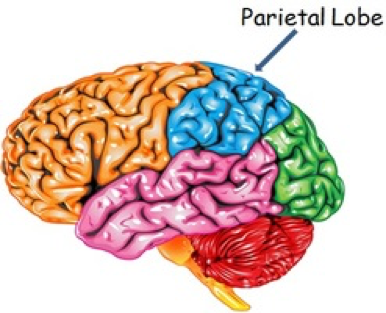
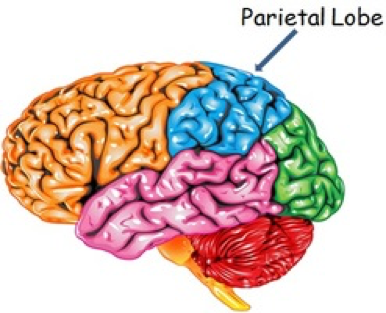
We taste, touch and smell in the parietal lobe
Hearing: We hear in the temporal lobe
We taste, touch and smell in the parietal lobe
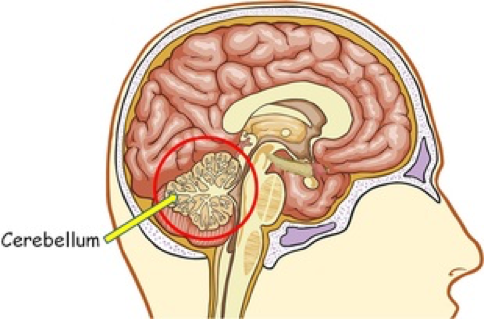
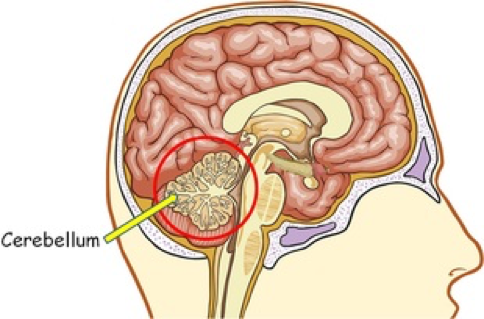
Walking, writing, balance we control in the cerebellum
We taste, touch and smell in the parietal lobe
Walking, writing, balance we control in the cerebellum
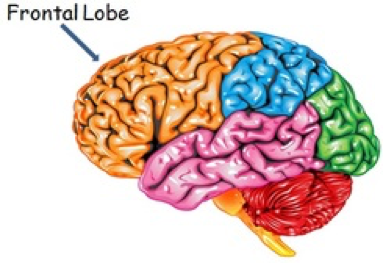
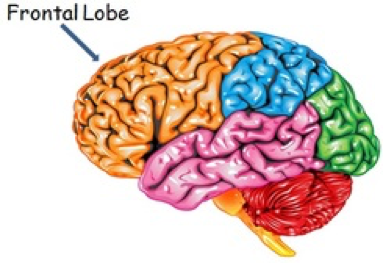
We think plan and speak from the frontal lobe
Walking, writing, balance we control in the cerebellum
We think plan and speak from the frontal lobe
We think plan and speak from the frontal lobe
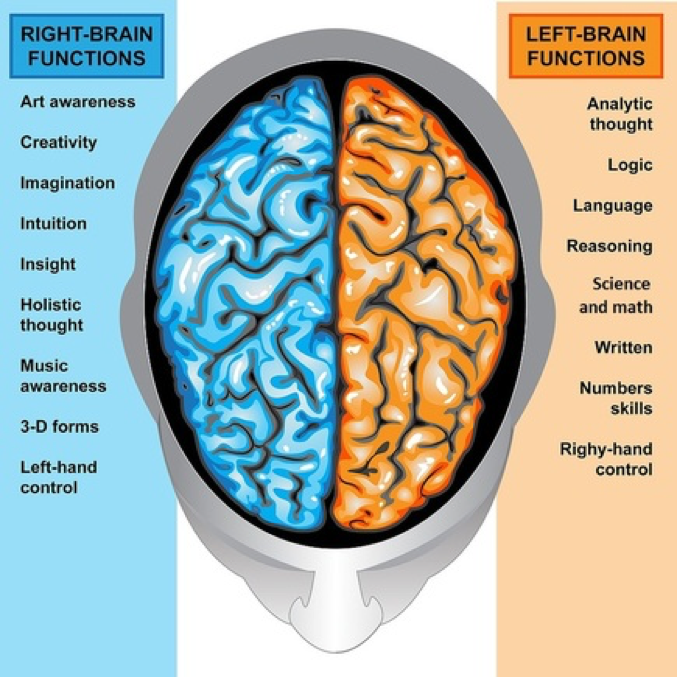
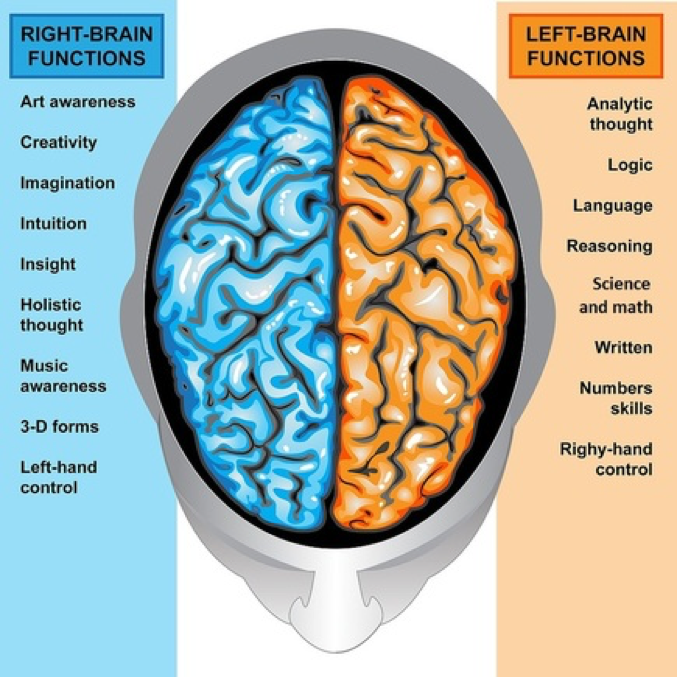
In the left brain (yellow) we think, control language, do science and math, control our right hand
In the right brain (blue) we do art, imagine, have intuition, 3-D forms, music, left-hand control
In the left brain (yellow) we think, control language, do science and math, control our right hand In the right brain (blue) we do art, imagine, have intuition, 3-D forms, music, left-hand control
In the left brain (yellow) we think, control language, do science and math, control our right hand In the right brain (blue) we do art, imagine, have intuition, 3-D forms, music, left-hand control
Sensations
Sensations are the nerve stimulation of our approximately 25 physical senses. (Yes, we have more than 5 senses.)
All sensations go from the sensing organ to specific brain locations.
All sensations traveling along the nerves from the sensing organ to the receptor part of the brain are of exactly the same type.
They are interpreted and differentiated by the location to which they travel.
The Synthesis
These we have shown are not all the parts of the human brain, but they are major components.
No one has yet satisfactorily scientifically explained how we see.
But we do see.
Somehow we put all the sensations together and form a world in
our imagination. Imaginations are most vivid when we are
actually sensing something.
We have the illusion that when we are sensing, we touch reality.
Reality
But reality is also a figment, a creature of our imagination.
To call something real is simply to say we are quite sure of it.
But we make enough mistakes that it pays to be humble.
When we are humble, we say “It seems to me that . . . “
When we are not humble we say “I am sure that . . . “
Sometimes our life depends upon being sure enough of our
sensations that we are able to avoid trouble, as when we step
out of the path of a speeding automobile.
Where we live
So we each live in the world of our imagination, inside our heads.
We form images of where we live and the surroundings of that place.
We form images of the people we know, ascribing to them various
character traits, personalities.
We form images of the rest of the world we do not now see.
We form images of the rest of the universe we do not now see.
We form images of the past, which we cannot see.
We form images of the future, which we cannot see.
And thus we live, move and have our being and doing in the world of our images.
Rebuttal
But, you say, there really is a reality out there that is not just our imagination. Let me prove it to you by punching your arm. Now, doesn’t that hurt? See, there really is a reality out there.
I must agree with you that there is a reality out there. It is just that we see that reality only through a glass, darkly. That glass we see through darkly is our flesh, our physical bodies. We thus know we are in a real world. But we are really sure about only some things, and those are not the most important things.
Example of an illusion: The Necker Cube: Which is the near corner, upper or lower?
Example of an illusion: The Necker Cube: Which is the near corner, upper or lower?
The world is full of Necker Cubes
Every person we meet is like a Necker Cube. We imagine a character for them. We tend to believe our imagination about them is the truth.
The future, the past, and everything we are not now sensing exist in our imagination, and we determine and control what we believe about them.
Most of what we think we know we only imagine. And a lot of what we perceive is like Necker Cubes where we must choose an interpretation.
Conclusions about perception:
Perception is absolutely necessary to relate to the real world around us.
Perceiving accurately and surely is done only in environments where we are very familiar with what we are sensing and doing.
If we are not familiar with what we are sensing and are unable to do anything in the situation, we need to be humble about what we believe we are sensing because we are only guessing.
Only what we can do over and over is sure to us. But we have no guarantee the future will be like the past. If we think we are sure about the future, we need to realize that that surety is only a hope.
Reason as a source of knowledge
There are three basic forms of reasoning:
Deduction: Drawing justified conclusions from given premises.
Induction: Drawing possible or probable conclusions from given arrays of data (observations, perceptions).
Adduction: Inventing premises for a conclusion we already have.
Examples of Deduction:
Given the premises:
All men are mortal.
James is a man.
We may surely conclude that:
James is mortal.
Thus deduction makes explicit the relationships of ideas we already have.
Other examples:
When you add up all your checks and deduct that amount from your bank balance, you can find out (become psychologically aware of) how much money you have in the bank.
If you know the weight of an object, you can calculate the energy required to lift it 10 feet.
Examples of Induction:
Given that your back yard has been visited by skunks the last four nights, you may reasonably conclude that skunks will visit again tonight. But you cannot be sure that they will.
You friend has lied to you several times about what he has been doing for the past month. You may reasonably conclude that he is lying to you now about something else. But you cannot be sure he is lying just because he lied before.
Your friend has remembered your birthday every year for the past ten years. You may reasonably expect him to remember again. But you cannot be sure he will.
Examples of adduction:
Given the conclusion that your friend is acting very strangely, you might think:
My friend has suffered the death of a beloved sibling.
When people suffer the death of beloved siblings they act strangely.
Therefore, my friend is acting strangely.
Or you might think:
My friend has been drinking too much.
When people are drunk they act strangely.
Therefore, my friend is acting strangely.
Conclusions about the three ways of knowing by reasoning:
Deduction is always sure but produces nothing not in the premises.
Induction is always guesswork, never sure, but can be very useful, producing ideas that often work.
Adduction: There are always an infinite number of reasons that can be invented to justify any given conclusion.
To use our power to reason is good, but it does not produce sure knowledge. It’s main help is to allow us to be consistent with ourselves.
Conclusions about reasoning:
It is usually good to be rational (consistent) in trying to know.
No one can be said to be totally rational about what he or she thinks they know. All reasoning begins with premises we cannot prove.
Anyone who claims to be totally rational about what they think shows a lack of understanding of what reason is and can do.
Since we cannot be totally rational about knowledge, we all live by faith. Faith, the things we believe but cannot prove, is where we get all of our initial premises for reasoning.
Experimentation as a way of knowing.
Doing is a form of knowing.
Doing what we can do, and doing it over and over, gives us surety that we know what we are talking about.
Experimenting is trying to do something for the first time.
When we experiment, we usually have a goal in mind, something we are trying to achieve.
If we achieve our goal, we think we have an understanding of one of the ways the universe works.
As we repeat the experience, we become settled in our confidence about what works. This is experimentation, or “pragmatism.”
A Human life is actually one big experiment:
A human baby lives by trying first one thing, then another.
First, it learns to breathe, and then to eat and sleep.
It looks around and begins to form images and expectations out of the sights and sounds and feelings and odors it experiences.
The baby learns to experiment to produce more of what it wants and less of what it doesn’t want.
The baby’s attempts to produce what it wants and avoid what it doesn’t want become habits.
Habits become a character, a personality, as the individual shapes himself or herself.
Personality (character) is the fruit of human living.
Every human life is a chain of successful and unsuccessful experiments.
The successful experiments lead us to repetition, which is the mother of learning.
As we learn to cope with the universe, we develop ideas: structures and sequences which we think are the reality of where we find ourselves.
The more successful is our coping with the universe to fulfill our desires, the more sure we become of the structures and sequences we have built as our understanding of the universe.
We turn our ideas of structure and sequence into what we call “knowledge.” This knowledge becomes part of our personality, our character.
The core of human knowledge is the result of successful experimentation.
What we really know in this world is the ideas we find help us to fulfill our desires, a core of ideas that “work” over and over.
We then add to that core of ideas, ideas formed by communicating with others. This is not knowledge, but rather belief.
If we can fit what others tell us is consistent with our core of knowledge, we tend to believe. If the things we are told don’t fit, we either accept those ideas as blind belief, reject those ideas, or experiment with them to see if we can make them fit with our core knowledge.
Until we have tried an idea for ourselves, it is not knowledge to us.
We humans are quite capable of being irrational:
When we have great respect or affection for persons who tell us things about the universe, some of us tend to believe those ideas, even when they do not fit with our core knowledge.
Some persons are “hard-headed,” “from Missouri,” and refuse to believe what does not fit with their experimentally produced core knowledge.
Gullibility, the willingness to believe others persons without experimenting on what they tell us, afflicts most human beings.
Gullibility makes propaganda a social force used to control populations.
We live in a sea of propaganda (lies and half-truths). Examples:
Much of the “news” we are given by media sources is propaganda.
A lot of what is taught in schools is propaganda.
A lot of the substance of gossip is propaganda.
A lot of what is taught in churches is propaganda.
A lot of history is propaganda.
A lot of so-called “science” is propaganda.
What politicians tell us is often propaganda.
What we tell ourselves is the real truth is often propaganda.
One cure for propaganda is personal experimentation, being “pragmatic.”
If someone tells us a certain medicine works, we can try it for ourselves to see if it works for us.
If someone tells us there is a formula for making money, we don’t have to believe them, we can just try it for ourselves.
If someone tells us a certain political expediency is what is best for our country, we can look for where the idea has been tried to see if it worked.
If someone tells us a certain religious practice is helpful, we can try it for ourselves to see if it really works that way.
Experimentation is a great help in knowing
Sooner or later, most humans learn that it pays to take what others say with a “grain of salt.” In other words, it is not usually useful to be gullible.
As we build up a store of ideas that really “work,” we begin to have confidence that we really are figuring things out.
Our store of ideas that “really work” is the basis of our life accomplishments. As we implement those ideas, what we do becomes our “works.”
Authoritarianism: Gaining ideas from other human beings.
As we watch what other humans do, we gain ideas as to what we might do ourselves. Example: We watch others ride a bicycle, then experiment ourselves until we can also ride a bicycle.
But most of our ideas from others come from verbal communication. We learn a “mother tongue,” and that becomes our major link to the world of people.
As others speak to us, we are busy in our imagination inventing meaning for the noises and gestures they display, and often find great pleasure in listening to them. Communication becomes a major part of our human living.
There are four parts to every communication:
If we really understand someone who is communicating with us, we must fix on four things:
What is the intent or purpose of the speaker.
What is the message of the speaker.
The power of this message: It’s truth or importance.
The consequences of accepting or rejecting this message.
But most humans do not carefully sort out these four things. We tend to be gullible and just accept as so what the speaker says. Because of this, most human minds contain a lot of garbage.
Conclusions about Human Communication:
We are flooded with communications from others.
That process of receiving communications often keeps us from thinking for ourselves and is always a mixture of good and bad.
It is difficult for humans accurately to sort out the good from the bad.
Any idea we accept from another person is always belief or faith. It may be their knowledge, but it is not knowledge to us, even if true.
We live in a communication jungle that helps or hurts us at every turn.
Imagination as a source of knowledge
We synthesize our sensations into a world we imagine, and fill in all the blanks with our imaginative inventiveness.
We look at the body of a person and imagine to ourselves what goes on inside them, their thinking and feeling, desires and future.
We see the present moment, and with the aid of memory and what others tell us, we invent all of the past and future in our imagination.
We hear of events in distant places, and imagine them.
We live in the world of our own imagination. And we tend to believe ourselves.
And our imagination is very useful:
We do all of our planning in our imagination.
We do all of our remembering in our imagination.
We do all of deciding in our imagination.
The universe we grasp only in our imagination.
We decide we have or do not have a Heavenly Father and a Savior in our imagination.
If we did not have an imagination, we would not be a human being.
Imagination makes Science possible
Science is man’s collective attempt to understand the universe using only perception, reason, experimentation, and imagination. Most scientists specifically try not to include any information from a spiritual source. Thus science is the delight of the natural man.
Being blind to all of spiritual existence, science does better when dealing with material things such as physics and chemistry.
But science stumbles when it ignores all spiritual existence, as in psychology, sociology, political science.
But social scientists do not think they stumble. They tend to think they are “emancipated” by pretending spiritual things do not exist.
Imagination makes History possible:
History is the imaginative invention of a story of the past. It is based in documentary evidence about the past, but its creation is always a controlled by the beliefs and imagination of the historian.
History is rewritten in every generation to satisfy the changing prejudices of historians.
In a real sense, all historical accounts are fiction. The word “fiction” comes from the Latin “faceo” which means to make or do. All historical accounts are made up by historians taking the beads of ideas gleaned from documents and stringing those beads on a narrative string of their own prejudices.
Shall we then discard Science and History?
No, we should not discard science and history. Both are interesting, often useful, often helpful, though sometimes disastrous.
Science and history should be taken with a grain of salt. That salt is the skepticism we should attach to all human endeavors.
In all human endeavors we are dealing three kinds of people: 1) the natural man who knows not God, 2) the natural man who thinks he knows God, and 3) the man who does know God. Each produces different beliefs, actions and societies.
Science and history are at their best when invented by men who know God.
Knowledge of Good and Evil:
Knowledge not only relates to what is true and false, what works and what does not work, but also to what is good and bad: values.
Some think that all values are environmentally stimulated by the persons who influence a given person.
But we see examples of people who are different from the persons of their environment.
Within each normal human being there is what is called a “conscience.”
Conscience is the Light of Christ, which lightens every person who comes into this world.
The Mission of Conscience:
Conscience gives us feelings about what is good and bad to do and say.
But the voice of Satan is always with us to give us a choice agency.
Choosing good over evil is what separates the sheep from the goats.
Conscience seems to be the key to all further spiritual knowledge.
When humans ignore their conscience often, it stops functioning. They are then “past feeling.”
Possibly those who are “past feeling” cannot escape being “the natural man.” Examples: Laman and Lemuel.
Personal Revelation as a way of knowing:
Personal revelation is communication of God to mankind through the Holy Ghost.
It comes in many forms: To heart (feelings); to mind (ideas), to strength (health), and to might (prospering). But illness and bankruptcy can also be revelations from God.
Those who really understand revelation see the hand of God in all things.
Different forms of Personal Revelation:
New understanding of a scripture.
Confirmation that what someone else is saying is true or false.
Feeling that something we plan to do needs more planning.
Understanding what unusual thing will happen next.
Confirmation that someone we are asked to sustain is the Lord’s choice.
Help with preparing a talk or a letter.
Help teaching a class.
Guidance as to what to say when speaking and praying.
Seeing a vision, having the heavens opened.
The Holy Ghost is the Pearl of Great Price
If we desire to be righteous (to bless others as God does), there is no greater aid than receiving the Gift of the Holy Ghost.
Having the Holy Spirit as our constant companion should be our Number 1 priority. We should try with all our heart, might, mind and strength to have the Holy Spirit as our constant companion.
Attaining the companionship of the Holy Spirit is what turns a Latter-day Saint (a member of the LDS Church) into a saint (a holy person, one who is forgiven of his or her sins and does only righteous acts).
”And by the power of the Holy Ghost ye may know the truth of all things.” (Moroni 10:5)
How to gain the constant companionship of the Holy Ghost: The Precious Gospel Formula
Faith in Christ: Put our whole trust in Him. This is what makes it possible to become whole, holy.
In that trust in Christ, repent of all of our sins.
Make a covenant with God to keep all of his commandments by being baptized.
Receive the right to the Gift of the Holy Ghost by the laying on of hands, then working until we actually receive the Gift of the Holy Ghost.
Why Receiving the Gift of the Holy Ghost is not the End but the Beginning of Salvation.
Receiving the Gift of the Holy Ghost is entering the gate.
We must also endure to the end.
The end we should all endure to become like Christ.
As we obey God through the Holy Spirit in all things, we become a new creature, remade in the image of Christ’s character.
But remember, there are three voices in our minds: Satan, our own ideas, and the Holy Ghost. Deciding which one to follow is our agency. Learning to follow only the Holy Ghost is the key to enduring to the end.
To become as Christ is the goal, the end to which we may all endure.
The Gospel of Christ is the Good News
The precious Gospel five-step formula is the greatest message on earth. No other compares with it in importance.
Part of that good news is that every normal human being can complete the precious five-step formula.
No one can complete the formula without help. That help is called the “grace” of God.
God is willing and able to bless us to complete the process of changing us from a natural man to the stature of Jesus Christ himself.
Summary of the ways of human knowing:
Through the ordinary human ways of knowing the truth about the universe in which we live, we see through a glass, darkly. We see enough to live our human, animal lives with some success.
This is a possible rank order of the ordinary ways of human knowing, most reliable to least reliable:
Experimentation
Perception
Reason
Authoritarianism
Imagination
But if we add ways of knowing from God
If we first pay attention to what is good and what is evil, and choose to do the good instead of the evil through the Light of Christ, then:
God will eventually, in this world or the next, make the fullness of the Gospel of Jesus Christ, the “good news” available to every human.
Then, if we so choose, we can receive the Gift of the Holy Ghost, which makes God our Senior Companion in all that we want, feel, say and do.
The Gift of the Holy Ghost then leads us to perform the best experiments, perceive truly, reason wisely, know what other persons to believe and who not to believe, and to imagine wisely and fruitfully.
Only using the Gospel of Jesus Christ can we fulfil our human potential.
When are you an expert witness, one whose testimony really counts?
Your are an expert witness when you are bearing testimony of something you can do, do do, and have done over and over.
When you are bearing testimony of something you have personally and often experienced: Seen, heard, touched, smelled or tasted.
You are not an expert witness about the things you hope for, desire, or dream about unless others want to know what you hope for, desire, or dream about.
When you bear testimony as an expert witness, you bless your hearers: They then have access to truth through you.
Conclusions about Human Knowing:
We human beings really know only two things:
That which we can do, do do, and have done many times.
The perceptions we have had about very familiar things.
Someone who has either of those two things is an expert witness.
Everything else we have in our minds is not knowledge, but rather belief.
We humans know very little, but believe a lot of things.
We would do well to treat all the statements of expert witnesses as something to be tested by our own experiments and experience.
“Prove all things; hold fast to that which is good.” 1 Thessalonians 5:21
Part Two: Applications of what we know about human knowing:
We will concentrate on four applications:
Organic Evolution as a theory of science.
Adam and Eve as the first human beings (history).
The attempt to solve human social problems.
The location of the Book of Mormon lands.
Organic Evolution
Organic Evolution is the scientific theory that life came to exist on this earth an by spontaneous generation (chance), and that all present living animals and plants are descended from that spontaneous generation as shaped by environmental forces.
Science is ideas about the universe consisting of:
Facts: Things sensed, perceived.
Laws: Generalizations of observed facts.
Theories: Ideas invented to explain laws and facts.
There are always and infinite number of theories possible to explain any given set of facts and laws.
Organic Evolution is one of many possible theories to explain the universe.
No scientific theory can be proved to be true because all theory consists of things which are purely imaginary, not perceivable.
Scientific theories can be falsified if their logical consequences are not observed.
Choosing among possible theoretical explanations of observed facts and laws is a personal choice of the persons choosing.
Every one who chooses to follow Darwin and to believe in organic evolution does so because they want to, not because any evidence makes that choice necessary.
Major problems with the Theory of Organic Evolution:
The theory depends upon the idea that life formed spontaneously. There are no examples of spontaneous generation of life known to mankind. (This is a major problem.)
The theory depends upon one species of life form changing into another species. There are no examples of one species changing to another species known to mankind. (This is a major problem.)
The theory depends upon there being an immense amount of time in the past since life on earth began to be: Millions of years. The age of the earth is a theory itself. (This is a major problem.)
The theory defies the Law of Entropy: Natural systems disintegrate (run down) as they lose heat. (This is a major problem.)
Why are some people willing to believe in the spontaneous generation of life?
Some believe that because so many other people believe it.
Some believe that because if it is true, there is no need for God and therefore no need to repent, and they don’t want to repent.
Some believe that because they think (mistakenly) that scientists are never wrong.
Some believe that because they do not think very carefully.
Why do people believe that species beget other species? (Speciation)
Some believe this because speciation is absolutely necessary to the theory of organic evolution, and they desperately want that theory to be true.
Some believe this because they are shown different animals and plants in the fossil record that resemble one another, and they want to believe that the change represents the natural emergence of a new species. But there is no way to know that one form is ancestral to another.
Some believe because so many other persons who they respect believe in this idea.
Why do people believe life has been on the earth for millions of years?
Some believe because they have been told this idea all of their lives.
Some believe in an earth millions of years old because it is necessary to the theory of organic evolution, and they desperately want the theory of organic evolution to be true.
There are many theories as to how long life has existed on earth, but there are no proofs of any of these theories.
Why do people disregard the Law of Entropy?
Some disregard it because they believe in evolution and use organic evolution as a proof that the Second Law of Thermodynamics (The Law of Entropy) is not true.
Some disregard it because they have limited experience with the natural world and suppose that order can naturally come out of disorder.
The watchmaker objection seems trite to some. To find a running watch on the beach and to suppose the winds and the waves put it together seems perfectly logical to some people.
Conclusion: The Theory of Organic Evolution is built upon other pure theories, not on facts or laws. It is wishful thinking.
Notwithstanding the theory of organic evolution is widely taught and believed, especially at universities, it remains suspect and unprovable.
There are no expert witnesses who can give evidence that the theory of organic evolution is true. (Though some would like to claim to be such expert witnesses.) No one can do evolution or has seen it.
The main present-day argument for the theory of organic evolution is that so many people believe it.
A great many people also believe in Santa Claus.
Adam and Eve as the first human beings (History)
To write history is to invent what happened in the past on the basis of evidence available in the present time.
To write prophecy is to invent what will happen in the future on the basis of evidence available in the present time.
To write history is much safer than writing prophecy, because the future will become the present and we will all know which prophecies are correct.
But history will never again become the present, so historians can say anything they want to and not be found out.
The story of Adam and Eve is automatically rejected by most historians.
To accept the story of Adam and Eve as the ancestors of the human race would be to accept the Bible a historical record, which almost no scholars are willing to do.
So historians fall in with the theory of organic evolution and postulate that human beings are one fruit of a long evolutionary process, having descended from some ape-like creature. The fact that there is less evidence for that evolutionary theory than for the Biblical account does not bother them. They of course reject the evidence for the Biblical account because the Biblical account has God and a supernatural spiritual realm as part of it, which things are anathema to the natural man.
Some people try to marry the story of Adam and Eve to the theory of Organic Evolution
Some postulate that Adam and Eve were ape-like creatures to whom God gave a conscience and superior intelligence and they then became human beings.
That postulate flies in the face of three things we are told about Adam and Eve and the Garden of Eden:
There was no death in the Garden (on earth?) until Adam and Eve fell. Adam became mortal because he transgressed. All nature became mortal with him.
Before the fall, Adam and Eve were celestial beings and had spirit matter in their veins, not blood.
Adam and Eve were literally of the race of the gods. (Otherwise, Mary could not have been the mother of Jesus.)
The Fall of Adam and Eve is central to Faith in Jesus Christ
There are three things about the story of Adam and Eve that are crucial to faith in Jesus Christ.
Adam chose to disobey God and therefore fell.
In his fallen state, Adam and all his posterity are dead to the spiritual existence around them.
Being fallen, therefore becoming carnal (trapped in a physical body), sensual (sensing only with the physical body), and devilish (subject to the temptation of Satan through the flesh), Adam and his posterity were in need of a redemption to spiritual life and the presence of God.
Redemption from the Fall of Adam comes only in and through Jesus Christ.
It takes supernatural power to restore humans to spiritual life and to be able to abide the presence of God.
It takes supernatural power to put humans beyond the power of Satan to continue to tempt them.
It takes supernatural power to rescue the physical bodies of mankind from mortal death.
These three things are principal features of what Christ does through his work of Atonement.
Conclusions about Adam and Eve:
Unless men and women have a correct idea of where they came from and what they are supposed to be doing in mortality, they will not accomplish what God sent them to do.
God tells men where they came from and why they are here in the accounts of the Fall of Adam and Salvation through Jesus Christ.
The world rejects both the correct understanding of Adam and Eve and the mission of Christ.
Part of coming out of this world and not being of it is to gain a true understanding from the Holy Ghost both of Adam and Eve and the Fall and of the Redemption made possible by Jesus Christ.
How can men create heaven on earth?
If there was no fall of Adam, there is no need for redemption.
If there is no need for redemption, there is no need for a Savior.
If there is no Savior, mankind must save itself.
The main salvation naturalistic thinkers envision is socialism.
Socialism is humans appointing themselves to be the saviors of mankind.
Socialists have only one goal: Total control of human society, using guns (force).
Socialists seek total control of human society because they theorize they can then solve all human problems:
Poverty, through government redistribution of wealth.
Ignorance, through government control of all education.
Disease, by government control of scientific endeavor.
Crime, by government control of all neighborhoods.
Opposition, by government control of all media.
Christian values (which they see as an enemy) by government control of the upbringing of all children.
Total Government Control is another name for Hell, the implementation of Satan’s plan
Satan proposed in the pre-mortal existence to save all of mankind.
Satan proposed to save all mankind by taking the power of God to force all mankind to live in a force-centered Utopia.
Satan has tried ever since Adam and Eve to set up a Utopia on earth.
Every attempt of Satan to establish Utopia has failed.
The advocates of socialism want to keep trying to establish Utopia because they see no alternative.
Present socialist half-measures are stepping stones to total control.
The proper alternative to Utopia is Zion.
Zion is a people who are pure in heart because of their own agency (choice) and the grace of Christ.
In Zion, people have one heart: They all have pure, unselfish hearts.
In Zion, people believe the same truths: they are of one mind.
In Zion, people voluntarily work righteousness: every man seeks the interest of his neighbor.
In Zion, there are no poor: those who have more voluntarily share with those who have less.
Zion has been created on earth many times, so it is a real possibility.
To make possible the establishment of Zion today is one of the main reasons the Gospel of Jesus Christ was restored in the latter days.
Why do we not have a Zion today?
We don’t have a Zion on earth today because so many Latter-day Saints are not willing to keep their covenants.
Latter-day Saints are working hard on the other reason for the restoration of the Gospel of Jesus Christ: To teach the Gospel to every nation, kindred tongue and people.
But Latter-day Saints will never fully witness the value of the Restored Gospel to the world until we establish a Zion.
We now say to the world “We have the wonderful, true Gospel of Jesus Christ to share with you. We can’t live it, but it really is true.”
When there is a true Zion on earth, the world will have its second witness of Christ.
The Restored Gospel of Jesus Christ is the one and only formula for saving mankind, both temporally and spiritually.
The Holy Ghost bears witness to everyone who will accept that witness that Jesus is the Christ, the Savior of all mankind.
Those who are saved by the Savior are different from those who are not saved. If they live the whole Gospel, they will establish a Zion. The existence of a Zion will become a witness that the Restored Gospel really does work and save people.
Until we have a Zion, we Latter-day Saints, as a people, are “Mene, mene, tekel upharsin,” weighed in the balance and found wanting.
But are there not some LDS people who live the whole Gospel of Jesus Christ?
Yes, there are some members of the LDS Church who live the whole Gospel of Jesus Christ.
If you put all of those people in one stake, they would establish Zion there.
But then the rest of the Church would fall apart.
The Authorities of the LDS Church are trying mightily to establish Zion.
When we members begin to fully implement what they ask us to do, we will have a Zion.
The engine that will finally create a Zion is the ordinances of the Temple.
There are two keys to the establishment of Zion:
Key #1: To study the Book of Mormon until we truly understand how to come to Christ and be perfected in Him. The Book of Mormon is the manual of instructions as to how to come to Christ and be perfected in Him.
Key #2: Because knowing how to come to Christ is not enough, we must also have the power to come to Christ and be perfected in Him. That power is only obtained through the ordinances of the New and Everlasting Covenant, focusing particularly in the blessings and covenants of the temple endowment and sealings.
Blessed are those who use these to keys unto perfect Faith in Christ.
What will it take to get LDS people to use those two keys?
God protects human agency above all else. Because he knows that only if his children voluntarily create Zion can they avoid creating Hell on earth and going to hell afterwards.
We will establish Zion only when enough LDS people freely choose to keep all of their covenants.
The Savior will never force anyone to create or live in Zion.
When we Latter-day Saints want Zion more than anything else, we will establish it. Right now, too many of us are overcome by worldliness. At most, only half of the LDS church members will overcome the love of the world before He comes again.
When we start loving our God and our neighbor instead of ourselves, we will have Zion.
Selfishness is the great enemy of our souls.
Selfishness is the gospel of Satan.
Jesus Christ would have us live “outside ourselves in love.” And that love must be pure, the gift of charity from Christ.
Therefore, seek after charity, for charity, the pure love from Christ, never fails.
Charity is the gift of God to all who seek to make their eye single to his glory with all of their heart, might, mind and strength.
If we gain charity, we will save our own souls and establish Zion.
The inhabitants of Zion are all expert witnesses to the truth of the Restored Gospel
Imagine if the world were flooded by expert witnesses who could say to the fallen people of this world: “Jesus Christ has come again and restored his true Gospel and Church. Look to Zion, and you can see that Gospel in action. It really does work. I know it saves mankind because I have participated in Zion and have there seen the Lord solve all human, mortal problems by helping them to have charity. You also can be part of a true heaven on earth by accepting Jesus Christ as your Savior and fully living His Restored Gospel in the Church of Jesus Christ of Latter-day Saints unto having this pure love from Christ.”
What a powerful expert witness that will be. Then the powers of hell will be shaken forever.
We turn now to the fourth application, the location of Book of Mormon lands.
This discussion has full meaning only to those who have received the witness of the Holy Ghost that the Book of Mormon is the work of God. Otherwise the discussion is purely academic.
Knowing the Book of Mormon is a true record of ancient peoples on this, the American Continent, we might then profitably wonder just where it all took place.
Joseph Smith’s statement about the Book of Mormon:
Joseph Smith said that the Book of Mormon is “the most correct of any Book on earth & the keystone of our religion & a man would get nearer to God by abiding by its precepts than by any other Book.”
(Wilford Woodruff journal, Nov. 28, 1841, Church History Library, Salt Lake City).
Notice that he did not say that the Book of Mormon is the keystone of the Church. He said it is he keystone of our religion. Our religion is our way of life, the habits of character we foster to endure to the end in our faith in Jesus Christ. That goal or end is to “come to the measure of the fullness of the stature of Christ.” Ephesians 4:13)
The first business of an LDS person is to make our calling and election sure:( See 2 Peter 1: 5-10)
Our calling is to become the children of Christ, become new crearures remade in His image, and to then inherit all he has and is.
We can receive this inheritance only as we build spiritual muscle that will enable each of us NEVER to give in to the temptations of Satan.
The commandments of God are given to us to build that spiritual muscle so that we could be trusted with godhood.
The Atonement of Christ makes forgiveness of breaking the commandments of possible, but until we stop sinning, we cannot receive full forgiveness.
Repentance is stopping sinning. Is that possible? Only in Christ.
Don’t be taken in by those who say one cannot become perfect in this life.
To become perfect means to become complete, whole, holy.
To say we cannot become perfect in this life is to say Christ cannot save us.
What he saves us from two things:
The weakness of our character that allows us to sin. He gives us the knowledge and power to learn to keep all of his commandments, thus to build the spiritual muscle necessary to be able to stand godhood.
Christ also saves us from the penalty due for having sinned.
Satan will try every way to divert us so that we will not fully repent.
Satan will fill our minds with lies (like: you can’t become perfect).
Satan will fill our hearts with lusts (like: you deserve to pleasure yourself)
Satan will try to destroy our physical tabernacle (like: you ought to try using tobacco, alcohol, or other drugs)
Satan will try to abort our mission in life (like: I’ll wait to have children until it is convenient)
The solution? To love God with all of our mind, heart, strength and might, first and foremost.
When our calling and election is sure:
When we as a people learn to live the Gospel of Jesus Christ as given in the Book of Mormon we will be able to know everything we need to know and do everything we need to do.
We will receive the sealed portion of the Book of Mormon plates. (This blessing is to the children of Lehi when they become faithful.)
We will receive the full record of the Jaredites. (This blessing is to the Gentiles when they become faithful).
Perhaps we will again have the Book of Lehi (the lost 116 pages)
And we will be able to establish Zion again on the earth.
In this setting, What about Book of Mormon Geography?
Book of Mormon geography is a fascinating subject.
I appreciate the scholarship of John Sorensen in his study of the archaeology of Meso-America and his contention that those are the Book of Mormon lands.
I also greatly appreciate the work of Rod Meldrum and others in bringing to our attention the remains of ancient civilization in North America, urging us that they are the Book of Mormon lands.
I find both of them giving interesting and compelling evidence and reasoning. But I honestly have to conclude that Book of Mormon geography is a red herring to me.
A Red Herring is a diversion. Be not diverted.
I lean towards the Heartland theory of Book of Mormon lands. Knowing where they are is important.
But there is something that is 100 times more important.
The priority of Latter-day Saints should be to:
Come unto Christ and be perfected in Him.
To establish His Zion.
When we have done those two things, we will not only know what are the true Book of Mormon lands, but a lot of other precious things also.
So let us be about doing those two things, first and foremost.
Conclusions about Human Knowing:
Humans know best what they can do. So treasure the testimony of the expert witnesses: the doers.
We humans know least about the things we cannot now experience. About those things we invent theories. Appreciate the ideas of those who talk theory. But take it all theory with grains of salt.
Remember: All human supposing of the past is theory. All human supposing of the future is theory. So learn about the past and the future only from God, for whom they are not theory.
Great doers:
The greatest doer is Jesus Christ himself: He lived a perfect life, He fulfilled his mission completely, he wrought the Atonement to reconcile every child of God who will receive it to come back to be with and live the life of God the Father, and brings about the best possible eternal happiness for each human being.
Joseph Smith was a great doer. He was able to bridge between God and man to restore the fullness of the Gospel of Jesus Christ to the earth and to establish the Kingdom of God on the earth for the last time.
Other great doers:
Brigham Young was a great doer. He was the down-to-earth doer who was able to secure the continuation of what Joseph Smith established, to help the Latter-day Saints continue the Kingdom of God in the desert, to meet with good sense the challenges of every-day life.
Thomas S. Monson is a doer who shows the way to love God by loving our fellowmen. As our leader-doer at the present day, he and the other General Authorities would have us reach out to all others in the pure love of Christ.
Recommendations for the writings of doers:
Dean Sessions is a doer who has learned to make fossils. I commend to you his Universal Model of science. His proofs of the Universal Flood are most impressive. If you want a fresh look at science and geology and to see good reasons why organic evolution is a false hypothesis, take time to investigate the Universal Model. See at https://universalmodel.com/
David Allan is a doer who has learned to measure and calibrate time. I commend to you his book It’s About Time, wherein he tells you how to measure time and to establish simultaneity. His work with time was a critical factor in establishing GPS and other navigational aids. And as a disciple of Christ, he tells you much about living the Gospel. See at http://itsabouttimebook.com
Other Doers
Stephen Covey, our deceased friend, had much good to say about doing our human life. His book The 7 Habits of Highly Effective People is a good manual for living life as an intelligent human being. It is great terrestrial wisdom.
But the greatest doer of all time is Jesus Christ. He create the heavens and this earth and all of us, and is our Savior. I commend to you all of his words about how to come to Him and to our Father in Heaven to become an eternal doer of righteousness. Please don’t accept any human being as your Savior.
My plea to you today: Come unto Christ
The best thing any of us can do for this world is to come unto Christ, all the way, until we are filled with and show His pure love.
Then we will establish Zion, get the rest of the scriptures that are promised to come forth, and each fill our missions.
Please show love and tenderness for those who do not believe in Christ, and for those who do believe in organic evolution, that Adam and Eve evolved, and that the solution to our political problems is socialism. And treat them that way even if they don’t treat you that way.
Above all, let us be humble before Christ and our Father in Heaven, that their will, not our will, be done on this wonderful earth.
Conclusion:
I bear my witness that Jesus is the Christ, that He lives and answers prayers, and that He tempers the elements for his sheep who are shorn of pride. There is no more intelligent thing to do for any human being than to search out a knowledge of this Christ. And then we can waste and wear out lives out in loving and serving Him with all of our heart, might, mind and strength by tirelessly sharing all we have with our neighbors in His pure love.
One of the very important commandments God gave Adam and Eve when they were placed in the Garden of Eden was to “be happy.” They were not told to do it if it were convenient, or if it pressed itself upon them. They were told to “Do it.” Since God gives no commandment unto the children of men without also giving them the opportunity and ability to keep that commandment, this is something Adam and Eve must do. And I believe they did it. How did they do it? By using the agency they did have at that point in their lives. They did not yet have the greater mortal agency which would come only after they disobeyed and fell from the grace they then enjoyed, but they had enough to be happy. I believe they obeyed and were happy in the Garden.
There are at least three lessons we can all learn from this, the commandment to “be happy.”
First lesson: It is important for Adam and all of his children to be happy. Why by happy? Because God commands it and every human being can do it and reap the rewards for such obedience. How can one be happy? By insisting on being happy as a matter of choice and will power. We humans have the ability to be happy if we want to. So we should want to and do it. A positive, cheerful attitude becomes every one of the children of men. That positive, cheerful attitude is the basis for feeling happy. It involves a gratitude for all of one’s blessings, an optimism about the prospects for the future, and an admiration for the goodness of God in providing for His children both temporally and spiritually. It is important to note that for any human being, if they were to add up their blessings on one hand, and their trials and sufferings on the other hand, every human would have more blessings than problems. So it is not only possible but reasonable for each human to be happy. Anyone who wants to keep the commandments of God can do so within the limits each is provided. In the worst of physical trials, it is possible to be happy and thank God for His goodness. Those who exercise their agency to do so are rewarded with the sweet peace of the Spirit of God, no matter what their physical problems or circumstances. We live in a time when depression is rampant. The temptation to be depressed is always with us. But the Gospel message is, we don’t have to give in just because we are tempted. We can fight that temptation and be happy.
Second lesson: We live in an age when people are taught they are victims, passive recipients in a fickle world. That is Satan’s message. The Savior’s message is that we are agents, and can do good things. The world says we “fall in love,” a passive reaction to our circumstances. The Savior says we can love anyone and everyone, and should, because it is in our power to do so. The world says someone “made us angry.” The Savior says anger is a choice, and we should not choose it. The world says we are robots controlled by our environment. Some people say they just can’t have faith in Jesus Christ. But the truth is, anyone who wants to can put their trust in Jesus Christ. The Savior tells us that we are agents because His spirit enlightens every person who comes into this world. So we get to believe Satan through our culture, or believe Christ through our conscience. To choose culture over Christ is to give in to Satan and captivity. To choose Christ over culture is to be free, and to be able to grow to become like our Master.
Third lesson: Let us draw our inspiration from the temple, from the scriptures, and from the Holy Spirit (which is the Pearl of Great Price). The world is much with us, giving us lies and half-truths which deceive and derail us if we give in to the world. Much of what we hear in the news, in schools, in textbooks, and sometimes even in church meetings is the garbage generated by Satan. Satan will let us believe anything our heart desires as long as it is not the truth from Jesus Christ. We live in a day when Satan is raging, because he knows he has but a short time. The way of Christ will prevail, but only if you and I make it prevail by force of our own will power. Every other dispensation of the Gospel has failed because eventually the covenant servants of Christ gave in to Satan.
Let us hold fast to the Iron Rod, which is the word of God, and which is vouchsafed to us only through the witness of the Holy Spirit, is my hope and prayer, in the name of Jesus Christ, Amen.