Blog

  • A Matter of Life and Death

    JAMES E. TALMAGE LECTURE SERIES

    1970-1971

    by Chauncey C. Riddle

    You have all heard the saying, “Fools rush in. . .” We have selected topics tonight that are interesting but usually discussions of these topics are quite charged with emotion. My hope is that we can discuss these rather dispassionately, looking at them coolly in the light of certain things that we know to be true.

    I propose that we would examine these issues in the light of an LDS frame of reference. I warn you in advance this is my conception of an LDS frame. We have no established creed and therefore each individual must try to find that true frame for himself. l think that one of the glories of the gospel is that no one is required to believe a certain way.

    Because of that, of course, we can all grow and perfect our understanding as we have experiences and opportunities to have spiritual insight.

    The beginning point of our discussion is on a point fundamental to all. We begin with the point that there are absolute moral laws in the universe. I take it that this is a proposition that is even prior to the existence of God. The fact that there is a right and a wrong to every question is fundamental to our existence. My understanding is that God is God because he recognizes, obeys, and sustains those absolute moral laws of the universe. Should he cease to act on and sustain those laws, he himself would cease to be God. His station is contingent upon His recognition of this. Therefore, it is important for us to recognize the importance of these laws in our lives.

    The work of God, who is an exalted man, is to help us to become exalted. As his children, his only purpose is to bless us. This means that God’s work in everything he does–every word, every act–is intended to benefit His children. We speak of curses, of judgments, of the wrath of God, and so forth. My comprehension of these things, however, is that these are not simply vindictive reactions; that they are all intended for the betterment, for the blessing, and for the eventual happiness of the persons to whom they are given. As we see the scriptures in that light, they take on quite a different meaning. The work of God is to bless each of His children as much as each can stand. l take it that in the eternities every person will be as happy as he can possibly be. For some it is not possible to be very happy, but nevertheless they will be as happy as they can be.

    One of the great deliverances of the omniscience and omnipotence of God is the assurance that every person will be as happy as he can be. God’s power is sufficient to that end and thus He can guarantee it. Each of us is an individual personality which was not created by God. God, howùever, took us in to his association and seeks to bless us that we might have the opportunity to become like Him. He has clothed us first in a spirit body like His and now in a physical tabernacle made in His image. The question is, will we come to act after His pattern, to be in His image mentally and morally? If we can do this, he holds out the opportunity of inheriting, of being blessed to receive ALL that He has.

    God, however, cannot bless His children indiscriminately. He can bless them only according to their own righteousness. He is bound by the moral absolute laws of the universe. As we struggle with and overcome temptations that face us, the more we can live by those laws, and the more He can bless us. So His program is one of teaching us, opening the way to righteousness, that we might be able to live by that standard.

    Righteousness, in my definition, is doing good for one’s fellow beings. This is what makes it absolute. Each individual has a certain nature. Each has a certain potential quotient of happiness. It is our work as righteous beings to contribute to the happiness of other beings. If we help every other person we contact to be as happy as they can be, then we are participating in the work of God, which is the work of righteousness. Righteousness, of course, cannot exist except as the act of a free agent. Though I might do something that might help someone be happy–if I don’t do it freely it is not a righteous act on my part, even though it might be done for his good. Free agency, then, becomes a matter of concern to us.

    A free agent is first of all an intelligent being. Secondly- he is a being who has knowledge of the important alternatives. That is to say, he must know both good as well as evil. A person might be said to be somewhat free (that is to say, he could make choices) if he knew several varieties of evil. But the real freedom of choice is the freedom to know the good; to know what is righteous to do in a particular case.

    Man of himself cannot know righteousness. A man can know what he feels is for his own good, but he cannot know what is good for another or for himself. We are simply not that intelligent or perceptive, and therefore we must rely upon God to know what is right. That is why the scriptures say that the Savior is the fountain of ALL righteousness. No person can act righteously apart from Him and from His power. So to become free, a man must come unto Christ.

    The third characteristic of the free agent is the power to carry out his own choice. We know good from evil or right from wrong. We need then the power to act according to choice. Again, this is the gift of God. In God we live and move and have our being. Were it not for His sustaining &power, we could not draw a single breath. The most evil man on the earth perpetrates his evil because of the gift of Cod who has given him his life, his power, his intelligence, his opportunity to act. All men, then, at one stage or another of their probation, are made partially free agents by God. They are given the opportunity to choose, the opportunity to carry out these choices to a sufficient extent that they can establish to themselves, to God, and to everyone else, just how righteous they are. God, then, gives man a limited free agency. No mortal on the earth has all of it, because each of us have a limited knowledge and a limited power.

    We are given the parable of the talents that we might understand that if we do well with this little bit of agency that we have, we shall be given more. As we use that more to the same degree of righteousness, the time will come when we need not be limited in every way as to knowledge or as to power. This state we call exaltation, or the attainment of the office of Godhood.

    We have, then, these two alternatives which face us in our lives. We may act selfishly, which is to choose our own good, or we may act unselfishly, which is to act righteously, to choose the good of others. Basically, this is the dilemma of each choice we face. Do we seek to save our own lives, to promote our own good? Or do we seek to promote the work of others? The work of Godliness is to promote the good of others. But each of us, being individuals and having agency, some people wish simply to promote their own good. This is the reason for the evil in this world, God allows it, but men choose it and carry it out. Therefore, both men and Cod are responsible.

    God has done something about His part. In fact, the Savior has taken upon Himself the sins of the whole world, of every living creature. He did this because He has allowed those sins. He gave men the agency to commit sin, therefore He personally suffers for them. But He does this because He wants to achieve two things: First, He absolves Himself of responsibility for them. Second, He makes possible the forgiveness of sins for those who turn away from selfishness and learn to be righteous beings. Those who will not turn away then have the opportunity to suffer for their own sins, to make their own recompense.

    The basic choice of men is between selfishness and unselfishness. Another way to put it is that our choice is between yielding to the lust of the flesh and yielding to the enticings of the Holy Spirit. It turns out that our problem in this world, having passed our first estate, is to come down here to see if we can cope with the physical body. If we can subdue it, learn to master it and control it, then we need not be limited–that is to say, damned. We can receive an inheritance of all things. But if it turns out that upon achieving this opportunity of a body of flesh and bone like God, that it overwhelms us and Satan continues to the end of our probation to have power over us through our flesh, then we must be limited. We will all be privileged to have a body continue with us into eternity, but the body will have power only to that degree that we learn to be righteous in our probation. We are constantly faced then with this challenge. Do we do what we do because our bodies desire it, or do we do what we do because our spirit desires to do the will of God, to do what is righteous, to bless our fellow man?

    All of this raises the question of the position of pleasure in the framework of the gospel. I understand that righteous men do not seek pleasure for its own sake. They seek to do the Lord’s will. In doing the Lord’s will, they may be called upon to undergo considerable sacrifice, pain, anguish, difficulty. But it turns out that those who seek to do the Lord’s will in blessing others also, in line of their duty in serving God, encounter pleasure. That pleasure they thus encounter is not evil. In fact, they are entitled to enjoy it and usually their enjoyment is heightened. They enjoy pleasure more because of the fact that they are not seeking it for its own sake. They seek righteousness and it is strictly a byproduct. You will find that spiritual people take great delight in certain pleasures. They are very much impressed by the beauties of nature, for instance. They take pleasure in good music, often in good food, especially in good company. These pleasures are good, and servants of the Lord certainly enjoy them, but they do not seek them for their own sake. That is the key.

    We might next ask, what is the place of sex? My understanding of sex is that it is a holy, divine institution. It is an act ordained and commanded of God. He tells us that a man should leave his father and mother and cleave unto his wife and they twain shall be one flesh. I understand God’s prime purpose in allowing this opportunity is to give man an opportunity to participate with Him in the life-forming process. The work and glory of God is to beget children and to bless them. If a man would become like God, then the work and glory of that man will be to beget children and to bless them as God does. He will bless them with knowledge of the opportunities of righteousness, so that they too may obtain the inheritance available to all of us as heirs of Jesus Christ. Sex is a most beautiful, a most sacred, a most wonderful opportunity, a very precious aspect of love. But that love must not be what the world calls love; it must be the pure love of Christ. The pure love of Christ is different from worldly love because it is not self-seeking in any way. It is unmixed with selfishness and therefore it is pure. The word chastity itself means purity. It comes from the Latin word for “pure.”

    A person who is pure, then, and who remains chaste even in marriage is one who does not seek simply pleasure but seeks to do the works of righteousness under the direction of God. There is only one marriage which is recognized by, in the full sense, and ordained of God. This is a marriage between two people who have come unto Christ and have taken upon themselves His name. They have entered upon the straight and narrow way of righteousness that leads to exaltation. They have been forgiven of their sins. They have covenanted to receive the powers of the priesthood and in their marriage they are consecrated in a very special way to do the work of God in begetting children. If their love of the Lord is sufficiently great, their sex life will be for the purpose of begetting children to the glory of Cod. This is not to say that they will not enjoy it. They can and they will. Their joy in righteousness will be much greater than anything that can be had outside the bonds that God has ordained.

    If we see the essence of sex as a life-forming process, then we see how important it is to unite only a righteous person and with the righteous person that God has appointed. This is a stewardship. We do not own our own bodies and therefore we do not have a right to give our bodies to anyone. Only God, who owns our bodies, has that right. It is His stewardship to give us in marriage. We have the quaint custom in the world of the father giving the bride away, That is simply a dim recollection of the day when men knew of the glory of God and recognized that only God gives the bride away. As God does this, He gives a man and a woman to each other who are fit parents, and they are fit because they are covenant servants of Christ. To engage in sexual intercourse in any other circumstance is a defeat of the whole purpose and plan of God because children would then be born to parents who are not worthy to be parents in the full sense, and who will not bring up their children in the nurture of God. Therefore, the plan is frustrated. Our Father knew that many children would be born without a knowledge of the gospel with terrible handicaps go far as righteousness is concerned. Therefore, He organized not only families, but a Church that there might be foster fathers and mothers to teach the Gospel to everyone. Our Father also organized a spirit world so that if someone should have to go through this whole life without hearing the gospel, they would still have the chance to hear it and have the chance to be righteous. But the ideal, nevertheless, is that men should be born into homes of covenant servants of God, to be blessed as the children of God should be.

    Unchastity, then, is a double evil because it seeks pleasure for pleasure’s sake first, and is secondly a life-forming act outside of one’s stewardship. It is a rejection of God’s order. It is on a par with the sin of priestcraft.

    We might note a parallel between the righteous action of a true servant of God contrasted with priestcraft. On one hand the ideal is to be chaste and pure and to be a true representative of God, a true servant of the Lord holding the priesthood. One step removed from this is unchastity or indulging in sexual intercourse outside the bounds the Lord has prescribed. The priesthood correlation of this is being a law unto oneself. Those who have the true priesthood are not laws unto themselves. They function in the order of the priesthood within the kingdom of God. They find their place and serve well in their place. But when people reject the priesthood, they become a law unto themselves. An evil that is worse than unchastity is prostitution, which is unchastity for the sake of gain. Worse than being a law unto oneself is to pretend to be God to someone else for gain. This is priestcraft.

    It is interesting to me how parallel these two sins are in the world. Unchastity and being a law unto oneself go together. Prostitution and priest craft and the problems we are talking about tonight are marvelously promoted by priestcraft in this world.

    I take it then that life-forming under the priesthood of God is the most important activity of adults in this world, which, of course, can only be done correctly by covenant servants of the Lord. This work has two phases. First, temporal or physical aspect which is blessed and made holy by chastity and an eternal or spiritual aspect which is blessed and made possible through priesthood. Life-forming, then, is ultimately God’s power and doing. Without Him we could not do this. But we may participate with Him. I think the closest any being on this earth ever comes to a celestial state of existence is where there is a priesthood home of faith, where children are wanted and are loved.

    The prophets have given us plain and simple counsel on this. They have instructed us that those who love the Lord will not artificially prevent life formation. To put it bluntly, they will not artificially control the size of their families. There is a natural way to do that. If people for some righteous legitimate reason need not to have children at a given time, the simple way to do it is to abstain. But those who live for pleasure find abstinence an unduly great burden. They do various things that break the commandments of God. It is popular in the world we live in both to prevent and to extinguish life in behest of pleasure. These are acts of selfishness, or in other words, sin. They are indications of subjection to Satan. They are thwarting the work of God and worst of all, the usurping of the prerogatives of God.

    Abortion is the deliberate taking of life after participating in giving it. If we wish to associate with the Gods in the giving of life, then we must remember that we have not been given the authority to take it. We don’t have the power to give it solely of ourselves and we should not usurp the power to take it. The taking of life is God’s prerogative except under very special conditions which He has laid down, Abortion then is one form of the shedding of blood, or to put it bluntly, it is a form of murder. Those who indulge in it for whatever purpose, except where there might be a case where this art is commanded by God, are guilty of sin.

    My question to you is this: Can a society which countenances and justifies such action long endure? You can look at nations which have practiced this for a long, long time. Some seem to prosper, but I think there is one group that can never prosper in sin. These are the house of Israel, the servants of the Lord, Wicked people may sometimes inhabit promised lands, but covenant people cannot when they are wicked.

    I believe that if you and l and the membership of this Church were ever to descend into this pit and begin practicing abortion that God would destroy us. It is one thing for people who know not God to do these things. It is quite another thing for people who know God to do it. One point of the gospel is no one need be subjected to Satan. No one need live for pleasure. There are things so much greater than the physical pleasures of this life which come through the gospel. To live a real human life is to partake of the fullness of the ordinances of the gospel and the joy which only God can give and only God does give to the righteous. To prefer immediate physical pleasure to that I take to be a form of insanity.

    Let us turn for a moment to a discussion of capital punishment. In the scriptures we find some rather instructive statements about the nature of capital punishment, beginning in Genesis, Chapter 9. I am reading from the inspired version. You may not find some of these things in the King James’ version:

    Noah went forth, and his sons, and his wife, and his sons’ wives with him. And every beast, every creeping thing, every fowl upon the earth after their kinds went forth out of the ark. And Noah built him an altar unto the Lord and took of every clean beast and every clean fowl and offered burnt offerings upon the altar and gave thanks unto the Lord and rejoiced in his heart.

    Noah did this, of course, because he was commanded. That was his reason for taking the blood of these animals,

    And the Lord blessed Noah and Noah smelled a sweet savor and he said in his heart, l will call upon the name of the Lord that he will not again curse the ground anymore for man’s sake for the imagination of man’s heart is evil from his youth.

    Just before this in the flood social conditions became so bad that the only thought of men’s hearts was to do evil continually. When that is the case, there is no point in life, so God destroyed man, leaving only those who were committed to his covenants. Noah being the realist that he was knew that as children began to be born again, they would fall into the same pattern and they would again begin to be evil because of the tremendous power of Satan. He was desirous that the Lord would not again destroy life with a flood:

    And that he will not again smite every living thing as he hath done while the earth remaineth and that seed time and harvest and cold and heat and summer and winter and day and night may not cease with man. And God blessed Noah and his sons and said unto them, Be fruitful and multiply and replenish the earth and the fear of you and the dread of you shall be upon every beast of the earth and upon every fowl of the air and upon all that moveth upon the earth. And upon all the fishes of the sea, into your hand are they delivered.

    I wonder what that means: “the fear of you.” I think we might have some interesting thoughts there trying to understand this in terms of as man should fear God so the animals should fear man.

    Every moving thing that liveth shall be meat for you; even as the green herb have I given you all things.

    But the blood of all flesh which I have given unto you for meat shall be shed upon the ground which taketh life thereof; and the blood ye shall not eat.

    And surely blood shall not be shed, only for meat to save your life. And the blood of every beast will I require at your hands.

    And whoso sheddeth man’s blood, by man shall his blood be shed: for man shall not shed the blood of man. For a commandment I give that every man’s brother shall preserve the life of man for in mine own image have I made man. And a commandment I give unto you, be fruitful and multiply and bring forth abundantly upon the earth and multiply therein.

    This is the first reference we have to the principle of capital punishment. We might ask why the principle of capital punishment? Why would God command that if a man shed another’s blood his blood must be taken. Part of the answer to this is given in Exodus 11. I am going to take the liberty to read a good deal of this presuming that not many of you read Exodus 11 very often,

    He that smiteth a man, so that he die, shall be surely put to death.

    And if a man lie not in wait, but God deliver him into his hand; then I will appoint thee a place whither he shall flee.

    This verse apparently is a distinction between murder which is pre-meditated, that is to say lying in wait, and manslaughter, which a person might do accidently. They are both killing, but there is a way out for a person who commits unpremeditated murder or manslaughter. There is a place of refuge where he can go. But for the one who murders, the only out is for him to give his own life,

    But if a man come presumptuously upon his neighbor, to slay him with guile; thou shalt take him from mine altar, that he may die.

    And he that smiteth his father, or his mother, shall be surely put to death,

    And he that stealeth a man, and selleth him, or if he be found in his hand, he shall surely be Put to death. . .

    And if men strive together, and one smite another with a stone, or with his fist, and he die not, but keepeth his bed:

    If he rise again, and walk abroad upon his staff, then shall he that smote him be quit: only he shall pay for the loss of his time, and shall cause him to be thoroughly healed.

    And if a man smite his servant, or his maid, with a rod, and he die under his hand; he shall surely be put to death.

    Notwithstanding, if he continue a day or two and recover, he shall not put to death for he is his servant.

    If men strive, and hurt a woman with child, so that her fruit depart from her, and yet no mischief follow: he shall be surely punished, according as the woman’s husband will lay upon him; and he shall pay as the judges determine.

    And if any mischief follow. then thou shalt give life for life,

    Eye for eye, tooth for tooth, hand for hand, foot for foot.

    Burning for burning, wound for wound, stripe for stripe.

    And if a man smite the eye of his servant, or the eye of his maid, that it perish; he shall let him go free for his eye’s sake.

    And if he smite out his manservant’s tooth, or his maid- servant’s tooth; he shall let him go free for his tooth’s sake.

    If an ox gore a man or a woman, that they die: then the ox shall surely be stoned, and his flesh shall not be eaten; but the owner of the ox shall be quit.

    But if the ox were wont to push with his horn in time past, and it has been testified to his owner, and he hath not kept him in, but that he hath killed a man or a woman; the ox shall be stoned, and his owner also shall be put to death.

    If there be laid on him a sum of money, then he shall give for the ransom of his life whatsoever is laid upon him.

    Whether he have gored a son, or have gored a daughter, according to his judgment shall it be done unto him.

    If the ox shall push a manservant or a maidservant; he shall give unto their master thirty shekels of silver, and the ox shall be stoned.

    And if a man shall open a pit, or if a man shall dig a pit, and not cover it, and an ox or an ass fall therein;

    The owner of the pit shall make it good, and give money unto the owner of them; and the dead beast shall be his.

    And if one man’s ox hurt another’s, that he die; then they shall sell the live ox, and divide the money of it; and the dead ox also shall they divide.

    The point is this. They didn’t have jails in Israel. What did they have instead? They had justice. What is justice? Justice is the man receiving his rights. When a man injured another, instead of putting people in jail for it, which doesn’t do the injured party any good at all, the injured party had the right to receive recompense–that is to say, he bad the right to be paid, not necessarily an eye for an eye, but the price of an eye for an eye; the price of a tooth for a tooth; or the price of an ox for an ox; and so forth. If a person did wrong, he must pay for it; he must pay for it; he must make recompense. It is a curious thing that in our so-called enlightened civilization, we have rather lost sight of the concept of justice. When a person commits a wrong against another man, we are willing to put him in jail, but we make no demand that he restore, that he benefit the one whom he has injured. Because we have lost the concept of justice in that regard, we seem also to have lost the concept of justice in regard to murder. It is fashionable in our society today to speak against capital punishment, to think that somehow it is an act of mercy or righteousness or goodness to let the murderer go free. I submit to you it is exactly the contrary: that letting the murderer go free shows a complete misunderstanding of humanity and the rights of man. If we let the murderer go free, we are saying in essence, that the life of the one whom he has murdered has no worth. Are we prepared to make that judgment?

    The only person who can legitimately excuse the murderer is either the person himself who was killed or someone who has paid the debt for that murder, which could only be God himself.

    There are only two people, then, who are able to forgive a murderer: the person murdered and God. If man takes it upon himself to forgive a murderer, he is saying then that the life of the person murdered it worth nothing–it needs no recompense. No justice needs to be done. Nothing needs to be satisfied.

    God commanded, then, that if a man sheds another man’s blood and kills him, that his blood must be shed. That is the only way that justice can be satisfied.

    There are some side benefits to that; namely, if a man has no rights in society he can be killed without any recompense. What is there to stop murder? Nothing. Thus, sin and this kind of taking opportunity against a man’s neighbor run rampart. A society cannot be well ordered if there is no justice.

    What do we do then? If we forgive a man for murder, having no right to do so, then we are accountable to God and to the murdered man for it. We become guilty of the murder. This is why the prophets say in the scriptures that if we do not take a man’s blood when he has shed another’s blood, that blood is upon us. The only way injustice can be answered is by justice. So, I submit to you that it is not noble to give a reprieve to a murderer. It is on the contrary a complete despising of human life, or a pretension to the prerogatives of Godhood, which is a species of priestcraft.

    I think it would be valuable now to delineate the frame of mind that justifies abortion and the elimination of capital punishment. It is first of all naturalistic. That is to say, persons of this mind do not believe there is a God in the universe. Because they do not believe there is a Cod, they do not believe there can be such a thing as righteousness. Because there is no God, there is no such thing as justice, because only God can guarantee justice.

    Second, it is monistic in metaphysics. Persons of this mind believe that man is only a body and is a chance evolutionary creation of the ongoing blind processes of the universe. Because this is all that life is, life is cheap. Life is not important. There is no problem in either doing away with it or in dismissing its worth.

    Thirdly, the frame espouses amorality. That is to say that morals don’t count. There is no right or wrong. Persons of this mind say that the so-called standards of right and wrong are simply cultural traditions that reflect the prejudices of some persons and have no basis in the reality of the universe. All three of these principles, you see, are contrary to the teachings of the gospel.

    The purpose of the gospel is to teach man a correct understanding as to who they are and what their existence is. The purpose of Satan is to substitute lies for these truths that men may be confused, and being confused, they step into the paths of evil and wrongdoing very readily, not knowing the landmarks.

    As I came over tonight I was trudging along through the snow and I suddenly noticed that the path I was following led right across the lawn. I happen to be one of those who believe in not walking across the lawn because I know what it does to the lawn. I would rather have a nice, green lawn than a muddy patch. So I felt a little bit chagrined that I had been trapped into just following the path. That happened, of course, because the landmarks had gone. Everything was covered with snow, and I was enticed into doing something that I would not otherwise do by this blindness.

    This is very similar to what happens in the world. As Satan can substitute false ideas for the true concepts, the landmarks are gone in men’s minds and they fall into the evil paths and don’t know that they are in them.

    We live in a day when God has told us that the love of men will wax cold; a day when men will hate one another unreservedly, much like the end of the Nephite nation. I think we are seeing this today in these two moods. Isn’t it curious that the innocent are condemned to die in abortion, and the guilty are allowed to go free as men try to eliminate capital punishment? This is just exactly the opposite of what God would have; but the opposite because men’s minds are damaged, are stultified by the power of the adversary. The force that principally aids and abets both of these causes in the world is priestcraft: men setting themselves up for a light to the world for praise and gain.

    What should be done about these problems? The key to these problems is not in the problems themselves. The point that I am trying to make tonight is that it doesn’t do much good to go out and fight abortion or capital punishment. The place where we can be most effective in bringing about good is in helping men to change their minds. It is their thinking; it is their understanding of the universe that gets them to espouse causes that we can see are evil. The best way to help the world is to convert men to Christ, to help them to come unto him and let Him form the concepts of their minds and set the standards and establish the values. The key to this and every other is the message of salvation — it is to help men to repent. To repent means to change one’s mind.

    It is our great opportunity to take upon ourselves the mind of Christ. We do this not all at once but line upon line, precept upon precepts answer by answer as we seek the mind and will of the Lord through His Holy Spirit. Each of us as members of the Church is commanded to receive the Holy Spirit. If we do receive it and profit from it and are obedient, the Lord will fill our minds with His truth. We will see and know.

    I have dwelt somewhat on negative things. I hope that won’t be what you remember. I hope the thing that you will remember from what I say is that there is a positive side. There is an alternative to abortion, living the gospel of Jesus Christ. There is an alternative to abolishing capital punishment, namely a recognition of justice through God’s will. We can recognize that man lives eternally, and that it just might be that the greatest favor that can be possibly done for that man is to allow him to have his blood shed that he might satisfy the demands of justice and be better off in eternity. But that is not for us to decide. God has set the policy. It is for us to live our lives and do good as we can under Christ. It is a terrible thing to take the life of another man. But he who thinks nothing of taking the life of another in murder, nevertheless, has an opportunity to do something about that sin by having his own life taken.

    It is my hope and prayer that we as Latter-day Saints will be a force for the work of Christ in this world; for the work of goodness and righteousness. As the Adversary spreads his mists of darkness and false doctrine abroad among us, that we might not be taken in by the world; that we might not succumb to the propaganda; that we might tread a steady course, straight along the path of righteousness.

    I don’t think it pays to go out into the world and shout these things. I say these things rather plainly and rather bluntly to you tonight because I presume that you are servants of Christ. If you are not a member of the Church, I don’t expect that you will even understand what I say, much less accept it. If you are a member of the Church, I would expect that you will be enlightened by the Spirit and thus will come to a position in which you can be a servant of Christ, edifying and blessing those around you.

    My only hope is that each of us will do that. I hope that each of us will search our souls to rid ourselves of the selfishness, of the lust that keeps us from doing what we know is right, that we might serve Christ. Our opportunities to build a kingdom where righteousness prevails, where there is justice but also mercy, the justice and mercy of God, not our pretended justice and mercy. I hope for the day when He will reign whose right it is to reign — the only one who knows enough to establish righteousness and justice and truth. I bear witness of Him that He is our only hope, that He lives, that He is a reality, that we can come to Him and know of Him and be of Him. I pray that each of us might know this. I bear this testimony in the name of Jesus Christ. Amen.

  • Thy Constant Companion

    Let thy bowels … be full of charity toward all men, and to the household of faith, and lt virtue garnish thy thoughts unceasingly; then shall thy confidence wax strong in the presence of God; and … the Holy Ghost shall be …

    “THY CONSTANT COMPANION”

    Doctrine & Covenants 121:45-46
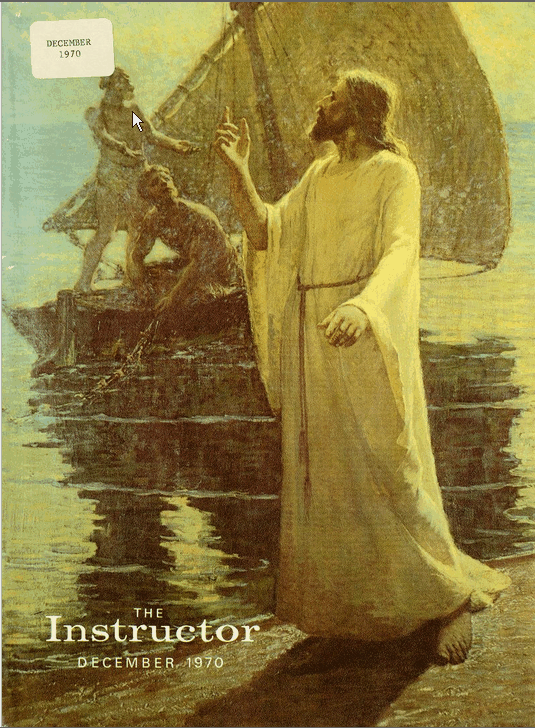
    The Instructor, December, 1970

    by Chauncey D. Riddle

    Chauncey C. Riddle received his Ph.D. in Philosophy at Columbia University and now serves as dean of the Graduate School at Brigham Young University. A member of the Sharon (Utah) Stake high council, he is married to Bertha Allred. The couple have two children and are members of the Orem 16th Ward.

    This article first appeared in The Instructor December 1970

    This article discusses some practical points on enjoying the constant companionship of the Holy Spirit. It has its focus in the area of religion — the discipline of living the gospel — more than in theology, which is theory or understanding of the gospel. The points here reviewed are the personal conclusions of the writer, who hopes that each reader will enjoy comparing notes with him on this vital topic. In this article the Holy Ghost is referred to as a personage and the Holy Spirit as his influence.

    Recognize the Holy Spirit’s Voice

    1. The first and foremost problem of spirituality is to recognize the influence of the Holy Ghost. One key to this recognition is the knowledge that for some person, the voice of the Holy Spirit is their own conscience bringing word to them from the Savior. President David O. McKay said:

    When that word comes to you — call it conscience, or, if you are in the Church and doing your duty, the whisperings of the Spirit, because you are entitled to be a partaker of it — then be true to that whispering, and some day you will know for yourself that you are in harmony with the universe. (Conference Report, April, 1963, page 95)

    The “honest in heart” are those who are able to admit what the Holy Ghost tells them in their own consciences.

    Manifestations of the Holy Spirit through one’s conscience have two ordinary forms. One is the feeling of the rightness or wrongness of something we plan to do. The feeling of rightness is the burning in the bosom; this “burning” may be faint, but it is plainly warm and positive, assuring us of the correctness of our decision. If we have chosen wrongly. a feeling of sullen sadness warns us that we will be sorry if we proceed.

    Another manifestation of the Spirit is that of hearing actual words. We do not really “hear.” for this voice of conscience makes no noise, but we are enlightened with plain ideas, sometimes occurring as pictures, other times as sentences or words. Usually the burning will accompany these pictures or words.

    A third most important manifestation is the peace brought to us by the Comforter. When we receive insight through revelation from the Holy spirit, plus the burning in the bosom, and are then obedient to the Lord, we receive that great blessing of peace, of knowing, that we are doing what is right and are “in harmony with the universe,” as President McKay said. This is real living. In fact, it is the beginning of eternal life.

    A Demanding Discipline

    The Constant Companion appeared in the December 1970 issue of The Instructor – page 454

    2. It is important to know that living by the Spirit of God involves much labor in thinking, and that learning to live this way completely is as demanding a discipline as any human being can undertake. We must not suppose that the Lord always gives people ready-made answers to their prayers. Rather, he expects us to examine, explore, and attempt to resolve the issue ourselves. We should pray, of course, for his guidance in this process. Prayerful meditation should be most important part of our daily routine and lives, equal in importance to carrying out the Father’s will when we finally know it. When we reach a conclusion, we must not automatically suppose that our conclusion is correct, but must then present our idea to the Lord for his seal of correctness, according to the pattern which he gave to Oliver Cowdery:

    Behold, you have not understood; you have supposed that I would give it unto you, when you took no thought save it was to ask me.

    But, behold, I say unto you, that you must study it out in your mind; then you must ask me if it be right, and if it is right I will cause that your bosom shall burn within you; therefore, you shall feel that it is right.

    But if it be not right you shall have no such feelings, but you shall have a stupor of thought that shall cause you to forget the things which is wrong; therefore, you cannot write that which is sacred save it be given you from me. (Doctrine & Covenants 9:7-9.)

    The Lord will not always require that we search out the answer to a problem at length. Sometimes he will give us the answer even while we are asking him about the problem. But as a kind and all-knowing Father, he knows our needs and abilities and tries to help us grow in ability to think and understand whenever possible.

    The Constant Companion appeared in the December 1970 issue of The Instructor – page 454 & 455

    This is Our Pattern

    We must remember that in this life, no matter how much good practice at thinking the Father gives us, we will never be able to make righteous decisions without his help. Even the Savior, who was already a God during his earthly ministry, never did anything nor said anything save that which his Father commanded him. This must be our pattern too.

    3. There is a definite relationship between spirituality and pleasure. When we partake of pleasures of the flesh or of the mind as part of keeping the Lord’s commandments and of filling our assigned missions in the world, spirituality is heightened, increased; but when we indulge in pleasures merely because our bodies or our minds crave them, we cut ourselves off from spirituality. Alma counseled his son Shiblon as follows:

    … See that ye bridle all your passions, that ye may be filled with love. (Alma 38:12.)

    The bridle on our pleasures and passions is supposed to be the Holy Spirit. If we accept that bridle, we will have forsaken selfishness. Then God can fill our hearts with the pure love of Christ.

    This is why living the Word of Wisdom is such a full aspect of living the gospel. To break the Word of Wisdom is to yield to the craving of the flesh. That yielding keeps us from growing spiritually, which means we cannot do great works of righteousness. The work of a saint, of the latter-days or otherwise, is to serve God by working the works of righteousness under divine direction.

    Satan is Ever Ready

    4. Great care must be taken, when we try to be spiritual, that we do not let ourselves be influenced by evil spirits. Satan is ever ready to give people spiritual manifestations, but he never will lead us to do a righteous act. Generally speaking, Satan’s promptings are permissive. They are whisperings to us that it is all right to get angry or to indulge our cravings or to break or “bend” the commandments of God or the standards of the Church.

    The following are safeguards to prevent our being misled by Satan:

    a. Keep in touch and in tune with those who preside in the priesthood. If we cannot fully support them and abide by their counsel, we are in trouble spiritually.

    b. Stay within the bonds of our own stewardship. Reject supposed revelations which relate to matters which are the priesthood responsibility of someone else.

    c. Know the scriptures. Satan cannot easily deceive us if we know the programs of the Church, what the presiding brethren say in general conferences, and the standard works, If we have not done our homework, Satan can easily slip us a lie.

    Spirituality Begins With Small Issues

    5. What happens when we pray and pray, but do not get an answer? Try a simple experiment in such a case. Stop asking the Lord what you want to know about; instead ask him what he would have you be concerned about and what he should have you do at the moment. Frequently we pray about the wrong problems and therefore do not receive answers. Spirituality begins with small issues and decisions related to the tasks at hand in our daily lives. If we can be faithful in these small matters, we gain the spiritual strength and obedience necessary to be able to enjoy receiving answers to the larger problems of life.

    What a joy to trust in the Lord, to stay ourselves upon the Holy One of Israel, to receive counsel and instructions from the only wise and true God! May we be true, as He is, that Zion might be established in the tops of the mountains, that righteousness and truth might sweep the earth as a flood, that we might prepare a New Jerusalem, worthy of our Master.

  • Last Lecture

    July 15, 1970

    Dr. Chauncey C. Riddle

    Chauncey C. Riddle, professor of philosophy at BYU, currently serves as dean of the Brigham Young University Graduate School.

    Dr. Riddle joined the BYU faculty in 1953. previous to his appointment as dean, he served as chairman of the Department of Graduate Studies in Religious Education, He was named Professor of the Year in 1962, and in 1967 he received the Karl G. Maeser Award for Teaching Excellence.

    A native of Salt lake City, he received his Bachelor of Science degree from BYU in 1947, the Master of Arts degree from Columbia University in 1951, and the Doctor of Philosophy degree from Columbia University in 1958.

    A devoted Church worker, Dr. Riddle presently serves as a member of the Sharon Stake High Council; he is a former bishop of three wards.

    When one approaches such an opportunity as this, it’s a temptation to want to give a grand bombast. But perhaps more realistically, a few simple observations and conclusions which I have come to in my life and experience would be what I would like to leave with you today.

    First of all, I would like to make a remark or two about education. This is the business in which we are all principally engaged. I think it important to know that education is a do-it-yourself program. Education is not something that someone else can give to you. In my own experience I think one of the great things which has happened to me was suddenly to realize that if I was ever to know anything for sure and to be very good at it, I would have to assume the responsibility for that myself. I couldn’t leave it up to any professor or any schedule or curriculum or university but would have to seize upon it and do something about it.

    Another thing that I came to (and unfortunately rather lately) is the realization that in education the most important thing is not acquiring facts and ideas, but it is acquiring the tools whereby to create and judge facts and ideas. In other words, tools are really the essence of a genuine education. And I mean by tools, first of all a mastery of one’s mother tongue. This is, of course, the absolute indispensable; unfortunately, it is not particularly prized in our society today. I think that is one reason for much of the fuzzy thinking we see going on.

    Next I would put foreign languages. Of all the languages I have studied, l find that the Latin that I took in high school has been by far the most pervasively valuable. Next to that I would put my little smattering of Greek, and then German and French. I found that the better I know these tools, the more I am able to use them. We hear people say once in a while “Well, I studied languages for my Ph.D. and have never used them since.” I think that most unfortunate. I think people must be hiding from opportunities when they say that; because opportunities abound and to be able to use language tools is a great benefit.

    But after all is said and done about education and tools, I take the standpoint that whatever a man says then, having used his tools and having thought about the world and about his discipline and about life, must be taken as his testimony — his reaction to the world. I wish somehow we could drop the indicative mood from the English language. To be very blunt about it, I think that that indicative mood is presumptive of the powers and prerogatives of deity. If somehow we could speak in the subjunctive we would be much more humble and much more careful as to what we say. If we would say, “It seems to me” or “If it were such and such,” then I think we would be speaking more honestly, relative to our own knowledge. When any man speaks, even in the field of his expertise, he is sharing his conviction. It would be very unlikely that he is really describing the universe the way it is. He may be approximating the way it is, but to take any man’s word as final on any topic at any time and any place, I think is disastrous for an educated person. I think a person should take what a learned man says as something worth listening to, but not to be believed. He should not believe anything until he has come to a conviction of it through his own investigation and resources.

    Well now, on to philosophy. Having spent a few years in philosophy, I have discovered that at any one point in time my ideas are not the same as at other points in past history. I would like to share with you some of my conclusions. I don’t suppose I will believe all of these next year. And so don’t you believe any of them. But I hope you find some stimulus for your own thought in what I have to say about philosophy, because the things that I say have come to me in a rather forceful way and I don’t say them lightly. I say them in the subjunctive, “This is as it were,” “This is my frame of reference.”

    One of the interesting things about the word “philosophy” is the shift in the meaning of the sophia part. Originally sophia in the Greek meant “practical ability to do something.” In later times as philosophy became a discipline of its own, the sophia came to mean “discourse.” And I suppose this is why philosophy has gained a bad name and the epithet of sophistry has become rather widespread. But I think that the original route is more meaningful.

    I take it that the business of philosophy is to prepare a man to do something in his life, not just to talk about it. People who can talk glibly are a dime a dozen in the world, but the people who can solve problems and really accomplish something are rare. I like to think that philosophy really is a preparation for life and for doing rather than just to be able to debate and discourse. Not that debating and discourse are not good in and of themselves but they are surely not enough. A person should achieve what Socrates would call the “examined life”–a life that is structured by thought that is deliberate, that is grounded in something more than fantasy. This is the real business of philosophy. And this always is a personal thing.

    Achievement is not a public objective enterprise; it is something that is private. Philosophy ultimately will prepare a person to think through his own mind and ideas and to live a life in accordance with these ideas. Now thinking is a rather specialized enterprise. The idea of thinking scares a lot of people. It’s amazing the trauma that is associated with certain kinds of thinking. Mathematics has acquired a bad name because of the poor way it’s taught most of the time. I notice that in teaching logic, when one gets any- where near the mathematical aspects, blinds come down in people’s minds and fear arises to shut out any further learning. So much fear attaches to all the thinking processes; but it should not. Thinking is a rather simple thing. If studied without fear, it can be mastered rather readily.

    There are a few basic thinking processes that one ought to know. One ought to be aware, for instance that though it is good to have a rational structure in our minds, we need to be consistent in what we think and believe that there is no such thing as being a rational person. The old idea of man being a rational animal is one of the great myths. Human beings are not rational, that is to say, out of the deductive reasoning process man does not fashion a life. Reasoning is after the fact in life. Man rationalizes. Man is a rationalizing animal. What happens basically is that people decide what they want to do, and then they think up good reasons for doing it. This is not to demean man to say this; it is just to describe the nature of the way he actually thinks. If you haven’t hitherto known this fact, you might simply contemplate that reasoning depends upon premises. Premises themselves cannot depend upon reasoning. The premises come from non-rational sources; therefore, reasoning itself is based in a non-rational faith. Whatever we assume as premises–the basis of our thought–is the governor of our thought. We can never be rational about that. That is something we simply pull out of thin air in accordance with out desires, our prejudices, our feelings, We need to be very explicit about that fact and not pretend that somehow I am rational and somebody else is not. That’s a bit of hypocrisy; that does not become a learned man.

    Another thing to know about language, logic, and thinking is the very peculiar fact that truth or the existence of the universe is always very particular and very specific. But when we think about the universe, we have a very difficult time thinking about the specifics; and therefore, we generalize. Our language consists of class names, and classes are always generalizations. If you will notice when we speak of our language being true, the more general our language is, the more chance it has of being true. The more specific it is, the less chance is has of being true. But then on the other hand, truth itself, the existence of the universe is extremely specific. We have, there- fore, this strange phenomena of people trying to speak truly about the universe in which they must speak most generally to speak most truly, and yet, truth itself is most specific.

    Herein lies many of the problems that philosophers get into. For example, suppose that there are no words for red in the English language; only words for the discriminable particular shades of red and every time you mention the color of something, you must use one of these shades. Now there are thousands of discriminable shades (I don’t know how many there are of red). But if you used a particular shade name every time you wanted to mention a particular object in tho universe, you would probably get the wrong one every time because of the difference in light circumstances. You might get one close to it, but you would speak wrongly every time you used a color name. That is why when we wish to speak truly we speak very generally. But truth is specific.

    Another important thing to know about language is that our knowledge of the world is based largely on induction. Induction is always guesswork. We have a very wonderful, complicated system of statistics that we study in the world. Statistics is the attempt to make induction good instead of bad. But the interesting thing about it is that no matter how skillful we are about our deductions and our statistics, it all comes back to the fact that we are jumping from the part to the whole. We are guessing. There is no way of certifying this guess by induction. You hear talk about probability in statistics. Probability is merely a second-order induction. It’s an induction on inductions which is guesswork upon guesswork. While we can do better guessing rather than poor guessing, it’s still guesswork. We need to remember that when we describe the world, by making general conclusions about the world, we are guessing. And therefore we must always be ready to admit a fault in our generalizations.

    Going on to epistemology. Epistemology is basic. Probably the most fundamental thing to know about any human being is why he believes what he believes. If you can find out where he gets his premises, what the source of his evidence is, you’ve got an understanding of that person. And there are some important things to know about epistemology. It’s important to know for one thing that wherever a man gets his evidence or his premises about the world, he must have preconceptions. Descartes tried desperately to eliminate all pre-conceptions from his mind and get back to his fundamentals. His is a classic case. But it is impossible. He had to assume something. He assumed that he had thought. He didn’t mention the other premise that he assumed, namely that thinking things exist, which enabled him to conclude that he existed. But nevertheless, you have to start with some premises. It is so important to realize that the premises that we adopt always control our inquiry. There is no such thing as starting off with a blank slate in this world, of pretending to be “objective.” We always start with premises, with preconceptions; these control inquiry.

    It is important to note that there is no such thing as being strictly empirical. We like to think sometimes that we’re going to the world and being hard and cold about the facts that are there, but we aren’t. There’s no such thing as a hard, cold fact. They don’t exist in the universe. The things we call hard, cold facts are very carefully marshaled bits of evidence which are fully interpreted in the light of prejudices and preconceptions. Hard, cold facts have a way of changing and flipping. It just doesn’t pay to be dogmatic and say “Let’s just go to the evidence.” The evidence frequently is a matter of rationalization. We must pick and choose evidence in this world. It’s impossible to take all of it; and as we begin to pick and choose, we’re not going to the evidence, we’re going to our evidence. And our evidence almost always is what we want to believe. That doesn’t make us very happy, perhaps, but nevertheless, if that’s the way it is we’d better face the nature of the beast.

    The world we live in then, the world we think we know, the world we describe when we speak of it as accurately as we can, is a world of construct. It’s a world of imagination something that exists within our minds. There is probably a universe out there somewhere, but the world we live in is within our own skulls. It’s a function of our own imagination. We create it. We invent it. We live in it. We fashion it. Sometimes we’re willing to take account of the things out in the world to change our construct. But all of us have the problem that we cannot afford to believe what our senses tell us. You see our senses are not objective. They are very perspectival. They do not give us the universe as it really is. When you look at railroad tracks and see them converge in the distance your mind must reassure you that they do not actually converge. You cannot afford to believe the way it looks. We must know that the real universe is somehow different from the way it appears. But on the other hand, is what we construct it to be in our minds the truth of the Universe? With proper humility we have to say no. Each of us constructs a universe and then lives in that hoping that somehow there is a sufficient correspondence between our constructed universe and that which actually exists.

    Now that which actually exists of course is the domain of metaphysics. And this is again crucial to our thinking–to the way we live our lives. But our metaphysics depends upon our epistemology. How we get our answers deter-mines what we believe about the universe. You hear a lot of noise in metaphysics about idealism and materialism. Many people in the world claim to be materialists–the Marxists for instance, and many of our humanist friends claim to be materialists–their world is material and they base their ideas on evidence; objective evidence about the physical world. The problem with that is that when you examine so-called materialists, when you go into their thinking and ask them what the metaphysical basis of the world really is, you find that what they are telling you is a platonic ideal. I personally have never met a philosopher who claimed he was a materialist who wasn’t an idealist. In other words, the material world he claims to believe in is actually an ideal.

    My test for telling whether a person is a genuine materialist or not is simply to ask him if he knows what the universe is. If he says, “No,” he has a chance of being a materialist. I say that simply, because you see, we are so constructed as human beings that our consciousness is within our bodies. We don’t see out through our bodies. What we see is apparently something that is cast on some kind of a screen on the back of our brain. We don’t see in our eyes. We don’t touch in our fingers. We don’t hear in our ears. All these sensations take place in the back of the head; therefore, we never see the world.

    We never have any direct contact with that part of the reality of the universe. The “outside world” is a function of the sensory mechanisms of this body plus our imagination. For instance, we don’t visually observe a third dimension in any way, and yet you think you see one, don’t you, as you look at me. You think you see depth. But that’s something that is pure imagination. There is no vision about depth at all, because the eye is a two dimensional surface. It doesn’t project depth at all. There are cues to depth, but the eye projects only two dimensions; and therefore, when we think of the third, it’s strictly imagination. Would that we could know how much more of the universe we think that we directly perceive is also imagination. You see this is one of the tricks of life to figure out how much you’re imagining and how comes through sense. We’ll probably never find out. The one thing we do know is that we don’t see the universe directly; and therefore anybody who pretends to know the truth of the universe is not a materialist. He is assuming that his ideas are the universe, and therefore he is an idealist.

    One of the problems in metaphysics is the question concerning how many kinds of things there are in the universe. The popular conception today is monism, the supposition that there is only one basic kind of substance in the universe. I personally find monism to be a rather terrible philosophy, terrible simply because of its many unhappy consequences. People who are monists go around decrying and belaboring the fact that they can’t find any meaningful freedom in the universe. The peculiar thing is that you believe in a monism, if you believe there is only one kind of substance and one kind of law operating in the universe, you cannot have a meaningful concept of freedom. Determinism must govern all pervasively and effectively. That’s a real fatalism. And that’s what people are trapped into if they are consistent monists.

    So people who are born and bred in our modern society believing in the scientific approach they’re given to the universe almost always are monists. And it’s not surprising that they grow up believing in monism. In jurisprudence it is thus commonly held that people don’t really have any agency; and therefore, there’s no point in punishing a criminal. You see, what traps them, what keeps them from being free is their preconceptions–their metaphysics. I find that a dualism, or better 3ùet, a pluralism is a better way to conceive the universe. I can’t find any basis for genuine freedom for human beings short of at least three basic kinds of things in the universe. So I’m a pluralist. And using this system of thought, I can make some very meaningful distinctions. The monist might say to me, “But of course that’s your presumption.” Then I simply say back to him, “But monism is only your presumption.” There is no possible way to demonstrate either monism or pluralism. A person believes what he believes about metaphysics simply because he wants to. And the sooner we all find that out and acknowledge it, perhaps we will stop burning people at the stake for their beliefs. I find this a terrible thing to think that human beings could be so ignorant of their own knowledge processes that they would think to take another man’s life because he doesn’t believe like they do. And yet, you see, the inquisition is not dead. We have a social inquisition that goes on in very much the same way in our society today, if you would care to search it out, which has an exact parallel to the inquisition of the sixteenth century.

    Going on to ethics. Usually when people talk about ethics they talk about various kinds of goods and so forth. I’d like to just jump over all of that and point out a few things that I think are crucial and fundamental. First of all, when people talk about what good for man really is, they usually make the mistake of assuming that all men are identical. This is a metaphysical assumption. It goes along with monism. But I find it impossible to believe that every human being that I know is cast in exactly the same mold and that ultimately the only differences are differences of particularity of environment. I just can’t find that to be a meaningful way of thinking about human beings. To me, I find that “the good,” that pleases a man, is something quite personal. I don’t believe there is an absolute good in the universe. I think it’s entirely relative and personal to the individual involved. We can’t say what is good for someone else. It is up to every individual to find for himself what is good for himself. I think that one of the great obligations of being an intelligent creature is to cut through all the acculturation we receive in our education and our environment and find out for ourselves what we really like.

    But then at the same time I think we need to recognize that good and right are two very different creatures. Usually they are not distinguished. Most philosophers confuse them. The scriptures usually do not differentiate them, but they are two separate questions. I take it that when we have freedom we can do what seemeth to us good, so to speak. But that doesn’t mean we’re right in doing it. I take right to be what we ought to do. It’s a truism that every man will do what is good to him. Ultimately, when he becomes free, he will choose that which pleases him most. You don’t have to worry people doing what’s good, everybody does that. Everybody does his own good. But you see, the real question in ethics is what is right. What “ought” a man to do. Is there any “ought”? I think there is an “ought.” And I think the “ought” is supplied within us. I think the “ought” comes when a person says, “What is my concern in this universe?” If my concern is only my personal pleasure then the only “ought” that I can muster is the “ought” of pleasure.

    But on the other hand if I see a genuine concern for other people I take it this is the basic meaning of the word “right”. Right is a social thing. And that the social relations that should govern us so that we can all find our own good or our own happiness is what makes the “right.” This is an objective thing. I think this is absolute. I think it is something that a person must wrestle with if he wishes to have any concern for others, he must come to grips with the fact that when he starts trying to help someone else that is not a subjective thing. He must do what actually helps that other person, And that becomes objective, that becomes universal, that becomes absolute.

    So I think that we cannot hide behind the fact that good is relative and pretend that all things are relative. They are not, some are relative and some are absolute.

    Going on to religion, I define religion as the way a person orders his life. In the latin relago. It is analogous that every man has a religion. And the religion is simply the pattern by which he lives. Not every man has a church, but every man has a religion. I find it paradoxical that I can hardly find anybody whose professed religion is the same as his actual religion. Most people tell you they believe in one thing and they’ll do quite another. It’s like Chrysler Corporation got into this box a few years ago they went and asked everyone what they would like if they had the ideal car. So people described the ideal car, it was an economy vehicle, no trim on it just the absolute transportation. So they produced it, nobody bought it, because what people really wanted was a plush car with the trim. And that’s what they bought. You see, we are very much that way about religion. We think we believe one thing, we go to great pains to give certain theological answers, but then go out and act entirely as if those answers didn’t exist. As I say, the rarest thing I know among human beings is a being whose professed religion and his actual religion are the same thing. I take it that is one thing philosophy can help a person to achieve. To help him think through what he is doing in connection with what he says and thinks he believes to see if they are all consistent. But that’s a rare bird.

    Consistent with this is the idea that every man has a god. The word god is a contraction of the word good. A person’s god is simply his good. There is something in every person’s life which is a greatest good to him. And that’s his god. Again I find it amazing to see how few people who claim that Jesus Christ is their god actually have him as their good. It seldom happens. I think there are a lot of people who would like to. But you see, that’s what I guess the business of repentance is. It’s getting our mind shaped around to where we are consistent. Where we don’t say one thing and profess another.

    The word `repentance’ in the Greek is metanoya which means “change your mind.” I find it very enlightening to construe repentance that way. Getting our thinking straightened out is probably the biggest challenge we have in this life. And to think consistently; to get our religion, our god, our goods all lined up and going the same direction; that’s a great achievement.

    One problem in the religion that always bothers people is the problem of evil. And I find that I have a conclusion on that subject which not very many people share. My conclusion is with Liebnitz: that this is the best of all possible worlds. I wish we had time to go into this into some detail, because I think that this, when you understand it, becomes a delightful concept. I mean to say by that the universe as we know it, the world we live in today, is the best is could possibly be. Now knowing what you know of the world. I think you’ll find that hard to swallow. I hope you won’t swallow it, of course. But I think you’ll find it hard even to understand that a rational creature could say such. Or a rationalizing creature, pardon me. But nevertheless, I find this to be a deliberate conclusion. To put it very briefly, I happen to believe in a God who is all powerful, and who is good, and who has this world completely in control. If there were any way it could be better, I am convinced he would change it to be that. And since he doesn’t, since he has ordained it to be the way it is, I am convinced that this world is the best of all possible worlds for us. Now I think it will have to change, the world changes from moment to moment in accordance with your actions and my actions. But I think that from moment to moment, especially when you and I do what we know we ought to do, the world continues to be from moment to moment what it ought to be. It is the perfect place for what it is designed to be. Namely, a place to try men’s souls. To purify them, to prepare them. And I find that I cannot fault the Lord in any way, he has done a marvelous job in constructing this world. I am not very happy with many of the things that are going on in it, but nevertheless as I stop and contemplate it philosophically, I have to acknowledge these things that I see happening (and I say this both out of the particulars of my own suffering and the suffering I see others engaged in) I have to admit that God is good. He is achieving marvelous things with all this evil and this suffering that is going on in the world.

    A word about science. The basic problem that most people are concerned about in connection with science is the conflict between science and religion. Many people will say there is no conflict, I find myself that there is a vast difference between science and at least LDS religion. I sure there are some religions that are indistinguishable from science. But between LDS religions and science I find a vast difference. However the conflict arises only when one insists upon making science a religion. It’s quite possible to do that. But I don’t find it necessary to make science our religion to be a scientist or to be scientific. We can be perfectly scientific without giving it our ultimate allegiance. Without making “it” that chimerical, mythical “it” (there is really no such thing as science, you know) that is merely an idea in our minds. There are lots of particulars in the world that we catch under this rubric, but there is no such thing as the rubric itself. When a person makes science his god, or his good, I think somehow he is in spiritually trouble (obviously) but intellectual trouble as well. Because he may not be aware what science really is as an enterprise. But that’s where the conflict comes.

    A person must declare his allegiance; he must give his allegiance in our church either to the gospel, or to something else. And I find many in our church who give their allegiance to science. And then for them there does become a very definite conflict, they cannot stomach many of the things that go on in the church. Which is the beginning of their departure.

    I find there is little true science around. Science is the business, I take it, of reorganizing concepts of the world in order to think of the world more effectively and more economically. Technology, on the other hand, is taking concepts which have been thus formulated and adjusting the world in accordance with them. As I look at science books, I find almost no science in them. They’re almost 100 percent technology. I believe that is one reason why America has never excelled in science. We excel in technology because we teach technology. European institutions do a much better job of teaching scientific thinking; and that’s why most of the great discoveries have come out of European institutions.

    Dipping into politics for just a moment; I have a bad time in politics because every time I listen to liberals, I know I’m not one of them. Every time I listen to conservatives, I know I’m not one of them, And both of them think I’m the other. Those labels don’t mean an awful lot. To be very blunt about it and frank with you my own political persuasion is that I’m a revolutionary. I am utterly disgusted with this world the way it is. And I am bound and determined to do something about it. The force of my life and strength is to be spent in changing it. But I’m a little different from most revolutionaries. The battleground for my revolution is within my own breast. I find it a terrible species of temerity for people to launch revolutions to try to force other men to conform to their ideas when they haven’t got themselves straightened out. For some reason I can’t find any sympathy with people who want to go out and burn and shout and force other people. I think that’s a very non- intelligent kind of revolution. I think that if I will put my own heart and mind in shape, then perhaps I can be an asset to this universe. Until then, I’d better stick to home and get the work done. If I ever should become an asset to this universe, then I think I could through persuasion show other people and maybe help them, not by any force, but simply by persuasion, a way that we could better our society and circumstances. To me that is the true revolution.

    To go back to what I said about good and right, I think you can do good using force, but never what’s right. Right is always a thing that needs freedom and persuasion. The integrity of the individual must be preserved, or right cannot be involved. And those who would force good upon the world ultimately are simply denying the integrity of the individual.

    I think you probably observe in all that I have said that though I have been talking about philosophy, my thoughts have never been far from the gospel. I would find it personally a terrible travesty to have it any other way because I happen to know the gospel is true. For me. I can’t claim it to be true for anyone else, but I know it’s true for me. I know that as my thinking gets better and better, speaking of it in relation to its internal consistency, speaking of it in relation to the evidence I have from the world, that the more my thinking grows and gets better the more it approximates the gospel. What I know from the scriptures and from listening to the brethren. My own propensities force me to bring everything I think professionally in terms with what I know in the gospel. I cannot have two pockets. They must be consistent. My life must be a whole. And so of necessity I continually compare my own thinking and philosophy with what I learn in the gospel, and I find the two complement each other beautifully. They enhance one another. But I must be careful to put one as ultimate, namely that the things of the gospel are ultimate.

    Now, one of the problems that bothers a lot of the people in the Church is the fact that we don’t have unity on what we believe. I find this not too disturbing. I can get along very well with a man who disagrees with me as long as he will work beside me in the kingdom, I find it important that we disagree simply for the reason that I know that I haven’t arrived yet and I don’t think he has arrived yet. If we can’t disagree and change our minds, neither of us will come to the truth eventually. The ability to err is also the ability to repent. I’m grateful for the fact that the brethren give us a lot of latitude in this Church to think false doctrine. Where they are strict is on what we do and I think that is just the way it ought to be. If we work together in the Church, if we ever get the priesthood harness on, I think we will come more and more to a unity of the faith. We will come to see eye to eye. I think there will come a day when people will believe exactly the same. That’s the day they become Christ-like. They will have the same opinions on politics and food and recreation. This doesn’t mean they will lose their individuality completely, but they will come to see eye to eye on all things. And I hold this as a great and wonderful goal. But in the meantime, I’m not at all disturbed that we don’t have that. The unity that I think we ought to be concerned about is the unity of our action and support of the brethren in moving forward the work of the kingdom.

    Well, as I come to conclude now, I suppose that something I have said has been disagreeable to you. I hope so, because that means you have been thinking for yourself. You could not have had all the experiences I have had in my life, and therefore if you come to my conclusions it’s perhaps unfortunate. You ought to come to the conclusions that your life brings you to. I hope that we will deal with each other in ways that pay more attention to what we do rather than what we say. What a man does is really the measure of what he believes and thinks, not what he says. I hope we all will do good things. I hope we will put our minds and lives in order, some of us think we are so great, let’s see what we can do with it. What kind of happiness we can bring into this world through the struggle that we have to purify and correct ourselves.

    Finally, I come down to this point. The only thing that I am sure about in this world that I can really anchor my thought and mind and hope to is Jesus Christ. I know his voice as he speaks to me through the Spirit. And I find that to be most precious. And I would encourage everyone who has a hope in any of the things that the gospel promises to try to come unto the Savior and to live knowing something of his Spirit. That is living. The Spirit is sweet, I don’t know about you, bu I can taste it. It tastes sweet and it is most delightful. I know of nothing more satisfying than to know that I am in accord with him who speaks to me through the Spirit. I’ve never seen him. I hope someday that my faith can be pure enough that I can. But I know that he is good, he is light, he is truth, because of the progress that he has enabled me to make.

    And one further thing that I have come to see so clearly in my own life. Namely, that sanity and righteousness are identical and that sin and insanity are identical. I’m not talking about people with organic disturbances that can’t think, but I’m talking about those of us who can think. I’m convinced that when we sin knowingly it is simply because we cannot accept the truth. We are insane. It’s no mistake that Satan is the Father of lies and that the Savior is the truth. He is the truth and the light. He is clarity. He is reality. Satan is an inconsistent deceiver.

    In all these things I would simply like to leave you with my testimony. I know the gospel of Jesus Christ is true. I am most grateful for that. And I’m grateful for the chance to associate with you and to say these few words. And I bear my testimony in the name of Jesus Christ, Amen.

  • The Pillars of Testimony

    AN ADDRESS GIVEN TO THE BRIGHAM YOUNG UNIVERSITY STUDENT BODY

    DR. CHAUNCEY C. RIDDLE
    Dean of the Graduate School
    June 30, 1970 – Devotional

    with an introduction by
    Dr. Dean A. Peterson
    Dean of the Summer School

    DR. DEAN A. PETERSON

    It is our privilege this morning to have as our devotional speaker, Dr. Chauncey C. Riddle, dean of the Graduate School and professor of philosophy. Dean Riddle was named Professor of the Year in 1962 and BYU Honors Professor of the Year in 1967. He also received the Karl G. Maeser Award for Teaching Excellence.

    He received his bachelor of science degree from Brigham Young University and his master’s degree and Ph.D. from Columbia University. He is a member of Phi Kappa Phi Honorary Scholastic Society and the American Plains Division of the American Philosophical Society. Since 1965 he has been a member of the high council in the Sharon Stake and has served on high councils since 1958. He is a former bishop of three wards: Provo Eighth Hard, Provo Nineteenth Ward, and the BYU Second Ward.

    Chauncey Riddle is a native of Salt Lake City and is married to the former Bertha Alfred. They are the parents of twelve children, ten of whom are living, and their twelfth child, a son, was born this past Sunday. We congratulate Dr. and Sister Riddle. It is now our pleasure to turn the time to Dr. Riddle.

    DR. CHAUNCEY C. RIDDLE

    Several years ago I was descending the main stairs of the Butler Library at Columbia University in New York City when a fellow student stopped me. He asked if it was true that I had graduated from Brigham Young University. Upon receiving my affirmative reply, he volunteered that he was a graduate of one of our neighboring institutions. But the thing that so delighted him about his university, he went on to explain, was that he had been “liberated.” I took the bait and innocently asked him from what he had been liberated. Then the roof fell in. For the next two hours, as we stood there on the stairs, he explained to me all of the terrible evils of the Mormon Church. He began quite calmly to explain these evils, but as time progressed his explanations became a tirade punctuated by invectives and blasphemies. His face became beet red; his fury was so great that he began to jump up and down in sort of a war dance. l wondered if he would leap upon me to vent his obviously full spleen.

    He told how he had once been a “good little Mormon boy.” He had attended all of his meetings faithfully, graduated from Primary, bad become a deacon, teacher, and priest in due order. He was well read in Church literature — was so well informed about doctrine that he was asked to teach a class in one of the auxiliaries of the Church during his freshman year at the university. Then he began to take classes in philosophy.

    His professors of philosophy had carefully explained to him the delights of being “an intellectual.” As an intellectual he was given to understand that religion is all subjective, and therefore completely unworthy of any thinking man’s allegiance. They convinced him that the General Authorities of the Church had no such thing as revelation from God since there is no personal God. These authorities, they said, were simply paranoid and had a variety of illusions of grandeur. They were power mad, according to his professors.

    Shades of Korihor 

    My fellow student, of course, wasn’t just quoting his professors. He believed fully in what he was telling me. He went on to explain how the Church was really a system for making money and emphasized how shameful it was that all those Mormons out there in Utah were being slavishly led around by the nose. His attack included the Book of Mormon in particular, which he claimed was gibberish, and the Bible, which to him was a collection of myths and bedtime stories. One by one he decried the major doctrines of the Church showing how, to him, each was ridiculous when compared with modern science.

    At first l attempted to counter his statements. As he launched upon the Brethren or certain doctrines, I would point out inconsistencies and untruths in what he was saying. These replies only made him the more angry, and soon I perceived that his attack was completely emotional and not intellectual.

    On only one point could we agree. l challenged him with the idea that he had taken this apostate stand because he couldn’t live the standards of the Church. He then vehemently affirmed that such was not the case, that he saw real value in the Word of Wisdom and in the moral standards of the Church. He claimed that he had never broken these standards and never would, for he saw a utilitarian value in these things quite apart from the gospel.

    The conclusion to his long outburst was that he intended to get his Ph.D. and then spend the rest of his days bringing light and cheer to Mormons of guilty conscience in order to smash the Church and its authorities wherever and whenever he could. Shades of Korihor!

    By the time we parted, l was somewhat numb, drenched with his vituperation, and frustrated too, for I had been unable to help him. l wondered how on earth anyone could help him. l especially wondered how he would fare in New York City in keeping true to the moral standards he claimed he would never violate. My wonder ceased after a few months. The last time I saw him was in a dimly lit corner of a campus restaurant. He was reclining in a booth, obviously drunk, surrounded by empty beer cans, with a cigarette in one hand, and the other hand on a girl whose appearance told the rest of the story.

    A Real Testimony       

    Oh, sad, sad story! I cannot think back on him without wanting to weep. That this could happen to the youth of the noble birthright is appalling. But it did happen and it does happen. And it happens again and again for the same reason. That reason is the lack of a real testimony.

    A testimony is that precious gift that enables a person to have enduring faith in These then are the components of testimony. First, an ability to hear the voice of the Lord when he guides us to righteousness; this we called recognition of spiritual experience. Second, knowledge of the work and the ways of God; this we might cull understanding. Third, having in our lives that most precious fruit of the gospel, the quiet inner peace that passeth understanding.

    The Parable of the Sower        

    The Savior gives us a graphic illustration of these three elements in the parable of the sower. He tells us what would happen if we were to lack any one of these elements.

    A sower went out to sow his seed.. and as he sowed, some fell by the way side; and it was trodden down, and the fowls of the air devoured it. (Luke 8:5.)

    The Savior explained this as follows:

    The seed is the word of God.

    Those by the way side are they that hear; then cometh the devil, and taketh away the word out of their hearts, lest they should believe and be saved. (Luke 8:11-12.)

    These people of the beaten path are those of the world who are so trodden down by the influences of the world that they do not recognize the word of the Lord when it comes to them. When the word of the Lord comes to any man, it is carried by the Holy Spirit into his heart. But perhaps that man pays little attention to his heart, priding himself on being objective in responding only to “hard, cold physical evidence” which affects his body and which he can demonstrate publicly to others. If so, the precious things in his heart lie undiscriminated, unsorted as time passes, it is easy for the adversary to snatch the precious word of the Lord from his memory. So, for want of attention and honest recognition of admitted worth, the word of the Lord is lost from consciousness and the opportunity to have a testimony and to be saved is gone.

    Returning to the Savior’s parable, we see the second error.

    And some [seed] fell upon a rock; and as soon as it was sprung up. it withered away, because it locked moisture. (Luke 8.6)

    This is interpreted by the Savior as follows:

    They on the rock are they, which, when they hear, receive the word with joy; and these have no root, which for a while believe, and in time of temptation fall away. (Luke 8:13.)

    These are persons who are able to recognize and treasure the word of the Lord. They begin to keep his commandments; yet they do not understand his work. In the face of temptation they wither because they cannot see the purpose and necessity of being different from the world, of keeping themselves pure and unspotted. Lacking the perspective of eternity, they fall easy prey to the desires of the moment, and the joy of the word of the Lord is overwhelmed by the lusts of the flesh. Had they searched in the scriptures and listened carefully to their priesthood leaders, they would have caught the point of sacrifice and they would have had the hope of the rewards of righteousness. This would have nourished their souls in the hot glare of temptation. But lacking root, not understanding what they were doing, they withered.

    The third problem is represented in the teaching of our Savior as follows:

    And some [seed] fell among thorns: and the thorns sprang up with it, and choked it.

    And that which fell among thorns are they, which, when they have heard, go forth and are choked with cares and rich’s and pleasures of this life, and bring no fruit to perfection. (Luke 8:7, 14.)

    This is the problem of what it is that satisfies us. Some persons hear the gospel message but are quite content with the world the way it is. They busy themselves with making and preserving their wealth and in living deliciously; they see no reason for a change. This is the problem of the upper economic classes of society especially. The Book of Mormon speaks of them being comforted with carnal security and thus being carefully led away down to hell. If they are ill, they have the best doctors; if they are hungry, they command the finest cuisine; if they are lonely they throw a party; if they are depressed or nervous, they are soothed by drugs, tobacco, alcohol, or whatever suits their fancy. They fancy, of course, that they do not need a Savior. Whatever they need, they can get — they think. These persons seldom gain testimonies until their health and wealth are taken from them. Bereaved of the temporal salvation they have so ignorantly enjoyed, they begin to glimpse the fact that there might be something better to life than just sating the flesh.

    The Gospel Produces Good Fruit   

    Undoubtedly there are some persons who do not have the fruits of the gospel in their lives simply because of not knowing what they are missing. My neighbor has a nectarine tree. He enjoyed its abundant fruit each year until he tasted one of the nectarines on my tree. Now his taste terrible, and he has grafted in many twigs from my tree hoping to convert his into a tree that produces good fruit.

    Producing good fruit is the point of the gospel. If we live the gospel, our lives produce love, kindness, charity; we produce righteousness. Righteousness is caring more to see others happy than worrying about our own happiness. This is one of the paradoxes of the gospel. The only way to be really happy is to forget about our own happiness and to labor diligently for the happiness of others. The Savior said:

    “He that findeth his life shall lose it: and he that loseth his life for my sake shall find it. (Matthew 10:39.)”

    Pillars of Testimony    

    Above all, our God is a god of righteousness. Whatever we do for his sake, we do in the cause of righteousness. And, among those who have tasted of the fruits of righteousness which have come through obedience to Christ, there are those who desire this fruit above all else. It is even more important than life itself to them. These are they who have strong, secure testimonies of the gospel, of the Savior. They know the gospel is true because when they heard the word of the Lord they had a spiritual quickening. Through this spiritual experience, they gained insight into the work of the Lord, the work of righteousness. And, when through faith they acted in obedience to that understanding, they tasted the precious fruit of the tree of life and knew of God’s goodness and love. Then they were founded on the rock. Then they had an anchor for their souls. These are they of whom the Savior said:

    And other [seed) fell upon good ground and sprang up, and bear fruit an hundredfold.

    But that on the good ground are they, which in an honest and good heart, having heard the word, keep it, and bring forth fruit with patience. (Luke 8:8, 15.)

    Testimonies and Righteousness     

    One plain and very important conclusion we may draw from the Savior’s parable is that testimonies are not for everyone. There will come a day when every knee shall bow and every tongue confess, but today only those who have honest and good hearts can be sure of gaining a testimony, and they gain one because they love righteousness. That love of righteousness leads them to the Savior, because only in and through him are they able to bring forth true fruits of righteousness. He is the way, the truth, and the life.

    We have seen in the example of the Savior’s parable of the sower what happens when we leave out one of the necessary elements in gaining a testimony. Let us observe the consequence of trying to depend upon only one of these elements.

    Spiritual Imitations        

    Rather frequently there are manifest in our society persons who claim to be spiritual. They have had some unusual experience which has caused them to embark on a crusade or to alter their way of life. With all seeming sincerity they claim to have discovered the truth, which supposed truth they pursue with great zeal. When we see this claim to spiritual manifestation and its attendant zeal, we ought to check carefully for the other two aspects of true testimony. First, does this spirituality this person claims to have bring him understanding? Does it ring true in comparison with What the scriptures tell us? Is it consistent with the advice and counsel of the authorities of the Church? Secondly, does it bring forth in that person’s life the works and fruits of righteousness: love, kindness, joy, peace?

    The Savior has given us a measure by which to judge those who claim to be spiritual. “By their fruits ye shall know them.” (Matthew 7:20.) It takes very little experience to separate good fruits from bad fruits if we are doing careful thinking. The reason for bad fruits and for being very wary of those who claim special spiritual experience is that Satan produces his own revelation or experience abundantly in the world. Many, many of those who think they have found the Lord have simply lent an ear to Satan. Undoubtedly, only those who are honest and good in heart can detect all spurious revelation, that is to say, revelation not from God.

    Detecting Spurious Revelation

    But there are rational means for detecting spurious revelation. Recognizing that a rational formula is no substitute for long experience in any field, we might note the following marks which are associated with people who have had false revelation.

    1. Indiscriminate recounting of the spiritual experience. (The Savior told us not to cast our pearls.)
    2. Insisting that others accept this spiritual experience. (In the Lord’s system each person depends on his own personal revelation.)
    3. Inconsistency of the supposed revelation with scripture and with the words of the living prophets. (The Lord has told us that his house is a house of order.)
    4. Fruits of unhappiness, contention, hate, confusion. (For the Lord’s way is light, truth, simplicity and unity.)

    There is no shortage of revelation in this world. The problem is to tell that which is true revelation, given of the Lord, from that which is spurious revelation, given of the adversary.

    Knowing or Living                            

    Let’s turn now to an examination of what happens when a person attempts to base his testimony solely on a knowledge or understanding of the gospel. We occasionally see a person who has read all the books and has accumulated a tremendous store of catechistic answers to questions about religious matters. When challenged on a point, the person uses the method of proof-texting; that is, he produces scriptures and quotations which purportedly substantiate his opinion. This person is in the tradition of the scribes and Pharisees whom the Savior so roundly scored because they delighted in knowing the words about the work of God rather than in living by the word of God.

    Many times this person who has only great knowledge has correct answers. He will quote scripture and propound the words of the prophets at great length. His problem is that it all comes from his head and not from his heart. It is sometimes said that this person has an intellectual testimony, which is to say, he is fascinated by the rational unity and consistency of the gospel and the scriptures. But this fascination is not a true testimony. It is only an intellectual game which the person is playing. Anyone who is said to be “intellectually” converted to the Church is not founded on the rock. Soon some other intellectual game will fascinate him more and he will be as zealous and catechistic about it as he was about the gospel. Or perhaps the Brethren will ordain certain of the seventy to be high priests, or they might put five counselors in the First Presidency, or perhaps they might even do away with one or more of the auxiliaries of the Church. These persons are then offended because the work of a former president of the Church is being countermanded. They see this as an inconsistency, and their intellectual house of cards is toppled. They forget that the original instruction was given spiritually, by revelation; that the change is given spiritually, by revelation; and that a member of the Church can appropriately sustain either or both only by means of his own personal revelation.

    But the person who glories only in knowing about the kingdom of God does not enjoy personal revelation from the Lord. And because he does not live the gospel, which he cannot do without personal revelation, he does not have the special fruits of the Spirit in his life. He will not and cannot endure in the kingdom unless he repents and adds these missing dimensions to his life.

    And Signs There Are      

    Turning now to the third possibility, we see the case of the person who settles for the fruits only, who has no spirituality nor depth of understanding in his life. This is the person who depends upon signs. And signs there are. Signs follow those who believe in Christ. Signs also follow those who knowingly or unknowingly serve Satan. The signs of these two masters are not always the same, but they are not always different. Thus a person who depends on signs alone has no true idea as to what or who might be the cause of the signs on which he depends.

    It is not unusual to see in the Church a person who believes the Church is true because he was there when Aunt Annie was administered to by the priesthood and was miraculously healed. He saw them lay on hands; he saw Aunt Annie healed. Is that not proof enough? It is for him. Building his house on the sand, he proceeds as if he had a testimony. But then Aunt Annie becomes ill again. She is administered to again, but this time she passes on. Everyone is grief stricken at losing beloved Aunt Annie. But our friend who based his testimony on her healing is not only grief stricken, he is terrified. He thinks that maybe the gospel is not true; perhaps there is no God; perhaps life is just a monstrous joke of nature. Because be has not accepted into his life the comforts and guidance of the spirit of the Lord, be does not and cannot know why Aunt Annie was restored on the one occasion and released on the other. He does not have the understanding of the gospel to know that death is not a curse but a blessing to the righteous. Bereaved of moorings, our friend is swept with the tide of skepticism and despair now despising the sandy foundation which once supported his unstable house of testimony.

    Testimony and Faith     

    It has been obvious through this discussion that testimony and faith are very closely associated in the gospel of Jesus Christ. What we have here called testimony is very close to what Paul talks about when he discusses faith in the book of Hebrews. The formula we have given sounds very much like Alma’s description of how to gain faith. The connection is that testimony is the necessary prerequisite to sustained faith. Testimony is the basis, the foundation for acting on faith. A testimony is knowing that the gospel is true. Knowing that, one can then exercise great faith.

    To exercise faith in Jesus Christ, one must hear the words of Christ. These come to us in the still, small voice of his spirit. If we then believe and obey the Savior, we are showing forth faith in him. But a person cannot go very far acting on faith, not far enough to save his soul, without knowing that the course he is pursuing is the will of God. Without that knowledge it is too risky and expensive to act on faith. The sacrifices demanded are too great. A sandy foundation will not support them. But when we have tried our God and know that he is just and true and righteous, then we can exercise faith in him, unto death if necessary, because we have a testimony.

    On the other hand, one may have a testimony and not continue to act in faith. This is the terrible route that apostates of every dispensation have taken. Having known the goodness of the Lord, they chose to stand apart, to forsake the ways of righteousness and to return to the world and to sin. A testimony never impels a person to be righteous; it only enables him so to act. The devils all have testimonies of Christ. They know him and know who he is, but they deliberately choose the way of sin because their hearts are not honest and good.

    The scriptures plainly reveal to us that testimony and faith must grow together before either is strong or of great value. The beginning point is always personal revelation for the Lord always takes the first step by extending the arms of mercy towards a man. The man must desire to believe and hope to find righteousness enough to try the Lord, to try the experiment of obeying him and his cords. If a man obeys the Lord, he receives a reward, a spiritual reward. This reward shows him that it is good to obey God. Thus, as a man adds obedience to spirituality, understanding to obedience, and recognizes the result, he has a testimony. As he is further obedient, he gains more understanding and more rewards which increase his testimony. As his testimony grows, he can stand greater and greater spiritual manifestations. As he obeys the instructions from the Lord given in these revelations, his faith becomes greater and greater. Thus these two, faith and testimony, grow together as the saving grace of our Savior until that person has overcome the world.

    Perhaps you have watched concrete being poured. In any job that is intended to be strong and lasting, reinforcing steel is placed at strategic intervals. This steel makes the concrete almost indestructible. It may crack and the surface may chip, but the mass remains solid and steadfast. If you have watched somebody trying to destroy reinforced concrete, you know that the simplest thing to do usually is just to pick up the whole mass and cart it off.

    Concrete is like faith. A testimony is like reinforcing steel. Satan is the destroyer trying to smash your faith. If you are full of reinforcing steel, Satan cannot smash you. He would like to take you up bodily and cast you away. But our Savior does not give him that power. So Satan hunts for faith without testimony, for good acts, obedient acts, where the person is not sure whom he is obeying, why he is obeying, and if it is worthwhile to obey. When he finds such a person, he puts the pressure on. Not necessarily a great massive pressure – just enough to chip off a corner. And then another corner. Here a piece, there a piece, the person is destroyed all the while trying to do what is right. Trying but not succeeding – because of only half trying. Trying to live the gospel without searching the things of the spirit, without pondering the meaning of the Lord’s message, without keenly observing the fruits of the Spirit. To try to have faith without a testimony is to be thoughtless. But to think, to search, to obey, to experiment, to find that rock upon which to build, that is thinking, the best kind of thinking; it is called repentance. And that kind of thinking is real living; in fact, it is the beginning of eternal life.

    Testimony Bearing        

    A word about the bearing of testimony. In one sense a testimony is a wholly private thing. It is something you know; it is part of your life, your conscience, your experience, but you cannot show it to anyone else because it is part of your inner life and experience, your spiritual life. That, of course, is why it is so valuable to you. It is your personal comfort and warrant for your faith. No matter what happens to anyone else, you have something you know for sure about spiritual matters. You and the Lord have a functioning, ongoing relationship and companionship.

    The privacy of your testimony is another witness to your personal free agency. Because it is private, other persons cannot judge you nor assist you in your thinking. You must think through the evidence for yourself. It is your own personal evidence. Others may check your reasoning, but they cannot check either your data or your desires. So you remain free of men because of your privacy, and free from the flesh because these data are spiritual. This is the freedom which the gospel offers to all who seek the truth.

    But though your testimony is private, the Lord does nt always want you to keep hidden the fact tat you have one. Under his guidance you are to bear your testimony. When he prompts you, he wants you to express to others the fact that you have one, as Paul says, to give account to men of the hope that is within you. You can never give another person your testimony, or even a testimony. But there are times when you must stand up to be counted.

    For when you bear your testimony, you declare yourself to be on the side of the Savior. You express to men that you have tried the Lord and found him to be good, and you stand as a personal witness to that truth. As you speak, truly the Holy Ghost is your companion. He, the Holy Ghost, also bears his witness to the souls of your bearers. He is a God; his witness is divine. His witness is the beginning of spiritual life, the basis of testimony, the opportunity for faith. While your witness is nothing so grand and mighty as that of the Holy Ghost, nevertheless your witness is the occasion and opportunity for his witness. Thus you are an important and even indispensable part of the Savior’s plan to save mankind. If no man bore true witness of God, the occasions for revelation from God would be so sharply diminished as to throw the world into another black night of apostasy. So we are sent into the world to be witnesses of the light. We are not the light. But we know him and bear testimony of him; he is Jesus Christ.

    There is also a responsibility upon those who receive a testimony, a witness of Christ. Like it or not, they must judge. When a man declares himself to be of Christ all of his hearers who claim to be servants of Christ also must react. If a man bears a true witness and his hearers who are members of the Church accept it, the speaker and bearers strengthen one another and draw closer to each other in the bonds of fellowship and unity that characterize the perfected kingdom of God. But if these members reject a true witness, they have opted in behalf of Satan. If a man bears a false witness and members of the Church accept it as true, they have likewise declared themselves against the Savior and for Satan. If members reject a false witness, then they know to labor with this man as an unbeliever. If they try not to accept or reject, then they are pretending that the occasion is unimportant. But a testimony of Christ is never unimportant; it is a matter of spiritual life or death for both hearers and bearers. When we attend sacrament meeting and especially testimony meeting we are all accountable. We add or detract from the meeting and we will have to answer for what we do. Sometimes it is fashionable for people to express boredom with a testimony meeting. But, for those who have and understand testimonies, a testimony is always a spiritual feast, a rich opportunity for discernment, an occasion to know how to act toward our brothers and sisters.

    Many times a point is made of the fact that we bear testimony in our deeds as well as in our words. And indeed we do. Whenever we who are covenant servants of Christ make a decision or perform a deed, we are bearing our testimony. If we seek and yield to the enticings of the Holy Spirit, we declare ourselves to be servants of Christ. Whenever we avoid him or act contrary to what we know to be right, we are plainly bearing witness to ourselves and to any who see our acts that we do not really believe in Christ. We are saying that though he may exist and he may be all right in his place he is not good enough to be worshipped with all of our heart, might, mind, and strength. And thus do we reject him.

    But thank the Lord for those few stalwart souls sprinkled through our midst who unpretentiously and steadily opt for the Savior. They can discern the Spirit of the Lord and they love it. They understand the gospel and have their eye on eternity, whose name is Jesus. They bear the fruits of faith in their lives, for they strengthen the weak knees, they lift up the hands that hang down. They build the kingdom of God day and night, summer and winter, by showing forth in purity of life the love of God towards men.

    In conclusion, may l give you my witness. l testify with all my heart and soul that I know that the gospel of Jesus Christ is true. I know because I have tried it. I know that it works. I know that the Holy Ghost is a sweet and a pure companion that leads to righteousness. I know that the gospel is profound, consistent. I know that to learn about the mysteries is a great and overwhelming blessing even though we may not speak of them. I know that God reigns in power in his priesthood, for I have seen lives change under the ordinances of the gospel and I have seen miracles performed. I witness to you that the authorities of the Church are men of God. They have his power; they have his authority; they are filled with his love; and they are working tirelessly to bring salvation to us and to all men. Above all I know that our God is god of righteousness and truth. I give glory to the name of our Savior, and I witness unto you that I know him to be true, to be good. And I know that all that I know that is good and true and virtuous I know though him.

    I pray that each of us may inventory his testimony, and then do whatever is necessary that we will never falter in our faith. I pray that we might love the Lord enough to become pure in heart, to establish Zion. That we might show forth the glory, honor, and majesty, and righteousness of the true and living God, I pray in the name of Jesus Christ. Amen

  • PREMISES OF LDS THOUGHT – Written about 1970 – (Thoughts about handicaps)

    by Chauncey C. Riddle

    1. God is a morally perfect, omniscient, omnipotent being, having a perfected body of flesh and bone. The work of God is to create men and to encourage them to become gods.
    2. Man is literally the child of God, but having a nonperfected body of flesh and bone.
    3. Both God and man are dual spiritual beings. The spirit is the person, the body is the tabernacle. Spirit and body, perfected and united, is a special condition known as “exaltation.” Exalted beings are gods; they have the distinctive capability of being able to do all possible good for other beings.
    4. Mortal existence is an occasion of trial andproving under a variety of physical, mental and social handicaps. These handicaps are essential to the eventual exaltation of men. They have come to exist for mankind in “the Fall.”
    5. Satan is a real spirit person who is assisted by many beings like himself. His work is to build a dominion for himself by enticing men to follow him, rather than God.
    6. Man is free to choose his own eternal destiny because he may choose either the way of righteousness by yielding to God, or the way of selfishness by yielding to Satan.
    7. Satan is given power over men to be a source of focus of their handicaps. Men cannot prove their love of righteousness except they consciously recognize and deliberately overcome these handicaps and reject Satan.
    8. God does not and will not lift handicaps from men until they have served their purposes. Some of their purposes are as follows:
      a. To acquaint men with their insufficiency and the need for help to be righteous.
      b. To give each person strength by teaching him to bear an inescapable burden.
      c. To give each person the opportunity to learn to be righteous by having compassion for the handicaps of other persons and sharing their burdens with them.
    9. Principal handicaps which make mortal existence meaningful:
      a. Disease
      b. Deformity
      c. False concepts
      d. Poverty and wealth
      e. Denial of the opportunity to hear the Gospel of Jesus Christ in mortality.
      f. Denial of the opportunity to bear the Priesthood of Jesus Christ in mortality.
      g. Death
    10. Men have struggled in vain to rid themselves completely of each of these handicaps by natural means.
    11. God’s means of overcoming the need for these handicaps is the Gospel of Jesus Christ. Through its laws and ordinances, the spirits and bodies of men can be cleansed and purified by turning from selfishness to righteousness.
    12. The most important thing any man can attain to is righteousness. Righteousness is to love others with a pure, unselfish love. The only means to righteousness is voluntarily to give oneself to God—to love, to serve, to obey him with all of one’s heart, might, mind and strength. Then God changes that man’s nature. He is born a new creature and can then grow to maturity by doing the works of righteousness.
    13. A fully righteous man needs no handicaps. He can be freed from each and all of them, even in mortality. But to remove his handicaps while he and his friends and family need them would be to curse all concerned.
    14. Handicaps are usually all lifted completely only after mortal death. Then, the remaining mortals are not overawed by perfected beings, being enticed to seek the rewards of righteousness rather than righteousness itself.
    15. Handicaps are sometimes lifted completely in mortality. This is called “translation.” Translated beings are usually taken from the presence of unrighteous men, lest the latter be enticed to seek the rewards of righteousness rather than righteousness itself.
    16. Righteousness is a matter of faith in a true and living god. Those who wait to know for sure before they sacrifice anything, cannot become righteous. Those who hunger and thirst after righteousness do not wait for sure knowledge; they are willing to try to live by the Holy Spirit of God when it comes to them, even though they cannot “prove” it. That Holy Spirit teaches them to be righteous. Obeying that  Holy Spirit is faith in Jesus Christ.
    17. Thus, handicaps are not usually lifted completely in this life in order that men might learn to have faith in Christ and through that faith to attain true righteousness. The assurance that handicaps are completely lifted in the next life is a matter of faith. But those who exercise enough faith to become righteous also have enough faith to accept the assurance that the handicaps will be lifted.
    18. The last and greatest handicap is death. The resurrection of Jesus Christ is the triumph of God over death and is the token of triumph over death by all men and over all other handicaps. The Gospel of Jesus Christ has no meaning apart from the assurance that Jesus Christ is resurrected. Those who lack that assurance quite naturally doubt that the other handicaps will be lifted.
    19. Just as God could not now lift from all men the handicap of death and still bless them as he wishes, so he cannot remove from his children all disease, deformity, false concepts, poverty and wealth, denial of the opportunity to hear the Gospel of Jesus Christ in mortality, denial of the opportunity to bear the Priesthood of Jesus Christ in mortality, and bless them as he wishes.
    20. God, in his love and mercy, visits his children with handicaps in order that they might learn to be faithful to him, that through that faith they might become righteous. When they become righteous, he can exalt them.
    21. Men should strive to help one another, to share their strength with the handicapped. They should strive to conquer and do away with each handicap. But they should also recognize that the most efficient way to remove any or all of the handicaps is to promote faith in Jesus Christ.
    22. God will remove each handicap from his children here as it is a blessing to do so. Otherwise he could and would not be God. Though men should strive to make the world a heaven, they should not fault God for not allowing it to be so yet.
    23. To remove the handicap of not receiving the priesthood before the time when that priesthood, would bless its recipients would be to curse them. God does not thus curse his children.
    24. God is not respecter of persons. He blesses each person according to that person’s capacity to receive. Every human being has an equal opportunity for each and every of God’s blessings. But those blessings are fully realized only in eternity. In mortality, some are diseased, some deformed, some believe the false teachings of their parents, some languish in poverty and others in wealth, some may not now hear the Gospel of Jesus Christ, some may not now bear the Priesthood of Jesus Christ, some have their bodies laid in earthly graves. All this in order that God might fully bless his children in eternity.
  • A STATEMENT CONCERNING PRIESTHOOD

    (Written about 1970)

    The Primacy of Personal Revelation

    The Primacy of Personal Revelation

    The first question which must be settled in any serious discussion is, “On what basis can we agree?” Stating this another way, it is to say, “What kind of evidence is necessary and sufficient to settle the problem at hand?”

    In all matters pertaining to the gospel or to the conducting of the affairs of the Kingdom of God on the earth, the justification for any principle, policy or act is spiritual. For a thing to be spiritual means that it is explicitly not physical or empirical, but relates to the conscience within each person, his feelings of right or wrong. This spirituality is declared to be a form of revelation from the true and living God which all men are invited to test and to experiment with in their own consciousness. Spirituality is a matter of faith, trusting the revelations of God personally received. It does not need physical evidence but rests secure in the tried and true whisperings of the Holy Spirit.

    Now faith is the assurance of things hoped for, the evidence of things not seen. (Hebrews 11:1)

    The power of reason in man, though important and desirable, is not sufficient to discern truth. It cannot because of what it is: reason is the power of correlating and ordering of ideas. It cannot certify truth in either the spiritual or the physical realm, but is limited to making explicit the consequences of our premises and the detection of inconsistency. The folly of those who claim to base their ideas solely in reason is that they must uncritically adopt premises with which to begin reasoning. Given correct initial assumptions, reason can marvelously detail the consequences. But success in either the spiritual or physical realm does not attend those who proceed with unaided reason.

    President McKay gives us this insight:

    There comes to my mind now the following words of the writer, John Dryden, which I think are applicable to the spiritual part of our work, getting the Holy Ghost, and rising above the temporal, selfish envious things which are contrary to the calling of any high priest, seventy, elder, priest, teacher, or deacon in the church:

    “Dim as the borrowed beams of moon and stars to lonely, weary, wandering travelers, is reason to the soul.” Notice that comparison—“Dim as the borrowed rays of moon and stars to lonely, weary, wandering travelers,” (on the earth) “is reason to the soul. And as on high those rolling fires discover but the sky, not guide us here, so reason’s glimmering ray was lent, not to assure our doubtful way, but lead us upward to a brighter day.”

    That day is faith, a realization of the enjoyment of the Spirit of God. What the sun is to the earth, so that Holy Spirit is to man, and the 40,000 assembled tonight—or 30,000, whatever  the number may be—are entitled—each individual is entitled to that glorious light of the Holy Spirit.

    That is why we like to have every young man and every young woman utilize his or her time intelligently, usefully, to bring the soul in harmony with the spirit, that we all might be partakers of his divine nature. That is the privilege, fellow workers, of all who hold the priesthood of God. [Conference Report, Oct. 1961 p. 90]

    Nor can the body senses of man supply him with the truth he needs about spiritual matters. Physical evidence is patently insufficient to determine if there is a spirit in man, or if man lives after death,–or indeed if we will live physically tomorrow or next year. In all the great questions of life and of mortality, physical evidence cannot be a decisive influence in attaining conclusions. Paul reminds us of what every honest student of spiritual matters has discovered:

    But as it is written, eye hath not seen, nor ear heard, neither have entered into the heart of man, the things which God hath prepared for them that love him. But God hath revealed them unto us by his Spirit: for the Spirit searcheth all things, yea, the deep things of God. For what man knoweth the things of a man, save the spirit of man which is in him? Even so the things of God knoweth no man, but the Spirit of God. Now we have received, not the spirit of the world, but the spirit which is of God; that we might know the things that are freely given to us of God. Which things also we speak, not in the words which man’s wisdom teacheth, but which the Holy Ghost teacheth; comparing spiritual things with spiritual. But the natural man receiveth not the things of the Spirit of God: for they are foolishness unto him: neither can he know them, because they are spiritually discerned. [I Cor. 2:9-14]

    Each man must then turn to his own conscience to discern the things of God. Our own reason and the senses of the flesh, wonderful though these powers are, cannot enable us to know the truth of spiritual things nor to work the works of righteousness. This is the meaning of justification through faith, and of the idea that the just live by faith. Paul, who himself once fought against these things bears us further witness:

    For they that are after the flesh do mind the things of the flesh; but they that are after the Spirit the things of the Spirit. For to be carnally minded is death; but to be spiritually minded is life and peace. Because the carnal mind is enmity against God: for it is not subject to the law of God, neither indeed can be. So then they that are in the flesh cannot please God. [Romans 8:5-8]

    The crucial question then becomes, “What is the order of the church in establishing the ways of God, in bringing a unity of the faith?” The answer is that there are three witnesses by which these things are done and established.

    The first witness is the testimony of living prophets. Paul explains the position of the leaders of the church as follows:

    And he gave some, apostles; and some, prophets; and some, evangelists; and some, pastors and teachers; For the perfecting of the saints, for the work of the ministry, for the edifying of the body of Christ: Till we all come in the unity of the faith, and of the knowledge of the Son of God, unto a perfect man, unto the measure of the stature of the fulness of Christ: That we henceforth be no more children, tossed to and fro, and carried about with every wind of doctrine, by the sleight of men, and cunning craftiness, whereby they lie in wait to deceive; But speaking the truth in love, may grow up into him in all things, which is the head, even Christ:[Ephesians 4:11-15]

    The role of the prophet is thus to explain to the children of men the things of God. But how are men to know which are true prophets? They will know only spiritually. If they humbly ask the Father, in the name of Jesus Christ, to tell them who are true prophets, it will be revealed unto them personally, in their own heart and mind. If they have the courage of their honest convictions, they can accept and learn great things from the prophets of God. It will be as though God himself were addressing them:

    Search these commandments, for they are true and faithful, and the prophecies and promises which are in them shall all be fulfilled. What I the Lord have spoken, I have spoken, and I excuse not myself; and though the heavens and the earth pass away, my word shall not pass away, but shall all be fulfilled, whether by mine own voice or by the voice of my servants, it is the same. [D & C 1:37-38]

    The second witness is the records left by former prophets, the scriptures. The scriptures are not given as systematic complete treatises on the things of God. They are in general but fragments  and sketches, giving glimpses of truth to those who can discern. About three things they are plain and emphatic:  The unique position of Jesus Christ as the Savior of mankind, the importance of acceptance of and obedience to the prophets of God, and the place of personal revelation in enabling men to be godly. But to whom are these three ideas plain and emphatic? These are the burden of the scriptures to those human beings who are spiritual, whose hearts are honest and broken. The scriptures are discerned spiritually; their true meaning cannot be assured by either reason or the physical senses, or both. But      to the spiritual person they become a wondrous doorway to the truths of eternity. Once spiritually discerned, these truths are delightfully agreeable to reason and are attested by all the mighty physical handiwork of God. But they must first be spiritually discerned.

    The third witness is that of the Holy Spirit. It is one thing to have a spiritual witness of the calling and message of a prophet of God. It is a second thing to have a spiritual witness of the truth and meaning of the Holy scriptures. But it is quite a different thing to be taught directly by the Holy Spirit. In the first and second cases, one is in the presence of something physical, something tangible, the person of the prophet on the one hand and the printed text of the scriptures on the other; these physical, tangible aspects before us provide a bridge to the unseen, spiritual aspects of the universe. When we are honest in our hearts; they act as catalysts to our spiritual inquiry. But when a person has made profitable spiritual inquiry in response to the prophets and the scriptures, and has lived in accordance with the truths and directions gained in that connection, he is sooner or later prepared to be taught truths and receive instruction directly from the Holy Spirit without need of the physical aid. This is somewhat analogous to the use the Prophet Joseph Smith made of the Urim and Thummim in receiving the initial sections of the Doctrine and Covenants; as he grew in spirituality, he did not have the same need for the physical catalyst.

    Once attuned to be able to receive instruction directly from the Holy Spirit one cannot profitably either disclaim the continuing need of living prophets and written scriptures or reject the schooling and preparation which led him to his spirituality. There is more than one source of personal revelation. Our double guarantee that we are not being misled by the adversary is first that we remain in unity with those who preside over us in the priesthood, and second, that any revelation we accept is in harmony with the scriptures. The true God is not the author of confusion. The adversary delights in confusion. Present and continuing unity with living and dead prophets is our key to living by the Holy Spirit sent from God. To achieve unity of understanding in that we perceive the sameness of the message of the living prophets with that of the scriptures with that which we feel in our hearts is one measure of our redemption. If we see contradiction and disunity, it is either because we are dealing with false prophets or scriptures, or because we are as yet unredeemed.

    The insinuation that a person who has not become one with the prophets, the scriptures and the Holy Spirit is yet in his sins is unredeemed, is of course offensive to those who have not attained this unity. Yet the message of the prophets is clear: until a man subdues his animal passions and gains communion with the infinite, he is not yet spiritual. He must come down into the depths of humility, as a little child, repent of his sins, and seek, as a child, to gain spiritual discernment of and unity with the words of living prophets. In this manner such and one can begin to understand and accept the things of God.

    Many persons claim they would be faithful to the Lord if only he would give them sure knowledge first. They often wish for physical, public scientific evidence that the gospel is true before they will repent. But the fruit of the gospel is righteousness: every man blessing his neighbor. Those who can accept the gospel because of the assurance of the Holy Spirit are those who love righteousness for its own sake. Those who demand physical proof of the gospel before they will live it are those for whom righteousness is but an expedient, a way to appease the wrath of God.

    The foregoing ideas distinguish two kinds of people: those who perceive the unity of the prophets and who themselves have the spirit of prophecy, and those who do not. The former are called by the scriptures the sons of God; the latter are called the sons of men. This distinction does not wholly follow lines of church membership. If any man wishes fully to understand any matter pertaining to the kingdom of God which is not a part of the fundamental gospel message which prepares a person for baptism, he must first become a son of God.

    The sons of men historically have looked upon the sons of God with both resentment and envy. This resentment and envy has been the source of persecution in every dispensation. To bear this persecution patiently, returning good for evil, is one of the opportunities for a son of God to prove his faith. The particular point of attack on the church varies from age to age, but the point is always the same: the righteous are persecuted because they live not after the manner of the flesh, but they believe and act according to the whisperings of the Holy Spirit:

    And now, my sons, I would that ye should look to the great Mediator, and hearken unto his great commandments; and be faithful unto his words, and choose eternal life, according to the will of his Holy Spirit;

    And not choose eternal death, according to the will of the flesh and the evil which is therein, which giveth the spirit of the devil power to captivate, to bring you down to hell, that he may reign over you in his kingdom. [2 Nephi 2:28-29]

    But, behold, the righteous, the saints of the Holy One of Israel, they who have believed in the Holy One of Israel, they who have endured the crosses of the world, and despised the shame of it, they shall inherit the kingdom of God, which was prepared for them from the foundation of the world, and their joy shall be full forever. [2 Nephi 9:18]

    The sum of all this is the answer to the question, “How do you prove this or that in your church?”, the Church of Jesus Christ of Latter-day Saints. The answer on all points of doctrine and policy is that “proof” is spiritual. When a person has the confirming comfort of the Holy Spirit, he has the necessary and sufficient evidence. He can accept the living prophets and the scriptures, understanding them by the Holy Spirit, but not depending upon them for final evidence.

    The spoken words of the prophets and the written words of the scriptures, may be classified as signs. Signs follow those that believe, for signs are the physical manifestations of the presence of the gifts of the Spirit. One would expect to hear words and to see writings on important gospel topics from men of God. But it is not solely upon these that the sons of God depend. They depend on the spiritual witness that gives unity and light to all that the prophets do and say; they seek after the gifts of the spirit. They do not seek for signs, but do enjoy them. If there were no signs, the sons of God would search elsewhere for the gifts, knowing that signs always follow the gifts of the spirit.

    To say to a living prophet of God, “Prove to me that you are right on such and such a point,” is an admission that the speaker lacks the gifts of the spirit. As one of the sons of men he seeks after a sign. Having rejected the only real proof of the truth of what the prophet says, he then asks for some tangible evidence—which kind of evidence is always inconclusive, since any physical event can be explained away by an infinite number of possible explanations. In the end, however, even signs will condemn the unrighteous, because the signs given from God have a unity and consistency that defies natural explanation. Witness the many failures in attempting to explain away the greatest of all signs of the latter-days: the Book of Mormon.

    He who asks the prophet for a sign is fully in accord, intellectually, with the person who says, “Prove that to me out of the scriptures.” Proof-texting is also seeking after signs. It is righteous to read the scriptures as a key to gaining the spirit, but to make the written text into a proof or a final authority is to ignore Paul’s plain warning:

    Do we begin again to commend ourselves? Or need we, as some others, epistles of commendation to you, or letters of commendation from you?

    Ye are our epistle written in our hearts, known and read of all men:

    Forasmuch as ye are manifestly declared to the epistle of Christ ministered by us, written not with ink, but with the Spirit of the living God; not in the tables of stone, but in fleshy tables of the heart.

    And such trust have we through Christ to God-ward:

    Not that we are sufficient of ourselves to think any thing as of ourselves; but our sufficiency is of God;

    Who also hath made us able ministers of the new testament; not of the letter, but of the spirit: for the letter killeth, but the spirit giveth life.    [II Cor. 3:1-6]

    Why, then, use scriptures at all? Why quote them as above in this writing? The answer is that these quotations, being signs or physical evidences of the gifts of God, are occasions to pause and receive spiritual edification. That edification comes not through the printed word, but in the presence of it, reverencing it as a thing coming from God, but treasuring above all the spiritual uplift and insight gained while looking at the written word.

    Again, this is not to despise the text of the scriptures. Even after all the difficulties of translation and the deliberate changes made in the Bible, it stands with the latter-day scriptures as a great monument to the mission of the Savior and will stand as a sign to condemn the unspiritual at the last day. It is evidence of the very kind which most of the sons of men profess to believe.

    The following statements on priesthood are offered in the context of the foregoing comments. They are offered as explanations, not proof; their warrant is spiritual.

    What the Priesthood Is

    The Holy Priesthood is the power and authority to act in the name of God. One prerequisite for receiving the priesthood is to be a son of God, having been born again of water and of spirit. The priesthood consists of three aspects:

    [[end of recording]]

  • The Value of Religious Conservatism, 1969

    Dr. Chauncey Riddle
    Salt Lake Institute of Religion—Forum
    May 9, 1969

    I appreciate the opportunity to treat this topic today because I thoroughly believe in being conservative. I take it that the meaning of the word conservative is simply one who conserves. I believe in the admonition of Paul who said to “test all things, probe all things; and hold fast to that which is good.” I believe this is basically what a conservative does. There are things that are good, that are tried and true and he hangs on these. There is such a thing as changing for changing’s sake and this is what the conservative desires to avoid. He’s not against change. He is for doing well in all things and that’s why he hangs on to what he has that really works, because sometimes change is retrogression.

    I would translate this term, this idea of being a conservative in the church, into very simple terms. To me, to be a conservative simply means to support the brethren; to follow the prophets of God. I don’t take it that this is anything very different from what some people who call themselves liberals do. But, nevertheless, I think this is the conservative position in the sense that through the centuries those who have followed the prophets of God have found for themselves blessings, rewards, opportunities which accrued to no one else. Now, it is especially important to follow the prophets when one considers the alternative. Everybody has to have faith and trust in something, and so there are various alternatives. Some people find their trust in preachers of religion, meaning other churches; some in scientists; some in politicians; some in philosophers; some find it in the majority; some find it right in themselves. I suppose everyone has a right to put his faith and trust in what he wants to. We find people of all different kinds and varieties in this world. That is what makes it such an interesting place. Some people find themselves able to put their trust in the prophets of God and other people would rather put their trust in something else. I’ve often pondered what makes the difference. It’s just obvious that some people can trust prophets and others can’t. I relate this to the gift of the Holy Ghost. The Spirit of God moves upon certain people, and they are able to receive it, to accept the prophets and to delight in their counsel, and to work with them in the building of the Kingdom of God. Other people for some reason find themselves unable to accept this counsel and find they would rather put their trust in one of these other sources; and so they do. And they reap their reward. I suppose that’s why we’re here, to make our choice; to reap whatever reward we really want. It’s safe to say that a person has to be a prophet to tell a prophet, so the only people who like prophets are prophets. We might define conservatism, then, as the association of prophets in the Church of Jesus Christ of Latter-day Saints, whose who are able to have the spirit of the Lord, to have unity of the faith, to support the cause of Jesus Christ through his spirit and in accordance with the directions and suggestions given by those who preside.

    Why do this? What’s the point in doing this particular thing? To me this is the same as asking, what’s the point in living the gospel of Jesus Christ? The point of living the gospel of Jesus Christ is to gain eternal life. There are many definitions of eternal life. I don’t which to quarrel with the principal ones that are taught. I’d like to give you one that is a little different that I think is quite compatible with the usual definitions. In the scriptures the word eternal means “god”. Eternal marriage is God’s marriage; eternal life is God’s life. And it seems to me that the purpose of the gospel of Jesus Christ is to teach a person to live a godly life; a life in which he thinks, acts, feels, and does what he does as a God would do. The purpose of the gospel is to change us, to convert us. When we are converted over from the beings that we start as, we will arrive at the station of godhood and spend the rest of our eternity doing godly things. But this time of mortal life is the time for change. This is the time for repentance, for initiating and making possible this total conversion process, where we are changed from the worldly, selfish, impotent persons that we are into persons who can do the work of gods. So eternal life is to begin to live the life of a god. This is a matter of degree. My conception is that everyone in every kingdom of glory in the hereafter will have some degree of eternal life. That is to say, they will be doing some work, some good. They will spend the rest of eternity working out some portion of the work of the gods, in harmony with the gods. Not all will be gods, but all will be doing some portion of God’s work. Only those who succeed in obtaining to the fullness, in other words, those who are exalted or become gods in their own right, are they who are able to eliminated every difficulty, every barrier, everything that would cause the necessity of any kind of damnation. These are people who can be turned absolutely free in the universe because they desire no evil; and desiring no evil, it is possible for the gods that be to share with them all power and all knowledge, and they will spend all the rest of their eternity, then, doing good with this power.

    Living the Gospel, then, in this world, is very much like and apprenticeship. If you wish to be, to learn to be, a good plumber, the first thing you would want to do would be to find a good plumber who already knows what he is doing, then you would make some kind of formal arrangement with him, for he would not likely take you without some formal agreement. So you would sign some kind of contract, and he would agree to teach you the skills of the trade if you would agree to follow and learn faithfully, and work with him for a certain period of time. At the end of this time you would then be called upon to pass an examination, showing that your work had indeed been profitable, that you did know how to do the work of plumbing. Then you would be a certified journeyman and be able to go forth on your own to do the work of a plumber. I take it that this is a pattern for learning almost anything that is good to do in this world. And learning to be a godly person follows exactly the same pattern and format. It is the purpose of the ordinances of the Gospel of Jesus Christ to introduce us to this apprenticeship, to make a formal arrangement with God, to give us association with godly persons that we might grow and develop strength and skill in righteousness as far as we wish to go.

    For instance, the purpose of baptism is to make a covenant. There isn’t much point in being baptized unless we are assured that the person we are covenanting with is what and who we wish to emulate. In this world there are many forces, many ideas, many claimants to be saviors of mankind. But there is one special person, Jesus Christ, with whom we may associate ourselves. The Savior invites all mankind, every man, woman and child, to come unto him, to be fed and nourished by him in all the ways of godliness. We have a sample of what it means to be godly as we read of the life and words of the Savior. And we read of the lives and doings of the prophets of God who have been his servants. The scriptures give us this wonderful opportunity to see for ourselves what an apprenticeship to Christ would entail. And if we find that this way of life is enticing to us, it becomes a real option for our future. If we somehow find the work the Savior did is repulsive to us, if we don’t want to relate to our neighbors as he admonished, then we could see that this apprenticeship is very burdensome. If so, we will turn to the world and find some other apprenticeship that is more attractive and apprentice ourselves to that manner of life. Not everyone wants to be saved from sin and sinning. Not everyone wants to be saved from ignorance and impotence. It is a rare bird that wants to be saved from unrighteousness, judging be the actions of most persons. But there are a few humble and faithful persons who recognize in the message of Jesus Christ the thing that they have a burning desire to achieve. This desire burns so brightly within them that it is more important to them than life itself or the honors of men. So they are able to come unto Christ and submit themselves as little children to Him, to be apprenticed, to learn the trade. And so they take the covenant of baptism. They promise that they will take upon themselves His name, that they will never be ashamed of Him or of His works or of His ways; that they will be pleased to witness for Him. If any other person they meet is interested also in this apprenticeship, they will be pleased to tell them about it, to explain this great opportunity to become as Christ.

    The second thing this person would do in entering this agreement would be to obey all the instructions of the Master. Obviously, one wouldn’t learn all they should and could if they did not obey the Master. So the Lord has us promise that we will obey all of his commandments. Fortunately, he is a very wise Master and does not just give us some generalizations. He is interested in us as individuals, therefore He takes the time and trouble to tailor-make an apprenticeship program exactly suited to our needs, our character, our challenges, so that there is no possibility that our apprenticeship will misfire.

    Our program is exactly tailored by the knowledge of an omniscient and omnipotent being to the needs that we have to become godly.

    The third thing we promise is that we will never forget that we are apprentice servants of Christ. We will always remember Him. For this apprenticeship in a real way the abandonment of our old self. In a sense, it is committing suicide. It is saying: This is what I am now, but I wish to die and become a new creature, a new person made in the image of Christ. I wish to be remade completely, born again, with a new heart, a new mind, a new countenance, with new associations with people. Now it is true that many people do not want to be remade. They are quite satisfied with themselves the way they are, so this new covenant is not very attractive to them. So the New Covenant is not for everyone, though everyone is invited to make it. Those who see in themselves things they would like to be rid of and that they would like to fashion themselves in the image of Jesus Christ find it delightful to enter into this covenant. The do this officially by going down into the waters of baptism, a symbol of the death and resurrection of Christ and also of the death of their old self and their rebirth as a new creature, reborn unto eternal life. This begins their journey to become godly, even as Christ is.

    Having embarked on a new path with the help of an authorized servant of Jesus Christ, they are given an official right to communicate with their new Master. Hands are laid upon their heads, and they are given the right to the enjoy the constant companionship of the Holy Ghost. The Holy Ghost is the unseen messenger of Jesus Christ, a personal companion and guide for their new life.

    Christ is the Master, and the things that the Savior wishes to teach us are not so much of the physical world as they are of the heart and mind. These are the controlling factors of our lives, so it is important to Him to send the Holy Ghost as His messenger. The Holy Ghost does not speak for himself, but for the Son and the Father. He speaks what he hears, and therefore is a perfect messenger. He is able to help us shape our heart and mind to be more and more like the heart and mind of the Savior. As we begin to think and see as the Savior does, we can begin to act as the Savior would.

    But there is more than one unseen messenger who affects us. Satan is always present with us, giving us the opportunity to be selfish and to ignore the whisperings of the Holy Spirit, It is possible that even though we might be very anxious to enter into this apprenticeship to Christ, that we might become confused and listen to the wrong voice. So the Lord Jesus Christ has given us two safeguards that are extremely important and to help us to know when we have the right spirit and are following the right master. These two safeguards are His written scriptures and words of His prophets and those who preside over us in the Church of Jesus Christ of Latter-day Saints. Those two sources give us counsel in a general way. They do not give us all the specifics, because they are not the Master. It is not the prophets that we are trying to pattern our lives after, though trying to do so would be good. But they are sent to give us warnings, to help us know what things are both within and without the boundaries of the righteousness of Christ. They also warn us that there are some spirits we should not follow, so that we need not stray off the narrow path that leads to the Tree of Life.

    Receiving the Holy Priesthood is another of these opportunities. Receiving the priesthood is another covenant we make with Christ to use this power to bless others and to learn to be a bit more godly.

    We all have physical power to do certain things, and this is the way we get much of the work of this world done. But priesthood is a special power. We must push something in this physical world to do our work in the world. But priesthood is pull power. It is the power to achieve things in this world without compulsory means. If I have an automobile, I must do certain things with my body to start it and control it. But if I want to accomplish things in the social realm, push power is possible and usable, but it ignores the agency of the other people one is dealing with, and does not produce excellence. It is never possible to use push-power to create a godly person. So to help other people, we must do it by persuasion. We help other by persuading them to use their own power to change, to repent and to serve Christ. This persuasion preserves them as an independent agent and builds them instead of controlling them. It gives them the possibility of themselves growing towards godhood. But those who use push-power on other human beings are saying “I am content to pretend to be god myself, but I don’t want anyone else to have that opportunity. I want to manipulate everyone around me. They will do what I want them to do because they can’t help it.” That is quite different from the way God would operate. The point of the ordinances of the Gospel of Jesus Christ is to bring us into the way of living a godly life.

    Let us now say a few words about the principles of the Gospel, some things we do and why we do them, and how they fit into this apprenticeship program. Faith in the Lord Jesus Christ is not a matter of consulting occasionally with the Savior. The scriptures are blunt. They say: Whatsoever act a man performs that is not an act of faith in Christ is sin. That is pretty strong doctrine. The point is, a godly being is not one who is one kind of person at one moment, then changes in the next moment. A godly being is one that is constant. One of the greatest things we know about our God is that He is always there and will never let us down. He tells us that He is without variableness or shadow of turning, which means that we can absolutely depend upon Him. The only things in this world that are that dependable are the laws of nature. But the laws of nature are the handiwork of that same dependable God. So to have someone we can go to day or night, summer or winter, rain or shine, someone we can trust and depend on, as a great anchor to our souls, a great blessing and opportunity. If we are to learn to be godly ourselves, we must learn to be constantly obedient. So, faith in the Lord Jesus Christ is simply obeying our Master in all things so that we may learn to be constant as He is.

    There is no faith in Christ except we first receive revelation from Christ, then obey him with all of our heart, might, mind and strength. As we so act he enlarges our knowledge and ability. He comforts us, strengthens us as we act through his Holy Spirit in faithful obedience.

    The concept of repentance fits right in in the same way. Repentance is changing, turning. In repentance we change from not acting on faith in Christ to consistently acting in faith in Christ. One of our troubles in this world is that we sometimes act for the wrong reasons and thus do the wrong things. Repentance means doing it differently, acting in righteousness instead of sinning. The Greek word for repentance is “metanoia.” which literally means “change your mind.” Our big trouble is the way we think. But if a person can get his thinking straightened out, and begin to think as God thinks, he can then begin to act in godly ways. “As a man thinketh in his heart, so is he.” So to think in godly ways, we must repent. We must take the Holy Spirit for our guide, for it brings to us the words of Christ, and thus as we obey, we are acting on faith in Jesus Christ.

    A person who repents thus strains everything he thinks and feels through the Holy Spirit, be it the sayings of some man, the words of the scriptures or the teachings of the prophets of God. There is a great temptation in this world to take the revelations of God and to measure them by the teachings of men. That is the reverse of what an apprentice servant of Christ must do. Those who are genuine apprentices are so because they know that Christ is our God and they trust in Him, not the world. The wise person thus uses the word of God to measure everything in this world. And that is what repentance enables one to do. It is changing our mind so that we put our trust in God, not in men.

    Why pray? Prayer is the opportunity to draw close to our Master. It is one thing to receive instruction from the Master, but it is another thing to have a close association with Him, and we will not learn to think and feel as He does unless we draw close to Him in constant prayer. I believe God does not just want servants. So he invites us to draw near to him in prayer. I am sure that you have all been in the presence of someone who is powerful and dynamic, and it is very easy when you are in their immediate presence to acquire their mannerisms and habits, to become like them. I remember when I was in the U. S. Army just after World War II. I was 18 years old and impressionable. I came to my first hearing of the Articles of War by an officer from our post. He read the Articles and then discussed them with us. I only saw that man for an hour that day, but he so impressed me that I tried to talk and act as he did for the rest of my life. The manner he had, the way he talked, the way he handled questions left such a powerful impression on me that I wanted to be like that also. I think we see the same phenomenon in the prophets of God as we experience them. And we may have the same experience with our Savior as we constantly pray to the Father in His name and experience the whisperings of the Holy Spirit. Thus we may come to think as he does, to pray as He does, to act as He does. Being changed, we can go about our daily work doing it like He would do it.

    Why do we fast? We fast because a godly person is not controlled by his or her body. A godly person would rather die than submit to the pressures of the flesh. He would rather give it up and go to the next world rather than sin by breaking the commandments. The next world is a better place, anyway, so there is really nothing lost. As long as he or she is in this life, he or she is pleased to do whatever as long as the spirit is boss and the body is subject to the spirit. So a person who is learning to be a god will fast consistently and often so that he or she can perfect oneself in this process of bringing the physical tabernacle under compete submission to the spirit. Then he or she will never have the unhappy circumstance of being directed to do something and not be able to do it.

    I irrigated all night a couple of nights ago and about four o’clock in the morning I had the strange sensation of saying to myself: “Okay, go down and do such and such,” and my body just wouldn’t respond. One can get so tired and so numb that the body becomes very recalcitrant. When we get into physical extremes of tiredness, of hunger, of emotion, of lust, it becomes nigh impossible to control this physical tabernacle. That is why the Savior gives us some very good rules. E.g., stay out of such circumstances, or if you must be in them, be sure that the Spirit of the Lord is with you so that you won’t be overcome. It’s just a sheer matter of who is boss. A godly person must never be controlled by his or her environment. What kind of god would be controlled by the environment? That person would be no god at all, just part of the machine. A godly person has to be independent of the machine, of all the forces that play upon the physical tabernacle, free of the advertising, of the speeches of others of the personal pressures to sin. The only influence that such a one can accept is influence that is not of this world but rather from God.

    Why pay tithing? Tithing is a schooling in becoming unselfish. As a person pays tithing and learns to give joyfully because it is the right thing to do and because it gives blessing to other people, he is enlarging his soul. He is learning that it is not important what we have, so far as the material things of this world go. What is important is what we do with what we have in the blessing of others. And tithing is the very beginning of this principle. Consecration would be another step that one may go. If he can learn to give 10% gladly, this would be a real help in learning to give 100%. When he has mastered tithing, then consecration comes into line nicely. I think that it is obvious that he would never have much success in giving his all if he could not start with giving 10%. We must be disconnected from our physical possessions. We must not covet our own money, our own time, anything of this world. The Lord gives us the opportunity to give our possessions away, to use them in his service, to learn to be completely disconnected from anything material.

    The Lord would have us practice sacrifice, where we do not just use things for the service of the Lord as we do in consecration, but actually give up something that is very important. That thing might be our life, maybe our reputation, our honor among men, our wife and children. If any of these things are more important to us than righteousness, than doing the will of God to bless others, we are in difficulty.

    Sacrifice is different from consecration. To consecrate a 100-dollar bill, we give it to the Church. To sacrifice it, we would take a match to it and burn it up. The Lord requires both sacrifice and consecration from his faithful servants, even as Christ himself consecrated his mortal life to blessing the children of men, but later sacrificed his mortal life to make possible the resurrection of all mankind.

    The principle of mystery is another thing very important in the Gospel of Jesus Christ. The word “mystery” in the Greek comes from the word myein, which means to shut the mouth. A mystery is simply something about which we should keep our mouths shut. It is not something we cannot know or should not know, but something we know that we should not talk about. A godly person has to be able to know things he or she will not share, so part of the apprenticeship training is to receive very important truths and to be told not to share them with anyone, anywhere, anytime, unless instructed by the Holy Spirit to do so. An example of a sacred mystery is certain things about the temple ceremonies. Another example would be certain revelations from the Savior given through the Holy Spirit which should not be shared. If one can be faithful with a few important mysteries, then he has the opportunity to receive more mysteries until he knows them in full. But all mysteries are given only to persons who have through their faith in Christ become godly persons.

    The final triumph of all the principles of the Gospel of Jesus Christ is the principle of mercy. This principle is to forgive others their trespasses against us. It is the role of a god to be just, but no person can wield omnipotence justly without learning to be first merciful, and being merciful is harder than being just. As we deal with our brothers and sisters in this world, our God wants us to forgive, and we must forgive others to receive any forgiveness from Him. We accountable mortals have all sinned, and so come under condemnation ourselves. We should be willing to suffer for each sin we have committed to satisfy the demands of God’s justice. But Christ has suffered for our sins and is willing to forgive the necessity of our suffering if we will forgive others all of their trespasses against us. Our hearts should go out in mercy; forgiveness should be the rule of our lives. This is part of the charity of which the scripture speak. When we come to the bar of justice in our final judgment to see if we have passed our apprenticeship test, there will be only one question asked, as I read the scriptures. No one will ask how much theology we know; no one will ask what fine things we did with our priesthood, how many books we wrote nor how many things we discovered scientifically. The scriptures tell us plainly: If you do not have charity, you are nothing. You may have learned to speak with the tongue of angels, or to move mountains with your priesthood power; you may have made great sacrifices for the Kingdom of God, but the scriptures say rather pointedly: all these things will fail you when you stand before the bar of justice. If you desire to be godly, the one thing we must learn above all else is to have mercy, to forgive. This is godliness. As the scriptures say we should do, we should clothe ourselves with charity, as with a mantle. Charity should become our way of life. There is nothing so wonderful about the Lord Jesus Christ as that he is merciful unto all who have fought against him, who have despised him, who have sinned against him. He gives everyone the opportunity to repent, the chance to do better, to become like himself, to overcome this world and every evil influence in it. So, if you desire to fulfill your apprenticeship, you need to make sure that you have fully in mind what the final test will be, to see if we have learned to forgive, to be able to suffer ourselves but not require that others suffer. The Savior passed this test in the Atonement. He who did no wrong, ever, suffered for the sins of all mankind. This was the supreme act of mercy that we know about.

    Let us now bring this discussion to a conclusion. In this apprenticeship I think there are three fundamental factors that the Gospel will bring every day of our lives. And if we realize as apprentices that these are to be our partners, it would be very helpful. Number One: We must have communion with our Master. We cannot grow in our apprenticeship without constant prayer, frequent fasting, and careful meditation. I believe that our day ought to begin with a solemn and joyous period of prayer and meditation, I hope you are aware that President McKay gets up at 4:00 in the morning because the most important thing in his life is to meet the Savior, to be with him for a few minutes. I don’t mean that the Savior is necessarily there in person, physically, but President McKay communes with Him to get his instructions for the day, to know what the Savior would have him work on, what his assignment is, his commission for that day. Interspersed throughout the day there ought to be prayer so that our apprenticeship is guided moment to moment, so that we will not lapse into the ways of this world. He will not need to fail and fall into the path of sin, the way of error, but can know what is right and be blessed to do what is right.

    Secondly, I think that every day we would want production, to accomplish some good work, something of real worth in this world. I think that there is something noble about doing physical labor. When the Lord told Adam that he should earn his bread by the sweat of his brow, I think that was a blessing to Adam, not a curse. That gave Adam the opportunity to grapple with and subdue part of this earth, to cause it to bring forth its fruits. This is part of the training of a godly being. I think that every person should strive to know how to do something well in relation to subduing the earth. Contributions are many and varied, but if each of us gives heart and mind, we will know what our assignment is, what we should produce.

    That producing is for the sake of the third activity that ought to be in our lives every day, which is sharing what we have with others. We may share with others the good things we have produced. If we produce food on a farm, to share it with others can be a great delight. If we search and produce knowledge, to share that knowledge with others is again a delight. If we produce systems of order for society that ennoble men, such as new mathematics, we can greatly bless others. In all of this we are but doing the work of the gods, for the work of a god is to bless others. The gods are as one god: they work is perfect harmony to bless others, each having his or her own tasks. And as we mortals meditate daily we will know how our labors may fit into the work of the gods. Their task is to create a universe full of good things with which to bless their children. And as we mortals share with each other, we get to participate in that great work of the gods to bless others. This is part of mercy and is charity, the pure love of Christ. We also may share and buoy others up, even as Christ does.

    My conception of this world is that it is a rather evil place. To put it bluntly, I see this world as a hell. Hell is a place where Satan largely rules, where things are not nearly as good as they could be, where there is much suffering and ignorance. Into this hell comes the light of the Gospel of Jesus Christ, which gives men the opportunity to be good, even godly, even in the midst of hell. The apprenticeship for being a god is to do godly works in a hell, and to rescue other souls in that hell unto righteousness, godliness. It is to go to the ignorant and unfortunate, to the miserable, and to bless them, to share with them, to lift them, to ennoble them. Because we are in a hell there is no shortage of opportunities to do good. And there is no danger of one person usurping all the opportunities to do good. The field is white and ready for the harvest, but the laborers are few. There are few who are willing to undertake the godly pattern of making hell into a heaven. I believe that eternal life is for now, not just for the next world. If eternal life is meaningful to anyone of us, it will be because we labor now, we cannot really sleep well at night because there is so much around us that needs to be done. And yet we have the wisdom to know that this world can be truly helped only in a godly way, only in and though the power of Jesus Christ.

    This is what I think it means to be conservative. It means to hang on to that which is good, and that which is good is the work of our Lord and Savior, Jesus Christ.

    I bear you my testimony that I know that these things are a reality. This gospel of Jesus Christ is not a mythology, something one person tries to foist off onto another. If you want to fight the Brethren, go ahead, but remember it is in your own personal experimentation that the Lord Jesus Christ will come to you or not come to you. The words of the Brethren are enticements for you to enter into the apprenticeship. You must work out the apprenticeship yourself. They aren’t the masters. They only point the way. They give you a sense of opportunity. But when you see the opportunity and through the Holy Spirit are able to humble yourselves as little children, oh how great it is to be in the presence of men and women who are in the path of godly lives, who themselves are learning to have eternal lives. That is the greatest enticement I know of that this world affords.

    I bear you my testimony that the Lord is real, that his Holy Spirit is real and is precious. The Holy Spirit is sweet: you can almost taste it. When you are filled with the Holy Ghost it just tastes good. This is real life, to have that Spirit and to be in the path of godliness, growing to become better, to be more Christ-like each day. I bear testimony that these things are true in the name of Jesus Christ, Amen.

  • The Gospel of Jesus Christ

    CHAUNCEY C. RIDDLE

    PRACTICAL APPLICATION OF THE GOSPEL AS PORTRAYED BY DR. CHAUNCEY RIDDLE, CHAIRMAN OF THE DEPARTMENT OF RELIGION AND PHILOSOPHY PROFESSOR AT BRIGHAM YOUNG UNIVERSITY.

    AN ADDRESS DELIVERED IN A YOUNG MARRIEDS’ FIRESIDE ON A SUNDAY EVENING IN 1968, INCLUDING QUESTIONS ON PRACTICAL LIVING BY CONCERNED LISTENERS AND WELL CONSIDERED REPLIES WHICH HELP TO ELUCIDATE DOCTOR RIDDLE’S PERSONAL PHILOSOPHY OF LIFE.
    —————————

    Brother Skousen asked me to talk about living the Gospel. As far as I’m concerned, that isn’t something you lecture about. I would hope that we could just have a conversation about it. So what I would like to do is just make a few statements, then let us all get into the act, because I think that is where the real fruit would come.

    First of all, let me say, I don’t think the Gospel is complex. One of its troubles’ is that it’s disarmingly simple and the historic pattern that has been used for the Gospel is the raising up of the brazen serpent in the wilderness. You remember the Children of Israel were being bitten by poisonous serpents, and apparently the bite was deadly. Moses was commanded to make a brazen serpent and to hold it up before them and they were told to look at it, and if they would look at it, they would be healed and if they would not look, they would die. Well, some 30,000 of them, as I remember, thought that was too foolish, that wouldn’t work, that was too simple. So they refused to look and they died and the ones that bothered to look lived. And this was likened unto the Savior, that whoso would look unto him and partake of him would be saved.

    So, in that vein then, I would like to give a quote from President McKay in yesterday’s CHURCH NEWS which I think boils the Gospel down quite nicely. He says this:

    “The whole purpose of life is to bring under subjection the animal passions, proclivities and tendencies that we might realize the companionship always of God’s Holy Spirit.”

    Now if we have a problem in living the Gospel, it’s simply because we have not been able to bring into subjection our animal passions, proclivities and tendencies. And so, it just boils down to that, and if we take care of that, then we have the companionship of God’s Holy Spirit.

    Now that’s important because of what we understand of what the mission of the Holy Spirit is. We might read a verse from Nephi tying that down. Nephi commends to men that they come unto the Savior through the gate, which is, faith in him, repentance, baptism and the receiving of the Holy Ghost, and then he says to them:

    “Behold my beloved brethren, I suppose that ye ponder somewhat in your hearts concerning that which ye should do after ye have entered in by the way. But, behold, why do ye ponder these things in your hearts? Do ye not remember that I said unto you that after ye had received the Holy Ghost ye could speak with the tongue of angels? And now, how could ye speak with the tongue of angels save it were by the Holy Ghost? Angels speak by the power of the Holy Ghost: wherefore, they speak the words of Christ.”

    Christ is the presiding authority over the Holy Ghost and the Holy Ghost’s mission is to bring the Savior’s words to us. So if we receive the Holy Ghost, then we can speak by the power of Christ. We speak the words of Christ.

    “Angels speak by the power of the Holy Ghost, wherefore they speak the words of Christ. Wherefore, I said unto you, feast upon the words of Christ; for behold, the words of Christ will tell you all things what ye should do. Wherefore, now after I have spoken these words, if ye are not brought into the light, but must perish in the dark. For behold, again I say unto you that if ye will enter in by the way; and receive the Holy Ghost, it will show unto you all things what ye should do.”
    (2 Nephi 38: 1-5)

    This is the Gospel of Jesus Christ. It is to repent of giving in to our animal appetites, passions, and tendencies. To stop that. And to listen to the voice of Christ as it comes to us through the Holy Ghost and to do all things that we are thus commanded. That’s all there is to it. Can anyone remember the Mutual theme of, let’s see, was it the year before last? I guess maybe it was. It comes from section 130 of the Doctrine and Covenants. Do you want to say that louder? “There is a law…” All right, can you quote the whole thing? See what you got into?

    “There is a law, irrevocably decreed in heaven before the foundations of this world, upon which all blessings are predicated. And when we obtain any blessing from God, it is by obedience to that law upon which it is predicated” (D&C 130:20 21).

    How many laws is that verse talking about? If you can remember the words in your mind, how many laws is it mentioning? “It says, there is a law.” How many is that? “One.” Just one. There is only one law in the Gospel of Jesus Christ. Now lots of people get the idea that the Gospel of Jesus Christ is like having a big computer bank sitting here, and we have a lot of circuitry sets. You know how they work the computer? And the circuitry set would be like a law and when you want a certain blessing, you take the law that’s appropriate and go stick it in the computer and out comes the blessing. You’ve got a big shelf over here of all the thousands of laws you’d want. I think that’s the image some people have of the Gospel, but it doesn’t fit, because in the Gospel of Jesus Christ, there is only one law, and every blessing that comes from God that’s of any eternal significance comes through that one law. What’s the name of the law. Anybody ever heard of it? “The law of Christ?” No, “Obedience, Obedience gets pretty close but it has a very common name, you’ve heard it all your life. The name of the one law from which all blessings come from God is? “The law of the Gospel?” This is the law of the Gospel, but what’s it’s name? “Faith?” No, everybody lives by faith. There isn’t a human being in this world that doesn’t live by faith. What’s the first principle of the Gospel? “Faith?” No, faith isn’t the first principle of the Lord Jesus Christ?” Aha. yes, faith in the Lord Jesus Christ. And what does that mean? Well, that means to receive his commandments as Nephi says here and do what he says, and he will tell us, if we listen, all things that we should do. And if we do all things that we should do, we get all the blessings. If we don’t, we don’t.

    So, when you talk about the Gospel, there aren’t a lot of rules, there aren’t a lot of laws but just ONE law, and the thing that our salvation will depend on is simply this. The Lord will say to us, “What did you do, when I told you what to do?” If we say, “Lord, I obeyed your voice every time it came to me,” no problems you see. but if we say, “Lord, I thought I was smarter than you, you were pretty good most of the time but you missed it a few places and so I had to judge you and decide that I was smarter than you and went off on my own a few times, what kind of salvation is there for that person? Well, he has to make his own salvation. He’s his own God, he made his own judgment, his own choices, he wouldn’t rely upon Christ, so he has to furnish his own salvation. That’s fair enough isn’t it?

    So it simply comes back to this. When we’re talking about the Gospel of Jesus Christ, it isn’t a matter of living some of the commandments of Christ, it’s a matter of living them all. Living ninety nine percent of the commandments of Christ is not the Gospel of Jesus Christ. A man might be a very good man. He’s pretty smart if he thinks that ninety-nine percent of the Lord’s commandments are good, but he’s not really very smart, otherwise he would know that a hundred percent of them are good.

    And so it just comes down to this. It’s a matter of accepting the commandments of Christ that comes to us in the voice of the Holy Spirit 100 percent, and then there is no blessing that will be withheld from us. So that’s the problem of our lives, it’s just a matter of being able to listen to the voice of our conscience 100 percent.

    Our conscience is the Holy Ghost. Now that isn’t true for everybody in the world, but for those of us who are members of the Church and trying to do our duty in the Church, the prophets have plainly told us, our conscience is the Holy Ghost. And if you don’t believe it, just try it. Just try doing whatever your conscience says. It’s an amazing thing. You ask anybody what happens if they go against their conscience. Everybody has the same report, what is it? It’s disastrous. What happens when you do what your conscience tells you to do? It’s good. You have a good feeling. You’re rewarded for it. Why, everybody knows that, why on earth aren’t we smart enough to do just that one simple thing of doing what our conscience says?

    Well, it’s because there is an adversary. And he keeps whispering in the other ear saying, You don’t have to live all the commandments, after all the Lord wouldn’t be so narrow minded as to demand absolute obedience of you. And so on with various vagaries of false doctrine and enticement, he tries to get us to go against what we full well know we should do. And unfortunately he succeeds a great amount of the time. So again, the problem is to just quit listening to Satan and start listening to the Lord one hundred percent. I’m talking too long. I’m sorry, I’m just about to quit though, if that’s any help.

    The question is you see, what is it that controls our mind. Is it the voice of Satan or is it the voice of the Holy Spirit, in other words, Christ? We can lean either way. Both powers are present in our mind. We can lean towards whichever one we want. If we foster Satan, that means that we’re giving in to the flesh and its proclivities, its tendencies, its appetites. That includes the mind. Or, we can listen to the voice of the Spirit. The Spirit isn’t always a voice, it’s sometimes just a feeling of right and wrong, but the longer one lives with this thing, The more black and white it gets as between the spirit of the Lord and the spirit of the adversary. After a few thousand experiments, it isn’t hard to tell at all. Maybe on the first experiment, but after a few thousand, there’s no problem. Then we’re able you see unerringly to live the Gospel of Jesus Christ.

    The word “repentance” means, literally translated form the Greek, “change your mind”. Change from listening to Satan and submitting to the flesh, change to listening to the Lord and submitting to his Spirit. So, if we can become as little children and be reborn again, and let him be our Father in all things, then he can perfect us sufficiently that he can put all his blessings upon us. And like Isaiah says, the Gospel is so plain and so simple that “the wayfaring man, THOUGH A FOOL, cannot err therein.”

    Well now, maybe that’s enough. Now the interesting thing is, what about the practical applications? You want to talk about that? What practical applications would you like to talk about?

    HOSTESS
    “I have a problem that bothers me constantly in distinguishing conscience from something else I experience.”

    Dr. Riddle
    Let me give you a key. There is never a problem at first. It’s always after you start to argue with it that there’s a problem.

    HOSTESS
    “Let me describe the situation and see if it’s still a problem.”

    Dr. Riddle
    O.K.

    HOSTESS
    “I have a hard time distinguishing between the feeling of right and wrong and the feeling I get when I make a choice about what type of food I should eat, or whether or not I should walk across the grass in the quad or..

    Dr. Riddle
    You mean there is a question about that?

    HOSTESS
    “Well, there is a question about the real morality of it. I chose normally to walk on the sidewalk but I feel quite guilty when I put one foot on the grass cutting a corner.”

    Dr. Riddle
    That’s probably good.

    HOSTESS
    “But there really is no moral problem of whether I put my foot on the grass.”

    Dr. Riddle
    Now wait a minute, wait a minute. There’s only one sin. It’s disobeying the Lord, as he speaks to us either through his prophets or through his Spirit. and there’s only one act of righteousness, and that’s obeying as he speaks to us through the voice of his Spirit, so you see, this is where we get fouled up, sometimes we get to thinking that well, there certain things which are in and of themselves right or wrong. but there aren’t. Now you can push that. there are some pretty good cases where you would be hard put to say it otherwise. But for almost anything we contact in our daily life, the only way we really know right or wrong is the voice of the Lord. that’s why Nephi had such a rough time when we was told to kill Laban.

    HOSTESS
    “Then you really advocate following your conscience and if I have a pudding, putting it back and taking a piece of cake instead?”

    Dr. Riddle
    If that’s what you’re told to do, you had better do it. (Laughter)

    HOSTESS
    “Well, I know, but this really is serious. The question comes up constantly of whether or not I should obey to take more or hold back…”

    Dr. Riddle
    The Lord tells us this. President McKay said this about three conferences ago. If you want to be a steward in the Lord’s kingdom, don’t suppose he is going to test you and try you in big stewardships. You wouldn’t do that if you were testing out a steward would you? You’d test him and try him in little things. That is what President McKay says, It’s the little impulses in our daily life that are a testing ground and are a strengthening ground for learning to live by the Spirit. Should you have the cake and not the pudding? That’s your test. Sounds ridiculous to persons who have never had experience with it, but if you’ve ever battled with it, it’s very real. And there is no better way to destroy the Spirit for the next several hours than just not do what you’re told to do. Then you won’t have it, won’t be bothered with it. Right?

    HOSTESS
    “Sometimes I think it’s almost unbelievable, and I’m continually bucking it…” (laughter).

    Dr. Riddle
    Yea, yea I know, it is sometimes. I’ve heard many people say, and sometimes I’ve found myself in this position of not daring to pray and ask lest we find out the answer. Now you see, that’s…but that’s our choice, you see Do we want Jesus Christ for our God. We just want a Santa Claus, that’s all we want. We aren’t really hungry for righteousness, because when we get hungry enough for righteousness, we don’t care what the Lord says to do, we’re willing to do it. Right? Yes?

    HOSTESS
    “I’ve wondered in this, how we grow in learning to live by the Spirit. Now, suppose you have a little child, and we have to tell our little children just what to do and how to live, and you know, socialize them and so on, but then we encourage them to try a little on their own. And we’ll approve it or disapprove it and… Could you comment a little bit on how this works with us. Then do we, throughout our mortal state do we have to still be little children and then after our mortal state we’ll grow up, or do we grow line upon line in this learning to live by the Spirit?”

    Dr. Riddle
    Well, the first requisite in learning to live by the Spirit is to become a little child, come down in the depths of humility and if we think we are wise and learned in any way, to case these things away and consider ourselves fools before God. Now that’s a stiffer medicine than most people can take, but it’s the plain announced requisite for the system. So, if we’re able to do that, then the Lord begins to guide us. and maybe the first day we try, he’ll only give us one or two instructions. If we keep those one or two, we’re perfect. We’ve done everything he said to do and that’s all that counts. If he doesn’t tell us what to do he can’t blame us. But when he does, we had better jump or we’re in trouble. And then the next day he’ll tell us three things to do, and the next day he’ll tell us four things to do. If we don’t do the fourth thing, the next day he’ll tell us three, and so forth. In other words it ebbs and flows according to our faithfulness and obedience. Now there are few people that I have ever encountered who have anywhere near one-hundred percent companionship with the Holy Spirit, and the plain reason is that I haven’t really met very many people that really want it. Now all of us we get baptized ostensibly announce that we want it, but you see, thinking we want it and actually wanting it may be two different things. So what the Lord does, he gives us a chance to try it, and we go to that point where we are comfortable with it and then we stop. And where we stop, that’s where we damn ourselves. We stop, we damn ourselves, he doesn’t do it. If we’re willing to go all the way, he’s willing to go all they way, but if we won’t go all the way, he can’t go all the way, because he’d be putting something on us we couldn’t stand.

    It would make us miserable to have too much blessing for too little faithfulness. I think the first thing parents ought to do when little children can understand is to transfer the implicit faith children have in their parents to the Lord. Little children can understand faith in Jesus Christ and they can pray when they are two. And there is no reason why, by the time they are eight they can’t be passed masters at living by the Spirit. Now most people wait until they get to be about twelve. They don’t really understand by the time they get baptized till they get into trouble and then they start explaining the Gospel to them. Well, my experience is that if you wait until someone’s twelve, you might as well forget it for about ten years, or at least until they get into College, then sometimes they begin to settle down a little bit then, but that period in those early teen age years I don’t think you can do much with them if there’s no foundations there. Now that’s a generalization of course, it doesn’t always follow, it’s just my experience.

    HOSTESS
    “I would like your opinion on the subject of whether we ever come to the point in this life of thinking like the Holy Ghost. My husband and I have had discussions where we have said, the Holy Ghost will tell you every single move to make. Now my contention was, well, if you live by the Spirit and have done this enough, he will. He will be with you all the time. Now, have you ever got to the point where you think like the Holy Ghost and have grown to the point where you make the decisions and he confirms them?” ….

    Dr. Riddle
    Who’s our model? Our pattern?

    HOSTESS
    “Christ.”

    Dr. Riddle
    What did he say about how he acted? He said “I do nothing except that which my Father has told me to do. I think that answers the question. If it was good enough for him. If we are going to be his servants, it ought to be good enough for us. And he doesn’t say this once; this is pounded home again and again. This is his mission, to do the Father’s will. Now as I understand it, this is the order of eternity. The question is simply this, do we want to do what we want to do, or do we want to do what’s right? Now we have no basis, there is no human basis for knowing what is right to do. We can always know what we want to do apart from right, but we can never know what’s right unless we have the knowledge and power of God.

    Well, if we’re willing to accept the knowledge of right from one who has the knowledge and power of a God, then we can do what’s right. And if we don’t want that, we can go our own merry way. But the only way you and I can do anything that is considered good in the eyes of God is to do what’s right, and that is to obey him. We have no power on our own to do any good thing in his eyes. And this can be shown, I mean you can just take what is known about human ability to know and prove that. That’s why the Savior says in John 15, “Except ye are in me ye can do nothing.” Moroni keeps hammering home to us that the Savior is the fountain of all righteousness, not just most of it, all of it, and that except we have his Spirit, we cannot do any good thing. Now that’s pretty plain you see. So the way of the world is not going off and doing terrible things like stealing, and murdering and committing adultery and so forth. the way of the world is simply doing what we want to do, which includes these things, but also everything else. But the way of Christ is straight and simple and narrow. It is simply listening to the voice of his Spirit and then doing it. It’s so simple most people can’t stand it.

    HOSTESS
    “What about the part in the Doctrine and Covenants where it says study it out for yourself?”

    Dr. Riddle
    That’s good. The Lord is trying to build us, he’s trying to get us to grow and so he will not usually give us information and direction until we have done all that we can. And as he instructed Oliver Cowdery, so he’s going to deal with us. You must study. it out in your mind, then you must ask me if it be right, you see. There is no supposition that his studying will come to the right answer. He has to determine whether it’s right or not by revelation from God. But nevertheless he has to do all he can. And for my money, and the experience I’ve had, living by the Spirit and searching the mind and will of the Lord in all things is about the most demanding intellectual activity that I have ever heard of. And of course that’s what the Lord wants him to do. He’s trying to create Gods, and that’s a pretty stiff undertaking and the principle thing he needs to make a God is not a person who is very keen as a thinker. The principle thing he needs is a person of sound character. I think that simply means the ability to recognize and follow truth. So lots of the brilliant people in this world will never make it. But those who have the ability, when they know something is right, to stick to it, they’re the ones who will make it. That’s why we go out looking for the honest in heart, not for the sharpies.

    HOSTESS
    “The real question in my mind is how lazy… it might appear sometimes to be lazy.”

    Dr. Riddle
    Aha! Just the opposite you have to work hard to live by revelation. The lazy man doesn’t want it, he’d rather do what he feels like doing, which is an animal proclivity.

    HOSTESS
    “Maybe I don’t get much revelation. I feel lots of times, even though I try to follow… what David was saying about choice. The other day I walked through the Y center and out the North doors walking to the Library, and I got about half way across the patio and thought to myself, ‘Go through the bookstore.’ I thought well that’s… there’s no reason why I should go through the bookstore. And I kept walking and I… ‘Go through the bookstore.’ So I went through the bookstore. (laughter) I wonder how many times a thing like this happens. It happens to me sometimes when I’m driving. I’ll be driving along and say, well I go down this street, so I go down that street. And maybe something would happen if I didn’t go down that street.. I don’t know. But the things like that plus also some of the major decisions I’ve had to make, even though, granted, I may be a wicked man, I really still strive to ask the Lord to guide me and to discern this feeling of right, you know.”

    Dr. Riddle
    Ahem.

    HOSTESS
    “And sometimes it is a real struggle, and I think that in my own thinking, sometimes in order to reach this decision, sometimes it seems like I don’t have the Spirit guiding me at least for a period of time such as I would be now. And so this would signify to me, at least in part that the Spirit isn’t always there. Maybe because of my own unrighteousness.”

    Dr. Riddle
    Well, I’m sure. I certainly have to testify that I don’t always have it, but I always know why I don’t have it now. I can remember what I did that I got rid of it with.

    HOSTESS
    “But at the particular time, sometimes you are not aware of it.”

    Dr. Riddle
    If I think back usually it will come to me what it was that I went against. I have the same experience of being told to do funny things so to speak. In fact, I’ve been told to say very peculiar things in front of audiences that people couldn’t understand. How come I said that? Awfully foolish thing to say. But when you know when you have to say, then you have to say it.

    HOSTESS
    “Well, I’ve had experiences like that. Probably every missionary probably had experiences like that sometime or another.”

    Dr. Riddle
    Ahem.

    HOSTESS
    “But I mean, some of these things, we’re told that we always have the… a lot of us don’t realize it in our…”

    Dr. Riddle
    Oh, I’ll say! It is, and that’s why you see we need to be masters at distinguishing. If you were a musician and you couldn’t quite tell whether you were on pitch or not, you wouldn’t be much of a musician. And so you have to develop that skill. Or if you’re a brick mason and you can’t quite tell whether or not your wall is plumb and square or not, you haven’t learned the trade yet. And after you’ve worked at it for some time, you can tell pretty much just by looking at the thing, you don’t even have to use any instruments. You can tell by looking at it whether it’s square and plumb. You develop that as kind of a sixth sense. Now you see, the same thing is true of the Spirit. It isn’t a matter of all of us being born experts. Saints are, not born. It’s a matter of struggling with the thing until you’ve made enough experiments that you can get very fine discriminations. I don’t know any way to do it except by trying

    HOSTESS
    “I realize that that’s the ideal way to be but you have to have determination. Like for instance, if I go out through the bookstore a number of times and nothing ever happens, even though I had a real strong feeling I should walk through the bookstore, I think that after a while I wouldn’t walk through the bookstore any more. And maybe there would be sometimes when I should walk through the bookstore. How do you distinguish that? What I’m saying is that I realize the perfect situation to be aware of this revelation from the Lord, but some of it will not be from the Lord and distinguishing meanwhile, until we get to that point when we can discern it as revelation.”

    Dr. Riddle
    I’ve had that experience, and then only to discover years later, someone come along and told me the rest of the story and discover what it was I steered out of by that. ???? Yea, you just never know. I’ve tried it both ways. I’ve stubbornly gone against that voice when it says ‘Go through the bookstores,’ and I know what happens when you try that.

    HOSTESS
    “Another example is when I have been driving along the highway and a voice has said to me to get into another lane, presumably because some traffic was just about to come around the corner, and when I did so, I came to the corner and there was no traffic there. So what do you do?”

    Dr. Riddle
    The best clue I’ve had in solving this problem is the strong sense that has come to me that I must not embark on any day’s activity until I have received my errand from the Lord. And sometimes that takes some doing. I find when I get up in the morning and I work through my plan of the day and get a confirmation of it or correction of it from the Lord, then as I’m busily about his errand, this kind of problem seldom comes up and if it does come up, I find that it’s immediately apparent almost always why I have been given a certain instruction. So I find that it’s just not enough to be always on the defensive, trying to keep from not doing what the Lord says, but to be seeking what he says and to get the instruction.

    I got the instruction a week ago today to pay off a mortgage, and it didn’t seem quite intelligent because it was a very low interest rate and I knew I was going to need some money again soon, but there was no question I got it. So Monday I paid it off. Today I found out I have to have the money probably this next week. Now I’m really wondering how the Lord’s going to make this thing come out right. But I have this comforts I’ve tried this thing before, and I know that it always works, he’s never let me down once before, so here we go. And it’s going to be fun to see how it comes out. Maybe a week from now, I’ll know, but I don’t right now. I just… I’m really wondering. But I’m not wondering about the Lord. I’m just wondering how he’s going to pull it off. (laughter)

    But I trust him and that’s the greatest comfort that I have ever had in my life. Just the comfort of knowing that having done what I should do, I have got nothing to fear. If I have to take it out again at a higher interest rate, I’m not going to worry because I know he can make up that difference very readily. A few years ago I had an impulse to pay off that same mortgage or put some money on it and I didn’t do it and I lost the money. So, having been burned, once burned twice shy you know.(laughter) And I could have used that money and I can see now looking back in my life, I can go over time and time again: things just like that. So I’m just down to the point where I know for myself, there is only one intelligent thing to do and that’s when you know the Lord’s told you something, do it, and do it just as quickly as you can.

    Speed is important. That’s what Peter says. Let’s see, what’s the wording in Second Peter? The english is “diligence.” With all diligence, add to your faith, virtue, it says. Well, the word in the Greek is “prouday”. I don’t know how you pronounce it but anyway it means speed. With all “speed” This is essential. It’s a matter of getting to the Lord early, not late. With all speed add to your faith virtue. What does virtue mean, anybody know Latin? What’s “vir?” Man. So, what’s virtue?. Virtue is manliness or strength. Now we use it in a special narrow sense relative to sexual purity, but it takes strength to stay pure, a real strength and it’s not inappropriate to link those two together. With all speed, add to your faith strength.

    And it takes strength to live by the Spirit. That’s the next thing we need. Once you’ve got the Holy Ghost, so you have a little bit of faith, then we’ve got to become strong in living by the spirit so that nothing will shake us off the course. And then he gives the rest of the steps to take. Once you get the strength, there’s another step to take, and once you get that, there’s another one. Pretty soon you’ll wind up with the goal. And the goal is to have charity, or the pure love of Christ, for Christ and for all men. You see, then we’re in good shape, but down here at this faith end we’re just barely beginning to go in through the gate. Did you have another comment?

    HOSTESS
    “I have trouble with this concept, maybe because of my upbringing, that the Lord will tell you everything you should do, I mean everything.”

    Dr. Riddle
    All right, he’ll give you your choice. He’ll let you go off and experiment on your own to see if you can improve on the system. I’m just here saying this, because I’ve tried both systems.

    HOSTESS
    “This is probably something I ought to keep to myself, but… sometimes I’ve had a feeling the Lord was there but haven’t been able to reach him. I can look back and…”

    Dr. Riddle
    Well, I have to admit that there have been a lot of times in my life when I have prayed for answers and haven’t gotten them, and I’ve found out the reason is this. Many times when I want an answer to a problem, that isn’t what the Lord wants me to worry about. He’s got some other thing he wants me to do now, and if I’ll pay attention to what he says, and go do the thing he wants me to do, eventually he’ll come around to the thing I want. But only after these other things are taken care of. And then I discover that if I had got the answer in the first place, I couldn’t have coped with it because I hadn’t made this preparation. So when I want an answer, the principle thing that I’m concerned about now when I get down on my knees, is Lord, what would you have me do? And if it’s something else, I go do it.

    HOSTESS
    “Is there a type of evaluation we can make of our lives? I know we’re not all miserable because we don’t follow the promptings of the Spirit, but I don’t know sometimes I think I should be.”

    Dr. Riddle
    All we have to do is ask ourselves, ‘Are you growing in the gifts of the Spirit.’ If we can say that to ourselves honestly, you see, that’s test. Certain signs follow those that believe, and the signs follow because they have the gifts of the spirit. Can you heal the sick? Can you foretell the future? Can you discern spirit’s? You see, if you can do these things you’re on the road. If you can’t, then that just means that your heritage has yet to be claimed, and if we if we’ll ask ourselves those things, it might get a little embarrassing, but at least we will know where we stand.

    The question is, what would we like to be doing? One of the biggest problems we have, you see, is this thing that Lehi saw in the vision. He saw people go up to the tree of life and partake of it, and taste the pure love of God through his Spirit. And then they looked over and saw the people in the big spacious building pointing the finger of scorn at them. They were saying in essence, are you so simple minded as to listen to your conscience? Don’t you have any intelligence of your own? Are you just a puppet? Do you have to be told every move to make? Why don’t you grow up and be a man? Well that gets pretty powerful you see and people begin excluding you from their society, and from their professional areas because you rely on the Spirit. Most people can’t stand that pressure, so they kick it over and start doing it the way the world does. We lose a lot that way. But that’s their choice. If they’d rather have the way of the world and the salvation it can offer as compared to the blessing and gifts of the Lord. They are the ones that have to make the choice. They have to lie in their beds, so let them make it.

    HOSTESS
    “When you are feeling bad and low spiritually, what’s the best way to purge that out?”

    Dr. Riddle
    You mean when you’ve got a bad feeling because you’ve done something wrong?

    HOSTESS
    “Yes, but not anything really bad”. (laughter)

    Dr. Riddle
    I know what you mean. The thing I’ve found that works is to just go someplace where I can be alone and get down on my knees and just really confess. The Lord says he wants a broken heart and a contrite spirit, he means it. And I know that it works. Whenever we don’t do what he says, it is because our heart is not broken and our spirit is not contrite. And occasionally when I get a little too uppity, the Lord just brings to my mind a few of some of the rather large errors I have committed in the past. And he lets me see that of myself I have nothing. I’ve done things that are sufficiently grievous that without his grace I’d just better die right now. So he’s very kind to me in that kind of reproof. And if I’m willing to take the chastening, well, it’s kind of overwhelming. The sad part of my life is that sometimes it doesn’t last very long. I get uppity again and begin to think that I can counsel the Lord and tell him what to do, and when he says go and do that, I say Lord, couldn’t it be some other way? It would be more convenient if it were this way, and so forth. And he’ll say, yes you can do it that way if you want, go ahead. So I go ahead and it turns out to be disastrous.

    HOSTESS
    “Sometimes you feel like you get almost too much chastening, more than you can take…”

    Dr. Riddle
    The problem is keeping it when you get it, isn’t it?

    HOSTESS
    “But it’s not wise to ask for…”

    Dr. Riddle
    You don’t have to pray for tribulation, you’ll get plenty of that. (laughter) No. But the Savior’s given us the keys to how to hang on to this thing. If we ever get it and get in the right mood, there is one simple key to hanging on to it. Anybody know what it is? Remember him always. Now we promise to do that twice a Sunday, if we do it, we’d have it made.

    HOSTESS
    “Tomorrow morning we’re all going to wake up, and the week will come crashing in on our consciousness. There will be a number of things that we are not thinking about now because we are at a high spiritual plane. Now my question is, do. you have some good specific suggestions to help us keep from being weighed down when the cares of the world do come crashing in upon us, and we find ourselves losing our spiritual power almost within hours…?”

    Dr. Riddle
    Well I find in my own experience, and as I watch others I think it’s true, there is a one to one correlation between sin and fear. When people are afraid of anything it’s because they are not keeping the commandments of Christ. And when we keep the commandments of the Lord, there is nothing to worry about because nothing will happen to us then but what it’s for our good. Now the only reason we get into pickles where we really have to sweat is because we haven’t kept the commandments of Christ.

    Sometimes I get into a day when I’ve got meetings and lectures and conferences scheduled right through the day and I just honestly haven’t had time to get ready for them. And it isn’t because I didn’t want to, its just that I couldn’t. And I find that whenever I am in that kind of a box, if I will just go to the Lord and talk it over with him and let him know that I’m trapped, and if he wants this work done it will have to be him that pulls me through. If I’m humble enough, he’ll do it. And I can go to the meeting I’m supposed to conduct that I haven’t prepared for and the agenda will come to my mind, and I give the agenda and away we go and it works. I go to the lecture, and I am able to give it. But if I have been slothful or have let my stomach get control of me and I’ve eaten the wrong things or the wrong time or the wrong place, or if I haven’t gotten up early enough that morning, or something like that. If I’ve let the animal part take over. I go through the day, and just like Coach Watts says, its one of those days when you might just as well stay in bed, everything goes wrong.

    But I’ve found too, there is something to that. I’ve found that when I’m in the middle of that kind of a day, it’s really kind of refreshing to have everything so bad. (laughter) Because as the blows reign upon my head, I realize that the Lord is just letting me reap the consequences of my own acts, and if I bear it patiently, it will help me to be humble, and come out again and start over.

    That’s the beautiful thing about having a new day every day.

    HOSTESS
    “How do you start your day?”

    Dr. Riddle
    A chance to start over, Prayer is the only way I know to start. Prayer and meditation. Have you ever read President McKay’s conference talk on meditation. This was about three conferences ago again. That is a masterpiece. And that’s the basis upon which every spiritual life is built. it’s taking enough time… it’s almost just like charging a battery. You can’t do it in a short time, it takes time to do it. Now you can put a fast charge on sometimes. But you know a fast charge is always dubious.

    It takes some time… Sometimes in the work of the university I’ve had situations come up when I had very serious pressures on me, where I’ve been under pressure to do something that’s wrong. And people with considerable power, able to get at me, if I don’t do what they want. And I find that whenever I have a situation like this, if I will just take the time to fast and pray and take it to the Lord and get his counsel, if I pray, the Spirit just kind of wells up and gives me enough strength to go and do the right thing and tell them that they can inflict their punishment on me if they want and I’ll take it. And every time I’ve done that, I’ve never had to take the punishment. The Lord has seen me through it. But if I ever compromise and don’t get his help and don’t do what he says I get set back a year or two in growth and accomplishment.

    So, I hope you realize that I’m just telling you what I think. This doesn’t do you a bit of good really, except that it might encourage you to try your own experiments because that is the only way you will ever find out. Nobody can transfer this to anybody else. It doesn’t matter if you sat at the feet of President McKay twenty-four hours a day for a year, he couldn’t transfer it to you, because all he could do is bear his testimony to you and tell you how he is doing it. But this is what preserves our agency, this is why we have integrity as an individual because nobody else can do this for us. Satan cannot control us if we don’t want him to, if we have the Spirit of the Lord, and the Lord will not control us. It is up to us to make the difference, and if we will just work on. it we can. Well, that’s about enough.

    HOSTESS
    “I would just like you to comment on what you said a little while ago about things coming up in the work of the University which you thought would make you compromise a basic principle. Has it ever been revealed to you through the Spirit that it would be better to go along with the will of the authorities rather than upsetting the boat? According to how you feel, would your principles direct you to do it? In other words, the only reason that… I think of Nephi when he was commanded to kill Laban. Naturally he wouldn’t have done it. The only reason he went against ingrained principles commanded of the Lord was because the Spirit had directed him to do that.”

    Dr. Riddle
    He knew the Spirit. He knew Christ personally, he had seen him.

    HOSTESS
    “Right, now when you know by basic principles that you are not supposed to do something, have you ever gone to the Spirit and prayed and meditated about it and somehow found that you were to do it, after you had prayed? You know what I mean?”

    Dr. Riddle
    Ahem, yes.

    HOSTESS
    “You have done this?”

    Dr. Riddle
    Ahem. Not a real compromise of basic principle, but something that looked to others like a compromise of basic principle. That’s the really rough part, when your friends come to you and say to you, How could you do that? The friends you have who are servants of the Lord, they know why you did it. So, that’s the kind of friend you want anyway, so that’s what counts. I’ve never been told to compromise a basic principle in my own life. I’ve been told to do things that were giving on small things to gain large things. And I’ve found that if you’re not able to give on small things, you become so brittle that people can’t work with you. But if you can give on where it’s unimportant, then you can work with people and help them come along.

    One thing I discovered when I first became bishop. I thought to myself unrighteously, now we’re really going to set this thing in order. (laughter) And there were two big lessons I learned in a hurry. I changed some programs that were standard program in the Church, and frankly they weren’t very good.. But the thing that I found out was that the Lord didn’t want me fixing it. And it took me a few months before I was back to all the Church programs just as they should be.

    Now where the Church hadn’t said, I moved out in some areas, and that was fine. But where specific instruction was given, I found out that you get the help of the Lord for all of your programs only when you do what he says, or what his servants say.

    So I learned that one, and I also learned that when you’ve got a Sunday School Superintendent working under, as Bishop, you don’t run the Sunday School. You have to let him exercise his personality, and if he has the kind of personality that makes a certain kind of mistake, as long as you are willing to leave him as the Superintendent, you’ve got to be willing to let that mistake be made, until you can convert him. In other words you have to work with people.

    And this is what looks like compromise sometimes you see. But the great thing about the Church is that it provides an opportunity for each of us to become perfected, and the work of administration in the Church is converting those who are immediately under us to the Gospel of Jesus Christ. Because if a man is not doing exactly right in his job, it is because he is not living the Gospel. And so the only way to do it is not to go to the Sunday School Superintendent and say, Look, you’re not handling these Sunday School classes and these teachers just right. The thing to do to him, is to go to him and read the scriptures with him and pray with him, and entice him to submit everything he does to the Lord in prayer, and do nothing, except he does it that way.

    And then, you see, once that’s accomplished, you never have to worry about him ever after. He’ll do what’s right whether you’re there or not. That’s the beauty of the system, you see. A man becomes self-actualized, self generated, and you can turn him loose Oh what a wonderful feeling it is to have people that are that way that you can trust. You can give them an assignment and you don’t have to worry that they will make foolish mistakes of judgement and sink the system, because they will go out, and they will pray about it and if they get a little off the track, the Spirit will tell them, and they will know it and they will be sorry and they will get back in line. Oh what a great comfort that is to know that the Lord is running the Church and not us.

    Well, I don’t know how long you want to go here.

    HOSTESS
    “Do you have a definition of meditation?”

    Dr. Riddle
    The difference between praying and meditation is that meditating is waiting for the answer. Lots of people pray and then get up and run and don’t wait for the answer. So, meditating is praying and then weighing things back and forth, thinking, considering, almost as a conversation with the Lord.

    And there is one more clue I’d like to give you. When the Lord tells you to do something, if its anything other than an immediate instruction to do something now, if he gives you any general or general insight, write it down. That’s what a book of remembrance is for. It’s a place to treasure the precious things the Lord gives us. That’s why Adam kept a book of remembrance. Genealogy is an incidental to a book of remembrance. But when the Lord give us a jewel, he expects it to put it in a jewel box, not just to stick it in our pocket to be pulled out when we pull out our handkerchief or something. He wants us to take care of it, and it’s so easy to forget the things that the Lord gives us. It’s like the seed that falls on the beaten path, and if we don’t do something with it the birds come and carry it away. Pretty soon we have forgotten that lesson. The next time the Lord isn’t quite as ready to give us that revelation. It’s terrible to have to learn things twice and three times. But if we’ll treasure them, what a great treasure house we can soon have. And what could you pass on to posterity better than these kinds of gems. Nothing you could give them in any other way could equal your testimony and a record of your dealings with the Lord. Can you think of anything else that would even touch it? I can’t. One more.

    HOSTESS
    “Just for a summary, I get the feeling that as we all listen to you, we feel like ‘Oh we are not on the ball at all,’ you know. We feel like we have a long ways to go to get up to the true path. I know that that is not true. But we feel like we’re sinners, and we’re not doing all that we should do.”

    Dr. Riddle
    We are all sinners.

    HOSTESS
    “I mean, that’s true (laughter). The only thing I want you to do, in summary, is to maybe give us a few steps of say,… we’ve already started to do it once… but maybe a few steps to take us from where we are to get back on the path. You mention prayer. Prayer and meditation, could you give us a few specific steps that we could perhaps take to break ourselves down, to humble ourselves so that we can start clean tomorrow morning You know what I mean? A summary in a way to take us from where we are to where you are claiming we should be.”

    Dr. Riddle
    Yes, I’m talking about ultimates.

    “Behold I say that ye must pray always and not faint., that ye must not perform anything unto the Lord, save in the first place ye shall pray unto the Father in the name of Christ, that he will consecrate thy performance unto thee. That thy performance may be for the welfare of thy. soul. That’s one (II Ne 32:9).

    Now let’ s try another one. Here is a kind of a good general instruction. Alma to Shiblon:

    “See that ye are not lifted up unto pride, see that ye do not boast in your own wisdom, nor of your much strength. Use boldness, but not overbearance; and also see that ye bridle all your passions, that ye may be filled with love; see that ye refrain from idleness (Alma 38:11 12).

    “Oh, remember, my son, and learn wisdom in they youth; yea, learn in thy youth to keep the commandments of God. Yea, and cry unto God for all thy support. Let all thy doings be in the Lord, and withersoever thou goest, let it be in the Lord. Yea, let thy thoughts be directed unto the Lord, yea, let the affections of thy heart be placed upon the Lord forever. Counsel with the Lord in all thy doings, and he will direct thee for good. Yea, when thou liest down at night, lie down unto the Lord that he may watch over you in your sleep. And when thou risest in the morning, let they heart be full of thanks unto God. And if ye will do these things, ye shall be lifted up at the last day.” (Alma 37:35-37).

    President McKay has said recently, “Make Christ the center of your life.” If he is the center, if we see ourselves as his covenant servants every moment of our life, sleeping or waking, it matters not; if we are thinking of him, conversing with him, praying to him, counseling with him in all things, working mathematics problems with him, buying groceries with him, – it may sound ridiculous, but it isn’t. This is the way of the Lord. I don’t know how to put a summary on it better than to say that just repeat some of these phrases we know so well. We should have our eye single to the glory of God. We should serve him with all of our might, mind, and strength. The world will count us fools, and the worst opposition we will have will come from other members of the Church, other members of our own family. But that’s simply part of the test. We are Christ’s, we are bought with a price, and we cannot do anything else without dishonoring him who has bought us.

    Well, Brothers and Sisters, I hope you understand that I am not putting myself above you. If I have made you feel, as this brother has said, that you are sinners. I only intend that I would recognize that I am. I’m talking about the ideal. But I glory in the ideal. It’s beautiful. Not only that, it’s true. And it works, I know that. And I know that you and I are part of a great work.

    We’re not here; members of this Church at this time and at this place, simply for our blessing. There are two very important reasons. To raise up righteous children unto the Lord first of all. That’s our most important responsibility in this life. And secondly, to raise up Zion through our work in the Church. Oh what a privilege to be in this. What a privilege to be able to conduct our professions, our civic life, our home life under the tutelage of Jesus Christ. To have his power and his Priesthood in everything we do. Why, there is no more blessed people that have ever lived on the earth than we are, and no people have a greater responsibility than we have.

    John the Baptist had a great charge, and there had never lived a greater prophet before him, because his mission was to prepare the way and make the path straight before the second coming of the Savior. And we have exactly the same opportunity: to prepare the way and make the path straight so that the Savior will have a kingdom when he comes. I pray that we might be as faithful as was John, even to the sacrifice of our lives if necessary as he did. That we will stand for the principles of truth. That we will in all humility bear witness, especially through our living each day, that we might be servants of Christ. This indescribable privilege is so pure and so holy. We should recognize that every moment of our lives is a holy opportunity. An opportunity to do the will of Jesus Christ, and thereby to promote real good in this world. The world has so much misery and so much evil in it, so many people languishing in ignorance and squalor and disease, and all because the light of the Gospel doesn’t bless their lives. And what a great chance we have to do something about it. Now the world has many programs to do something about it, but the nominal fact is that they all fail. But the Lord’s program does something about it. It gets at all of the problems in a unified, sufficient way, and that’s how people get their blessings.

    The Church is going to become sufficiently a light unto the world that people from all nations will see it, but you and I have some work to do before it gets to that point. I hope we’ll do it. I hope we will be faithful and not ashamed of the crosses of the world, that we might truly keep our covenants and serve the Lord with all of our heart, might, mind, and strength. And I ask this as a prayer in the name of Jesus Christ, Amen.

  • A Simple Choice for Certain Teachers, 1968

    15 November 1968

    God created man to be free—to act, and not to be always acted upon. The work of Satan is to thwart the work of God; Satan thus strives to make men captive, to be always acted upon rather than being free to act for themselves. Satan’s work seems to prosper, for most men are not free. They are subject to and controlled by physical and psychological forces.

    The mission of the servants of Christ in this world is to set these captives free. Any human being who is of age and of normal mentality who comes in contact with the Witness of the Holy Ghost is momentarily set free from whatever hereditary, physical, mental, emotional, and social forces that have fettered his spirit through his flesh. In that moment of freedom, every child of God, every human being, may choose to become permanently and eternally free by accepting the Gospel of Jesus Christ and being born again. Being born again, the new son or daughter of Christ has the opportunity to proceed consciously, deliberately, and freely, to replace each bad habit with a good one, each weakness with a strength, each false notion with truth, each emotional knot with peace and charity. No person born again must make any particular change. He is simply free to mold and shape his own nature and character as he wishes, to progress to that degree of being Christ-like, which is his desire. The real end result for those who love the Lord with a pure love is that they become exactly like Him, with a new mind, a purified heart, an enlightened countenance, and a renewed physical body. Then nothing need bar them from inheriting all that the Savior has, to become joint heirs with Him.

    But Satan does not want any joint heirs. His goal is to rule all, as when he sought to take the glory of the Father to himself in the council in heaven. The opposition between Satan and Christ can thus be designated: force and compulsion versus freedom and individual integrity; concentration of power versus equal sharing of power; rule by someone else versus the rule of self; to be acted upon versus acting.

    The struggle between Satan and the Lord reflects itself clearly in the problems of teaching, and especially in teaching the Gospel. Thus there are two basic ways of teaching and learning.

    Satan’s mode of teaching is to operate through force and pressure, physical and psychological and intellectual, both positive and negative. The following chart depicts the basic alternatives of the Adversary:

     PhysicalPsychologicalIntellectual
    Positive:RewardsKindnessPart Truth
    Negative:PunishmentsFearLies

    The essence of Satan’s plan is that the person is acted upon: he does not act for himself. The person is manipulated by someone else without regard to his own desires. One great key in detecting Satan’s work is that the principal concern is with ends, not means: “It doesn’t matter what happens to the people involved. Let’s get the job done.”

    Many people are fooled at this point because they think Satan must be wholly negative, that he manifests himself only in brute force, in fear, and in lies. They do not understand that he can damn people just as effectively, and preferably, with rewards, kindness, joviality and part truth. Any person will remain confused until he looks for the basic factor: Does a given program set men free or is it simply a more clever and scientific way of controlling them? Only as men are set free in Christ can they grow to be able to become joint heirs. Always to be acted upon is to remain stunted and damned. Thus any program that sets out to produce good ends without building great people in Satan’s program. Satan would have “saved” everyone, through force and compulsion; and thereby no one but him would have had any growth.

    There is then only one godly pattern in education. It is to introduce each person to the opportunity of having the Holy Ghost as his constant companion and guide. That holy spirit does not compel men. It only invites and entices everyone to come unto Christ, who is the fountain of all truth and all righteousness. In that still, small voice men are warned and instructed, but they must assert themselves and must choose according to their own desires in either accepting or rejecting. In this necessary choice of accepting or rejecting the way of Christ, men are free, and being free, each accepting choice builds and strengthens their character.

    The Holy Ghost will manifest to each person the truth of any or all things at the exact time and circumstances where appropriate. The Holy Ghost will impart gifts that will allow the person to become full of truth, pure in heart, strong in the path of righteousness, powerful in the ways of godliness, full of charity, grateful to serve in the stewardship order of the Holy Priesthood. The Holy Ghost has the perfect tutoring program and ability. The person must struggle, grow, and apply what he is given, or his tutor leaves him. As he struggles and applies, he grows. And he grows to be Christ-like, for the Holy Ghost is the unseen messenger of our Lord and Savior, Jesus Christ. At the end of his life he will not be judged simply for what he has done. He will be judged for what he has become through what he has done. Those who serve Christ through the Holy Spirit will be like Christ. They will see as they are seen and know as they are known. But he who rejected the Holy Spirit will have it said to him when he protests his good works, “Depart from me ye that work iniquity. You never knew me.”

    The conclusion of the matter is plain. To teach or to work upon people, even in kindness, benevolence and great service, in such a way that we manipulate them and do not make sure that they understand and taste of the powers of the Holy Spirit is to become a tyrant. It is to try to make them captive to our will. It is to pretend that we of ourselves know what to teach them and how. It is to assert that we can be free to control them, but they must not be free. It is to be as Satan, to perpetuate the captivity and spiritual degradation of men.

    On the other hand, to be as a little child to Christ, then under the influence of His Spirit to teach men to come unto him and to partake of his Holy Spirit is to introduce them to the greatest of all wealth and gifts: eternal life. For Christ is God and from Him and in Him come all good things to men. But the Savior does not force men to follow. He sets them free; they choose; they reap the consequences. The Savior does not insist on saving everyone.

    For those who are covenant servants of Jesus Christ and who teach covenant servants of Jesus Christ, the choice is simple. We either invite, persuade and entice those whom we teach to learn and know through the gifts and powers of the Holy Ghost, or we may proceed to instruct them ourselves. We either lead them to the source from which they may learn all truth, or we thrust our own ideas upon them as truth. We either set them free or we enchain them in the opinions of men. We either serve Christ or Satan.

  • Stewardship

    (Talk given by Chauncey C. Riddle at Education Week, 1968.)

    Once a person understands the basics of the gospel and decides to embark on a life of service to the Lord, Jesus Christ, that is to say that person has entered in at the straight gate, he/she must go along that narrow way and endure to the end. I believe the next big challenge is to learn to live in the order of the priesthood. This is an almost overwhelming challenge when we begin to contemplate its greatness. As we understand the importance and magnitude of the task, we might comprehend briefly the notion of learning to live in the priesthood order in the doctrine of stewardship, which is our topic for today.

    Stewardship is being given a responsibility by someone where we do not have ownership or right to absolute dominion in our own right, but where we receive it as a charge from someone else who does. It is the nature of our existence that we are stewards. For instance, we do not own the bodies that we inhabit. They are given to us as a stewardship — as a charge. We have been loaned them for the purpose of executing the will of the owner; nevertheless, it is given to us to have agency to defy the owner if we will. But then, if that is the case, he will not give us a body in exactly the same form in the resurrection as the one which we have now. We are given our minds as stewardships. The mind we have is a mind somewhat like the mind of God except it is very small; nevertheless, we have intelligence given to us that enables us to think, act, create, rule, and accomplish; also destroy and hurt (the evil things), according to our own will. We are given specific instruction by our Maker as to how to use this mind: what to take into it, what to believe, and on what basis we should make our decisions. The talents we have (whatever they might be), the money we have, the property we have — everything which the world counts as being in our discretionary power — is really not ours. It is only a stewardship from the Lord.

    Most of the people of this world, of course, do not believe in this stewardship nor accept it. When people are baptized members of this Church, they accept the Lord as the owner and governor of all things and acknowledge themselves as stewards, they take upon themselves the name of Christ not only to be known by themselves, but as the name of their Master, Jesus Christ. They promise that henceforth they will not do their own will but do His will and keep all the commandments He gives unto them. They promise that from henceforth they will not neglect this stewardship but will remember the Master always, that they might receive His instructions constantly and be faithful and wise stewards in executing their charge.

    Let us read a little bit in Section 104 of the Doctrine and Covenants, which further explains this idea. Beginning with verse 11, the Lord says,

    “It is wisdom in me; therefore a commandment I give unto you, that ye shall organize yourselves and appoint every man his stewardship; that every man may give an account unto me of the stewardship which is appointed unto him.”

    This, or course, is a very necessary and important part of being given a stewardship; namely, that we may be called at any moment to account for that stewardship. If we have served faithfully and well, according to the instructions given by the Master, there will be no regret. If we have been slothful or procrastinated keeping his commandments, if we have been doing our own will instead, then there is considerable reason to fear the presence of the Master. The scripture commends to us that if we keep the commandments of the gospel our countenance shall wax strong in the presence of the Lord, which is simply another way of saying we will be delighted to see His coming anytime and give an account of our stewardship. But if we are not ready to give an account of our stewardship, if we cannot say, Lord, I have faithfully fulfilled thy will in all things, it simply means we have not yet fully applied the gospel in our lives. One of the tests as to whether the gospel is our way of life is if we are ready to go to our Master at any time. Every day is sufficient to its own problems, and if we live each day as the Lord would have us do, there would never be a moment of any day that we would not be ready to make that accounting.

    Continuing with verse 13,

    “For it is expedient that I, the Lord, should make every man accountable as a steward over earthly blessings, which I have made and prepared for my creatures, I the Lord stretched out the heavens, and built the earth, my very handiwork; and all things therein are mine.”

    All things in heaven and earth.

    “But it must needs be done in mine own way; and behold this is the way that I the Lord have decreed to provide for my saints, that the poor shall be exalted, in that the rich are made low”

    –not by force, but by the doctrine of stewardship.

    “For the earth is full, and there is enough and to spare; yea, I have prepared all things, and given unto the children of men to be agents unto themselves.”

    We keep hearing that there is a terrible famine imminent, that the world is overpopulated. But these statements are all made by people who know not God. If we understand the nature and the work of God, He has plenty and to spare for each of his children. The only reason there ever has been famine on the earth, or difficulties or troubles among the children of God, is because (1) they have rejected their Maker, (2) they have not been willing to account to Him who is the owner and Master of all things, and (3) they have not been willing to be stewards. Had they been willing there would have been abundance for all.

    “Therefore, if any man shall take of the abundance which I have made, and impart not his portion according to the law of my gospel, unto the poor and the needy, he shall, with the wicked, lift up his eyes in hell being in torment.”

    Now this particular section relates specifically to the law of consecration practiced in the Church in the early days, but the general principle is also there.

    “Let’s read on a little bit in the last part of this section, beginning with verse 54. ”

    “And again a commandment I give to you concerning your stewardship which I have appointed unto you. Behold all these properties are mine or else your faith is vain.”

    If there is anything we think ye own which does not belong to the Lord, Jesus Christ, it simply means that we do not have faith in Him. He is not our Master, we have not really made a covenant with Him, or, in other words, our faith is vain.

    “And ye are found hypocrites, and the covenants which ye have made unto me are broken; and if the properties are mine, then ye are stewards; otherwise ye are no stewards. But verily I say unto you, I have appointed unto you to be stewards over mine house even stewards indeed.”

    This is the challenge, to see all things that you have and are as a stewardship from the Lord, Jesus Christ. One of the great blessings of being a steward before Christ is that we are responsible only for the stewardship; we are not responsible for things that lie outside the boundaries. For instance, supposing we think of our stewardship as a plot of ground. We are not responsible for what goes on anywhere in the world except within the limits of that plot which the Lord as designated as our stewardship. If we are faithful in that stewardship, the Lord might give us a supervisory stewardship not only over our plot but over some of our neighbors and over their plots too. It would then be our great opportunity to be in the chain that blesses these stewards; that is to Say, to help them be good stewards in their own areas. So we never have to worry about anything except exactly that which the Lord has designated as the boundary of our responsibility. It is not necessary for us to go out dashing throughout the world solving all the world’s problems. We can1t do it anyway. But we can solve the problems of our own stewardship.

    Satan of course, is actively trying to get people to neglect the matters of their own stewardships and go about solving the problems of other people1s steward- ships, because by that means he can thoroughly mess up the works. If we have weaknesses, sometimes we can have difficulty in getting revelation for our own stewardships, but almost always we think we see clearly what our neighbor should do about his. But it is important to realize that if we don1t see clearly what we ought to do about our own problems, it will be because we lack the Spirit of the Lord. Right? And if we lack the Spirit of the Lord for our own stewardship, will the Lord ever give us revelation for our neighbor’s stewardship? Obviously not. If we think we see clearly how to solve our neighbors’ problems, yet we can’t solve our own, who is telling us how to solve our neighbors1 problems? That obviously is Satan, and he delights in doing this. Thus he goes around fouling up the lines of stewardship- – changing the markers so that people won1t know where they belong and will stray out of bounds.

    One of the most misinterpreted circumstances in scripture is a classic example of this. This is the story of Cain. Cain killed Abel, and then the Lord came to him and said,

    “Where is Abel thy brother?”

    and Cain retorted,

    “I know not, am I my brother’s keeper?”

    Ordinarily the correct answer to Cain’s question would be,

    “What? No!”

    The truth is Cain was never given to be Abel’s keeper (brother is never a keeper). Nevertheless, by taking Abel’s life, Cain had stepped out of his stewardship and had usurped the stewardship of God Himself. By doing this Cain arrogated to himself the responsibility for Abel’s life. So it was quite appropriate that the Lord should come to ask Cain where Abel was. When Cain tried to get out of it by feigning ignorance of the situation by going back to the standard law that he was not Abel’s keeper, the Lord reminded him that He knew all things:

    “Thy brother’s blood crieth unto me from the ground.”

    Then Cain tried vainly to excuse his usurpation of the Lord’s stewardship.

    It is interesting that Satan has used this little story ever since to convince most Christians that they ought to be their brother’s keeper. It was never intended that way. By this technique more damage has been done in the world than by any other device. People take this story as their example and say,

    “Well, I need to be my brother’s keeper.”

    So they leave their stewardships to start fixing up their brother’s problems not by the revelation of God, but by the revelation of Satan.

    Every tyrant since the world began has been his brother’s keeper. He’s been solving problems for his brother that his brother wasn’t allowed to solve for himself. If you look in the history books, almost every ruler who has taken great power for himself has done it under the guise of blessing his brothers who didn’t know how to take care of themselves. He had some special insight and was going to bless and take care of them because they were not wise enough. And 1938 is no different from the time of Napoleon, the time of Caesar, or the time of Cain, who was the first tyrant of them all. It has been the same story ever since the beginning: stepping out of our stewardship and trying to solve another’s problems and fix things. If every man would learn to worry about his own problems and not try to mess up someone else’s life and stewardship, this would greatly free humanity. But we haven’t learned yet. Throughout the world we have continuing attempts by people who think they know better how to enlighten the minds of others.

    “QUESTION: What is a keeper?”

    I’m glad you brought that question up; that shows I haven’t made my point. What is a keeper? If you lived in the zoo and had a keeper, what would you have? Somebody who fed you, closed the gates on you, and opened the gates when he wanted. He would be your master. A keeper is a master. He is the one who calls the shots, who gives the orders, who says what goes on. It was never given in this world for a one man to be another man’s master. It is given to some to be masters. Now the proper relationship of brother to brother is to live together and to bear one another’s burdens. This is what Alma says: when my brother suffers, I have to go suffer with him; when he rejoices, I should rejoice with him. But I’m not to tell him what to do. I am not to instruct him or to chastise him or tell him where to get off. Now there will be people who will be sent to do that and they will be masters or keepers, but each will have a specifically appointed stewardship to do so given by the Lord Himself. It was never appointed that any brother go around pointing out his brother’s faults. Does this help explain the matter?

    “QUESTION: If your brother has an obvious problem, shouldn’t you go talk to him about it and try to help him?”

    That’s exactly the temptation I’m talking about. If the Lord won’t give you revelations for your own stewardship, will He for someone else’s stewardship?

    “QUESTION: But sometimes we are able to see someone else’s problems more objectively and thus be in a position to help.”

    All right, supposing you go to a friend of yours and say, “I’ve got a problem. Will you help me with this?” What are you doing in that circumstance? You are letting them be your keeper temporarily. You are yielding to them-a stewardship to counsel you. And in that circumstance, if they are wise, they might be able to help you a great deal. If someone asks you for help, then indeed it might be perfectly appropriate to give it. But supposing they don’t ask, would you then have the right to give counsel? If you did, you see, you would be overstepping the bounds of your stewardship.

    I don’t expect that this is going to sit well in one sixty-minute period- – simply because all of my life I have heard that we are supposed to be our brother’s keeper, until I began thinking about this scripture and found it just didn’t fit. And, as far as I am concerned, there is no justification for it. Who are keepers? Well, fathers and mothers are keepers; bishops, stake presidents, General Authorities, they are keepers. They have specifically appointed responsibilities and authority over the people over whom they preside. But they can’t go outside that stewardship and do any good. If a stake president goes from one stake into another and tries to preside, he does nothing but create havoc. This is how the Lord orders His kingdom.

    One of the reasons I’m talking about this is because we need to learn the order of the priesthood. And until we learn the order of the priesthood above us, to respect the stewardship we have below us, and to faithfully execute our duties, we cannot be Zion. It is not enough for us to be a good person individually. We also have to learn to live together in a harmonious arrangement, and the only way this arrangement can be harmonious is if it is a God-ordered arrangement. That’s the purpose of Priesthood and stewardship: that every person will know what his lines of authority are, what his area of responsibility is, and then don’t get all mixed up

    by doing things that are not appropriate. The Lord’s kingdom is a kingdom of order and this is the order that we are talking about. Now let’s get down to a lesson that is a little more ticklish.

    I suppose that more unhappiness has come out of the problems of stewardship between husbands and wives, even with people who are trying to live the gospel, than from any other thing. I would like to make some suggestions which I hope will be helpful.

    Basically, there are three stewardship relationships; we will have one of these with any human being in the world.

    • “We are either their father or their mother, “
    • “we are their brother or their sister, “
    • “or we are their son or their daughter. “

    These are the basic interpersonal relationships that exist between people. Can you think of any relationship that does not fit one of these three? Which of these is the husband-wife relationship? Is it a brother-sister relationship? The answer is no. It never was and was never intended to be a brother-sister relationship. What relationship is it? It is a father-daughter relationship. (Long Pause) Now what I am saying is that the husband presides over the wife and the wife does not preside over the husband. The husband’s stewardship includes the wife, but the wife’s does not include the husband; therefore it is a father-daughter relationship in the priesthood. Because this is not understood, a great deal of difficulty arises when people try to relate to each other. If people would listen when they take their temple covenants, they would already know this. But many do not, and, therefore, they do not understand how this relationship works.

    Let us talk about the responsibilities and duties of husband and wife in this respect. Anytime we have a father or mother relationship to someone, we preside over them in the authority of the priesthood. Our priesthood responsibility is to bless them. Blessing them means to help them develop and grow as strong, righteous individuals — that is the responsibility of one who presides in the priesthood. It is not to dominate. It is not to govern in the usual sense, but to be a source of information, of strength, of power, of courage. Whatever is needed that the person cannot bring to himself, he should be able to receive from the person over him. And, if he can’t get it from that person, he will have to go higher. God is not slack. God will deliver. We all know that we will get what we need if we go high enough. But, you see, the people in between will lose their blessings if they do not give us what we need. Each of us works out his own salvation in part by learning to be a good steward and in part by administering good things.

    Do you remember the scripture that says when the Lord comes in His second coming He finds His stewards giving meet in due season and that his a wise and faithful steward? What does that mean? It simply means this steward is measuring out the blessings and gives to his stewardship what they need, when they need it, as they need it. That is the due season. This is so that they can grow, so they can be nourished spiritually, physically, socially — whatever it takes. The power of God is sufficient for all the needs of human beings, and if we would live under the order of God we would need nothing but the government of God for the perfection of our souls. It would suffice for every need that we have.

    So, the role of a husband is to bless his wife, to be a reservoir to her, to be a source of everything she would need that she cannot herself supply to fulfill her stewardship. What is her stewardship? Her stewardship is to be a reservoir, a source, to help her children. It is the role of the wife to bring children into this world, to bear the souls of man, and to teach them and to nurture them. And whatever she needs that she cannot provide herself, she should go to her husband and get it. If her children are sick and she cannot heal them, she should go to her husband and request that his priesthood be invoked to heal these children. If she needs knowledge as to how to handle them in difficult, psychological circumstances, she has the right to go to him and seek counsel as to what she should do. He can fulfill his role only if he is a man of God, only if he is on good enough terms with the Lord that he in turn can go to the Lord and say, “Lord, I need power to give this blessing.” If he is a righteous man, the Lord is not slack. He will give power, and the blessing will be delivered and the mother will be satisfied that her stewardship is in good order. Likewise, children have a right to go to their mother or to their father.

    I am not sure I understand exactly how all the relationships fit. I just observe from my own family that the children, when they are very little, are almost completely in the stewardship of the mother, but as they get older they begin to come back into the covenant, shall we say, into the stewardship of the father and the father must take over some direct relationships, especially with the boys. I don’t think that, except in the case of a widow who would then receive special dispensation from the Lord, when the father is living a mother raises up righteous men. It seems to take a man to do that.

    “QUESTION: Sister Emma Mcffay, talking to the BYU women, suggested that a man cannot function in the office of his stewardship unless he is encouraged by a good woman. Do you agree?”

    I agree. I see no conflict whatsoever. What I am saying is very drastic, so I hope you will try to be sympathetic. I can see that, before we can be perfect ourselves in these relationships, we must become so strong in the power of the Lord in righteousness that we will never need anything from anybody beneath us in our stewardship. If we have needs we always go up the line to be fulfilled. Let me be specific. This is the ideal; there aren’t many people who are this way. We are all working in that direction. I don’t think that a man, when he becomes what he ought to be as a man of God, will ever be in a position of needing the support of his wife. This does not mean he would not enjoy it if he had it, but if she chooses not to support him, not to comfort him, not to sustain him, he can get along without it. He has to be that strong. It can be a great blessing to him to have that comfort, but he must not need it. You see, the Lord is in that relationship to us. The Lord cannot afford to need you and me. If he did, then we would be boss. We would be Lord if He needed us. He is grateful when we are obedient to Him, and when we do the work we are supposed to do we build His kingdom — but he does not need us. If we choose to go our way and defy Him, He can get along quite nicely without us. He may not have as much glory, He may not be as happy, but He will never have to come begging to us for anything. He is not in that position.

    Similarly we need to be in that position in the priesthood authority: to delight in receiving from beneath, but never to need it. For instance, have you seen mothers who so desperately needed their children to approve that they would give their children whatever they wanted and thereby destroy their children? But if the mother does not need those children, then she is in a position to do the very best possible job raising them. If the children choose to defy her, she does not have to get on her knees and beg them to be obedient. She then deals from a position of strength and can deal with them in love, disciplining them in a way she never could if she had to have their support.

    We are this way in relation to food, as well. If I need food, I am not a servant of Christ. If I can get along without food, if I am willing to starve to death if necessary, then I can be a servant of Christ — and not until. This is the same thing exactly. Because, if I need food and I have to have it, then whoever controls my food controls me and I am not a servant of Christ; I am a servant of whoever controls my food. But I see that food is a small thing, and if I am a servant of Christ I could care less if I should die tomorrow. What a great blessing and relief that would be. Therefore, there is nothing in this world that I can afford to need as a servant of Christ except to obey my Lord, and He will see to it that I always have power to do that. There is no one in this universe who can stop me from doing that except Him. And He won’t. Therefore, I need not fear. I would be able to fulfill my mission and do what I need to do. If it is my lot to die tomorrow because nobody will give me food anymore, that’s fine–I don’t mind; and the same with any other need. He can’t afford to need anything that comes from beneath us in our stewardship.

    Does that help make the concept clear? It is pretty strong medicine, I know, but I hope you will be sympathetic in your thinking and try to understand what I am saying because I honestly believe I am saying what is right. On the other hand, you cannot afford to merely believe; you have to find out for yourself whether it is right or not.

    QUESTION: Weren’t there times in the Prophet Joseph Smith’s life when Emma did not support him?

    Certainly there were times in the Prophet’s life when he did not get the support of his wife, yet that did not stop him from fulfilling his mission. If it had stopped him from fulfilling his mission he would not have been a servant of Christ. It is that simple.

    QUESTION: (Not able to transcribe from the tape.)

    I am glad you mentioned that. First of all, you have to have the foundation. The foundation is what we talked about yesterday. We have to be servants of Christ; we have to be responsible to Him in the spirit. Then one of the gifts of the spirit we will receive is the gift of love. And, if these relationships are worked out and perfected in a pure, self-sacrificing, long-suffering love, we have the pure charity that Paul talks about. It will work! If you try to work this out with some kind of hardnosed, puritanistic, businesslike arrangement, it will never work. It has to be done in love. I appreciate the question because this is certainly what I intended to convey.

    QUESTION: When you say the gift of love, can you develop it or do you have to receive it as a gift?

    The pure love that I am talking about is strictly a gift of the spirit. Nobody has it naturally. There are some people who are very kind and loving, but their love is not pure until they become servants of Christ and receive that pure gift.

    What would you do when someone over you in authority is not a very good steward? They are abusing their stewardship. This becomes a real test because it is trying. And I have a very simple formula of what to do about it. This again is a little drastic so I hope you will bear with me.

    Let me use an analogy. Supposing you had some books that were very valuable to you and you had them in a ten-cent cardboard box and the box was falling apart? What would you do? You would replace the box, so you could take care of the books, wouldn’t you? Supposing the box was filled with just excelsior and you didn’t care whether you had the excelsior or not, what would you do? Would you replace the box? I suppose you would let it stay as it is.

    Let’s try a different example. Supposing there was a ward where the bishop was doing a very poor job. He was not a servant of the Lord; he was just riding high and mighty with his authority and powers, exercising unrighteous dominion. But supposing the people of the ward were very faithful members and tried to follow his leadership. What do you suppose the Lord would do with that bishop? Replace him! All right supposing the people of the ward under that same bishop were slothful and did not care what the bishop said; they would not do what he said anyway. What would the Lord do about that bishop? Probably nothing. Do you see why? If you have a bishop you think is wrong, what should you do? The best thing you can do is support him. Do everything he says to do as faithfully as you can. Now when you do that, if you and other members of that ward become faithful to that bishop and honor him in his priesthood, something powerful would happen to that bishop. Do you know what that would be? The Lord would begin to work upon that bishop and He would harrow up the soul of that man until he got into line, or he would be dismissed. That is the way it works.

    I can bear you solemn testimony from my own experience as a bishop that when the people support you, if you aren’t doing what is right the Lord will allow you to go through hell. You will either shape up or He will get rid of you. It is that simple. But if the people aren’t doing what you say, you just go bungling along, you and the people, and it doesn’t matter, does it?

    “QUESTION: What if you are told to do something you feel strongly against?”

    I was once told by my bishop to stand by the door of the Church and physically throw out somebody if they came. That was hard for me to take. But I prayed about it and got confirmation that that was what I had to do. Fortunately they didn’t show up.

    I guess I have been in that circumstance at least a dozen times where I was told by the presiding authority over me to do something important that I did not think was right. And in every case, when I have gone to the Lord, the Lord has said to do it. I admit there might be a circumstance where the Lord would say not to do it. But if that time every came I would immediately check with the authority over the person speaking to me and find if I were out of line or if they were out of line. I have surely wondered sometimes, but as I have sought the will of the Lord it has always been to support that man. So I believe that if a wife has a husband and she does not think he is a very good servant of the Lord, the best thing she can do is obey him implicitly as if he were perfect. Now that is pretty strong medicine, isn’t it? You see, that is her stewardship, and if she does that the Lord will get busy on him. When the Lord begins to work on him, He has marvelous ways to bring husbands around. But if the wife isn’t paying any attention to the husband anyway, and the husband isn’t very faithful and the wife wants the husband to get faithful so that she will have some point in being faithful, it will never come to pass. Well, I shouldn’t say that. She might implore the Lord to do something about it, but until she is faithful, her prayers will not be answered. That is the point.

    “QUESTION: What about marriage outside the temple?”

    They have no stewardship in marriage. Their marriage is not appointed of God and is not, strictly speaking in the Lord, a marriage. I am talking about temple marriage. When a woman accepts a man as her husband, she must be willing to accept him as the Lord. Now if she does not think enough of him, if he is not good ù enough, she had not better marry him. If he is not that grown up yet, if he is not a servant of God and able to speak for the Lord to her, and to be the blessing that she needs to fill her role as a wife and mother, she is jumping off a cliff to marry him. So, if young people would marry righteously most of this problem would be eliminated. If a woman doesn’t know this when she gets married, then what should she do? The solution generally is not to kick over the traces. The solution generally is to honor the covenants that have been made and to serve righteously and faithfully, as sweetly and as humbly as is possible. If the point comes where the Lord tells her that she ought to depart from him, she ought to go to her bishop, and if it is right he will get the same counsel. There again, she is going to the person who has stewardship in the matter. When she gets married in the first place, she ought to counsel vith him who has stewardship over her, namely her father. And, if a girl has a righteous father and can counsel with him and be assured both through the Spirit of the Lord and through her father that she is marrying a man of God who will lead her to exaltation, blessed is she. But I’m afraid some marriages are not made that way.

    QUESTION: (Not heard)

    As long as the Lord directs her to stay with him she ought to stay with him and be as faithful to him as she can be. Her own salvation rests not on what he does but on how faithful she is in fulfilling her stewardship. As I have looked in the Church, I have found one of the biggest problems active LDS couples are having is that the wife does not think the husband is very righteous and therefore won’t do what he says. This is a source of endless misery and grief. I simply believe that as long as the wife is bound by that covenant she will do the very best thing by herself, by the Lord, and by righteousness to faithfully obey her husband. This may be difficult, but nevertheless this is the kind of trial and faithfulness in stewardship by which we show we are worthy of exaltation. If a woman can serve faithfully under an evil man, some day she will be given a righteous man to be her head and her guide, if her husband rejects the opportunity. But I have seen marvelous transformations in brethren when their wives have been faithful, because then they have seen that there is really some point in being a servant of the Lord, then they have responsibility. When this man’s wife does everything he says, he gets a little bit scared lest he tell her the wrong thing to do. When he gets a little scared he gets on his knees and asks the Lord for help and becomes mighty and powerful. When his wife comes to him for blessings in the priesthood, he gets shaken up a bit and so repents of his sins and tries to be righteous. It is marvelous what can happen.

    Remember, Lehi got a little out of line in the Book of Mormon. He began to rail against the Lord for the terrible afflictions they were having. What did his son Nephi do? He went to him and demanded that he act as a father. He said, “Father tell me where to go that we might have food.” Lehi was in no shape at all to get revelation from the Lord because he had been railing against Him. But he had to humble himself and pray to the Lord, and he got the revelation and fold Nephi where to go; and Nephi went and got the meat and they were saved.

    This is a marvelous principle the principle of obedience in stewardship. If we can learn to live it, it is one of the great keys in establishing Zion. It is one thing we have not as a Church come to yet, but, if we will, it will move us a great stride forward to that goal.

    QUESTION: (Not heard)

    I would think that very clearly when the boys reach twelve years of age, they ought to come directly under their father’s stewardship and as priesthood bearers they ought to serve under him. This does not mean they won’t receive instruction from their mother, especially if the father is absent. And the father ought to teach the boys to have complete respect and reverence for their mother. Nevertheless, she needs to be careful and begin to treat them not as children anymore. She does not preside over them in exactly the same sense she did when they were little children.

    QUESTION: (Not heard)

    When a young man marries, his stewardship relationship to his father does not change one bit. When a young lady marries her stewardship relationship changes drastically. That is to say, she passes from the stewardship of her father to the stewardship of her husband. And that is why there should be agreement by all parties concerned with the stewardship — the Church, the father, and the groom — that this transfer is right.

    Only through perfecting ourselves in these stewardship relationships in marriage can we ever have a faint hope for exaltation, because that is what exaltation is. It is the perfection of the marriage relationship. We are to become one in Christ — not two, but one. Christ is the head; we are the hands and the feet. We take our direction from Him. We are members of His body. In exactly the same sense as that relationship, the husband and wife must be one; the husband is the head and the wife the body, I suppose. And then they should function in perfect harmony of unity and love to accomplish the purposes of the family. The purpose of the family is the begetting and the rearing of children unto the Lord. And, if they by the Lord. Then they can act as one.

    President McKay in this last conference instructed us as Latter-day Saints to see what we could do to get Section 121 operative in every stewardship in the world, not just Church stewardship, but civil stewardship as well, so that they operate on the basis not of force, but of persuasion and love.

    Many people when they get a stewardship, as the scripture says, exert unrighteous dominion. They forget that the powers of the priesthood are inseparably connected with the powers of heaven. The powers of heaven through which the power of the priesthood becomes operative is the Holy Ghost, and, when any man or woman becomes unrighteous and exercises unrighteous dominion to gratify their pride and vain ambitions, the Spirit of the Lord is grieved and is withdrawn from them. Amen to their priesthood. They have lost their priesthood and authority. They may be able to get it back, but anything they do without it, they do so exercising unrighteous dominion. They are outside their stewardship. This is another very important principle we want to remember. We can act as stewards only under the direction of the Lord. If we try to do this of our own selves, of our own wisdom, we are only serving the adversary.

    In conclusion, let me simply request you to please not take anything I have said as the final word. I am here to throw out some suggestions worthy of thought, worthy of prayer, and hope you will find them valuable in sensing a correct understanding of the relationship the Lord would have us come to. I bear you my testimony of the truth of the gospel of Jesus Christ, and I feel with all my soul the importance and necessity of our making these relationships right in the Spirit of the Lord and in the power of the pure love of Christ; and I bear you this testimony in the name of Jesus Christ, Amen.