The following arguments are attempts to show that private language is impossible, as inspired by the Philosophical Investigations of Ludvig Wittgenstein.
Argument I.
1. All language in use tends to drift (change meaning), because:
a. People apply old language in new contexts, therefore definitions change.
b. Cultures meet and meld (change, accommodate) at their intersections.
c. Atypicality is deliberately employed.
(Each of the above is a sufficient condition for change. The categories are not cleanly discrete.)
2. Drift in language both enhances and limits its utility.
Drift enhances the utility of language in meeting new situations.
Drift limits ability to communicate with others: contemporaries, forebears, descendants.
3. One of the devices which thwarts drift in language is to make them rule-based, establishing standards of correct and incorrect usage.
4. A rule is a social norm, norms are socially defined. No one person can establish a social norm.
5. Therefore, language cannot be based on the actions and judgments of a single individual. (There can be no private language.)
Argument II.
1. Language is a rule-based system. The rules are social norms.
2. In a rule-based system, I either abide the rule or I do not.
3. Thinking that I abide the rule and abiding the rule are not the same thing. I do make mistakes.
4. Only the testimony of others can assure me that I actually am keeping a given rule when I think I am doing so. (This is one reason why we have judges, umpires, etc.)
5. If I think I am keeping a rule, and those around me say that I am not keeping that rule, there is no infallible internal evidence to which I can turn to prove either to myself of to others that I really did keep the rule. I must look for, find, and proffer external evidence (a photograph, circumstantial evidence, the testimony of additional persons, etc.) to assure that I kept the rule.
6. The search for external evidence to prove that I kept the rule is done to prove to others that I really did what I think I did. Therefore, others are the basis for being sure I abide the rule.
7. Therefore, there is no private language (no linguistic structure wherein I make up the rules, use the rules, judge that I use the rules, and have a right to be absolutely sure that all that is done correctly).
One. Suppose that someone says, “I have and use successfully a private language.” We ask: “Is this language made up of rules? (Standard patterns of symbol usage).” He will probably reply, “Indeed it is.” And we say: “How are you sure that your language does not drift, that you use it consistently through time?” He might say, “It is a genuine language. It has regularity. It is not just my whim as to how I use it.” Then we come to the point: “What is the evidence that you use this private language you have consistently, other than your own testimony?” If intelligent, he will likely say, “My private language is a technical language. Every term is carefully defined according to the essence involved. When I use a term, I can check all the essential items to be sure that I am using the term consistently and correctly.” We counter: “Are there any undefined, primitive terms in your language?” Being an honest person he admits, “Yes there are, since every language must have undefined primitives.” We add: “So you cannot then be sure that the meaning of these primitives does not drift?” He retorts, carefully, “While it is true that I cannot be sure that the definitions of my primitive terms do not drift, I am sure that my private language system is sound and does not drift because I am able to do things with it in the real world. Nature responds to my formulae. I am justified in saying that I have a genuine private language because it works.” Then we reach for the clincher: “And how are you assured that it works?” He proudly responds, thinking he has won the argument, “Because nature produces for me exactly what I want when I use my fomulae on it. Thus my private language constitutes a genuine private language, because no other human being knows it and I can use it to accomplish just what I desire to accomplish.”
For all of his intelligence and good will, our friend does not see two things. First, he does not see that his desires may be shifting, and that nature gives him what he desires because he has come to desire what nature gives him. He cannot produce any evidence except his own word that his desires have not changed. Second, if nature does respond to his formulae and give him desired results, that means that he and nature have a successful communication going. He communicates to nature what he desires, and nature communicates back, filling those desires. That is not a private language; it is only private relative to other human beings, but public in relation to himself and nature, the two together seen as a community. So there is no private language as yet.
Suppose our friend pulls out his last resort and says, “But I do have a private language with God. I have made up my own terminology and syntax, and I write and speak to God in that language which is completely unknown to any other human being.” We need only inquire: “And does God then speak back to you in that language, and using that language does he enable you to foreknow the future and to accomplish that which you could not do by your own power?”
If he says, “No. God never speaks to me.” He has a problem. He then thinks he has “a language,” but cannot assure himself or anyone else that he is using it consistently. Thus no private language, only private mumblings. If he says, “Yes. All of those things happen and more,” then he has given his case away again. For if he speaks to God and God speaks back to him through that process, he learns things he did not before, knows and does things he could not before do, then his language is not private but public, defining the community to which this language is not private but public, defining the community to which this language is public to be himself and God. Only where there is a community that serves as a check and balance on our language can we know that what we are doing is using a language. Otherwise what we say or do is meaningless babble. Thus, there is no private language.
What is a self? A self has a body, feelings, thought processes, desires; but a self is probably not any one of these nor even the collection. Perhaps a self is a consciousness that is aware of its body, its feelings, thinking and desiring. This consciousness has the power of attention. It can focus on anything within the stream of mental events. It is an active choosing force that we call “the real me.”
A healthy self is one that is ready to meet any happening in the world with aplomb. It is never afraid (though it tries to be prudent), never angry (sometimes wary), never self-pitying (though sometimes hurting), never envious (but has real desires). In short, the healthy self never entertains negative emotions, even though tempted to do so.
The unhealthy self is afraid. It fears its body will be hurt or not nourished or rested. It fears its feelings will be wounded. It feels its thoughts to be inferior, and therefore is hesitant to be open. It fears its desires will not be fulfilled. It fears its actions will be rejected as wrong or insufficient.
The fear of the unhealthy self probably has root in rejection as a child. There was an experience of real hunger that was not met until fear of hunger had lodged deeply. There may have been unassuaged hurts that culminated in fearful anticipation of further wounds. There were situations of “put down” embarrassment which caused the self to wonder when such would happen again. There probably were unfulfilled desires which left the self wondering if this were perhaps a totally hostile universe.
These fear-engendering experiences of the self have given rise to a defense mechanism: self-love. The self essentially says: “No one else loves me, so I will undertake the cause of my own welfare. I will love and take good care of me, then I will have less to fear.” But that strategy has a problem: it doesn’t work. The love of self never satisfies the fears of the self. And the self feels, deep down, that self-love may be wrong, to boot.
When the self adopts the posture of self-love, it has embarked on a course of further destruction of the self, but now self-destruction. It becomes self feeding upon self. For the measure of true love is sacrifice. Whatever we give up of our own comfort and benefit to help another is the sacrifice that makes true love real. But when the “other” is one’s self, one tries to give up comfort and benefit to try to give oneself comfort and benefit. This self-love doesn’t work well because it is a diminishing of the person as one sacrifices something usually better to comfort oneself with something usually worse. The conscience of the person tells him this is a doubtful enterprise, and the person is further discomfited. Between the depletion of good, the depletion of resources and the bad feelings engendered, self-love turns into classic self-destruction.
Self -love leads to self-despising. Self-love, the pampering of oneself, is despised by others. We naturally tend to think less of ourselves when others around us despise us. The fact that this self-indulgence of self-love is insufficient to satisfy the needs of the self further lowers one’s self-respect. One’s conscience causes self-shame. The self-destructiveness of self-love is a final blow. Self-respect sinks to an intolerable low point.
It is difficult for anyone else to help wounded lover of self. Such an one cannot openly discuss the problem because the wounds are so deep and painful. Discussion usually exacerbates the hurt. Nor can the self-lover brook criticism, for that is taken as further despising heaped upon the deep self-despising, becoming more than one can bear.
The distraught self-loving, self-despising self has no comfort or peace. The supposed antidote has become a torment. The torment soul thrashes wildly, trying to find peace, comfort, security. Typical attempts at compensatory behavior are
Stimulation of the body: (I’ll drown my sorrows.)
Overeating Drugs
High speed thrills Sexual libertinism
Seeking to be scared Loud and/or erotic music Escape: (I’ll forget my sorrows.)
Television Books
Workaholic performance Professional student
Immersion in peer group Overzealous espousing of some cause
Hiding: (No one must know.) Lying
Hypocrisy Rejecting help
Reclusiveness Denigration: (I’m not worth anything.)
Constant apologies Masochism
Psychosomatic illness Carelessness
Suicide Aggression: (You rejected me, world.I’ll get back at you!)
Sports brutality Anger
Hatred Crime
War Insult
Criticism of others Spite
Strikes Terrorism
Compensation:
If I can’t have real love, I’ll take .
Money Power
Prestige Possessions
Fashion clothing Jewelry
Cosmetics Famous friends
Arrogance Spendthriftness (I’ll be the generous one.)
A person who is bound down with self-love is in the bondage of sin. As in quicksand, every struggle to add more self-love takes him deeper.
The only cure for self-love, or sin, is to be loved with a pure love. When a person finds that instead of the usual patronizing love of another self-lover he is confronted by a pure love which accepts him as he is. (He does not despise him), which will not collude in causing him to sin or in accepting his sinning, and which sacrifices to be a friend to him, he is at first overwhelmed. Then he doubts it and tries to proved that it is hypocritical or not real. When doubt and attempts at disproof have failed, the self-lover must make a fundamental choice. He must either admit that sin and self-love are not good and don’t work, which the contrast with a pure love has shown him, or his must reject the pure love as spurious. Thus the person must either reject his own self-love for a better love, or he must turn and fight against the pure love by lying about it. Which is to say the person must at that point either repent of his self-love or sink more deeply into it by rejecting and lying about the real and pure love.
The only real and pure love in this world is the pure love of Christ as embodied in the Savior himself or in his true and faithful servants. To encounter this love is also to encounter the Holy Spirit, which witnesses to the person of the purity of that love and of the opportunity and necessity of repentance. Only through the Holy Spirit can one repent and come to the righteousness of pure love, replacing the self-righteousness of self=love.
The person who has loved himself, therefore only loved himself, can learn through the Holy Spirit how to forget about his own welfare and seek only to help others as the Holy spirit directs. He then realizes that he of himself does not know enough to really help anyone else unless he is given guidance by the Holy Spirit. That Spirit teaches him that God knows all and has all power, and that Jesus Christ is the only fountain of righteousness in this world. Feeling that pure love of Christ, he may yield himself as a little child into the arms of the Savior, not needing to fear nor to feather his own nest any longer. Being relieved of those burdens, he is free to follow the Holy Spirit in ministering to the needs of others in the pure love. He becomes a child of Christ, ready to obey every instruction the Savior gives him, willing to suffer humbly whatever the Savior sees fit to inflict upon him, ready to make any sacrifice to love purely. He feels that pure love of the Savior for himself, the pure love that casts out all fear because it is so satisfying. He never hungers nor thirsts again, but ministers freely and humbly of that which the Savior has given him to help others not to be afraid.
Thus the person lost to self-love may be reborn through the waters of baptism and in the warm spiritual cleansing of fire and the Holy Ghost. No longer needing to love and defend himself, he now focuses a true and pure love on the Savior, loving the Master as he himself is loved. Guided by the Holy Spirit he feasts upon the words, feelings, ideas and actions of his new father, Jesus Christ. He yearns to be nearer to Him and spends his best moments in mighty prayer, striving to draw ever nearer to his father. Upon arising from prayer he views the world with the eye of faith: it is his apple, the endless opportunity to demonstrate to his neighbors the wonders of his new father’s love. Thus he loves others without a trace of self-concern or self-love. He speaks the truth in all humility, visits the widows and the fatherless in their affliction, and keeps himself unspotted from the world.
Self-love has given way to pure love of God and of neighbor, the pure love of Christ for God and neighbor. This newness of life is not of this world. But the grateful possessor of this love is grateful to be in this world where he can reach out and comfort and share with others who are tormented by self-love.
1. Meaning is a function of people, not of things such as signs, signals and symbols.
2. People express themselves to “mean” through what they do and don’t do, often using signs, signals and symbols.
3. There are four parameters of meaning when someone communicates with another:
a. Purpose or intent, reflecting the desires of the heart. Known to self only, hypothesized by all other humans.
b. Assertion, the idea content of a message, reflecting the mind. Known to self, must be hypothesized by others. Also, contains the support or backup elaboration of meaning reflected in clarification, verification, understanding, evaluation and application content of the message.
c. Physical action of the person in signing, signaling or symbolizing the message. This is the strength aspect of a message. These are normally the sentences uttered.
d. Relevance of the message. The effect it has or will have, including what will happen next if the message is reacted to and reflected in the actions of the hearer(s) or not. This is the might aspect of the message.
4. Hypothesizing a person’s meaning (desire, assertion/support, and relevance) as attached to a signal structure (sentence), we may call “capture.” (Normal capture puts support in the place of the signal structure for convenience sake, but the original aspect of capture must be kept in mind, thus separating what a person “says” from what we hypothesized him to “mean.”)
5. A capture is analysis of a time-slice of a person. We can capture an eternal existence, a mortal lifetime, a career, a term of office, a year, a month, a day, a minute, or an instant.
6. A person who has integrity is easier to capture than one who doesn’t. For one who has integrity of heart, might, mind and strength, every capture is very much the same (same desires, typical message and support, typical relevance).
7. But:
a. Few persons are integrated.
b. Some persons who are integrated become disintegrated.
c. Some persons who are disintegrated become integrated.
d. Most people are simply guessing when they capture, anyway.
So unless one has a sure-fire method of knowing the truth about metaphysical matters, every capture must remain a hypothesizing, a guess.
8. Quality of capture improves as the following variables increase:
a. The integrity of the capturer.
b. The possession of an epistemology which delivers truth to the capturer.
c. The more truth the capturer already has in his or her mind about the universe.
d. The length of the time-slice of the person being captured being considered by the capturer.
e. The integrity of the person being captured.
Thus, the ultimate in capture is a god understanding God (seeing as we are seen, knowing as we are known).
Plato: There is a general ideal entity (the true) which is named. Materially instantiated particulars have their being in being like the general.
Aristotle: Recurring identities are noticed in the comparison of particulars, affirmed by the mind.
Locke: Selected identities (concepts) are built up out of comparison of empirical patterns.
Hume: Concepts are resemblances noticed in empirical observation.
Wittgenstein: There are ranges of overlapping family resemblances.
2. Existence is particularity. (There must be opposition (difference) for something to be separate, and thus to exist.
3. Language is universality. (Language always deals with patterns, with types. It is rule based.)
4. Particularity is initially and ultimately revealed in sensation.
5. Particularity as realized (revealed) in sensation is amorphous, irregular, anomalous. It can never be trusted or dealt with. It is an asymptote never grasped by human beings.
6. Universality is always realized (created) in the mind.
7. Universality is fictive convenience, at least as much bound by desire, the inside universe (mentality), as by the outside universe (supposed reality).
8. Universality and particularity are both universals and relate only to universals.
9. The mind considers and uses only universals.
10. All thinking is comparison of universals (pairing of patterns).
11. If two patterns are paired by a thinker, and that thinker chooses to emphasize their difference, one is called a particular vis-a-vis the other.
12. If two patterns are paired and the thinker chooses to emphasize their similarity, that similarity is called a universal.
13. But each pattern in the mind is already a universal. Where does the original universal come from? It is a hypothesis (guess) imposed upon phenomena by the thinker in self-defense, to simplify the unknowable welter of particularity in phenomena.
14. Knowledge consists of universals which are patterns used successfully in dealing with the universe. That success can be personal (heart, performative, satisfying), or mental (mind, coherence), or physical (strength, empirical), or enabling (might, pragmatic), or any combination of the above.
15. There are three main “enabling” realms:
a. Nature (technology)
b. Ideas (mathematics, logic, philosophy)
c. People (society, politics)
16. Particularity and universality are thus relational terms. Some universals when paired are seen as different, so one is called a particular. Some universals are seen to be alive, so they are united by the creation of a more general universal.
17. Thus is created a hierarchy of universals, culminating in The Universal. But The Universal has existence and significance only as a particular.
18. Language is of two types:
a. Ordinary: universality is family resemblance, which means that logic is not strictly usable. (Law of excluded middle does not hold.)
b. Technical: Universality is a common essence, which makes strict logical entailment possible, because the law of excluded middle does hold.
19. Law of Excluded Middle: Either A is true or not true. Logic can be used only when the terms are identical in each usage.
20. Questions:
a. Is ordinary language simply sloppy language?
b. Can “good” poetry be written in a technical language?
c. Can good thinking be done in ordinary language?
d. Can a person ever be saved if he knows only ordinary language?
1. “Mean” is an active verb. It signifies the intentional act of a person. It is appropriate to ask about any intentional act, “What do you mean (to do).” One of the mistakes of our civilization is to make “mean” a passive verb as regards both human action and “natural” events.
2. People “mean” through action, including language, to help others form correct associations of universals in the “others’” own minds.
3. False witness is knowingly or unknowingly to affirm a false association of universals or to negate a true association of universals.
4. Valid (honest, true) witness is affirming an association of universals or denying such an association on the basis of sufficient support.
5. People “mean” by using words, usually words in sentences. All meaning is pattern, type, shadow, paradigm. Example: The school is small. “The school” is a pattern: this thing which partakes of the pattern of being a collection of persons which includes those more learned and those less learned and where the more learned are assisting the less learned to learn more. “Small” means that the numbers of persons involved is fewer than one expects to find. “Is” means that one should add the two patterns into one to think of this school correctly.
6. Typical patterns of meaning:
a. Persons, places, things, concepts: Nouns
b. Partial patterns of persons, places, things, concepts: Adjectives
c. Actions or states: Verbs
d. Partial patterns of actions or states: Adverbs
e. Pointers to patterns: Articles, pronouns, demonstrative adjectives
f. Operators on patterns: Conjunctions
g. Affirmation of conjoined pattern: Verb “to be”
h. Prohibition of conjoined pattern: Negation
7. Sentence formation: All basic sentences are kernel sentences, having only one subject universal, one predicate universal, a copula affirming or denying the conjunction of the subject and predicate universals to form a new universal, plus the possibility of a pointer to the subject universal. Example: The school is small.
8. Complex sentences are simply grammatically felicitous concatenations of kernel sentences. Example: This aviation school has only one instructor. Constituent kernel sentences:
a. This school is aviational.
b. This aviation school is school-having-one-instructor.
c. This aviation school having one instructor is school-having-only-one-instructor.
9. Meaning of sentences: Permutations and combinations of the basic stock meanings in a person’s mind.
10. Metaphor: conjoining a universal with a target universal in a novel way, suggesting the result to be a more or less permanent description.
Dead metaphor: customary conjunction. Apt metaphor: combines reaction of surprise and appreciation of insight in receiver.
Example: He is a crab.
11. Simile: conjoining one standard universal to another in a more or less temporary arrangement. Example: He walks like a crab.
12. Class identification: Conjoining a given universal with a genus universal. Example: He is an Amerindian.
13. Personal identification: seldom possible with words; better done by photographs, paintings, fingerprint patterns, etc.
Sperry Symposium 1986 The Old Testament and the Latter-Day Saints 16 October, 1986
Chauncey C. Riddle
Introduction
We shall begin with a definition of religion, which will enable us to give a contextual definition of justification.
Justification, Ancient and Modern – quoted from The Old Testament and the Latter Day Saints – Sperry Symposium – 1986
Webster’s Third New International Dictionary lists the archaic definition of religion as “scrupulous conformity.” If we inquire as to what it is that enables a person to achieve scrupulous conformity, the answer might be that it is the person’s character, his habits, which allow him to be diligently faithful to principle or person, depending on the object or his faith, Using that cue we shall define religion to be a person’s character or habits, that which enables him to act in a regular manner in achieving his objectives. This definition distinguishes whimsical or fortuitous action from that which is characteristic, but also suggests that if a person’s actions are notably whimsical or fortuitous, his religion, his habits, are not very strong or reliable. This definition also distinguishes personal religion from the social institutions we call “church” or “culture.” A church functions to inculcate and perpetuate some person’s idea of what personal religion should be. It is noteworthy that leader and layman alike often do not personally exemplify the pattern of religious habit proclaimed by the church to which they belong. A culture is a group of people having a widely shared pattern of personal religion, a group of people having similar or identical character or habits, The mark of a successful church is a homogeneous culture. The mark of a successful personal religion is a set of habits which enables a person to achieve his goals in life. In a Latter-day Saint frame, a person’s religion is sufficient if it enables him to fill his divinely appointed life’s mission completely, which only the pure and undefiled religion will do.
We can now define justification. The root JUS is the Latin word for “right.” Ficare is the Latin word meaning to make or to do. Etymologically then, justification means “to make right, or the process by which a person becomes a righteous person.” In the frame of our definition of religion, we will give a secular definition : justification is the process by which a person acquires the character or habits which he personally deems to be ideal for himself. A person envisions a standard or pattern of being which he takes to be his desired state, the right condition, the nature of a just being. The process which delivers that desired state is then justification.
That definition of justification gives rise to two very different kinds of justification. It allows a person to say “I am just. What I do is the right thing to do.” This is self-justification, that favorite pasttime of mortals who do not wish to repent. But that definition also enables us to see that in addition to pulling the standard of right down to ourselves, we may work out a change of our character which wiIl lift us up to the standard of being and doing what is right. This latter kind of justification is the one on which we will focus. This second kind of justification is another name for the process of change. In some theological views that change is largely done for the person, with little effort required on his part. In other theologies justification is almost wholly up to the person. Only in some theological hypotheses does justification correspond to repentance.
It turns out, then, that justification is a key index by which to compare different religions, churches and cultures. In this paper we shall examine four different cultures to contrast the theory and procedures of justification which are typical to each. We shall first examine Judaism as a reflection of the teachings of the Old Testament. We shall then successively examine Catholicism and Protestantism as reflections of the teachings of the New Testament. Finally, we shall examine the LDS position as a reflection of latter-day scripture, particularly of the Book of Mormon.
Justification in Judaism
Our brethren of Judah have no trouble in knowing what the standard of righteousness is: the Old Testament is full of references to tsedek, righteousness, and tsadik, the righteous person. The thing that a person must do to be righteous is to love God with all of his heart, and soul, and might (Deuteronomy 6:5). To love God is also to fear him and serve him, and to swear by his name (Deuteronomy 6:13). To love God is also not to avenge, nor bear any grudge against the children of God’s people, but to love one’s neighbor as one’s self (Leviticus 19:18). The prophet Micah crystalizes the requirement: “He hath shewed thee, O man, what is good; and what doth the Lord require of thee, but to do justly, and to love mercy, and to walk humbly with thy God?” (Micah 6:8.)
Judah knows furthermore that it is commanded to treasure up the words of Moses:
And these words, which I command thee this day, shall be in thine heart:
And thou shalt teach them diligently unto thy children, and shalt talk of them when thou sittest in thine house, and when thou walkest by the way, and when thou liest down, and when thou risest up.
And thou shalt bind them for a sign upon thine hand, and they shall be as frontlets between thine eyes. And thou shalt write them upon the posts of thy house, and on thy gates (Deuteronomy 6:6-9.)
Judah has taken as its special task, the thing which will justify it before God, the treasuring of those words of Moses. Justification to them is to learn by heart the Torah, the Jaw of Moses, and then to learn the commentaries and the commentaries on the commentaries. Handelmann gives us the following insight into the Jewish view of the text:
The Biblical text is not, according to the Rabbinic view, a material thing located in a single space and circumscribed by a Quantifiable time. The text ultimately is not even that authoritative and divine document which was given to Moses at a particular and place, but, claims the Talmud, “The Torah preceded the world” (Shab. 88b)…. In other words, in the Rabbinic view the Torah is not an artifact of nature, a product of the universe; the universe, on the contrary is the product of the Torah… The written text is not only the enclothing of the fiery preexistent letters in which are contained the secrets of creation, but with the proper methods of interpretation, one can unlock the mysteries of all being. Every crownlet of every letter is filled with significance, and even the forms of letters are hints to profound meanings. To understand creation, one looks not to nature but to the Torah; the world can be read out of the Torah, and the Torah read from the world.1
The scriptural text, or first house, is accompanied in the Rabbinic tradition, by a second house, the oral tradition, which is as important as the first. According to Rawidowicz, the oral law is:
.. . not just a continuation or development but a new act of weaving undertaken by master weavers of rare power … and interpretatio of the highest order. Bayit Sheni is second only in time; it is first in essence, io its own particular essence. I dare say Bayit Rishon (the First House, inherited written scriptures) and the Bayit Shed are the beginnings of a system of thought and mode of life. This means that Israel has two beginnings. The second beginning or inlerpretatio achieved by Bayit Sheni may serve as a model for interpretatio in the sphere of thought at large.2
Judah is thus devoted to the word, interpreting, expounding on, reacting to, and elaborating of the tradition. In this tradition there is no room for prophets. Moses plainly warned them:
If there arise among you a prophet, or a dreamer of dreams, and giveth thee a sign or a wonder,
And the sign or the wonder come to pass, whereof he spake unto thee, saying, Let us go after other gods, which thou hast not known, and let us serve them; Thou shalt not hearken unto the words of that prophet, or that dreamer of dreams: for the Lord your God proveth you, to know whether ye love the Lord your God with an your heart and with all your soul.
Ye shall walk after the Lord your God, and fear him, and keep his commandments, and obey his voice, and ye shall serve him, and cleave unto him.
And that prophet, or that dreamer of dreams, shall be put to death; because he hath spoken to turn you away from the Lord your God, which brought you out of the land of Egypt … (Deuteronomy 13:1-5).
Since it is the rabbis who determine in Judah who and what is God and what he has said, no prophet can successfully challenge them. They can reject his God as a false God, and see him fit only for death.
Judah does await the Messiah. When he comes they will know him because he will come in power and establish a political kingdom. But in the meanwhile they believe that those who wish to become just in the eyes of God must do so by loving him through loving his word. To learn, to discuss, to debate, to interpret, to elaborate, to bring to precision that which is inchoate in the text or the oral tradition, these are primary things which make a person acceptable to God. And while the Messiah yet tarries, it is the business of every righteous Jewish person to work those works which will promote the work of Messiah: “The central idea of Judaism and its life purpose is the doctrine of the One Only and Holy God, whose kingdom of truth, justice and peace is to be universally established at the end of time.”3
Even as the people are to be perfected as a whole in the Messianic kingdom, so each individual 16 to be perfected, to become righteous. Kohler tells us: “Judaism holds that the soul of man came forth from the hand of its Maker, endowed with freedom, unsullied by any inherent evil or inherited sin. Thus man is through the exercise of his own free will, capable of attaining an ever greater perfection by unfolding and developing to an ever higher degree his mental, moral, and spiritual powers in the course ofhistory.”4
Justification in Jewish thought is thus done by the individual, for himself, using the word of God as a guide. Sanctification, on the other hand. is God’s work:
The blotting out of man’s sins with their punishment remains ever an act of grace by God. In compassion for man’s frailty He has ordained repentance as the means of salvation, and promised pardon to the penitent The truth is brought out in the liturgy for the Day of Atonement, as well as in the Apocalyptic Prayer of Manasseh. At the same time, Judaism awards the palm of victory to him who has wrestled with sin and conquered it by his own will. Thus the rabbis boldly assert: “Those who have sinned and repented rank higher in the world to come than the righteous who have never sinned,” which is paralleled in the New Testament: ”There is more joy in heaven over one sinner that repenteth than over ninety and nine righteous persons, who need no repentance,” No intermediary power without secures the divine grace and pardon for the repentant sinner, but his own inner transformation alone.5
Teshubah, which, means return, is an idea peculiar to Judaism, created by the prophets of Israel, and arising directly from the path of salvation, a “straying” into the road of perdition and death, the erring can return with heart and soul, end his ways, and thus change his entire being. This is not properly expressed by the term repentance, which denotes only regret for the wrong, but not the inner transformation. Nor is Teshubah to be rendered by either penitence or penance. The former indicates a sort of bodily self-castigation, the latter some other kind of penalty undergone in order to expiate sin. Such external forms of asceticism were prescribed and practiced by many tribes and some of the historical religions. The Jewish prophets, however, opposed them bitterly, demanding an inner change, a transformation of soul, renewing both heart and spirit.
“Let the wicked forsake his way.
And the man of iniquity his thoughts; And let him return unto the Lord and He will have compassion upon him, And to our God, for he will abundantly pardon”
(Isaiah 55:7). Judaism considers sin merely moral aberration, not utter corruption, and believes in the capability of the very worst of sinners to improve his ways; therefore it waits ever for his regeneration. This is truly a return to God, the restoration of the divine image which has been disfigured and corrupted by sin.6
The parallel justification of the person and of the people is distinctive in Judaism because it seems to indicate that the personal justification needs no help, no savior or divine intervention, while the redemption of the people, of the kingdom, does.
As a historical note we mention that this national justification has left many of Judah puzzled. They, as a people, have been diligent in pursuing this justification which they understand and believe. Why then has God so forsaken them and left them exposed to their enemies? How could the holocaust of World War 11 occur to a people who have been as sacrificing for the ideal as they have been? It would seem that the saying which most accurately represents modern Judah is “Eli, Eli, lama sabachthani” (Matthew 27:46).
Justification in Catholicism
We now tum to the New Testament and the justification which is envisioned by the Roman Catholic faith. The Savior says:
… thou art Peter, and upon this rock I will build my church; and the gates of hell shall not prevail against it.
And I will give unto thee the keys of the kingdom of heaven: and whatsoever thou shalt bind on earth shall be bound in heaven: and whatsoever thou shalt loose on earth shall be loosed in heaven (Matthew 16:18-19).
It is assumed by Catholics that Peter and his successors have received from the Savior the power to give and to deny persons on earth permission to pass into the presence of God. The token of permission for passage. the thing that must happen for a person to be receivable by God, to be acceptable to him, is that the person must receive the sacraments. The authority of Peter is the authority to administer or to withhold the sacraments.
But sacraments are a necessary, not a sufficient condition for a person to receive the beatific vision, to be in God’s presence in the hereafter. The full sufficient condition is the addition of grace to the sacraments. Through the atonement of Christ. and the supererogated good works of the saints, those who receive the sacraments also are given forgiveness for their sins. The process of justification for the Roman Catholic faith is thus to qualify for the sacraments and consequentially to be forgiven by the grace of God. The forgiven person in eternity dwells with God and the angels in an unending bliss.
In the Principles of Catholic Theology edited by E. J. Gratsch we find the following statement:
The just are the righteous, the friends of God. Justification is the transition from a state of sin or aversion from God to a state of sanctifying grace or friendship with God…. God justified the sinner in the sacrament of baptism by forgiving his sins and infusing sanctifying grace with the virtues and gifts that accompany it. One who is justi6ed becomes a son of God and heir of heaven. It is possible to advance in the state of grace by keeping the commandments and by good works which gain merit for eternal life. Grace is gratuitous and supernatural. It is lost by every mortal sin, but it can be recovered by repentance and the sacrament of penance.7
It is noteworthy that the person himself does very little in this process of justification. Though a person may struggle with sin, the nature of man is such that complete repentance is not possible. The difference is made up by penance, which is 8 form of paying for sin, as opposed to replacing sin by righteousness. God, in his mercy, is th e Justifier. Not through the works of the law, but in the works of the sacraments does a mortal qualify for that redeeming mercy. Carmody and Carmody show that the net importance of justification in the Catholic faith has to do with original sin:
On justification the Council (of Trent) disputed the Reformer’s notion that righteousness is merely imputed to believers because of Christ. Rather, original sin really is removed, though after baptism concupiscence or the “tinder of sin” (formes peccati) remains. Justification leads one to sanctification or inner renewal, for the grace that makes one righteous presses further to make one holy.8
Faithfulness to the church is the means of assuring the receiving of the sacraments by an individual. Faithfulness is mostly a matter of sustaining the faith. The faith is the teachings of the Roman Catholic church. Thus it turns out that orthodoxy is the key virtue in man for Catholics. Orthodoxy is thus the key to Justification. It is the theologians of the church, the Pope or others whose ideas are accredited by the Pope, who establish what a person must believe to qualify. Thus there is no role for prophets in this system. The saying which seems to epitomize the Roman Catholic re1igion is the Savior’s statement, ” . . . ye shall know the truth, and the truth shall make you free” (John 8:32), especially if we (mis-)interpret “the truth” to refer to theological knowledge.
Justification in Protestantism
The New Testament key to the Protestant religions is found in Romans 10:9-13:
If thou shalt confess with thy mouth the Lord Jesus, and shalt believe in thine heart that God hath raised him from the dead, thou shalt be saved. For with the heart man believeth unto righteousness; and with the mouth confession is made unto salvation. For the scripture saith, Whosoever believeth on him shall not be ashamed. For there is no difference between the Jew and the Greek: for the same Lord over all is rich unto all that call upon him. For whosoever shall call upon the name of the Lord shall be saved.
It is then faith in Christ which saves man. This faith “cometh by hearing, and hearing by the word of God” (Romans 10;11). Protestants generally deny the efficacy of the sacraments, maintaining that it is faith and faith alone which brings the mercy of God to man. But like the Catholics, justification is largely the responsibility of God for them. The trigger for the administration of God’s grace is that a man confess and believe when he hears the word. Then God sends grace upon him. The marks of that grace are good deeds in this world, those deeds being the result, not the qualification for grace. And like Catholicism, the results of grace are not realized fully in this life but only in the Resurrection. Having been cleansed and purified by the blood of Christ, the Protestant faithful dwell with God in eternal bliss.
For Protestants, justification is a forensic matter, a legal judgment pronounced upon man by God. Berkhof tells us:
Justification is a judicial act of God, in which he declares, on the basis of the righteousness of Jesus Christ, that all the claims of the law are satisfied with respect to the sinner …
Justification removes the guilt of sin and restores the sinner to all the filial rights involved in his state as a child of God, including an eternal inheritance. Sanctification removes the pollution of sin and renews the sinner ever-increasingly in conformity with the image of God.
Justification takes place outside of the sinner in the tribunal of God, and does not change his inner life, though the sentence is brought home to him subjectively. Sanctification, on the other hand, takes place in the inner life of man and gradually affects his whole being.
Justification takes place once and for all It is not repented, neither is it a process; it is complete once and for all There is no more or less in justification; man is either fully justified, or he is not justified at all. In distinction from it sanctification is a continuous process, which is never completed in this life.
4. While the meritorious cause of both lies in the merits of Christ, there is a difference in the efficient cause. Speaking economically, God the Father declares the sinner righteous, and God the Holy Spirit sanctifies hirn.9
Protestants do not enjoy a strong basis for claiming any priesthood authority from God. It is quite natural, therefore, that they should place less importance upon the ordinances, the sacraments which the Catholics emphasize. They also claim that the canon of scripture is full, so they have no room for a prophet in their midst Should one come claiming to be a prophet of God and proclaim anything other than their received tradition, he is rejected as being either unnecessary, since God has given his grace freely to alt who believe, or an imposter, if he tries to teach any different theology to them.
The epitome of the Protestants’ view of themselves is found in the words of Paul:
For whom he did foreknow, he also did predestinate to be conformed to the image of his Son, that he might be the firstborn among many brethren.
Moreover whom he did predestinate, them he also called: and whom he called, them he also justified: and whom he justified, them he also glorified ….
Who shall lay anything to the charge of God’s eject? It is God that justifieth (Romans 8:29-30, 33).
They see themselves as the elect, justified by God, the only heirs of salvation.
Justification in the Restored Gospel
We turn now to the account of the process ofjusti6cation as found in the scriptures of the latter days. One key scripture is found in the Pearl of Great Price:
That by reason of transgression cometh the fall , which fall bringeth death, and inasmuch as ye were born into the world by water, and blood, and the spirit, which I have made, and 50 became of dust a living soul, even so ye must be born again into the kingdom of heaven, of water, and of the Spirit, and be cleansed by blood, even the blood of mine Only Begotten; that ye might be sanctified from all sin, and enjoy the words of eternal life in this world, and eternal life in the world to come, even immortal glory;
For by the water ye keep the commandment; by the Spirit ye are justified, and by the blood ye are sanctified” (Moses 6:69-60).
We see from this scripture that to be sanctified is to be c1eansed from sin, to be forgiven of the debt due because of having sinned. This sanctification is made possible by the blood of Christ. The Savior gave his blood that he might ransom us from a damnation that could be broken in no other way. The occasion or this sanctification is the receiving of the baptism of fire and the Holy Ghost after the baptism of water: “For the gate by which ye should enter is repentance and baptism by water; and then cometh a remission of your sins by fire and by the Holy Ghost.” (2 Nephi 31:17). This sanctification is apparently an all or nothing phenomenon. If we sin deliberately after having once received it, we must reassume the burden of the debt of sin for which we were once forgiven:
“And the anger of God kindleth against the inhabitants of the earth; and none doeth good, far all have gone out of the way.
And now, verily 1 say unto you, I, the Lord, will not lay any sin to your charge; go your ways and sin no more; but unto that soul who sinneth shall the former sins return, saith the Lord your God (D&C 82:6-7).
Sanctification is thus the reward for seeking the way, for entering into it by the strait gate. This sanctification also makes it possible to go along the path. That straight path is the way which is an important, however. That. way is justification, or the process of doing what. is just. A man is made just. by doing just or righteous deeds. As he does those deeds, which he can only do as an act of faith in Jesus Christ and in a state of being sanctified, the just acts which be performs begin to form in him the divine nature, the character, habits, and strength of the Lord Jesus Christ himself. As long as a person qualifies for the continued companionship of the Holy Spirit, he maintains that precious dual gift: forgiveness because he is in the way, and knowledge of what to do next to stay in the way of holiness. Thus, sanctification is prerequisite to being in the way, and being in the way is prerequisite to becoming so much like the Savior that nothing can take us away from that way. To be a just man is not just to have done good deeds. It is also to have taken upon oneself the nature, countenance, habits, and character of the Savior, to have grown up unto the measure of the fullness of the stature of Christ. It is the justification of the man, not his deeds that is important in the long run. An evil tree cannot bring forth good fruit, neither will a good tree bring forth evil fruit. The Father and the Son are anxiously engaged in the cause of creating good trees through the process of justification.
One of the clear and fairly detailed descriptions of how this process of justification via sanctification actually works in a human life is given by Nephi in 2 Nephi 3–33. Rather than Quote that entire scripture, I will summarize what Nephi says, point by point, as to what that process entails, and invite you to compare notes:
Chapter 31, verse 2: Nephi 1S speaking in his calling as prophet to his people. Verse 3: Nephi delights in plainness, that he might assist his hearers to understand the message of the Lord God.. Verse 4: The Savior will be baptized by a. Prophet of God. Verse 5: If the Savior, being holy, already sanctified, needs baptism, how much more do we? Verse 6: Wherein did the Savior fulfill a1\ righteousness by being baptized? Verse 7: The Savior was baptized to keep the commandment or the Father that he might continue to be just (righteous, law-abiding), even as he was holy, or already in the state of sanctification. Verse 8: After his baptism, the Holy Ghost appeared in the form of a dove to show to all who could see the connection of baptism with receiving the Holy Ghost. Verse 9: This example shows men the exact gate by which they must enter to be on the narrow way of the sanctified who are doing justly and becoming just persons.. Verse 10: We can follow the Savior only by likewise being willing to obey the Father. Verse 11: The Father says, stop sinning and be baptized in the name of Christ. Verse 12: The Son will give the Holy Ghost to all who are baptized as he was. Verse 13: If you repent and are baptized with real intent to take upon you the name of Christ, you will receive the baptism of fire and the Holy Ghost and can then speak with the tongue of angels. Verse 14: The Savior says: If you speak with the tongue of angels and then deny me, it would have been better never to have known me. Verse 15: The Father saitb, He that endureth to the end shall be saved. Verse 16: Unless we endure to the end, we cannot be saved. Verse 17: Wherefore enter the gate by being born of the water and of the Spirit. Verse 18: Then are ye in the straight and narrow path to eternal life. Verse 19: Is all done? No. You must continue to rely wholly on the merits of Christ, with unshaken faith in him. Verse 20: Ye must press forward in faith, having a perfect brightness of hope and a love of God and of all men, to the end. Verse 21: There is no other way.
Chapter 32, Verse 1: Do you still wonder what the way is? Verse 2: Remember that when you receive the Holy Ghost you will speak with the tongue of angels. Verse 3: Through the Holy Ghost you may feast upon the words of Christ, for the words of Christ through the Holy Ghost will tell you all things what ye should do. Verse 4: If you do not now understand, it is because you are not seeking to understand, Verse 5: Again I say. if you receive the Holy Ghost it. will show you al1 things you should do (to act justly, to do the good works which are the fruit of the good tree), Verse 6: This is the doctrine of Christ; you will not receive any more doctrine until you have lived up to this doctrine to the end. Verse 7: I can say no more because of your wickedness. Verse 8: You still do not understand; to understand you must pray. Verse 9: Don’t do anything without praying and receiving the Holy Ghost to show you how to be just before the Father. 2 Nephi 33:4: The end to which we must endure is life eternal.
The end to which we should and must endure is then to become as the Savior is. When we have become as he is: we shall see him, and know him as we are known by him. John says: “Beloved, now are we the sons of God, and it doth not yet appear what we shall be: but. we know that, when he shall appear, we shall be like him; for we shall see him as he is. And every man that hath this hope in him purifieth himself, even as he is pure” (1 John 3:2-3). Life eternal is: to know him and the Father: “And this is: life eternal. that they might know thee the only true God, and Jesus Christ, whom thou hast sent” (John 17:3). And this promise is to all who endure to the end:
”Verily, thus saith the Lord: It shall come to pass that every soul who forsaketh his sins and cometh unto me, and calleth on my name, and obeyeth my voice, and keepeth my commandments, shall see my face and know that I am” (D&C 93:1 ).
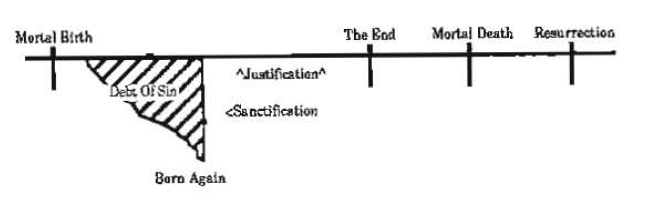
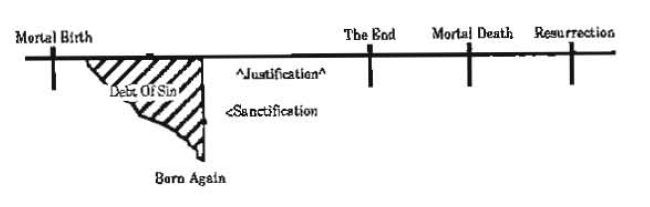
Thus by the waters of baptism we keep the commandment of the Father that all men should repent and be baptized after the manner in which our Savior was baptized, By the companionship of the Holy Spirit we are led to do just or righteous acts, even those acts the Savior would do were he in our position. Through doing those just acts. we learn to love purely as the Savior does taking upon ourselves the divine nature by adding grace to grace, virtue to faith, knowledge to virtue, temperance to knowledge, patience to temperance, godliness to patience, brotherly kindness to godliness, and charity to brotherly kindness which charity is the greatest of all, If we have truly become the sons of God, then our love of God, of Christ, and of our neighbor is full and pure: we have become as God is in that one most important respect which mortality offers: we have a pure heart. God can add upon that pure heart all other things which pertain to life and godliness. But until one obtains that pure heart by persevering in the narrow way, there can be no brightness of hope, no enduring to the end. A diagrammatic representation of the relationship of sanctification to justification is presented on Table I, with scriptural references to assist the reader in pursuing the matter, The chart is to be read as a time line from left to right. At birth every soul is innocent and on the narrow way. At age eight, sins accumulate a debt of sin. Hearing and accepting the Restored Gospel make sanctification by the Holy Spirit possible, which returns one to the straight and narrow way whereon justification, both of individual acts and of the person, may be pursued. Individual acts are just when they conform to the immediate instructions of God as received by personal revelation. The person becomes just as he or she becomes changed in character or nature so that he or she will not depart from the narrow way of righteousness no matter how great the opposition. Enduring to the end is completion of the process of justification of the person through successive performance of undeviating individual just acts.
Table 1
The Way of Holiness
The Human Problem for a Latter-day Saint:
To become a good (godly) person = have the personal character of the Savior = have the pure religion.
To satisfy the debt of sin incurred in the process of becoming a godly person.
1. A person is a human being: a body and a spirit.
An individual human person is one who has learned to act independently of other human beings and to act as a unit to do the things human beings do.
An individual human person has four parts which enable him or her to act as a unit to do the things which human beings do:
Heart: The ability to make choices among possible alternative actions. (Example: Shall I hit him back or not.)
Mind: The ability to understand self, the universe, and possible actions. (Example: He hit me because his brother hit him.)
Strength: Physical ability to act. Strength is time. (Example: I am too tired to hit him. Therefore, I have no strength, no time.)
Might: The things one can affect by acting. Might is space. (He is up in the tree above me. I cannot reach him. He is out of my space, therefore I have no might to hit him.)
A person becomes an individual by:
a. Gaining control of his heart, mind, strength, and might.
b. Unifying his heart, mind, strength and might.
2. Some actions of a person are unique. Others are habitual. The habits of a person are his character. An undeveloped character has weak habits; decisions are made by the pressures of the moment. A developed character has strong habits; decisions are made on the basis of principle. The basic parameters of character are as follows:
Heart:
Righteous (unselfish)
Unrighteous (selfish)
Mind:
Realistic (deals with reality)
Unrealistic (deals with fantasy)
Strength:
Gifted (many talents)
Limited (few talents)
Might:
Mighty (affects much)
Damned (affects little)
Effective person: Realistic, gifted, mighty Ineffective: Unrealistic or limited, damned.
Saint: a Righteous, effective person. Natural Man: An unrighteous person (effective or not).
The purpose of human mortality is to allow each person to become an individual, and in that process to achieve that character which he or she desires to achieve. Every person’s habits are his or her religion.
Habits = Character = Religion
3. Agency is power to act. A human being is an agent because he or she has power to act. The four essentials of that power to act are:
a. The ability to understand reality and possible actions: Mind
b. The ability to choose among possible actions: Heart
c. The physical ability to act to carry out the choices make: Strength
d. The ability to affect something with one’s strength: Might
Human agency is a gift of God. God controls our mind, our strength, our might, and only he can purify our hearts. As we allow God to purify our hearts, he can give us additional mind, strength, and might. As these increase, our agency increases. As our hearts become completely pure (righteous), God can increase our agency without limit until we have a fulness of all that he has. Receiving that fulness of mind, strength and might added to a pure heart is to be exalted.
The focal point of human agency is the heart. By the choices we make with our heart, we form our own habits=character=religion. Our agency is the power God has given each of us to form our own habits=character=religion.
4. Righteousness is doing what is best in the long run, in eternity, to achieve the greatest possible happiness for all others who will be affected by our personal choices. No human being, by human means, can know exactly who will be affected nor how by any given decision. Therefore, no human being can be righteous without help from outside himself, help from a being who is omniscient and righteous.
The most important use of agency any person can make is to become a righteous individual.
5. There is salvation from unrighteousness (the state of the natural man) only through God, the only being who is omniscient and righteous. God, our Father, has told us to hear his Son, Jesus Christ. He is the means, the way, the truth and the light to us. Only if we hear him can we be saved from unrighteousness.
A person can become a righteous individual only by hearing, accepting and loving Jesus Christ with all of his or her heart. To thus yield our hearts to God is the key to loving God with all of our heart, might, mind, and strength.
To become a righteous individual is to be saved. To be saved is to have the habits=character=religion to love God with all of our heart, might, mind and strength.
6. Whatever agency a person has received from God, he is responsible for that power and must account for it at the close of his probation. Those who know and enjoy the Restored Gospel of Jesus Christ have more agency than those who do not have it, and therefore are more responsible. During his or her probation, every human being is given enough agency to have power to be saved from unrighteousness. Those who use that power to become saved will rejoice; those who do not will weep and wail and gnash their (resurrected) teeth because they didn’t avail themselves of the opportunity. The net result of all this is that no human being can then blame what he or she is in heart, mind, and strength or what he or she has done with might on anyone else. We are free. We do what we desire to do. To blame anyone or anything else for the state of our being or our actions is untruthful and debilitating. Though we are not fully free now, we should act as if we were. Taking the full responsibility is the best way to facilitate repentance and to begin to become what the Restored Gospel makes it possible for us to become: exalted.
The first step in becoming a righteous individual is to take full responsibility for what one is and does. To blame anyone or anything other than ourselves for what we are or do is to dig a pit for ourselves. (See Deut. 6:5; Matt. 23:36–40; D&C 59:5; 2 Nephi 31:19; Moses 6:52)
7. Satan gained increased opportunity to tempt, afflict and torment mankind because Adam and Eve hearkened to him and rejected Father’s counsel. Satan is the destroyer, having power over disease and death, but carefully controlled by Father as to how he will use that power. Satan is the tempter, but his only power to tempt man is to encourage a man to follow after his own desires in disobedience to the commandments of Father. Thus, every man looks at the world and divides it into things desirable (good in his own eyes) and undesirable (evil in his own eyes). Satan simply encourages each person to seek and do that which is good in his (that person’s) own eyes. (James 1:13–15)
Woe unto that person who calls the Father’s good evil and evil good! (2 Nephi 15:20–21)
But happy is the person who hungers and thirsts after the Father’s good, which is righteousness. (3 Nephi 12:6)
8. Being spiritually dead, no man understands himself or his surroundings truly. Man judges upon appearances only, and thus makes many mistakes. Every person has the experience of choosing to do certain acts because he thinks they are good and will bring satisfaction, but discovers to his sorrow that he was mistaken. But men have enough success in gaining satisfaction that they tolerate a few mistakes rather philosophically, especially when what they seek is simply the pleasures of the flesh. (Isaiah 29:8)
9. The natural man is fallen man, selfish man, blinded man. He is without God and Christ in the world. He is able to live quite well as an animal, eating and drinking and procreating, but no individual is sure of success even in that. The more an individual yearns for something more than immediate physical satisfaction, the more he senses he needs help. If he wishes guaranteed physical pleasure, he seeks power. If he desires to know, he seeks to find a knower, usually another human being, or perhaps a book. But if it is the heart of man that yearns for righteousness, no satisfaction will be found in this world. (Ether 12:27–28)
10. The natural man is an enemy to God. “Enemy” means one who is not loved. Most natural men do not love God because they do not know him. Some do not want to know him and reject his message when it comes. But some men yearn for righteousness and welcome the message of the God of righteousness when they are privileged to receive it. (Mosiah 3:19)
11. To know good and evil and to be able to choose between them is to become an independent self. Every man is sufficiently instructed in good and evil that he can show his true desires. (2 Nephi 2:5) Only souls who have been given this agency and who then show that they love God enough to keep his commandments can be exalted. Thus the creation of the world focused on giving men this agency so essential to the time and place for making gods. (2 Nephi 2:16)
12. Though we know little about the creation of the earth, we are given great detail about the creation of the world. We are given a word by word, blow by blow account of that important process, that we might understand it. For our business on earth is to reverse the effects of that fall, to take ourselves out from under the evil influences of this world through the help of our Savior. (2 Nephi 2:24–25)
Lesson Two: God
1. The key to theology: Human beings are of the race of the gods, and may inherit all the gods have. Evidences:
a. Adam and Eve were literally begotten as children of the gods.
b. Mary, a human being, conceived and bore a child for her husband, Elohim.
c. Jesus, the Son of God (Elohim) and son of Mary, appeared to be a normal human being.
d. Some human beings were gods in the premortal existence.
e. The announced purpose of the Gospel of Jesus Christ is to invite every human being to become one with God, a god.
2. A god is a person having all power, to whom the angels are subject (D&C 132:20). Every god is a being who is righteous, omniscient, omnipotent, and coordinates with every other god.
a. Righteousness is doing what most contributes to the eternal welfare of every being one affects. Every god has a pure heart (devoid of selfishness) and is fully dedicated to the eternal cause of righteousness. No god takes any vacations or lapses from righteousness, but rather devotes his whole heart, mind, strength and might to that cause.
b. Omniscience is knowing all: everything small and large, near and distant, simple and complex, past, present, or future. An omniscient being cannot be surprised. Omniscience helps to make righteousness possible.
c. Omnipotence is having all the power that exist, so that anything which can be done may be done by an omnipotent being. That is not to say that an omnipotent being will need to do everything which can be done. A god uses omnipotence only to do the works of righteousness. And omnipotence helps to make righteousness possible.
d. To be coordinated with every other god is essential to being a god, for there is but one righteousness, one truth for the omniscient to know, one righteous use of omnipotence in any given situation. Were a god not to coordinate with all other gods there would be confusion as to who would and should do a given work of righteousness. But there is no confusion. As perfect (complete) omniscient beings, all gods are in full communication with each other at each instant, and act as one.
3. There is but one God. That one God is the sum total of all gods united in a priesthood structure. Every person in that priesthood structure has a specific place in the priesthood hierarchy and perfectly fills his or her role. Every person (god) has a father in the priesthood order. Every person (god) does only and exactly that which he or she is instructed to do by the person who stands to him or her in the relation of father. Thus, the whole group acts as one; they constitute a single unit. Thus, there is one true God but many true gods.
4. There are two kinds of true gods, though all have the four characteristics mentioned above. One kind is a personage of spirit, not having a tabernacle of flesh and bone. The other kind is the personage of spirit who has been through a mortal experience and has acquired a body of flesh and bone. The Savior as Jehovah before his mortal ministry was the first kind, and as that kind he created and governed the heavens and the earth and all things that in them are. As the Only Begotten of the Father, our Savior became the second kind of god, which he will be to the rest of eternity.
5. There are two kinds of false gods. Satan would feign claim to be the god of this world, and he indeed tries to become the same by intimidating human beings and conspiring with them. He is one kind of counterfeit God, and his counterfeit “good” is gain and power. The other kind of false god is the individual human beings invent to please themselves and to justify what they wish to do; the counterfeit good here is the selfish desires of the individual person. “For they have strayed from mine ordinance, and have broken mine everlasting covenant; They seek not the Lord to establish his righteousness, but every man walketh in his own way, and after the image of his own God, whose image is in the likeness of the world, and whose substance is that of an idol, which waxeth old and shall perish I Babylon, even Babylon the great, which shall fall.” (D&C 1:15–16)
6. God has said to man:
“… the fulness of the earth is yours, the beasts of the field and the fowls of the air, and that which climbeth upon the trees and walketh upon the earth;
Yea, and the herb, and the good things which come of the earth, whether for food or for raiment, or for houses, or for barns, or for orchards, or for gardens, or for vineyards;
Yea, all things which come of the earth, whether for food or for raiment, or for houses, or for barns, or for orchards, or for gardens, or for vineyards;
Yea, all things which come of the earth, in the season thereof, are made for the benefit and use of man, both to please the eye and to gladden the heart;
Yea, for food and for raiment, for taste and for smell, to strengthen the body and to enliven the soul.
And it pleaseth God that he hath given all these things unto man; for unto this end were they made to be used, with judgment, not to excess, neither by extortion.
And in nothing doth man offend God, or against none is his wrath kindled, save those who confess not his hand in all things, and obey not his commandments.
Behold this is according to the law and the prophets; wherefore, trouble me no more concerning this matter.
But learn that he who doeth the works of righteousness shall receive his reward, even peace in this world, and eternal life in the world to come.” (D&C 59:16–23)
7. We must know who and what our god and our God is. If the god we worship is a false god, there is no hope for our future. Our great opportunity and responsibility is to search until we find and associate ourselves with the true and living God. Then we can intelligently hope for every good thing. (Moroni: 7)
Lesson Three: Creation of the Earth
1. Compared with what there is to know about it, we know very little about the creation of the earth (either from the scriptures, because they say little about it, or from science, because all scientific accounts of the creation are guesswork).
2. When our story begins in Genesis 1, Moses 2, and Abraham 4, the earth was already in existence. At the time it was empty, desolate, without life. How long before had it been created? We do not know, but possibly it was very old even then.
3. How long did the creation last? We do not know for sure, but one good guess is that it took 7,000 years. (D&C 77:12)
4. Where was the earth reformed in this creation? Why is that important to us? Apparently not in this solar system, but somewhere near the throne of God. (Abraham 5:13)
5. Who reformed the earth for Adam and Eve? The council of the gods; or, in other words, God. (Abraham 4)
6. Why is it important to know that God created the heavens and the earth? So that we will know that it did not happen by chance or by some “natural” process. God was and is firmly in control of the process. To suppose that the universe operates on its own, without direction, is equivalent to a belief in magic. We have ample testimony to the contrary. To reject those testimonies is to reject God.
7. What is the order of the universe in which we live and wherein our earth has its place? The planets and stars of the universe are organized into orders, with each order being governed by a higher order. Each planet rotates at a certain set pace, the more rapid the rotation, the lower the order. At the center and governing all, never changing but pursuing one eternal round, is God. (Abraham 3)
8. What is a kingdom? A kingdom is a portion or space, and in every space there is a kingdom. All kingdoms are governed by law, and to every law there are certain bounds and conditions. The bounds and conditions are set by God, who is the king. (D&C 88:34–39)
9. How does God govern the universe? By light. The light which causes our eyes to see and the light of truth are the same light, from the same source. They are the light of Christ. This light created and governs the sun, the moon, the earth, and all living things. That light causes one to be intelligent. It fills all space with the influence of God. (D&C 88:6–13)
10. Some things are created to be acted upon. They are governed by the light of Christ. Other things are created to act. These latter may accept the law of Christ, which is His light, or they may be a law unto themselves. Those who insist on being a law unto themselves severely limit their capacity to grow.
Lesson Four: The Creation of the World
1. The earth is the physical planet upon which we dwell. A world is an extensive time and place for existence and action. A world was created by the fall of Adam, which world ended in the flood. We live in the second world, which will end in the fire at the Second Coming. The millennium will be the third world, and that world will end when the earth dies. See Joseph Smith History 1:55, which identifies the world with the wicked people who dwell on the earth.
2. Satan was Lucifer (light-bearer), who was an angel of great authority in the presence of God. He rebelled against God, seeking honor, glory and power independent of God. Because of that rebellion, he and his followers were cast away from the throne of God and were sent down to this earth. Their work here is to thwart the work of God by encouraging hate, anger, selfishness and disobedience to God on the part of mankind. (Moses 4:1–4)
3. Adam and Eve were born to the gods as children and sent to this earth. They had two bodies, one spiritual, the other of flesh and bone. The spiritual body consisted of three parts: heart, the sensor of truth and right and the decision maker; mind, the power of understanding and perception; and body, the power to move and act on spiritual material. The fleshly tabernacle also had a heart, which pumped spirit to the body; a brain, which coordinated the mind with the tabernacle of flesh; and the fleshy tabernacle, with which to interact with the coarse material of this earth.
When they were put into the Garden of Eden, Adam and Eve had celestial bodies. But their eyes were not yet open. They did not understand good and evil in general. They knew not to partake of the forbidden fruit, but had been given to choose for themselves. Thus God had given them a tiny bit of agency. (Moses 7:32)
4. Satan worked on that tiny bit of agency and convinced Eve that her own desire for knowledge was better than Father’s commandment. So she asserted her own will and defied Father. Then she convinced Adam that he must follow, which he did. Then the eyes of their understanding were opened in that each of them now could see that every opportunity to act could be seen as good (God’s will) or evil (anything else). With that new knowledge and using the power to choose for themselves which Father had given them, they became subject to their own wills, being able to and having to choose for themselves between good and evil in everything which they did. (Alma 12:31)
5. Adam and Eve had been told that if they partook of the forbidden fruit they would immediately die. When they partook, they did die, spiritually, and in that very day. This spiritual death was to be cut off from Father, no longer to be able to see him and converse with him directly. The opening of the eyes of their understanding was matched by the closing of the eyes of their spirit bodies. Their flesh became telestial, corrupt. This telestial flesh became a veil, the veil which stopped all of their spiritual senses. Their spirits were yet alive, but walled up in the corrupt tabernacle which now had blood in the veins instead of spirit matter. Thus they could no longer see and communicate with the spiritual existences around them at will as they had done. (D&C 29:36–41)
6. The blood which now coursed through the bodies of Adam and Eve gave them the opportunity to die.
7. The physical universe which we see with our natural eyes is created after the pattern of the spiritual universe. The spiritual universe is prior in time, and governs and controls the physical universe. (Moses 3:7; D&C 29:30–36)
8. To see the physical kingdoms of the universe, large and small, operating in their times and seasons and order is to see God moving in his majesty and power. (D&C 88:4)
9. One important fundamental of righteousness is to acknowledge the hand of God in all things, both spiritual and natural. (D&C 59:21)
10. Could the universe or this earth be improved upon? No, for they have been created (organized) by a perfect, omniscient and omnipotent being for the purpose of blessing His children.
Lesson Five: The Gospel
1. The Gospel of Jesus Christ is the good news of life and salvation sent to the natural man. It itself is a short message, consisting of perhaps ten ideas which can be said in about one breath. The gospel is compatible with all truth; indeed, it embraces all truth and light in the universe. Those ten ideas are as follows, given in an expanded version.
2. First, that Jesus Christ is the Son of God the Father, is himself a God, and is heir to all that the Father has. He was Jehovah, the god of the Old Testament, whose name means “will be.” The god who would be was born of Mary in the land of Jerusalem of the seed of Abraham, but is literally the only Begotten Son of God the Father in the flesh. He came into the world to do the Father’s will, which he did, leading first a sinless life and then giving up his perfect and potentially unending mortal life that he might ransom the souls and bodies of all mankind.
3. Secondly, it was the Father’s will that he be lifted up upon the cross. This is symbolic of his working out of the atonement for the sins of all mankind. Having lived a sinless life, he had no sin to his charge, and having a divine heritage, he never would have had to die. But it was the Father’s will that he personally and voluntarily takes upon himself to suffer the debt of justice due for each and every sin that had been or ever would be committed by any human being on this earth. The debt of justice is a suffering equal in pain to whatever pain had been inflicted on everyone affected by the original sinning of the sin being compensated for. This also includes righting the wrong and restoring to those hurt the opportunities and blessings they had been deprived of by the original sinning of that sin in question. The Savior could suffer for our sins because he had none of his own to pay for. He can right the wrongs because he is the Eternal God of Heaven and Earth, and has all power over all things to accomplish all things for the salvation of mankind. A third aspect of the atonement is that the Savior seized the keys of death and hell from Satan, which Satan had gained at the occasion of the Fall of Adam, thus making possible both the opening of the gates of hell, the prison doors, to make possible the preaching of the Gospel of Jesus Christ to the souls in prison, and the resurrection from the grave of every soul who had once received a mortal body on earth.
4. Thirdly, it is the Father’s will that after our Savior had paid the debt and made salvation possible for every human being, that every human being be required to stand before the Savior to account for the opportunity each will have had to repent of his sins an to be forgiven through the atoning blood of Christ. Our Savior is the keeper of the gate to the heavens, and he employs no servant there. What the Savior will want each person to witness is whether that person’s actions have been good, that is to say Godly, or evil, that is to say, in defiance of God. Apparently no one will have to say much, because what everyone did, thought and desired in their probation will be publicly manifest for all to see. Each person judged will agree with his own judgment and proclaim the wisdom, mercy and greatness of God.
5. There is a five-fold way for each human being to prepare for the great day of judgment. This five-fold way is the pattern for one’s entire life and also for each specific decision.
The first of the five-fold ways is to put one’s trust, one’s faith in Jesus Christ. When a person hears the Gospel taught by authorized servants and confirmed by the power of the Holy Spirit, one knows that one should rely wholly and solely on the merits of the Savior for all of his needs for light and truth. To receive revelation from God is to be invited to enter into the straight and narrow way. To put one’s whole trust in that revelation is to exercise faith in the Lord Jesus Christ, which is the only faith that saves.
6. The second part of the five-fold path is to repent. Under the direction of the Holy Spirit, that is to say through faith in Jesus Christ, each of us must undertake to go through our heart, mind, strength and might and order all of it according to the truth and light which the Savior sends to us. This is a lifetime project, but it is incumbent upon those who have received some portion of direction to live up to that direction before doing anything else. That is godly repentance.
7. The third part of the five-fold path is to enter into covenant with the Father, the Son, and the Holy Ghost, to become completely faithful in all things. Specifically, we promise to take upon ourselves the name of Jesus Christ, to proclaim that name and never to be ashamed of it before any man; to keep all of the commandments which he gives to us personally; and to remember him always. These promises lead to all of the higher ordinances of the Gospel of Jesus Christ and have perfection of the person as their goal.
8. The fourth part of the five-fold path is to actually receive the Holy Ghost. No one can get to this point without having received something from the Holy Ghost already. Knowing what that spirit is and what it does for us, we must now take that spirit as our constant companion, knowing that as we are faithful, it will show us all things that we should do. This is our life-line, the rod of iron that enables us to stay in the narrow way of righteousness through the mists of darkness.
9. The fifth part of the five-fold way is to endure to the end. The end is life eternal, to become as Christ himself is in heart, might, mind and strength. This is truly a counsel of perfection, reaching for the stars with a grasp wherein the grace of God fully complements all we can do to suffice unto attaining to the end.
10. The power and pertinence of that five-fold message are matched by a solemn warning that enduring to the end is important. For if one does not endure to the end, one will be hewn down and cast into the fire with no further opportunity to repent, to change, to inherit eternal life.
11. Finally, there is the promise to match the warning: He who will repent, be sanctified by the Holy Ghost and will endure to the end through this five-fold process will enter into the kingdom of God and will be fully acceptable to the Father. That is the Gospel of Jesus Christ.
12. The message of the Father to all mankind is that we should hear his Beloved Son, in whom he is well pleased. The Son gives us his Gospel, the good news as to how we can overcome the Fall of Adam and be restored to the presence of the Father as beloved sons and daughters. That Gospel is not the only way to love God, but it is the only way to love God fully and to become as God is.
13. When God’s children live the Gospel of Jesus Christ in any numbers, they are given the privilege of instituting a celestial society on the earth. That society is called, “Zion.”
Lesson Six: The Savior
1. Our Savior has over four hundred name-titles (counting all the variations). Each of these is significant of some special aspect of his mission. Some of the principal name-titles he bears are the following:
· Christ: Anointed One, the one whom Father has commissioned.
· Messiah: The Hebrew version of the title, “Christ”.
· Redeemer: The one who saves men from the Fall.
· Savior: The one who saves men from their sins.
· Jehovah: The god of the Old Testament who became Jesus.
· Jesus: The Anglicized form of the Greek representation of the Hebrew “Joshua”, which was the Savior’s given name in mortality.
· Master: The leader to whom we look.
· Lord: The ruler or president over the faithful.
· Rabbi: The Hebrew for “teacher.”
· Only Begotten: The only human on earth ever directly begotten by God the Father.
· Son of Man: Son of Man of Holiness, God the Father being Man of Holiness.
· Alpha and Omega: The one who begins all things and also ends them.
· Great I Am: The fully existing one.
· Mighty One of Israel: Abraham’s God, who is almighty and specially remembers the children of Abraham.
· Good Shepherd: He who leads us into life eternal.
· Fountain of Righteousness: The only source of righteousness for the inhabitants of this earth.
· The Way: He is the perfect example of the only way back to the Father.
· The Truth: He is the source of all truth for mankind.
· The Life: He is the giver of all forms of life.
· The Light of the World: His light brings hope for righteousness and peace to all mankind.
· The Door: No one can get into heaven except through Him.
2. The merits of Him who is mighty to save:
· He is the authorized representative of our Father in Heaven.
· He knows all things.
· He can do anything which can be done.
· He is perfect; no selfishness of any kind.
· He is love: His love blesses every human being.
· He is long-suffering: He lets us work out our salvation.
· He is mindful: He maintains a constant vigilance over all his creations, and no thought, feeling, desire, action or problem of any of His creations escapes his attention.
· He is in control: Nothing in heaven or earth happens except by his instruction, permission or allowance.
· He saves: He can perfect and exalt any human being who desires to be saved.
3. As Christ (Messiah, the Anointed One), our Savior has a specific mission to perform in behalf of the Father. We will break it into parts for understanding, with the understanding that in reality this mission is all one piece, each part being a necessary part of the single whole.
a. Firstborn of the Father: His role was to accept the Father’s will as the plan for salvation of all mankind.
b. Jehovah: His role was to create the heavens and the earth (and many other earths and heavens like this one) and all things that in them are. This creation includes the Fall, and is ongoing, even now.
c. Lord God: His role after the Fall was to be the light of the world, thus to control how much knowledge, truth and wisdom every man has or can get. Thus, the Savior is in control of the life, breath, accomplishments and failures of every being. (Of course every being has agency; the Savior’s control is what enables that agency to be a reality.)
d. Son of God: Being born of Mary, from her gaining a body of flesh and bone and blood, and being sired by our Father in Heaven, he gained power to be perfect and to live forever. He lived a perfect life, explicitly obeying His Father in all things he said and did.
e. Savior: He atoned for the sins of all mankind, suffering the wrath of Almighty God for them, that they might not need to. And he voluntarily gave up his opportunity to be a mortal forever in order to seize the keys of death that all men might be resurrected from the grave.
f. Judge: All men go immediately to his presence when they die and are assigned to prison or paradise, as is expedient. But only those who go to paradise see him and know that they have gone back to his presence when they die.
g. Advocate: When all preparations are complete, each person is resurrected and stands before the Father, the Son and the Holy Ghost to receive a final (eternal) judgment. The Savior there pleads the case of every soul who was willing to hear His voice and repent through the Holy Spirit.
h. Father: The Savior is father in the patriarchal lineage to all of the righteous for the remainder of eternity. With them he shares all that His Father has given Him, and they become equal with Him to all eternity. Those who were not completely righteous become the servants to him and his righteous children, and they willingly, gladly serve the Savior and his righteous children to all eternity (exception: the sons of Perdition).
4. The Atonement:
God’s law is righteousness. He only commands or instructs or entices men to do that which is righteous. The spokesman for that law is Christ. To obey that law with one’s body is the beginning of faith. To obey fully is to love God (obey Him) with all of one’s heart, might, mind and strength. Whatsoever any person does that is not of faith is sin.
Sin, being transgression of God’s law, knowingly or unknowingly, always inflicts evil on those whom it affects (opposite to the blessings which faith begets). The Father is acutely mindful of the blessings and evils which men visit upon one another, and he cannot look upon sin with the least degree of allowance. Every sin must be compensated for by 1) a suffering equal to the suffering caused by the sin, and 2) a restoration to the person(s) sinned against by the blessing(s) they would have had, had the perpetrator not sinned.
Our Savior did not sin once during mortality. Because of this He could take upon Himself the suffering due for the sins of every other human being. This he did, suffering he wrath of his Father or all the sins of mankind, past, present and future, in that last twenty-four-hour period of his life. Only a God could suffer that much. But the Savior persevered, difficult though it was, and finished his preparations to the children of men. This specific act of suffering was the atonement. The Hebrew form of this concept means, “to cover.” The Greek form means, “drastic change.” The English form means, “to reconcile.”
Lesson Seven: Faith in Jesus Christ
1. A principle is a general rule, a universal. In the Gospel of Jesus Christ there is but one rule or law. All other principles are but explications, portions or facets of the one general rule. (D&C 132:4–13)
2. The name of the one law is: Faith in the Lord Jesus Christ. Other wordings to describe the law are:
a. Thou shalt love the Lord thy God with all thy heart, with all thy might, mind and strength; and in the name of Jesus Christ shalt thou serve him. (D&C 59:5)
b. One must love, hear and obey Jesus Christ, making every sacrifice necessary to do so. (D&C 97:8)
3. There is no shortage of faith in the world, for every person lives by faith. Each must do so because we know nothing about the future (we only guess). Every person puts his faith and trust for the future in something or somebody.
4. Characteristics of faith in Christ:
a. Type: Relationship to Christ.
b. Similar: Trust, obedience, love for, belief in.
c. Contrary: Unbelief, distrust, disobedience, disdain for, ignoring.
d. Prerequisite: Personal revelation from Jesus Christ.
e. Constituents: Love for, trust in, obedience by sacrifice.
f. Perfection: To live by every word that proceeds forth from His mouth, with a firm mind in every form of godliness.
g. Counterfeit: To confess with the mouth, but not to believe or obey.
h. Complement: Fear.
i. Opposite: actively work against Christ by the power of Satan.
j. Celestial faith: To love and obey God will all of my heart, might, mind and strength.
k. Terrestrial faith: To believe and obey God when he speaks to me.
l. Telestial faith: To obey God when I am threatened.
m. Perdition: To pretend to obey God, but secretly to work against him.
5. Key scriptures on faith:
a. Hab. 2:4 The just shall live by faith
b. Matt. 9:22 Thy faith hath made thee whole
c. Matt. 9:29 According to thy faith, be it unto you
d. Matt. 21:21 If ye have faith, and doubt not
e. Luke 22:32 I have prayed for thee, that thy faith fail not
f. Rom. 10:17 Faith cometh by the hearing of the word
g. Rom. 14:23 Whatsoever is not of faith is of sin
h. 2 Cor. 5:7 For we walk by faith, not sight
i. Gal. 2:6 Be justified by the faith of Christ
j. Gal. 3:12 The law is not of faith
k. Eph. 2:8 By grace are ye saved through faith; it is the gift of God
l. Eph. 4:13 We all come in a unity of the faith
m. Eph. 6:16 Above all, taking the shield of faith
n. Heb. 11:1 Faith is the substance of things hoped for
o. Heb. 11:6 Without faith it is impossible to please God
p. Heb. 12:2 The author and finisher of our faith
q. Jas. 1:6 Let him ask in faith, nothing wavering
r. Jas. 2:14 Even so, faith, if it hath not works, is dead
s. 1 Pet. 1:7 Through the trial of your faith
t. 2 Pet. 1:7 Add to your faith, virtue
u. 2 Nephi 31:19 Christ with unshaken faith in him
v. Mosiah 8:18 That man through faith might work might miracles
w. Hel. 3:35 Wax firmer in the faith of Christ
x. Eth. 3:19 He had faith no longer
y. Moro. 7:39 Of strong faith and a firm mind
z. D&C 8:10 Without faith you can do nothing
aa. D&C 63:9 Faith cometh not by signs
bb. D&C 104:55 All the properties are mine or else your faith is vain
6. Key Questions:
a. How is faith related to knowledge? One must have a personal knowledge of God’s command, then do it, not knowing that God will bless us, but believing that he will.
b. Who needs faith in Christ? All who have sinned and are accountable.
c. Will faith ever be done away? Some faith is replaced by knowledge. But faith is the principle by which the gods interrelate. It is an eternal principle.
d. What can faith accomplish? Faith is the power to lay hold of every good thing, including enduring to the end.
e. What is it to be faithful? It is to endure to the end, until I have the heart, might, mind and strength of Christ.
Lesson Eight: Obedience and Sacrifice
1. Obedience and sacrifice are part of faith in Jesus Christ. When one who has not had faith desires to begin to do so, the beginning of faith is to obey the commandments of God. That obedience must be sincere. It must not be just a business deal with God: I’ll do this for you if you will do that for me. The obedience must be that of a humble child before his father, who, having sinned, now earnestly seeks to walk in the way of his father. The measure of the sincerity of that obedience is the sacrifices one is willing to make to obey the Father.
2. Obedience is of the strength, the body. Sacrifice is of the strength and of the might. Before we can obey, we must learn the Father’s will; this is the involvement of our mind. We understand the instruction of God with our mind, obey with our bodies, and give up whatever of our might (money, time, property, influence) that is necessary to fulfill obedience. This is part of faith, a substantial beginning to faith. It lacks only the pure love of Christ to make it a complete faith. But most of us can learn and gain that pure love that completes faith only through obedience and sacrifice.
3. The word obey derives from the Latin obedire, which comes from ob + audire, to give ear. The Greek is hupakouo, to hear under. The Hebrew is shama, to hearken, to hear.
a. Celestial obedience is to hear and recognize the voice of God and do exactly as he instructs, and to do it immediately.
b. Terrestrial obedience is to obey God only after we fully understand why we are being told to do something.
c. Telestial obedience is to obey God only when we feel like doing so.
d. Perdition obedience is to obey God only when forced to do so.
e. Constituents: Understand the revelation from God, and act accordingly.
f. Counterfeit: To obey God’s instruction only when and as Satan prompts us to do so. This is not obedience to God.
g. Opposite: Obedience to Satan.
h. Complement: To do only as we desire to do.
i. Similar: Faith in Jesus Christ, to hearken, to serve.
j. Contrary: Refuse to hear; to disdain, disobey and ignore.
k. Positive example: Adam offering sacrifice after being cast out.
l. Negative example: Jonah trying to run away from his mission call.
4. The difference understanding obedience should make:
a. Heart: I should desire to obey God in all things, no matter the cost.
b. Mind: I must strive to identify the voice of God unerringly and to understand all that he would have me do.
c. Strength: I must discipline my body to do God’s will in all things.
d. Might: I must never count the cost; I will serve and obey no matter what the cost, knowing that eventually the cost is all that I have.
5. Key scriptures on obedience:
a. Rom. 5:19 So by the obedience of one
b. Rom. 16:26 To all nations for the obedience of faith
c. Heb. 5:8 Yet learned he obedience by the things which he suffered
d. Isa. 1:19 If ye be willing and obedient, ye shall eat
e. Deut. 27:10 Obey the voice of the Lord, thy God
f. 1 Sam. 15:2 To obey is better than sacrifice, and to hearken than
g. Acts 5:29 Ought to obey God rather than men
h. Rom. 6:16 His servants ye are to whom you obey
i. Heb. 5:9 Salvation unto all them that obey
j. 1 Pet. 1:22 Purified your souls in obeying the truth
k. D&C 105:6 Chastened until they learn obedience
l. D&C 130:19 Through his diligence and obedience
m. Moses 5:8 Be obedient unto the ends of your lives
n. Moses 5:11 God giveth unto all the obedient
o. 1 Neph. 4:18 I did obey the voice of the Spirit
p. Jac. 4:6 And the very trees obey us
q. D&C 42:2 Hearken and hear and obey
6. The word sacrifice comes from the Latin sacra, holy and ficeo, to make or to do: to make holy.
7. To sacrifice is to put oneself into the path of holiness by obeying the voice of God and by giving up all that he requires us to give up to perfect that obedience. There is no sacrifice without obedience.
a. Celestial sacrifice: To obey the Lord unto giving up all he requires.
b. Terrestrial sacrifice: To sacrifice unto the Lord when it seems right (to our own mind) to do so.
c. Telestial sacrifice: To sacrifice when we feel moved (by our own desires) to sacrifice unto the Lord.
d. Perdition sacrifice: To sacrifice only as Satan instructs us to do.
e. Genus of sacrifice: Quality of obedience.
f. Similar: Diligence, promptness, carefulness.
g. Contrary: Loose, undependable, careless, shallow.
h. Perfection: To lay down one’s life.
i. Opposite: To cling to all we have and are.
j. Counterfeit: To sacrifice only as Satan commands.
k. Prerequisite: Obedience.
l. Constituents: Something owned that is precious to us. Giving up that something precious to be abused.
m. Positive example: The Savior gave up his infinite mortality.
n. Negative example: The rich young man would not give away his wealth.
8. Difference understanding sacrifice should make:
a. Heart: I must hold nothing more dear than obedience to God.
b. Mind: I must learn what sacrifices he would have me make.
c. Strength: I must perform the sacrifices he instructs.
d. Might: I must suffer any loss necessary, possibly all I have.
9. Key Question: What is the most important sacrifice which all persons must make: To have a broken heart (to give up all pride or supposition that I somehow am “worthy” of being saved), and to have a contrite spirit (to be willing to suffer with Christ, to give up everything of this world, if necessary, as he did).
10. Key scriptures:
a. Exo. 5:8 Let us go and sacrifice to our God
b. Exo. 12:27 It is the sacrifice of the Lord’s Passover
c. The physical universe which we see with our natural eyes is created after the pattern of the spiritual universe. The spiritual universe is prior in time, and governs and controls the physical universe. (Moses 3:7; D&C 29:30–36)
d. Prov. 15:8 Sacrifice of the wicked is an abomination
e. Daniel 12:11 The daily sacrifice shall be taken away
f. Hos. 6:6 For I desire mercy, and not sacrifice
g. Plus: Mal. 1:8; Rom. 12:1; Heb. 11:4; 2 Neph. 2:7; Alma 26:32, 34:10; D&C 59:8, 64:23, 97:8
Lesson Nine: Gospel Principles (Continued)
1. Hope is the righteous expectation of receiving the blessings which the Father has to give to us.
2. “Hope” comes from the Anglo-Saxon hopa; Ger. hoffa.
3. Hope is an attitude of heart and mind; the mind understands a possibility which the heart then desires. If the person works intelligently to achieve that possibility, then hope is justified.
4. Gospel hope is to understand the way of holiness, to desire it and the place to which it leads, and to enter into it. Only then, through one’s faithful obedience to God, can one have a hope in Christ.
a. Celestial hope is righteous expectation of eternal life.
b. Terrestrial hope is the expectation of a just reward.
c. Telestial hope is wishing that things would be better.
d. Perdition hope is the desire both to sin and to receive the blessings of God.
e. Opposite: Doubt.
f. Complement: Wonder.
g. Counterfeit: Wish.
h. Positive example: Lehi had a hope in Christ.
i. Negative example: Laman had no hope in Christ.
5. Difference this concept should make in my life:
a. Heart: I trust completely in the Lord’s love and providence because I love Him.
b. Mind: I believe that the future is assured because I understand and accept the ways of God.
c. Strength: I serve God with all of my strength because I have hope.
d. Might: I perfect my stewardship to become a celestial kingdom stewardship because I have hope: I trust that God will be with me and sustain me.
6. Key Scriptures:
a. Joel 3:16 The Lord will be the hope of His people
b. Heb. 6:19 Which hope we have as an anchor of the soul
c. 2 Neph. 31:20 A perfect brightness of hope
d. Alma 32:21 If ye have faith, ye hope for things
e. Ether 12:4 With surety hope for a better world
7. Charity is the pure love of Christ, caring for Him and for His righteousness above all else unto the perfect fulfilling of all of his instructions.
8. How does one obtain this pure love? This love does not occur naturally. It is a gift of God to all who seek it through mighty prayer, repentance from all sinning and striving to be faith full.
9. “Charity” comes from the Latin caritas, which derives from carus, dear.
a. Celestial love is charity, God’s pure love reflected back to him and to our neighbors (which includes our enemies).
b. Terrestrial love is loyal love for family and friends.
c. Telestial love is whimsical affection.
d. Perdition love is love for self and self alone.
e. The genus of charity is relationships with others. Similar are to like, esteem, venerate, honor, eulogize.
f. Contrary are to despise, ignore, vilify, deprecate.
g. Opposite: Hatred for Christ and neighbor.
h. Complement: Selfishness.
i. Prerequisites: Receiving the pure love from Christ, plus faith on our part.
j. Constituents: Love grows through faith in Christ until it is perfected in charity.
k. Counterfeit: Fawning.
l. Positive example: Nephi loved so purely that he could perform miracles.
m. Negative example: Laman and Lemuel could not love their father, their brothers, nor their God, though they were served, blessed, protected and preserved by them.
10. Key Scriptures:
a. 1 Cor 13 (Whole chapter)
b. Moroni 7:44 If he have not charity he is nothing
c. John 13:34 A new commandment I give unto you, that ye love
d. John 14:15 If ye love me, keep my commandments
e. D&C 121:41 By meekness and love unfeigned
11. Repentance is to turn from whatever we have been doing to the way of Christ, to love and serve Him with all of our heart, might, mind, and strength.
12. “Repent” derives from the Fr. repentir, from the L. poenitentia, to regret. The Greek is metanoia, to change one’s mind. The Hebrew has two forms, one meaning to sigh, the other to return.
a. Celestial repentance is to replace every sin with faith in Jesus Christ.
b. Terrestrial repentance is to have remorse, resolve, replacement and restitution.
c. Telestial repentance is to say, “I’m sorry.”
d. Perdition repentance is to repent celestially, then to repent of that repentance (to turn back to sinning deliberately.)
e. Prerequisites: Desire to change, knowing how and to what to change.
f. Opposite: To turn to evil.
g. Complement: Hard-heartedness.
h. Counterfeit: To say one has repented, but to continue sinning in secret. (Confess but not forsake.)
i. Positive example: Cornelius fully accepted the way of Christ.
j. Negative example: Ananias and Sapphira said they were faithful, but were not.
13. When is it too late to repent? When one has denied the Holy Ghost; when one has shed innocent blood; after mortal death (LDS persons who understand the Gospel cannot repent to celestial salvation except in this life); when one has so little life left that he cannot establish new habits of righteousness (there can be no deathbed repentance).
14. When is repentance complete? Only when one has become as the Savior in heart, might, mind and strength.
15. What restitution is required for the law of Moses? One for one. For the law of Christ (the Gospel): four for one. (See D&C 98)
16. Key Scriptures:
a. Alma 5:49 They must all repent and be born again.
b. D&C 19:4 Every man must repent or suffer.
c. + 2 Cor. 7:10; Heb. 6:4–6; 1 Ne. 14:5; Jac. 3:3.
Lesson Ten: Gospel Principles (Concluded)
1. Justice is required of men by God, for God is just, and for men to be godly they must be just. The word “justice” comes from the Latin justus, just, which derives from jus, right or law.
2. To be just or to achieve justice is to do what is right according to the law. To do what is right according to human law is an approximation of real justice, for neither the laws themselves nor the interpretations and procedures by which men pursue justice are perfect. True Justice is thus to obey God’s law according to his instructions. It is to be upright, square, to measure up to what God requires. The opposite of justice is to default on one’s obligations.
3. God requires that a man make only appropriate promises, then keep those promises exactly. This includes the careful discharge of stewardships, the honoring of others, the full payment of debts. Terrestrial justice is to restore one for one for a wrong done, a tooth for a tooth. Celestial justice requires that a wrongdoer restore four times the hurt caused.
4. In the New and Everlasting Covenant, every person promises to obey every instruction which God gives them. Thus to be just, a person must live by every word which proceeds forth out of the mouth of God. Perhaps the most important thing a person can do is just to have an eye single to the glory of God.
5. God commands all men to be merciful. The word mercy comes from the Latin mercedem, which means reward or fee. Also derived from that root are the words merchant and mercenary, both involving the payment of money.
6. To be merciful is to pay the debts of others, either those owed directly to ourselves or those owed to others. God commands every man to pay his own debts if he can, thus to be just, but also commands us to be merciful towards others, even as He is. Thus to refuse to be merciful when God so instructs is to decline to be just.
7. No man can pay the debt for his own sins, for that takes a being of infinite power to correct the wrongs that we have done which have infinite consequences. Thus we all depend on God for mercy. But God requires of us that we forgive all men their trespasses against us before he will forgive us.
8. The justice of God requires that every man recognize the source of all of the good things which he has, which source is God himself. The formal manner of making that recognition is to consecrate all that one has to God.
9. The word consecrate comes from the Latin consecrare, to devote as sacred. To consecrate is to dedicate someone to the service of God, or to dedicate and use something in the service of God. It is required of every just servant of God that he consecrate everything he has to the service of God. That means that he will use his strength, his mind, his talents, his property only to serve the God of Heaven. In this serving of the God of Heaven, he will pay his debts to the world, but will never willingly use anything which he controls for an evil purpose.
10. One who has consecrated all to the Lord must use all that he has to promote good in the world according to God’s instruction, and to report back to God exactly what he has done in fulfilling those instructions. Thus to use one’s goods and to report back in a cycle which begins on earth and extends into eternity is to fulfill the principle of stewardship.
11. The word stewardship comes from old English stig, of uncertain meaning, and ward, keeper. The word was used to designated one who controls the domestic affairs of a household or a special officer of a royal household.
12. To be a steward is to acknowledge God as the owner of all that we are and have, including our own bodies, and to strive to please Him in all that we do with His property. The only way to please Him is to act in faith in Jesus Christ, which is to obey his law, which is to be just.
13. To Keep the commandments of God is not a power which men have naturally. Thus the natural man, he who is without God and Christ in the world, can only sin continually. But God sends His love into the world to save every man out of the world who desires to be saved. This salvation comes by teaching the Gospel of Jesus Christ and administering the ordinances to all who sincerely obey it. The power which enables men to keep the commandments of God is the constant companionship of the Holy Ghost, which no natural man can have. But to all those who are willing to come to Christ as little children, repenting of their sins and sincerely desiring to keep every commandment which God gives them, God gives the unspeakable gift of the Holy Ghost. But this holy person cannot dwell in an unclean vessel. So any person who needs the Gospel because they have sinned and is unclean must also be cleansed by the blood of Christ, through the atonement, before that constant companionship can come. That cleansing does come after one has made the covenant of baptism and at the moment one receives the Holy Ghost according to the command given in the ordinance of confirmation into the church, when it is said to us, “Receive the Holy Ghost”. That necessary cleansing is called in the scriptures sanctification.
14. The word sanctification comes from the Latin sacra, sacred or holy, and from ficare, to do or to make. Thus sanctification means to make holy. In the gospel of Jesus Christ, sanctification means to make holy. In the gospel of Jesus Christ, sanctification is the making of something whole or holy by the power of God for the sake of a subsequent special service to God. That service is the living of a faithful, just, merciful, consecrated life of stewardship under Christ. That sanctification is achieved by God forgiving all the past sins of the repentant person who has forgiven others their trespasses.
15. The desired result of mortality in the Gospel of Jesus Chris is to attain to the habits, the character, the religion of Jesus Christ, to take upon ourselves the divine nature, which is to rise to the measure of the fulness of the stature of Christ. This change can be made only by those who are sanctified. The change itself is called justification.
16. The word justification comes from the Latin and means to make just. Gospel justification is not only making the deeds of a man just, but making him just, one who will do no sin. He abides every law (commandment) of God, and thus is lawful, Just. The counterfeit of gospel justification is being excused for breaking the law while remaining unable to keep the law. This counterfeit may be asserted by the self, and is then known as self-justification. Or it may be asserted by an earthly judge as a way of suspending a punishment. But real gospel justification is rising in strength and the gifts of God unto keeping every law, thus becoming a truly just person.
Lesson Eleven: The Saving Ordinances
1. The saving ordinances are those necessary to exaltation. They are also called the New and Everlasting Covenant. The specific ordinances of that covenant are baptism, laying on of hands for the bestowing of the Gift of the Holy Ghost, ordination to the Melchizedek Priesthood, the temple endowment, and temple sealing.
2. Baptism is the beginning of the covenant with God. To be eligible for this ordinance one must be accountable, have heard, understood and accepted the Restored Gospel of Jesus Christ, must have exercised faith in Jesus Christ unto repentance from all sinning (of which the person is aware), and repentance unto the requesting of baptism. This worthiness is to be ascertained and attested by the person who controls the records, for a baptism is official only when recorded by the person who has the authority to do so.
3. Baptism is administered by one having authority from the record keeper, who has authority from God. The candidate enters the water with the person performing the ordinance and is completely immersed in and then brought forth from the water. This process serves as a symbol of the death and resurrection of the Savior. It also represents the death of the old, unrepentant person, the candidate was who then arises out of the water into a new life, a new creature being remade in the image of Christ. Two competent witnesses must attest the correctness of the administration of this ordinance.
4. The purpose of this ordinance is for the candidate to make a covenant with God through this immersion in which he or she promises (1) to take upon themselves the name of Jesus Christ (willing to be known by all men as His servant), (2) to keep all the instructions he or she receives from the Savior, and (3) to remember the Savior (and this covenant) always. This covenant is not of force unless the candidate truly makes those promises. The ordinance cannot be recognized unless it is immediately followed by the next ordinance, the laying on of hands, for only then can the promises be kept.
5. The laying on of hands for the Gift of the Holy Ghost is performed by someone who is authorized to do so by he who controls the records. The administrator must hold the Melchizedek priesthood. The essence of the ordinance is to pronounce that the person is a member of the Church of Jesus Christ of Latter-day Saints and to command him or her to receive the Holy Ghost. The purpose of this ordinance is to bestow the opportunity for the constant companionship of the Holy Ghost on the person. Through that companionship he or she will have access to the knowledge and power necessary to know and keep the general and personal commandments of Jesus Christ to him or her.
6. Those who enjoy and treasure the companionship of the Holy Spirit will be obedient, and as they are obedient, they are told more and more of what to do. The ultimate and ideal condition is to walk, talk, think and feel under the constant influence of this divine being. That is the basic preparation for being able to abide the presence of the Son and the Father, which is eternal life.
7. Ordination to the Melchizedek Priesthood is administered to one who has been faithful in keeping the covenant of baptism and faithful in yielding to the influence of the Holy Spirit (those two are one and the same thing, said in different ways.) The recipient promises to use the power of God righteously: to do whatever God instructs the bearer to do, and to do it as he is instructed to do it. This is the covenant of the priesthood. The oath of the priesthood is God’s promise to share all that he has with those who prove faithful to their priesthood covenants during their probation.
8. Every bearer has potentially the full power of the Melchizedek Priesthood as an elder. But that power is manifest only as authorized. Specific authorization may come with ordination to an office other than elder, such as seventy, high priest, or patriarch. A priesthood bearer is fully authorized only when (1) he is acting in the authority to which he has been ordained, (2) to which he has specifically been set apart, and (3) for which he is acting under specific instructions from the Holy Spirit (D&C 68:2–4). A Melchizedek Priesthood bearer who is thus fully authorized speaks the mind and will of the Lord and has the power of God unto salvation. Ordinations to this priesthood are eternal in nature.
9. The purpose of the temple endowment is to give further priesthood knowledge, power and authority to the recipient. It is a special gift from God to complement the Gift of the Holy Ghost. It gives the worthy recipient knowledge and power to overcome the world while in the flesh and to pass to the celestial kingdom in the next world. Much of the endowment is highly symbolic. It may be understood only by one who enjoys the companionship of the Holy Spirit born out of faithful obedience to Jesus Christ through that same Holy Spirit. There are specific covenants and promises which a person must make to complete the receiving of the endowment. The promises are sacred, and must not be spoken of outside the temple, but are all embraced in the idea that we should love the Lord, our God, with all of our heart, might, mind and strength, and serve Him in the name of Jesus Christ (D&C 59:5). Anyone who is willing to do that will have no surprises nor discomfiture with any of the covenants or promises made in the temple. The temple is not a place one goes as a test of his faith, but as a reward for his past faith and an empowering of greater faithfulness in the future.
10. The temple sealing is marriage in the New and Everlasting Covenant and the binding of children to their sealed parents. The ordinance is permissive, not compulsory. It permits the formation of an eternal union which God will honor if the participants forge and prove an eternal bond of love in righteousness. But no one is required to maintain any association or binding which is against his or her will or desires. This temple sealing is the official ordination and setting apart of a couple to be authorized mother and father before God. No one else can or does have that authority (ability and authority must not be confused). All other forms of marriage that human beings have participated in must be repented of and replaced by this sealing to have any force or existence beyond the grave. (D&C 132).
11. These saving ordinances are earthly ordinances and can only be performed on earth in the flesh. Thus this mortality is the unique access to the celestial blessings in eternity. Faithfulness in mortality on the part of the human family is the only possible means of becoming as the Father is and sharing all He has. Faithful children may perform these ordinances on earth and in the flesh for their departed ancestors, but if no one were faithful on earth while in the flesh, there could not be any blessing in eternity for anyone, including the righteous (Malachi 4:5–6).
12. The details of the New and Everlasting Covenant are the most important piece of information in this world. But that information is useless without the power and authority to administer the ordinances.
Lesson Twelve: Other Ordinances
1. The Blessing of Little Children
Purpose: To assist and protect children until they come to the age of accountability.
Procedure: The child is given a name which is to be used on the records of the church and such blessing as the person who is mouth is inspired to give.
Priesthood: The Melchizedek Priesthood is necessary.
Note: Many children are prayed for, not blessed, in the attempt to perform this ordinance.
2. Administering to the sick
Purpose: To keep the adversary from cutting the person’s mission short. The healing is not given simply to relieve the person, but so that they can do the Lord’s work. In other words, healing is not done so that the person can continue to sin, but so that he or she can to the work of righteousness.
Procedure: Normal: Two persons perform. One anoints with consecrated oil. The second seals the anointing and pronounces whatever blessings are given to him to say by the Holy Spirit.
Exceptions: One person may anoint and seal and bless in one operation. One person may lay hands and bless without using consecrated oil. A worthy sister may, for members of her family, anoint with consecrated oil and pray for the person to be blessed. In an emergency situation a priesthood bearer can administer to himself if and as he is instructed by the Holy Spirit.
Priesthood: The Melchizedek Priesthood is necessary.
Note: If the person is healed, he or she is also forgiven of his or her sins.
3. Blessing
Purpose: To increase the flow of divine blessings to the recipient. These may be blessings of comfort, knowledge, strength, courage, etc., according to the need of the recipient.
Procedure: Any person may request a blessing for a special concern, and any priesthood leader may initiate a blessing for someone in his stewardship. If both parties agree that a blessing from the Lord is desirable, then hands are laid on and the mind and will of the Lord is spoken.
Priesthood: The Melchizedek Priesthood is necessary.
Note: much evil can be done in attempting to perform this ordinance outside of priesthood stewardship boundaries.
4. Patriarchal Blessing
Purpose: To provide a personal revelation to the recipient which designates his or her lineage in Israel and such other blessings as are important to administer by the Holy Spirit.
Procedure: Upon receiving the proper recommendation from one’s Bishop (and Stake President, in some cases), the person presents himself or herself to the patriarch designated by agreement between the person receiving the blessing and the person making the recommendation. The patriarch then administers that blessing which is given through him by revelation.
Priesthood: The administrator must be an ordained patriarch.
Note: Fathers may give patriarchal blessings which may be recorded by the family, but they will not be recorded by the church as the ordained patriarch’s blessings are.
5. Cursing
Purpose: To bring the person to his senses so that he will be encouraged to repent. All cursings from the Lord are actually blessings.
Procedure: The person administering the curse must be acting in his priesthood stewardship and say and do only that which the Lord instructs.
Priesthood: The Melchizedek Priesthood is required.
Note: The administrator must take no delight in the curse.
6. Excommunication
Purpose: This is a form of curse. It is administered to release the person from his or her covenants, to cut him off from the companionship of the Holy Spirit, and to deliver the person into the power of Satan. All this is done in the hope that the person will be brought to repent.
Procedure: An official church court must be convened, to which the person involved must be invited. A high council court must try a bearer of the Melchizedek Priesthood. A Bishop’s court may try any other person who is a member, and may also disfellowship a bearer of the Melchizedek Priesthood. Witnesses are heard, and the charges against the person must be established either by the person’s own testimony, or in the mouths of two or more witnesses. After the evidence has been heard, the presiding authority renders the verdict of the Lord (received through prayer, from the Holy Spirit). If the verdict is upheld by the other members of the court (the Bishop’s counselors, or the counselors and high council of the Stake President), then the verdict is rendered to the person concerned with whatever counsel to encourage him or her to repent that seems appropriate. It is the recording of this ordinance which makes it official. Priesthood: The person administering this ordinance must be the presiding high priest over the person concerned.
7. Consecration.
Purpose: To set somebody or something apart for the work of the Lord. This is an occasion for the administration of the blessings which will make the performance of that work possible. Examples: Consecration of oil; dedication of a home, a chapel, a temple, or a grave; the setting apart of a person to a special calling.
Procedure: The person who performs the ordinance does and says those things which are given to him to do by the Holy Spirit.
Priesthood: The person performing must either have stewardship authority over whoever or whatever is being consecrated, or have a specific delegation of authority to do so from the proper steward.
8. The Sacrament of the Lord’s Supper.
Purpose: To enable a person to renew all of his or her own covenants with the Lord, and to thereby regain the companionship of the Holy Spirit.
Procedure: The emblems (bread and wine, or bread and water) are consecrated and passed to worthy members of the Church. The sacramental prayers of consecration recapitulate the covenant of baptism. To be worthy to partake, one must be earnestly striving to keep one’s covenants. The emblems represent the flesh and blood of the Savior and may become the flesh and blood of the Savior.
Priesthood: The administrator must hold the office of Priest in the Aaronic Priesthood, but may be assisted by Teachers or Deacons.
Note: To partake of the sacrament unworthily, not intending to honor one’s covenants, is to invite Satan, disease and death into one’s life.
Lesson Thirteen: Priesthood
1. Priesthood is the power and authority to represent God. It is the power of God himself, given to man to use correctly. To receive the priesthood is to enter into an apprenticeship training to become a god by learning to do all things under the tutelage of God.
2. There are two basic kinds of power in the universe. One is push power, such as the power of a lever, a jack or an explosion; this kind takes a small amount of physical push power, such as muscle power, and multiplies it through mechanical or chemical means. The second kind of power is word power, the ability to control and direct things by speaking to them. Priesthood power is this second kind of power.
3. The life of a Latter-day Saint is supposed to be the learning of the ability to do all things by priesthood power instead of push power (which is compulsion). The more righteous a person is, the more successful he or she will be in using priesthood power to accomplish the work of his or her stewardship. To most LDS persons, it seems easier and faster to use push power to get things done, so priesthood power is perhaps wished for, but is not employed except in an emergency when there is no other hope.
4. In actual practice, a righteous person under the influence of the Holy Spirit will simply do whatever he or she is instructed to do by that Spirit, and in the manner instructed. When doing the work of God, the how of doing is always at least as important as the what of doing. This means that some things will be done by push power, and some by priesthood power. But the long-term trend will be to increase the usage of priesthood power and to decrease the use of push power.
5. The instruction for using priesthood power is as follows:
… the rights of the priesthood are inseparably connected with the powers of heaven, and that the powers of heaven cannot be controlled nor handled only upon the principles of righteousness. That they may be conferred upon us, it is true; but when we undertake to cover our sins, or to gratify our pride, our vain ambition, or to exercise control or dominion or compulsion upon the souls of the children of men in any degree of unrighteousness, behold, the heavens withdraw themselves; the spirit of the Lord is grieved; and when it is withdrawn, Amen to the priesthood or the authority of that man. Behold, ere he is aware, he is left unto himself, to kick against the pricks, to persecute the saints, and to fight against God. We have learned by sad experience that it is the nature and disposition of almost all men, as soon as they get a little authority, as they suppose, they will immediately begin to exercise unrighteous dominion. Hence, many are called, but few are chosen. No power or influence can or ought to be maintained by virtue of the priesthood, only by persuasion, by long-suffering, by gentleness and meekness, and by love unfeigned; By kindness, and pure knowledge, which shall greatly enlarge the soul without hypocrisy, and without guile—Reproving betimes with sharpness, when moved upon by the Holy Ghost; and then showing forth afterward an increase of love toward him whom thou hast reproved, lest he esteem thee to be his enemy; That he may know that thy faithfulness is stronger than the cords of death. Let thy bowels also be full of charity towards all men, and to the household of faith, and let virtue garnish thy thoughts unceasingly; then shall thy confidence wax strong in the presence of God; and the doctrine of the priesthood distill upon they soul as the dews from heaven. The Holy Ghost shall be thy constant companion, and thy scepter an unchanging scepter of righteousness and truth; and thy dominion shall be an everlasting dominion, and without compulsory means it shall flow unto thee forever and ever. (D&C 121:36–46)
6. The pattern of the world is to use force and compulsion, especially on other persons, in the satisfying of one’s personal needs (some form of slavery), and the use of force and compulsion to manage one’s stewardship (political or business arrangements which depend upon the use of force).
The pattern of the saint is to use his own physical power to satisfy his own personal needs (to labor with his own hands), and to use the power of the priesthood (persuasion) to manage his stewardship.
Why does the saint insist upon supplying his personal needs by the labor of his own hands?
7. How is the power of the priesthood to be used in:
a. Education
b. Farming
c. Manufacturing
d. Law
e. Medicine
f. Police work
g. Building
h. Scientific research
i. Scholarly work
j. Politics
k. Raising a family
l. Bonding a husband and wife
Lesson Fourteen: Marriage
1. The marriage companionship is the unit of exaltation. “Nevertheless neither is the man without the woman, neither the woman without the man, in the Lord.” (1 Cor. 11:11)
2. God ordained marriage as a holy ordinance pertaining to the Melchizedek Priesthood. Many ignore the Lord, choosing to marry in their own way, as they please. “Noah called upon the children of men, that they should repent, but they hearkened not unto his words. And also, after they had heard him, they came up before him saying, Behold, we are the sons of God, and have we not taken unto ourselves the daughter of men? and are we not eating and drinking and marrying and given in marriage? and our wives bear unto us children, and the same are mighty men, which are like unto men of old, men of great renown.” (Genesis 8:8–9, JST)
3. Temple marriage is the setting apart of a man and a woman to the priesthood offices of husband and wife, father and mother. If that couple honors all of their covenants and thus enjoys the constant companionship of the Holy Ghost through faithful obedience, they will have the full power of God and of eternity to assist them in forging a new priesthood unit, to become gods.
4. The covenants and keys of the endowment are special helps to assist that couple to live lives so faithful that they inherit all the blessings God has to give and to escape the penalties for unfaithfulness.
5. Having all the prerequisites, the couple may set about to become as one in heart, might, mind and strength. This can be done only as each of them first loves the Lord their God with all of his and her individual heart, might, mind and strength.
6. To become one in heart is first to become pure in heart, unmixed with any selfishness. No one can become pure on his or her own, and no one comes that way. But anyone can become pure in heart by partaking of the New and Everlasting Covenant and then imploring the Lord, patiently and with tears, until He grants through His grace that the person’s nature, his or her desires, can be changed. It takes long imploring so that each can first prove to the Lord that he or she desires to be pure in heart, more than anything else, including continued mortal life itself. This is essentially a dying, a ceasing to exist of the person we were, which was good and evil (selfishness) mixed together. When each becomes pure, each is as the Lord Jesus Christ. Being one with Him, then each is also one with his or her spouse. They then share a special pure love for each other and a pure love for all others.
7. As a couple becomes one in heart, they necessarily must also be becoming one in mind. Being one in heart greatly facilitates becoming one in mind. To be one in mind is to have exactly the same knowledge and beliefs. This is achieved by having common experience, sharing individual experiences through communication, working through the scriptures together, facing problems together and learning from such experience. The key is for each to come to have the mind of Christ, for then will they see eye to eye with each other. They will have the mind of Christ according to their sincere repentance from all sin, and through humbly seeing to know both the gospel and the mysteries through the help of the Holy Spirit. One object of study, searching and prayer should be the temple ceremonies themselves. They may not be discussed outside the temple, but a husband and wife may go to the temple, study the ceremonies diligently, then compare notes and impressions while yet in the temple. Their goal should be complete agreement about religion, education, art, politics, scientific theories, history, current events, and the future. As each acquires the mind of the Savior, the two will become one with each other.
8. The two must become one in strength. They must learn to work together, sharing the burdens and harvests, setbacks and rewards. Each must adjust eating, sleeping and hygiene habits unto what the Lord would do until they are in perfect harmony. Through commanded sexual union they will form a common gene pool from which the Lord may draw special combinations of bodies for the spirits he desires to send into the world. As each learns to work hard, intelligently, and spiritually on the appropriate tasks in the Lord, which they can do fully only in the Lord, then they will grow together and literally become one flesh, one strength. They will learn, do, perceive, be pleased by, abhor and seek the same things. While it is true that sometimes their work will be complementary (she may be cooking while he repairs the roof) they will work so cooperatively that each learns to do virtually all that the other does so that each can fill the other’s place if needed.
9. They become one in might in that they have all things in common. All that they own is the Lord’s property, and they are stewards. As companions and as a presidency they counsel on all matters. Neither is ever surprised by what the other does, for they have first become one in heart, mind and strength, thus making it natural and fully possible to be one in administering their money, their property, their political influence, their social benefactions. As they are one with the Lord as to how to govern their might, even so will they then be one with each other.
10. Above all other helps that a husband and wife need to become one, there are four helps that stand out above all the rest, and all are of God. The great help for the hearts to become one is the love of God. The Father’s perfect example in an ever available blessing of love shows each husband and wife just how each must feel. When we are filled with that love and can return that same love back to God, then we can show that love for our spouse. The great help for our minds is the truths which come to us through the Holy Spirit. As we cherish that Spirit and the truths it brings, our whole souls become filled with truth, and as husband and wife we can rejoice in the truths we share as one. The great help we have for our strength is that our bodies are literally the bodies of the gods. We are genetically of the race of the gods and can inherit the full potential of that heritage in our flesh as we as a couple are properly united in strength. The great help we enjoy as to might is the Holy Priesthood. By making the priesthood the basis of how we relate to all persons, problems and things, doing all things as the Lord has shown us he would do and has done, we truly can fulfill our apprenticeship.
11. There is no other success in this world which compares with the forging of an eternal bond of love between a husband and wife. Raising a family is important, but that will never be a complete success unless the marriage is eternally bonded. There is no scientific breakthrough, no artistic excellence, no triumph on the battlefield, no political contribution, no service rendered which can compare with the importance of the welding together of a man and a woman in the New and Everlasting Covenant. If that possibility were to fail, all the eternal work of the gods fails. Where it succeeds, the work of godliness is assured to all eternity.
Lesson Fifteen: Israel
1. The most important thing to associate with the name “Israel”, is the covenant, the New and Everlasting Covenant, the covenant God made with Abraham and with the fathers before him. Israel is the people of the covenant. The children of Israel are the heirs of the covenant, having the potential to become the Children of Christ. One must become part of the House of Israel before he can become part of the House of Christ.
2. The blessings of Abraham came to Abraham because he partook of and was fully faithful to the New and Everlasting Covenant. That is to say, he was fully obedient to the Lord in all things, and thus was called the Friend of God.
Those blessings are:
a. The hand of Jehovah, the Almighty, would be over Abraham and his posterity.
b. To become a great nation.
c. To receive blessing above measure.
d. To have his name great among all nations.
e. He and his seed to be a blessing to all nations by taking the covenant to them.
f. All who accept the covenant will become Abraham’s seed and rise up and call him blessed.
g. God will bless those who bless him and curse those who curse him.
h. The right of the Holy Priesthood will continue in Abraham’s seed forever. (The above from Abraham 2:8–11)
i. To be a father of many nations.
j. To receive a new name.
k. To be exceedingly fruitful; to have posterity as the sands of the seashore or the stars in heaven.
l. Kings should be among his seed.
m. God would specially follow and be a God unto his seed forever.
n. To receive a promised land for an everlasting inheritance. (Items 9–14 from Genesis 17: 8–13, Inspired Version.)
3. Sarai, wife of Abraham, is partaker of all of Abraham’s blessings with him, for they are one in the New and Everlasting Covenant. Some of the specifics are reiterated as the “blessings of Sarah” (Genesis 17:21–22, JST):
a. She would receive a new name.
b. God would bless her.
c. She would have posterity.
d. She would be the mother of nations.
e. Kings and people would be of her.
4. The token of the covenant God made with Abraham was circumcision. From the time of Abraham until after the death of the Savior, all blood and convert Israel was circumcised. But many who were circumcised either rejected or could not enter into the ordinances of the New and Everlasting Covenant, which was what brought the blessings listed above to Abraham and Sarah. Therefore in the time of the Apostles of the Savior, circumcision was done away as the token of the Abrahamic blessings of Abraham. Judaism, an apostate form of Christianity, could not deliver either the covenants nor the blessings of Abraham. Thus circumcision remains the token of Judaism.
5. The blessings of Abraham are thus the heritage both of blood Israel (Abraham’s literal seed) and spiritual Israel (those who receive the Holy Priesthood through the New and Everlasting Covenant). But only those who are faithful to Jesus Christ inherit.
6. Those who do inherit are specially blessed above all other persons on earth. As heirs of God through Christ and Abraham, they have the potential to enjoy the powers of God (called the “gifts of the Spirit”) in mortality. Through those powers they can do mighty works and miracles. The life of the Prophet Joseph Smith is a measure of the difference that heritage can make.
7. The heritage of Israel is a spiritual but also a physical heritage. There is a gene for faith in Jesus Christ. To be faithful, one must either inherit that gene from Abraham or acquire it by being born again of water and the spirit in the New and Everlasting Covenant.
8. To have the physical gene of faith by either heritage sets one apart from the rest of the world. The heritage of the New and Everlasting Covenant requires that one spend the remainder of his and her life in the service of Christ. Part of that requirement is to bear children: not just one’s own children, but God’s children and Abraham’s children. Children are not a convenience, not a nicety in the New and Everlasting Covenant. They are a necessity required by the covenant. The faithful therefore do not attempt to limit the number of children they bear except as they are expressly directed by God Himself. The passing on of the gene of faith is as much a part of the living of the covenant as is paying a full tithing or consecrating all of one’s talents. To stint on any of the requirements is not to serve and love God with all of one’s heart, might, mind and strength.
9. Israel is given a promised land as a place in which to partake of the new and Everlasting Covenant and through it to love, serve and know God. The scattering of Israel is primarily the removal of the privilege of partaking of the New and Everlasting Covenant. Secondarily, Israel may also be sent away from its promised land. Either scattering takes place only because of wickedness on the part of those who have the right to the covenant.
10. The gathering of Israel is the opportunity to return to the New and Everlasting Covenant. Israel is gathered by the preaching of the Restored Gospel of Jesus Christ. If Israelites are gathered physically, that is primarily to partake of the temple ordinances to receive the fullness of the New and Everlasting Covenant. Wherever a temple is built, there is a promised land. If the people of that land receive the covenant and live by it, they will make that place into a holy land.
11. But Israel is not always faithful. 1 Nephi 11:34–36:
“And after he was slain I saw the multitudes of the earth, that they were gathered together to fight against the apostles of the Lamb; for thus were the twelve called by the angel of the Lord.
And the multitude of the earth was gathered together: and I beheld that they were in a large and spacious building which my father saw. And the angel of the Lord spake unto me again, saying: Behold the world and the wisdom thereof; yea, behold the house of Israel hath gathered together to fight against the twelve apostles of the Lamb. …”
Lesson Sixteen: Overcoming the World
1. Our challenge and probation in this world is to see if we will do all things which the Lord our God commands us to do. (Abraham 3:25) Each person is sufficiently instructed that he or she knows good from evil. Good is what God commands through the Light of Christ. Evil is what Satan encourages. Overcoming the world is to learn to choose only the will of God (the good) over our own selfish desires, which is the evil that Satan encourages.
2. Our mortal opportunity presents us with many challenges and predicaments. Each is an occasion to exercise faith in Jesus Christ, thus to choose the good over evil. Every time we choose the good, we grow towards the stature of Jesus Christ. Every time we choose the evil, we shrivel towards the likeness of Satan. By rejecting Satan and evil in choosing good, we have our opportunity to prove ourselves true and faithful to God in all things.
3. Want (poverty) is an occasion to choose to value what we have and make the most of it. If we develop our talents and use our time to produce good things, we grow and at the same time lessen our poverty. But we may also choose evil by complaining that others have more than we do and by trying to get something for nothing (as in stealing, overcharging, underpaying, etc.)
4. Illness is an occasion to thank the Father for all of the parts of us that don’t hurt and strive to set our lives in order before him so that we no longer need to be ill. Or we may choose evil in complaining, exaggerating our woe, being nasty to others because we are in pain, seeking worldly remedies for a cure.
5. To have enemies is an occasion to love them, to pray for them, and to do good for them. Or we may endlessly tell others how terrible they are, seek to be nasty to them as they are nasty to us, and undermine them in any way we think we can get away with.
6. To live in a neighborhood is an opportunity to love those close by in acts of thoughtfulness, generosity and kindness, sharing their burdens and joys with them. Or we may impose on them, criticize them, encroach on them, ignore them, and rejoice in their misfortunes.
7. To live in a ward is the opportunity to support the priesthood authority over us by our faith, prayers, and diligent carrying out of callings, rejoicing with and serving our brothers and sisters in the Gospel. Or we may sit back and point out how it really should be done, use our callings for personal aggrandizement, flaunt our superiority over the less well-endowed members, undermine the priesthood, see ourselves as God’s gift to those struggling imbeciles.
8. To have a prophet at the head of the church is the opportunity to treasure every word that comes from him, to pray for him, to support fully by doing what he instructs us to do. Or we may choose evil by deciding to ignore him, or think he is very old and senile, complain that he is really quite narrow in his views of the world’s problems, and see him as rigid and unfeeling, a man carried away by power and authority.
9. To be a husband or wife is to have the opportunity to cooperate fully with someone, twenty-four-hours a day, in the Lord; the opportunity to have a close, close neighbor to learn to love fully and deeply, a great preparation for learning to love our children the same way. Or we may thrust the burden of cooperating on our partner, use our partner as a punching bag to vent our frustrations, be selfish and demanding, pout and punish him or her, and harp on his or her shortcomings.
10. To have an automobile is a great advantage to care for a stewardship, to use it with care and thanksgiving, to have it convey us comfortably to those places where we need to be to fulfill our errand before the Lord, to show that we are courteous and law-abiding. Or we may use it to show off, to invest time and money which should be spent elsewhere, to have it convey us for pleasure alone, to drive dangerously and recklessly for thrills, to intimidate others who offend us by their driving mistakes.
11. We have a home as a shelter in which to live as a family, in love and cooperation, where order and peace and love may abound, where the word of the Lord is sought and treasured, where good literature and music and art are savored, where friends may come to share our joys with us, a place where family and genealogy are honored. Or our home can be a place of contention, a dwelling place for evil spirits; it can be a mess, a monument to sloth and procrastination; it can be a convenience store only, where people pass one another as little as possible enroute to their favorite pleasure.
12. Mealtime can be an occasion for sharing love, stimulating intelligent conversation, and enjoying beautifully prepared nourishing food. Or mealtime can be an occasion for individual snacks on junk food, critical sibling and spouse rivalry, and the celebration of animosity.
13. Family prayer can be an occasion wherein the concerns of each member of the family are tenderly addressed and the will and help of the Father are sought in cooperative humility. Or it can be a burden which someone feels we have to do and everyone else wants to get over as possible to get on with his or her selfish projects.
14. Growing a garden is an occasion to worship God and the marvelous and productive earth He has given us, to produce a space of beauty, order and productivity, a means of providing the very best nourishment for one’s family while getting needed exercise, to celebrate the success of tender know-how horticulture. Or a garden can be a place of weeds and neglect, or failure and frustration, of too little and too late in a halfhearted attempt to fulfill someone else’s desire.
15. Accident or calamity is the occasion for implementing previously well-prepared contingency plans, to minimize suffering while demonstrating faith and intelligence, to show that priesthood power and righteousness are the great allies in times of trouble. Or we may go into a state of shock, hiding ill-preparation behind a facade of uncontrollable emotion, complaining about the idiocy and dementedness of others, or loud breast-beating to draw sympathy, all the while only making the situation worse instead of helping.
16. While the examples could be multiplied many times, the pattern is clear. Every situation of daily life is a situation of challenge, an opportunity to choose good over evil, an opportunity to further the work of God or to abet Satan. It is not mainly in the grand events of history that souls are won and lost. Rather, it is in the decisions of simple everyday life that we prove our allegiance to the Father.
Lesson Seventeen: Putting It All Together
1. Everything that has been said so far about Gospel Essentials is but preparation to live it. Knowledge of these matters without living them is worse than ignorance, for to know these things and not to live them is to stand condemned. So how do we put it all together to live it?
2. The key to living the gospel is not mysterious or abstract. Rather, it is simple and obvious: it is simply a matter of what we desire. If we desire to live the Restored Gospel, heaven comes to our aid and there is nothing in heaven or earth which can stop us. On the other hand, if we desire not to live the Restored Gospel, nothing in heaven or earth can force us to, for God will not force us, nor will he let anyone else do so.
3. This simple solution is complicated by the fact that usually our desires are mixed. Usually a member of the Church genuinely desires to live the gospel, but also desires other things. So what do we do when we are torn in different directions by a desire to be social, to have political clout, to have health at any cost, to be independently wealthy, to travel first class to see the world, to live in a fine home, to have prosperous children and grandchildren,—and still be true to Jesus Christ?
4. Again there is a simple solution: have an eye single to the glory of God. Then we shall reap the promise: “If, therefore, thine eye be single, thy whole body shall be full of light.” (3 Nephi 13:22) To have one’s eye single is to desire nothing of ourselves except to fulfill the work and plan of the Father. It would be outrageous to give complete and unquestioning allegiance to any man. But God is not a man as men are. Man of Holiness is our Father’s name. This is he who is perfect, complete in righteousness, who lives not for himself, but only lives to bring to pass the happiness of others. To know that he is worthy of such allegiance, we must try Him. Have you tried not desiring anything but the will of the Father? For a minute? For an hour? For a day? Only he who has tried knows very much about light. Only he who has tried knows that this is the key to the water that one drinks and never thirsts again.
5. So what is the key to making our desires single to the glory of God? Again, the answer is straightforward: pray. Pray always, about everything, in every circumstance, that the Kingdom of God may come, that the will of God might be done on earth as it is in heaven. And if no one else will, it is enough that I, alone, might strive to be full of faith in God, so full that I can let go of everything which I personally desire in this world. That leaves only the will of the Father to be desired.
6. But how to pray so that such a marvelous end might be achieved? Again, we are not ignorant. We know that the beginning of spiritual life is to have the Holy Spirit with us, bringing messages from the Son and the Father. To recognize that Holy Spirit, never to confuse it with the evil spirit, is our challenge. If there are at least some times and places where we can identify that Holy Spirit for sure, then we have sufficient beginning. Then what must we do? We must pray and pray in the name of Jesus Christ until we come to a circumstance wherein we know and are sure that the Holy Spirit is directing us. This moment of light is our window on eternity. If at that moment we will simply do what it is that we know we have been instructed by God to do, we set in motion the eternal cosmos in our behalf. By obedience to what we know is the Holy Spirit, we qualify for more of that same influence. If when it comes again, and we are sure of it, we are again faithful to it, then we will again add to our opportunity to have that influence with us. Eventually, through our faithfulness, that influence will become so great that it will begin to tell us how to pray: the exact feelings to have, ideas to treasure, and words to say. When we thus learn how to pray, we pray truly, after the manner of Jesus, rather than after the manner of men.
7. Thus, if by that holy path, we can learn to pray truly, in the order of prayer of the Savior, then we have entered into that path of Holiness that leads to the purification of our desires. When our desires are pure, every other good thing will follow, for then our faith will be full, complete, perfect.
8. Prayer is an exercise which we perform often in public. But true prayer is not learned and not perfected in public. Prayer is learned and perfected only when one is alone. “But thou, when thou prayest, enter into thy closet, and when thou hast shut the door, pray unto the Father who is in secret; and the Father, who seeth in secret shall reward thee openly.” (3 Nephi 13:6) There in secret, with no posturing, we experiment and try until we know the Holy Spirit and how to pray.
9. True prayer is that which one feels, thinks and says when guided in the exactitude of those things by God: Father, Son, or Holy Ghost. “That which of God is light, and he that receiveth light, and continueth in God, receiveth more light; and that light groweth brighter and brighter until the perfect day. And again, verily I say unto you, and I say it that you may know the truth, that you may chase darkness from among you; He that is ordained of God and sent forth, the same is appointed to be the greatest, notwithstanding he is the least and the servant of all. Wherefore, he is possessor of all things; for all things are subject to him, both in heaven and on earth, the life and the light, the Spirit and the power, sent forth by the will of the Father through Jesus Christ, his Son. But no man is possessor of all things except he be purified and cleansed from all sin. And if ye are purified and cleansed from all sin, ye shall ask whatsoever you will in the name of Jesus and it shall be done. But know this, it shall be given you what ye shall ask: …” (D&C 50: 24–30)
10. Where and when should we pray? Everywhere, and at all times, according to Amulek. (Alma 34:17–27) Why? For one thing, so we can learn how to do it correctly. Why not practice constantly? If that is the key to living the Restored Gospel, why not learn to do it as perfectly as possible and as soon as possible?
11. Thus learning to fulfill the New and Everlasting Covenant can be done only by doing, by measuring up to the promises we have made with God. With man, this is impossible. But with God, all these things are possible unto him whose heart is pure, who, through mighty prayer, has overcome the world and has laid all that he is and has at the feet of the Savior.
12. Is this not life, that eternal life of mind, heart and posterity which is the heritage of those who are the children of Christ?
Lesson Eighteen: Worthiness
1. To be worthy is to be good. None but God is good (completely; Matt. 19:17). Therefore, none but God is worthy. We are all unprofitable servants (Mosiah 2:21).
2. To be invited to go to the House of the Lord, the temple, is to be invited to approach the Celestial Kingdom and the presence of the Father. In our present state we could not endure him, for no unclean thing can enter into his presence. Only through the power of the ordinances of the Melchizedek Priesthood can we be transformed enough to be able to stand in His presence. “This greater priesthood administereth the gospel and holdeth the key of the mysteries of the kingdom, even the key of the knowledge of God. Therefore, in the ordinances thereof, the power of godliness is manifest. And without the ordinances thereof, and the authority of the priesthood, the power of God is not manifest unto men in the flesh; For without this no man can see the face of God, even the Father, and live. Now this Moses plainly taught to the children of Israel in the wilderness, and sought diligently to sanctify his people that they might behold the face of God; But they hardened their hearts and could not endure his presence; therefore, the Lord in his wrath, for his anger was kindled against them, swore that they should not enter into his rest while in the wilderness, which rest is the glory of his presence. Therefore, he took Moses out of their midst, and the Holy Priesthood also.” (D&C 84:19–25)
3. Not having the priesthood after the order of Melchizedek, the children of Israel were cut off from the temple ordinances, and thus from the presence of God. They were then given a lesser opportunity, the Law of Moses, as a schoolmaster to bring their faith up to par where they could partake of the New and Everlasting Covenant without damning themselves. The essence of the law of Moses is found in the Ten Commandments. These are the terrestrial requirements which prepare the heart, might, mind and strength of a person to then go on to love God will all of one’s heart, might, mind and strength as required in the New and Everlasting Covenant. The basic preparation for receiving the Restored Gospel, the Melchizedek Priesthood and the temple covenants is to be faithful in keeping the Ten Commandments.
4. “Thou shalt have no other gods before me.” Do we worship other gods? Some people worship money, some power, some pleasure, some their own ego. The requirement is that we carefully search our hearts and minds to be sure that we worship only the true and living God.
5. “Thou shalt not make unto thee any graven image, or any likeness of any thing that is in heaven above, or that is in the earth beneath, or that is in the water under the earth: Thou shalt not bow down thyself unto them, nor serve them: for I the LORD thy God am a jealous God, visiting the iniquity of the fathers upon the children unto the third and fourth generation of them that hate me; And shewing mercy unto thousands of them that love me, and keep my commandments.” Having rejected other Gods, we must also reject their ways, customs and commandments, serving and obeying only the true and living God. We must examine ourselves to eliminate every trace of the worship of false gods.
6. “Thou shalt not take the name of the LORD thy God in vain; for the LORD will not hold him guiltless what taketh his name in vain.” Do we treasure the names of God, making them sacred and holy, using them with great care and only when surely appropriate? The names of God are keys. If the keys are misused or mangled, they will not work in their necessary places in the ordinances of the New and Everlasting Covenant.
7. “Six days shalt thou labor, and do all thy work: But the seventh day is the sabbath of the LORD thy God: in it thou shalt not do any work, thou, nor thy son, nor thy daughter, thy manservant, not thy maidservant, nor thy cattle, nor thy stranger that is within thy gates: For in six days the LORD made heaven and earth, the sea, and all that in them is, and rested the seventh day: wherefore the LORD blessed the sabbath day, and hallowed it.” Do we indeed work hard six days a week to provide for the needs of those who depend upon us? And do we then reverence the Lord’s day, making it very special, a time to remember Him in ordinances and in doing his work? Remembering the sabbath faithfully is a significant mark of true Israel.
8. “Honor thy father and thy mother: that thy days may be long upon the land which the LORD thy God giveth thee.” Do we esteem and honor our parents, not finding fault with them (though faults there may be)? Do we care for them in their old age? Do we honor all that they have done to help us? Do we speak well of them?
9. “Thou shalt not kill.” Is life sacred and holy to us because it is the handiwork of God? Would we rather be killed than to kill (unless the Lord commands otherwise)? Do we think twice about killing animals, trees and plants, unborn children?
10. “Thou shalt not commit adultery.” Are we chaste and noble in our sexual relations and practices, in every thing, in every way?
11. “Thou shalt not steal.” Are we scrupulously careful never to take that which is not ours, and to return that which we find that belongs to our neighbor? Do we refrain from stealing time as well as substance? Do we pay enough for everything we purchase? Do we refrain from extortion or gouging when we sell something?
12. “Thou shalt not bear false witness against thy neighbor.” We may not always know the whole truth, but when we speak, are we careful not to misrepresent what we do know? Is our word as good as our bond? Are we trustworthy in all things?
13. “Thou shalt not covet thy neighbor’s house, thou shalt not covet thy neighbor’s wife, nor his manservant, nor his maidservant, nor his ox nor his ass, nor any thing that is thy neighbor’s.” Are we content with the blessings which the Lord has given us, or will give us through our own honest labor?
14. Those Ten Commandments spell out our general preparation. We must also relate properly to the Savior’s kingdom in this dispensation: Do we know that the president of the Church truly represents the Savior? Do we know that only he has all of the keys necessary? Do we think anyone else is worthy of our allegiance? Are we willing to support the Church and Kingdom? Do we evidence that by paying a full tithing? Do we abide the precepts of the Word of Wisdom? And are we ready to go on to perfection while upholding the Church of Jesus Christ?
15. These things make us ready. Not worthy; but rather, then able to grow to become as our Savior is.
Royal weddings and state occasions are top news items in our world. The reason for that is that people in general, of nearly every nation and culture, enjoy the show, pomp and ceremony that these occasions feature. A conspicuous aspect of many of these occasions is the use of crowns and crown jewels, of royal purple, and other finery.
The use of crowns themselves is an ancient custom that seems to have four somewhat interrelated origins. Some crowns were first helmets, part of personal military gear. As the rank of the person increased, the helmet tended to become more elaborate, sometimes losing all pretense of being a protective device and serving solely to signify to all the high rank of the wearer. We see an example of this in the “scrambled eggs” on the visor of a naval officer’s cap.
A second antecedent of the crown is found in the laurel wreaths that were anciently bestowed as honors on the heads of successful athletes. These were later bestowed on persons receiving honor and status of many kinds. The garlands became stylized, and we are probably seeing a version of the garland in the festive headbands some modern people wear.
A third antecedent of the crown is the religious headdress worn in many different cultures to suggest the possession of authority. These are represented in the modern world by the rather massive crown used in the coronation ceremony of the Pope.
A fourth related item is the bridal garland that is part of the traditional marriage regalia in many cultures.
All of these cultural streams converge in the regal headdress so familiar as part of the courtly trappings of European aristocracy, including crowns, coronets, and tiaras, each often festooned with precious gems according to the wealth and rank of the possessor. The investment of a fortune in such items has been deemed desirable to set the wearer apart from those of lesser status. Sometimes the common people of a nation are insulted if their leaders are not appropriately bedecked; they seem to take a vicarious pride in such ostentation. All of this provides the show and pageantry of which some people are so fond and that attract worldwide attention. Ordinary people tend to mimic royalty by wearing jewelry and expensive clothing even though they cannot indulge in crown jewels and royal purple. The highlight of some commoners’ lives is to live and look like the nobles and the wealthy for a moment, perhaps to be “queen for a day.”
Though the world is awed and carried away by the royal show of jeweled crowns and royal purple, it is important to remember that in the restored gospel frame of reference, those worldly indulgences are counterfeits of something good and spiritual. Crowns are counterfeits of true priesthood authority. Purple robes and other rich and royal vestments are counterfeits of the robe of righteousness that every person may wear and bear through faith in Jesus Christ. The jewels that are so costly and outwardly beautiful are counterfeits of the true concepts and principles of the gospel of Jesus Christ that make a life of righteousness possible. These precious jewel concepts, when properly cut and polished, become instruments through which the light of Christ is translated into understanding and good deeds in the life of a Saint.
Let us now turn to an examination of some of the precious jewels one may find in connection with the gospel of Jesus Christ. Like natural jewels, these concepts that pertain to godliness are first found rough and irregular, mixed with things of lesser value. The deposit to which we turn to seek out these treasures is the scriptures. The fullness of the scriptures is itself a treasure, but within the scriptures are some ideas that stand out as precious guiding lights when properly uncovered, shaped and polished, and installed in our system of thinking.
The Concept of Fear
An example of a real and eternal jewel is the concept of fear as found in the scriptures. As we turn to instances where the word “fear” is used, we see that fear is commended and commanded. In Deuteronomy 6:13 we read, “Thou shalt fear the Lord thy God, and serve him, and shalt swear by his name.” Samuel tells the children of Israel in 1 Samuel 12:1415,
If ye will fear the Lord, and serve him, and obey his voice, and not rebel against the commandment of the Lord, then shall both ye and also the king that reigneth over you continue following the Lord your God:
But if ye will not obey the voice of the Lord, but rebel against the commandment of the Lord, then shall the hand of the Lord be against you, as it was against your fathers.
We see plainly from these scriptures and many others like them that the servants of God are to fear him.
But turning to other scriptures, we read passages such as the following in the same chapter in 1 Samuel just quoted:
And Samuel said unto the people, Fear not: ye have done all this wickedness: yet turn not aside from following the Lord, but serve the Lord with all your heart;
And turn ye not aside for then should ye go after vain things, which cannot profit nor deliver; for they are vain.
For the Lord will not forsake his people for his great name’s sake: because it hath pleased the Lord to make you his people.
Moreover as for me, God forbid that I should sin against the Lord in ceasing to pray for you: but I will teach you the good and the right way:
Only fear the Lord, and serve him in truth with all your heart; for consider how great things he hath done for you. [1 Samuel 12:2024]
How is it that a prophet of God would tell the people both to fear and not to fear in almost the same breath?
We see the same problem in Isaiah. Isaiah counsels Israel in Isaiah 35:4: “Say to them that are of a fearful fear, Be strong, fear not: behold your God will come with vengeance, even God with a recompence; he will come and save you.” But Isaiah also says, “Sanctify the Lord of hosts himself; and let him be your fear, and let him be your dread” (Isaiah 8:13). It sounds again as if we are both to fear and not to fear. Without further multiplying examples we can readily conclude that the concept of fear is important but needs to be clarified. But who shall we believe as to the correct concept of fear?
The one whom we should believe is, of course, the Lord himself. The written scriptures as we have them are our treasure mine. But the treasures do not jump out at us in ready-made splendor. We must search, hypothesize, test, correct, perfect, and live by what we find. The holy scriptures are our raw material; the revelations of the Lord that result from our diligent searching of the scriptures become our jewels, our keys to understanding and to faithful obedience.
Let us suppose we have made a diligent search of the scriptures, old and new, concerning fear. Having done that we are then in a position to make hypotheses in the attempt to lay out clearly and distinctly the concepts of the scriptures. If we have done our work well, every scripture should be clear and understandable with no contradictions. Great light should be shed on the topic, and it should tie beautifully with other correct concepts.
May I now share with you the results of my own personal search into the scriptures concerning the concept of fear. Without going through all the detailed steps of the search, I will give only my present conclusions, because every day as I think about the gospel and the scriptures, new light seems to come. A new insight in one area of ideas sheds light and new perspective on every truth hitherto discovered. Thus, one must constantly readjust his thinking to new and grander perspectives as the panorama of the Father’s marvelous love for his children slowly takes shape and detail. This is exciting to experience. Of all the experiences a person can have, I suppose that learning the ways of God is perhaps next to the greatest of all experiences. I believe that the greatest experience is to have the privilege of putting those newly learned truths into action, to do the work of righteousness that correct concepts and true understanding make possible.
May I then share with you my hypotheses concerning fear. Please do not be tempted to believe what I say because I say it. I am not an authority to you. But I am your brother in Christ, and gladly share what I believe in the hope you may hear something that will cause you to make your own diligent search into these matters. For if you search in faith, I believe you will find and be greatly edified. Should you already have made your search, you will be able to compare notes and see where I have both scored and failed. Perhaps then, some occasion of testimony will bring your insights to me that I may then test your hypotheses. Thus may we all grow together in the knowledge of the Lord.
But on to my hypotheses as illustration of the true crown jewels.
Fear One
I see fear as an emotional state, a matter of the heart of man, having much to do with the choices he makes. But it seems from the examples we have already presented that there must be two different concepts represented by the English word “fear,” which would explain why we are commanded both to fear and not to fear. I shall begin with the more ordinary variety and will call it Fear One.
Fear One is closely related to prudence; it is prudence with a powerful emotional charge. When one is prudent, he carefully calculates the results of his actions before doing anything, taking care to avoid results that are not desirable. When that prudence becomes an emotional, compelling force, it turns to Fear One. Examples of Fear One are fear of heights, fear of the dark, fear of spiders and snakes, and most important, the fear of death. I personally have known this fear strongly in the fear of not surviving graduate school and in the fear of not being able to support my family adequately. In many ways this kind of fear is a good thing. Fear of traffic may help a child to be wary of a busy thoroughfare. Fear of falling may temper some desires to climb. But this fear can also become a paralyzing phobia as when a person freezes high on a building and cannot rationally be induced to save himself. I suppose that every human being is well acquainted with Fear One, and that life for many of us is a precarious balance between the strength of desire for results that impel us to action and Fear One, which prevents us from doing many things. When Fear One prevents us from doing things we should not do, that is one thing. But often it also prevents us from doing what we well know we should do. So it is a mixed opportunity.
I see Fear One well represented in the scriptures. In Deuteronomy 28:5867, the curse upon wayward Israel is couched in terms of this fear:
If thou wilt not observe to do all the words of this law that are written in this book, that thou mayest fear this glorious and fearful name, THE LORD THY GOD;
Then the Lord will make thy plagues wonderful, and the plagues of thy seed, even great plagues, and of long continuance, and sore sicknesses, and of long continuance.
Moreover he will bring upon thee all the diseases of Egypt, which thou wast afraid of; and they shall cleave unto thee.
Also every sickness, and every plague, which is not written in the book of this law, them will the Lord bring upon thee, until thou be destroyed.
And ye shall be left few in number, whereas ye were as the stars of heaven for multitude; because thou wouldest not obey the voice of the Lord thy God.
And it shall come to pass, that as the Lord rejoiced over you to do you good, and to multiply you; so the Lord will rejoice over you to destroy you, and to bring you to nought; and ye shall be plucked from off the land whither thou goest to possess it.
And the Lord shall scatter thee among all people, from the one end of the earth even unto the other; and there thou shalt serve other gods, which neither thou nor thy fathers have known, even wood and stone.
And among these nations shalt thou find no ease, neither shall the sole of the foot have rest: but the Lord shall give thee there a trembling heart, and failing of eyes, and sorrow of mind:
And thy life shall hang in doubt before thee; and thou shalt fear day and night, and shalt have none assurance of thy life:
In the morning thou shalt say, Would God it were even! and at even thou shalt say, Would God it were morning! for the fear of thine heart wherewith thou shalt fear, and for the sight of thine eyes which thou shalt see.
Fear One has a complement concept in boldness. The more bold one is, the less Fear One one has, and vice versa. The fullness of Fear One is petrification, or the inability to act.
Fear Two
We turn now to build the concept of Fear Two by contrast. Fear Two is also an emotional state, a matter of the heart. But where Fear One is a negative emotion, Fear Two is largely a positive one. Fear Two is awe and respect and admiration for God and for his goodness. Fear Two begets reverence and faithful obedience to the commandments of God. Perhaps the clearest contrast between the two concepts of fear is seen in the relationship each has to sin. Fear One causes one to be afraid to sin for fear of the resulting punishment when justice comes. Fear Two, on the other hand, is a fear to sin lest one disrupt the plans and purposes of God in bringing to pass the salvation of all mankind. Fear Two trembles at the very thought of sin, as we see in the words of Nephi:
Behold, my soul delighteth in the things of the Lord; and my heart pondereth continually upon the things which I have seen and heard.
Nevertheless, notwithstanding the great goodness of the Lord, in showing me his great and marvelous works, my heart exclaimeth: O wretched man that I am! Yea, my heart sorroweth because of my flesh; my soul grieveth because of mine iniquities.
I am encompassed about, because of the temptations and the sins which do so easily beset me.
And when I desire to rejoice, my heart groaneth because of my sins; nevertheless, I know in whom I have trusted. . . .
O Lord, wilt thou redeem my soul? Wilt thou deliver me out of the hands of mine enemies? Wilt thou make me that I may shake at the appearance of sin?
May the gates of hell be shut continually before me, because that my heart is broken and my spirit is contrite! O Lord, wilt thou not shut the gates of thy righteousness before me, that I may walk in the path of the low valley, that I may be strict in the plain road! [2 Nephi 4:1619, 3132]
We see that Fear One is fear of the consequences of sin, fear for one’s own skin, fear of the punishment that is surely to follow. It is a selfish fear, a concern only for oneself. Fear Two, by contrast, is fear of sinning, fear of harming others, fear of destroying the beautiful plan of blessing that God has ordained for all of his children here and now. It is not a fear for self, but a sorrow that one is weak and may harm others. It is a fear of thwarting God, of harming other persons; it even extends to plants and animals, which are also God’s creatures. Fear Two is a reverence for all of nature, which is God’s handiwork. Fear Two is the anguish of soul that causes a person to repent of all sin. Fear Two does not shrink from the penalties due for past sins. It gladly and willingly would suffer tenfold if that would do any good; but it learns that the freedom from sinning is inextricably coupled with the forgiveness for the debt of past sins. Fear Two cannot rest until repentance is complete and sin is done away with in the heart, mind, strength, and might of the person forever. Fear Two is also a concern for the welfare of others, an anxiousness when they will not repent.
A person driven by Fear One is obsessed with forgiveness of sins, if indeed he does believe in God and in an accounting. Fear One has a natural tendency to hope there is no God, and that there will be no day of accounting.
The salvation that Fear Two desires is to be free from sinning so that one will no longer inflict wounds on others. It so hungers and thirsts after righteousness that it is willing to forego eating and drinking, sleep and rest, riches and honors, even life itself in the quest for freedom from transgressing against the God it knows and reveres. Fear Two is not a motive open to atheists and agnostics. It is available only to those who have perceived the existence of God through the Holy Spirit and who worship to partake of more of the same.
Indeed, this Fear Two is a gift of the Holy Spirit, as we see in the account of the reaction of the people to the great sermon of King Benjamin:
And now, it came to pass that when king Benjamin had made an end of speaking the words which had been delivered unto him by the angel of the Lord, that he cast his eyes round about on the multitude, and behold they had fallen to the earth, for the fear of the Lord had come upon them.
And they had viewed themselves in their own carnal state, even less than the dust of the earth. And they all cried aloud with one voice, saying: O have mercy, and apply the atoning blood of Christ that we may receive forgiveness of our sins, and our hearts may be purified; for we believe in Jesus Christ, the Son of God, who created heaven and earth, and all things; who shall come down among the children of men.
And it came to pass that after they had spoken these words the Spirit of the Lord came upon them, and they were filled with joy, having received a remission of their sins, and having peace of conscience, because of the exceeding faith which they had in Jesus Christ who should come, according to the words which king Benjamin had spoken unto them. [Mosiah 4:13]
The Fear of God
Now it is possible to call Fear One worldly fear and Fear Two godly fear on the model of the distinction between worldly sorrow and godly sorrow. But if we do that we must be careful to maintain a distinction between Fear One of God and Fear Two of God. As an instance of Fear One of God, Isaiah describes the situation of the wicked of the house of Israel in the last days, when they realize that the prophets were right, that there is a God, and that he is actually visibly arriving on earth to recompense every man for his deeds:
Therefore thou hast forsaken thy people the house of Jacob, because they be replenished from the east, and are soothsayers like the Philistines, and they please themselves in the children of strangers.
Their land also is full of silver and gold, neither is there any end of their treasures; their land is also full of horses, neither is there any end of their chariots:
Their land also is full of idols; they worship the work of their own hands, that which their own fingers have made:
And the mean man boweth down, and the great man humbleth himself: therefore forgive them not.
Enter into the rock, and hide thee in the dust, for fear of the Lord, and for the glory of his majesty.
The lofty looks of man shall be humbled, and the haughtiness of men shall be bowed down, and the Lord alone shall be exalted in that day.
For the day of the Lord of hosts shall be upon every one that is proud and lofty, and upon every one that is lifted up; and he shall be brought low: . . .
And the loftiness of man shall be bowed down, and the haughtiness of men shall be made low: and the Lord alone shall be exalted in that day.
And the idols he shall utterly abolish.
And they shall go into the holes of the rocks, and into the caves of the earth, for fear of the Lord, and for the glory of his majesty, when he ariseth to shake terribly the earth.
In that day a man shall cast his idols of silver, and his idols of gold, which they made each one for himself to worship, to the moles and to the bats;
To go into the clefts of the rocks, and into the tops of the ragged rocks, for fear of the Lord, and for the glory of his majesty, when he ariseth to shake terribly the earth. [Isaiah 2:612, 1721]
For an example of Fear Two toward God, we turn to Psalms 22:2331:
Ye that fear the Lord, praise him; all ye the seed of Jacob, glorify him; and fear him, all ye the seed of Israel.
For he hath not despised nor abhorred the affliction of the afflicted; neither hath he hid his face from him; but when he cried unto him, he heard.
My praise shall be of thee in the great congregation: I will pay my vows before them that fear him.
The meek shall eat and be satisfied: they shall praise the Lord that seek him: your heart shall live for ever.
All the ends of the world shall remember and turn unto the Lord: and all the kindreds of the nations shall worship before thee.
For the kingdom is the Lord’s: and he is the governor among the nations. . . .
A seed shall serve him; it shall be accounted to the Lord for a generation.
They shall come, and shall declare his righteousness unto a people that shall be born, that he hath done this.
Thus we see that Fear One sees God as terrible and threatening, whereas Fear Two sees God as marvelous and wonderful, the object of adoration.
This difference between Fear One and Fear Two of God is reflected in an interesting passage in Isaiah that is also represented in the Book of Mormon. In Isaiah 29:1314, the Lord himself laments that men have only Fear One for him, and therefore he will restore the true gospel to them that they might again worship in spirit and truth:
Wherefore the Lord said, Forasmuch as this people draw near me with their mouth, and with their lips do honour me, but have removed their heart far from me, and their fear toward me is taught by the precept of men:
Therefore, behold, I will proceed to do a marvellous work among this people, even a marvellous work and a wonder: for the wisdom of their wise men shall perish, and the understanding of their prudent men shall be hid.
When men teach the fear of God to other men, they usually do it by preaching hellfire and damnation, or purgatory and limbo. Or they may portray God as a terrible and unloving being, sometimes as completely impersonal. Such may generate wariness and prudence but can never become the heartfelt adoration of Fear Two, which comes only as a gift of the Holy Spirit. To know God is first to know his Spirit.
If we know his Spirit, the thing that Holy Spirit teaches us is the nature and attributes of God in the pattern revealed in D&C 93:1920:
I give unto you these sayings that you may understand and know how to worship, and know what you worship, that you may come unto the Father in my name, and in due time receive of his fulness.
For if you keep my commandments you shall receive of his fulness, and be glorified in me as I am in the Father; therefore, I say unto you, you shall receive grace for grace.
That grace begins with fear of and for God. It seems to me that it does not really matter whether one begins with Fear One or Fear Two. What does seem to matter is the reaction. Either Fear One or Fear Two can come as a gift of the Holy Spirit. When received as this kind of gift, the receiver is turned toward repentance. In repentance and faith, Fear One always turns to and becomes Fear Two. The basic issue seems to be, when one fears, does one turn to God through the Holy Spirit or does one turn away and harden his heart? We read in Proverbs 1:7: “The fear of the Lord is the beginning of knowledge: but fools despise wisdom and instruction. ” With either Fear One or Fear Two as a beginning, the humble servant of God progresses from grace to grace until Fear One grows into Fear Two, and Fear Two grows into a perfect love for God and for all of God’s creatures. We read in 1 John 4:1518:
Whosoever shall confess that Jesus is the Son of God, God dwelleth in him, and he in God.
And we have known and believed the love that God hath to us. God is love; and he that dwelleth in love dwelleth in God, and God in him.
Herein is our love made perfect, that we may have boldness in the day of judgment: because as he is, so are we in this world.
There is no fear in love; but perfect love casteth out fear: because fear hath torment. He that feareth is not made perfect in love.
This passage from John presents us with a problem. If perfect love casts out fear, is it Fear One or Fear Two that is cast out? Or is it both? I will venture an interpretation. My belief is that John was referring only to Fear One when he says perfect love casts out fear. One clue that this is his meaning is the phrase “fear hath torment.” Fear One indeed has and is torment. But Fear Two has no torment, unless you wish to call the agony of hating one’s own sins a torment. I deem John to be saying that when one accepts God’s love and the redemption from sin and sinning that eventually attends the faithful, he ceases entirely to have any Fear One, for anything. I believe that same idea is reflected in D&C 63:17, where the Lord speaks concerning the fate of those who covenant with him and then deliberately go on and die in their sins:
Wherefore, I, the Lord, have said that the fearful, and the unbelieving, and all liars, and whosoever loveth and maketh a lie, and the whoremonger, and the sorcerer, shall have their part in that lake which burneth with fire and brimstone, which is the second death.
Now we know that only the sons of perdition suffer the second death and that only those who take the covenants in this life can become sons of perdition. Therefore, it seems urgent that anyone who has taken the covenants needs to press on in the gifts of the Spirit until their trust in the Lord is great, until they can acknowledge his hand in all things, until they know there are no accidents of nature, until they know that not a sparrow falls without the Lord being aware of it, until they know that all things work together for their good for they who love the Lord. Then there is nothing to fear in the sense of Fear One.
The Perfecting of the Soul
If, then, we walk in the Spirit of the Lord, the Lord will lead us in the paths of righteousness, and in that path nothing can harm us in any eternal way–that is to say, in any important way. Wicked men may prey upon us, disease may fell us, war may ravage us, but through all of this we will know that the Lord is working out his eternal purposes. Though these may indeed hurt our body, if we love God they can in no way hurt our eternal spirit. Therefore we endure them without Fear One, knowing that the Lord is master of all, that he is fully mindful of our predicament, and that he is but using our faith and suffering to work out his eternal purposes for all of his other children as well as for us. Thus we will have no Fear One, no gripping concern for the future welfare of ourselves or of our loved ones, for we rest content to do our part in the Lord’s great drama. Thus does love of God with all of our heart, might, mind, and strength, serving him in all things in the name of Jesus Christ, cast out all Fear One.
My hypothesis is that a righteous being maintains Fear Two always. Fear Two forms a tension with the pure love of God. We see on the one hand the enormity of sin and the inability of God to look upon sin with the least degree of allowance because of his justice. That is in appropriate tension with the love and mercy of God on the other hand. Fear of sinning stretches against love of God. I see this tension as the power by which a righteous being keeps himself eternally on the straight and narrow path of righteousness.
The righteous, those who are impassioned and motivated by Fear Two, see sin as a devastating destruction of the happiness of mankind. They recognize that God has prepared a celestial heritage for every human being, one that can be claimed in all important aspects even here in mortality. They come to realize that the potential of every human life is to do great good through our Savior in establishing and maintaining that celestial society to which all men are invited. They see that sin, which is selfishness, is the great destroyer of the blessings of mankind, and it even causes God himself to suffer. The terrible thing about sin is not that one has to pay for sin, as the believer in Fear One would have it, but that I cause everyone else to suffer here and now when I sin. He who understands Fear Two knows that he is hating God and each of his fellowmen when he transgresses the commandments of God. Such a one would far rather suffer himself than cause the least of these, his brethren, to suffer because of his own weaknesses. Thus he strives for perfection by making every sacrifice necessary to love the Lord God with all of his heart, yearning to receive it.
My conclusions about fear, then, are that Fear One is human fear of being hurt, and it fears God and sin because of the possibility of being brought to justice and thus having to suffer. Fear One is selfish, an attempt to protect one’s own skin. Fear Two is godly fear, a gift of the spirit, a sense of awe and gratitude at the goodness of God and the life opportunity he has given. This awe and reverence makes one tremble at the very thought of sinning, or hurting someone else. The fullness and perfection of Fear Two is the perfecting of the soul through the sacrifice of repentance unto a perfect man, even to the measure of the fullness of the stature of Christ. A person who has Fear Two is the God-fearing man of the scriptures, one who reverences God through faithful obedience, striving to love purely, even as God does.
The Riches of Eternity
Those are my conclusions about fear. These ideas are very precious to me; they are some of my jewels. But do not mistake them for the main point of my discourse with you today. The conclusions about fear are my conclusions, and are intended to be illustrative only. My main point concerns crown jewels and purple robes, if we may return to where we began. My belief is that the concepts and principles of the restored gospel have virtually infinite worth compared with the paltry dust of gold, silver, jewels, and expensive clothing. He who knows the ways of God has the riches of eternity, for having that knowledge, he can live the gospel of Jesus Christ and thus fulfill the work of righteousness. Those who lack that knowledge seem to know their lack and adorn themselves with that which has no life and cannot save. One beauty of the truths of the restored gospel is that they are not a limited resource. One does not need to deprive someone else to gain them. In fact, as they are shared, all grow richer.
We may all seek and obtain these riches by a simple process. The Father has ordained that we should have written scriptures. If we hunger and thirst after righteousness, these scriptures will be delicious to us. But the main thing we learn from them is that there is more. The fullness of the gifts of the Spirit, including all of the mysteries of godliness, are ours if only we will relinquish selfishness and begin to live by every word that proceeds forth out of the mouth of God. Through personal revelation we may share a fullness of all that the Father has, even unto eternal lives, but we must begin with a knowledge of him and his ways.
We may go to the Father, in the name of Jesus Christ, in mighty prayer, fasting, scripture study–searching the words of the dead prophets but especially the words of the living prophets–pondering, piecing, hypothesizing, experimenting, feeling, thinking, and trying with all the power we have to search out the ways of God. I bear you my testimony that this is a very rewarding process.
The true jewels are of immense benefit to us. Even as light shines on earthly jewels and reflects visible light of pleasing color and brilliance, even so do the true concepts and precepts enable us to reflect the light of Christ into noble thoughts, clear ideas, and goodly deeds. Through correct gospel concepts and principles we receive and assimilate the riches of eternity. Through them we minister to our stewardship. Using them and the power of the priesthood, we have the ability to work mighty miracles unto the salvation of souls. In place of the purple robes of earthly royalty, we may enjoy the garment of the wedding feast when Christ comes as the bridegroom. Our wedding garment is the invisible sacrifices we make to keep our covenants and to minister to the poor and the needy out of the abundance that the Lord has given to each one of us. The true robes are the robes of righteousness, and they are spotless white, not royal purple.
We are saved no faster than we gain knowledge of the ways and goodness of our God. It is my prayer that we shall all be diligent in obtaining the true riches, that there will be no regrets when our eyes are opened in death and we realize that our whole life we lived in the hand of God. I believe that we shall then see that he was trying to bless us and help us all the while so we would not need to try to comfort ourselves with crown jewels and royal purple. I say this in the name of Jesus Christ. Amen.
Chauncey C. Riddle Brigham Young University 13 Feb. 1986
Riddle, Chauncey C. (1986) “The Basic Unit of Human Communication,” Deseret Language and Linguistic Society Symposium: Vol. 12: Iss. 1, Article 11. Available at: http://scholarsarchive.byu.edu/dlls/vol12/iss1/11
This paper attempts to give a definitive answer to the question: What is the basic unit of human communication? The inquiry will proceed by establishing communication as a systems concept and will then propose that assertion-in-use-context is the basic unit of human communication, showing the superiority of that unit over others which might be reasonably considered as the basic unit.
In systems theory we may distinguish three kinds of systems, each of which has an appropriate companion definition of communication. We shall assume that in reality there is only one system in existence, which is the totality of the universe. The term system used below should be read as sub-system of the universe. Static systems are geometric arrangements of non-changing parts of sane arbitrarily defined whole. Each static system has internal parts (each of which has some internal relationship with every other part), a system boundary, and an environment. Communication in a static system is unobstructed contiguity of parts of a static system. This is a non-transitive relationship. For example, we say that the kitchen of this house communicates with the living room because there is a doorway which leads directly from one to the other. We say that tunnel A does not communicate with tunnel B in the mine because one must go outside the mind into another static system to gain access from tunnel A to tunnel B.
Dynamic systems are first static systems to which change or functioning of internal parts and the external environment have been added. The dynamic aspect of dynamic systems is construed in terms of input from the environment, internal processing of that input, and output from the system to the environment. Communication in a dynamic system is the effect which one or more parts of a dynamic system has upon any other part. This communication is to be taken as transitive, effect transferring from part to part, contrary to the non-transitive nature of static communication. The unit of dynamic communication may be taken to be effective force applied through time, as in foot-pounds of work per minute. For example, the engine of an automobile delivers an output of foot-pounds of power which is transmitted through the transmission, drive shaft, differential, axles, wheels and tires of the automobile; that power translated into friction between the tires and the pavement propels the vehicle along the surface of the pavement. Thus the engine communicates with the tires to accomplish the work of the automobile. If any linkage part is missing or defective (e.g., if the differential is stripped), then the engine no longer communicates with the tires and the functioning of the system is defective.
An agent system is a dynamic system of which at least one part is an agent. An agent is a being whose acts are discretionary: given any act performed in its specific context, if the actor could have acted otherwise then the actor is an agent. This is an ideal definition, for it presupposes an omniscient observer. For mere humans, agency is attributed when the actor acts first one way am then quite another in apparently identical but time differentiated situations. Communication for an agent system is (1) action of the agent upon the environment to attempt to effect a desired change in the environment; or (2) action by the agent to interpret present input from the environment in order to project a hypothesis as to what will happen next as a basis for communication (1). In other words, agents both send and receive communication as agents. In the agent communication situation the universe is divided into two systems: the agent and all he controls, and the remainder of the universe. Thus agent communication is simply any output from the agent system to the remainder of the universe or any input from the remainder of the universe to the agent system. For example, an agent who reads a newspaper is being affected by an input from the environment in the receiving of communication; he may then write a letter to the editor in the attempt to create a change in the environment by sending communication. Negative examples would be failure of the delivery of the newspaper (so that no effect of the newspaper is possible on the agent) and failure of the letter to reach the editor (thus making impossible any change such as that which the agent desires).
It is now necessary to posit two hypothetical creatures to answer the needs of the two kinds of agent communication posited above. The receiving of communication from the universe by an agent we shall denominate assessment; the sending of communication to the universe by an agent shall be denominated as assertion. Thus an agent receives input from the universe and processes it. This processing is never a simple result of the universe acting upon the agent in a mechanical fashion: the agent is always a creative participant, injecting his desires and beliefs into the construction which he creates to represent in his own mind what is happening “out there” in the universe. Likewise, his attempt to project a cause into the universe which will create a desired change in the universe is clearly a function of the agent’s desires and beliefs. Thus, agent communication is significantly different from either static or dynamic communication. Whereas static communication is wholly a matter of internal relations constrained by spatial contiguity, and whereas dynamic communication is a mechanical type of input and output constrained in a mechanical fashion by the physical properties of the environment and the receiving and producing system, so the input and output of an agent system is internally shaped by the desires and beliefs of the agent (beliefs being a function of the desires of the agent). Incoming and outgoing action is not mechanically determined but is always factored by the unique nature of the desires of the individual agent.
When we compare assessment with assertion we see that both are necessary to communication. But assertion is action, whereas assessment is reaction. Assertion is public and objective, whereas assessment is private and subjective. Assertion is fixed and final for a given time and place, whereas assessment may be ongoing, perhaps never concluding definitively among several possibilities. Assertion is intrusive, offensive; assessment is protective, defensive. Assertion is a reflection of the assessments of the asserter, though assessment may remain mute, silent. Assertion tends to increase in importance with increase of the agency of the asserter, whereas assessment does not necessarily do so. An asserter is found out for what he is, whereas an assessor may simply be a blotter. These contrasts suggest that assertion is the primary factor in agent communication, a better target for fixing a single unit of communication than assessment would be.
Assertion is the intentional act of an agent who attempts to effect a change in the universe (the universe outside of himself) in order to change how the universe affects him. He makes this attempt by a more or less calculated launching ofa perturbation (an effective force) into the universe. This assertion can take a verbal or nonverbal form, the universe seeming to be indifferent to which form it is. Thus an assertion can be a sentence, an exclamation, any noise, any gesture, any movement of body, perhaps even a thought process, should thought processes be detectable by am therefore influential on sane aspect of the universe.
We must also distinguish between assertion in the abstract and assertion in the context of a specific usage by a given agent in a specific environment. Abstract assertions are in reality not assertions but only hypotheses. They are potential assertions, having the form of assertions but lacking the pertinent autobiographical and contextual realities to make them real assertions. All real assertions are thus assertions by an agent in a specific, unique, historic situation. One final preliminary stipulation is necessary. We shall make a basic inclusion of human communication within agent communication. This inclusion cannot be made categorically, for not all humans are agents, and it is typical of adult human beings to be agents. Therefore this stipulation will suffice for the present concern.
It is now possible to state the thesis of this paper precisely. This is the thesis: The basic unit of human communication is an assertion in its historic context of actually being propounded by a real agent. We shall use this concept of assertion-in-use-context as the focus of attention for the remainder of this paper, and shall refer to it by the acronym AIUC.
We shall now state basic laws which apply to the AIUC.
Every AIUC is unique, individuated by space, time, quality and author.
The summed series of a given author’s assertions are his history. (assessments are presumed to be reflected in subsequent assertions.)
Every agent is propounding an assertion at every moment.
The AIUC of a given moment is the being of the agent.
The measure of the agency of an agent is the sum of the agency of the agent assessors which respond positively to his assertion, plus the sum of his effect on non-agent reactors.
The limiting factor on the expansion of the agency of an agent is his ability correctly to assess the desires of other agents as an instrument in the fulfilling of those desires of other agents.
AIUC is the unique vehicle of message.
Messages are assessments of AIUCs. Messages exist only in the minds of assessors. They are different from intentions, for authors may intend one thing then see that their own assertion must be assessed to have a different message than that which they themselves intended. Messages are the reaction of each sentient, intelligent observer to a given AIUC, including the reaction of the asserter.
Messages have the following components:
The asserter’s intent is hypothesized.
There is a propositional decoding of the assertion.
There is an attribution of strength (urgency, importance, authoritativeness, truthfulness, rightness, all these positive or negative) for that assertion.
There is an estimate of the impact or result on the universe of that AIUC being assessed (present result and probable future results.)
Propositional decoding is the observer’s mental action of translating the signals of the AIUC into a concatenation of concepts which the observer deems to be a full and adequate representation of what the asserter is saying. This translation may have two or more versions. One version may be the “literal” meaning of the asserter’s words which is then contrasted with the deeper or “real” meaning. When someone say’s “How are you?” upon meeting you for the first time in the morning, it is usually best to ignore the literal interpretation of the words spoken and answer only the “real intent,” which is often simply an acknowledgement that they recognize your presence. This propositional decoding is not necessarily a translation into a standard spoken language. It may be this in same cases. But it is always a translation into the personal concept language of the individual.
The personal concept language of the individual is those concepts which have been formed out of experience and need by each person. If people have many experiences in common, the concepts with which they think about those common experiences will tend to have greater similarity than if they do not have such experiences in common.
The hallmark of understanding of one another’s concepts is the ability to cooperate. When people work together over a period of time, language becomes adequate to facilitate extensive cooperation. This, for instance, is what makes government of the people and by the people possible. When a group of people are familiar only with oppression and tyranny, when they have learned to survive that tyranny only by being selfish and devious, they do not have the mind set nor the cooperative habits and attitudes which enable them to govern themselves peaceably. Another way of saying this is that there must be a language of freedom and responsibility in successful use before a people can enjoy freedom and responsibility.
The construction of a message by an observer is very much like the process that takes place as one watches a person draw, and shoot an arrow. If one wishes to understand the archer, one must figure out the archer’s target, assess the nature of the arrow (poison tipped, well-fashioned, etc.), have some sense of the power behind the arrow (full or partial draw, 20 lb. bow or crossbow, etc.), and estimate the damage the arrow will inflict on what it strikes as well as the future consequences of that striking. If the arrow is aimed at us, the urgency of determining the message is great, and those slow to translate sometimes do not survive. It is noteworthy that the shooting of an arrow is always an assertion, an AIUC, since all actions by a person are such, as noted above.
It would be extremely helpful if one were able to construct the true and correct message related to each AIUC which one observes. Most persons are aware through the passage of time and the confirmation or disconfirmation of subsequent events that their message constructions vary widely in their degree of accuracy. Intelligence would have us study this matter to learn to be as accurate as we can be at all times, hoping and striving for complete accuracy, but still being cautious enough to recognize that we probably will not attain such extraordinary perceptiveness as mortals. The substitute for this unerring perceptiveness which most people desire to have is power. The more power one has, the less one needs to be accurate in judging the assertions of others (up to a point). A potentate commands, not needing to cooperate; whatever interpretation he places on his own AIUC will often stand for the truth even if not true. Of course, the downfall of potentates often comes when they blindly paint themselves into a corner in not correctly assessing the intent of someone close to them who intends to usurp their power.
True message portrayal is the province of the gods. Belief that one’s message portrayals are true is the province of fools and those who think they are gods. Mere mortals must simply do the best they can, shoring up their guesses by redundancy, tentativeness and humility as needed.
True or false, partially true or insufficiently so, whenever we utter our interpretation of another person’s AIUC we are asserting ourselves, and it is then up to our observers to guess what we really mean and how correct we are in interpreting the AIUC which we report. The fabric of society is thus one great AIUC fair wherein everyone is taking in everyone else’s AIUCs, making judgments and hanging out their own AIUCs for everyone else to judge and comment on. No wonder the course of wisdom is sometimes to remain silent.
The message one creates for the AIUC of another is the meaning one attaches to the AIUC. No AIUC is self-revelatory. All meaning is attributed by an observer. With a multiplicity of observers there will undoubtedly always be a multiplicity of meanings for any AIUC. Meaning, like message, which meaning is, is always specifically related to the context of assertion.
Thus words and sentences in mention-context have no meaning. Hypothetical or mock-up meanings can be made up for them. But ordinarily they are not intended to be used, which is to say, to have meaning. There are meanings-in-general of words and phrases, which are the modal uses of the linguistic item in question in historic contexts of use. But there are no proper meanings, no necessary or correct meanings of any linguistic structure.
It is important now to compare AIUC with other candidates for the position of most fundamental unit of language. Comparison will be made with phoneme/character, morpheme/word, phrase, sentence, proposition and message.
Phoneme/character: An isolated phoneme/character may mean anything because it means nothing. These are units of syntactic structure, and they play a necessary and decisive role in the use of language. They are the critical factors in creating and determining morphemes and words. But they are not the basic units of language because apart from their use in or as morphemes or words they have a mention-value only.
Morpheme/word: A morpheme or a word apart from an actual use in a living context has no meaning but may have several potential standard meanings and always has an infinite number of potential use meanings. These cannot serve as the basic unit of language because each, until used, can have no meanings.
Phrase: A phrase is yet incomplete, having the same position and shortcomings of morphemes and words.
Sentence: Sentences in use are assertions in use, even as words and phrases in use may be assertions in use. But to isolate a sentence from a specific use context is to leave it as potential language, not real language. Assertion-in-use-context is an actual linguistic unit, have a manifold richness of meaning indicators both in the body language of the speaker and in the spatial and temporal context of utterance. So we must reject sentence as our candidate for most basic unit of language.
Proposition: Propositions are whatever they are construed to be by their authors, ranging from true descriptive assertions to the essential informational content of any assertion. Propositions are thus specialized sentential usages and suffer the same problems relative to AIUCs as do sentences.
Messages: Message is always the subjective reaction of a participant in the assertion context. Linguistic structures in mention context do not have messages, and messages related to use context are always answers to the question as to what is being asserted. These messages grow and improve with time and the interpretive ability of the observer, even relative to a given AIUC, and they may also deteriorate with time. To make the subjective reaction of the observer the unit of language would be to beg the question, for to ask what is the basic unit of language is to ask what is the basic unit of meaning.
We are thus left with assertion-in-use-context as the basic unit of human communication. Only that unit is an objective starting point for human inquiry, for the interpretation process. Only the AIUC has the reality and richness to provide determinative clues as to what a given person really means by mankind an assertion is some manner in some particular context.
There are other points which favor AIUC as the basic unit of language.
This use of AIUC is continuous with common sense. Common sense is not always a touchstone, but to defy it is to assume the burden of proof in any matter. But it does seem that we all know that our language teachers are saying something important when they tell us, time after time, that the specific meaning of some syntactical usage must be determined by context.
The AIUC gives us the most behavioral target possible for our interpretive quest, even allowing the electronic capturing of the nuances of speech utterance, body language, physical context, etc. Such capturing is never complete, for the full context of any utterance is all that has gone before and much of what comes after. But we can generally agree on the assertion as an assertion in a specific context, even if we cannot agree on the interpretation.
The use of AIUC is metaphysically parsimonious. It does not necessitate the invention of such creatures as “deep structure,” “objective referents” or “platonic categories.” It simply points to language use as the self-expression of particular human beings in particular contexts.
This use of AIUC recognizes agency in both the speaker and the hearer of language. Thus communication is not forced into the narrow reductionistic or mechanistic frame which robs it of its agentive spontaneity and creativity. This freedom allows language to rise above human resources and to partake of whatever supernatural potential for language the speakers and hearers may have at their disposal. While this point is a debit rather than a credit for a person of naturalistic philosophic bent, it enhances the linguistic understanding of that majority of mankind who savor contact with the supernatural.
AIUC as the unit of language facilitates consideration of non-verbal languages and non-language actions as part of the actual communication phenomenon. Considered attention to these often-neglected aspects of communication has given dramatists power through the ages and advertisers commercial application in modern advertising techniques, which, even with all the advertisers pecuniary diverting of basic principles, still function as prime examples of expert communication.
This use of AIUC is also helpful in that it helps to prevent hubris in the human species by reminding us that there is no human voice that is final and authoritative—about anything—and that every assertion in its actual context of use is always the personal bearing of personal testimony. Much as we would desire to be the last word, to state eternal truth the way it really is, we must simply settle for saying the best we know and for hoping that someone can successfully construe what we mean to their own edification.
The conclusion of this matter is the hope that focus on AIUC will provide an enhancement to the use and understanding of language by seeing it ecologically, as it really grows in a real world.