Blog

  • Lesson Five: Concepts (Philosophy 110)

    Definition: Concepts are the standard thought patterns which each human being creates as the units of imagination. These units are used to create larger (combinations of) concepts, some of which are denominated “reality,” others “pretend,” “what will be,” and “what might have been,” etc.

    An elementary concept has no parts, such as the concept green or garlic odor. Combinations of concepts to form larger concepts are called “constructs.” The universe is such a construct in our minds.

    Constructs in and of themselves are neither true nor false; they just exist as a creatures of our minds. It can be demonstrated that no concept of a human being matches reality exactly, but most persons think of the concepts which they call “reality” as truth. A wiser course would be to see our constructs as art forms which do represent reality to us even though never exactly the way things really are.

    Whatever we sense, feel or imagine can be captured in a concept. Thus there are concepts of the visual form of a dog, the barking sound of a dog, the smell of a dog, the touch of a dog, the warmth of a dog, (for some perrophiles, the taste of a dog), fear or love for a dog, the hope that the ill dog will live, the ancestry of the dog, the idea of a dog heaven, etc. Concepts which pattern sensation are called “percepts.”

    Whatever and whenever one thinks, one does so with concepts. They are the habit patterns of mind, the standard ways of reducing the “blooming, buzzing confusion” of the universe to an understandable order.

    Concepts are socially created and adjusted. We tend to share concept patterns with those with whom we frequently associate. Were it not for a concept base which we share with others, we could not communicate.

    Connections among constructs are known as understanding.” Knowledge is of two kinds: understanding knowledge and personal acquainticeship. Saber, savoir, and wissen knowledge is understanding: connections among concepts and constructs. Conocer, connaitre, kennen and erkennen knowledge is perceptual, a relating of sensations to concepts and constructs, thus being personal acquainticeship.

    The goal of every servant of Jesus Christ is to gain concepts and percepts which are correct (adequate to faithful obedience to Christ). This would enhance the ability of that person to be righteous, because they would then be meeting real needs rather than their own imaginary constructs as to other person’s needs. But the commitment to righteousness must come first, then correct constructs may be created by the servant of Christ with the help of the Holy Spirit.

    Some persons say, “I would accept righteousness if first I could have it proved to me that the Gospel is true.” But notice the following connections of ideas:

    Jesus Christ is the Spirit of Righteousness. For this earth he is the sole fountain (source) of righteousness.

    Jesus Christ is the Spirit of Truth. To know the truth of anything which one cannot immediately sense, one must do it through Jesus Christ (through the Holy Spirit, which is his messenger.)

    The Savior commands all men to put righteousness ahead of truth. If they will accept and establish the Savior’s true righteousness, then he will give them the correct ideas (concepts) about things they cannot otherwise know.

    Conclusion: If a person thinks he will judge righteousness by the truth, he is mistaken. Anyone who rejects the righteousness of Christ also rejects the Spirit of Truth, and thus will be limited to error for all but the most fundamental concepts of physical things.

    Another way to state this matter is to point out that righteousness is of the heart. The mind can never perfect the heart. But the heart can correct the mind. If the heart accepts righteousness, then it can use that same Spirit or feeling to relieve the mind of error, replacing it with God-given ideas.

    The point of all this is that concepts are never neutral. They are value laden and value oriented. A person’s commitment to good or evil will always govern his ability to recognize, accept and learn truth by way of concepts, constructs and principles.

    There are five basic types of concepts:

    Type                                     Examples

    •       Structures               House, mountain, Celt, person, month, garlic
    •       Functions                Washing, dancing, evaporating, being ashamed
    •       Qualities                  Leud, red, righteous, quickly
    •       Relationships         Under, older, cause
    •       Values                      Beautiful, insipid, exciting

    Question:   Is this taxonomy exhaustive and unambiguous?

    Concepts are learned, stored and used in connection with symbols.

    A symbol is anything (but usually a human artifact) which is habitually associated with any other thing (its referent). There is a triadic relationship among a concept (a meaning), the symbol associated with it, and the physical object(s) or experiences (the referent(s)) associated with them. Thus:

    Symbol                                Meaning (concept)       Referent

    •       “Gibraltar”             stability                           the physical rock
    •       “fleur-de-lis”         idea of France                iris
    •       “line”                       Idea of a line                   ———
    •       “lilac”                      idea of fragrance            the fragrance

    The symbol-referent relationship is always at least potentially reciprocal. For example, anger and the color red may be symbols of one another, the one stimulating the concept of the other.

    All symbol-referent relationships are arbitrary. No symbol is inherently related to any concept and any symbol may refer to any concept.

    • Ambiguity obtains when a symbol represents two or more concepts.
    • Redundancy obtains when a concept is represented by two or more symbols.

    A vocabulary test serves as a good intelligence test because it is essentially a measure of the concept development of the person.

    One form of learning is to make valuable associations among concept complexes and their associated symbols. When one enters a new field of study, the first thing one usually does is to acquire or to invent a new (mental) lexicon for that subject, which involves new names and a new concept for each new name.

    It is possible to think by manipulating concepts, or symbols, or both at the same time. Example: Mathematics could not advance very far until parametric notation was invented.

    Definition is the process of creating a concept to associate with a given symbol. No person can actually define a concept for another; what we call defining is simply the attempt to facilitate concept formulation in another person.

    There are four basic modes of defining:

    1. Ostensive: Physically pointing to an appropriate experience
      Example: Showing someone a tick to define “tick”
    2. Synonymous: Employing a different symbol for the same concept
      Example: Escargot = snail
    3. Denotative: Verbally pointing to an appropriate experience
      Example: I-I5 is a freeway
    4. Connotative: Using words to establish a genus (larger class) and a differentia which separates it from other members of the same genus
      Example: A moped is a bicycle with a small gasoline engine attached

    There is a precise skill to concept formulation.

    The following steps are one mode of precisely formulating a concept. You are challenged both to use it and to find a better mode if you can. The steps of this mode are here outlined:

    1. Select a symbol/concept to be formulated/clarified. List the variant forms of the symbol in use. These are your keys to information about the concept.
    2. Select a concept base. A concept base is a cultural milieu. The same symbol can mean very different things in different cultures. To be conversant with the concept systems of several cultural bases is an advantage, for then one begins to understand each one better by the comparison afforded. Most people select a home base, the frame in which they do their most personal and most important thinking and communicating. Some persons hit from base to base as the social occasion demands, never establishing a strong self-identity in a home base. Not all bases are equal. One should carefully, deliberately select his or her home base as the one which affords the most truth and the most power.
      1. There are three cultural bases important to most LDS persons:
        1. The LDS scriptural “Church” culture.
        2. The scientific/humanistic culture found on university campuses.
        3. The American cultural base found among non-college, non-religious persons.
      2. Example: The word “sin” is used in all three for very different purposes.
        1. In LDS culture, sin is a serious thing, any transgression of the law of God. It becomes an absolute barrier to the celestial kingdom if one does not repent.
        2. In the scientific/humanistic culture, sin does not exist, but “sin” is a word used in archaic religions to create fear among backward peoples.
        3. In the American cultural base, a sin is something one feels is naughty but which one often takes delight and pride in doing anyway.
      3. For formulating a concept, one should select a base, then stick to it to avoid confusion. Sometimes it is useful to formulate the different concepts associated with a given symbol as suggested in the example above.
    3. Find the etymology of the word. Knowing the roots and their historic meanings can be very helpful.
    4. Discover dictionary definitions of the symbol. Dictionaries reflect modal usage of words, so a word may mean something quite different in a given context. Do not settle for the dictionary formulation as your formulation unless careful thought yields no alternative.
    5. Note important usage of the symbol in the literature of the base, paying special attention to users who are important and/or influential. This further helps to give one an understanding of historic usage.
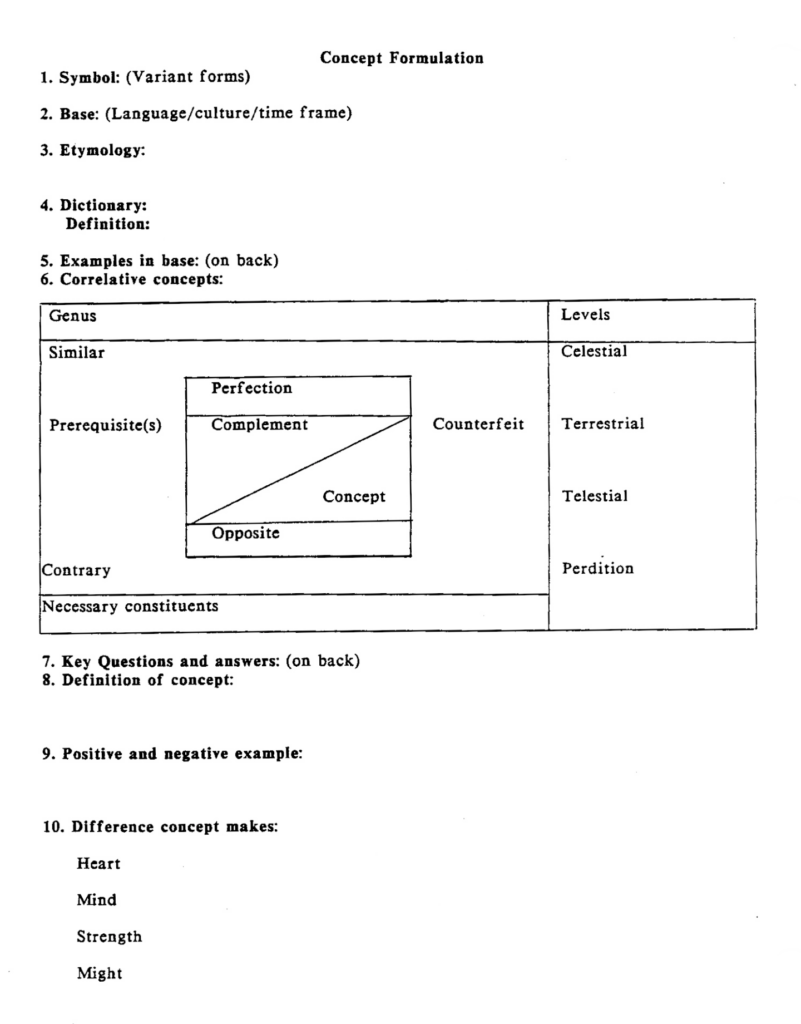
    6. Establish the correlative concepts to the target you seek to formulate. No concept exists in isolation, and the concept neighbors of your target concept help to define it. Each correlative slot is a question one might ask to understand the target concept better, though there may not be an answer, or a good answer, to some of the questions. Categories which should be objects of inquiry are:
      1. The genus: The larger class to which the concept belongs
        1. Constituents: Any classes which make up the concept being formulated
        2. Prerequisites: Concept(s) of things necessary for the referent to exist
        3. Consequences: Concept(s) of things which are caused to be by the target concept.
        4. Similar: Concepts like but not identical
        5. Contrary: Concepts most unlike the concept being formulated
        6. Perfection: The ultimate implementation of the concept
        7. Opposite: The ultimate unlike concept
        8. Complement: The X which decreases/increases as the referent increases/decreases (example: dark is the complement of light)
        9. Counterfeit: A thing which appears to be the referent but is not
        10. Levels: (These apply to Gospel concepts only. What the referent would be like in each respective kingdom):
          1. Celestial
          2. Terrestrial
          3. Telestial
          4. Perdition
    7. Ask and answer key questions which will help to illuminate the concept.
    8. Formulate your own concluding definition using any or all of the modes of definition to attempt to portray your concept as fully and as precisely as possible.
    9. Give a positive and negative examples (clear historic examples of the concept in question, and something which may appear to be like it but is actually not it as a negative example). This helps to define and communicate your concept.
    10. Show what difference your concept makes to important things such as heart, might, mind, and strength. This also helps to define and communicate your concept.

    A store of well-formulated concepts is a key to good thinking, and therefore a key to real success in this world.

    To master any subject matter it is necessary to have well-formulated concepts that adequately represent reality. Well-formulated concepts are a creation of the self by the self. Thus mastery of any subject matter or skill is self-mastery at the same time.

    The most important concepts any person ever grapples with are those which define his God, mankind, himself or herself, the future, success in this world, and salvation. The following list gives examples of specific concepts which are very useful:

    Gospel Concepts:

    • God
    • sacrifice
    • charity
    • stewardship
    • contrite
    • righteousness
    • consecration
    • hope
    • command
    • spirit
    • priesthood
    • iniquity
    • wicked
    • obey
    • revelation
    • god
    • inequity
    • good
    • HolyGhost
    • peace
    • justice
    • family
    • evil
    • Christ
    • revile
    • man
    • freedom
    • eternal
    • pride
    • flatter
    • self
    • faith
    • everlasting
    • murmur,complain
    • covet
    • time
    • repentance
    • prayer
    • lust
    • eternity
    • baptism
    • pondering
    • hearken
    • mercy
    • agency
    • fasting
    • broken heart

    Social Concepts:

    • cooperation
    • contract
    • equality
    • equity
    • franchise
    • democracy
    • republic
    • constitution
    • socialism
    • communism
    • right
    • self-interest
    • poverty
    • opulence
    • freedom
    • public virtue

    Financial Concepts:

    • budget
    • record
    • tax
    • shelter
    • net worth
    • leveraged
    • scam
    • pyramid
    • balance sheet
    • credit
    • insurance
    • capital
    • free market
    • needs
    • wants
    • integrity

    Scientific Concepts:

    • mass
    • inertia
    • gravity
    • atom
    • molecule
    • cell
    • organism
    • entropy
    • unity of
    • science
    • fauna
    • evolution
    • kinship

    Question:   Do you understand how a concept is a system and how concept formulation is systems thinking?

    Concept Formulation Worksheet

  • Lesson Four: Success (Philosophy 110)

    Definition of success: that which follows in this life and in the next. But there are two aspects of what follows:

    1. actual consequences,
    2. desired consequences.

    Everyone succeeds (everyone reaps consequences of his or her acts). But not everyone has actual consequences that match his or her desired consequences. How does one assure that one’s desires will be fulfilled? This is the problem which faces every human being.

    • Machiavelli said success depends on learning to wield power.
    • Confucians say you must live by the customs of society.
    • Jews say you must meticulously observe the Law of Moses.
    • Buddhists say you must get rid of your desires.
    • Christian Scientists say it is all in your mind.
    • Catholics say works (sacraments) will bring success in the next world.
    • Protestants say grace will bring believers success in the next world.
    • American Indians say you must be one with nature, thus one with God.
    • Hindus say you must be reborn to frustration until you accept Karma.
    • Communists say you must yield your desires to the state.
    • Muslims say you must live a life of piety.

    But what is the truth about success?

    The scriptures say that every man does that which is right in his own eyes (does that which he believes will bring him the success he desires). But most men do not lead very happy or contented lives. In other words, most men fail to gain the desires of their hearts.

    Is there a formula which will guarantee men the success they desire?

    Every normal human being is guaranteed short range freedom: We are free to choose and seek that which we desire among the possibilities at hand at a given moment. But we do not always attain what we desire. Every human being may desire and choose the good to do in his or her environment, because each has been given the special gifts of God to do so. Anyone who consistently chooses only the good will find that his or her desires for good will be completely fulfilled in the long run. Real success is counted only in the long run, though some are wining to sell the long run for short range success.

    The World’s Laws of success (some good, some bad):

    1. Buy low, sell high.
    2. Prioritize your goals, review them at least daily.
    3. You get no more than you pay for.
    4. Discipline wins over native ability.
    5. Early to bed, early to rise …
    6. Pray as if it all depended on God, work as if it all depended on you.
    7. No pain, no gain.
    8. Never give a sucker an even break.

    Must we be simple, sentimental or cynical? Or just wrong?

    The fundamental mistake of the thinking of the world is to believe that success and happiness is somehow produced by physical or external things such as pleasure, wealth, power, eminence and immortality. Those who gain any of the above quickly learn than no one of them nor any combination of them brings happiness or real success. But most persons would rather have any and all of the above if they have to be miserable anyway.

    What is man? Who are we?

    All men are the children of God, begotten unto him through two births, a spiritual one and a physical one. Each birth is the receiving of a body of a special order of material. Thus man is a dual being: “And the spirit and the body are the soul of man.” (D&C 88:15)

    The spirit of man has two parts: heart and mind.

    • The heart is the decision maker.
    • The mind is the understander and facilitator.

    The physical nature of man has two parts: strength and might.

    • The strength is the physical tabernacle, the body.
    • The might is everything which a person controls or influences through his body.

    The character of a person is his or her habits, the patterns of choice, thought, action and stewardship which he or she displays. Habits are created by choices. We come to this world to make choices and thus to build our own character.

    Mortals who eventually attain a celestial character have the character of God:

    • A heart which is righteous.
    • A mind which is omniscient.
    • A body which is immortal.
    • A might which is in perfect celestial order.

    All of which makes it possible for him and her, becoming one, to become omnipotent and possessor of all things. (Cannot be done by one person alone.)

    Mortals who have attained a perdition character have a character like that of Satan.

    The following table suggests the pattern for a celestial character:

    Aspects     Description      Function                   Character         Celestial
    Heart        Decider             Choosing between  Pure (selfless) Righteous
    –                  –                         good and evil                                      desires
    Mind          Understander  Thinking, planning Knowledge      Omniscient
    Strength    Doer                   Acting                        Skills, able      Omnipotent
    Might         Dominion         Presiding                   Order               Possessor of  all

    Question: What would the pattern for terrestrial, telestial and perdition character look like?

    Question: Do the possibilities for heart, mind, strength and might constitute a menu from which each person chooses his eternal character by choosing his actions each day?

    Question: The order of the four human factors is listed above in logical order. What is the psychological order? (Logical order: Most fundamental First. Psychological order: The order in which humans must actually act.)

    1. If every human being is a son or daughter of God, perhaps God has given men a formula for success. Is this true? Our Savior has told us that the goal for each man or woman is to conquer his or her own soul. He also pointed out that no one can do this without divine assistance. The laws of success in this world as given by God are the laws of the Restored Gospel of Jesus Christ. They are:
      1. A person must put his or her whole trust and belief in Jesus Christ.
      2. Under the direction of Jesus Christ, that person must repent of his or her sins.
      3. The person must then covenant to become perfect in Jesus Christ.
      4. The person must then receive the right to the constant companionship of the Holy Ghost by the laying on of hands of one who has divine authority.
      5. The person must then endure to the end in the New and Everlasting Covenant, which is to attain the same character as Jesus Christ.

    Question: Can a leopard change its spots? Can I become like the Savior in heart, mind, strength and might?

    One very interesting thing to note: Living the Restored Gospel does not require any special status except the ability to understand that gospel and to choose to follow the Holy Spirit. Thus it does not matter whether one is rich or dirt poor, healthy or sickly, male or female, old or young, bond or free, white or black, married or unmarried. Starting from any human condition, a person can achieve success in this world through the laws and ordinances of the Gospel of Jesus Christ.

    Question: If the way is open to every human being to become as Jesus Christ, why do so few find the narrow gate and enter into life?

    1. There is a powerful opposition to the work of Jesus Christ. The opposition has four factors, which might be described as follows:
      1. A heart which is set upon the things of this world.
      2. A mind which knows not God.
      3. A body which is easily habituated to ease and pleasure.
      4. An influence on others which promotes selfishness in them.

    The principal opposition to the work of God is not Satan. It is simply every human being in the world. The description above is that of the “natural man” which the scriptures discuss. The only real enemy any person has is himself or herself. Salvation is thus the process of rescuing each person from his own slothfulness. Salvation through Jesus Christ and his New and Everlasting Covenant is the only true and eternal success available in this world.

    The following table summarizes the contrast between the spiritually successful person (the saint) and the natural man:

    Factor                  Saint                                          Natural Man
    Heart                   Pure, desiring only                 Hardened, unwilling
    –                             to do the will of God              to be entreated by                                                                                                                                 conscience
    Spirit Body         Disciplined, good skills,        Disciplined only for
    good habits                              personal benefit
    Feelings               Appetites controlled by        Appetites rule for
    the Holy Spirit                        pleasure, thrills, power
    Brain                     Active, clear,                          Geared to fulfillment
    coordinated                            of desire
    Physical Body     Physically strong, hard         Suited to desire
    working, able to endure

    Problem: Show how the basic laws and ordinances of the Restored Gospel map on to heart, might, mind and strength.

    • Faith maps to:
    • Repentance maps to:
    • Baptism maps to:
    • Receiving the Holy Ghost maps to:
    1. The means to become as God is to love him with all our heart, might, mind and strength, and in the name of Jesus Christ to serve him (D&C 39:5).

    Question: The above sentence is possibly the most important sentence in all the universe. Can you think of one that is more important, more powerful?

    This sentence defines the human system (heart, might, mind and strength) and tells us how to perfect that system (by love of God by every aspect of our individual system). Gospel thinking is systems thinking.

    The beginning of wisdom is to fear God. This is to respect him, realizing that he is perfect, has overcome every temptation we face, and cannot look upon sin with the least degree of allowance.

    The end of wisdom is to love God. This is to devote the whole affection of our heart towards him, to dwell on him and his ways in our minds, to serve him with all of our strength, and to set our stewardship in the precise order which he instructs. To love the Lord is to recognize in him the only true good, the sole source of righteousness, the only hope of man, the kind and loving Father in whom we live and move and have our being, drawing every breath by his power and permission.

    As we love the Lord by keeping his commandments, he can bestow upon us his truth, his righteous desires, his skills, his priesthood, and his dominion. There is nothing greater to desire or receive in all eternity.

    1. Man is an agent. To be an agent one must have three prerequisites.
    2. One must be an intelligent being (goal oriented).
    3. One must have understanding of alternatives and choose among them.
    4. One must have power to carry out the choices made.

    God gives men their understanding and the power to carry out their choices. Should he withdraw either, the person would lose his agency.

    As men and women obey God, he increases their knowledge and power bit by bit. If they waver and retreat, their powers decline. But if they press on to serve God with all of their heart, might, mind and strength, he can bestow all of his knowledge and power upon them. Thus they can become gods, fully free agents as the Father is.

    To be like God is to:

    1. Have a pure heart, to desire only righteousness. This is 90% of the human problem.
    2. Have a mind which clearly discerns truth from error and comprehends all truth. This is 9% of the human problem.
    3. Have a body as disciplined and capable as that of God. This is 1% of the human problem.

    This course is concerned with both the heart and the mind problem, but the latter will consume most of our attention as we focus on intellectual skills.

    1. Skill learning is a specialized art which involves three essential steps.
      1. Clear comprehension of the skill to be learned. (The easiest and best way to this comprehension is to study a role-model who e::habits the skill desired.)
      2. Role-playing the skill until the basics have been mastered. This may require the assistance of a mentor.
      3. Fine tuning one’s performance by self-evaluation and correction.

    The test of adequacy of skill learning is whether or not we have overlearned the skill so well that we can succeed in our tasks under great pressure and adversity.

    The most important mentor in the development of any skill is God himself. That is why each covenant servant of Jesus Christ is promised that he or she can have the constant companionship of the Holy Ghost. The next most valuable mentor is a human being who has overlearned the skill desired and acts under the influence of the Holy Spirit.

    Question: What skills are important to human beings? –

    Human Skills

    Heart: Feeling Skills

    Type                                            Description

    • Compassion                          Ability to sense others’ feelings and to feel for them
    • Pain tolerance                     To allow pain to work its beneficence without masking it
    • Self-motivation                   To generate out of one’s own desire impetus to gain a goal
    • Purity of heart                     Discern needs of others without concern for self
    • Spirituality                           Identity both the Holy Spirit and the evil spirit unerringly
    • Discipline                             Strength to do what one knows one should when one should
    • Judging, Evaluating           Ability to establish a good or right for any situation

    Might: Social skills based on communication

    Type                                            Description

    • Motivating others               Using others’ desire to achieve a common goal
    • Manners                               Protocol to avoid unpleasant surprises in social relations
    • Management                       Coordinate the activities of others
    • Friendship/enmity             Ability to maintain warm/cold personal relations
    • Love/hate                             Ability to sacrifice for/injure another person
    • Priesthood                            Authorized sharing of light, truth, power from God
    • Mentor/Master                   Guiding the development of another person w/wo consent.
    • Disciple/slave                      Receiving regimen from another person w/wo consent
    • Business/extortion             Exchange of goods for mutual/one-sided benefit
    • War/assault                         Forcible deprivation of another group/person
    • Diplomacy/negotiation     Verbal process of reaching agreement
    • Training                                Programming the reaction patterns of another person

    Mind: Intellectual skills

    Type                                             Description

    • Philosophy                            Asking questions which elicit understanding
    • Science                                   Form of peer-acceptable assertions about the natural world
    • Scholarship                           Creation of imaginary accounts of past on record evidence
    • Mathematics                         Creation and use of systems of order
    • Engineering                          Ability to achieve specific goals using current technology
    • Thinking                                Relating patterns in the mind
    • Perceiving                              Identification of sensory phenomena
    • Comprehending                    Relating an idea to a matrix of relevant ideas
    • Systems                                   Representing things as organized parts of organized wholes
    • Deduction                               Deriving necessary conclusions from given premises
    • Induction                                Supposing the whole to be like the part
    • Adduction                               Creation of premises to deduce a given conclusion

    Strength: Physical Skills

    Type                                               Description

    • Walking/running                  Ability to change spatial location
    • Carpentry                                Ability to create structures of wood
    • Music                                       Ability to create patterned noises
    • Observation                            Ability to summarize sensory perception
    • Experimentation                   Observation of controlled experiment

    All: Skills which specially involve heart, might, mind and strength

    Type                                              Description

    • Learning                                 Achieving desired changes in one’s habits (religion)
    • Communication                    Achieving desired reactions in another person
    • Righteousness                       Achieving the action patterns of a god with help from God
  • Lesson Three: Systems (Philosophy 110)

    A concept analysis of systems:

    1. Symbol variants: System, systemic, systematic, systematize, unsystematic.
    2. Base: Scientific/humanistic origin, 20th century, but applied here to a Restored Gospel (LDS) setting.
    3. Etymology: L. systema, fr. Gr. synistanae, to place together; fr. Gr. ~, with, and histanai, to place.
    4. Dictionary: Webster’s New Collegiate
      1. Definition: an assemblage of objects united in some form of regular interaction or interdependence; an organized whole.
    5. Examples in base: The solar system. The human nervous system. The American system of government. Systematic theology. The double-entry accounting system.
    6. Correlative concepts:
      1. Genus:                   Relationships
      2. Constituents:       Environment, boundaries, structure, function, input, output
      3. Prerequisites:      Two or more existing things.
      4. Consequences:     n/a
      5. Similar:                 Organization, group, complex, machine, layout, scheme, plan
      6. Contrary:              Chaos, jumble, collection, random
      7. Perfection:           Closed system
      8. Opposite:             Unorganized
      9. Complement:      Disorganized
      10. Counterfeit:         Facade (The appearance of being a well-organized system.)
      11. Levels:
        1. Celestial:        Being in an order presided over by our Father.
        2. Terrestrial:     Presiding: The Son.
        3. Telestial:         Presiding: The Holy Ghost.
        4. Perdition:       Presiding: Satan.
    7. Key Questions:
      1. How are systems created? They are the result of intelligent action.
      2. How are systems destroyed? By entropy and evil, the “natural” forces.
      3. What is a closed system? A system that has or needs no environment.
      4. What is a system “in control”? One which does all and only that which its agent- steward commands it to do.
      5. Is there a closed system? The universe (including God) may be one.
    8. Formulated concept: A system is some set of objects related in some manner which makes it convenient to consider the set as a whole. All of the systems humans deal with are imaginary systems. Humans believe that some of their systems represent reality, such as the solar system, and some do not, such as the story of Alice in Wonderland.
    1. Positive example: The human body is a system composed of numerous subsystems.
    2. Negative example: (There are no negative examples. Everything which can be thought of can be construed as a system or part of a system, for everything which exists is related to everything else which exists. But a ticking clock is a better example of a well-organized whole, or system, than is a pile of sand, though the latter is also a system.)
    3. What difference should a knowledge of systems thinking make to my life?
      1. Heart: It could encourage me to be true to my covenants and principles, because I could see all of my decisions as needing to be systematic (intelligent).
      2. Mind: I could master the techniques of systems thinking.
      3. Strength: I could be more systematic in the way I treat and use my body.
      4. Might: I could create a celestial order in my stewardship.

    What kinds of systems do humans use to think about the universe?

    An initial taxonomy relates to the input of the environment.

    1. Open systems are those which have some input from or output to an environment.
    2. Closed systems are those which have no exchange with their environment. (Some systems which have very little exchange are analyzed as closed systems by simplification for purposes of convenience.)

    Another taxonomy of systems is created by emphasizing change.

    1. Systems that do not change appreciably over a given time period are known as static systems. Example: A map is a static system.
    2. Systems which do change or function are known as dynamic systems. Example: A living orchid plant is a dynamic system.
    3. Systems in which the changes are at least in part due to intelligent (goal setting and seeking) behavior are known as agent systems. Example: A human being is an agent system.

    All systems have a static aspect (a structure). All agent systems have static structure and a dynamic system in addition to the agent aspect.

    A third taxonomy of systems is created by emphasizing subject matter.

    1. Mechanical systems are those being analyzed according to structure and force applications. They can be analyzed as closed systems with considerable success. Their principal opposition is change of structure (wear and tear). Example: A bicycle.
    2. Biological systems are those systems which have as their main feature the ability of units to reproduce their own kind. They are best analyzed as open systems which achieve homeostasis (steady state) with their environment. Their principal opposition is anything which destroys that homeostasis to bring death.
    3. Intellectual systems are concept systems in a human mind as represented in some symbolic form for communication purposes. The symbolic manifestations of such systems tend to be used as closed systems. The opposition to such systems is that they tend to be ignored or lost.
    4. Social systems are organizations of people who cooperate to operate and perpetuate the system. These systems tend to be open, with the principal opposition to each being rival social systems. Example: The LDS Church.

    A final dichotomy relates to how men view the systems they create.

    1. Real systems are those which the person creating or using them believes actually characterize the universe.
    2. Imaginary systems are those which the person creating or using them understands to be a creative expression of his own mind and not necessarily to be characteristic of the real universe.

    There is but one real system known to man: the universe. Man can only vaguely characterize the universe in its entirety, which is its reality. So we spend our time analyzing and characterizing subsystems of the universe to attempt to shed light on the nature of the whole.

    Thus all of the subsystems men deal with are fictional abstractions (constructs) by which we attempt to guess at reality.

    And thus the line between real and imaginary systems is very thin, often non-existent. One mark of intelligence is to be able to draw that line accurately.

    Thus reality is really imaginary and all imaginary systems really exist in someone’s mind.

    What are the types of systems thinking?

    There are four basic types of systems thinking: systems analysis, systems design, systems operation, systems evaluation.

    1. Systems analysis is the description of some real subsystem of the universe in systems thinking categories. Example: Analysis of an automobile.
    2. Systems design is the specification of the system parameters of some new thing which a person has imagined. Example: The design of a home one hopes to build.
    3. Systems operation is the functional use of some real system paying special attention to the system parameters. Example: Driving an automobile.
    4. Systems evaluation is the comparison of one system either with some ideal system or with some other real system, comparing them as to some standard such as effectiveness or efficiency. Example: Is it better to use a typewriter or a computer to write a paper?

    What are the basic parameters of systems thinking?

    Parameters of static systems:

    1. System boundaries are the edges of the subsystem selected for analysis.
    2. System environment is everything outside the system boundaries.
    3. System parts are all things within the system boundaries.

    Example:    An automobile has boundaries, which are its tangible surfaces. It has an environment, which is everything outside its tangible surfaces but including the air which freely circulates among its parts. And it has parts, which are all the pieces of material out of which it was built.

    Parameters of dynamic systems in addition to the static parameters:

    1. System function is the internal operations of the static parts.
    2. System input is the input of the environment to the system.
    3. System output is the output of the system to the environment.
    4. System opposition is whatever causes the functioning of the system to break down, to deteriorate.

    Example:    An automobile functions by burning fuel to produce power to turn the wheels to provide locomotion. The system input (in part) is fuel and air. The system output (in part) is exhaust fumes and noise, and power turning of the wheels. The opposition is (in part) bad roads and bad driving, which produce wear and tear.

    Parameters of agent systems in addition to those of static and dynamic systems.

    1. Agent goals are the desires, the objectives of, the agent.
    2. Agent resources are the wherewith by which the agent could achieve goals.
    3. Agent strategy is the overall plan of the agent to achieve a goal.
    4. Agent tactics are the specific actions to be taken to implement the agent strategy.
    5. Agent work is the actions of the agent in implementing strategy and tactics.
    6. Agent assessment is the observations of the agent to see if and when the goal has been reached.
    7. Agent evaluation is the decision of the agent as to whether or not attaining the goal was worthwhile or not, once having attained it.

    (Note: Agent goals is an example of systems analysis: What do I with it? Agent resources, strategy and tactics are examples of systems design. Agent work and assessment are examples of systems operation. And of course Agent evaluation is an example of systems evaluation.

    Example:    A young man desires to gain the hand of a young lady in marriage (goal). He decides to impress her (strategy) by an unusual date (tactic). He arranges and executes the date (work), gains her acceptance and marries her (assessment), then tries to decide if he did the right thing (evaluation). (In a Restored Gospel frame the answer to the evaluation is not determined by the eventual outcome but by how he performed steps 8 through

    What is it essential to know about systems analysis?

    Reality is usually too complex to deal with, so we simplify it. We try to retain all the essential features of our subject and eliminate only unnecessary aspects, but we don’t always succeed in doing that. The parameters of systems thinking listed above are an attempt to provide a standard for the minimum essential features which must be specified to describe a system successfully.

    Systems analysis is the attempt to capture the essential features of some existing (real) object of attention and curiosity in this world in order better to understand and/or control it.

    There is usually one key factor in any systems analysis. As one answers the questions to find the basic parameters, one should ask also, what is the real key to control, to using this system successfully.

    Examples: What is the key factor in systems analysis of an automobile?

    • Of a political system?
    • Of a person?
    • Of a theology?

    Question: What advantage does systems analysis have over ordinary attempts to understand?

    What is it essential to know about systems design?

    Reality sometimes does not have all of the “things” we feel we need. We may desire houses, automobiles, fruits and vegetables, clothing, honors, social organizations, and works of art, all of a sort which do not exist. So we wax creative and design new things.

    Systems design is the planning of new things to meet our human desires and needs.

    The key factor in systems design is effectiveness. Will the thing created fill the need for which it was created? The second factor is efficiency. Was this creation done with a minimum of cost? Is there a better way?

    Most systems design is a slight modification on an old pattern. Most changes proceed in small increments. Few are cataclysmic.

    Systems design and creativity are the same thing. Systems design is an artistic undertaking. One can increase his skill at systems design by:

    1. Thinking of alternatives to every human creation one observes.
    2. Experiencing a wide range of cultures and achievements within cultures.
    3. Constantly looking for new ways to apply old ideas.
    4. Designing and implementing new systems, then evaluating them and seeking for better solutions.

    Creativity or artistic design is essentially a spiritual matter.

    Question: What distinguishes systems design from ordinary planning?

    What is it essential to know about systems operation?

    Reality usually needs some minor rearranging to fill our human needs. These rearrangements we achieve by using the structures and powers in our control. Thus we use our legs to change our location, we use a broom to sweep the floor, we use a pair of scissors to cut hair, we use a lathe to reduce the diameter of a spindle, etc.

    Systems operation is intelligent human action. All goal-oriented action is systems operation, for in all of such doing, we are systems using other systems to implement desired systems.

    The keys to systems operation are again effectiveness and efficiency, in that order.

    Systems operation is the skill of doing anything that is consciously and deliberately pursued.

    Systems analysis is a helpful preface to successful systems operation. One can drive an automobile without understanding how it works, but one will do better if one does understand the intricacies of the machine.

    Question:   Why is self-control necessary to systems control?

    What is it important to know about systems evaluation?

    Some persons pretend there is no good and bad, no righteousness or sin. But without such judgments, no person could attain to his or her desires. We must distinguish between good and bad (that which will lead to our goal or will take us away from it) and some persons want to and can distinguish between good and evil (that which makes the doer righteous or that which makes the doer evil). Not to make such evaluations is to step backwards from being human and intelligent.

    Systems evaluation is always a comparison of one system (the one being evaluated) with another system (the one being used as a standard), real or ideal, and judging the system being evaluated to be adequate or not, m comparison with the system being used as a standard, according to the desires of the evaluator.

    Example of evaluation: One has a desire to have a piece of wood of just the right dimensions to fill a hole. So one measures the dimensions of the hole (this sets up the standard to be met). Then one uses those dimensions to measure pieces of wood until one finds one that either fits those dimensions or can be shaped to those dimensions to satisfy the need. The wood is evaluated as adequate if it either fits the dimensions or fills the hole adequately.

    The key to evaluation is the standard of value being used. Human beings compare ideal standards against each other, then pick the one that they believe most suits their desires. Then they use the ideal standard to judge real systems.

    Evaluation is not measurement (assessment). Measurement is the determination that a desired quantity exists or not. Evaluation is the determination that a desired quality exists or not.

    Example: One measures to see if his gas tank is full.

    One evaluates to see if the gasoline performs as it should.

    The ultimate evaluation is comparison of how one thing actually works in the real world as compared with another. Ideal systems can only be evaluated theoretically, for they are only theoretical systems.

    Every evaluation measures the evaluator as much as the thing being evaluated. This is because the evaluator must select the standard of evaluation, thereby revealing or evaluating himself.

    Question:   Why is snap judgment usually a bad form of evaluation?

    Living the Restored Gospel successfully is an application of good systems thinking.

    Systems analysis reveals to the honest observer that his own life is in need of repair.

    Systems design leads one to form a hypothesis as to how to do better.

    Systems operation is the process of implementing the new plan to try to do better.

    Systems evaluation is the opportunity of an intelligent person to see if his new plan is actually any better than the old one.

    Where does the Restored Gospel come in? Any person who is already engaged in this process of trying to do better will welcome the Restored Gospel opportunity to receive divine assistance to analyze, plan, operate and evaluate. As the Holy Spirit touches a mortal’s life, it tells him that he needs to repent, and that only as he puts his trust in Jesus Christ unto baptism by proper authority can he fulfill his potential as a son of God. Repentance, baptism, and the receiving and obeying of the Holy Ghost are the systems operations or work he must do. Having been faithful, he can then compare his new self with his former self by systems evaluation to see if he is really any better off.

    Does understanding systems thinking help a person to live the Gospel any better than one could without that understanding? No, for the Holy Spirit brings one all one needs to live the Gospel. But systems thinking will help one to understand and to explain the process of living the Gospel better than one can without it. If a person is humble and desires understanding of the ways of the Lord, systems thinking will help him to form those questions he must ask about the ways of God which must be answered for understanding to grow.

    Question: Is systems thinking of equal value to evil as well as to good persons?

    What are the laws/rules of systems?

    The following laws and rules apply to all systems and are therefore useful in every context:

    1. Causation: There is a cause (input) for every change in a system. There is an explanation for everything.

    Application: There are no “accidents.”

    1. Sufficient reason: Every change is caused by something great enough to have the effect observed.

    Application: For every output there must be a larger input. There is no free lunch.

    1. Entropy: Energy concentrations in a physical system tend to dissipate.

    Application: Things of this world tend to cool down, wear out, break up.

    1. Prediction in a system is sure only if the system is in complete control.

    Application: The only things we humans completely control and therefore can completely predict are our own personal choices.

    1. Law of social systems: No open social system of this world can be perfected.

    Application: If you take in everyone or admit all comers, your system will always be evil because there are always people who will choose evil. A marriage can be perfected because it can become a closed system (so far as input is concerned) in the New and Everlasting Covenant.

    1. Focus of energy at the right time and place is the key to power in dynamic systems.

    Application: The spark must jump at just the right time in an internal combustion engine. There is a tide in the affairs of men that taken at the crest leads on to victory…” “Strike while the iron is hot.”

    Systems Analysis Format

    Target system: [Focus of concern for an analysis]
    Example:    An automobile

    Static analysis: [System seen as a spatial configuration only)
    Example:    Automobile sitting still, engine off.

    System boundaries: [What are the edges of the system?]
    Example:    Tangible boundaries of body, engine, etc.

    System environment: [What other subsystems are close by?]
    Example:    Air, highway, rainstorm, countryside.

    System parts: [What are the important internal parts?]
    Example:    Body parts, seats, controls, drive train.

    Dynamic: [Target system seen as temporal (moving, functioning)]
    Example:    Automobile being driven down a highway.

    System function: [How the system parts work together.]
    Example:    Explosions in engine turn shaft, gears, rear wheels, propel automobile.

    System input: [What the environment feeds into the system.]
    Example:    Air, gasoline, heat.

    System output: [What the system puts out into the environment.]
    Example:    Motion of automobile, exhaust, dripping oil.

    System opposition: [Factors which destroy the system and its functioning.]
    Example:    Deep water on highway, collision with another automobile, etc.

    Agent:      [Target system seen as an agent or controlled by an agent.]
    Example:    You

    Agent goal(s): [What the agent desires at the moment.]
    Example:    You wish to go downtown.

    Agent resources: [What can the agent call upon or use to achieve the desired goal?]
    Example:    You have permission to use the family automobile, but it is out of gasoline. But you have money and put gasoline in.

    Agent strategy: [What is the agent’s overall plan to achieve the goal?]
    Example:    You plan to use the freeway.

    Agent tactics: [What specific things will the agent do to   carry out the strategy?]
    Example:    You plan to drive very carefully and to avoid rush hour.

    Agent work [How much energy, ability, intelligence and persistence does the agent apply in employing the chosen strategy and tactics?]
    Example:    You do drive carefully, and pay attention to where you are at all times.

    Agent assessment: [How close is the agent to attaining the goal?]
    Example:    You see the store which you wish to patronize [and park close by].

    Agent evaluation: [What did attaining the goal cost the agent? Was the attainment worth the cost?]
    Example:    They are out of what you wanted, so the trip was wasted. Ouel dommage!

    Key Factor: [Which system factor is the most influential one, the one which gives the operator of the system the greatest power and control?]
    Example:      Ignition key.

    (Note: To do a systems analysis, copy the section below from this page.)

    Systems Analysis Format

    Target system:

    Static analysis:
    System boundaries:
    System environment:
    System parts:

    Dynamic analysis:
    System function:
    System input:
    System output:
    System opposition:

    Agent analysis:
    Agent goal(s):
    Agent resources:
    Agent strategy:
    Agent tactics:
    Agent work:
    Agent assessment:
    Agent evaluation:

    Key Factor:

  • Lesson Two: Thinking (Philosophy 110)

    1. Theories of thinking:
      1. Concept theory: Thinking is the development and use of concepts. (This is the theory in use in this course.)
      2. Behaviorist theory: Thinking is the name for unknown functions in an organism which intervene between a stimulus and the response to that stimulus by an organism.
      3. Verbal theory: Thinking is the internal aspects of action patterns stimulated by the acculturation of an individual by linguistic interaction with a social group.
    2. Concept theory of thinking: The concept theory of thinking sees the imagination as the arena of human thinking. In response to experience (arising both from internal and external sources) an individual develops patterns of thinking which are called “concepts.” Concepts may be unitary, such as a certain shade of red, or very complex, such as the planetary system of which the earth is a part. These patterns can be unique or somewhat standardized; whichever they are depends upon the desires of the individual who creates them. All conceptual patterns are created by individuals, and no two individuals have identical concept patterns. A degree of commonality of concept patterns is essential for communication and cooperation, however.

    Thinking is pairing concepts to produce new concepts.

    1. Kinds of concept thinking:
      1. Concept formulation and identification: The development of concepts on the basis of external and/or internal information sources, or, comparing a concept with an information source to see if that is the concept in question. (This is the attempt to establish conocer, connaitre, kennen knowledge.)
        1. Example of formulation: Examining a machine again and again until one has built a concept which contains all of the physical parts and functioning of the machine being observed.
        2. Example of identification: Examining a machine again and again until one is certain that it is of the exact type of which one already has a complete concept.
      2. Concept relating: Establishment of larger concepts in which any two given concepts are seen as related parts of a whole. (This is the attempt to establish saber, savoir, or wissen knowledge.)
        1. Example: Understanding how an electric motor relates to the generator which supplies it with electrical input.
      3. Concept evaluation: Differential holding of concepts wherein some are seen to be more important than others, more “good” than others, etc, according to whatever values are important to the person who is thinking about the concepts.
        1. Example: Understanding that a three phase electric motor is better than a two phase motor for certain purposes.
        2. Example: Understanding that the most important thing about a human being is the person’s desires.
      4. Concept choosing: Selecting a concept pattern for some use, such as one to be remembered, one to be put into action, etc.
        1. Example: After contemplating a number of hypotheses, selecting one of them to be one’s characterization of another person.
        2. Example: Choosing the cherry pie instead of chocolate pudding for dessert.
        3. Question:   How is each of the above kinds of concept thinking an exemplification of the principle of pairing.
    2. Tactics of thinking: Thinking can be done with various degrees of complexity:
      1. Linear thinking: Single track concept manipulation.
        1. Example:    Imagining a way to pick an apple which is growing ten feet off the ground in an apple tree.
      2. Lateral thinking: Multiple track concept manipulation.
        1. Example:   Imagining six ways by which to retrieve an apple which is growing ten feet off the ground in an apple tree.
      3. Systems thinking: Searching out and understanding all of the essential parts of any object of study, how those parts relate to each other statically and dynamically, and how that object affects and is affected by its environment.
        1. Example:    Imagining as many of the costs and consequences of picking an apple which is ten feet off the ground in an apple tree.
      4. Lateral systems thinking: Doing systems thinking for many possibilities.
        1. Example:    Imagining as many of the costs and consequences as one can for each different means of retrieving and apple which is growing ten feet off the ground in an apple tree, by all of the means known to the thinker.
      5. Holistic thinking. Seeing things as they really are, were, and will be, and simultaneously understanding the importance, and the value, and the goodness or evilness of each thing. (This kind of thinking is done only by divine beings or those who are under the influence of the power of divine beings.) This is the goal towards which the best human thinking aspires.
    3. Characteristics of good (effective) thinking:
      1. Clear: Precise and articulated pattern formulation and manipulation.
      2. Accurate: Sufficiently representative of the real or imaginary world being considered.
      3. Moral: Explicit recognition of good (righteousness) and evil in what is being thought about.
      4. Complete: Recognition of all factors important to a given systemic thinking.
    4. Definition of an Agent: An agent is an intelligent being which chooses among alternatives for action on the basis of knowledge of the situation, desire to attain specific goals, and ability to act to attain those goals.
      1. Kinds of agentive thinking/acting: Two kinds of acting are here envisioned, following the ancient dichotomy popularized by Aristotle: a. Knowing: Aristotle’s contemplation (which produces concepts which become knowledge or belief. b. Planning: Aristotle’s practical thinking: to prepare for acting to produce some result.

    (Note: It is important to see that agentive thinking and acting cannot be entirely separated. Thinking is acting physically (things mental are also physical) and physically acting involves thinking.)

    1. Characteristics of good (effective) acting:
      1. Effective: Action which attains the envisioned result.
      2. Efficient: Action which attains the envisioned result with relatively low expenditure of resources.
      3. Righteous: Action which attains the envisioned result and which makes everyone affected by the action to be happier than they were before.

  • Lesson One: Course Mechanics (Philosophy 110)

    1. The nature of this course: This course is a workshop in skill development. Each class period will be devoted to discussion of skills and of exercises which develop those skills. Text material is to be studied ad learned outside of class. There will be at least one written assignment designed to enhance your skill development due each time the class meets. Each day’s assignment must be completed and handed in on time to receive full credit.
    2. The place of this course in your life this semester: This course should be your principal academic focus for the semester. You should plan on two to four hours outside of class for every hour spent in class.
    3. Religion: Religion and theology will be frequent topics of discussion, but you will not be held for any religious knowledge or commitment. We will begin each day’s class with prayer.
    4. Seating: Please sit where you like, but be found in that same seat each day thereafter.
    5. Learning this material:
      1. The best way to learn this material is to teach it to someone else on a daily basis.
      2. Next best is to form a study group of members of your class to review the skills and concepts.
      3. Regular private review is indispensable. A careful review the next day, then the next week, followed by a careful review after one month will enable you to fix these matters in your mind more or less permanently.
    6. Grading: You will be graded on a point system, your final grade being determined by your cumulative point total. Notice that the grading is weighted to balance personal discipline with competence. Points are assigned on the following basis:

    Out of this world:                                                     12 points
    Superlative:                                                               11 points
    High A                                                                        10 points
    Low A                                                                          9 points
    B                                                                                   8 points
    C                                                                                   7 points
    D                                                                                   6 points
    Failing grades                                                            0-5 points
    Papers turned in late during class:                        -1 point
    Papers turned in after class within one week:     Half credit
    Papers turned in after one week or not at all:      -5 points

    The Target Skills of this Course

    1. Key Questions: The careful formulation, asking and answering of questions which elicit key information about a subject in order to facilitate effective and efficient learning.
    2. Concept formulation: The precise shaping and reshaping of important ideas.
    3. Assertion formulation: The translation, classification and analysis of communication situations, usually focusing on sentences used in a specific context.
    4. Capture: Asking and answering the questions which adequately summarize the essence of a message.
    5. Systems formulation: Seeing things one wishes to understand as related functioning parts of a larger functioning context of related parts.
    6. Presupposition formulation: Making explicit the epistemological, metaphysical and ethical commitments which are assumed by the deliverer of a given message.
    7. Expansion: Adding to a body of knowledge through one’s own investigative efforts.
    8. Evaluation: Establishing the comparative value of an idea, deed or message by comparison of it with some accepted standard.
    9. Oral communication: Thoughtful use of spoken language to facilitate learning and cooperation by fitting deftly into a given oral/aural context.
    10. Written communication: Creation of a written representation of a message in such a form that the message is clearly and powerfully represented. Written messages generally create their own immediate context but must also fit into a larger cultural context.

    Question: The word “formulation” has or could have been used in the description of each of the skills mentioned above; why is this appropriate?

    Question: What is formulation?

    Question: What is the relationship between formulation and information?

  • Philosophy 110 (BYU)

    Content Summary Page

    This Introductory Philosophy course was taught by Dr. Chancey C. Riddle while at BYU until 1992. It is taught from an LDS perspective or what Dr. Riddle calls a Restored Gospel perspective.

    Lesson 1 – Course Mechanics
    Lesson 2 – Thinking
    Lesson 3 – Systems
    Lesson 4 – Success
    Lesson 5 – Concepts
    Lesson 6 – Communication
    Lesson 7 – Strategies
    Lesson 8 – Epistemology
    [[No course materials provided for the final 3 lessons]]
    Lesson 9 – Metaphysics
    Lesson 10 – Ethics
    Lesson 11 – Worldviews

    Appendix
    Epistemologies
    Humanist Manifesto
    Joseph Smith and the Ways of Knowing – Dr. Truman G. Madsen
    Self-Love – 1983
    The Choice – Elder Boyd K. Packer
    The Marks of a Saint
    We Mr. Taylor I Can Tell You Nothing

  • Code Language in the Book of Mormon

    Chauncey C. Riddle

    Brigham Young University

    (c) 1992 Chauncey C. Riddle

    Caveat: This paper has been created to demonstrate that the Book of Mormon is a text worthy of careful pondering and solemn thought. No reader should take anything said herein as Gospel truth. What is said is an invitation to every person to turn to the Book of Mormon and through prayer and meditation about what is contained therein to establish a living link with heaven through the person al manifestations of the Holy Spirit. It is what the Holy Spirit teaches an individual as the person ponders the text that is the important thing about the book of Mormon. Commentaries on the text, such as the following paper, do more harm than good if someone believes them without further inquiring of Father in the name of Jesus Christ as to exactly what he or she should believe about such matters. Now to the commentary.

    The title of this work is a bit misleading. All human mother tongues are code languages. To become an adult in any culture is to learn well the language of that culture. This involves being able to interpret to oneself the meanings of various other persons who use the same coding and to express meaning to them. This is always done within a cultural worldview and a common physical environment which provide limiting and enabling parameters for “meaning” something using a given language. So all of the language of the Book of Mormon is code language.

    The actual import of the title is to point out that there are special codes or usages in the Book of Mormon which are not culturally transparent to the user of ordinary English (whatever ordinary English might be taken to be). These codings are not those of the sort of “King James style” of English which Joseph Smith employed in translating the text. This paper will focus on four major kinds of hidden meaning which the ordinary contemporary reader of the Book of Mormon might miss even though he or she might be fluent in King James as well as contemporary English usage.

    The stated purposes of the Book of Mormon, given on the title page are: “To show unto the remnant of the house of Israel what great things the Lord hath done for their fathers; and that they might know the covenants of the Lord, that they are not cast off forever — And also to the convincing of the Jew and Gentile that Jesus is the Christ, the Eternal God, manifesting himself unto all nations.” These purposes are achieved in a narrative that is primarily a historical record of a people interspersed with commentary, sermons and admonitions, scriptural quotations, and allegorical allusions.

    The four major kinds of hidden meanings with which we shall concern ourselves in this paper are as follows: 1. Obscure usages. 2. Technical usages. 3. Metaphorical/allegorical usages. 4. Double entendres.

    1. Example of text having obscure meaning: Jacob’s mark.

    An obscure meaning is the usage of ordinary words of language in such a way that the reader has to puzzle out what the author means by a given coding. For instance, in Jacob 4:14 we read: But behold, the Jews were a stiff-necked people; and despised the words of plainness, and sought for things that they could not understand, Wherefore, because of their blindness, which came by looking beyond the mark, they must needs fall; for God hath taken his plainness from them, and delivered unto them many things which they cannot understand,because they desired it. And because they desired it God hath done it, that they may stumble. The question arises, what is the mark? A good deal of speculation about this topic is observed in LDS scriptural discussions. But the issue is interesting, because Jacob has taken pains to lay a ground work for his remark, which groundwork, if ignored, leads the reader of the Book of Mormon into the same trap as he describes for the ancient Jews: the modern reader can also easily look beyond the mark by misinterpreting “the mark.”

    The context of Jacob’s allusion to the mark is a discussion of Christ. In the preceding verse 4 Jacob mentions that he and others took the pains to make a record on metal plates so that their children would not lose that most precious of all knowledge, and understanding of Christ and his mission. He mentions that they (those who wrote upon the plates) worshipped in the name of Christ and kept the law of Moses because it pointed to Christ. In verse six he points out that the message of Christ has not been lost on them; through their knowledge of Christ, they have obtained a hope in Christ, and their unshaken faith has enabled them to do great miracles. But notwithstanding the greatness of those miracles, they knew their weaknesses, and they knew that only in the grace of Christ could they do those things. In verse eight, Jacob extols the world of Christ, the Lord, his mysteries and his mighty works. In verse eleven, he asks all his readers to be reconciled to Father through the Atonement of Christ. In verse twelve he asks why not attain to a perfect knowledge of Christ? In verse thirteen he points out that we can attain this knowledge through the Holy Spirit, and that all the prophets have testified of these things.

    Then, in verse fourteen, he speaks of the mark. With that preceding context could the mark reasonable be anything or anybody but Christ himself? Jacob seems to be saying that our life has one point and one point only: to come unto Christ, to be redeemed, saved, and reconciled to Father. To pursue any other goal is to miss the mark or the point of living a mortal life.

    The Jews missed the mark by seeking after knowledge of distant things. They seemed to have delighted in mysteries and metaphysics. Their quest to align themselves with a recondite and mythological truth was a way of ever laboring and never coming to the goal. They seemed not to realize that the point of life is to become a little child in establishing a very personal relationship with the most important person, Christ, and that through becoming his child they could gain all other good things as well, including truth. Jacob seems to be saying that not to see that the mark, the goal of human life held highest by the scriptures, is to know Christ face to face in mortality, is to look beyond the mark in any time and age.

    2. Example of a term in technical usage: Innocent blood.

    Technical usage in a language is opposed to common-sense usage. Common-sense usage is a fuzzy, family relationship type of meaning where the purpose is to approximate, not to be precise. When there is a need to be precise in order not to be misunderstood, technical language is introduced. Technical language has an essence, a specifiable and precise core content of meaning, which common-sense language does not have.

    A good example of coding which represents technical usage is found in the Book of Mormon usage of the phrase “innocent blood.” After preaching his second witnessing to the wicked King Noah and his court, Abinadi warns the king that though he is willing to die, should the king choose to kill him the king will shed innocent blood. (Mosiah 17:10) Examination of the scriptures shows that the word “innocent” means having no sin to one’s charge. Thus we read in the Doctrine and Covenants: “Every spirit of man was innocent in the beginning; and God having redeemed men from the fall, men became again, in their infant state, innocent before God.” (D&C 93:38) I take this to mean that though every spirit was innocent in the beginning, having no sin to its charge. Being born under the curse of the fall of Adam would have caused little children born into this life to be under the curse of sin were it not that the Savior prepared a redemption from the fall and thus every person is innocent or guilty according to his or her own sins and not because of Adam’s transgression.

    But being innocent, either not having sinned or having been forgiven of one’s sins, does not of itself create the technical matter know as “innocent blood.” The repentant people of Ammonihah were burned by the wicked inhabitants of that city. Alma notes that in burning them the people of Ammonihah were bringing upon themselves the “blood of the innocent.” Those who burned others were guilty of murder, and would have to answer for that. But there is no suggestion that they were shedding innocent blood.

    It is in D&C 132 that the key is given to know how and why Abinadi’s blood was innocent blood whereas the blood of the repentant women and children of Ammonihah was the blood of the innocent. The phrase is used repeatedly which says: “if ye abide in my covenant and commit no murder whereby to shed innocent blood.” (D&C 132:19) This introduces the idea that the shedding of innocent blood pertains to the New and Everlasting Covenant and to it only. A later verse then clarifies the matter. “The blasphemy against the Holy Ghost, which shall not be forgiven in the world nor out of the world, is in that ye commit murder wherein ye shed innocent blood, and assent unto my death, after ye have received my new and everlasting covenant, saith the Lord God.” (D&C 132:27)

    The sum of the matter is then that innocent blood is the blood of Christ or his personal priesthood representative who has been sent to other covenant servants of Christ. Abinadi was sent by God to call Noah and his courtiers to repentance. In slaying him, they in effect slew the Savior himself, and that after having partaken of the New and Everlasting Covenant and pretending to administer and to teach it. For this there can be no forgiveness of sins, either in this world or the next. The case of the wicked people of Ammonihah was different. They had explicitly rejected the New and Everlasting Covenant and were not bound by it. The murders they committed were indeed laid to their charge, but they were not charged with deliberate murder of the Savior. There is murder, and then there is murder whereby one sheds innocent blood.

    In another passage of the Book of Mormon, the father of King Lamoni uses the term innocent blood mistakenly. Ammon has just warned the old king that should he slay his son, he would be killing an innocent man, for Lamoni had repented and had been forgiven of his sins. The old king replies: “I know that if I should slay my son I should shed innocent blood; for it is thou that has sought to destroy him.” This usage is understandable, but does not qualify as a technical usage of the term innocent blood, for the king had not yet received the New and everlasting Covenant, nor did his son preside over him in priesthood authority. Therefore had the old king killed his son he also would have been shedding the blood of the innocent.

    3. Example of metaphorical/allegorical meaning: Alma’s tree of life.

    The Book of Mormon contains a significant number of references to plants and trees, used in a metaphorical sense to represent persons. One of these references is puzzling because no interpretation is given as it was by Nephi telling his brothers about father Lehi’s tree of life vision. The reference in question is Alma’s reference to another tree of life in Alma 32. The question is, who is the person represented by the tree of life? Is it God as the tree of life, as it was in Lehi’s vision? Or is it some other person? Again, close reading of the text provides our clues for interpretation.

    In Alma 32:28 the word is compared to a see, and is specifically identified as the Spirit of the Lord. A message from the Lord is received through the spirit and is to be planted in the heart of the hearer. The test that the seed is good is that it swells, sprouts and begins to grow. (Verse 30) By that the hearer may know that the seed is good. Further confirmation of the goodness of the seed comes in the fact that the soul also begins to expand, the understanding is enlightened and the mind doth begin to expand.(Verse 34) Alma says that it is the hearer’s heart and mind which are growing and expanding. So, what is the tree?

    Alma further warns the hearer that the tree must be nourished with great care, lest the sun come and scorch it because it has no root. He tells us that we do this by not laying aside our faith, but by continuing to exercise our faith. (Verse 36) But if one nourishes the tree with faith unto great diligence, the tree will take root and will be a tree springing up unto everlasting life. (Verse 41) Alma concludes by saying that “Because of your diligence and your faith and your patience with the word in nourishing it, that it may take root in you, behold, by and by ye shall pluck the fruit thereof, which is most precious, which is sweet above all that is sweet, and which is white above all that is white, yea, and pure above all that is pure; and ye shall feast upon this fruit until ye are filled, even that ye hunger not, neither shall ye thirst.”(Verse 42)

    Now it seems plain that the hearer is the tree of life. It was in his heart that the seed was planted, being the spirit of the Lord. It is he that is transformed in heart and mind, swelling and expanding as the seed grows. It is he that must continue to nourish the seed by continuing in faith to hearken to the spirit of the Lord. And it is his own self that is the tree of life, bringing forth the pure fruit of Christ in the deeds of pure love done for others.

    One might be confused by Alma’s wording that the hearer himself feasts upon this fruit, thinking that perhaps the tree might be another person by whom the hearer is blessed. But that does not fit the analogy. It is not in another’s heart that the seed is planted, nor is it another person’s heart and mind which swell and expand. Indeed, the hearer becomes the tree of life, for the only way to attain everlasting life is to be a tree of life, doing good for others in the pure love of Christ. Then indeed one never hungers nor thirsts again, for one has then the most satisfying opportunity in the universe, that of doing all that is possible in righteousness to bless others.

    The final clincher to this is the factor of testimony, of knowledge, which was the purpose of Alma’s rehearsing this allegory. The original purpose was to know “whether the word be in the Son of God, or whether there shall be no Christ.” (Alma 34:5) Alma has been explaining to the Zoramites how to know if what they were preaching of Christ were indeed the true word of God. Alma tells them that the way to know for sure is to plant the seed, the word of God as it came to them by the Spirit of the Lord, that they might know for themselves. The swelling and sprouting would tell them that the seed was live and good; but only when the tree was mature could they know exactly what that seed would lead to. Only when one lives the Gospel of Jesus Christ to the end and produces the fruits of love and peace himself or herself does that person know for sure that this is the seed which is pure above all that is pure and produces a fruit that is white above all that is white. “By their fruits shall ye know them.” The person who does the will of God unto producing that fruit knows the truth of the Gospel in a way that one who is only blessed by the love of God through the labors of others can never know.

    4. Examples of double entendre.

    The double entendre type we are concerned with here is language use where there is a plain, straight-forward and legitimate ordinary interpretation of a language usage which is underlayed by a second, more significant but abstruse meaning. Punning is another type of double entendre with which we are not here concerned.

    a. “Prosper in the land.”

    The Book of Mormon abounds in references to the fact that if the children of Lehi keep the commandments of God they will prosper in their land of promise. (1 Nephi 4:14) The obvious and straight forward meaning is that they will do well as to the things of this world in the land which is choice above all other lands, which land abounds in natural resources. And the children of Lehi certainly did prosper in this land of promise. They produces abundance in flocks and herds, grain and fruit, gold and other metals, until they were rich as to the things of this world.

    The second and more significant meaning of prosper is uncovered by reflection on the negative reward which is the complement of the prospering. “Inasmuch as ye shall keep my commandments ye shall prosper in the land; but inasmuch as ye will not keep my commandments ye shall be cut off from my presence.” (2 Nephi 1:20) This passage reveals that the cursing for not keeping the commandments of the Lord is to not have the opportunity to enter into his rest, which is the fullness of his glory. (D&C 84:24) Jacob says: “Wherefore we labored diligently among our people, that we might persuade them to come unto Christ, and partake of the goodness of God, that they might enter into his rest, lest by any means he should swear in his wrath they should not enter in, as in the provocation in the days of temptation while the children of Israel were in the wilderness.” (Jacob 1:7) To keep the commandments of God is the only way to come unto Christ. And the reward for that is to be with Christ, to enjoy the glory of his presence. But those who will not keep the commandments cut themselves off from that strait and narrow path which leads to his presence and cannot enjoy that presence in mortality.

    The meaning of the phrase “land of promise” figures in this double meaning. A land of promise is a special place where one goes to meet the Lord, which is to prosper in the land. The Savior told his disciples in Jerusalem: “After I am risen, I will go before you unto Galilee.” Why should the disciples go to Galilee? Because there they would meet the Savior. Likewise, when the Savior gives anyone a promised land, he goes before them to that land. That land is then the place where they can and will meet the Savior, if in that land they keep his commandments. Abraham was given a promised land, and there kept the commandments and knew the Lord face to face. (Genesis 12:1-3; 17:1) Moses tried to get the children of Israel to keep the commandments so that they could prosper in the land, but they would not. (D&C 84:19-25) And among the Nephites, many kept the commandments and were thus prospered. (Alma 13:10-13)

    b. The seed of Abraham.

    In 1 Nephi 22:8-9 we read: And after our seed is scattered the Lord God will proceed to do a marvelous work among the Gentiles, which shall be of great worth unto our seed; wherefore it is likened unto their being nourished by the Gentiles and being carried in their arms and upon their shoulders. and it shall be of great worth unto the Gentiles; and not only unto the Gentiles but unto all the house of Israel, unto the making known of the covenants of the Father of heaven unto Abraham, saying: In the seed shall all the kindreds of the earth be blessed. The question arises: What does the text mean in alluding to the seed of Abraham?

    The surface meaning of seed is plain in the passage mentioned. Nephi speaks of the children of his brothers and himself as “our seed,” a common usage in the Old Testament and Book of Mormon, So the plain interpretation of the seed of Abraham is his physical posterity. Through the children of Abraham will all nations eventually be blessed.

    The deeper meaning of this usage relates to the fact that “Abraham” is the new name given unto Abram. Abraham had a son named Ishmael when he was as yet Abram. Will all the nations of the earth be blessed through Ishmael? It appears not, though great blessings are given to Ishmael and his seed: And as for Ishmael, I have heard thee: Behold, I have blessed him, and will make him fruitful, and will multiply him exceedingly; twelve princes shall he beget, and I will make him a great nation. (Genesis 17:20) But the greater blessings were reserved to Isaac, who was conceived and born after Abram’s name was changed to Abraham: Sarah thy wife shall bear thee a son indeed; and thou shalt call his name Isaac: and I will establish my covenant with him for an everlasting covenant, and with his seed after him. (Genesis 17:19)

    Now the question is, Are all of the children of Isaac the seed of Abraham through which the nations of the earth will be blessed? Again the answer seems to be “No”. The matter is explained in the Book of Abraham: My name is Jehovah, and I know the end from the beginning; therefore my hand shall be over thee. And I will make of thee a great nation, and I will bless thee above measure, and make thy name great among all nations, and thou shalt be a blessing unto thy seed after thee, that in their hands they shall bear this ministry and Priesthood unto all nations; And I will bless them through thy name; for as many as receive this Gospel shall be called after thy name, and shall be accounted thy seed, and shall rise up and bless thee, as their father; And I will bless them that bless thee; and curse them that curse thee; and in thee (that is, thy Priesthood) and in thy seed (that is, thy Priesthood) for I give unto thee a promise that this right shall continue in thee, and in thy seed after thee (that is to say, the literal seed, or the seed of the body) shall all the families of the earth be blessed, even with the blessings of the Gospel, which are the blessings of salvation, even of life eternal. (Abraham 2:8-11)

    Now it is plain from this passage that the blessings which Abraham’s seed give to the nations come through the holy priesthood. It is true that the seed of Abraham according to the flesh have first rights to the priesthood because of the righteousness of Abraham, but they will receive the priesthood only upon their own righteousness. If they come into the New and Everlasting and receive the holy priesthood, then indeed they can and will be ministers of the blessings of Jehovah to all nations. But if they will not come into the covenant, they will be replaced by Gentiles who are not the literal seed of Abraham’s body, but who are adopted unto Abraham, and thus counted as his seed in the priesthood, in their acceptance of the New and Everlasting Covenant.

    But the matter does not rest, even there. The new name which Abram received, Abraham, literally means “father of many people.” While it is true that Abram/Abraham is the father of many people, the title Abraham is rightfully the name of the great Jehovah, the true father of many people. In putting the name Abraham upon Abram, Jehovah (that is to say, Christ) is putting his own name upon his faithful servant. thus the seed of Abraham, speaking of that portion of his seed who will bless the nations, is actually a designation of the children of Christ. The blessing that is given to the nations is that the children of Christ invite all others to become the children of Christ, and administer that opportunity through the holy priesthood which has been put upon them by Christ. But the Savior chooses to honor his faithful servant Abram by putting upon Abram his own name, his own covenant, his own priesthood,m and by calling his own seed the seed of Abraham.

    c. The house of Israel.

    One of the most common references in the Book of Mormon is Israel and the house of Israel. The surface meaning of the name “Israel” is that it is a reference to Jacob, the son of Isaac, the grandson of Abraham, and the father of the twelve tribes. A principal concern of the writers of the Book of Mormon is what has happened, what was happening and what would happen to the house of Israel, and particularly to their won family, a branch of the house of Israel, In general, Israel is important as a people in the history of the world because it is through Israel that the blessing of all nations by the seed of Abraham will be administered.

    The tie to the seed of Abraham gives us a clue to the deeper, more important meaning of the name Israel. First we know that the name is again a new name given to one who was a faithful servant of Jehovah. As a new name, it is given of Jehovah, or Christ, as a reward, and to signify a new relationship of the recipient to Christ. If we look at the name “Israel” etymologically, we see that it is purported to come from two roots. One of the roots means, mighty, a prince, one who rules. The other root is the Hebrew name for God. The standard references tell us that the name Israel mans “he will rule as God,” or “he rules as God.”

    Now it is plain that he who rules or will rule as God is Jehovah, himself, or Jesus Christ. The new name for Jacob is also a name of God himself, even as was Abram’s new name. The conclusion is that the house of Israel is the house or family of Jehovah, the house of Christ. The children of Israel are thus of two kinds: the seed of the flesh, the literal descendants of Jacob; and the children of the new and everlasting covenant, who are the children of men who have come unto Christ and have become his sons and daughters, his seed. Thus does Abinadi explain: When his soul has been made an offering for sin, he shall see his seed. And now what say ye? Who shall be his seed? Behold I say unto you, that whosoever has heard the words of the prophets, yea, all the holy prophets who have prophesied concerning the coming of the Lord–I say unto you, that all those who have harkened unto their words and believed that the Lord would redeem his people, and have looked forward to that day for a remission of their sins, I say unto you, that these are his seed, or they are the heirs of the kingdom of God. (Mosiah 15:10-11_

    Now we might push the matter a bit further. Pointing, or the designation of vowels in the Hebrew language and script is a rather late invention. For this reason, we can call into question the pointing that is given to the name “Israel.” Without pointing we can see that the roots can be taken to be yasher and El. Israel could thus mean the just God, the righteous God. Pushing it a bit further, it could be Ja, the prince of God. Ja is the shortened version of what we call “Jehovah” or “jahvah”. These interpretations give meaning to the statement that every prophet who has prophesied since the beginning has testified of Christ. Perhaps the testimonies did not use the name “Christ,” but every prophet has used one of the names of Christ, one of which is Israel.

    d. The name of God.

    In reading the Book of Mormon we encounter passages such as the following: Behold, my soul abhorreth sin, and my heart delighteth in righteousness; and I will praise the holy name of my god.(2 Nephi 9:49)

    Behold, my beloved brethren, remember the words of your God; pray unto him continually by day, and give thanks unto his holy name by night. (2 Nephi 9:52)

    Behold, they will crucify him; and after he is laid in a sepulchre for the space of three days he shall rise from the dead, with healing in his wings; and all those who believe on his name shall be saved in the kingdom of God. Wherefore, my soul delighteth to prophesy concerning him, for I have seen his day, and my heart doth magnify his holy name. (2 Nephi 25:13)

    And under this head ye are made free, and there is no other head whereby ye can be made free. There is no other name given whereby salvation cometh; therefore, I would that ye should take upon you the name of Christ, all you that have entered into the covenant with God that ye should be obedient unto the end of your lives. (Mosiah 5:8)

    After this manner therefore pray ye: Our Father who art in heaven, hallowed be thy name. (3 Nephi 13:9)

    . . . that they are willing to take upon them the name of thy Son, and always remember him, and keep the commandments which he hath given them, that they may always have his spirit to be with them. (Moroni 4:3)

    Careful inspection of those passages reveals that something unusual is going on. The surface meaning of praising the name of God and taking that name upon us is to praise the words “Jesus Christ” and being known as servants of Jesus Christ. The surface meaning is good and true. But it is plain that there is more. For salvation comes by this name. Being know by the name of Christ does not bring salvation; so there must be something more.

    That something more, the deeper level of interpretations, is alluded to in other scriptures:
    And the Lord spake unto Moses, saying, Speak unto Aaron and unto his sons, saying, On this wise shall ye bless the children of Israel, saying unto them, The Lord bless thee, and keep thee: The Lord make his face shine upon thee, and be gracious unto thee: The Lord lift up his countenance upon thee, and give thee peace. And they shall put my name upon the children of Israel; and I will bless them. (Numbers 6:22-27)

    Ye shall utterly destroy all the places, wherein the nations which ye shall possess served their gods, upon the high mountains and upon the hills, and under every green tree: And ye shall overthrow their altars, and break down their pillars, and burn their groves with fire; and ye shall hew down the graven images of their gods, and destroy the names of them out of that place. Ye shall not do so unto the Lord your God. But unto the place which the Lord your God shall choose out of all your tribes to put his name there, even unto his habitation shall ye see, and thither shall ye come. (Deuteronomy 12:2-5)

    And when thy days by fulfilled, and thou shalt sleep with thy father, I will set up they seed after thee, which shall proceed out of thy bowels, and I will establish his kingdom. He shall build an house for my name, and I will establish the throne of his kingdom forever. (II Samuel 7:12-13)

    I am the first and the last; I am he who liveth, I am he who was slain; I am your advocate with the Father . . . Let the hearts of your brethren rejoice, and let the hearts of all my people rejoice, who have, with their might, built this house to my name. For behold, I have accepted this house, and my name shall be here; and I will manifest myself to my people in mercy in this house. (D&C 110:4-7)

    These references show us that indeed there is something more referred to than the bare mention of the name of Jesus Christ. What seems to be alluded to by the words “the name of the Lord” is the ordinances of salvation, specifically the temple ordinances. To take upon ourselves the name of the Lord is to take the covenants of the Lord upon us. In ancient times this apparently was the ordinance of the Law of Moses as fulfilled in the temple. In the latter-days this is to receive all the ordinances of his holy house.

    So when the prophets say: Blessed be the name of the Lord: that saying has a double meaning. Indeed blessed is the sacred name of Jesus Christ. But also blessed be the ordinances of salvation by which we by further degrees take more and more of the name of Jesus christ upon ourselves.

    The importance of this double entendre may be seen when one uses the name of the Lord to do his work. If one has taken little of the name of the Lord upon himself, he probably has little power to cast out devils or to bless. But if one has fully received the ordinances, both in the sense of having made the covenants and having honored them, then when one acts in the name of the Lord, he acts in great power unto fulfilling the works that the Savior would have him do.

    So “the name of the Lord” has a precious double meaning. It is both a literal designation of the name by which we know our God, but is also in most places also a representation of the power and authority from God which we may receive in the ordinances of the holy temple. Hopefully we will not take the name of the Lord in vain.

    f. Amen.

    The final item in this discussion of double entendres is a concern with the word “Amen.” The surface meaning is the one usually given, the “So be it” of the tradition or the idea of an ending. The Book of Mormon is replete with instances of the use of the word. In most places where it is used it comes at the end of a commentary, a sermon, or a doctrinal discourse. In each of those settings the surface meaning is appropriate and useful.

    It is my hypothesis that the underlying meaning is that the word designates one of the special names of Jesus Christ. Each usage of it therefore might also be interpreted to say “in the name of Jesus Christ.” There is only one place in all of the scriptures where such an underlying meaning seems inappropriate, and that is in the discussion of the priesthood in D&C 121:37. Let us now recount some evidences for this hypothesis of underlying meaning.

    In Revelation 3:14 we read: “These things saith the Amen, the faithful and true witness, the beginning of the creation of God; I know thy works . . .” This plainly is a reference to the Savior, the Firstborn.

    In the New Testament there are over seventy references where the Savior uses the construction “amen lego” in the Greek. These are translated in the English version to say “verily, I”, but that is an interpretation as much as it is a translation. It is my opinion that the correct interpretation is to see that the Savior is saying “Amen, I say unto you” or “I, Amen, say unto you.” No one else uses that construction in the New Testament. If it meanly only “verily, I say unto you” it seems likely that it would have been used by the apostles as well.

    One of the special names of the Savior as designated in latter-day scripture is the name Ahman. “Wherefore, do the things which I have commanded you, saith your Redeemer, even the Son Ahman.” (D&C 78:20)” Again we read: “And let the higher part of the inner court be dedicated uno me for the school of mine apostles, saith Son Ahman; or in other words Alphus; or, in other words, Omegus; even Jesus Christ your Lord.” (D&C 95:17) Ahman is an appropriate vocalization of the Amen of the greek or Hebrew. Ahman is the vocalization given for the word in at least one Hebrew concordance.

    The word “amen” in its unpointed Hebrew form means just or righteous, a very appropriate name for the Savior. The Egyptians took that name for their god Ammon.

    Finally, we note that in giving the manner of prayer both to the Jews and to the Nephites the Savior specified that a prayer should end in the word “Amen.” On the theory that he would not have given his faithful followers a deficient pattern, we see another reason for seeing that the word “Amen” is a name of Jesus Christ. To say “Amen” at the conclusion of a prayer, either as mouth or as hearer could thus be to affirm our own witness that the order of the prayer was correct; that the prayer was inspired of God and thus is appropriately closed in the name of Jesus Christ. While it certainly is true that no one can mean by a word in a prayer anything but what is in their own heart and mind, it is also plain to see that for those who understand the possibility, they could be saying at the conclusion of their prayer: “I say this prayer in that special name of Jesus Christ which is Amen.”

    5. Conclusion

    If the work of this paper has been done well, the conclusion should be obvious at this point. The conclusion I draw is that the code language of the Book of Mormon points toward Jesus Christ. It points to him so many ways that one has no trouble seeing that what the Nephites said of themselves is true: “For we labor diligently to write, to persuade our children, and also our brethren, to believe in Christ, and to be reconciled to God; for we know that it is by grace that we are saved after all we can do . . . And we talk of Christ, we rejoice in Christ, we prophesy of Christ, and we write according to our prophecies, that our children may know to what source they may look for a remission of their sins.” (2 Nephi 25:22-26)

    Our Savior has several hundred names, some of which have figured prominently in this discussion. Many of his names are code words in the scriptures. It is as though it was known from the beginning that men would not properly use and would try to lose the name of God, so his name was spread out among many names to that his names would never be entirely lost. Some names were never pronounced, and thus became unknown in their true form, as in Jehovah as a representation of the tetregrammaton. Some were made common words of the vocabulary, such as Amen. Some were given to others so that they would not go out of use, such as Abraham, Israel, and Melchizedek. All of this so that the trace of the true Savior would not become lost among the children of Israel, try as they might to avoid it.

    Understanding these code usages also gives understanding to the words of Jacob: “We have written these things that they may know that we knew of Christ, and we had a hope of his glory many hundred years before his coming; and not only we ourselves had a hope of his glory, but also all the holy prophets which were before us. Behold, they believed in Christ and worshipped the Father in his name, and also we worship the Father in his name.” And may the day soon come when all mankind will worship the Father in his name.

  • Theory of Communication, 1991

    December 1991

    1.   Definition: Communication: The effect or relationship one being has on or with another.

    Kinds: Static: One thing contiguous with another.
    Dynamic: One thing affecting another.

    Static communication is always reciprocal. Dynamic communication may or may not be reciprocal.

    Intentional communication = agentive communication.

    2.   Definition: Human communication: One human being affecting the body of another human being.

    Static human communication: One human body being contiguous to another. Dynamic human communication: Acting with one’s body to change the body of another human being.

    Kinds of active human communication:

    • a.   Visual affect
    • b.   Auditory affect
    • c.   Substance affect
    •            1)   Taste
    •            2)   Smell
    •            3)   Chemical
    •            4)   Solid object
    •            5)   Addition or deprivation of heat
    • d.   Kinetic communication (hitting, pushing, etc.)

    Prominent myth about communication: Human communication is the exchange of ideas.

    3.   Spiritual communication: One (at least partly spiritual) being affecting another (at least partly spiritual) being by non-physical means.

    Principle kinds:

    • a.   Good: Radiating the good spirit, thus influencing other beings to do godly (righteous)      things.
    • b.   Evil: Radiating the evil spirit, thus influencing other beings to do evil (selfish) things.

    Postulate: Human beings are always spiritual beings and always under the influence of at least one other spirit, either the spirit of God or the spirit of Satan, or both, plus the possible spiritual influence of other persons.

    4.   Communication between human beings is always a combination of human communication and spiritual communication. (The effect of spiritual communication gives rise to the myth of transfer of ideas.)

    5.   Agent communication always has specific parts:

    • a1. Sender intention: what the sender desires to accomplish.
    • b1. Sender main idea: the mental image which prompts the sender’s action.
    • c1. Sender assertion: the physical action launched by the sender to affect the target of communication.
    • d1. Sender affect: the net result of what the sender accomplished in asserting.
    • a2. Receiver intention: what the receiver desires to achieve as a response to what the receiver believes the sender intends.
    • b2. Receiver main idea: what the receiver thinks as a result of what the receiver thinks the sender had as a main idea.
    • c2. Receiver assessment: the urgency or importance or strength which the receiver places on the communication from the sender in light of what he or she knows and imagines.
    • d2. Receiver affect: the specific response of the receiver to the sender’s communication.

    6.   Postulates of communication:

    • a.   To exist is to communicate. Not to affect anything nor to be affected by anything is not to exist. All real beings communicate with something other than themselves. Reality is the sum of all communications.
    • b.   How a being communicates defines its being, since anything exists only in communicating.
    • c.   In a given situation, one being may not act, but only be acted upon by another. But to be a being, it must be potentially able to act. If it is never able to act for itself, it is not a separate being but only a part of the being which acts upon it.
    • d.   The effects of communication upon agents are effects only of accident. Ordinary human communication never does or can change an agent’s essence. Only God can change a being’s essence.
    • e.   An agent being has two potentials, one good, the other evil. The choices and actions (the communications) of the agent fix upon that agent one of the two potentials. Thus the agent partly creates himself or herself.
    • f.    Salvation is communication from the Savior to an agent who has consistently chosen good over evil, inasmuch as he or she was able to do so, to make the person wholly good (holy).
    • g.   Agentive communication, sending or receiving is always good or evil. (There are no value-neutral actions.)
    • h.   Communication is always an entropic process. More is sent than is ever received.

    7.   Total communication: Two beings interact so completely that they become as one being.

    • Satan attempts total communication, but cannot succeed long run.
    • God never attempts total communication, but honors the agency of the other person.
    • Humans who follow Satan attempt to control, mold, shape other persons or things.
    • Humans who follow God always respect the individuality and agency of every person and thing with which they cooperate.

    8.   Ways to improve communication:

    • a.   Communicate in more ways than before.
    • b.   Communicate about more things.
    • c.   Communicate in more and different environments.
    • d.   Be redundant.
    • e.   Communicate only good (unselfishness).

    Exercises for communication:

    1.   Why is no human communication intelligible?

    2.   When is there too much communication? Give examples.

    3.   When is there too little communication? Give examples.

    4.   What is the connection between communication and reality?

    5.   What is the connection between communication and morality?

    6.   What is the connection between communication and epistemology?

    7.   What are examples of total communication?

    8.   How does one communicate love?

    9.   Devise a strategy for communicating to any other person your concept of faith in the Lord Jesus Christ. Implement your strategy. Test and evaluate your strategy. Learn something from the process.

    • a.   Your strategy:
    • b.   Your implementation:
    • c.   Your test and evaluation:
    • d.   What you learned about communication.
  • Persuasion, 1991

    November 1991

    Part I. The Place of Argument.

    1. What is an argument?

    Argument-1: A conclusion accompanied by supporting ideas.

    Argument-2: An antagonistic conversation between two people.

    This work will deal only with Argument-1 and will use the word “argument” to refer to Argument-1.

    2. Why would anyone want to produce an argument?

    The purpose of argument is the attempt of one person to persuade another person (or persons) to believe or to do something.

    3. What is there about this world that makes arguments important?

    Human beings are often in doubt as to what to believe or what to do. Arguments are the attempts of one person to persuade someone (including oneself) as to what to believe or what to do.

    4. Why is this world that way?

    Father designed the world and his children so that they could come to truth (knowing what to believe) and wisdom (knowing what to do) on their own only with difficulty. He has prepared means by which each of His children may gain a fullness of truth and wisdom through our Savior. But many humans would rather stumble in the dark rather than to go to Father through His Son to learn truth and wisdom.

    5. When we try to find truth and wisdom using only human resources, we find that some matters are easy, some are very difficult.

    Learning what to believe about what is immediately and physically around us is truth that is fairly easy to come by. Learning how to deal wisely with the physical things around us is also at the easy end of the scale. But even at this easy end of the scale, human beings make mistakes which can cost them their physical and spiritual lives when they rely on human means to gain truth and wisdom.

    Learning what to believe and what to do to satisfy our immediate needs for nourishment and protection is also at the easy end of the scale.

    Learning what to believe and what to do to be successful and happy in this life is mid-range in difficulty.

    Learning what to believe and what to do to claim our full eternal inheritance as children of God is at the very difficult end of the scale of learning truth and wisdom.

    6. What are the options human beings have for learning what to believe and what to do?

    Human beings have two basic options:

    • a.   Accept the opinions of other human beings, or
    • b.   Make contact with God and learn from Him.

    7. Why do most human beings learn mostly from human beings?

    Because:

    • a.   God asks men to be obedient when He teaches them. Some men do not want to be moral (obedient to God), so they do not seek to learn from God.
    • b.   There are always plenty of human beings ready to tell others what to believe. And to communicate with human beings is easier, at first, than communicating with God. But communicating with human beings is not a hundredth part as profitable as is communicating with God if one is willing to be moral.

    8. Where does argument fit into this picture?

    Human beings have noticed that some human beings are better sources of ideas about things to do and to believe than others are. The ones who are better sources usually can explain why they say what they say. These explanations are arguments.

    The human being who says to others, “You believe and do what I say without questioning!” are pretending to be gods, but following any of them around for a day proves they aren’t up to much as gods.

    Human beings who try to persuade others to believe and do as they say by argumentation are honoring the intelligence and the agency of their hearers.

    Argument appeals to the minds of men and is meaningful to those who try to approach life using their minds to help themselves.

    9. How does argumentation fit in with being skeptical?

    To demand and argument (support for an idea) is the essence of skepticism. Skepticism is the unwillingness to believe or do anything where there is insufficient evidence to support the correctness of the belief or the action.

    We are under instruction from the Lord to be skeptical of the sayings of every human being. But we are also under instruction to pay special attention to those whom we know are called of God and preside over us in His priesthood authority, but to believe and do only that which the Holy Spirit confirms to us is the mind and will of the Lord.

    If we do not know the Holy Spirit (cannot tell when it is speaking to us), then we are trapped in the opinions of men.

    10. Does God also present arguments to human beings?

    God does honor men with arguments. He sends His missionaries out armed with arguments such as the continuity of the Restored Gospel of Jesus Christ with the Biblical account of that gospel, as opposed to other current “Christian” versions of the gospel. The purpose of such arguments is to provide an occasion for the missionary to commend the hearer to pray to Father in the name of Jesus Christ in the attempt to establish a personal communication relationship with God. When one has come to know that he is truly communicating with God, the human being must then be willing on some occasions to accept what God says for him or her to believe and to do without demanding proof (argument) that what God says is correct. To act on the word of God which results from having prayed earnestly in the name of Jesus Christ, without demanding antecedent proof of truth or wisdom from God is what constitutes faith in Jesus Christ. Only in faith in Jesus Christ can any human being be saved (brought back into Father’s presence to share with Father and our Savior all that they have).

    11. What is Father’s purpose in this freedom of choice which men have?

    Father wishes to prove who can be trusted with great knowledge and power and who cannot. Thus He leaves His children free to choose between His truth and wisdom and the so-called truth and wisdom of men.

    When human beings accept Father’s truth and wisdom, they also accept His righteousness. When a human being has become fully righteous, then Father can then bestow a fullness of light (wisdom) and truth (correct belief) upon that person.

    But if men do not desire Father’s righteousness, He leaves them the option to accept whatever they can get by way of beliefs and wisdom from other human beings and from Satan.

    12. Are there other alternatives for getting things done with human beings other than those of accepting the arguments of men or having faith in Jesus Christ?

    A favorite human alternative for “getting things done” is brute force. War, police, law and personal assault are force alternatives to persuasion.

    13. Is there a counterfeit to persuasion?

    Genuine persuasion (presenting of an argument) is done in love, kindness, and pure knowledge of the truth. The counterfeit to this honorable persuasion is to use lies, half-truths and threats of brute force to get people to agree.

    14. What is the best use to which human arguments can be put?

    The best use of human arguments is to persuade all men to come to Christ. For in Christ come all good things: all light, all truth, and the only way back to Father. For a person who is full of light and truth from Christ has no further need to receive the arguments of men except to counter such arguments with better arguments from Christ by which to lead his hearers also to put their faith in Jesus Christ.

    The goal of all honorable presentation of arguments is to bring other human beings to light and truth. But the best way to bring human beings to light and truth is to encourage them to come unto Christ, the earthly source of all light and truth.

    15. Should all human arguments which do not persuade men to come to Christ be rejected by those who are servants of Christ?

    The scriptures bear plain witness: Whatsoever does not promote good (Father’s righteousness) and testify of Christ is not of Christ (and therefore is not good).

    Any servant of Christ who wishes not to be misled will take every idea to Father, in the name of Christ, to find our whether to believe and to do it or not. This is part of the strait and narrow path of which the scriptures speak.

    The arguments of men are mixtures of truth and error, good and evil. To accept any human argument at face value without going to Father to discern the true worth of that message is folly. For thus the blind lead the blind.

    Through the power of Christ His servants may select what is true and righteous from every human message and leave that which is dross (false and evil) behind.

    16. Why then learn to argue?

    Argument is the “coin of the realm” in the academic world. The academic measure of any contribution is judged by the arguments which men produce to persuade their fellowmen.

    If you wish to succeed in the academic world, you must learn to judge well the arguments of others and to argue well yourself.

    The greatest single help to learn to judge the arguments of others and to learn to argue well is to have the Holy Spirit to be one’s guide, which can only come to covenant (baptized) servants of Christ.

    And if you learn to argue well, you can use that power to persuade other human beings to come to Christ. But one must remember that no human argument can “prove” Christ. What our human arguments do is catch the attention of other persons and get them to pray to Father in the name of Christ to see if He has any message for them. It is Father, and our Savior, and the Holy Ghost who are the ultimate persuaders. Their persuasion will eventually win the assent and love of all humans, even if not so right now.

    17. How does Satan work upon human beings?

    Satan’s only direct access to human beings is to persuade them. But his persuasion is never honorable. For though he teaches some truth, he also uses lies whenever it suits his purpose, and thus is an unreliable witness; and he never encourages good, but strictly and carefully pursues an undeviating course to persuade men to do evil.

    Satan’s only real leverage is to whisper to men encouragement to believe what is pleasing to them and to do what pleases them. Satan can only tempt or try to persuade us through our own lusts.

    Any human being who tries to persuade others to believe something which is not true or to do something which is not righteous is in the service of Satan, whether he or she knows it or not.

    The only way to avoid being a servant to Satan is to come unto Christ. One cannot serve two masters. The only way to completely stop serving Satan is to come unto Christ through the New and Everlasting Covenant and through it to be perfected in Him. Then one’s faith and one’s arguments of persuasion will be pure and holy, even as the person is holy, even as Christ is holy.

    18. What then is to conclusion of this conversation?

    The conclusion is that argumentation is a very important human academic skill which all persons in academia must master. All of the technical professions employ this methodology. Using this skill one can either do evil or righteously apply it to eternal purposes.

    Part II: The Kinds of Argumentation

    1. There are five kinds of arguments (to use one taxonomy):

    Arguments are used to:

    • a.   Clarify (interpret)
    • b.   Verify (establish the truth or probability of truth)
    • c.   Understand (tell how something works)
    • d.   Evaluate (establish the worth of some belief or action)
    • e.   Apply (this is how you do X)

    2. Example of an argument of clarification:

    Question: What does it mean to be “pure in heart?”

    Argument:

                Conclusion: To be pure in heart means to have the pure love of Christ in our hearts for all others.

    Premises:

    1. To be “pure” means to be unmixed.
    2. The business of hearts is choosing.
    3. To be “pure in heart” means that with our hearts we choose only one kind of thing (choosing is unmixed).
    4. Hearts choose between good and evil.
    5. Pure hearts choose only good.
    6. The only good thing is to love Father and our neighbor with all of our heart, might, mind and strength.
    7. To love Father and our neighbor with all of our heart, might, mind and strength is to have the gift of charity, which is the pure love of Christ.
    8. To love Father and our neighbor is to love all others.

    Therefore: To be pure in heart means to have the pure love of Christ in our hearts for all others.

    3. Example of an argument of verification:

    Question: Is it true that this earth is the most wicked of all the earths Father has created?

    Clarification: Earths are not wicked. Only children of God on His earths can be wicked.

    Conclusion: The most wicked of all of God’s children who had ever been given mortality up to the time of the life of Enoch upon this earth were human beings living on this earth at that time.

    Premises:

    • a.   Moses 7:35–36 says: Behold, I am God; Man of Holiness is my name; Man of Counsel is my name; and Endless and Eternal is my name, also. Wherefore, I can stretch forth mind hands and hold all the creations which I have made; and mine eye can pierce them also, and among all the workmanship of mine hands there has not been such great wickedness as among thy brethren.
    • b.   The scriptures of the Pearl of Great Price reveal the truth.

    Therefore: It is the truth that the most wicked of all of God’s children who had ever been given morality up to the time of the life of Enoch upon this earth were human beings living upon this earth at that time.

    4. Example of an argument of understanding:

    Question: How does one become a son or daughter of Jesus Christ?

    Conclusion: One becomes a son or daughter of Jesus Christ by obeying His instruction to believe in Him and His gospel, to repent of one’s sins, and to be born again of water and Spirit through authorized servants of Christ.

    Premises:

    • a.   To become a son or daughter of Jesus Christ is to become an authorized inheritor of what Christ is and has.
    • b.   To become an authorized inheritor of what Christ is and has, one must hear the Gospel of Jesus Christ taught by the power of the Holy Ghost, and one must believe that divine witness.
    • c.   If one believes that divine witness, he or she will repent of sinning (which is to say, one will confess one’s sins and forsake them).
    • d.   If one believes in Christ as explained in the gospel of Christ, and has repented, one is prepared to take the covenant of baptism.
    • e.   If one is prepared to take the covenant of baptism, an authorized servant of Jesus Christ (bearing the Holy Priesthood) will interview the person to ascertain the fulness of that preparation, and when satisfied that one is prepared, will administer the ordinance of baptism by water.
    • f.    In accepting baptism by water under the power of an authorized servant of Christ one promises to: 1) Be willing to take upon them the name of Christ; 2) To always remember Him; and 3) Keep every commandment which He (Christ) gives unto them.
    • g.   Baptized persons who have actually made the promises specified above are ready to be confirmed members of the Church of Jesus Christ of Latter-day Saints.
    • h.   An authorized servant lays his hands upon the head of the one who is ready to be confirmed and commands them in the name of Christ to receive the Holy Ghost and announces that they are now members of the Church of Jesus Christ of Latter-day Saints.
    • i.    If the person confirmed does not receive the companionship of the Holy Ghost at the moment of confirmation, they should pray and seek for it until they receive it.
    • j.    When the person actually receives the companionship of the Holy Ghost after confirmation they have then been baptized with fire.
    • k.   Every person who is truly born of the water and of the Spirit has kept the commandment of God and is now a son or daughter of Jesus Christ and will remain so as long as they keep the promises they made in receiving the covenant of baptism.

    Conclusion: One becomes a son or daughter of Jesus Christ by obeying his instruction to believe in Him and His gospel, to repent of one’s sins, and to be born again of water and Spirit through authorized servants of Christ.

    Note that this argument of understanding does not consist of proofs of the correctness of individual steps: that would make argument one of verification. An argument of understanding is a careful explanation as to how to do something. If one applies the formula and gains the desired result, then the explanation has worked. In this example, one knows that one has become a son or daughter of Jesus Christ if he or she fulfills the understanding given and thereafter enjoys the companionship of the Holy Spirit.

    5. Example of an argument of evaluation:

    Question: What is the worth of a human soul?

    Conclusion: A saved human soul is worth more that the life time of labor of an ordinary human being.

    Premises:

    • a.   The lifetime labor of an ordinary human being is not worth a great deal, because of themselves, no human being can do any fully good thing. If human beings do fully good things, it is because they have come unto Christ and do His good (righteousness).
    • b.   No human soul can be saved by a lifetime of unaided human labor, because that labor is not good (not worth saving).
    • c.   A saved human soul will do the work of Christ. This work is eternally worthwhile, and the fruits of this work will last into all eternity. And this soul will go on in eternity doing good to all eternity.
    • d.   A single mortal work of a saved soul which will have eternal good consequences is worth more than a whole mortal lifetime of human work which will be destroyed at death and not be remembered any more.

    Therefore: A saved human soul is worth more than the life time labor of an ordinary human being.

    Note that arguments of evaluation are all comparative. Something is established as a standard or as better, and a judgment is then made about value or worth.

    6. Example of an argument of application:

    Question: What should one do with love?

    Conclusion: One should learn to love better and better until that love is pure and complete, as is Father’s love. Then one can help wayward souls.

    Premises:

    • a.   Every person on earth once did what was right because they felt Father’s love for them.
    • b.   Some persons on earth now do not do what is right because they no longer feel Father’s love for them.
    • c.   The best thing one can do for a neighbor is to gain Father’s kind of love and then love our neighbor.

    Therefore: One should learn to love better and better until that love is pure and complete, as is Father’s love. Then one can help wayward souls.

    Part III. What Makes a Quality Argument?

    1. A quality argument is complete.

    All must be explicit. There should be no suppressed premises.

    2. A quality argument must be valid.

    The argument must be formally correct. The premises must make the conclusion to be warranted.

    3. A quality argument must be based in truth.

    The premises must be true, and known to be true. Plausible premises only allow plausible conclusions.

    4. A quality argument is audience centered.

    The language, figures of speech, clarity and tone must be appropriate to the intended hearers of the argument.

    5. A quality argument must be delivered in suitable rhetorical device.

    If delivered by an essay, a poem, or a play, they must be well written lest they mask their message. If delivered by the actions of a person, they must be consistent and competent.

    Connotations are also important. A hymn loses its spiritual force when sung in nightclub style. The vehicle must not be too long (to lose the audience) nor too short (to fail to convey the full weight of the message).

  • Conversation and Sanity, 1991

    October 1991

    1.   Human being consists of doing: Be-ing.

    2.   Human beings assert themselves to fulfill desire.
          Assertion: Any deliberate action (doing: Be-ing)

    3.   Assertion results in conversations.
          Conversation: A series of interactive assertions and receiving of assertions with a partner.

    4.   The more and better conversations one has, the more be-ing one has.

    5.   Human beings have four different kinds of partners in conversation:

    • a.   Other human beings (who tend to be unpredictable).
    • b.   Nature: Everything physical which is not human. (Tend to be predictable.)
    • c.   God: Predictable, the source of all good and all truth.
                  Good is that which increases the long-term happiness of any individual.
    • d.   Satan: Source of all evil, many lies and some truth. (Tends to be unpredictable.)
                  Evil is anything which is not as good as it could and should be.

    6.   No human being can escape conversing with all four kinds of partners.

    7.   Conversational competence: Ability to converse with a partner to satisfy one’s desires.

    • One must converse competently with other humans to satisfy social desires.
    • One must converse competently with nature to satisfy desires for food, clothing, shelter, location, etc.
    • One must converse competently with God to satisfy desires for truth and good.
    • One must converse competently with Satan to avoid doing evil.

    8.   Sanity is conversing to increase one’s quotient of be-ing.

    • Insanity is self-destruction: conversing to reduce one’s quotient of be-ing.
    • Quotient of being =     One’s present ability to converse
      One’s potential ability to converse.

    9.   Good conversation is sane conversation because in doing so, one advantages one’s partner, enhancing the being of one’s partner. But as the be-ing of one’s partner is enhanced, the opportunity for one to converse is enhanced. So as one enhances one’s partner, one enhances one’s own being as well.

    10. Evil conversation is insane conversation because in doing so, one disadvantages one’s partner in conversation, thus diminishing the be-ing of one’s partner and their conversational ability. So as one diminishes one’s partner in conversation, one diminishes oneself, because one has diminished the conversations one may have with that partner.

    11. Fostering conversation with God is the best way to foster conversational competence and sanity, for all good comes from God.

    Lack of sufficient competent conversation with God automatically forces one to be incompetent and insane in conversing in with other people, nature and Satan.

    12. Conclusions:

    • a.   Those who wish to be fully sane and fulfilled will do all in their power to foster more and more conversation with God, which will enable them to grow in conversational competence and good. Then they can converse with every kind of partner correctly and competently to fulfill every desire, which is to have a fullness of Be-ing. (Which is Eternal Life.)
    • b.   Goodness is conversational competence which advantages and enlarges one’s partners.
    • c.   Evil is built on the insane untruth that disadvantaging one’s partners in conversation will somehow enhance and enlarge one’s self.