Blog
-
Fireside, Aug. 2009
17 August 2009
Topic: Exit strategy: How to leave this world as intelligently as possible.
(Definition of “this world:” This fallen state where Satan controls most of what goes on.)
Main goal: To be “unworldly.” To love God with all of our heart, might, mind and strength. (D&C 59:5)
(Definitions: Heart is our desires. Might is all we own or have power over. Mind is what we think and believe. Strength is our physical body and its powers.)
Heart:
- Want and pray of only that which is good before God. (D&C 88:65)
- Live by every word that proceeds forth from the mouth of God. (Matthew 4:4)
- Add to our faith, virtue … (2 Peter 1:4–8)
- Forgive others any and all trespasses we have suffered. (D&C 64:10)
- Repent of every evil desire. (Mosiah 16:12)
- See the good in everything and everybody, and pass over the evil unless we are assigned to remedy the evil. (Articles of Faith 13)
Might:
- Possess only that which we need. (D&C 82:17)
- Have all that we need in place, in order, our stewardship ready to present to the Savior. (D&C 107:84, 128:24)
- Minister to the widows and orphans, keep ourselves unspotted from the world. (James 1:27)
- Use our power to support good causes in this world. (D&C 58:27)
- Complete all legal arrangements for the handing on of our estate.
- Restore four-fold to anyone and everyone we have defrauded. (Luke 19:8)
Mind:
- Don’t believe anything not attested to by the Holy Spirit. Get rid of every false idea. Do believe all that is attested by the Holy Spirit. (Moroni 10:5)
- Seek to understand all the ways of the Lord. (Deuteronomy 10:12)
Strength:
- Eat for nutrition, not just for taste. (D&C 89:10–21)
- Exercise/work hard enough to perspire and breathe hard every day (except Sunday). (Mosiah 13:17–18)
It is impossible to be saved in ignorance. (D&C 131:5–6)
Seek the face of the Lord always, that in patience we may possess our own souls. (D&C 101:35–37) If we don’t possess our souls, who does?
Remember: To be prepared for death is not the goal. The goal is to be prepared for disability.
Questions:
- Is chastity a matter of heart, might, mind or strength?
- How can we leave this world a better place for our having lived in it?
Exit strategy checklist:
- Have I put my heart, might, mind and strength in order, ready to depart this world?
- Do I have a will or trust with power of attorney for health and estate?
- Have I paid all my legitimate debts?
- Have I put all my property in order, ready to present my stewardship to the Savior?
- Have I restored fourfold to anyone whom I have defrauded?
- Have I apologized to all whom I have wounded?
- Have I established an eternal bond of love with my spouse?
- Have I taught my children the Restored Gospel of Jesus Christ?
- Have I witnessed of the truthfulness of the Restored Gospel to all my neighbors?
-
The First Principles Revisited, 2009
6 March 2009
Thesis: The first principles and ordinances of the Restored Gospel form a tight unity which is a beauty to behold.
Latter-day Saints are familiar with the first principles and ordinances but are not always aware of the tight interconnections among them. To show those interconnections, each will be defined, then a discussion of each will follow. The definitions:
- 1. Faith in the Lord Jesus Christ: Belief and trust in Jesus Christ unto willing and grateful obedience to the commandments He gives us.
- 2. Repentance: Replacing all acts of non-faith in Jesus Christ with acts of faith in Jesus Christ.
- 3. Baptism: Promising by covenant to gain and live full faith in Jesus Christ.
- 4. Laying on of hands for the gift of the Holy Ghost: Being given the power to gain full faith in Jesus Christ by the Holy Ghost.
- 5. Enduring to the end: Actually attaining full faith in Jesus Christ, culminating in charity and loving God with all of our heart, might, mind and strength.
1. Faith in the Lord Jesus Christ: Belief and trust in Jesus Christ unto willing and grateful obedience to the commandments He gives us.
Everyone in this world lives by faith in someone or something. That is because no human has enough sure knowledge to live by anything but faith. So the question then becomes, in what or whom should an intelligent person have faith? The world is full of candidates for this special allegiance, and many use the name of Christ. But it is not just the name of Christ in which we must have faith, but rather in Him. We make that faith real not just by believing but by keeping His commandments.
Our obedience to Christ must be willingly given. The purpose of our choosing is to form and build our character. Only by exercising our character in choice and action can we build that character.
Mere obedience is not enough. The devils obey Christ, but not willingly. We distinguish ourselves from the devils by giving our obedience willingly, even gratefully. We are grateful for the opportunity to do a real good for someone else made possible by our faith in Jesus Christ.
There are three sources of His commandments for those of us who are Latter-day Saints. The first is the scriptures, the four standard works. It is our opportunity to study them intently to discern what our Savior would have us do, then do those things. The second is the instructions given to us by those who preside over us in the priesthood authority of the Church: The First Presidency and Quorum of the Twelve, our stake president, and our bishop. To pay special attention to their advice and counsel in general conference, stake conference, ward conference, and ward meetings is our second opportunity to show faith in Jesus Christ. The third opportunity is to hearken to the promptings of the Holy Spirit which we personally receive. When we have a particular problem to solve as to what to do, we may draw upon those three resources to know what our Savior would have us do. If we are diligent in seeking out the counsel from all three sources, we are very likely to know what our Savior would have us do, and thus be able to exercise faith in Him.
If in trying to be faithful we have used those three sources and are still in doubt as to what to do, and if further prayer and fasting do not help us to receive the answer we need, we must then act on our own, but carefully within the limits and boundaries given to us in our previous revelations as to the mind and will of the Lord from those three sources. For instance, if we think possibly, we must lie or steal to solve some problem, we know those things are clearly outside the boundaries of the counsel we have received, and thus should not be given a second thought. If we remember that all we do should be for the intent to bring glory to the name of Jesus Christ, just that will be a great help to us in making our decisions.
When the humble seeker after good is told of Jesus Christ and what He has done for them, the Holy Spirit bears witness that the message is true. Having previously received and honored the Light of Christ in choosing between good and evil, the seeker after the good recognizes the Holy Ghost as being also good, like the Light of Christ. Thus knowing that the spirit which brings that witness is a good spirit, such a one will accept the witness. Accepting that witness, one may then begin to put one’s trust in Christ by beginning to obey His commandments. The first commandment of the Savior to anyone is to repent.
2. Repentance: Replacing all acts of non-faith in Jesus Christ with acts of faith in Jesus Christ.
Repentance is the opportunity for each person to take charge of his or her life by becoming conscious of the reason for acting in each decision made. With each choice we can and should ask: Is this what my Savior, Jesus Christ, would have me do? As we begin to replace acts we know are not in accordance with His will with those that are clearly in obedience to Him, we have begun the process of truly repenting of our sins.
It is important to remember that there are counterfeit varieties of repentance. Perdition repentance is to recognize that an act is evil, in opposition to the instructions of Christ, and to do it anyway. Any covenant servant of Jesus Christ who continues in that path will wind up in perdition. When one is conscious of having done an act in opposition to the instructions of Christ and simply says “I’m sorry” without changing the action in the future, we have the telestial version of repentance. If the person continues in that path, they will wind up in the telestial kingdom eventually. If the person recognizes that he is doing wrong, makes a change he thinks is better, and is willing to make restitution for the wrong done, the person is among the honorable men and women of the earth and if he or she continues in that path only, will inherit the terrestrial kingdom. Only if the person consciously puts his or her trust in Jesus Christ and valiantly manages to obey His instructions and commandments does the person begin to qualify for a celestial reward. But most of us find ourselves working up through that progression. Hopefully we will all get to full and real repentance.
One of the first fruits of repentance is acceptance of baptism.
3. Baptism: Promising by covenant to gain and live full faith in Jesus Christ.
As we allow ourselves to be immersed in the waters of baptism by one having true priesthood authority, we are making three promises to the Father, the Son, and the Holy Ghost: 1) That we are willing to take the name of Jesus Christ upon ourselves. 2) That we will keep all of the commandments He gives us. 3) That we will always remember Him.
We begin the process of taking the name of Christ upon us in baptism itself, whereby we are known disciples of Christ, those who are learning His ways and trying to be like Him. With every deed of faith we continue to witness for Jesus being the Christ. As we take upon ourselves the priesthood of God and administer blessings to others in our callings and opportunities, we further receive His name and glorify it. In receiving our temple endowments we receive more of the name of Christ upon us. And when we are sealed as couples in the temple in holy matrimony, we receive the final installment of His name. As our life of faithful service then unfolds, our faithful acts bring continuing glory to the name of Jesus Christ as others see our good works and glorify God.
By promising to keep all of the commandments our Savior gives us, we dedicate our lives to the service of our fellow beings in His behalf. Our labor will then be a ministry of bringing hope to the forlorn, succor to the needy, instruction to the ignorant, kindness to those ill-used by others, and above all reassurance that there is a God who cares deeply about each one of them. Our life dedication is then to tread the pathway of turning evil situations (things not as good as they could and should be) into good situations (things that are as good as they should and could be). To comfort a mourner, to feed the hungry, to clothe the naked, to give employment to the unemployed: these sorts of challenges will become our daily path and accomplishments.
By remembering Him always, we dedicate ourselves to the path of faith and repentance, always seeking His will and the carrying our of His will in every act. By this constant remembrance we neutralize the temptations of the adversary who tries to get us to forget who we are and what we are supposed to be doing. By striving consciously always to remember Him, we prevent ourselves from being diverted into the meaningless and subversive pastimes of our culture. Every hour of every day becomes a challenge to be humbly met and gratefully overcome as we press steadily along the path of faith in Jesus Christ.
Baptism by water is but half a baptism, and must be followed by the baptism of the spirit through the laying on of hands.
4. Laying on of hands for the gift of the Holy Ghost: Being given the power to gain full faith in Jesus Christ.
The gift of the Holy Ghost is the right to the constant companionship of that special being. Everyone who is confirmed a member of the Church of Jesus Christ of Latter-day Saints has this gift. But not everyone has the constant companionship of that being. That right to have the companionship is but an option, and we can exercise that option by praying intently for the actual companionship of the Holy Spirit and by carefully treasuring and obeying any whispering we receive from that holy companion. The more humble and obedient we are, the more we will enjoy specific promptings from that companion. The more proud and rebellious we are, the less we will feel His presence and help. We get to try it both ways to see which way pleases us more. For, having come this far, we are agents unto ourselves, and will enjoy whatever measure of faith in Jesus Christ or faith in anything or anyone else that our heart desires.
As we begin to enjoy that constant companionship, we also become aware that the power of the evil spirit to tempt and try us begins to increase. The more mighty we become in the Holy Spirit, the greater will be our temptations from the evil spirit. And this is by design. For our Father knows that we must remain free to grow into the stature of Jesus Christ. Only in strength of freedom can we come to be what Jesus is and do what He does, which is our goal. It is as if we are standing on the middle of a teeter-totter. On one end is the Holy Ghost, and on the other end is Satan. As long as the weight of the two is equally balanced, we in the middle are free to control the teeter-totter. So as the power of the Holy Ghost grows in our life, so does the power of Satan grow to tempt us even more strongly. Thus the greatest saint has the capability of becoming the greatest sinner. But the opposite is not true. If we yield to Satan and do his will (which is the temptation to do our own will instead of the will of the Savior), the power of the Holy Ghost subsides. The more we pursue selfishness over faithful obedience to Christ, the less of the companionship of the Holy Ghost we enjoy, until at last we are left in the arms of Satan to be just as fully selfish as we care to be.
The constant struggle of a Latter-day Saint is thus discernment. We must discern and distinguish the promptings of the Holy Ghost from the temptations of Satan with sure clarity and understanding. To mistake the one for the other could mean physical or spiritual death in extreme cases. The beauty of the situation is that we get a lot of practice in instances where it is not a matter of life or death, and by careful attention we can learn to discern clearly and correctly between what the Lord desires us to do and what our own carnal or worldly desires might be. It is good to know that Satan cannot tempt us with everything. He can only tempt us with our own desires. As our hearts become purer and purer through careful discipleship and obedience to Christ, the less power Satan has to tempt us. Our goal is to become impervious to temptation to evil, even as our Master was during His earthly ministry.
If we master the temptation to do evil in this world, we will have no need to continue the struggle after we leave this mortal probation. We will have established our character, which is our armor, and never again will we struggle with temptation to think, feel, desire, or do evil to all eternity. Our sure course will be only to bless others, even as Father, the Sons, and the Holy Ghost.
Baptism of the spirit is the beginning, but the goal is to endure to the end.
5. Enduring to the end: Actually attaining full faith in Jesus Christ, culminating in charity and loving God with all of our heart, might, mind and strength, even as Christ does.
Enduring to the end is to complete what we set out to do in baptism, to gain full faith in Jesus Christ. When we have full faith we will rely alone upon the merits of Jesus Christ, and the Holy Spirit will show us all things that we should do. And we will do them.
Our goal of attaining full faith in Jesus Christ is to attain a perfectness of the pure love of God, which is charity, through the hope and faith which our assiduous keeping of the commandments has made possible. Having that charity, we then are reliable saints on whom the Lord can place any assignment or burden, and He will know that we will fulfill all that He desires of us. For charity never faileth, and those who have it are not thwarted. The full power of God is with them in what they do, and nothing on earth or in hell can withstand them. The gates of hell are no obstacle to them as they invade it to rescue souls, even as they overcome all obstacles on earth to establish Zion and to welcome the Lord into His pavilion to dwell with and bless His saints.
To say that we have charity is to say that we have learned to keep the first and great commandment: we love God with all of our heart, might, mind and strength. We are wholly dedicated and fully consecrated to His work, and His work succeeds in spite of all that hell can do to break loose and try to hinder the work. The powers of hell become the tempering factor which prove and verify that the faith of the saints is whole and holy, complete and full. Then His saints enter into His rest, which is the glory of the presence of God. They are just men and women made perfect in the cause of Christ and receive the eternal reward of following in the footsteps of Christ to bless other souls unto all eternity.
Conclusion: The first principles and ordinances of the Restored Gospel of Jesus Christ are indeed a unified package which can and will lead all mankind unto all things pertaining to life and salvation.
-
Talk Given in Stake Conference, 2006
January 21, 2006
In the Saturday Evening Session
of Stake Conference for the
Oak Hills Stake of Provo, UtahDear Brothers and Sisters:
Sister Riddle and I are glad to be home and to make our continuing contribution to the work of the Savior here.
What is the work of the Savior? It is to sanctify His people, his sons and daughters, so that He can bring them into His presence and introduce them to Father. This Sanctification is necessary, because the Fall of Adam has made the nature of all human beings evil continually. Each of us will remain in that condition as natural men unless we take the advice of King Benjamin: “For the natural man is an enemy to God, and has been from the fall of Adam, and will be, forever and ever, unless he yields to the enticings of the Holy Spirit, and putteth off the natural man and becometh a saint through the atonement of Christ the Lord, and becometh as a child, submissive, meek, humble, patient, full of love, willing to submit to all things which the Lord seeth fit to inflict upon him, even as a child doth submit to his father.” (Mosiah 3:19)
A saint is one who is sanctified. To be sanctified is a dual process. It is both to be forgiven of our sins and to change our nature, our character, so that we no longer sin. Our Savior suffered for us so that we could be forgiven of our sins, but we ourselves must also suffer to overcome the natural man in us that caused us to sin in the first place. Nephi described this process as going through the mists of darkness, which are the temptations of Satan, hand-over-hand along the iron rod, which is the word of God, until we have overcome our temptations and arrive at the tree of life. If our travel through the mists has been truly full of faith in Christ, we will have repented of our character flaws, we will have been forgiven of our sins, and will partake of the fruit of the tree of life, which is to receive the full love from God into our lives.
The message of God to man in all ages is the same as that He gave to ancient Israel, through Moses, after they came out of Egypt: “Now therefore, if ye will obey my voice indeed, and keep my covenant, then ye shall be a peculiar treasure unto me above all people: for all the earth is mine: And ye shall be unto me a kingdom of priests, and an holy nation.” (Exodus 19:5–6) Again he said: “For I am the LORD that bringeth you up out of the land of Egypt, to be your God: ye shall therefore be holy, for I am holy.” (Leviticus 11:45)
Let us note that the words “holy” and “sanctified” have essentially the same meaning. “Holy” is the Anglo Saxon translation of the Latin sanctus. Sanctus has the same root as saint, one who has become holy, and the word “sanctified” signifies the process of having become holy or pure. The Anglo Saxon “holy” is a variation of the word “wholly,” which means complete or fully given to something. When our Savior said: “Be ye therefore perfect” he was saying, “Be ye therefore holy,” which is essentially the same as saying “Sanctify yourselves.”
So our task is to sanctify ourselves. This is another way of saying that we should come unto Christ and be perfected in Him, which is the theme of this stake conference. The question is: How is this to be done? How can we who are getting older do it before we all leave this mortal sphere? With a bit of temerity I offer a suggestion of the four steps each of us can take to sanctify ourselves, to become pure before the Lord and be able to endure His presence.
Step 1. Go back to the basics. Do what the Savior did with the children of Israel in the wilderness when they rejected the Gospel of Jesus Christ. He gave them the Ten Commandments.
To build upon the Ten Commandments is to build one’s house upon the Rock of Christ. He it is that gave the Ten Commandments, and without them, no attempt to live a higher law can succeed.
Let us now review those commandments (Exodus 20:3–17):
- Thou shalt have no other gods before me. This is the preparation for having an eye single to the glory of God.
- Thou shalt not make unto thee any graven image: Thou shalt not bow down thyself to them, nor serve them. This commandment is the preparation for serving God in spirit and in truth.
- Thou shalt not take the name of the LORD thy God in vain. Not taking the name of the Lord in vain is the preparation for using His name with correct authority as in priesthood ordinances and in receiving His name in the temple endowment.
- Remember the sabbath day, to keep it holy. This commandment is the beginning of consecration, wherein we give all to the Lord, not just one day.
- Honor thy father and thy mother. Honoring father and mother is the foundation for the great work of Elijah of binding up the generations of mankind back to Adam through the sealing power of the Holy Priesthood.
- Thou shalt not kill. This is the preparation for seeing all life as God-given, therefore very precious, and the basis for the celestial activity of filling the earth with posterity.
- Thou shalt not commit adultery. This commandment is the recognition of the sacredness of sexual relations with our spouse, and an absolutely necessary antecedent to receiving a continuation of the seed forever.
- Thou shalt not steal. This commandment is the basis for the celestial recognition that all things belong to God, including our own bodies, a necessary preparation for celestial stewardship.
- Thou shalt not bear false witness against thy neighbor. This commandment is the basis for the celestial injunction to avoid every idle word, to say only what the Lord would have us say.
- Thou shalt not covet. This commandment enables us to remember to be content with what God has given us, a necessary preliminary for receiving all that the Father has and to use all we have in doing good for others under His direction.
As Paul so clearly says, the law of Moses was a schoolmaster to bring us to Christ, that through Him and His sacrifice, we might add our own new sacrifice and obtain the greater blessings.
Step 2. The context for the new sacrifice was the New and Everlasting Covenant, beginning with the baptism as offered by John the Baptist, adding the bestowal of the Gift of the Holy Ghost which our Savior brought through His own priesthood, and going on to the exalting requirements of the Sermon on the Mount. Using the more clear and complete account of that sermon as found in the Book of Mormon (3 Nephi 12), we read: “1 Blessed are ye if ye shall give heed unto the words of these twelve whom I have chosen from among you to minister unto you, and to be your servants; and unto them I have given power that they may baptize you with water; and after that ye are baptized with water, behold, I will baptize you with fire and with the Holy Ghost; therefore blessed are ye if ye shall believe in me and be baptized, after that ye have seen me and know that I am.” Baptism of water and of fire brings to each of us the blessing of the great and last sacrifice of Jesus Christ: His atonement. If we have the broken heart and the contrite spirit, our own new sacrifice, we avail ourselves of His sacrifice and attain a true forgiveness of our sins, not just a symbolic forgiveness as under the Law of Moses. Being truly forgiven, we now have the power to progress, change, and learn under the tutelage of the Holy Spirit, being able to make actual changes in our character and nature with the Lord’s divine assistance.
“3 Yea, blessed are the poor in spirit who come unto me, for theirs is the kingdom of heaven.” Those who find themselves lacking the Holy Spirit will become rich in that spirit if they will come unto Christ and be born again.
“4 And again, blessed are all they that mourn, for they shall be comforted.” Blessed will be all who are sorry for their past sins, brokenhearted about them, who come unto Him in baptism, for they shall receive that greatest of all comforts, the Comforter Himself, to be their constant companion.
“5 And blessed are the meek, for they shall inherit the earth.” The meek are those who truly have a contrite spirit, who are willing to listen to and obey the whisperings of the Holy Spirit.
“6 And blessed are all they who do hunger and thirst after righteousness, for they shall be filled with the Holy Ghost.” Our Savior here gives us the great key to salvation: we must want it, as strongly as we want food and drink when we are starving. If we realize our fallen nature, admit that evil besets us continually, and desperately want to do good in place of evil, we make the best preparation possible for treasuring the Holy Spirit when it comes to us.
“7 Blessed are the merciful, for they shall obtain mercy.” One of the indispensable marks of a true servant of Jesus Christ is that he or she forgives all others their trespasses. If we know that we are absolutely beholden to our Savior for forgiveness of our trespasses, and we understand that He cannot and will not forgive us until we forgive others, we will readily forgive others, and be merciful to them, so that we can obtain that merciful forgiveness for ourselves. Only in that state of forgiveness can we grow rapidly in the nurture of Christ to become like Him in heart, might, mind and strength.
“8 Blessed are all the pure in heart, for they shall see God.” This tells us that great, hopeful truth that when we have changed our character under the influence of the Holy Ghost and have become as much like our Savior as we can, He will then give us a new, pure heart. We then will no longer have any disposition to do evil, and the temptations of Satan will be as ineffective on us as they were on our Savior during His mortal ministry. In that state of purity we can then stand that greatest of all blessings, to be redeemed back into the presence of God and see Him, knowing Him even as he knows us. This is eternal life, to know our Savior, and to have Him introduce us to the Father. This is the highest possible culmination of human effort, and the reason for which each of us was born into mortality: to overcome the flesh and the world and to be brought back into the presence of those who love us most.
We need to go through the Sermon on the Mount as we would a checklist, pondering each statement of the Master to discern clearly what are the next steps we must take in our repentance, so that the temptations of the adversary might be as ineffective on us as they are on Him.
Let us turn now to the third thing we can do to come to Christ and be perfected in Him.
Step 3. Step three is to receive the full benefit of the blessings of the temple. As we begin the endowment, we first receive our washings and anointings, which part to me is the heart of the endowment. In this initial step, we receive all of the background blessings requisite to serve as kings and priests, queens and priestesses to the Most High. Each promise is precious and literally out of this world. Like the gift of the Holy Ghost given at the time of our confirmation, this ordinance does not literally give us the blessings, but rather the right to claim the blessings. We claim these blessings by our faith, repentance, and humble asking for each blessing, then treasuring and using each blessing so that we can retain them.
Next we need to fix in our minds and hearts an absolute determination to obey the instructions and commandments of God to us in every detail. We must be so firm in our minds, and our hearts must be so set on pleasing Father and His righteousness, that nothing can successfully tempt us to disobey Him. After their transgression, Adam and Eve did learn to obey God in all things. They came unto Christ, and were perfected in Him, and were redeemed from the Fall even in their mortal state. And we can be redeemed also if we will follow them and become completely obedient to God, in our repentance, even as they were.
And with Adam and Eve, we must also learn to sacrifice. To sacrifice is to give up or go without something of value. To sacrifice to obey God lets Him know where our values are, where our hearts are taking us and will take us. When we keep the sabbath day holy, we attend our church meetings and do the work of the kingdom, and we give up going to the movies, or shopping, or attending athletic events, or hunting or fishing. We give up the things that would please us in other circumstances in order to please God and to show Him that we really do hunger and thirst after His righteousness.
When we are dedicated and delivered to obedience and sacrifice, we are then ready to fully live the Gospel of Jesus Christ. Then and only then can we offer true faith in Jesus Christ, profound repentance that changes our hearts, minds and actions, and can fully receive the Holy Ghost by the laying on of the hands of those who have the true authority to bestow it. The Restored Gospel of Jesus Christ can become the rule and the law of our lives only when firmly embedded in a context of humility that enables full obedience, and suffering that enables sufficient sacrifice. How precious and powerful is the Gospel law when toyed with by one who has not laid the foundation upon which to build the sturdy house. Whatever house we build, sturdy or flimsy, it will be the house we dwell in for eternity. For that house is our character, our own habits of doing good or of doing evil, or of some mixture. Those who are committed to full obedience and the sacrifice of everything of this world, perhaps even their own lives, are prepared through fully living the Restored Gospel of Jesus Christ to build that character which will house the work of pure love and service to all eternity.
With the firmness of heart and mind that enables us to live the Gospel of Jesus Christ, we must pay special attention to the gifts which God has given us, particularly to the gift of a physical body which has the power of procreation. It is tempting to look at the plants and animals of the earth which procreate so faithfully and to take procreation as something entirely common, natural, and casual. But procreation and the personal relations which enable it in human beings must never be taken as common, natural and casual for those who are made in the image of God Himself. You and I are literal children of God, gods in embryo, potential heirs of all that is good and godly in the universe. You and I were begotten in the spirit by parents who recognized their procreation as a task most holy, of the essence of their holy work to bless others, to share in all of their powers and blessings. God will have a people who are sexually pure, who accept and love Him, and who will not sell their birthright for that mess of pottage which is illicit physical pleasure. He does not ask us to give up the opportunity of sexual relations, but he pleads with us to have our pleasure only within bounds, only with the one He has appointed unto each of us through holy matrimony to cooperate with in procreation. Is this too much to ask of those with whom He is trying to share all His powers for eternity? Certainly not. And this requirement turns out to be one of the great keys to the possession of all things.
Those who will be and are sexually pure are then ready to give all things to God for His use in blessing His other children. Giving all things to Him is another key to the possession of all things. If we are willing to give all things we hand our power over to God for His use. He will be willing to give all things in His power for our use to do the work of righteousness for eternity. This is the great opportunity of consecration. To consecrate is to set something aside as holy, to dedicate it to the work of Christ, to bless His children in the time present in this world, and to continue that consecration to all eternity. We consecrate all that we possess or control to that same end.
A Latter-day Saint armed with demonstrated obedience, willingness to sacrifice all things of this world, living the Restored Gospel of Jesus Christ, sexually pure and fully consecrated, is ready to receive the greatest blessings eternity has to offer: the blessings of celestial marriage in the holy temple wrought be the power of God Himself. This calling to the patriarchal order of eternity is the preparation for living in eternity in family kingdoms, exactly as does our Father in Heaven. If a couple have laid an adequate, secure foundation for this step in keeping the ten commandments, profiting from the Sermon on the Mount, enjoying faithfulness to the blessings and promises of the endowment, they stand on path to exaltation. That path leads them to learn to be a good husband and wife, good father and mother, even as they have learned hitherto to be good children to a perfect Father in Heaven and to an imperfect mortal father and mother.
I need to say a word to all of you who are single at this point. Being single is not of itself a barrier to exaltation and the great blessings Father is trying to give to all of us through Jesus Christ. Being single is also an opportunity to benefit from the blessings of the Ten Commandments, The Sermon on the Mount and the Temple Endowment. If you live each day in obedience to all that you know and understand of the ways of Christ, role acting with Him as if He were your spouse, striving in all things to become pure, selfless, full of love for all, abounding in good works, the time you spend single is also efficacious for you in coming unto Christ and being perfected in Him. If you will use each day of mortality as a delightful challenge and opportunity to prove your faith in Christ and your willingness to be a good spouse: cooperative, humble, prayerful, cheerful and full of love, you will also gain the character which will enable you to live with a divinely appointed spouse in the due time of the Lord. Remember that the greatest weapon of Satan on the faithful is despair. If you will count your blessings instead of your trials and frustrations, you will not be stopped from growing in the nurture of the Lord and becoming ready to receive all your promised blessings at Hi hand. God is good, He is fair. He will not shorten anyone’s blessings in eternity because of the circumstances of time over which they had no control. Trust in Him, grow in Him, come unto Christ and be perfected in Him and you will find that your eventual blessings will surpass your fondest hopes.
Now we come to Step 4, the capstone and polishing of our coming unto Christ and being perfected in Him. I commend to you Moroni Chapter 7, which is the great sermon of Mormon on faith, hope and charity. If we will carefully review chapter 7 frequently, and are able to assure ourselves as we do this that we are acting with all of our being in true faith in Jesus Christ, in true hope in Jesus Christ, and in the pure love of Jesus Christ, then indeed have we put it all together and have come unto Christ.
If we think we have true faith, hope and charity, there is a proof in the pudding. If we have those things we will love God with all of our heart, might, mind and strength, and will love our neighbor as ourselves. Having fulfilled the two great commandments, there is a reward. Our Savior will give us a new heart, which is pure. And when we have a pure heart, he will reveal Himself to us, and we will be redeemed from the Fall. “Blessed are the pure in heart, for they shall see God.”
Why would anyone want a pure heart and to be redeemed from the Fall? Because then our efforts to do good will have no impediment. If there is anything that will perfect our marriage, draw our children close to us and to the Lord, enable us to succeed in our church callings, and to confront every challenge the world offers us, it is having a pure heart and a pure love, to do what our Savior would do if He were in our place. This is coming unto Christ and being perfected in Him.
It is my prayer that each of us will take our God-given opportunity of coming unto Christ and being perfected in Him to our hearts, and do it, that we will have no regret when this mortal life is over. In the name of Jesus Christ, Amen.
-
Mission Talk, 2004
24 April 2004 – Oak Hills Stake
My Brethren: I count it a great blessing to have the opportunity to speak to you about missionary work. I wish to ask and answer four questions:
- What is a mission?
- Why serve a mission?
- What kind of mission?
- How to prepare for a mission?
Number 1. A mission is being sent to serve. In this church, we do not call ourselves on missions. Rather, we are sent by priesthood authority, which means that our call comes from the Lord Himself through His appointed servants. The nice thing about this arrangement is that when the Lord calls someone, He also makes it possible for them to succeed on their mission: according to our faith, He endows us with the blessings we need to be successful.
A mission is always a sending to someone, some human being or group of human beings. Yes, we serve the Lord on a mission, but our specific call is to serve His children. We need to have exactly in mind who it is that we are sent to. A father and mother are missionaries, called and set apart in their temple sealing, sent to serve their children. A husband is sent to serve his wife. A wife is sent to serve her husband. A temple worker is sent to serve the patrons of the temple. The patrons of the temple are sent to serve those who have passed on to the spirit world. Proselyting missionaries are sent specifically to the honest in heart in the area in which they serve. Since they don’t know at first who is honest in heart, they must treat all persons they meet as if they were honest in heart and let the persons decide for themselves if they are honest or not. A missionary on any mission is the Lord’s hand reaching out to someone to offer them the spiritual riches of eternity through Jesus Christ.
Number 2. Why serve a mission? Perhaps you have also noticed what the authorities of the Church are saying: The world is getting more worldly, that is to say, more Satanic, and it will get worse before it gets better. What can you or I do about the rising tide of selfishness, of lying, of pornography, or licentiousness, of wickedness in high places, of political chicanery, of endemic disease, of the terrible treatment of women in many cultures, etc. There are many things any of us can do to try to fight against these evils, and the good people of this world are doing many of them. But there is one best thing to do in any culture, in any circumstance: Invite people to come to Christ and be perfected in Him. To be sent on a mission, at home or abroad, to extend this invitation is what the world and all of its problems need most.
When the Savior was on earth the crushing power of the Roman empire was keenly felt by the Jews, and the corruptness of the Jewish leaders was keenly felt by the common people. The Savior did not directly try to change either of these things. His solution was to reach out to individuals, with love, to get them to repent so that He could bless them in their individual misery through their faith in him.
The world has little changed since the time of the Savior on earth. Evil still has great sway over every people on earth. Their salvation is not in economic reform, political savvy, equal opportunity, more education, welfare plans, miracle cures or better looks. The answer is the same as it has been since Adam: Because of the Fall, men are carnal, sensual and devilish and will be forever unless they come unto Christ and be renewed in Him unto the likeness of our Savior himself. This is true salvation. Remember: Every nation on earth will fail before Christ comes, including our own. Every work of man will crumble and be brought to naught. The only thing that will survive is a soul purified in Christ through receiving and living by the ordinances of the Restored Gospel. So if you want to help anyone, or be of help in this dying world, be on the team whose work will survive the fire. We go on missions to have an eternal impact on the problems of this world by saving the people of this world from the worldliness of this world, even as our Master did.
Number 3. What kind of mission can we serve? It is important to remember that every calling in the church is a mission. We are sent by authority to someone to bring them to Christ and to be perfected in Him, be it as a bishop, a ministering brother, a quorum president, a Sunday School teacher, a volunteer at Deseret Industries, or a full-time missionary. But there are special blessings and opportunities that accrue to a full-time missionary, for they have special suasion with the Lord. Worried about your family? Serve a full-time mission. A sister I know in this stake was serving a full-time mission with her husband when serious trouble came to their family. She prayed earnestly for help. The Lord gave her a specific reply: “You take care of my children, and I will take care of yours.” She stopped worrying about her own family and concentrated on the work of her mission and the problems at home were taken care of.
What kinds of full-time missions are there? We could probably name ten or twenty kinds in just thinking about it. Some are foreign missions, some are done from home. My sister-in-law could not leave home because of medical problems, but she and our brother-in-law served a very effective and useful full-time mission without ever leaving home. If the desire is there, a way can be found to serve for most people.
Number 4. How to prepare for a full-time mission? The preparation is what everyone should be doing all of the time: Be ready, be prepared. There are four things which might happen to any one of us and they all require exactly the same preparation: 1) The Savior could come in the Second Coming. 2) We could die and go on to eternity. 3) We could become totally incapacitated. 4) We could be sent on a full-time mission. The preparation for each of these is to repent of our sins, set our house in order, make sure we have borne our testimony to those to whom we have been sent, and be ready to serve the Lord with all of our heart, might, mind and strength.
How long does it take to repent? Some of us try to stretch it out over a lifetime or more. That is not the true spirit of repentance. True repentance is always in a hurry. When we figure out that our sins always inflict injury on those whom we love, we become anxious to repent as fast as possible. Alma the younger did it in three days. Of course, he was unconscious and thus could give it his full attention. Each of us needs to ask ourselves: What can I do to want to repent badly enough to get the job done now?
How do we set our house in order? We get our debts paid, we unclutter, we set our estate in order so that our survivors will have a simple task of handling our estate, we simplify and strengthen everything necessary in our lives. This is not just the way to go on a mission, but the way to live. One thing difficult sometimes is to set our health in order. If we are keeping the commandments and are eating for nutrition and not for pleasure, the Lord will solve our health problems through priesthood blessings if he wants us to serve a mission for him.
How do we bear our testimony to those of our family, our stewardship? Mostly by trying. My wife and I tried very hard to teach all of our children the Gospel as they were growing up. Everyone should do that, and that is part of bearing our testimony to our children. But in my old age I now see that there are some important messages I did not teach with sufficient pointedness. I now need to repent of that before we go on our mission to Mexico City. May I mention three things I now see that I missed on:
I want my children to know that our Savior is the center of their lives, whether they realize it or not, or want it or not. In Him we live, move, breathe, think and have the power to act. If we do a good thing, it will be because we have gotten our errand from Him and using His power, we act. If we do an evil thing it will be because we have taken counsel from Satan, but still act by the power of Jesus Christ, who has given us our agency. If they are beautiful, or rich, or smart, or talented, each of these things is a gift from Christ and we must be most humble about being the recipient of such. Since we live and act in the power of Christ, the only intelligent thing we can do is to come unto Him and be perfected in Him so that we will not be sorrowful when He asks us at the bar of judgment what we did with His gifts.
Secondly, I want my children to know that they are daily at war with Satan. They cannot feel, think, or act without Satan tempting them to deny Christ and break His commandments. All they have to do to let Satan win is to relax and “do what comes naturally.” For the natural man is an enemy to God, and always will be, unless he comes to Christ as a little child and repents of ever giving in to Satan. No one can get away from Satan’s influence in this world. The only thing we can do is to face up to that influence and stare it down by heeding only the voice of the Holy Spirit, which is the voice of Christ. I taught my children about Satan, but I did not emphasize sufficiently the black-and-whiteness of the situation nor the tremendous loss it is to give in to selfishness in any degree, at any time, in any situation.
Thirdly, I would teach my sons better about the holiness of the opportunity to have women in their lives and that they should and must treat every woman with great, I emphasize, Great respect. As a man, each of them has a mission to be deferential to all women, those that keep the commandments of God and those that don’t. One of the greatest evils of this world is the almost universal bad treatment of women by men in almost every culture. This fact is just another testimony to the great power of Satan in this world. When they marry, they must do everything in their power to lead their wife to Christ, and with her to be perfected in Him. If they will treat their wife with this great respect in Christ-like love, they will do for their children the greatest thing they can do.
Brethren, enjoy your mission from the Lord. He is the greatest, and you will be great and do great work if you will only love him instead of yourself and do his work in power and the glory of the Holy Spirit. In the name of Jesus Christ, Amen.
-
Sacrament Meeting Talk, Feb. 2003
Oak Hills 2nd Ward
23 February 2003The most important choice we can make if to decide to have faith in Jesus Christ.
I would like to share some things with you that I have learned about faith in the big part of a century that I have been in this mortality.
- Faith in Jesus Christ is not something one has, though we speak that way. Strictly speaking, faith is what we are. It is like honesty. Honesty is not something one has; only knee-jerk honesty is real honesty. If we have to stop and decide each time we speak if it is worthwhile for us to tell the truth, we are not honest. Likewise, if we are faithful, we do not stop to think if it is worthwhile to keep the commandments of God; we just act faithfully because we have acquired the characteristic of faithfulness. It is what we are.
- Everyone has faith, and there is no shortage of faith in this world. But the only faith that saves anyone’s soul is faith in Jesus Christ. Faith in Christ is to obey His commandments. Specifically, it is to obey all of the commandments He gives to us as an individual, as we promise to do when we partake of the sacrament. We receive instruction from the Savior through the scriptures, through His living prophets and others who preside over us in the Holy Priesthood, and we receive it directly through the gift of the Holy Ghost. Without faith, that is to say, without being obedient to the instruction He gives us, it is impossible to please Him or to do any good thing. All good comes from Christ. If we do not obey Christ, we of necessity are doing evil, for there are only two choices in any situation. There is no middle ground. Either we do good through faith in Christ, or we do evil. Evil covers the whole range of things that are not as good as they could and should be. If we have faith in Christ, we do His will, and then our acts are as good as they could and should be. In sum of point No. 2: Either we act in faith in Christ and do good by doing what He directs us to do, or we do evil because our faith is in something or someone else.
- Why we do what we do in responding to the instructions of Christ is as important as what we do. Our Savior has commanded us to attend Sacrament Meeting. If I attend because I love Him and want to do His good, my obedience will be accepted. But if I attend for some other reason, it is not counted as faith. Cain learned this when he performed sacrifices unto the Lord. He had been commanded to offer sacrifices, but did so only because Satan prompted him to do so. He did the right what but had the wrong why, so his offering was rejected.
- How we do what we do in acting in faith in Christ is as important as what we do and as why we do it. It is not enough to do what we are asked to do, even if we do what we do out of love. We must also do what we do correctly. Oliver Cowdery learned this lesson when he tried to translate the inscriptions on the plates from which our Book of Mormon came. He wanted to do a good thing and probably had a good motive for doing it. But he did not inquire of the Lord how to translate. He proceeded by the means he thought appropriate. But that is not faith in Jesus Christ. Had he inquired of the Lord and tried to figure out what the inscriptions meant with the help of the Lord, he probably would have succeeded. I have made this same mistake in disciplining my children. In trying to teach them the way of Christ, and out of love for them and for the Lord, I nevertheless sometimes have disciplined them in wrong ways, which wrong ways did not work. Had I gone to the Lord for specific instructions as to how to do what he wanted me to do, the result would have been far different.
- When we do what we do in acting in faith in Jesus Christ is equally as important as what we do, as why we do it, and as how we do it. The Lord has His own timing, and if we are on His errand, we must act when He says to act, not at our own convenience. If we receive an instruction from the Lord and say in our hearts, “That is a good thing to do. Someday I will do it”, we are rejecting Christ as our master and do not have faith in Him. To have true faith in Jesus Christ we must receive His instruction and do exactly what He says to do, for the right reason, how He says to do it, and exactly when He says to do it. There is no other way to true faith in Christ.
- Faith cannot become strong without hope. As our faith grows, we begin to have confidence in our relationship with our Savior, and that confidence waxes stronger as our faith grows. It becomes a bastion of power against the opposition to faith that enables us to endure to the end.
- The end to which we and our faith and hope must endure to have full faith is charity, the pure love of Christ. This love is the ability to reflect the love that comes from Christ back to Him and also to all others we encounter in our daily walk of faith in Christ. When we have this love, there will be no obstacle, no barrier, no task, no opportunity that our faith cannot overcome. We will then be just men made perfect through Jesus Christ.
- There is a tremendous opposition to this true faith in Jesus Christ in this world. The principal opposition might be said to be worldliness, or taking our cues and instruction from the people around us in the world. But to say it that way simply masks the real truth: the principal opposition to Christ in this world is within each one of us. It is our temptation to be selfish, to do things our own way, according to our own desires. The world affects us only because we individually want it to do so. We are agents. We can choose. But our choice is limited to doing our own will, which always produces evil of some degree, or to have this true faith in Christ which we have been describing, and do good. So the opposition to faith in Christ boils down to our own selfishness.
- It is difficult to be faithful to Jesus Christ. Our Savior said: Straight is the gate, and narrow the way and few there be that find it. Any human being can find it once they know the Restored Gospel of Jesus Christ, for the purpose of preaching and teaching the gospel to every soul is to set every soul free to choose between Christ and selfishness. If we choose Christ, we have but entered the gate; we must then press forward, feasting upon the word of Christ and endure to the end, which is to be a person of pure faith in Christ, which is also eternal life. Anyone can do it, but few do, because only a few want to. Motivation is hugely important. If you wanted to become a skilled violin player, you would have to practice many hours a day for years to attain your goal. And not everyone has the innate ability to succeed at that task. But the Savior makes it possible for every human soul to develop pure and full faith in Him. This is more difficult to do than to become a skilled violinist. But we are given 24 hours a day to practice for a lifetime, and that is enough to become faithful.
Let us remember King Benjamin’s insight: The natural man is an enemy to God and has been since the fall of Adam and ever will be [selfish] unless he putteth off the natural man through the atonement of Christ and becomes as a little child: meek, submissive, humble, patient, full of love, willing to submit to all things the Lord sees fit to inflict upon him. (Mosiah 2:19) We will do this by doing as Mormon enjoins: “Wherefore, my beloved brethren, pray unto the Father with all the energy of heart, that ye may be filled with this love which he hath bestowed upon all who are true followers of his Son, Jesus Christ; that ye may become the sons of God; that when he shall appear we shall be like him, for we shall see him as he is; that we may have this hope; that we may be purified even as he is pure. Amen.” (Moroni 7:48)
The Lord’s curriculum is unerring. Anyone who wants to love God with all of his heart, might, mind and strength will, through prayer and repentance, learn to overcome by faith and to enter into the rest of the Lord Jesus Christ for all eternity.
Let us summarize: The most important thing any of us will do in our eternity is to practice until we become a person of full faith in Jesus Christ so that we do what He instructs us to do, for the right reason, in the right way, at the right time, in full hope in Christ and in the pure love of Christ. There is no other way. I pray that each of us may accept the love of Jesus Christ and come unto Him through praying with all the energy of our hearts to be full of faith, hope, charity in Jesus Christ. Amen.
-
The Two Covenants
The Two Covenants
Chauncey C. Riddle is an emeritus professor of philosophy at BYU.
Chauncey C. Riddle
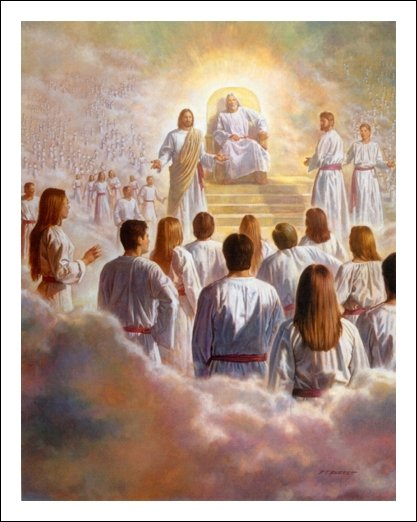
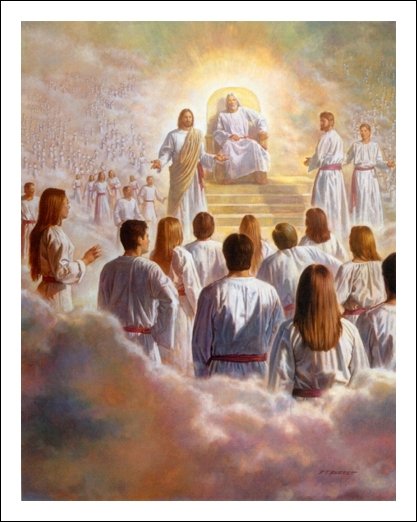
The Grand Council by Robert E Barratt The most important things for any human being to know are that there does exist a God of righteousness, that He is our Father, and that He is trying to help all of us inherit all that He is and has. He is righteous and acts only to maximize the happiness of every being He oversees. He is our Father because He begat us as His spirit children in our premortal existence. And He is trying to share with us His character of perfect righteousness, His omniscience, His omnipotence, and His dominion. His program to share with us is the joyous news, the gospel of Jesus Christ. To share with us, Heavenly Father provided two covenants whereby His children could demonstrate the ability to bear the weight of blessings He would like to share. Both covenants were planned from the beginning to suit the needs of His children. Each covenant allows the child of God to demonstrate an ability to perform in his or her own sphere, as evidence that the full weight of the Father’s blessings would bring happiness, not sorrow, to the individual. The full weight of the Father’s blessings is called “exaltation” and is a calling to join with God in His eternal work of righteousness to bring to pass the maximal happiness for each being in the universe.
The Two Covenants – Quoted from The Religious Educator Vol 3 No 3 2002 Obedience
The first covenant, as announced in the premortal existence, is the covenant of perfect obedience. His children would be brought into mortality and would be proved to see if they would do all things whatsoever the Lord their God would command them to do (see Abraham 3:22–25). This covenant is fulfilled only by our living a perfect mortal life, by not deviating from the path of perfect obedience one iota, no matter what the opposition or the consequences. This demonstration of perfect obedience is no idle or pointless exercise. It is a demonstration of the ability to do what exalted beings all do: to lead an absolutely disciplined existence of action in accordance with the principles of righteousness and order in the priesthood chain of command in the process of blessing others. This is the eternal path: blessing others here and now as preparation for an eternity of blessing them there and then, in a way that is selfless and holy. One deviation from the path, however minor, would show that that person cannot be trusted. And because he or she cannot be trusted, he or she cannot be given the blessings of exaltation. To be trusted is more important than to be loved. All of God’s children are loved by Him, but only a few can He trust completely.
Adam and Eve were participants in the first covenant in the Garden of Eden. Adam was determined to keep all the Father’s commandments. But before long, Adam and Eve broke the covenant of obedience and were thrust out of the garden and out of God’s presence. This fall was part of the Father’s plan so that they and their children would have an opportunity to generate the internal strength they did not already have and thus to become trustworthy. In this way, God could save and bless more than just those who were already of perfect character and therefore already trustworthy.
Repentance
The second covenant, companion to the covenant of perfect obedience, is the covenant of perfect repentance (see Moses 6:56–57). The word perfect means “complete.” Perfect obedience can be demonstrated only by persons of already perfect character. But all of God’s children, of any character, can choose to comply with the second covenant of perfect repentance by repenting until they have perfect character. Then, when they have perfect character, they can comply with the first covenant and demonstrate perfect obedience. This second covenant of perfect repentance is usually referred to as the new and everlasting covenant. It is “new” because it comes after the first covenant. It is “everlasting” because it is made possible only through the life, mission, and Atonement of Jesus Christ, one of His names being “Everlasting.”
When most people think of the work of Jesus Christ and His covenant, they think of forgiveness of sins. And forgiveness is important. But it is not the most important thing the second covenant does. The most important thing the new and everlasting covenant does is to bring about a change of character so the person can perform with perfect obedience under the first covenant. When we have attained perfect repentance through Jesus Christ, we then can prove that we can be perfectly obedient, and our Savior is pleased to be able to forgive us of our sins. And He is very forgiving. All who go to a kingdom of glory—celestial, terrestrial, or telestial—are forgiven of their sins either through Jesus Christ or through their own personal suffering. But only a few of those forgiven of their sins can be trusted completely. Only a few who can be given all knowledge, power, dominion, and freedom will then not exercise unrighteous dominion. Those few are precious. They become joint heirs with Christ in receiving all that He has, and He has received all His Father has. Those who cannot be trusted may receive glory but not a fulness. Therefore, their state in eternity is, in a sense, damnation. They receive all the blessings they have demonstrated they will use in righteousness. But where their character has not been changed so that they can be perfectly obedient, in that area they cannot receive a fulness of the blessings; this is damnation to some degree. Even the angels in the celestial kingdom are damned to a degree because they would not fully partake of the new and everlasting covenant (see D&C 131:1–4). Thus, the main point of the new and everlasting covenant is that it allows a person to change character until he or she is a new creature. The individual may become new to any degree desired. The power of Christ in the new and everlasting covenant is sufficient to help any person attain any degree of perfection desired. Total perfection, to come into the measure of the stature of Christ, is attained only by those persons who fully keep the new and everlasting covenant. As they work through to complete repentance, they are added upon, bit by bit, until they are as noble, as selfless, and as trustworthy as is Christ Himself. Through perfect repentance, they have come to be a perfect person, renewed unto the full measure of the stature of Christ Himself.
The Merits of Christ
How is this perfection achieved? The story of this process of repenting is the gospel of Jesus Christ. Perfection comes only in and through the merits of Christ. What are His merits? First, He has a perfect character. Second, He is exalted and has all the Father’s knowledge, power, and ability. Third, He performed the Atonement and thus is able to resurrect all men and women and to plead before the Father for the forgiveness of their sins. Fourth, He is the creator of heaven and earth and all things that in them are, the governor and manager of our universe. Because He was already perfect in character, our Savior came into mortality and kept fully the first covenant of perfect obedience. Subject to all the problems of mortality that every other human being suffers, He came into this world as a human being, denied each temptation of Satan, and fulfilled the Father’s will in every single instruction.
He was and is exalted, having all power in time and in eternity to do whatever work of godliness is required for the blessing of mankind. We do not yet comprehend the great blessings He has in store for the faithful. But the faithful are not primarily faithful so that they will get the blessings; they are faithful because faithfulness is the right thing to do, the thing that will enable them to bless others. The life and mission of Jesus Christ as a whole could be called His Atonement, or His at-one-ment, whereby He attempts to reconcile each of us with the Father. Father cannot look upon sin with the least degree of allowance, and our Savior tries to help each person to stop sinning and to be forgiven of the sins committed so that he or she can again stand in Father’s presence. He sends His gospel into the earth that all might be fully instructed as to how to enter into and complete the second covenant and be fully empowered through its ordinances to grow in character. Only those who complete the second covenant—who achieve perfect repentance—can be fully trustworthy and thus acceptable to our Father, to become one with Him, even as He and our Savior are one. The arms of mercy and repentance are extended to all mankind that everyone who wishes to partake may, without money and without price. But repent they must. Being the creator and governor of the universe, our Savior manages all things for the instruction and blessing of each human being. Every human experience is an opportunity to repent, to change our actions and through changing our actions to change our character. Through the gifts of the Spirit, which Christ bestows, the efforts of men and women are matched with the divine power each needs to repent until repentance is complete and each has endured to the end, which is to become as Christ.
There is no more intelligent thing to do in the universe than to rely on the merits of Jesus Christ. That is the only path to happiness. The degree to which any human being relies on the merits of Christ will be the measure of his or her happiness.
The Measure of Our Faith and Repentance
It is important now to say how the first principles of the gospel of Jesus Christ are to be applied in this quest for complete repentance. The first principles are faith in the Lord Jesus Christ and repentance.
To have faith in Jesus Christ means to accept His gospel message as attested to by the Holy Ghost and then to rely fully upon the merits of Christ. It means to rely on His name, to keep His commandments, and to strive for perfection of character in all things. If there is anything mean, cowardly, lascivious, untruthful, snobbish, lazy, careless, or lacking in character, our business as servants of Christ is to root out these things with all haste and effort. This is done not only that our own souls can be saved but because we cannot love anyone else purely or deeply until all of these ungodly things are rooted out of our souls through faith and repentance. To have faith in Christ means to trust in Him completely to the giving up of all our sins, bad habits, untrue ideas, evil thoughts, or untoward desires.
An essential part of trusting in Jesus Christ is knowing who His servants are and accepting them as His servants. For instance, no one alive today can fully come unto Christ and receive the fulness of His blessings in this life or in the world to come if that person cannot and does not accept Joseph Smith Jr. as the prophet of this dispensation. It is through him that the keys of the priesthood have come to this time to offer salvation to every soul on earth. Joseph Smith truly did represent Jesus Christ in full authority to bring souls to Christ. Likewise, no one can be saved today and receive all the blessings unless he or she accepts Gordon B. Hinckley as the living prophet. One thing that faithful people quickly learn is that they must also accept the leadership of their stake president and bishop—or their mission president if they are missionaries. No one who has true faith in Christ would think of making a serious life change, such as getting married or divorced, without consulting their bishop and staying close to him in the process. This phenomenon of accepting priesthood authority as part of faith in Jesus Christ is somewhat jokingly in the Church called being “priesthood broke,” the western term referring to a horse being broken to be manageable and ride-able. Those who have true faith in Christ wear the priesthood harness well; they do their assignments well; they support those in authority over them; they minister to those under their priesthood authority; and they strive to bring all humans to Christ both by precept and by example.
One very good measure of our faith and trust in Christ is our lack of fear. If we are His faithful servants, He has promised that all things would and will work together for our good, no matter what happens (see D&C 98:3). If we believe this, we can meet each day with joy and gladness, each crisis with equanimity, and each calamity with recognition of an opportunity to do good. If we are afraid of anything, that fear is the measure of our lack of trust in Christ. For if all things work together for our good, what is there to fear? If we will only do our part and obey Christ in all things, there is no need to fear anything except not having faith in Jesus Christ. The second principle of the gospel is repentance. Repentance is changing each act of our life that is not an act of faith in Christ to become an act of faith in Jesus Christ. To help us with this process, our Savior sends the Holy Spirit to be the constant companion of His covenant servants. With the help of the whisperings and promptings of the Holy Spirit, each of us is guided into the narrow path of obedience to Jesus Christ. Humble, willing obedience to Jesus Christ is faith in Him. Without the Holy Spirit, we cannot perfect our faith in Christ. And perfect faith in Christ is the end or goal of repentance. To repeat: repentance is changing our feelings, thinking, decisions, and actions until each thing we do is an act of faith in Jesus Christ. Then we are faith-full. What makes the second covenant so drastically different from the first covenant is that in the first covenant if we make one mistake, break one commandment of God, we are lost. In the second covenant, if we break a commandment and misstep on our way, that can be forgiven if we are truly sorry and get ourselves back onto the strait and narrow way of faith. That getting back is repentance. Should we sin many times, we still can be forgiven if we truly repent and get back onto the track of trust in Christ. Thus, the second covenant is the covenant of complete or perfect repentance.
All the other laws and principles of the gospel of Jesus Christ are examples of the application of faith in Jesus Christ and repentance in our lives and can be truly and fully understood only in that light. Faith, repentance, and all of the other laws and principles of the gospel have one end: to produce persons of perfect character whose only actions are those of the pure love of Christ. Pure means selfless. Those who are pure live outside of themselves in service to others. They have a pure love for Christ, looking to Him in every thought (see D&C 6:36). They see the face of Christ in every person they encounter. They minister to every person they encounter as Christ would, discerning their needs and blessing each person with whatever he or she needs to take the next step on the individual path to happiness. Filled with the Holy Ghost and the power of the holy priesthood, the child of Christ knows what to do and has the power to do whatever is necessary to manifest the pure love of Christ.
An Ongoing Work
If enough of the children of Christ who have pure love happen to be in one place, they together constitute a Zion, for they are pure in heart (see Moses 7:18). To establish Zion is to encourage and entice every person to enter the new and everlasting covenant and to endure to the end, which end is to be able to love with pure love, and which end is also eternal life. The work of establishing Zion is a work of power. It cannot be done by mortal means. Only as the powers of heaven come down and infuse the natural, mortal situation can we be saved, which salvation is to be changed from the natural, mortal condition to the stature of the character of Christ, full of pure love, as He is. A key power that makes this transformation possible is the holy priesthood. God bestows the holy priesthood upon men, and they use it in the service of Christ to bring about the personal transformations I have been discussing. They use it to teach and preach the gospel of Jesus Christ. They use it to administer the ordinances of the new and everlasting covenant. They use it to establish and guide The Church of Jesus Christ of Latter-day Saints. They use it to bless each other, to check evil, to control the elements of nature, and to do whatever God instructs them to do.
Special mention needs to be made of the ordinances of the new and everlasting covenant as administered by the holy priesthood. The two basic parts of that second covenant are baptism and the receiving of the holy Melchizedek Priesthood.
Baptism is the first part of the new and everlasting covenant. It allows individuals formally to renounce their old, natural way of living and to announce a determination to accept the power of God to change their nature into the character of Christ. The person who truly is reborn of water and of the Spirit is as a little child: meek, submissive, patient, humble, and willing to submit to whatever the Lord sees fit to inflict upon him or her (see Mosiah 3:19). Having been given the right to the constant companionship of the Holy Ghost, the person strives to treasure that influence and to obey God in all things, putting aside all worldliness and walking in the plain path of goodness, virtue, and service to others in the pure love of Christ.
When men and women are well rooted and established as reborn children of Christ, anxiously engaged each day in selflessly pursuing the services the Master would have them render to others, they are ready to receive and profit from the holy Melchizedek Priesthood. For men, there are three steps in receiving that priesthood power to be able to minister to others as a greatly enhanced being. The first step is to be ordained to the Melchizedek Priesthood. The second is to receive one’s endowment in the holy temple. The third is to be sealed to an eternal companion in the temple.
To be ordained to the Melchizedek Priesthood is to join the ranks of the empowered servants of God to give special service: missionary work, church work, family work, and temple work. All who receive that priesthood are assigned to a quorum, where they are to learn to serve with others and to learn to wear the priesthood harness well, pulling their load in coordination with others. As they are faithful and continue in repentance, the power of the priesthood wells up within them; they become full of the gifts and powers and knowledge of the Lord and gain the power to bless others with ordinances, miracles, direction, and insight.
In due time, the faithful servant of Christ is invited to go into the holy temple to receive the endowment. The endowment is a gift, as the name suggests. It is a gift of all the eternal powers and blessings the person needs to overcome the world and to accomplish his or her mortal mission. Without the endowment, the person has not the power to defeat Satan and to fulfill all the callings received as a servant in the kingdom of Christ. The blessings of the endowment, like that of the gift of the Holy Ghost at baptism, do not come automatically. The ordinances are the bestowing of a right to receive, and as the gifts are carefully sought for and treasured by explicit prayer and obedience, the gifts come in the sequence and degree the Lord sees is best for the development of the individual into the likeness of the character of Christ. When endowed persons are ready to marry and establish a new eternal family, those who preside over them send them to the temple to receive a fulness of the blessings of the gospel. In the temple sealing, they receive all the other powers and rights they need to act as husband and wife, father and mother, in their own eternal kingdom. Their own eternal kingdom is not solely their property. They are Christ’s, and Christ and all of His are the Father’s. The couple joins the eternal family and kingdom of the gods and through faithfulness enter into the order of the gods for an eternal career of blessing others with all that time and eternity afford.
A Path to Perfection
Now to sum up this discussion of the two covenants.
The first covenant is the basic covenant. It is never replaced by the second covenant. The purpose of the second, or new and everlasting covenant, is to enable us to grow in stature and character until we can fulfill the first covenant of perfect obedience. Our Savior, Jesus Christ, kept the first covenant in His mortal life and through His Atonement made the second covenant possible for us. The key to remember is that neither covenant excuses sin. The first covenant requires sinlessness, always. The second covenant is a covenant of mercy, which allows a person to learn through experiment, and in experimenting and trying, perhaps to sin, but then to repent unto not sinning. The second covenant is an inclined plane that leads gently up to perfection, whereas the first covenant demands perfection from the beginning. Both demand perfection, and the reward of each is the powers, abilities, and life of a perfect person. One is direct; the other is roundabout.
The first covenant is pure and straight justice. The second covenant is a covenant of justice mixed with temporary mercy for those who do not as yet have the character of Christ to produce and to abide perfect justice. Both come to the same end, the first by direct obedience to the Father, the second by becoming first children of Christ and then, as His children, growing until we can give direct and total obedience to the Father.
The good news is that “the leopard can change its spots.” Whatever we are and have been, we can change. By submitting ourselves to Christ through His new and everlasting covenant, we can become new creatures with new habits, new desires, a new mind, a new heart, and a new body.
This is salvation indeed.
I rejoice in the goodness of our God in providing two covenants whereby mankind may join the ranks of the gods. The first is the eternal order of the gods. The second is the apprenticeship whereby we learn to abide the perfect and eternal order of the gods. I thank our Father and His Son for giving us these two great gifts to bless our lives.
-
Talk for Oak Hills 6th Ward, 2002
28 July 2002
I have been assigned to speak to the topic: “Now is the time to prepare to meet God.” May I refer you to an excellent discourse on this topic given by President Thomas S. Monson in the October general conference of 2001. It is found in the November Ensign on page 59. Would you please review that article and find out why “Seagull” is important.
This title comes from the Book of Mormon in a speech by Amulek to the people of Ammonihah: “This life is the time for men to prepare to meet God: yea, behold the day of his life is the day for men to perform their labors. … Do not procrastinate the day of your repentance until the end; for after this day of life, then cometh the night of darkness wherein there can be no labor performed. Ye cannot say, when ye are brought to that awful crisis, that I will repent, that I will return to my God. Nay, ye cannot say this. …” (Alma 34:32–34)
Now we all know that the way to prepare to meet God is to have faith in His Son, Jesus Christ, and to keep the commandments. Our consciences amply supply us with things to do better. If we would follow our consciences, things would go better with each of us. But today, I have a bit of a different message. Instead of talking about what to do to have faith in our Savior, I am going to give you a formula as to how to exercise your faith. I believe this is a sure-fire formula. Anyone who will do the four things I will mention, will come to full faith in Jesus Christ and be well prepared to meet God when they pass from this life. In addition to helping us to prepare to meet God, this formula also has the added benefit of making each passing day most enjoyable. And it is a good practice for the way we will live in eternity. So how could we go wrong with such a formula? Now to the formula.
How to No. 1: Be happy. I say be happy, because being happy is something each of us controls entirely. We are not made happy or unhappy by what we own or don’t own, by what others do or don’t do to us and for us, nor even by what we do. Happiness comes from within. It is not something that happens to us. Rather it is an attitude of ours. If we insist on being happy, we will be happy, no matter what is going on around us or to us. And, if we insist on being unhappy, we will be unhappy, no matter what.
Why be happy? Because we are children of our Heavenly Father, children of Jesus Christ, and blessed beyond our desserts. Any live human being can write down all of the pluses in his or her life, then all of the minuses, and the pluses will far outweigh the minuses. Just being children of God and potential heirs to all that they have and are should be enough to make us happy. To make a long story short, to be unhappy is to be ungrateful for our blessings. Anyone who really understands what is going on in this world will insist on being happy. Being happy is the beginning of love of God and of our neighbor.
It took me a long time in this mortality to figure out that I am responsible for my own happiness. Most of the time I have been apprehensive, worried, burdened down with cares and responsibilities. Yet when I look back, I see how incredibly blessed I have been. I should have been happy all of the time. So I insist on not being unhappy or depressed. I like this quotation from the Prophet Joseph: “I should never get discouraged, whatever difficulties should surround me. If I was sunk in the lowest pit of Nova Scotia and all of the Rocky Mountains piled on top of me, I ought not to be discouraged but hang on, exercise faith and keep up good courage and I should come out on top of the heap.” (Citation lost)
So please be happy.
How to No. 2: Live by prayer. Nephi counseled us: “But behold, I say unto you that ye must pray always, and not faint; that ye must not perform anything unto the Lord save in the first place ye shall pray unto the Father in the name of Christ, that he will consecrate thy performance unto thee, that thy performance may be for the welfare of thy soul.” (2 Nephi 32:9)
Amulek also counsels us on this matter: “Therefore may God grant unto you, my brethren, that ye may begin to exercise your faith unto repentance, that ye begin to call upon his holy name, that he would have mercy upon you; yea, cry unto him for mercy, for he is mighty to save. Yea, humble yourselves, and continue in prayer unto him. Cry unto him when ye are in your fields, yea, over all your flocks. Cry unto him in your houses, yea, over all your household, both morning, mid-day, and evening. Yea, cry unto him against the power of your enemies. Yea, cry unto him against the devil, who is an enemy to all righteousness. Cry unto him over the crops of your fields, that ye may prosper in them. Cry over the flocks of your fields, that they may increase. But this is not all; ye must pour out your souls in your closets, and your secret places, and in your wilderness. Yea, and when you do not cry unto the Lord, let your hearts be full, drawn out in prayer unto him continually for your welfare, and also for the welfare of those who are around you.” (Alma 34:17–27)
Indeed, prayer is the Christian’s vital breath, his native air. Prayer is the key to feeling right, planning correctly and executing our work well. I cannot tell you how much better genealogy work goes with constant prayer. It is marvelous to see the difference between praying and just doggedly slogging along. If we wake up praying, the Lord will help us plan the day that we labor not in vain. If we consult Him all during the day, he will see that we are alerted to what we need to do and watch out for. As we lie down unto Him at night, we rest secure in His love.
How to No. 3: Live for others. To live outside ourselves in love is the purpose of a Christian life. If we cast our bread upon the waters, our needs will be taken care of as we concern ourselves about meeting the needs of another. To give service to others is the occupation of the child of Christ, service to friends and enemies, service to the deserving and the undeserving. It is our business to drop into bed exhausted each night, having spent our day improving everything we affect or lay our hands on. Our path through this work should be one of overcoming the second law of thermodynamics: While the world around us tends to disorder, decay and evil, everything we do should tend to order, improvement, good, and kindness. What a difference one good person can make in this world.
The consecrated life is a life of purpose, and the servant of Christ makes that a priesthood purpose. Many years ago the Aaronic Priesthood handbook had a wonderful message. Make sure that every activity for the young people of the Church has a priesthood purpose. I came to see that this applies to all of us. If we bear the Lord’s power and authority, everything we do should be an act of priesthood service, directed by Him, to make this world a heaven.
Every time we forebear doing things for our own will and pleasure, and instead seek the will and pleasure of him who sent us in service to others, we are helping to reduce the quantity of evil in the world and preparing for the coming of our Savior. And service is a great backbone for happiness.
How to No. 4: Fear nothing. Our Lord has counted fear as one of the great sins, classing fear with lying, whoremongering and sorcery (D&C 63:17). those who pretend to be servants of Christ and yet are in fear are contradicting themselves. For the work of Christ is to see that all things work together for the good of those who love and serve Him. If all things work for our good, what is there to be afraid of? Illness? It will be the hand of the Lord to bless us. Afraid of poverty? It will come only because it is needed. Afraid of failing? Failing is the great way to learn to succeed. Afraid of not getting something your heart is set upon? If it is right, God will give it to you, and if it is not right for you, he will spare you the misery of getting an unrighteous desire fulfilled. Afraid of pain? Know you not that pain is the great purifier of souls, and that to always deaden or mask pain is to miss one of the great blessings of life. Afraid of dying? We are born to die, and dying is the only way we can progress to our eternal blessings. Afraid of not finishing a task? If it is your errand and mission to do this task, the Lord will see fit that you can do it, and if it is not your errand and mission, it doesn’t matter whether you finish it or not.
Fear is the enemy of faith and love. Let us not be fearful, but rather let us bask in the love of Jesus Christ, in the arms of His mercy, in the richness of His blessings. Anything else would be rank ingratitude.
May I now review the four things that help us to maximize each mortal day, that help us prepare to meet God, that prepare us to live in eternity: 1. Be happy. 2. Live by prayer. 3. Live to serve others. 4. Fear nothing.
I pray that our faith in Christ may be fulfilled by our being wise servants unto Him, that when He appears, we will have no regrets. In the name of Jesus Christ, Amen.
-
Conference Talk, June 2002
22 June 2002—Provo Utah Oak Hills Stake
Priesthood Leadership Meeting 6:00 p.m.Setting Apart
Review of Melchizedek Priesthood Handbook material.
Three things to keep in mind when setting someone apart:
1. Be prepared: Be ye Holy.
- Lightmindness, loud laughter.
- Over eating.
- Pornography, worldly entertainment.
2. Bless the person with what they need:
- Health
- Family
- Occupation
- Understanding
- Charity
- Physical contact
- Lay on hands and, not “to”
3. Follow up:
- Commend, congratulate them
- Advise (lightly), teach
- Let them know that you care.
Exo. 19:6 “And ye shall be unto me a kingdom of priests, and an holy nation.”
Lev. 11:44 “For I am the Lord your God: ye shall therefore sanctify yourselves: and ye shall be holy:”
D&C 43:16 “Sanctify yourselves and ye shall be endowed with power, that ye may give even as I have spoken.”
Alma 31:36 “Now it came to pass that when Alma had said these words, that he clapped his hands upon all them that were with him. And behold, as he clapped his hands upon them, they were filled with the Holy Spirit.”
-
Set Your House in Order, 2002
Sacrament Meeting Talk-26 May 2002-Oak Hills 5th Ward
1960’s bomb shelter. We must prepare spiritually against the power of Satan.
Checklist for the family: You do the following with fasting, prayer and scripture study.
1. Husband and wife: Unified in the Lord.
Test: Whatever problem arises, agree on a solution that works. And never get angry with one another.
2. Family: Lead your children to Jesus Christ through regular family home evening, family prayer, family work and play activities.
3. Testimony: Unshakable knowledge that the Restored Gospel and Church are true and that the General Authorities, your stake president, and your bishop are appointed of Jesus Christ.
Test: You move with the church as the dispensation unfolds.
4. Building the Kingdom: Make a significant contribution toward the establishment of Zion each week in your callings. You are concerned about the poor.
Test: Someone else is more faithful and more blessed because of your labors.
5. You are a missionary: You bear testimony of Christ wherever, whenever the Holy Spirit prompts you.
Test: You distribute Books of Mormon and your testimony regularly.
6. You are a genealogist: Your four generations have been submitted, and you are working on ancestral lines.
Test: You are doing family names in the temple for someone connected to you.
7. You are financially responsible:
Test: You pay a generous tithing and offerings, and spend less than you take in.
8. You care for your physical tabernacle:
Test: You have a regular exercise routine and eat for health, not just for taste.
9. You are ready to be reassigned to the next world.
Test: You are properly insured and have an air-tight estate plan. And you have repented.
10. You have a pure mind and heart:
Test: You do not countenance pornography, evil influences, or light-mindedness, but garnish your thoughts with virtue. You systematically root out all selfishness from your soul.
11. Your house and belongings are in physical order. You own only what you need, and all is neat, clean, and functional.
Test: You can find and use whatever you need quickly.
12. You are civically responsible.
Test: You take an active interest in bettering your community, state, nation, by getting good people into office.
If you do these things, you will be very close to loving the Lord with all of your heart, might, mind and strength, and you will have power in the priesthood.
This is the way to Christ: it is strait and narrow, a few there be that find it. But those that find it inherit everything.